REVIEW 2 major objections 3 minor 30 references
Shapley values on PDF flavors reveal a hidden gluon blind spot at intermediate x and quantify which data constrain which partons.
Reviewed by Pith at T0; open to challenge. T0 means a machine referee read the full paper against a public rubric. the ladder, T0–T4 →
T0 review · grok-4.5
2026-07-12 07:56 UTC pith:77JG3XLE
load-bearing objection Clean, model-agnostic PDF diagnostic that recovers textbook lore and exposes a real intermediate-x gluon blind spot; the single-bump probe is a limitation but not a fatal one. the 2 major comments →
Interpreting Parton Distributions with Shapley Values
The pith
A machine-rendered reading of the paper's core claim, the machinery that carries it, and where it could break.
Core claim
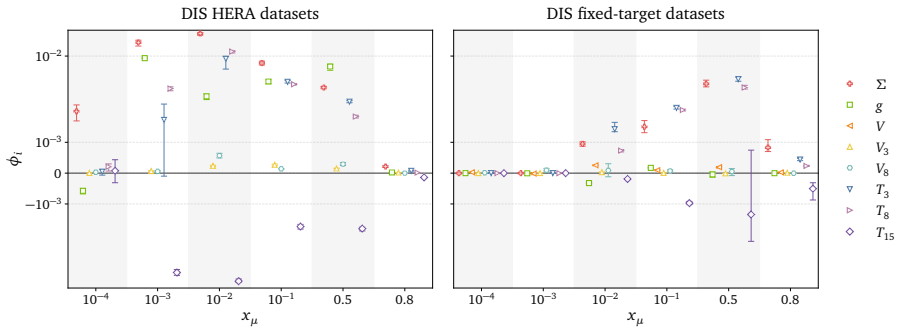
Exact Shapley values computed on the eight PDF flavors, after a localized Gaussian perturbation of amplitude equal to the 68 % PDF uncertainty and with sum rules restored, quantitatively recover the known data-to-PDF map and reveal a universal local loss of sensitivity of the gluon PDF around x ≈ 0.07 that is invisible to ordinary uncertainty bands.
What carries the argument
The exact Shapley value φ_j(x_µ) for flavor j at perturbation center x_µ, obtained by averaging the marginal change in χ² over all 128 coalitions of the eight flavors while a calibrated Gaussian bump is applied and sum rules are re-enforced.
Load-bearing premise
That a single, symmetric Gaussian bump of fixed logarithmic width, applied simultaneously to every flavor inside a coalition and then averaged over positive and negative signs, faithfully probes the local sensitivity of the full nonlinear PDF-to-observable map.
What would settle it
Recompute the gluon Shapley profile after replacing the Gaussian bump with an alternative localized deformation (e.g., a Mellin-space moment shift or a different width) and check whether the dip at x ≈ 0.07 persists across NNPDF4.0, CT18 and MSHT20; its disappearance would falsify the claimed universality of the sensitivity loss.
Editorial analysis
A structured set of objections, weighed in public.
Referee Report
Summary. The paper introduces exact Shapley values as a model-agnostic diagnostic for parton distributions, treating the eight PDF flavors (in flavor or evolution basis) as players in a cooperative game whose value function is the experimental χ^{2}. A localized Gaussian perturbation of amplitude equal to the 68% PDF uncertainty, with sum rules restored after each coalition, is applied one x-region at a time; the resulting Shapley values φ_j(x_µ) quantify the marginal contribution of each flavor to the description of a chosen dataset. Applied to NNPDF4.0 (and cross-checked on CT18 and MSHT20), the method recovers the standard data-to-PDF map while revealing a previously unnoticed, universal dip in gluon sensitivity near x≈0.07. The dip is traced to the vanishing eigenvalue of the singlet-gluon anomalous-dimension matrix at N=2 (enforced by the momentum sum rule) and mapped to x-space via the saddle point of the Mellin inversion. Two applications are shown: a diagnostic of under-constrained regions relevant to BSM searches and Higgs production, and a proof-of-concept improvement of the K-fold design used in NNPDF hyperparameter optimization.
Significance. If the results hold, the work supplies a quantitative, methodology-independent tool that can be applied to any existing PDF set without re-fitting. Exact evaluation over the 128 coalitions (rather than the additive SHAP approximation) correctly retains flavor correlations and sum-rule constraints, a clear technical advance over prior XAI proposals in the field. The recovery of textbook expectations places those expectations on a numerical footing, while the gluon dip—confirmed on three independent global fits and given a clean QCD explanation—is a genuine new observation with direct phenomenological consequences for gluon-fusion Higgs and possible new-physics reabsorption. The fold-optimization example further demonstrates immediate practical utility for the NNPDF pipeline. These strengths make the paper a useful addition to the PDF-diagnostics literature.
major comments (2)
- [Sec. 3.2, Eqs. (21-23)] Sec. 3.2, Eqs. (21–23): the central claim that the observed gluon dip is a genuine local loss of sensitivity rests on a highly restrictive probe (identical-sign Gaussian bump of fixed logarithmic width w applied simultaneously to every flavor inside a coalition, then averaged over + and - signs, one x-bin at a time). Because the momentum sum rule and the coupled singlet-gluon evolution are non-local, this coalition geometry can cancel or amplify the marginal contribution of the gluon relative to a pure single-flavor, single-x probe. The paper itself notes the combinatorial barrier to a fuller feature space, yet provides no robustness checks (variation of w, single-flavor-only games, or opposite-sign coalitions). Without such tests the dip could be an artifact of the chosen probe rather than a property of the PDF-to-observable map.
- [Appendix B, Table 9] Appendix B and Table 9: the iterative removal of any dataset for which v_Di(S)>10^5 is an ad-hoc regularization whose threshold is a free parameter. The discarded points (chiefly fixed-target DY ratios) change with PDF set and with x_µ; it is not shown how much the gluon Shapley profile (especially the depth and location of the dip) moves when the threshold is varied or when those datasets are retained with a milder cut. Because the dip is the paper’s principal new result, its stability under this pruning must be quantified.
minor comments (3)
- [Figs. 4-5] Fig. 4 and Fig. 5: the symlog color scale and the vertical offsets used for readability make quantitative comparison of the size of φ_j across x_µ difficult; a linear inset or a table of peak values would help.
- [Sec. 4.3] Sec. 4.3: the broader secondary dip near x~10^{-2} (visible for CT18 and, more weakly, for the other sets) is noted but not discussed; a short remark on its possible relation to the gluon-fusion Higgs region would strengthen the phenomenological claims.
- [Sec. 3.2] The Gaussian width w is fixed once and for all to the bin spacing of the 50-point scan; a one-sentence statement of the numerical value and a brief stability check would remove an unnecessary free parameter from the method.
Circularity Check
No significant circularity: the method treats any pre-existing PDF set as an external black-box input and evaluates exact Shapley values from the definition of the cooperative game; nothing is forced by construction or by self-citation.
full rationale
The paper’s derivation chain is self-contained and non-circular. A previously determined PDF set (NNPDF4.0, or CT18/MSHT20) is loaded as an immutable external input; no information about the fitting procedure that produced it is ever used (explicitly stated in Sec. 3 and Fig. 1). Players are the eight PDF flavors; the value function is the ordinary experimental χ² evaluated after a controlled, sum-rule-restoring Gaussian perturbation (Eqs. 21–23). The Shapley value is then the exact combinatorial average of marginal contributions (Eq. 18). This is a definitional computation, not a prediction that re-uses a fitted parameter. The observed gluon dip at xµ≈0.07 is an output of that computation; its subsequent physical explanation (vanishing eigenvalue of the anomalous-dimension matrix at N=2 mapped to x-space by the saddle point of the Mellin inversion) relies only on textbook QCD evolution and is independently verified on two external PDF sets. Self-citations to NNPDF papers are ordinary methodological background and are not load-bearing for the central claims. The restrictive single-bump probe is an acknowledged modeling choice (end of Sec. 3.2), not a circular reduction. Consequently the strongest claim—that the method recovers known data–PDF maps and reveals a universal local loss of gluon sensitivity—does not reduce to its own inputs by construction.
Axiom & Free-Parameter Ledger
free parameters (3)
- Gaussian width w
- perturbation amplitude
- pathology threshold 10^5
axioms (3)
- domain assumption QCD factorization theorem and DGLAP evolution equations hold to the order used in the theory predictions
- domain assumption Momentum and valence sum rules must be restored after every coalition perturbation
- standard math Shapley value formula (Eq. 18) with combinatorial weights correctly attributes marginal contributions
read the original abstract
We show that Shapley values can be used to trace how individual parton distributions (PDFs) shape the theory predictions for high-energy observables computed from them. This provides a tool for assessing the impact of data on PDFs when determining them, and the impact of PDF uncertainties when using the PDFs to compute collider observables. The Shapley value is computed by treating the regression of PDFs from data as a cooperative game. The PDFs are the players, and the reward is the likelihood ($\chi^2$) that characterizes the agreement between data and the predictions obtained from a given PDF, with theory and methodology held fixed. The method is agnostic to the way PDFs have been determined in the first place: for PDFs determined with a black-box AI model it may be used in order to explain the behavior of the model, and for PDFs determined using a fixed parametrization it may be used in order to expose the features and potential limitations of the parametrization. We find that the method recovers known expectations about which data constrain which PDFs in a global fit, while placing them on a more quantitative footing. We demonstrate its effectiveness in two ways. We uncover an unexpected loss of sensitivity of the gluon PDF at intermediate $x$, with potential implications for BSM searches and the gluon fusion Higgs cross section. We also show that the method can be used to improve the hyperparameter optimization procedure currently used by the NNPDF collaboration.
Figures




Reference graph
Works this paper leans on
-
[1]
Tailored PDFs for New Physics searches,
E. Cole, M. N. Costantini, E. Hammou, L. Mantani, F. Merlotti, M. Morales-Alvarado, and M. Ubiali, “Tailored PDFs for New Physics searches,”arXiv:2602.20235 [hep-ph]
-
[2]
Mapping the sensitivity of hadronic experiments to nucleon structure,
B.-T. Wang, T. J. Hobbs, S. Doyle, J. Gao, T.-J. Hou, P. M. Nadolsky, and F. I. Olness, “Mapping the sensitivity of hadronic experiments to nucleon structure,”Phys. Rev. D98 no. 9, (2018) 094030,arXiv:1803.02777 [hep-ph]
Pith/arXiv arXiv 2018
-
[3]
Quantifying the interplay of experimental constraints in analyses of parton distributions,
X. Jinget al., “Quantifying the interplay of experimental constraints in analyses of parton distributions,”Phys. Rev. D108no. 3, (2023) 034029,arXiv:2306.03918 [hep-ph]. [4]PDF4LHC Working GroupCollaboration, R. D. Ballet al., “The PDF4LHC21 combination of global PDF fits for the LHC Run III,”J. Phys. G49no. 8, (2022) 080501, arXiv:2203.05506 [hep-ph]
Pith/arXiv arXiv 2023
-
[4]
Neural network parametrization of deep inelastic structure functions,
S. Forte, L. Garrido, J. I. Latorre, and A. Piccione, “Neural network parametrization of deep inelastic structure functions,”JHEP05(2002) 062,arXiv:hep-ph/0204232. [6]NNPDFCollaboration, R. D. Ballet al., “The path to proton structure at 1% accuracy,” Eur. Phys. J. C82no. 5, (2022) 428,arXiv:2109.02653 [hep-ph]
Pith/arXiv arXiv 2002
-
[5]
The mythos of model interpretability,
Z. C. Lipton, “The mythos of model interpretability,”arXiv:1606.03490 [cs.LG]
-
[6]
Explainable AI classification for parton density theory,
B. Kriesten, J. Gomprecht, and T. J. Hobbs, “Explainable AI classification for parton density theory,”JHEP11(2024) 007,arXiv:2407.03411 [hep-ph]
Pith/arXiv arXiv 2024
-
[7]
M. T. Ribeiro, S. Singh, and C. Guestrin, “"why should i trust you?": Explaining the predictions of any classifier,”arXiv:1602.04938 [cs.LG]. https://arxiv.org/abs/1602.04938
-
[8]
Learning important features through propagating activation differences,
A. Shrikumar, P. Greenside, and A. Kundaje, “Learning important features through propagating activation differences,”arXiv:1704.02685 [cs.CV]
-
[9]
Layer-wise relevance propagation for neural networks with local renormalization layers,
A. Binder, G. Montavon, S. Bach, K.-R. Müller, and W. Samek, “Layer-wise relevance propagation for neural networks with local renormalization layers,”arXiv:1604.00825 [cs.CV]
-
[10]
A value for n-person games,
L. S. Shapley, “A value for n-person games,” inContributions to the Theory of Games II, H. W. Kuhn and A. W. Tucker, eds., vol. 28 ofAnnals of Mathematics Studies, pp. 307–317. Princeton University Press, Princeton, NJ, 1953
1953
-
[11]
A unified approach to interpreting model predictions,
S. Lundberg and S.-I. Lee, “A unified approach to interpreting model predictions,” arXiv:1705.07874 [cs.AI]
-
[12]
How to Deep-Learn the Theory behind Quark-Gluon Tagging,
S. Vent, R. Winterhalder, and T. Plehn, “How to Deep-Learn the Theory behind Quark-Gluon Tagging,”SciPost Phys.20(2026) 084,arXiv:2507.21214 [hep-ph]
Pith/arXiv arXiv 2026
-
[13]
Parton distributions at the dawn of the LHC,
S. Forte, “Parton distributions at the dawn of the LHC,”Acta Phys. Polon. B41(2010) 2859–2920,arXiv:1011.5247 [hep-ph]
Pith/arXiv arXiv 2010
-
[14]
The Structure of the Proton in the LHC Precision Era,
J. Gao, L. Harland-Lang, and J. Rojo, “The Structure of the Proton in the LHC Precision Era,”Phys. Rept.742(2018) 1–121,arXiv:1709.04922 [hep-ph]
Pith/arXiv arXiv 2018
-
[15]
Can New Physics hide inside the proton?,
S. Carrazza, C. Degrande, S. Iranipour, J. Rojo, and M. Ubiali, “Can New Physics hide inside the proton?,”Phys. Rev. Lett.123no. 13, (2019) 132001,arXiv:1905.05215 [hep-ph]. 32 [18]NNPDFCollaboration, R. D. Ballet al., “An open-source machine learning framework for global analyses of parton distributions,”Eur. Phys. J. C81no. 10, (2021) 958, arXiv:2109.02...
Pith/arXiv arXiv 2019
-
[16]
Pineline: Industrialization of high-energy theory predictions,
A. Barontini, A. Candido, J. M. Cruz-Martinez, F. Hekhorn, and C. Schwan, “Pineline: Industrialization of high-energy theory predictions,”Comput. Phys. Commun.297(2024) 109061,arXiv:2302.12124 [hep-ph]
Pith/arXiv arXiv 2024
-
[17]
Study of Monte Carlo approach to experimental uncertainty propagation with MSTW 2008 PDFs,
G. Watt and R. S. Thorne, “Study of Monte Carlo approach to experimental uncertainty propagation with MSTW 2008 PDFs,”JHEP08(2012) 052,arXiv:1205.4024 [hep-ph]
Pith/arXiv arXiv 2008
-
[18]
R. K. Ellis, W. J. Stirling, and B. R. Webber,QCD and collider physics. Cambridge monographs on particle physics, nuclear physics, and cosmology. Cambridge University Press, Cambridge, 2003.https://cds.cern.ch/record/318585. Photography by S. Vascotto
2003
-
[19]
Progress in the Determination of the Partonic Structure of the Proton,
S. Forte and G. Watt, “Progress in the Determination of the Partonic Structure of the Proton,”Ann. Rev. Nucl. Part. Sci.63(2013) 291–328,arXiv:1301.6754 [hep-ph]
Pith/arXiv arXiv 2013
-
[20]
Double asymptotic scaling at HERA,
R. D. Ball and S. Forte, “Double asymptotic scaling at HERA,”Phys. Lett. B335(1994) 77–86,arXiv:hep-ph/9405320
Pith/arXiv arXiv 1994
-
[21]
HTowards an explainable machine learning model of proton structure,
M. Fusi, “HTowards an explainable machine learning model of proton structure,” 2024. https: //nnpdf.mi.infn.it/wp-content/uploads/2025/06/2024_Magistrale_Fusi.pdf
2024
-
[22]
Soft gluon resummation of Drell-Yan rapidity distributions: Theory and phenomenology,
M. Bonvini, S. Forte, and G. Ridolfi, “Soft gluon resummation of Drell-Yan rapidity distributions: Theory and phenomenology,”Nucl. Phys. B847(2011) 93–159, arXiv:1009.5691 [hep-ph]. [26]NNPDFCollaboration, R. D. Ball, J. Cruz-Martinez, L. Del Debbio, S. Forte, Z. Kassabov, E. R. Nocera, J. Rojo, R. Stegeman, and M. Ubiali, “Response to ”Parton distributio...
Pith/arXiv arXiv 2011
-
[23]
New CTEQ global analysis of quantum chromodynamics with high-precision data from the LHC,
T.-J. Houet al., “New CTEQ global analysis of quantum chromodynamics with high-precision data from the LHC,”Phys. Rev. D103no. 1, (2021) 014013, arXiv:1912.10053 [hep-ph]
Pith/arXiv arXiv 2021
-
[24]
Parton distributions from LHC, HERA, Tevatron and fixed target data: MSHT20 PDFs,
S. Bailey, T. Cridge, L. A. Harland-Lang, A. D. Martin, and R. S. Thorne, “Parton distributions from LHC, HERA, Tevatron and fixed target data: MSHT20 PDFs,”Eur. Phys. J. C81no. 4, (2021) 341,arXiv:2012.04684 [hep-ph]
Pith/arXiv arXiv 2021
-
[25]
Parton distributions need representative sampling,
A. Courtoy, J. Huston, P. Nadolsky, K. Xie, M. Yan, and C. P. Yuan, “Parton distributions need representative sampling,”Phys. Rev. D107no. 3, (2023) 034008, arXiv:2205.10444 [hep-ph]
Pith/arXiv arXiv 2023
-
[26]
J. Cruz-Martinez, A. Jansen, G. van Oord, T. R. Rabemananjara, C. M. R. Rocha, J. Rojo, and R. Stegeman, “Hyperparameter optimisation in deep learning from ensemble methods: applications to proton structure,”Mach. Learn. Sci. Tech.6no. 2, (2025) 025027,arXiv:2410.16248 [hep-ph]
Pith/arXiv arXiv 2025
-
[27]
J. M. Cruz-Martinez, T. Giani, and T. R. Rabemananjara, “Hyperoptimisation algorithm for the next generation of PDF determinations: ensemble regression with an unbiased selection model,”arXiv:2605.31482 [hep-ph]. 33 [32]New MuonCollaboration, M. Arneodoet al., “Accurate measurement of F2(d) / F2(p) and R**d - R**p,”Nucl. Phys. B487(1997) 3–26,arXiv:hep-ex...
Pith/arXiv arXiv 1997
-
[28]
Precise measurements of the proton and deuteron structure functions from a global analysis of the SLAC deep inelastic electron scattering cross-sections,
L. W. Whitlow, E. M. Riordan, S. Dasu, S. Rock, and A. Bodek, “Precise measurements of the proton and deuteron structure functions from a global analysis of the SLAC deep inelastic electron scattering cross-sections,”Phys. Lett. B282(1992) 475–482. [35]BCDMSCollaboration, A. C. Benvenutiet al., “A High Statistics Measurement of the Proton Structure Functi...
1992
-
[29]
D. A. Mason,Measurement of the strange - antistrange asymmetry at NLO in QCD from NuTeV dimuon data. PhD thesis, Oregon U., 2006. [39]H1, ZEUSCollaboration, H. Abramowiczet al., “Combination of measurements of inclusive deep inelastice±pscattering cross sections and QCD analysis of HERA data,” Eur. Phys. J. C75no. 12, (2015) 580,arXiv:1506.06042 [hep-ex]....
Pith/arXiv arXiv 2006
-
[30]
Dimuon Production in Proton - Copper Collisions at√s= 38.8-GeV,
G. Morenoet al., “Dimuon Production in Proton - Copper Collisions at√s= 38.8-GeV,” Phys. Rev. D43(1991) 2815–2836. [44]SeaQuestCollaboration, J. Doveet al., “The asymmetry of antimatter in the proton,” Nature590no. 7847, (2021) 561–565,arXiv:2103.04024 [hep-ph]. [Erratum: Nature 604, E26 (2022)]. [45]CDFCollaboration, T. A. Aaltonenet al., “Measurement of...
Pith/arXiv arXiv 1991
discussion (0)
Sign in with ORCID, Apple, or X to comment. Anyone can read and Pith papers without signing in.