REVIEW 4 major objections 5 minor 120 references
Quantum gravity can fix the Fermi scale instead of leaving it a free parameter.
Reviewed by Pith at T0; open to challenge. T0 means a machine referee read the full paper against a public rubric. the ladder, T0–T4 →
T0 review · deepseek-v4-flash
2026-08-03 08:30 UTC pith:7BQDNDM4
load-bearing objection A coherent in-principle argument for predicting φ0/Mp from an analytic UV scaling solution, but the key existence assumptions are unproved and the numerical section is a consistency check rather than the prediction the abstract claims. the 4 major comments →
Fermi scale from quantum gravity scaling solution
The pith
A machine-rendered reading of the paper's core claim, the machinery that carries it, and where it could break.
Core claim
The paper claims that the ratio of the Fermi scale to the Planck mass is a calculable output of quantum gravity, not a free input. In the scale-invariant standard model with a cosmon field, the ratio is controlled by the dimensionless cosmon-Higgs coupling λ_m. The paper argues that metric fluctuations induce a positive anomalous dimension for this coupling, making it irrelevant in the renormalization flow. Analyticity of the scaling solution at vanishing dimensionless fields then forces the integration constant for λ_m to vanish, leaving a unique value. Under the paper's assumptions, the numerical solution finds λ_m near 3.3×10^-5 in the Planck-scale region, corresponding to a tiny Fermi-to
What carries the argument
The central object is the cosmon-Higgs coupling λ_m, the dimensionless coefficient multiplying H†H χ² in the effective potential, which directly sets the ratio of the Fermi scale to the Planck mass. The argument runs through the scaling solution of the functional renormalization group equation for the effective scalar potential, combined with the gravity-induced anomalous dimension A_m^(gr) = (5/(12π²f))(1−2u/f)^(-2). This positive anomalous dimension renders λ_m irrelevant; analyticity at (ρ̃, h̃)→(0,0) then eliminates the integration constant and fixes λ_m. The machinery thereby converts the gauge hierarchy from a parameter to a prediction of the ultraviolet scaling solution.
Load-bearing premise
The load-bearing premise is that a global analytic scaling solution exists with the assumed ultraviolet fixed point, meaning all couplings approach finite values as the dimensionless fields go to zero and the gravity-induced anomalous dimension stays positive; the paper states plainly that this is assumed, not proven.
What would settle it
A concrete falsification would be an explicit construction of a non-analytic ultraviolet scaling solution, or a full numerical solution of the scaling equation in which two different boundary values at k = m_Z both extend to finite λ_m(0). Either result would show that the integration constant does not vanish and the Fermi scale remains a free parameter.
If this is right
- If the central claim is correct, the ratio φ0/Mp is no longer a free parameter for any short-distance model that remains valid to infinitely small distances; it is fixed by the scaling solution.
- A realistic Fermi scale emerges naturally from proximity to a second-order quantum electroweak phase transition, so the small ratio is explained without tuning the Higgs mass parameter.
- In principle, all standard-model couplings become predictable once the ultraviolet model is specified, so comparing such predictions with observation can falsify a given short-distance model.
- The setting also draws a sharp line: if the largest intrinsic mass scale exceeds the Fermi scale, predictivity is lost and the Fermi scale reverts to a relevant parameter, making the framework a test of fundamental scale invariance.
Where Pith is reading between the lines
- Beyond the paper: if analyticity fails in some concrete ultraviolet completion, the integration constant for λ_m reappears and the Fermi scale reverts to a free parameter; explicitly constructing such a non-analytic fixed point would be a direct test of the mechanism.
- Beyond the paper: the numerical value near 3.3×10^-5 comes from a simplified one-loop beta-function set and a chosen ultraviolet fixed point; a systematic scan over short-distance models could sharpen the prediction or show that the result depends on the truncation.
- Beyond the paper: the same mechanism—positive gravity-induced anomalous dimension plus analyticity—could fix other marginal-looking couplings in extensions of the standard model, potentially turning the Fermi/Planck ratio into one element of a larger predictive structure.
- Beyond the paper: because the argument ties the hierarchy to self-organized criticality rather than to a particular high-energy scale, it suggests the observed ratio is a robust consequence of any analytic scaling solution, which could be tested by searching for global scaling solutions that do not share this property.
Editorial analysis
A structured set of objections, weighed in public.
Referee Report
Summary. The paper proposes that, in a scale-invariant standard model coupled to quantum gravity with a field-dependent Planck mass, the dimensionless cosmon-Higgs coupling λ_m determines the ratio of the Fermi scale to the Planck mass. The central mechanism is that a gravity-induced anomalous dimension A_m^(gr) makes λ_m an irrelevant coupling near the UV fixed point, and analyticity of the scaling solution at zero field forces the integration constant of λ_m to vanish, leaving a unique value λ_m = -Δ_m(0) and hence a predicted φ0/Mp. The paper develops local scaling solutions, threshold functions, and a seven-coupling truncated numerical system, reporting λ_m(x=0) ≈ 3.3×10^-5 for two boundary values, with one boundary value compatible with an analytic UV extension. The authors repeatedly emphasise that the decisive global analytic scaling solution is assumed, not proven.
Significance. If the global analytic scaling solution with the assumed UV fixed point existed, the result would be of very high significance: the gauge hierarchy would become a computable consequence of the short-distance model, a genuinely new mechanism of self-organized criticality. The analytic derivation in §§VIII-IX is explicit and internally consistent within its truncation, and the paper is unusually candid in stating that the existence of the scaling solution is not proven. The numerical demonstration, however, does not currently establish the decisive uniqueness property, and the use of the observed m_Z as the matching scale weakens the claim that the numerical value is a prediction. The paper is therefore a well-formulated research proposal rather than a demonstrated result.
major comments (4)
- [§IX, eqs. (314), (336), (360)] The derivation of λ_m = -Δ_m(0) assumes a global analytic scaling solution with β_i ∼ c_i ρ̃ near ρ̃=0 (eqs. 327, 332). This is the load-bearing premise of the paper, and it is not established. The text itself concedes in §VI that the assumptions are 'not proven' and in §XI that it has 'not attempted to prove that a scaling solution with these properties exists.' Without such a proof, the local family parametrised by λ̄_m in eq. (68) is not shown to collapse to a discrete set, and the Fermi scale remains a free parameter. The abstract's statement that the ratio 'can then be predicted' should be made conditional on this existence result unless a proof is supplied.
- [§IX, eq. (301)] The positivity of A_m^(gr) for all ρ̃ is essential: it is what makes (ρ̃/ρ̃0)^(-A/2) vanish as ρ̃→0 in eq. (314). The paper asserts that v=2u/f<1, but no proof or numerical evidence is given that this holds along the actual scaling solution in the UV. If 1-2u/f crosses zero, A_m^(gr) changes sign, λ_m ceases to be irrelevant, and the integration constant d_m reappears. A concrete check would be to plot u/f along the numerical scaling solution for x∈(-∞,0] or to prove the bound from the fixed-point equations.
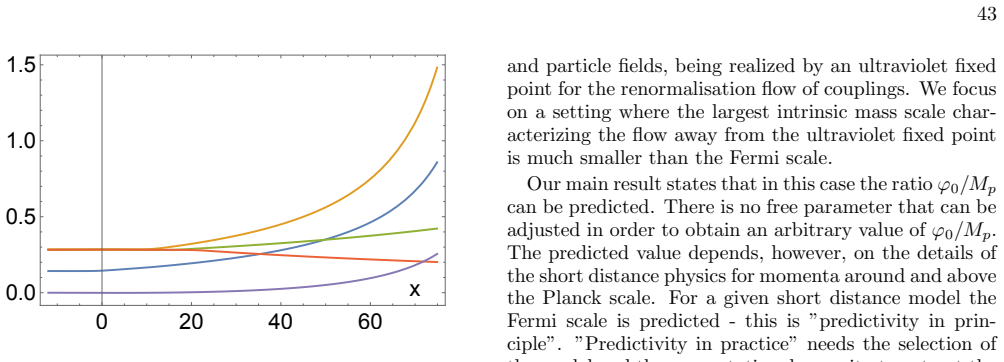
- [§X, Fig. 5 and eqs. (376)-(378)] The numerical evidence for uniqueness is not yet sufficient. Only two initial values σ_m(x_F)=-0.1 and 0.4 are shown; one is 'compatible' with an analytic extension and the other is not. This does not demonstrate that a continuum of δ_m(x_F) values selects a unique λ_m(0). In addition, the UV β-function parameters are chosen 'rather arbitrarily' and the fixed point is engineered to reproduce the observed gauge couplings. A scan over initial conditions and over parameter variations, showing that all but one value diverge as x→-∞, is needed to support the self-organized-criticality claim.
- [§X, eq. (376)] The numerical setup anchors the calculation to the observed electroweak scale: x_F = ln(M_p²/2m_Z²) is the matching point, and y_t(x_F) is adjusted to satisfy λ_h(0)=0. Thus the quoted λ_m(0) ≈ 3.3×10^-5 is not an independent prediction of φ0/Mp; it is a consistency check on a trajectory whose starting point already contains the target value. The UV β-functions are likewise adjusted to yield the observed couplings. This limitation should be stated whenever the numerical result is invoked, including in the abstract.
minor comments (5)
- [§X] Typo: 'predictibility' should be 'predictability'.
- [§I] The symmetry 'χ− → −χ' should presumably read 'χ → −χ'.
- [Fig. 5] The horizontal axis is labelled only 'x'; give the definition x = ln ρ̃ and ensure the green/orange curves are distinguishable in grayscale (e.g. line styles, not only colours).
- [§II] The text refers to 'the scaling equations (16), (17)', but those equations are the flow equation and related expressions; the actual scaling equation appears later as eq. (26). The cross-reference should be corrected.
- [§IV] The sentence 'With our boundary condition m̄_c² = m̃_-² vanishes' is hard to parse; it should be clarified whether this is a condition, an output, or an approximation.
Circularity Check
No significant circularity: the Fermi-scale prediction rests on an explicit analyticity/irrelevance argument, with unproven existence assumptions acknowledged rather than smuggled.
full rationale
The core derivation is self-contained. Eq. (301) gives a positive gravity-induced anomalous dimension A_m^(gr); eq. (314) shows that a free integration constant d_m would diverge as ρ̃^(-A_m/2) unless d_m=0; and eq. (360) then fixes λ̄_m = -Δ_m(0). This is a consistency argument from analyticity and irrelevance, not a tautology: the target ratio φ0/Mp enters only at the final formula eq. (324), which expresses φ0/Mp in terms of the already-determined couplings. The numerical section uses measured gauge and Yukawa couplings at a matching point x_F = ln(Mp²/(2m_Z²)) while explicitly varying λ_m(x_F); the near-independence of λ_m(0) from those two very different initial values is the advertised predictivity, not a fitted parameter renamed as a prediction. The paper candidly states that the decisive existence assumptions are not proven ('While reasonable, our assumptions are not proven'; 'we have not attempted to prove that a scaling solution with these properties exists'). That is a gap in support, not a circular reduction. Self-citations to prior FRG work are used for standard techniques and for the form of the gravity contribution, but eq. (301) is re-derived in the text from c_U^(gr), so the citation is not load-bearing. No step in the derivation reduces by construction to its own input.
Axiom & Free-Parameter Ledger
free parameters (5)
- y_t²(x_F) (top Yukawa at matching scale) =
'slightly smaller than the observed top mass' (§X)
- UV β-function parameters (a_y, a_g, b_t, w₀, n_UV, ¯β_UV, c_F) =
only v₀=0.2 and x_GUT≈11 are specified
- δµ(x_F) (deviation from critical mass term at matching scale) =
taken 'in the vicinity of µ_cr' (§X)
- Boundary function L(h) / ¯λ_m (local integration constant) =
target of the prediction
- ξ (non-minimal coupling) and K∞ (cosmon kinetic normalization) =
ξ=1 chosen as normalization
axioms (6)
- domain assumption Existence of an asymptotically safe UV fixed point for quantum gravity coupled to the standard model, with non-zero gauge and Yukawa fixed-point values.
- domain assumption Analyticity of the scaling solution at (˜ρ,˜h)=(0,0), with β_i ≈ c_i˜ρ for all couplings.
- domain assumption Gravity-induced anomalous dimension A_m^(gr) = (5/12π²f)(1−2u/f)⁻² > 0 persists to the UV.
- standard math The simplified flow equation k∂_kU = Nk⁴/32π² with Litim-type threshold functions is a sufficient truncation.
- domain assumption Largest intrinsic mass scale (LIMS) much smaller than the Fermi scale / fundamental scale invariance.
- domain assumption Below M_p, field-dependent gauge and Yukawa couplings follow one-loop perturbative β-functions.
invented entities (3)
-
Cosmon χ (dilaton with field-dependent Planck mass)
independent evidence
-
Non-shift-invariant UV fixed point with non-flat scalar potential (generalization of dilaton quantum gravity scaling solution)
no independent evidence
-
'Self-organized criticality' mechanism
no independent evidence
read the original abstract
We propose that quantum gravity may predict the Fermi scale. Fundamental scale invariance implies the scale invariant standard model. Both the Fermi scale and the Planck mass are given by fields, and their ratio is dictated by a dimensionless cosmon-Higgs coupling. For an ultraviolet fixed point of quantum gravity this coupling is an irrelevant parameter of the renormalization flow and becomes predictable. An analytic scaling solution for quantum gravity admits no free parameter for the mass term of the Higgs boson. We discuss a new asymptotically safe quantum gravity fixed point for which the scalar potential is not flat. If the largest intrinsic mass scale generated by the renormalisation flow away from this fixed point is sufficiently below the Fermi scale, the couplings of the scale invariant standard model are determined by the scaling solution. For a given short distance model remaining valid to infinitely small distances the ratio Fermi scale over Planck mass can then be predicted. With reasonable assumptions for the ultraviolet fixed point a numerical solution finds a tiny value for the ratio between the Fermi and Planck scales, very close to a second order quantum electroweak phase transition. This could explain the observed gauge hierarchy.
Figures



Reference graph
Works this paper leans on
-
[1]
one- loop value
The ratioλ h/y2 t is predicted for the scaling solution from the conditionλ h(x= 0)≈0, sinceλ h is an irrelevant coupling. We adapty 2 t (xF ) in order to realize this condition. This results in a “one- loop value” for the top quark mass slightly smaller than the observed top mass. (For a precise determination of the predicted ratiom t/mH one has to proce...
-
[2]
With reasonable accuracy we may only include the contributions of the gauge couplings in eq
For smaller values ofµ h the contributions∼y 4 t are present forD, but the overall size of the term∼Dis small. With reasonable accuracy we may only include the contributions of the gauge couplings in eq. (A4). Electroweak crossover If for some ˜ρthe scaling solution deviates from the UV- fixed point ˜ϵt,UV with ˜ϵt >˜ϵt,UV, the value of ˜ϵt(˜ρ) will in- c...
-
[3]
Gildener, Gauge Symmetry Hierarchies, Phys
E. Gildener, Gauge Symmetry Hierarchies, Phys. Rev. D14, 1667 (1976)
1976
-
[4]
Weinberg, Gauge Hierarchies, Phys
S. Weinberg, Gauge Hierarchies, Phys. Lett. B82, 387 (1979)
1979
-
[5]
Wetterich, Fine Tuning Problem and the Renormal- ization Group, Phys
C. Wetterich, Fine Tuning Problem and the Renormal- ization Group, Phys. Lett. B140, 215 (1984)
1984
-
[6]
W. A. Bardeen, On naturalness in the standard model, inOntake Summer Institute on Particle Physics(1995)
1995
-
[7]
Hempfling, The next-to-minimal coleman-weinberg model, Physics Letters B379, 153 (1996)
R. Hempfling, The next-to-minimal coleman-weinberg model, Physics Letters B379, 153 (1996)
1996
-
[8]
R. D. Peccei, J. Sol` a, and C. Wetterich, Adjusting the cosmological constant dynamically: Cosmons and a new force weaker than gravity, Physics Letters B195, 183 (1987)
1987
-
[9]
K. A. Meissner and H. Nicolai, Conformal symmetry and the Standard Model, Physics Letters B648, 312 (2007), arXiv:hep-th/0612165 [hep-th]
Pith/arXiv arXiv 2007
-
[10]
K. A. Meissner and H. Nicolai, Effective action, con- formal anomaly and the issue of quadratic divergences, Physics Letters B660, 260 (2008), arXiv:0710.2840 [hep-th]
Pith/arXiv arXiv 2008
-
[11]
R. Foot, A. Kobakhidze, and R. R. Volkas, Elec- troweak Higgs as a pseudo-Goldstone boson of broken scale invariance, Physics Letters B655, 156 (2007), arXiv:0704.1165 [hep-ph]
Pith/arXiv arXiv 2007
-
[13]
Wetterich, Where to look for solving the gauge hierarchy problem?, Phys
C. Wetterich, Where to look for solving the gauge hierarchy problem?, Phys. Lett. B718, 573 (2012), arXiv:1112.2910 [hep-ph]
Pith/arXiv arXiv 2012
-
[14]
M. Shaposhnikov and A. Shkerin, Gravity, scale invari- ance and the hierarchy problem, Journal of High Energy Physics2018, 24 (2018), arXiv:1804.06376 [hep-th]
Pith/arXiv arXiv 2018
-
[15]
G. K. Karananas, M. Shaposhnikov, and S. Zell, Weyl- invariant Einstein-Cartan gravity: unifying the strong CP and hierarchy puzzles, Journal of High Energy Physics2024, 146 (2024), arXiv:2406.11956 [hep-th]
Pith/arXiv arXiv 2024
-
[16]
T. de Boer, M. Lindner, and A. Trautner, Hid- den Sector Custodial Naturalness, arXiv e-prints , arXiv:2507.22980 (2025), arXiv:2507.22980 [hep-ph]
Pith/arXiv arXiv 2025
-
[17]
Wetterich, Exact evolution equation for the ef- fective potential, Phys
C. Wetterich, Exact evolution equation for the ef- fective potential, Phys. Lett. B301, 90 (1993), arXiv:1710.05815 [hep-th]
Pith/arXiv arXiv 1993
-
[18]
Reuter and C
M. Reuter and C. Wetterich, Effective average action for gauge theories and exact evolution equations, Nucl. Phys. B417, 181 (1994)
1994
-
[19]
Tetradis and C
N. Tetradis and C. Wetterich, Critical exponents from the effective average action, Nuclear Physics B422, 541–592 (1994)
1994
-
[20]
N. Dupuis, L. Canet, A. Eichhorn, W. Metzner, J. Pawlowski, M. Tissier, and N. Wschebor, The nonperturbative functional renormalization group and its applications, Physics Reports910, 1–114 (2021), arXiv:2006.04853 [cond-mat.stat-mech]
Pith/arXiv arXiv 2021
-
[21]
U. Ellwanger, Flow equations for N point functions and bound states, Zeitschrift fur Physik C Particles and Fields62, 503 (1994), arXiv:hep-ph/9308260 [hep-ph]
Pith/arXiv arXiv 1994
-
[22]
T. R. Morris, The Exact Renormalization Group and Approximate Solutions, International Journal of Mod- ern Physics A9, 2411 (1994), arXiv:hep-ph/9308265 [hep-ph]
Pith/arXiv arXiv 1994
-
[23]
Wetterich, Quadratic Renormalization of the Aver- age Potential and the Naturalness of Quadratic Mass Relations for the Top Quark, Z
C. Wetterich, Quadratic Renormalization of the Aver- age Potential and the Naturalness of Quadratic Mass Relations for the Top Quark, Z. Phys. C48, 693 (1990)
1990
-
[24]
H. Gies, C. Gneiting, and R. Sondenheimer, Higgs Mass Bounds from Renormalization Flow for a sim- ple Yukawa model, Phys. Rev. D89, 045012 (2014), arXiv:1308.5075 [hep-ph]
Pith/arXiv arXiv 2014
-
[25]
H. Gies and R. Sondenheimer, Higgs Mass Bounds from Renormalization Flow for a Higgs-top-bottom model, 55 Eur. Phys. J. C75, 68 (2015), arXiv:1407.8124 [hep- ph]
Pith/arXiv arXiv 2015
-
[26]
T. Krajewski and Z. Lalak, Fine-tuning and vacuum stability in the Wilsonian effective action, Phys. Rev. D 92, 075009 (2015), arXiv:1411.6435 [hep-ph]
Pith/arXiv arXiv 2015
-
[27]
T. Krajewski and Z. Lalak, Naturalness of effec- tive theories in Wilsonian approach, arXiv e-prints , arXiv:1510.02154 (2015), arXiv:1510.02154 [hep-ph]
Pith/arXiv arXiv 2015
-
[28]
A. Eichhorn, H. Gies, J. Jaeckel, T. Plehn, M. M. Scherer, and R. Sondenheimer, The Higgs Mass and the Scale of New Physics, JHEP04, 022, arXiv:1501.02812 [hep-ph]
-
[29]
H. Gies and R. Sondenheimer, Renormalization Group Flow of the Higgs Potential, Phil. Trans. Roy. Soc. Lond. A376, 20170120 (2018), arXiv:1708.04305 [hep-ph]
Pith/arXiv arXiv 2018
-
[30]
M. Reichert, A. Eichhorn, H. Gies, J. M. Pawlowski, T. Plehn, and M. M. Scherer, Probing baryogenesis through the Higgs boson self-coupling, Phys. Rev. D 97, 075008 (2018), arXiv:1711.00019 [hep-ph]
Pith/arXiv arXiv 2018
-
[31]
Sondenheimer, Nonpolynomial Higgs interactions and vacuum stability, Eur
R. Sondenheimer, Nonpolynomial Higgs interactions and vacuum stability, Eur. Phys. J. C79, 10 (2019), arXiv:1711.00065 [hep-ph]
Pith/arXiv arXiv 2019
-
[32]
A. Held and R. Sondenheimer, Higgs stability- bound and fermionic dark matter, JHEP02, 166, arXiv:1811.07898 [hep-ph]
-
[33]
´A. Pastor-Guti´ errez, J. M. Pawlowski, and M. Reichert, The Asymptotically Safe Standard Model: From quan- tum gravity to dynamical chiral symmetry breaking, SciPost Physics15, 105 (2023), arXiv:2207.09817 [hep- th]
Pith/arXiv arXiv 2023
-
[34]
H. Gies, R. Schmieden, and L. Zambelli, Interplay of chi- ral transitions in the standard model, European Physi- cal Journal C85, 56 (2025), arXiv:2306.05943 [hep-th]
Pith/arXiv arXiv 2025
-
[35]
J. P. Garc´ es, F. Goertz, M. Lindner, and ´A. Pastor- Guti´ errez, The quantum criticality of the Stan- dard Model and the hierarchy problem, (2025), arXiv:2506.15919 [hep-ph]
arXiv 2025
-
[36]
Weinberg, Ultraviolet divergences in quantum theo- ries of gravitation, inGeneral Relativity: an Einstein Centenary Survey(Cambridge University Press, 1980) p
S. Weinberg, Ultraviolet divergences in quantum theo- ries of gravitation, inGeneral Relativity: an Einstein Centenary Survey(Cambridge University Press, 1980) p. 790
1980
-
[37]
Reuter, Nonperturbative evolution equation for quantum gravity, Phys
M. Reuter, Nonperturbative evolution equation for quantum gravity, Phys. Rev. D57, 971 (1998), arXiv:hep-th/9605030 [hep-th]
Pith/arXiv arXiv 1998
-
[38]
K. S. Stelle, Renormalization of higher-derivative quan- tum gravity, Phys. Rev. D16, 953 (1977)
1977
-
[39]
E. S. Fradkin and A. A. Tseytlin, Renormalizable asymptotically free quantum theory of gravity, Nucl. Phys. B201, 469 (1982)
1982
-
[40]
I. G. Avramidy and A. O. Barvinsky, Asymptotic free- dom in higher-derivative quantum gravity, Phys. Lett. B159, 269 (1985)
1985
-
[41]
S. Sen, C. Wetterich, and M. Yamada, Asymptotic free- dom and safety in quantum gravity, JHEP03, 130, arXiv:2111.04696 [hep-th]
-
[42]
M. Shaposhnikov and C. Wetterich, Asymptotic safety of gravity and the Higgs boson mass, Phys. Lett. B683, 196 (2010), arXiv:0912.0208 [hep-th]
Pith/arXiv arXiv 2010
-
[43]
A. Eichhorn, Y. Hamada, J. Lumma, and M. Ya- mada, Quantum gravity fluctuations flatten the planck- scale higgs potential, Physical Review D97(2018), arXiv:1712.00319 [hep-th]
Pith/arXiv arXiv 2018
-
[44]
J. M. Pawlowski, M. Reichert, C. Wetterich, and M. Yamada, Higgs scalar potential in asymptotically safe quantum gravity, Physical Review D99(2019), arXiv:1811.11706 [hep-th]
Pith/arXiv arXiv 2019
-
[45]
Wetterich, Quantum scale symmetry (2019), arXiv:1901.04741 [hep-th]
C. Wetterich, Quantum scale symmetry (2019), arXiv:1901.04741 [hep-th]
Pith/arXiv arXiv 2019
-
[46]
C. Wetterich and M. Yamada, Variable planck mass from the gauge invariant flow equation, Physical Review D100(2019), arXiv:1906.01721 [hep-th]
Pith/arXiv arXiv 2019
-
[47]
C. Wetterich, Effective scalar potential in asymptot- ically safe quantum gravity, Universe7, 45 (2020), arXiv:1911.06100 [hep-th]
Pith/arXiv arXiv 2020
-
[48]
C. Wetterich, Fundamental Scale Invariance, Nuclear Physics B964, 115326 (2021), arXiv:2007.08805 [hep- th]
Pith/arXiv arXiv 2021
-
[49]
D. Dou and R. Percacci, The running gravitational cou- plings, Classical and Quantum Gravity15, 3449–3468 (1998), arXiv:hep-th/9707239
Pith/arXiv arXiv 1998
-
[50]
W. Souma, Non-Trivial Ultraviolet Fixed Point in Quantum Gravity, Progress of Theoretical Physics102, 181 (1999), arXiv:hep-th/9907027 [hep-th]
Pith/arXiv arXiv 1999
-
[51]
O. Lauscher and M. Reuter, Ultraviolet fixed point and generalized flow equation of quantum gravity, Phys. Rev. D65, 025013 (2001), arXiv:hep-th/0108040 [hep- th]
Pith/arXiv arXiv 2001
-
[52]
M. Reuter and F. Saueressig, Renormalization group flow of quantum gravity in the Einstein-Hilbert trun- cation, Phys. Rev. D65, 065016 (2002), arXiv:hep- th/0110054 [hep-th]
arXiv 2002
-
[53]
G. Narain and R. Percacci, Renormalization group flow in scalar-tensor theories: I, Classical and Quantum Gravity27, 075001 (2010), arXiv:0911.0386 [hep-th]
Pith/arXiv arXiv 2010
-
[54]
R. Percacci and G. P. Vacca, Search of scaling solutions in scalar–tensor gravity, The European Physical Journal C75(2015), arXiv:1501.00888 [hep-th]
Pith/arXiv arXiv 2015
-
[55]
P. Don` a, A. Eichhorn, P. Labus, and R. Percacci, Asymptotic safety in an interacting system of grav- ity and scalar matter, Physical Review D93(2016), arXiv:1512.01589 [hep-th]
Pith/arXiv arXiv 2016
-
[56]
A. Eichhorn and M. Pauly, Constraining power of asymptotic safety for scalar fields, Physical Review D 103(2021), arXiv:2009.13543 [hep-th]
Pith/arXiv arXiv 2021
-
[57]
C. Laporte, A. D. Pereira, F. Saueressig, and J. Wang, Scalar-tensor theories within asymptotic safety, Journal of High Energy Physics2021(2021), arXiv:2110.09566 [hep-th]
Pith/arXiv arXiv 2021
-
[58]
C. Wetterich and M. Yamada, Gauge hierarchy prob- lem in asymptotically safe gravity - The resur- gence mechanism, Physics Letters B770, 268 (2017), arXiv:1612.03069 [hep-th]
Pith/arXiv arXiv 2017
-
[59]
Bornholdt and C
S. Bornholdt and C. Wetterich, Selforganizing critical- ity, large anomalous mass dimension and the gauge hi- erarchy problem, Phys. Lett. B282, 399 (1992)
1992
-
[60]
H. Gies and M. M. Scherer, Asymptotic safety of sim- ple Yukawa systems, Eur. Phys. J. C66, 387 (2010), arXiv:0901.2459 [hep-th]
Pith/arXiv arXiv 2010
-
[61]
H. Gies, S. Rechenberger, and M. M. Scherer, Towards an Asymptotic-Safety Scenario for Chiral Yukawa Sys- tems, Eur. Phys. J. C66, 403 (2010), arXiv:0907.0327 [hep-th]
Pith/arXiv arXiv 2010
-
[62]
H. Gies and M. Picciau, Self-organized criticality in a relativistic Yukawa theory with Luttinger fermions, (2025), arXiv:2506.13441 [hep-th]
Pith/arXiv arXiv 2025
-
[63]
C. Wetterich, Cosmology and the fate of dilatation symmetry, Nuclear Physics B302, 668–696 (1988), 56 arXiv:1711.03844
Pith/arXiv arXiv 1988
-
[64]
C. Wetterich, The Quantum Gravity Connection be- tween Inflation and Quintessence, Galaxies10, 50 (2022), arXiv:2201.12213 [astro-ph.CO]
Pith/arXiv arXiv 2022
-
[65]
Wetterich, Quantum gravity and scale symmetry in cosmology (2023), arXiv:2211.03596 [gr-qc]
C. Wetterich, Quantum gravity and scale symmetry in cosmology (2023), arXiv:2211.03596 [gr-qc]
Pith/arXiv arXiv 2023
-
[66]
Wetterich, Dark energy evolution from quantum gravity, (2024), arXiv:2407.03465 [gr-qc]
C. Wetterich, Dark energy evolution from quantum gravity, (2024), arXiv:2407.03465 [gr-qc]
Pith/arXiv arXiv 2024
-
[67]
T. Henz, J. Pawlowski, and C. Wetterich, Scaling so- lutions for dilaton quantum gravity, Physics Letters B 769, 105 (2017)
2017
-
[68]
T. Henz, J. Pawlowski, A. Rodigast, and C. Wet- terich, Dilaton quantum gravity, Physics Letters B727, 298–302 (2013), arXiv:1304.7743
Pith/arXiv arXiv 2013
-
[69]
Y. Maitiniyazi, C. Wetterich, and M. Yamada, Scaling solutions for gauge invariant flow equations in dilaton quantum gravity (2025), arXiv:2512.14009 [hep-th]
Pith/arXiv arXiv 2025
-
[70]
con- stant
C. Wetterich, Cosmologies with variable Newton’s “con- stant”, Nuclear Physics B302, 645 (1988)
1988
-
[71]
C. Wetterich, Probing quintessence with time varia- tion of couplings, JCAP2003(10), 002, arXiv:hep- ph/0203266 [hep-ph]
-
[72]
C. M. M¨ uller, G. Sch¨ afer, and C. Wetterich, Nu- cleosynthesis and the variation of fundamental cou- plings, Phys. Rev. D70, 083504 (2004), arXiv:astro- ph/0405373 [astro-ph]
arXiv 2004
-
[73]
T. Dent, S. Stern, and C. Wetterich, Primordial nucle- osynthesis as a probe of fundamental physics parame- ters, Phys. Rev. D76, 063513 (2007), arXiv:0705.0696 [astro-ph]
Pith/arXiv arXiv 2007
-
[74]
H. Meyer and U.-G. Meißner, Improved constraints on the variation of the weak scale from Big Bang nucle- osynthesis, Journal of High Energy Physics2024, 74 (2024), arXiv:2403.09325 [hep-ph]
Pith/arXiv arXiv 2024
-
[75]
J.-P. Uzan, Fundamental constants: from measure- ment to the universe, a window on gravitation and cosmology, Living Reviews in Relativity28, 6 (2025), arXiv:2410.07281 [astro-ph.CO]
Pith/arXiv arXiv 2025
-
[76]
M. Shaposhnikov and D. Zenh¨ ausern, Scale invariance, unimodular gravity and dark energy, Physics Letters B 671, 187–192 (2009), arXiv:0809.3395 [hep-th]
Pith/arXiv arXiv 2009
-
[77]
M. Shaposhnikov and D. Zenh¨ ausern, Quantum scale invariance, cosmological constant and hierarchy prob- lem, Physics Letters B671, 162 (2009), arXiv:0809.3406 [hep-th]
Pith/arXiv arXiv 2009
-
[78]
M. Shaposhnikov and I. Tkachev, Quantum scale invari- ance on the lattice, Physics Letters B675, 403 (2009), arXiv:0811.1967 [hep-th]
Pith/arXiv arXiv 2009
-
[79]
D. Blas, M. Shaposhnikov, and D. Zenh¨ ausern, Scale- invariant alternatives to general relativity, Physical Re- view D84(2011), arXiv:1104.1392 [hep-th]
Pith/arXiv arXiv 2011
-
[80]
G. K. Karananas and M. Shaposhnikov, Scale-invariant alternatives to general relativity. II. dilaton properties, Physical Review D93(2016), arXiv:1603.01274 [hep- th]
Pith/arXiv arXiv 2016
-
[81]
J. Garc ´ ıa-Bellido, J. Rubio, M. Shaposhnikov, and D. Zenh¨ ausern, Higgs-dilaton cosmology: From the early to the late universe, Physical Review D84(2011), arXiv:1107.2163 [hep-ph]
Pith/arXiv arXiv 2011
discussion (0)
Sign in with ORCID, Apple, or X to comment. Anyone can read and Pith papers without signing in.