REVIEW 3 major objections 4 minor 147 references
Exploring and Improving Initialization for Deep Graph Neural Networks: A Signal Propagation Perspective
T0 review · 3 major / 4 minor · reviewed 2026-08-15 · deepseek-v4-flash
Pith's one-line read Searching for layer-wise weight variances that keep forward, backward, and graph-embedding signals stable yields an initialization, SPoGInit, that turns depth in GCNs from a liability into an asset.
desk verdict A useful three-metric signal-propagation framework and a practical initialization search, but the central causal claim is confounded by a label-dependent backward term that the paper never discloses. read the letter →
The pith
A machine-rendered reading of the paper's core claim, the machinery that carries it, and where it could break.
The reading
What carries the argument
The machinery is a three-metric signal-propagation analysis paired with a variance-search algorithm. The forward metric $M^{(L)}_{\mathrm{FSP}}$ is the expected output-input Frobenius norm ratio, the backward metric $M^{(L)}_{\mathrm{BSP}}$ is the expected squared gradient norm of the first-layer weights at initialization, and the graph embedding variation metric $M^{(L)}_{\mathrm{GEV}}$ is the expected normalized Dirichlet energy $\mathbb{E}[\mathrm{Dir}(H^{(L)})/\|H^{(L)}\|_F^2]$. SPoGInit solves $\min_{\{\sigma_{w,l}\}} w_1 V_{\mathrm{FSP}} + w_2 V_{\mathrm{BSP}} - w_3 M^{(L)}_{\mathrm{GEV}}$ using projected gradient descent on layer-wise variance scaling factors, with the NNGP covariance recursion $\Sigma^{(l+1)} = \sigma_w^2 \hat{A} G(\Sigma^{(l)}) \hat{A}$ as the theoretical lens. The graph embedding variation term is what connects initialization directly to over-smoothing, and the search is what lets the same framework adapt to vanilla GCNs, residual GCNs, MixHop, GAT, and bipartite GCNs.
What would settle it
Train a 64-layer GCN with SPoGInit's searched variance profile but at width 16 and width 512 on the same datasets: if the accuracy gains over baselines shrink or vanish at either width, or if the three evaluated metrics no longer track training stability, the infinite-width premise is not faithful. A second decisive check is to run SPoGInit without the label-dependent backward term: if the accuracy gains disappear, the source of the improvement is gradient geometry informed by training labels, not generic signal stability.
Extended reading notes
Core claim
The central claim is that over-smoothing and gradient pathology in deep GCNs are two faces of one signal-propagation problem, and that a variance search over three metrics can resolve both. Under the infinite-width neural-network Gaussian process approximation, the paper shows that ReLU-activated vanilla GCNs driven by standard initializations either lose forward signal or lose graph embedding variation, and that the variation metric is actually independent of weight variance for ReLU, so no scalar rescaling can fix over-smoothing there. For residual GCNs, it shows that any nonzero initialization variance that satisfies the natural residual condition makes forward signal explode while graph embedding variation vanishes. The paper then proposes SPoGInit, which minimizes a weighted objective combining forward stability, backward stability, and graph embedding variation by adjusting layer-wise initialization variances, and demonstrates that the resulting initialization stabilizes all three metrics and yields accuracy gains as depth grows, including on long-range tasks and combinatorial optimization problems.
Load-bearing premise
The theoretical results live in the infinite-width Gaussian-process limit, and the experiments use width-64 networks, so the entire argument stands on the assumption that this limit faithfully predicts signal propagation and training behavior at finite width.
Editorial extensions
If this is right
- Widely used initializations provably fail to control all three signal-propagation metrics at once, so the depth problem in GCNs is not only an architectural or normalization issue but also an initialization issue.
- For ReLU-activated vanilla GCNs, graph embedding variation is independent of weight variance, meaning over-smoothing cannot be cured by scalar rescaling; a per-layer search or a different activation is required.
- SPoGInit stabilizes forward, backward, and graph embedding variation across GCN, ResGCN, gatResGCN, MixHop, and GAT, with 64-layer ResGCN and gatResGCN models gaining accuracy over their 4-layer counterparts.
- On long-range tasks such as missing-feature node classification and MILP-based combinatorial optimization, SPoGInit shifts the optimal depth toward larger networks and improves the accuracy of 16-layer bipartite GCNs.
- SPoGInit is transferable across starting initializations: starting from Conventional, Xavier, VirgoFor, or VirgoBack, the variance search improves deep-network accuracy relative to the starting point.
Reading between the lines
- A label-agnostic variant of SPoGInit that drops the backward signal term, or computes it from random labels, would isolate whether the gains come from label-dependent gradient geometry or from generic signal stability; the paper's BSP term uses training labels, which makes the searched initialization label-dependent while all baselines are label-agnostic.
- If the mechanism is right, the same three-metric objective could serve as a training-free diagnostic for whether a proposed GCN architecture will tolerate depth, predicting the depth at which degradation begins before any training is run.
- The variance-search idea may transfer to other message-passing layers and graph transformers, since the metrics only require forward and backward passes plus a normalized Dirichlet energy computation over the final embeddings.
- Because SPoGInit uses training labels at initialization, it is effectively a hybrid between an initialization and a warm start; future comparisons should state this asymmetry explicitly when interpreting accuracy differences.
Signed reviews
Editorial analysis
A structured set of objections, weighed in public.
Referee Report
Summary. This paper argues that depth-related performance degradation in graph convolutional networks can be understood as a signal-propagation failure involving three metrics: forward signal propagation (FSP), backward signal propagation (BSP), and graph embedding variation (GEV), the last being a graph-specific normalized Dirichlet energy. Under an NNGP infinite-width approximation, it proves that for ReLU vanilla GCNs and linear ResGCNs standard variance choices drive FSP and/or GEV to degenerate limits, and it proposes SPoGInit, an initialization search that minimizes a weighted combination of the three metrics by rescaling per-layer weight variances. Experiments on Cora, PubMed, OGBN-Arxiv, Arxiv-year, additional homophily/heterophily datasets, missing-feature settings, and MILP show that SPoGInit stabilizes the SP metrics and reduces accuracy degradation in deep GCN, ResGCN, MixHop, and GAT models compared with Xavier, Conventional, VirgoFor, VirgoBack, and G-Init initializations.
Significance. If the causal claim were established, the paper would make a useful contribution: it offers a compact diagnostic (FSP/BSP/GEV), gives careful NNGP derivations for the forward and GEV recurrences, and shows that depth degradation can be attacked at initialization, a route that is orthogonal to normalization, dropout, and architectural rewiring. The empirical scope is broad, the SP plots in Figures 3-5 directly illustrate the proposed diagnostic, and the integration experiments with DGN, CO-GNN, and G-Init strengthen the practical claims. The main weakness is that the paper does not yet isolate the mechanism: SPoGInit's backward term is label-dependent while all baselines are label-agnostic, and the theoretical results cover only a subset of the stated claims. These gaps are fixable with targeted controls and rewording.
major comments (3)
- [Section 4, Algorithm 1 (Appendix E), Eq. (49)] The BSP term in SPoGInit's objective is computed from the gradient of the training loss on the true training labels (Algorithm 1, line 5; Eq. (49), with g^(l)=∂ℓ/∂W^(l)), so the searched initialization is label-dependent. Every baseline initialization (Conventional, Xavier, VirgoFor, VirgoBack, G-Init) is label-agnostic, and Appendix G.2's ablation does not control for this asymmetry because removing the BSP term removes both gradient stabilization and label information. The experiments therefore do not isolate whether SPoGInit's gains come from stabilizing backward signal propagation or from exploiting label information at initialization; this is a comparison-integrity and interpretability problem rather than leakage, since labels are legitimately available at initialization. A decisive control is to run the same search with random labels (or a label-agnostic BSP proxy) and compare accuracy; if the gains persist, the causal interpretation is supported, and if not, the central claim needs substantial qualification.
- [Section 3 and Abstract] The abstract and Section 3 state that standard initializations are theoretically proven to fail to control all three SP metrics simultaneously. However, Theorem 3.1 (vanilla GCN) and Theorem 3.3 (ResGCN) establish results only for FSP and GEV; no theorem anywhere characterizes BSP, and the sentence following Theorem 3.3 asserts a shrinking BSP that is not a stated or proved consequence of the theorem. In addition, Theorem 3.1 is proved for ReLU while the main vanilla GCN experiments use tanh (Section 5.1), and Theorem 3.3 is proved for linear ResGCN while the ResGCN experiments use ReLU. The theoretical support for the headline claim is therefore narrower than presented; the authors should either supply the missing BSP and nonlinearity results or reword the abstract and Section 3 to match what is proved.
- [Section 6, Infinite-width-limit regime, and Section 5.1] All experiments use width 64, while Propositions C.1 and D.1 are sequential infinite-width limits. The only direct validation is the Kolmogorov-Smirnov test in the Infinite-width-limit regime paragraph of Section 6, applied to three node embeddings from the final layer of a 4-layer network; this does not establish that the NNGP recursions are faithful at L=64 and width 64 for all three metrics. Since the negative theorems are stated in the NNGP limit, the transfer of those conclusions to the finite-width models in Figures 3-5 and Tables 2-5 needs additional support, for example a width-ablation showing that the SP metric curves or the searched variances stabilize as width grows. I treat this as a correctness-risk concern rather than an observed contradiction.
minor comments (4)
- [Appendix E.2] The text introducing the w2 analysis says Table 7 reports the values, but the displayed table is numbered Table 6; fix this cross-reference.
- [Table 2] On OGBN-Arxiv, SPoGInit's vanilla GCN degradation from 4 to 64 layers is 21.4 points, substantially worse than VirgoFor (8.5) and VirgoBack (8.8); the text in Section 5.2 says SPoGInit significantly reduces performance degradation and should be qualified to most settings, with a discussion of this exception.
- [Section 5.1] The paper reports that all results are averaged over at least three runs, but Tables 4, 5, and 9-11 report single numbers without standard deviations; for differences of one to two accuracy points this is insufficient evidence, and the authors should report error bars or significance tests.
- [Appendix G.1] Please state whether the code for SPoGInit will be released; the search algorithm is intricate, and reproducibility would benefit from code or detailed pseudo-code in addition to the current description.
Circularity Check
SPoGInit's signal-propagation gains largely restate the optimizer's own objective; the accuracy claims remain independent, so circularity is partial and mild.
-
fitted input called prediction
[Section 4 Eq. (2); Section 5.2 Q1 (Figures 3-5); Appendix E Eq. (49) and Algorithm 1]
"SPoGInit solves the following optimization problem: minimize {σw,l}L l=1 w1VFSP +w2VBSP−w3M(L) GEV, (2) ... In contrast, SPoGInit is highly effective in stabilizing all three SP metrics."
The layer-wise variances returned by SPoGInit are obtained by gradient descent on an objective whose three terms are exactly the FSP, BSP, and GEV metrics (Eq. 2; Appendix E uses point estimates of these same quantities in Eq. 49). Therefore the Section 5.2 answer to Q1, that SPoGInit stabilizes all three SP metrics, is essentially a report on the success of the minimization rather than an independent validation that the proposed SP framework improves signal propagation. The independent content of the paper lies in the test-accuracy comparisons (Tables 2-5, 9-11, 17-18) and the ablation in Table 20, which test an outcome not contained in the objective; those results keep the central performance claim from being purely definitional.
full rationale
The negative theorems about Conventional, Kaiming, LeCun, and Xavier initializations are derived from the stated NNGP correspondence (Proposition C.1) and standard spectral properties of the normalized adjacency matrix; they are not fitted to the experimental outcomes, and the numerical SP plots serve as validation of the bounds. The main circularity is limited to the Q1 demonstration: SPoGInit's variances are chosen by minimizing an objective whose three terms are exactly the FSP, BSP, and GEV metrics (Eq. 2; Appendix E Eq. 49), so Figures 3-5 showing that SPoGInit 'stabilizes all three SP metrics' largely report the result of the minimization rather than an independent test of the SP framework. This is a fitted-input-called-prediction step if the SP stabilization is treated as the paper's evidence for the framework. However, the accuracy improvements on Cora, PubMed, OGBN-Arxiv, Arxiv-year, the missing-feature and MILP tasks, and the Table 20 ablation test an independent outcome (test accuracy), so the central claim that SPoGInit mitigates depth degradation does not reduce to the objective by definition. One non-circular but important confound is that the BSP term uses gradients on the true training labels y(t) (Algorithm 1 line 5, Appendix E), making the searched initialization label-dependent while all baselines are label-agnostic; this threatens the causal interpretation of the accuracy gains but is not a definitional reduction. Self-citations (e.g., Han et al. 2022 for the MILP setting) are not load-bearing, and no uniqueness theorem or ansatz is imported from the authors' prior work. Overall the circularity is partial and mild: score 3.0.
Assumptions & free parameters
free parameters (3)
- layer-wise weight variances sigma_w,l =
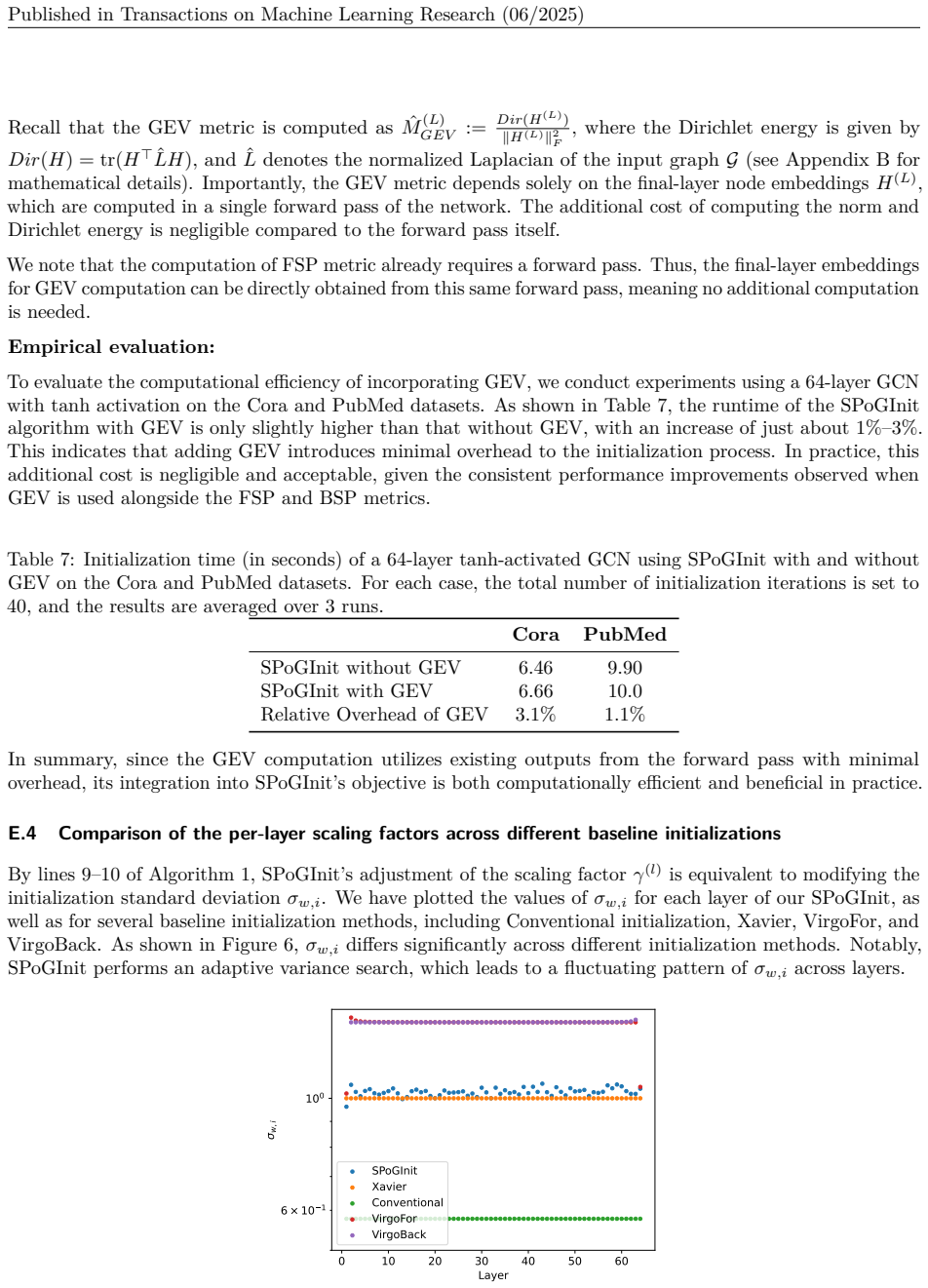
Optimized per dataset and architecture by SPoGInit (Figure 6 shows an example 64-layer pattern)
- SPoGInit objective weights w1, w2, w3 =
(1, 10, 1) for vanilla GCN; (1, 1, 1) for other architectures
- SPoGInit search hyperparameters (learning rate, early-stopping delta, iterations) =
Learning rates 0.02 to 0.2, delta 10 or 20, up to 40 to 100 iterations
assumptions (3)
- domain assumption NNGP correspondence (Proposition C.1): as hidden widths go sequentially to infinity, pre-activation channels are i.i.d. Gaussian with covariance recursion Sigma^(l+1) = sigma_w^2 * A_hat * G(Sigma^(l)) * A_hat.
- domain assumption Initialization-time normalized Dirichlet energy (GEV) is a valid proxy for the over-smoothing that degrades accuracy after training.
- domain assumption The BSP metric, defined as the expected norm of the first-layer loss gradient at initialization computed on training labels, predicts gradient stability during training.
Cite this review
Pith. "Pith review of Exploring and Improving Initialization for Deep Graph Neural Networks: A Signal Propagation Perspective." pith.science (2026). https://pith.science/paper/7EHDOLYW
@misc{pith2026250616790,
  author       = {Pith},
  title        = {Pith review of: Exploring and Improving Initialization for Deep Graph Neural Networks: A Signal Propagation Perspective},
  year         = {2026},
  howpublished = {\url{https://pith.science/paper/7EHDOLYW}},
  note         = {Machine review of arXiv:2506.16790}
}
read the original abstract
Graph Neural Networks (GNNs) often suffer from performance degradation as the network depth increases. This paper addresses this issue by introducing initialization methods that enhance signal propagation (SP) within GNNs. We propose three key metrics for effective SP in GNNs: forward propagation, backward propagation, and graph embedding variation (GEV). While the first two metrics derive from classical SP theory, the third is specifically designed for GNNs. We theoretically demonstrate that a broad range of commonly used initialization methods for GNNs, which exhibit performance degradation with increasing depth, fail to control these three metrics simultaneously. To deal with this limitation, a direct exploitation of the SP analysis--searching for weight initialization variances that optimize the three metrics--is shown to significantly enhance the SP in deep GCNs. This approach is called Signal Propagation on Graph-guided Initialization (SPoGInit). Our experiments demonstrate that SPoGInit outperforms commonly used initialization methods on various tasks and architectures. Notably, SPoGInit enables performance improvements as GNNs deepen, which represents a significant advancement in addressing depth-related challenges and highlights the validity and effectiveness of the SP analysis framework.
Figures


Figures from the paper (8 more)




Reference graph
Works this paper leans on
-
[1]
Mixhop : Higher-order graph convolutional architectures via sparsified neighborhood mixing
Sami Abu-El-Haija, Bryan Perozzi, Amol Kapoor, Nazanin Alipourfard, Kristina Lerman, Hrayr Harutyunyan, Greg Ver Steeg, and Aram Galstyan. Mixhop : Higher-order graph convolutional architectures via sparsified neighborhood mixing. In International Conference on Machine Learning, pp.\ 21--29. PMLR, 2019
2019
-
[2]
On the bottleneck of graph neural networks and its practical implications
Uri Alon and Eran Yahav. On the bottleneck of graph neural networks and its practical implications. In International Conference on Learning Representations, 2021
2021
-
[3]
A machine learning-based approximation of strong branching
Alejandro Marcos Alvarez, Quentin Louveaux, and Louis Wehenkel. A machine learning-based approximation of strong branching. INFORMS Journal on Computing, 29 0 (1): 0 185--195, 2017
2017
-
[4]
Label propagation across graphs: Node classification using graph neural tangent kernels
Artun Bayer, Arindam Chowdhury, and Santiago Segarra. Label propagation across graphs: Node classification using graph neural tangent kernels. In ICASSP 2022-2022 IEEE International Conference on Acoustics, Speech and Signal Processing (ICASSP), pp.\ 5483--5487. IEEE, 2022
2022
-
[5]
Machine learning for combinatorial optimization: a methodological tour d’horizon
Yoshua Bengio, Andrea Lodi, and Antoine Prouvost. Machine learning for combinatorial optimization: a methodological tour d’horizon. European Journal of Operational Research, 290 0 (2): 0 405--421, 2021
2021
-
[6]
Decision diagrams for optimization, volume 1
David Bergman, Andre A Cire, Willem-Jan Van Hoeve, and John Hooker. Decision diagrams for optimization, volume 1. Springer, 2016
2016
-
[7]
The maximum clique problem
Immanuel M Bomze, Marco Budinich, Panos M Pardalos, and Marcello Pelillo. The maximum clique problem. Handbook of Combinatorial Optimization: Supplement Volume A, pp.\ 1--74, 1999
1999
-
[8]
Can graph neural networks go deeper without over-smoothing? yes, with a randomized path exploration! In IEEE Transactions on Emerging Topics in Computational Intelligence
Kushal Bose and Swagatam Das. Can graph neural networks go deeper without over-smoothing? yes, with a randomized path exploration! In IEEE Transactions on Emerging Topics in Computational Intelligence. IEEE, 2023
2023
Show all 147 references
-
[9]
Reconnaissance de la parole par reseaux connexionnistes
L \'e on Bottou. Reconnaissance de la parole par reseaux connexionnistes. In Proceedings of neuro Nimes, volume 88, pp.\ 197--218, 1988
1988
-
[10]
A survey on optimization metaheuristics
Ilhem Boussa \" d, Julien Lepagnot, and Patrick Siarry. A survey on optimization metaheuristics. Information sciences, 237: 0 82--117, 2013
2013
-
[11]
A note on over-smoothing for graph neural networks
Chen Cai and Yusu Wang. A note on over-smoothing for graph neural networks. In International Conference on Machine Learning. PMLR, 2020
2020
-
[12]
Measuring and relieving the over-smoothing problem for graph neural networks from the topological view
Deli Chen, Yankai Lin, Wei Li, Peng Li, Jie Zhou, and Xu Sun. Measuring and relieving the over-smoothing problem for graph neural networks from the topological view. In Proceedings of the AAAI Conference on Artificial Intelligence, volume 34, pp.\ 3438--3445, 2020 a
2020
-
[13]
Dirichlet energy enhancement of graph neural networks by framelet augmentation
Jialin Chen, Yuelin Wang, Cristian Bodnar, Rex Ying, Pietro Li \`o , and Yu Guang Wang. Dirichlet energy enhancement of graph neural networks by framelet augmentation. 2022 a
2022
-
[14]
Universal deep gnns: Rethinking residual connection in gnns from a path decomposition perspective for preventing the over-smoothing
Jie Chen, Weiqi Liu, Zhizhong Huang, Junbin Gao, Junping Zhang, and Jian Pu. Universal deep gnns: Rethinking residual connection in gnns from a path decomposition perspective for preventing the over-smoothing. arXiv preprint arXiv:2205.15127, 2022 b
2022 arXiv
-
[15]
Simple and deep graph convolutional networks
Ming Chen, Zhewei Wei, Zengfeng Huang, Bolin Ding, and Yaliang Li. Simple and deep graph convolutional networks. In International Conference on Machine Learning, pp.\ 1725--1735. PMLR, 2020 b
2020
-
[16]
Dynamical isometry and a mean field theory of rnns: Gating enables signal propagation in recurrent neural networks
Minmin Chen, Jeffrey Pennington, and Samuel Schoenholz. Dynamical isometry and a mean field theory of rnns: Gating enables signal propagation in recurrent neural networks. In International Conference on Machine Learning, pp.\ 873--882. PMLR, 2018
2018
-
[17]
Bag of tricks for training deeper graph neural networks: A comprehensive benchmark study
Tianlong Chen, Kaixiong Zhou, Keyu Duan, Wenqing Zheng, Peihao Wang, Xia Hu, and Zhangyang Wang. Bag of tricks for training deeper graph neural networks: A comprehensive benchmark study. IEEE Transactions on Pattern Analysis and Machine Intelligence, 2022 c
2022
-
[18]
On representing linear programs by graph neural networks
Ziang Chen, Jialin Liu, Xinshang Wang, and Wotao Yin. On representing linear programs by graph neural networks. In The Eleventh International Conference on Learning Representations, 2023
2023
-
[19]
Expressive power of graph neural networks for (mixed-integer) quadratic programs
Ziang Chen, Xiaohan Chen, Jialin Liu, Xinshang Wang, and Wotao Yin. Expressive power of graph neural networks for (mixed-integer) quadratic programs. arXiv preprint arXiv:2406.05938, 2024
2024
-
[20]
Adaptive universal generalized pagerank graph neural network
Eli Chien, Jianhao Peng, Pan Li, and Olgica Milenkovic. Adaptive universal generalized pagerank graph neural network. In International Conference on Learning Representations, 2021
2021
-
[21]
Better not to propagate: Understanding edge uncertainty and over-smoothing in signed graph neural networks
Yoonhyuk Choi, Jiho Choi, Taewook Ko, and Chong-Kwon Kim. Better not to propagate: Understanding edge uncertainty and over-smoothing in signed graph neural networks. arXiv preprint arXiv:2408.04895, 2024
2024 arXiv
-
[22]
Approximation algorithms for bin-packing—an updated survey
Edward G Coffman Jr, Michael R Garey, and David S Johnson. Approximation algorithms for bin-packing—an updated survey. In Algorithm design for computer system design, pp.\ 49--106. Springer, 1984
1984
-
[23]
On provable benefits of depth in training graph convolutional networks
Weilin Cong, Morteza Ramezani, and Mehrdad Mahdavi. On provable benefits of depth in training graph convolutional networks. Advances in Neural Information Processing Systems, 34: 0 9936--9949, 2021
2021
-
[24]
Metainit: Initializing learning by learning to initialize
Yann N Dauphin and Samuel S Schoenholz. Metainit: Initializing learning by learning to initialize. Advances in Neural Information Processing Systems, 32, 2019
2019
-
[25]
Graph neural networks as gradient flows: Understanding graph convolutions via energy
Francesco Di Giovanni, James Rowbottom, Benjamin P Chamberlain, Thomas Markovich, and Michael M Bronstein. Graph neural networks as gradient flows: Understanding graph convolutions via energy. arXiv preprint arXiv:2206.10991, 2022
2022 arXiv
-
[26]
Adagnn: Graph neural networks with adaptive frequency response filter
Yushun Dong, Kaize Ding, Brian Jalaian, Shuiwang Ji, and Jundong Li. Adagnn: Graph neural networks with adaptive frequency response filter. In Proceedings of the 30th ACM international conference on information & knowledge management, pp.\ 392--401, 2021
2021
-
[27]
Graph neural tangent kernel: Fusing graph neural networks with graph kernels
Simon S Du, Kangcheng Hou, Russ R Salakhutdinov, Barnabas Poczos, Ruosong Wang, and Keyulu Xu. Graph neural tangent kernel: Fusing graph neural networks with graph kernels. Advances in Neural Information Processing Systems, 32, 2019
2019
-
[28]
Learning from the dark: boosting graph convolutional neural networks with diverse negative samples
Wei Duan, Junyu Xuan, Maoying Qiao, and Jie Lu. Learning from the dark: boosting graph convolutional neural networks with diverse negative samples. In Proceedings of the AAAI conference on artificial intelligence, volume 36, pp.\ 6550--6558, 2022
2022
-
[29]
Graph convolutional neural networks with diverse negative samples via decomposed determinant point processes
Wei Duan, Junyu Xuan, Maoying Qiao, and Jie Lu. Graph convolutional neural networks with diverse negative samples via decomposed determinant point processes. IEEE Transactions on Neural Networks and Learning Systems, 2023
2023
-
[30]
Layer-diverse negative sampling for graph neural networks
Wei Duan, Jie Lu, Yu Guang Wang, and Junyu Xuan. Layer-diverse negative sampling for graph neural networks. Transactions on Machine Learning Research, 2024
2024
-
[31]
The power of depth for feedforward neural networks
Ronen Eldan and Ohad Shamir. The power of depth for feedforward neural networks. In Conference on learning theory, pp.\ 907--940. PMLR, 2016
2016
-
[32]
DropMessage : Unifying random dropping for graph neural networks
Taoran Fang, Zhiqing Xiao, Chunping Wang, Jiarong Xu, Xuan Yang, and Yang Yang. DropMessage : Unifying random dropping for graph neural networks. In Proceedings of the AAAI Conference on Artificial Intelligence, volume 37, pp.\ 4267--4275, 2023
2023
-
[33]
Grato: Graph neural network framework tackling over-smoothing with neural architecture search
Xinshun Feng, Herun Wan, Shangbin Feng, Hongrui Wang, Qinghua Zheng, Jun Zhou, and Minnan Luo. Grato: Graph neural network framework tackling over-smoothing with neural architecture search. In Proceedings of the 31st ACM International Conference on Information & Knowledge Mana...
2022
-
[34]
Matthias Fey and Jan E. Lenssen. Fast graph representation learning with PyTorch Geometric . In ICLR Workshop on Representation Learning on Graphs and Manifolds, 2019
2019
-
[35]
Cooperative graph neural networks
Ben Finkelshtein, Xingyue Huang, Michael Bronstein, and Ismail Ilkan Ceylan. Cooperative graph neural networks. arXiv preprint arXiv:2310.01267, 2023
2023 arXiv
-
[36]
Exact combinatorial optimization with graph convolutional neural networks
Maxime Gasse, Didier Ch \'e telat, Nicola Ferroni, Laurent Charlin, and Andrea Lodi. Exact combinatorial optimization with graph convolutional neural networks. Advances in Neural Information Processing Systems, 32, 2019
2019
-
[37]
Predict then propagate: Graph neural networks meet personalized pagerank
Johannes Gasteiger, Aleksandar Bojchevski, and Stephan G \"u nnemann. Predict then propagate: Graph neural networks meet personalized pagerank. In International Conference on Learning Representations, 2019
2019
-
[38]
The travelling salesman problem and related problems
Bezalel Gavish and Stephen C Graves. The travelling salesman problem and related problems. 1978
1978
-
[39]
Graph convolutional networks from the perspective of sheaves and the neural tangent kernel
Thomas Gebhart. Graph convolutional networks from the perspective of sheaves and the neural tangent kernel. In Topological, Algebraic and Geometric Learning Workshops 2022, pp.\ 124--132. PMLR, 2022
2022
-
[40]
Dynamical isometry and a mean field theory of lstms and grus
Dar Gilboa, Bo Chang, Minmin Chen, Greg Yang, Samuel S Schoenholz, Ed H Chi, and Jeffrey Pennington. Dynamical isometry and a mean field theory of lstms and grus. arXiv preprint arXiv:1901.08987, 2019
1901 arXiv
-
[41]
Understanding the difficulty of training deep feedforward neural networks
Xavier Glorot and Yoshua Bengio. Understanding the difficulty of training deep feedforward neural networks. In International Conference on Artificial Intelligence and Statistics, pp.\ 249--256. JMLR Workshop and Conference Proceedings, 2010
2010
-
[42]
Orthogonal graph neural networks
Kai Guo, Kaixiong Zhou, Xia Hu, Yu Li, Yi Chang, and Xin Wang. Orthogonal graph neural networks. In Proceedings of the AAAI Conference on Artificial Intelligence, volume 36, pp.\ 3996--4004, 2022
2022
-
[43]
Contranorm: A contrastive learning perspective on oversmoothing and beyond
Xiaojun Guo, Yifei Wang, Tianqi Du, and Yisen Wang. Contranorm: A contrastive learning perspective on oversmoothing and beyond. In International Conference on Learning Representations, 2023
2023
-
[44]
Structure-aware dropedge toward deep graph convolutional networks
Jiaqi Han, Wenbing Huang, Yu Rong, Tingyang Xu, Fuchun Sun, and Junzhou Huang. Structure-aware dropedge toward deep graph convolutional networks. IEEE Transactions on Neural Networks and Learning Systems, 2023 a
2023
-
[45]
A gnn-guided predict-and-search framework for mixed-integer linear programming
Qingyu Han, Linxin Yang, Qian Chen, Xiang Zhou, Dong Zhang, Akang Wang, Ruoyu Sun, and Xiaodong Luo. A gnn-guided predict-and-search framework for mixed-integer linear programming. In The Eleventh International Conference on Learning Representations, 2022
2022
-
[46]
Mlpinit: Embarrassingly simple gnn training acceleration with mlp initialization
Xiaotian Han, Tong Zhao, Yozen Liu, Xia Hu, and Neil Shah. Mlpinit: Embarrassingly simple gnn training acceleration with mlp initialization. 2023 b
2023
-
[47]
Which neural net architectures give rise to exploding and vanishing gradients? Advances in Neural Information Processing Systems, 31, 2018
Boris Hanin. Which neural net architectures give rise to exploding and vanishing gradients? Advances in Neural Information Processing Systems, 31, 2018
2018
-
[48]
Inequalities
Godfrey Harold Hardy, John Edensor Littlewood, George P \'o lya, Gy \"o rgy P \'o lya, et al. Inequalities. Cambridge university press, 1952
1952
-
[49]
On the impact of the activation function on deep neural networks training
Soufiane Hayou, Arnaud Doucet, and Judith Rousseau. On the impact of the activation function on deep neural networks training. In International Conference on Machine Learning, pp.\ 2672--2680. PMLR, 2019
2019
-
[50]
The curse of depth in kernel regime
Soufiane Hayou, Arnaud Doucet, and Judith Rousseau. The curse of depth in kernel regime. In I (Still) Can't Believe It's Not Better! Workshop at NeurIPS 2021, pp.\ 41--47. PMLR, 2022
2021
-
[51]
Delving deep into rectifiers: Surpassing human-level performance on imagenet classification
Kaiming He, Xiangyu Zhang, Shaoqing Ren, and Jian Sun. Delving deep into rectifiers: Surpassing human-level performance on imagenet classification. In Proceedings of the IEEE International Conference on Computer Vision, pp.\ 1026--1034, 2015
2015
-
[52]
Deep residual learning for image recognition
Kaiming He, Xiangyu Zhang, Shaoqing Ren, and Jian Sun. Deep residual learning for image recognition. In Proceedings of the IEEE Conference on Computer Vision and Pattern Recognition, pp.\ 770--778, 2016
2016
-
[53]
Open graph benchmark: Datasets for machine learning on graphs
Weihua Hu, Matthias Fey, Marinka Zitnik, Yuxiao Dong, Hongyu Ren, Bowen Liu, Michele Catasta, and Jure Leskovec. Open graph benchmark: Datasets for machine learning on graphs. Advances in Neural Information Processing Systems, 33: 0 22118--22133, 2020
2020
-
[54]
Towards deepening graph neural networks: A gntk-based optimization perspective
Wei Huang, Yayong Li, Weitao Du, Jie Yin, Richard Yi Da Xu, Ling Chen, and Miao Zhang. Towards deepening graph neural networks: A gntk-based optimization perspective. International Conference on Learning Representations, 2022
2022
-
[55]
Tackling over-smoothing for general graph convolutional networks
Wenbing Huang, Yu Rong, Tingyang Xu, Fuchun Sun, and Junzhou Huang. Tackling over-smoothing for general graph convolutional networks. arXiv preprint arXiv:2008.09864, 2020
2008 arXiv
-
[56]
Batch normalization: Accelerating deep network training by reducing internal covariate shift
Sergey Ioffe and Christian Szegedy. Batch normalization: Accelerating deep network training by reducing internal covariate shift. In International Conference on Machine Learning, pp.\ 448--456. PMLR, 2015
2015
-
[57]
Old can be gold: Better gradient flow can make vanilla-gcns great again
Ajay Jaiswal, Peihao Wang, Tianlong Chen, Justin Rousseau, Ying Ding, and Zhangyang Wang. Old can be gold: Better gradient flow can make vanilla-gcns great again. Advances in Neural Information Processing Systems, 35: 0 7561--7574, 2022
2022
-
[58]
Fast graph neural tangent kernel via kronecker sketching
Shunhua Jiang, Yunze Man, Zhao Song, Zheng Yu, and Danyang Zhuo. Fast graph neural tangent kernel via kronecker sketching. In Proceedings of the AAAI Conference on Artificial Intelligence, volume 36, pp.\ 7033--7041, 2022
2022
-
[59]
Towards feature overcorrelation in deeper graph neural networks
Wei Jin, Xiaorui Liu, Yao Ma, Charu Aggarwal, and Jiliang Tang. Towards feature overcorrelation in deeper graph neural networks. 2022
2022
-
[60]
Reducing oversmoothing in graph neural networks by changing the activation function
Dimitrios Kelesis, Dimitrios Vogiatzis, Georgios Katsimpras, Dimitris Fotakis, and Georgios Paliouras. Reducing oversmoothing in graph neural networks by changing the activation function. In ECAI 2023 - 26th European Conference on Artificial Intelligence, September 30 - Octobe...
2023
-
[61]
Reducing oversmoothing through informed weight initialization in graph neural networks
Dimitrios Kelesis, Dimitris Fotakis, and Georgios Paliouras. Reducing oversmoothing through informed weight initialization in graph neural networks. arXiv preprint arXiv:2410.23830, 2024
2024 arXiv
-
[62]
Not too little, not too much: a theoretical analysis of graph (over)smoothing
Nicolas Keriven. Not too little, not too much: a theoretical analysis of graph (over)smoothing. In Advances in Neural Information Processing Systems, 2022
2022
-
[63]
Learning to branch in mixed integer programming
Elias Khalil, Pierre Le Bodic, Le Song, George Nemhauser, and Bistra Dilkina. Learning to branch in mixed integer programming. In Proceedings of the AAAI conference on artificial intelligence, volume 30, 2016
2016
-
[64]
Learning to run heuristics in tree search
Elias B Khalil, Bistra Dilkina, George L Nemhauser, Shabbir Ahmed, and Yufen Shao. Learning to run heuristics in tree search. In Ijcai, pp.\ 659--666, 2017
2017
-
[65]
Semi-supervised classification with graph convolutional networks
Thomas N Kipf and Max Welling. Semi-supervised classification with graph convolutional networks. International Conference on Learning Representations, 2017
2017
-
[66]
Goat: A global transformer on large-scale graphs
Kezhi Kong, Jiuhai Chen, John Kirchenbauer, Renkun Ni, C Bayan Bruss, and Tom Goldstein. Goat: A global transformer on large-scale graphs. In International Conference on Machine Learning, pp.\ 17375--17390. PMLR, 2023
2023
-
[67]
Graph neural tangent kernel: Convergence on large graphs
Sanjukta Krishnagopal and Luana Ruiz. Graph neural tangent kernel: Convergence on large graphs. arXiv preprint arXiv:2301.10808, 2023
2023 arXiv
-
[68]
Imagenet classification with deep convolutional neural networks
Alex Krizhevsky, Ilya Sutskever, and Geoffrey E Hinton. Imagenet classification with deep convolutional neural networks. Advances in Neural Information Processing Systems, 25 0 (1106-1114): 0 1, 2012
2012
-
[69]
Efficient backprop
Yann LeCun, L \'e on Bottou, Genevieve B Orr, and Klaus-Robert M \"u ller. Efficient backprop. In Neural networks: Tricks of the trade, pp.\ 9--50. Springer, 2002
2002
-
[70]
Deep neural networks as gaussian processes
Jaehoon Lee, Yasaman Bahri, Roman Novak, Samuel S Schoenholz, Jeffrey Pennington, and Jascha Sohl-Dickstein. Deep neural networks as gaussian processes. In International Conference on Learning Representations, 2018
2018
-
[71]
Pdhg-unrolled learning-to-optimize method for large-scale linear programming
Bingheng Li, Linxin Yang, Yupeng Chen, Senmiao Wang, Qian Chen, Haitao Mao, Yao Ma, Akang Wang, Tian Ding, Jiliang Tang, et al. Pdhg-unrolled learning-to-optimize method for large-scale linear programming. arXiv preprint arXiv:2406.01908, 2024 a
2024 arXiv
-
[72]
Deepgcns: Can gcns go as deep as cnns? In Proceedings of the IEEE/CVF International Conference on Computer Vision, 2019
Guohao Li, Matthias M \"u ller, Ali Thabet, and Bernard Ghanem. Deepgcns: Can gcns go as deep as cnns? In Proceedings of the IEEE/CVF International Conference on Computer Vision, 2019
2019
-
[73]
Deepergcn: All you need to train deeper gcns, 2020
Guohao Li, Chenxin Xiong, Ali Thabet, and Bernard Ghanem. Deepergcn: All you need to train deeper gcns, 2020
2020
-
[74]
Training graph neural networks with 1000 layers
Guohao Li, Matthias M \"u ller, Bernard Ghanem, and Vladlen Koltun. Training graph neural networks with 1000 layers. In International Conference on Machine Learning, 2021
2021
-
[75]
On the initialization of graph neural networks
Jiahang Li, Yakun Song, Xiang Song, and David Wipf. On the initialization of graph neural networks. In International Conference on Machine Learning, pp.\ 19911--19931. PMLR, 2023
2023
-
[76]
On random deep weight-tied autoencoders: Exact asymptotic analysis, phase transitions, and implications to training
Ping Li and Phan-Minh Nguyen. On random deep weight-tied autoencoders: Exact asymptotic analysis, phase transitions, and implications to training. In International Conference on Learning Representations, 2019
2019
-
[77]
On the power of small-size graph neural networks for linear programming
Qian Li, Tian Ding, Linxin Yang, Minghui Ouyang, Qingjiang Shi, and Ruoyu Sun. On the power of small-size graph neural networks for linear programming. In The Thirty-eighth Annual Conference on Neural Information Processing Systems, 2024 b
2024
-
[78]
Deeper insights into graph convolutional networks for semi-supervised learning
Qimai Li, Zhichao Han, and Xiao-Ming Wu. Deeper insights into graph convolutional networks for semi-supervised learning. In Proceedings of the AAAI Conference on Artificial Intelligence, volume 32, 2018
2018
-
[79]
Why deep neural networks for function approximation? In 5th International Conference on Learning Representations, ICLR 2017, 2017
Shiyu Liang and R Srikant. Why deep neural networks for function approximation? In 5th International Conference on Learning Representations, ICLR 2017, 2017
2017
-
[80]
Large scale learning on non-homophilous graphs: New benchmarks and strong simple methods
Derek Lim, Felix Hohne, Xiuyu Li, Sijia Linda Huang, Vaishnavi Gupta, Omkar Bhalerao, and Ser Nam Lim. Large scale learning on non-homophilous graphs: New benchmarks and strong simple methods. In Advances in Neural Information Processing Systems, volume 34, pp.\ 20887--20902, 2021
2021
-
[81]
Towards deeper graph neural networks
Meng Liu, Hongyang Gao, and Shuiwang Ji. Towards deeper graph neural networks. In Proceedings of the 26th ACM SIGKDD International Conference on Knowledge Discovery and Data Mining, pp.\ 338--348, 2020
2020
-
[82]
Skipnode: On alleviating over-smoothing for deep graph convolutional networks
Weigang Lu, Yibing Zhan, Ziyu Guan, Liu Liu, Baosheng Yu, Wei Zhao, Yaming Yang, and Dacheng Tao. Skipnode: On alleviating over-smoothing for deep graph convolutional networks. arXiv preprint arXiv:2112.11628, 2021
2021 arXiv
-
[83]
Break the ceiling: Stronger multi-scale deep graph convolutional networks
Sitao Luan, Mingde Zhao, Xiao-Wen Chang, and Doina Precup. Break the ceiling: Stronger multi-scale deep graph convolutional networks. In Advances in Neural Information Processing Systems, volume 32, 2019
2019
-
[84]
Training matters: Unlocking potentials of deeper graph convolutional neural networks
Sitao Luan, Mingde Zhao, Xiao-Wen Chang, and Doina Precup. Training matters: Unlocking potentials of deeper graph convolutional neural networks. arXiv preprint arXiv:2008.08838, 2020
2008 arXiv
-
[85]
Classic gnns are strong baselines: Reassessing gnns for node classification
Yuankai Luo, Lei Shi, and Xiao-Ming Wu. Classic gnns are strong baselines: Reassessing gnns for node classification. arXiv preprint arXiv:2406.08993, 2024
2024 arXiv
-
[86]
A fractional graph laplacian approach to oversmoothing
Sohir Maskey, Raffaele Paolino, Aras Bacho, and Gitta Kutyniok. A fractional graph laplacian approach to oversmoothing. Advances in Neural Information Processing Systems, 36, 2024
2024
-
[87]
Gaussian process behaviour in wide deep neural networks
Alexander G de G Matthews, Mark Rowland, Jiri Hron, Richard E Turner, and Zoubin Ghahramani. Gaussian process behaviour in wide deep neural networks. In International Conference on Learning Representations, 2018
2018
-
[88]
Scattering gcn: Overcoming oversmoothness in graph convolutional networks
Yimeng Min, Frederik Wenkel, and Guy Wolf. Scattering gcn: Overcoming oversmoothness in graph convolutional networks. Advances in Neural Information Processing Systems, 33: 0 14498--14508, 2020
2020
-
[89]
Solving mixed integer programs using neural networks
Vinod Nair, Sergey Bartunov, Felix Gimeno, Ingrid Von Glehn, Pawel Lichocki, Ivan Lobov, Brendan O'Donoghue, Nicolas Sonnerat, Christian Tjandraatmadja, Pengming Wang, et al. Solving mixed integer programs using neural networks. arXiv preprint arXiv:2012.13349, 2020
2012 arXiv
-
[90]
Bayesian learning for neural networks, volume 118
Radford M Neal. Bayesian learning for neural networks, volume 118. Springer-Verlag, 1996
1996
-
[91]
Random gradient-free minimization of convex functions
Yurii Nesterov and Vladimir Spokoiny. Random gradient-free minimization of convex functions. Foundations of Computational Mathematics, 17 0 (2): 0 527--566, 2017
2017
-
[92]
Revisiting over-smoothing and over-squashing using ollivier-ricci curvature
Khang Nguyen, Nong Minh Hieu, Vinh Duc Nguyen, Nhat Ho, Stanley Osher, and Tan Minh Nguyen. Revisiting over-smoothing and over-squashing using ollivier-ricci curvature. In International Conference on Machine Learning, pp.\ 25956--25979. PMLR, 2023
2023
-
[93]
Graph neural networks exponentially lose expressive power for node classification
Kenta Oono and Taiji Suzuki. Graph neural networks exponentially lose expressive power for node classification. In International Conference on Learning Representations, 2019
2019
-
[94]
Applications of combinatorial optimization
Vangelis Th Paschos. Applications of combinatorial optimization. John Wiley & Sons, 2014
2014
-
[95]
Resurrecting the sigmoid in deep learning through dynamical isometry: Theory and practice
Jeffrey Pennington, Samuel Schoenholz, and Surya Ganguli. Resurrecting the sigmoid in deep learning through dynamical isometry: Theory and practice. Advances in Neural Information Processing Systems, 30, 2017
2017
-
[96]
The emergence of spectral universality in deep networks
Jeffrey Pennington, Samuel Schoenholz, and Surya Ganguli. The emergence of spectral universality in deep networks. In International Conference on Artificial Intelligence and Statistics, pp.\ 1924--1932. PMLR, 2018
1924
-
[97]
A critical look at the evaluation of gnns under heterophily: Are we really making progress? arXiv preprint arXiv:2302.11640, 2023
Oleg Platonov, Denis Kuznedelev, Michael Diskin, Artem Babenko, and Liudmila Prokhorenkova. A critical look at the evaluation of gnns under heterophily: Are we really making progress? arXiv preprint arXiv:2302.11640, 2023
2023 arXiv
-
[98]
Exponential expressivity in deep neural networks through transient chaos
Ben Poole, Subhaneil Lahiri, Maithra Raghu, Jascha Sohl-Dickstein, and Surya Ganguli. Exponential expressivity in deep neural networks through transient chaos. Advances in Neural Information Processing Systems, 29, 2016
2016
-
[99]
Exploring the power of graph neural networks in solving linear optimization problems
Chendi Qian, Didier Ch \'e telat, and Christopher Morris. Exploring the power of graph neural networks in solving linear optimization problems. In International Conference on Artificial Intelligence and Statistics, pp.\ 1432--1440. PMLR, 2024
2024
-
[100]
Dropedge: Towards deep graph convolutional networks on node classification
Yu Rong, Wenbing Huang, Tingyang Xu, and Junzhou Huang. Dropedge: Towards deep graph convolutional networks on node classification. In International Conference on Learning Representations, 2020
2020
-
[101]
Simplifying the theory on over-smoothing
Andreas Roth. Simplifying the theory on over-smoothing. arXiv preprint arXiv:2407.11876, 2024
2024 arXiv
-
[102]
Rank collapse causes over-smoothing and over-correlation in graph neural networks
Andreas Roth and Thomas Liebig. Rank collapse causes over-smoothing and over-correlation in graph neural networks. In Learning on Graphs Conference, pp.\ 35--1. PMLR, 2024
2024
-
[103]
A survey on oversmoothing in graph neural networks
T Konstantin Rusch, Michael M Bronstein, and Siddhartha Mishra. A survey on oversmoothing in graph neural networks. arXiv preprint arXiv:2303.10993, 2023 a
2023 arXiv
-
[104]
Gradient gating for deep multi-rate learning on graphs
T Konstantin Rusch, Benjamin P Chamberlain, Michael W Mahoney, Michael M Bronstein, and Siddhartha Mishra. Gradient gating for deep multi-rate learning on graphs. In International Conference on Learning Representations, 2023 b
2023
-
[105]
New insights into graph convolutional networks using neural tangent kernels
Mahalakshmi Sabanayagam, Pascal Esser, and Debarghya Ghoshdastidar. New insights into graph convolutional networks using neural tangent kernels. arXiv preprint arXiv:2110.04060, 2021
2021 arXiv
-
[106]
Representation power of graph convolutions: Neural tangent kernel analysis
Mahalakshmi Sabanayagam, Pascal Esser, and Debarghya Ghoshdastidar. Representation power of graph convolutions: Neural tangent kernel analysis. arXiv preprint arXiv:2210.09809, 2022
2022 arXiv
-
[107]
Exact solutions to the nonlinear dynamics of learning in deep linear neural networks
Andrew M Saxe, James L McClelland, and Surya Ganguli. Exact solutions to the nonlinear dynamics of learning in deep linear neural networks. In International Conference on Learning Represenatations, 2014
2014
-
[108]
Deep information propagation
Samuel S Schoenholz, Justin Gilmer, Surya Ganguli, and Jascha Sohl-Dickstein. Deep information propagation. In International Conference on Learning Representations, 2017
2017
-
[109]
Residual connections and normalization can provably prevent oversmoothing in gnns
Michael Scholkemper, Xinyi Wu, Ali Jadbabaie, and Michael T Schaub. Residual connections and normalization can provably prevent oversmoothing in gnns. arXiv preprint arXiv:2406.02997, 2024
2024
-
[110]
Collective classification in network data
Prithviraj Sen, Galileo Namata, Mustafa Bilgic, Lise Getoor, Brian Galligher, and Tina Eliassi-Rad. Collective classification in network data. AI magazine, 29 0 (3): 0 93--93, 2008
2008
-
[111]
Pitfalls of graph neural network evaluation
Oleksandr Shchur, Maximilian Mumme, Aleksandar Bojchevski, and Stephan G \"u nnemann. Pitfalls of graph neural network evaluation. arXiv preprint arXiv:1811.05868, 2018
2018 arXiv
-
[112]
Graph transformers: A survey
Ahsan Shehzad, Feng Xia, Shagufta Abid, Ciyuan Peng, Shuo Yu, Dongyu Zhang, and Karin Verspoor. Graph transformers: A survey. arXiv preprint arXiv:2407.09777, 2024
2024
-
[113]
Very deep convolutional networks for large-scale image recognition
Karen Simonyan and Andrew Zisserman. Very deep convolutional networks for large-scale image recognition. In International Conference on Learning Representations, 2015
2015
-
[114]
On the infinite width limit of neural networks with a standard parameterization
Jascha Sohl-Dickstein, Roman Novak, Samuel S Schoenholz, and Jaehoon Lee. On the infinite width limit of neural networks with a standard parameterization. arXiv preprint arXiv:2001.07301, 2020
2001 arXiv
-
[115]
Dropout: A simple way to prevent neural networks from overfitting
Nitish Srivastava, Geoffrey Hinton, Alex Krizhevsky, Ilya Sutskever, and Ruslan Salakhutdinov. Dropout: A simple way to prevent neural networks from overfitting. In Journal of Machine Learning Research, volume 15, pp.\ 1929--1958, 2014
1929
-
[116]
Representation benefits of deep feedforward networks
Matus Telgarsky. Representation benefits of deep feedforward networks. arXiv preprint arXiv:1509.08101, 2015
2015 arXiv
-
[117]
Graph attention networks
Petar Veli c kovi \'c , Guillem Cucurull, Arantxa Casanova, Adriana Romero, Pietro Li \`o , and Yoshua Bengio. Graph attention networks. 2017
2017
-
[118]
Bag of tricks for node classification with graph neural networks
Yangkun Wang, Jiarui Jin, Weinan Zhang, Yong Yu, Zheng Zhang, and David Wipf. Bag of tricks for node classification with graph neural networks. arXiv preprint arXiv:2103.13355, 2021
2021 arXiv
-
[119]
Graph Neural Networks: Foundations, Frontiers, and Applications
Lingfei Wu, Peng Cui, Jian Pei, and Liang Zhao. Graph Neural Networks: Foundations, Frontiers, and Applications. Springer Nature, 2022 a
2022
-
[120]
Nodeformer: A scalable graph structure learning transformer for node classification
Qitian Wu, Wentao Zhao, Zenan Li, David P Wipf, and Junchi Yan. Nodeformer: A scalable graph structure learning transformer for node classification. Advances in Neural Information Processing Systems, 35: 0 27387--27401, 2022 b
2022
-
[121]
A non-asymptotic analysis of oversmoothing in graph neural networks
Xinyi Wu, Zhengdao Chen, William Wang, and Ali Jadbabaie. A non-asymptotic analysis of oversmoothing in graph neural networks. International Conference on Learning Representations, 2023
2023
-
[122]
Demystifying oversmoothing in attention-based graph neural networks
Xinyi Wu, Amir Ajorlou, Zihui Wu, and Ali Jadbabaie. Demystifying oversmoothing in attention-based graph neural networks. Advances in Neural Information Processing Systems, 36, 2024
2024
-
[123]
A comprehensive survey on graph neural networks
Zonghan Wu, Shirui Pan, Fengwen Chen, Guodong Long, Chengqi Zhang, and S Yu Philip. A comprehensive survey on graph neural networks. In IEEE Transactions on Neural Networks and Learning Systems, volume 32, pp.\ 4--24. IEEE, 2020
2020
-
[124]
Dynamical isometry and a mean field theory of CNNs : How to train 10,000-layer vanilla convolutional neural networks
Lechao Xiao, Yasaman Bahri, Jascha Sohl-Dickstein, Samuel Schoenholz, and Jeffrey Pennington. Dynamical isometry and a mean field theory of CNNs : How to train 10,000-layer vanilla convolutional neural networks. In International Conference on Machine Learning, pp.\ 5393--5402....
2018
-
[125]
Representation learning on graphs with jumping knowledge networks
Keyulu Xu, Chengtao Li, Yonglong Tian, Tomohiro Sonobe, Ken-ichi Kawarabayashi, and Stefanie Jegelka. Representation learning on graphs with jumping knowledge networks. In International Conference on Machine Learning, pp.\ 5453--5462. PMLR, 2018
2018
-
[126]
Optimization of graph neural networks: Implicit acceleration by skip connections and more depth
Keyulu Xu, Mozhi Zhang, Stefanie Jegelka, and Kenji Kawaguchi. Optimization of graph neural networks: Implicit acceleration by skip connections and more depth. In International Conference on Machine Learning, pp.\ 11592--11602. PMLR, 2021
2021
-
[127]
Two sides of the same coin: Heterophily and oversmoothing in graph convolutional neural networks
Yujun Yan, Milad Hashemi, Kevin Swersky, Yaoqing Yang, and Danai Koutra. Two sides of the same coin: Heterophily and oversmoothing in graph convolutional neural networks. In 2022 IEEE International Conference on Data Mining (ICDM). IEEE, 2022
2022
-
[128]
Revisiting over-smoothing in deep gcns
Chaoqi Yang, Ruijie Wang, Shuochao Yao, Shengzhong Liu, and Tarek Abdelzaher. Revisiting over-smoothing in deep gcns. arXiv preprint arXiv:2003.13663, 2020
2003 arXiv
-
[129]
Graph neural networks are inherently good generalizers: Insights by bridging gnns and mlps
Chenxiao Yang, Qitian Wu, Jiahua Wang, and Junchi Yan. Graph neural networks are inherently good generalizers: Insights by bridging gnns and mlps. In International Conference on Learning Representations, 2023 a
2023
-
[130]
Mean field residual networks: On the edge of chaos
Ge Yang and Samuel S Schoenholz. Mean field residual networks: On the edge of chaos. Advances in Neural Information Processing Systems, 30, 2017
2017
-
[131]
Bridging smoothness and approximation: Theoretical insights into over-smoothing in graph neural networks
Guangrui Yang, Jianfei Li, Ming Li, Han Feng, and Ding-Xuan Zhou. Bridging smoothness and approximation: Theoretical insights into over-smoothing in graph neural networks. arXiv preprint arXiv:2407.01281, 2024
2024 arXiv
-
[132]
Tackling over-smoothing in graph convolutional networks with em-based joint topology optimization and node classification
Rui Yang, Wenrui Dai, Chenglin Li, Junni Zou, and Hongkai Xiong. Tackling over-smoothing in graph convolutional networks with em-based joint topology optimization and node classification. In IEEE Transactions on Signal and Information Processing over Networks, volume 9, pp.\ 1...
2023
-
[133]
Revisiting semi-supervised learning with graph embeddings
Zhilin Yang, William Cohen, and Ruslan Salakhudinov. Revisiting semi-supervised learning with graph embeddings. In International Conference on Machine Learning, pp.\ 40--48. PMLR, 2016
2016
-
[134]
Revisiting graph convolutional network on semi-supervised node classification from an optimization perspective
Hongwei Zhang, Tijin Yan, Zenjun Xie, Yuanqing Xia, and Yuan Zhang. Revisiting graph convolutional network on semi-supervised node classification from an optimization perspective. arXiv preprint arXiv:2009.11469, 2020
2009 arXiv
-
[135]
Model degradation hinders deep graph neural networks
Wentao Zhang, Zeang Sheng, Ziqi Yin, Yuezihan Jiang, Yikuan Xia, Jun Gao, Zhi Yang, and Bin Cui. Model degradation hinders deep graph neural networks. In Proceedings of the 28th ACM SIGKDD Conference on Knowledge Discovery and Data Mining, pp.\ 2493--2503, 2022 a
2022
-
[136]
Graph-adaptive rectified linear unit for graph neural networks
Yifei Zhang, Hao Zhu, Ziqiao Meng, Piotr Koniusz, and Irwin King. Graph-adaptive rectified linear unit for graph neural networks. In Proceedings of the ACM web conference 2022, pp.\ 1331--1339, 2022 b
2022
-
[137]
Pairnorm: Tackling oversmoothing in gnns
Lingxiao Zhao and Leman Akoglu. Pairnorm: Tackling oversmoothing in gnns. In International Conference on Learning Representations, 2020
2020
-
[138]
Tackling oversmoothing of gnns with contrastive learning
Lecheng Zheng, Dongqi Fu, and Jingrui He. Tackling oversmoothing of gnns with contrastive learning. 2021
2021
-
[139]
Graph neural networks: A review of methods and applications
Jie Zhou, Ganqu Cui, Shengding Hu, Zhengyan Zhang, Cheng Yang, Zhiyuan Liu, Lifeng Wang, Changcheng Li, and Maosong Sun. Graph neural networks: A review of methods and applications. AI open, 1: 0 57--81, 2020 a
2020
-
[140]
Towards deeper graph neural networks with differentiable group normalization
Kaixiong Zhou, Xiao Huang, Yuening Li, Daochen Zha, Rui Chen, and Xia Hu. Towards deeper graph neural networks with differentiable group normalization. In Advances in Neural Information Processing Systems, volume 33, pp.\ 4917--4928, 2020 b
2020
-
[141]
Dirichlet energy constrained learning for deep graph neural networks
Kaixiong Zhou, Xiao Huang, Daochen Zha, Rui Chen, Li Li, Soo-Hyun Choi, and Xia Hu. Dirichlet energy constrained learning for deep graph neural networks. In Advances in Neural Information Processing Systems, volume 34, pp.\ 21834--21846, 2021 a
2021
-
[142]
Understanding and resolving performance degradation in deep graph convolutional networks
Kuangqi Zhou, Yanfei Dong, Kaixin Wang, Wee Sun Lee, Bryan Hooi, Huan Xu, and Jiashi Feng. Understanding and resolving performance degradation in deep graph convolutional networks. In Proceedings of the 30th ACM International Conference on Information and Knowledge Management,...
2021
-
[143]
On the explainability of graph convolutional network with gcn tangent kernel
Xianchen Zhou and Hongxia Wang. On the explainability of graph convolutional network with gcn tangent kernel. Neural Computation, 35 0 (1): 0 1--26, 2022
2022
-
[144]
Gradinit: Learning to initialize neural networks for stable and efficient training
Chen Zhu, Renkun Ni, Zheng Xu, Kezhi Kong, W Ronny Huang, and Tom Goldstein. Gradinit: Learning to initialize neural networks for stable and efficient training. Advances in Neural Information Processing Systems, 34: 0 16410--16422, 2021
2021
-
[145]
Beyond homophily in graph neural networks: Current limitations and effective designs
Jiong Zhu, Yujun Yan, Lingxiao Zhao, Mark Heimann, Leman Akoglu, and Danai Koutra. Beyond homophily in graph neural networks: Current limitations and effective designs. Advances in Neural Information Processing Systems, 33: 0 7793--7804, 2020
2020
-
[146]
Layer-dependent importance sampling for training deep and large graph convolutional networks
Difan Zou, Ziniu Hu, Yewen Wang, Song Jiang, Yizhou Sun, and Quanquan Gu. Layer-dependent importance sampling for training deep and large graph convolutional networks. In Advances in Neural Information Processing Systems, volume 32, 2019
2019
-
[147]
write newline
" write newline "" before.all 'output.state := FUNCTION n.dashify 't := "" t empty not t #1 #1 substring "-" = t #1 #2 substring "--" = not "--" * t #2 global.max substring 't := t #1 #1 substring "-" = "-" * t #2 global.max substring 't := while if t #1 #1 substring * t #2 gl...
Reviewed August 15, 2026 · model on record in the stance chip above.
Discussion (0). Continue with ORCID to comment.