REVIEW 2 major objections 6 minor 1 cited by
Effects of planetary mass uncertainties on the interpretation of the reflectance spectra of Earth-like exoplanets
T0 review · 2 major / 6 minor · reviewed 2026-08-09 · deepseek-v4-flash
Pith's one-line read Reflected-light retrievals misidentify the dominant gas of cloudy Earth-like planets unless the mass is known to about 10%.
desk verdict Useful retrieval study with a concrete, actionable claim (mass prior ~10% for background gas ID), but the headline result rests on a fixed cloud fraction and a single noise realization, so treat the quantitative threshold as provisional. read the letter →
The pith
A machine-rendered reading of the paper's core claim, the machinery that carries it, and where it could break.
The reading
What carries the argument
The load-bearing mechanism is the mass$-$scale-height$-$composition degeneracy. In reflected light the spectrum constrains column abundances, approximately partial pressure over surface gravity ($P/g$), and scale height $H = kT/(\mu g)$ folds the planet's mass into the gas mean molecular mass $\mu$. When the mass is uncertain, the retrieval can keep the spectrum unchanged by trading mass against $\mu$, so a nitrogen-dominated air column is re-labeled as oxygen or carbon dioxide. This trade is enabled by three upgrades: composition-dependent Rayleigh scattering (so the slope carries information about $\mu$), partial pressures as free parameters (so no filler gas is assumed), and a 1.5D two-column cloud model with 25% cloud fraction (so patchy clouds mute the Rayleigh slope).
What would settle it
Run the same mock-observation retrieval suite with cloud fraction as a free parameter, or with spectra from a 3D cloudy atmosphere, and check whether nitrogen still gets misidentified as oxygen under a flat mass prior; if the background gas is then recovered, the 10% mass requirement is an artifact of the fixed 25% cloud fraction rather than a property of real cloudy planets.
Extended reading notes
Core claim
In the paper's own terms: using the Bayesian retrieval framework ExoReL with composition-dependent Rayleigh scattering, adaptive vertical layering, and partial pressures as free parameters, the authors show that reflected-light spectra of cloudy Earth-like planets only yield the correct background gas when the mass prior is a Gaussian with 10% width. Without that precision, the retrieved mass drops toward 0.5 Earth masses, the radius inflates to about 1.1 Earth radii, and the dominant gas switches from the true N$_2$ to O$_2$ (modern case) or CO$_2$ (Archean case). The same suite on a cloud-free modern Earth succeeds under all priors, isolating clouds as the condition that hides the Rayleigh slope needed to pin down the invisible background gas. The authors conclude that mass measurements accurate to roughly 10%, from extreme-precision radial velocity or astrometry, should be a prerequisite for biosignature interpretation with future direct-imaging missions.
Load-bearing premise
The result assumes the simplified cloud treatment, two atmospheric columns with a fixed 25% cloud cover, captures how real patchy water clouds hide the Rayleigh scattering slope; if that fails, the mass threshold could shift or disappear.
Editorial extensions
If this is right
- For cloudy terrestrial exoplanets, a 10% mass prior becomes a practical requirement for reflected-light characterization, not a refinement.
- Without such a prior, a modern Earth analog could be reported as an oxygen-dominated planet, which would look like a strong false-positive biosignature.
- Archean Earth analogs could be misread as carbon-dioxide-dominated, erasing the methane/CO$_2$ disequilibrium that marks a biosphere.
- Cloud-free planets are safe: their Rayleigh slopes survive and the mass can be co-retrieved from the spectrum alone.
- Precursor extreme-precision radial velocity or astrometry programs targeting Habitable Worlds Observatory candidates should aim for 10% mass errors.
Reading between the lines
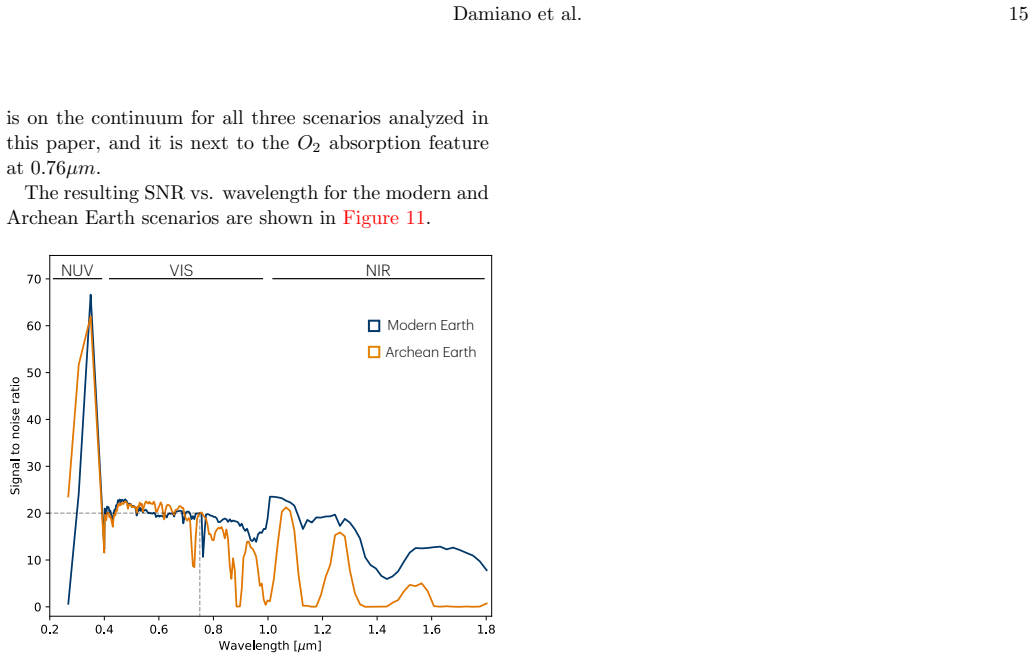
- The 10% threshold was derived at one signal-to-noise level (SNR 20 at 0.75 $\mu$m) and fixed spectral resolution; the same degeneracy may persist or relax at higher SNR, and the paper does not map that boundary.
- The mass$\mu$ trade is not specific to N$_2$/O$_2$/CO$_2$: comparable misidentifications could affect super-Earth and sub-Neptune retrievals where H$_2$ or He is the invisible background gas.
- A practical test: apply the same retrieval suite to real Earthshine spectra with deliberately mis-specified mass priors to see whether the O$_2$-for-N$_2$ swap reproduces in data rather than only in simulated spectra.
- Because clouds are the trigger, better cloud constraints (e.g., phase curves or polarimetry) might reduce the mass precision needed, a possibility the authors deferred to a companion study.
Editorial analysis
A structured set of objections, weighed in public.
Referee Report
Summary. The paper investigates how prior knowledge of planetary mass affects atmospheric retrievals of Earth-like exoplanets in reflected light. Using an upgraded version of the ExoReL retrieval framework that includes composition-dependent Rayleigh scattering, a two-column treatment with fixed 25% cloud fraction, partial-pressure sampling, an adaptive vertical grid, and a new noise model, the authors generate simulated NUV-VIS-NIR spectra of cloud-free modern Earth, cloudy modern Earth, and Archean Earth analogs and retrieve them under five mass-prior scenarios: perfect knowledge, unknown, a physically motivated 2D mass-radius prior, and Gaussian priors with 30% and 10% width. In the cloud-free case the composition is recovered in all scenarios. In the cloudy modern-Earth case, the unknown, 2D, and 30%-Gaussian priors bias the retrieved mass low and cause N2 to be replaced by O2 as the dominant gas; in the Archean case N2 is replaced by CO2. Only the 10% Gaussian prior recovers the correct composition. The authors conclude that mass constraints near 10% (about 10 sigma) are needed to avoid misidentifying the background gas and to correctly interpret potential biosignatures with the Habitable Worlds Observatory.
Significance. If the central result is robust, it is directly relevant to HWO target selection and precursor radial-velocity or astrometry campaigns, and it identifies a concrete failure mode—background-gas misidentification—that could produce false-positive O2-dominated atmospheric interpretations. The study is a well-structured simulation experiment with known truth, so no fitted constant is presented as a prediction; the strengths are the clearly described setup, the physically motivated prior, and the quantitative reporting of posterior ranges in Tables 3 and 4. However, the headline claim rests on a forward model in which cloud fraction is fixed at its truth value (Section 2.1.1), and the paper defers the free-cloud-fraction case to a companion study; until that degeneracy is explored, the 10% mass-prior requirement is conditional rather than established.
major comments (2)
- [Section 2.1.1; Tables 3 and 4] The cloud fraction is fixed at 25% in both the forward model and the retrievals, and Section 2.1.2 states that clouds mute the Rayleigh scattering slope, which is the primary observable for identifying the background gas. Because cloud fraction affects the amplitude of the Rayleigh slope, a retrieval with free cloud fraction could reduce the cloud fraction to steepen that slope and compensate for an incorrect mass or surface gravity, potentially retaining N2 as the dominant gas. The reported composition flips in Tables 3 and 4 may therefore be an artifact of fixing cloud fraction to its true value rather than a general consequence of mass uncertainty. This concern is explicitly acknowledged by the authors as deferred to a companion study, but it directly bears on the central conclusion that mass must be known to 10%. I request that the authors rerun the Modern and Archean Earth retrievals with cloud fraction as a free parameter (or with a prior that includes the true value) and report whether the misidentification persists, or alternatively temper the headline claim to explicitly state the dependence on the fixed cloud fraction.
- [Section 2.3 and Section 5] The quantitative recommendation that mass should be known to within 10% is derived from retrievals of a single synthetic noise realization at a signal-to-noise ratio of 20 at 0.75 microns. The paper does not examine how the threshold depends on the random noise seed, the overall SNR, or the noise color, although the new noise model itself allows such variations through the parameters alpha and beta in Appendix A. Because the abstract and conclusion present '10% uncertainty' as a robust observational requirement, the authors should either justify that the single realization is representative (for example, by repeating the key experiments with several noise seeds or at one additional SNR) or explicitly limit the claim to the specific noise realization used here.
minor comments (6)
- [Section 2.1.1] The choice of 25% for the fixed cloud fraction is not physically justified in the main text; a sentence explaining the rationale (or a statement that the value is illustrative pending the companion study) would help the reader interpret the results.
- [Table 1 and Section 2.1.5] The text says the Gaussian priors correspond to a '3.3 sigma or 10 sigma detection,' while the tables label them 'Gaussian prior (30%)' and 'Gaussian prior (10%)'. These are consistent only if the reader knows that sigma is defined relative to the mean (e.g., 1/0.3 ≈ 3.3), so please state this equivalence explicitly to avoid confusion.
- [Section 2.2] The MultiNest settings (2000 live points, evidence tolerance 0.5) are reported, but there is no convergence check; running one scenario with a larger live-point count (e.g., 4000) or reporting the Bayesian evidence with a second sampler would strengthen confidence in the posteriors shown in Figures 3-10.
- [Software section] The paper does not indicate whether the upgraded ExoReL code is publicly available; adding an availability statement or a link to a repository would improve reproducibility, especially since the study introduces several new features (cloud fraction, adaptive grid, partial-pressure sampling).
- [Figures 2 and 3-10] The spectral feature labels in Figure 2 are small and overlapping at the displayed size, and the captions for the posterior corner plots could define the derived 'surface pressure' quantity in the caption itself rather than only in Section 2.1.4.
- [Text typos] There are several typographical errors, including 'Moden' (Section 3.2), 'errobars' (Section 4.1), and 'Archaen' (Section 4.2 and elsewhere); a careful proofreading pass is needed.
Circularity Check
No significant circularity; controlled simulation experiment with known truth.
full rationale
This paper is a controlled simulation experiment, not a derivation from fitted data: synthetic reflected-light spectra are generated from known Modern/Archean Earth model atmospheres (Tables 2-4), noise is added by an analytic model normalized to SNR=20 (Appendix A), and ExoReL retrievals are run against these simulated observations under different mass priors. The headline claim - that looser mass priors lead to misidentification of the background gas while a 10% Gaussian prior recovers N2 - is read directly from posterior distributions of an internally consistent forward+inverse model, with truth values known by construction. No fitted constant is renamed as a prediction, and no load-bearing step is justified by a self-citation: the cited ExoReL papers (Damiano & Hu 2020, 2022; Damiano et al. 2023) provide the retrieval code and cloud/radiative-transfer formulation, but the present paper's conclusion is produced by running that code on synthetic data, not by importing a uniqueness theorem or ansatz. The paper explicitly flags the fixed 25% cloud fraction and defers its marginalization to a companion study (Burr et al., in prep.); even if this limitation could affect generalization to real cloudy planets, it is a model assumption explicitly acknowledged by the authors, not a circular step. The 2D mass-radius prior is adopted from Zeng et al. (2016), an external reference, and the mass-composition degeneracy is diagnosed from the retrieval posteriors rather than assumed. Accordingly, no circularity is found.
Assumptions & free parameters
free parameters (4)
- Cloud fraction =
25% (fixed, not retrieved)
- Noise model scaling parameters alpha and beta =
alpha chosen so Fp=2*alpha*Fs*lambda^2 at 0.75 um; beta scales SNR to 20 at 0.75 um
- Partial pressure prior bounds =
Log-uniform 10^-7 to 10^7 Pa
- Mass and radius prior bounds =
Mass U(0.01, 20) M_E; radius U(0.5, 10) R_E, or U(0.58, 2.2) R_E with 2D prior
assumptions (5)
- domain assumption ExoReL radiative transfer model accurately computes reflected-light spectra of Earth-like atmospheres
- domain assumption The 1.5D two-column cloud model with linear averaging weighted by cloud fraction approximates real patchy clouds
- domain assumption The analytic photon-noise model (planet plus exozodi, no speckles or dark current) represents HWO-like observations
- standard math MultiNest nested sampling with 2000 live points and evidence tolerance 0.5 converges to the true posterior
- domain assumption The Zeng et al. (2016) mass-radius relations bound physically plausible terrestrial planets
Cite this review
Pith. "Pith review of Effects of planetary mass uncertainties on the interpretation of the reflectance spectra of Earth-like exoplanets." pith.science (2026). https://pith.science/paper/7FURIFMC
@misc{pith2026250201513,
  author       = {Pith},
  title        = {Pith review of: Effects of planetary mass uncertainties on the interpretation of the reflectance spectra of Earth-like exoplanets},
  year         = {2026},
  howpublished = {\url{https://pith.science/paper/7FURIFMC}},
  note         = {Machine review of arXiv:2502.01513}
}
abstract
Atmospheric characterization of Earth-like exoplanets through reflected light spectroscopy is a key goal for upcoming direct imaging missions. A critical challenge in this endeavor is the accurate determination of planetary mass, which may influence the measurement of atmospheric compositions and the identification of potential biosignatures. In this study, we used the Bayesian retrieval framework ExoReL$^\Re$ to investigate the impact of planetary mass uncertainties on the atmospheric characterization of terrestrial exoplanets observed in reflected light. Our results indicate that precise prior knowledge of the planetary mass can be crucial for accurate atmospheric retrievals if clouds are present in the atmosphere. When the planetary mass is known within 10\% uncertainty, our retrievals successfully identified the background atmospheric gas and accurately constrained atmospheric parameters together with clouds. However, with less constrained or unknown planetary mass, we observed significant biases, particularly in the misidentification of the dominant atmospheric gas. For instance, the dominant gas was incorrectly identified as oxygen for a modern-Earth-like planet or carbon dioxide for an Archean-Earth-like planet, potentially leading to erroneous assessments of planetary habitability and biosignatures. These biases arise because, the uncertainties in planetary mass affect the determination of surface gravity and atmospheric scale height, leading the retrieval algorithm to compensate by adjusting the atmospheric composition. Our findings emphasize the importance of achieving precise mass measurements-ideally within 10\% uncertainty-through methods such as extreme precision radial velocity or astrometry, especially for future missions like the Habitable Worlds Observatory.
Figures


Figures from the paper (8 more)


Forward citations
Cited by 1 Pith paper
-
Revisiting TOI-4438 and TOI-442 planetary systems with new observations from SPIRou and TESS
Refined masses and radii for TOI-4438 b and TOI-442 b, stellar rotation periods from magnetic variability, and a single-transit planet candidate around TOI-4438.
Reference graph
Works this paper leans on
-
[1]
, " * write output.state after.block = add.period write newline
ENTRY address archivePrefix author booktitle chapter doi edition editor eprint howpublished institution journal key month number organization pages publisher school series title misctitle type volume year version url label extra.label sort.label short.list INTEGERS output.state before.all mid.sentence after.sentence after.block FUNCTION init.state.consts ...
-
[2]
write newline
" write newline "" before.all 'output.state := FUNCTION format.url url empty "" new.block "" url * "" * if FUNCTION format.eprint eprint empty "" archivePrefix empty "" archivePrefix "arXiv" = new.block " " eprint * " " * new.block " " eprint * " " * if if if FUNCTION format.doi doi empty "" " " doi * " " * if FUNCTION format.pid doi empty eprint empty ur...
-
[3]
thebibliography [1] 20pt to REFERENCES 6pt =0pt -12pt 10pt plus 3pt =0pt =0pt =1pt plus 1pt =0pt =0pt -12pt =13pt plus 1pt =20pt =13pt plus 1pt \@M =10000 =-1.0em =0pt =0pt 0pt =0pt =1.0em @enumiv\@empty 10000 10000 `\.\@m \@noitemerr \@latex@warning Empty `thebibliography' environment \@ifnextchar \@reference \@latexerr Missing key on reference command E...
work page Pith review arXiv 2021
-
[4]
Astropy Collaboration , Robitaille , T. P., Tollerud , E. J., et al. 2013, , 558, A33, 10.1051/0004-6361/201322068
-
[5]
Astropy Collaboration , Price-Whelan , A. M., Sip o cz , B. M., et al. 2018, , 156, 123, 10.3847/1538-3881/aabc4f
-
[6]
Astropy Collaboration , Price-Whelan , A. M., Lim , P. L., et al. 2022, , 935, 167, 10.3847/1538-4357/ac7c74
-
[7]
Batalha , N. E., Lewis , T., Fortney , J. J., et al. 2019 a , ApJL, 885, L25, 10.3847/2041-8213/ab4909
-
[8]
Batalha , N. E., Marley , M. S., Lewis , N. K., & Fortney , J. J. 2019 b , , 878, 70, 10.3847/1538-4357/ab1b51
Show all 51 references
- [9]
-
[10]
2012, , 753, 100, 10.1088/0004-637X/753/2/100
Benneke , B., & Seager , S. 2012, , 753, 100, 10.1088/0004-637X/753/2/100
2012 doi
-
[11]
2014, , 564, A125, 10.1051/0004-6361/201322971
Buchner , J., Georgakakis , A., Nandra , K., et al. 2014, , 564, A125, 10.1051/0004-6361/201322971
2014 doi
-
[12]
2019, , 487, 1082, 10.1093/mnras/stz1215
Collier Cameron , A., Mortier , A., Phillips , D., et al. 2019, , 487, 1082, 10.1093/mnras/stz1215
2019 doi
- [13]
-
[14]
2023, , 678, A2, 10.1051/0004-6361/202347232
Cretignier , M., Dumusque , X., Aigrain , S., & Pepe , F. 2023, , 678, A2, 10.1051/0004-6361/202347232
2023 doi
-
[15]
Dalcin, L., & Fang, Y.-L. L. 2021, Computing in Science & Engineering, 23, 47, 10.1109/MCSE.2021.3083216
2021
-
[16]
2020, , 159, 175, 10.3847/1538-3881/ab79a5
Damiano , M., & Hu , R. 2020, , 159, 175, 10.3847/1538-3881/ab79a5
2020 doi
- [17]
- [18]
-
[19]
2023, , 166, 157, 10.3847/1538-3881/acefd3
Damiano , M., Hu , R., & Mennesson , B. 2023, , 166, 157, 10.3847/1538-3881/acefd3
2023 doi
-
[20]
P., & Bridges, M
Feroz, F., Hobson, M. P., & Bridges, M. 2009, Monthly Notices of the Royal Astronomical Society, 398, 1601, 10.1111/j.1365-2966.2009.14548.x
2009
- [21]
-
[22]
R., Howard , A
Gibson , S. R., Howard , A. W., Rider , K., et al. 2024, in Society of Photo-Optical Instrumentation Engineers (SPIE) Conference Series, Vol. 13096, Ground-based and Airborne Instrumentation for Astronomy X, ed. J. J. Bryant , K. Motohara , & J. R. D. Vernet , 1309609, 10.1117...
2024 doi
-
[23]
E., Schwieterman, E
Harman, C. E., Schwieterman, E. W., Schottelkotte, J. C., & Kasting, J. F. 2015, The Astrophysical Journal, 812, 137, 10.1088/0004-637X/812/2/137
2015 doi
-
[24]
2019, The Astrophysical Journal, 887, 166
Hu, R. 2019, The Astrophysical Journal, 887, 166
2019
-
[25]
2021, JATIS, 7, 021205, 10.1117/1.JATIS.7.2.021205
Hu , R., Lisman , D., Shaklan , S., et al. 2021, JATIS, 7, 021205, 10.1117/1.JATIS.7.2.021205
2021 doi
-
[26]
2014, , 784, 63, 10.1088/0004-637X/784/1/63
Hu , R., & Seager , S. 2014, , 784, 63, 10.1088/0004-637X/784/1/63
2014 doi
-
[27]
Hunter, J. D. 2007, Computing in Science & Engineering, 9, 90, 10.1109/MCSE.2007.55
2007 doi
-
[28]
A., Collier Cameron , A., Faria , J
John , A. A., Collier Cameron , A., Faria , J. P., et al. 2023, , 525, 1687, 10.1093/mnras/stad2381
2023 doi
-
[29]
2010, in Exoplanets, ed
Lovis , C., & Fischer , D. 2010, in Exoplanets, ed. S. Seager , 27--53
2010
-
[30]
K., Ford , E
Luhn , J. K., Ford , E. B., Guo , Z., et al. 2023, , 165, 98, 10.3847/1538-3881/acad08
2023 doi
-
[31]
2012, in Society of Photo-Optical Instrumentation Engineers (SPIE) Conference Series, Vol
Malbet , F., Goullioud , R., Lagage , P.-O., et al. 2012, in Society of Photo-Optical Instrumentation Engineers (SPIE) Conference Series, Vol. 8442, Space Telescopes and Instrumentation 2012: Optical, Infrared, and Millimeter Wave, ed. M. C. Clampin , G. G. Fazio , H. A. MacEw...
2012 doi
- [32]
-
[33]
Meadows , V. S. 2017, Astrobiology, 17, 1022, 10.1089/ast.2016.1578
2017
-
[34]
Meunier , N., Desort , M., & Lagrange , A. M. 2010, , 512, A39, 10.1051/0004-6361/200913551
2010 doi
-
[35]
2023, JATIS, 9, 016003, 10.1117/1.JATIS.9.1.016003
Morrissey , P., Harding , L., Bush , N., et al. 2023, JATIS, 9, 016003, 10.1117/1.JATIS.9.1.016003
2023 doi
-
[36]
2021, Pathways to Discovery in Astronomy and Astrophysics for the 2020s (Washington, DC: The National Academies Press), 10.17226/26141
National Academies of Sciences, Engineering, and Medicine . 2021, Pathways to Discovery in Astronomy and Astrophysics for the 2020s (Washington, DC: The National Academies Press), 10.17226/26141
2021 doi
-
[37]
2015, Guide to NumPy (Continuum Press)
Oliphant, T. 2015, Guide to NumPy (Continuum Press). https://books.google.com/books?id=g58ljgEACAAJ
2015
-
[38]
2021, , 645, A96, 10.1051/0004-6361/202038306
Pepe , F., Cristiani , S., Rebolo , R., et al. 2021, , 645, A96, 10.1051/0004-6361/202038306
2021 doi
-
[39]
R., Ong , J
Petersburg , R. R., Ong , J. M. J., Zhao , L. L., et al. 2020, , 159, 187, 10.3847/1538-3881/ab7e31
2020 doi
-
[40]
J., Caballero , J
Quirrenbach , A., Amado , P. J., Caballero , J. A., et al. 2014, in Society of Photo-Optical Instrumentation Engineers (SPIE) Conference Series, Vol. 9147, Ground-based and Airborne Instrumentation for Astronomy V, ed. S. K. Ramsay , I. S. McLean , & H. Takami , 91471F, 10.111...
2014 doi
-
[41]
Roberge , A., & Moustakas , L. A. 2018, NatAs, 2, 605, 10.1038/s41550-018-0543-8
2018 doi
-
[42]
D., Stapelfeldt , K
Robinson , T. D., Stapelfeldt , K. R., & Marley , M. S. 2016, PASP, 128, 025003, 10.1088/1538-3873/128/960/025003
2016 doi
-
[43]
D., Fortney , J
Salvador , A., Robinson , T. D., Fortney , J. J., & Marley , M. S. 2024, , 969, L22, 10.3847/2041-8213/ad54c5
2024 doi
-
[44]
2016, in Society of Photo-Optical Instrumentation Engineers (SPIE) Conference Series, Vol
Schwab , C., Rakich , A., Gong , Q., et al. 2016, in Society of Photo-Optical Instrumentation Engineers (SPIE) Conference Series, Vol. 9908, Ground-based and Airborne Instrumentation for Astronomy VI, ed. C. J. Evans , L. Simard , & H. Takami , 99087H, 10.1117/12.2234411
2016 doi
-
[45]
J., Booth , J., et al
Seager , S., Kasdin , N. J., Booth , J., et al. 2019, in Bulletin of the American Astronomical Society, Vol. 51, 106
2019
-
[46]
I., Bisikalo , D
Spro , L., Scherf , M., Shematovich , V. I., Bisikalo , D. V., & Lammer , H. 2021, Astronomy Reports, 65, 275, 10.1134/S1063772921040077
2021 doi
-
[47]
C., Belikov , R., Bolcar , M
Stark , C. C., Belikov , R., Bolcar , M. R., et al. 2019, JATIS, 5, 024009, 10.1117/1.JATIS.5.2.024009
2019 doi
-
[48]
C., Shao , M., Tanner , A
Unwin , S. C., Shao , M., Tanner , A. M., et al. 2008, , 120, 38, 10.1086/525059
2008 doi
-
[49]
E., et al
Virtanen, P., Gommers, R., Oliphant, T. E., et al. 2020, Nature Methods, 17, 261, 10.1038/s41592-019-0686-2
2020 doi
-
[50]
2014, , 785, L20, 10.1088/2041-8205/785/2/L20
Wordsworth , R., & Pierrehumbert , R. 2014, , 785, L20, 10.1088/2041-8205/785/2/L20
2014 doi
-
[51]
D., & Jacobsen , S
Zeng , L., Sasselov , D. D., & Jacobsen , S. B. 2016, ApJ, 819, 127, 10.3847/0004-637X/819/2/127
2016 doi
Reviewed August 9, 2026 · model on record in the stance chip above.
Discussion (0). Continue with ORCID to comment.