REVIEW 5 major objections 6 minor 59 references
Black hole shadow parameters and quasi-normal modes for Weyl-incorporated gravity
T0 review · 5 major / 6 minor · reviewed 2026-07-30 · grok-4.5
Pith's one-line read Weyl-matter coupling yields mass-dependent black-hole shadows and long-lived scalar ringdowns under a constant-density halo.
desk verdict First WIG shadows and scalar QNMs, but the numbers sit outside the controlled expansion the authors themselves define. read the letter →
The pith
A machine-rendered reading of the paper's core claim, the machinery that carries it, and where it could break.
The reading
What carries the argument
The first-order corrected lapse function f^(1)(r) obtained by expanding the Weyl-incorporated field equations for constant density ρ_c; photon-sphere and shadow radii are read from its effective potential, and the same f^(1) supplies the potential barrier for WKB/AIM quasi-normal frequencies and characteristic time-domain integration.
What would settle it
Recompute the horizon condition and shadow radius with a realistic, radially falling halo density that vanishes at the horizon and a fully consistent two-function metric; if no unique λ near 3.5–3.9 survives, or if the resulting shadows become indistinguishable from Schwarzschild, the reported phenomenology collapses.
Extended reading notes
Core claim
For spherically symmetric static black holes embedded in a constant-density baryonic halo within Weyl-incorporated gravity, there exist unique values of the coupling λ ≈ 3.5–3.9 that preserve a horizon near r = 2m; the associated photon-sphere impact parameters produce shadow radii that increase with black-hole mass, decrease under homogeneous plasma, and support test-field massive scalar modes that all decay while reaching quality factors of order 10^3–10^4.
Load-bearing premise
The calculation assumes a single lapse function even though pressureless dust plus the Weyl interaction make the two metric potentials unequal, and the authors’ own error estimates show the expansion is not under control at the working densities.
Editorial extensions
If this is right
- Shadow size in this framework is predicted to grow with black-hole mass once λ is fixed by the halo model.
- A homogeneous plasma background systematically shrinks the apparent shadow relative to the pure baryonic-halo case.
- Massive scalar test-field ringdowns on these backgrounds are long-lived (quality factors 10^3–10^4), offering a potential gravitational-wave signature.
- Time-domain waveforms show slower late-time decay than Schwarzschild for low multipoles, consistent with enhanced wave trapping.
- The same λ that was previously used for galactic rotation curves is here shown to leave strong-field imprints that can be compared with EHT and LIGO/Virgo data once realistic halos are included.
Reading between the lines
- Because the reported λ values sit outside the controlled weak-coupling regime, any observational claim will first require a non-perturbative or fully consistent two-metric-function solution.
- If the long-lived massive-scalar modes survive a full gravitational perturbation analysis, they could appear as slowly damped echoes or prolonged ringdowns distinguishable from Kerr templates.
- Joint EHT-plus-galaxy-rotation constraints on a single λ would constitute a sharp, mass-scale-spanning test of whether the Weyl-matter coupling is universal.
Editorial analysis
A structured set of objections, weighed in public.
Referee Report
Summary. The manuscript studies spherically symmetric static black holes in "Weyl-incorporated gravity" (WIG/MORD), which adds a coupling λ C_{αμβν}T^{αβ}T^{μν} to the Einstein–Hilbert action. Assuming a constant-density baryonic halo (ρ_c = 0.5) and a single-lapse ansatz ds² = −fdt² + dr²/f + r²dΩ², the authors solve the field equations iteratively to first order in λρ_c, determine λ for each black hole mass by imposing that the lapse vanish at r_s = 2m, and compute photon-sphere radii, shadow impact parameters (Table 1), energy emission using the Schwarzschild Hawking temperature, shadow modifications from a "homogeneous plasma" (Table 2), and massive-scalar QNM frequencies via 6th-order WKB and AIM, supplemented by a characteristic time-domain integration. The authors state all computed QNMs have ω_i < 0 with quality factors up to ~10⁴. The paper is explicitly framed as a theoretical exploration, and it is unusually candid about its own approximations — eqs. (32)–(33) quantify ε ≈ 0.5 and δ ≈ 1.9 — but the central numerical results are nonetheless presented at face value.
Significance. If the computations were controlled, the paper would provide the first black-hole shadow and QNM phenomenology for WIG/MORD, a framework whose galactic-scale fit (λ = 4.3125, Ref. [23]) makes a strong-field cross-check genuinely interesting. The manuscript has real strengths: it derives and reports its own consistency diagnostics (eqs. 29–33) rather than hiding the ansatz error; the QNM sector cross-checks two semi-analytic methods (6th-order WKB and AIM) against an explicit time-domain integration, a reasonable robustness standard for test-field claims; and the long-lived massive-scalar modes (Q ~ 10³–10⁴) are a falsifiable phenomenological prediction. However, the central numerical outputs currently rest on a first-order expansion at δ ≈ 1.9 and an internally inconsistent metric ansatz, so the results as tabulated cannot yet support the paper's conclusions.
major comments (5)
- [§2.1] §2.1, eqs. (29)–(33): The single-lapse ansatz (4) is inconsistent with the field equations for the matter model used: eq. (31) gives G^t_t − G^r_r = −κρ_c + λO(ρ_c²) ≠ 0 for pressureless dust, and the authors' own error measures at the working point are ε ≡ ρ_c r² ≈ 0.5 and δ ≡ λρ_c ≈ 1.9. Every quantitative output of the paper (Tables 1–2, Figs. 1–7) is built on f^(1), a first-order truncation whose neglected terms are the same order as those retained. The authors acknowledge this and call the exercise 'pedagogical', but the text then presents Table 1/2 numbers to three significant figures and draws trend conclusions ('positive correlation between mass and shadow size', '~7% barrier reduction'). Either the two-lapse system (A ≠ B) must be solved, or the claims must be explicitly re-scoped so that no quantitative precision is asserted beyond the uncontrolled regime.
- [Table 1] §2.1, Table 1: λ is not predicted; it is solved per-mass from the condition f^(1)(r_s) = 0. This has two load-bearing consequences. (a) The reported deviations of r_p and R_s from Schwarzschild are partially by construction, since λ is tuned to hold the horizon at r_s. (b) The text states 'for the larger λ the horizon lies slightly inside r = 2m', which contradicts the construction f^(1)(r_s)=0 with r_s = 2m — the horizon location should be re-solved and reported, not asserted. (c) The near-constancy λ ≈ 3.864–3.869 over nine decades of m followed by a jump to 3.568 at m = 10³ km is unexplained; it suggests either numerical conditioning of the root-finding or a branch change, and must be diagnosed.
- [Table 1] Table 1, columns 3–5: For m = 1 km the table gives r_p = 1.504 km while r_s = 2m = 2 km; for m = 10³ km it gives r_p = 1.873 km while 2m = 2000 km. The 'photon sphere' thus lies inside the nominal horizon for the two largest masses, and r_p is nearly mass-independent (~0.36–1.87 km) while m spans 10⁻⁶–10³ km. If r_p < r_h, the maximum of V_eff is not causally accessible to distant observers and R_s = r_p/√f(r_p) (eq. 42) is not an observable shadow radius. Either the units/normalization of Table 1 are mislabeled, the horizon is not at ~2m (in which case r_h must be tabulated), or the reported configurations do not describe shadows. This must be resolved before any conclusion from Table 1 stands.
- [§4] §4, eq. (46): the 'homogeneous plasma' refractive index n(r) = √(1 − ρ_p/r) is (i) explicitly r-dependent and therefore not homogeneous; (ii) dimensionally inconsistent if ρ_p is a density, since ρ_p/r must be dimensionless; and (iii) not the standard cold non-magnetized plasma dispersion n² = 1 − ω_p²/ω² with constant ω_p used in the cited formalism (Synge; Perlick/Tsupko). No derivation or reference is given. Since all of Table 2 and Fig. 4 follow from eq. (46), the plasma section must either derive this index from a stated microphysical model or be reworked with the standard plasma dispersion, including a clear definition of ρ_p and its units.
- [§3] §3, eq. (45): the energy-emission estimate uses the Schwarzschild temperature T = 1/(8πm) while the background lapse is explicitly non-Schwarzschild. The surface gravity T = f^(1)′(r_h)/(4π) is directly computable from the f^(1) the authors already construct, so the approximation is not forced by complexity. As it stands, §3 combines a WIG-corrected σ_lim with an uncorrected T, which is internally inconsistent and removes precisely the WIG effect the section is meant to estimate. At minimum the exact T should be computed or the induced error quantified.
minor comments (6)
- [§2.1] Units of the densities are never stated: ρ_c = 0.5 and ρ_p = 0.4/0.2 are given as pure numbers, but in geometric units with m in km a density has units km⁻². Please state units for ρ_c, ρ_p, and λ, and note how far ρ_c = 0.5 km⁻² sits from realistic halo densities (~10⁻²⁴ kg/m³).
- [§2.1] Eq. (42) and Fig. 2: the Carter constant is set to K = 1 without justification. For spherical symmetry K is fixed by the orbit, not chosen; please clarify the role of K and why K = 1 is consistent with the critical orbit used for R_s.
- [§2.1] Eq. (35): the conserved energy E is written with an overall factor 1/2 multiplying the g_tt ṫ term; as written this is not the standard normalization E = f(r) ṫ. Please check and correct, since eqs. (40)–(42) inherit this normalization.
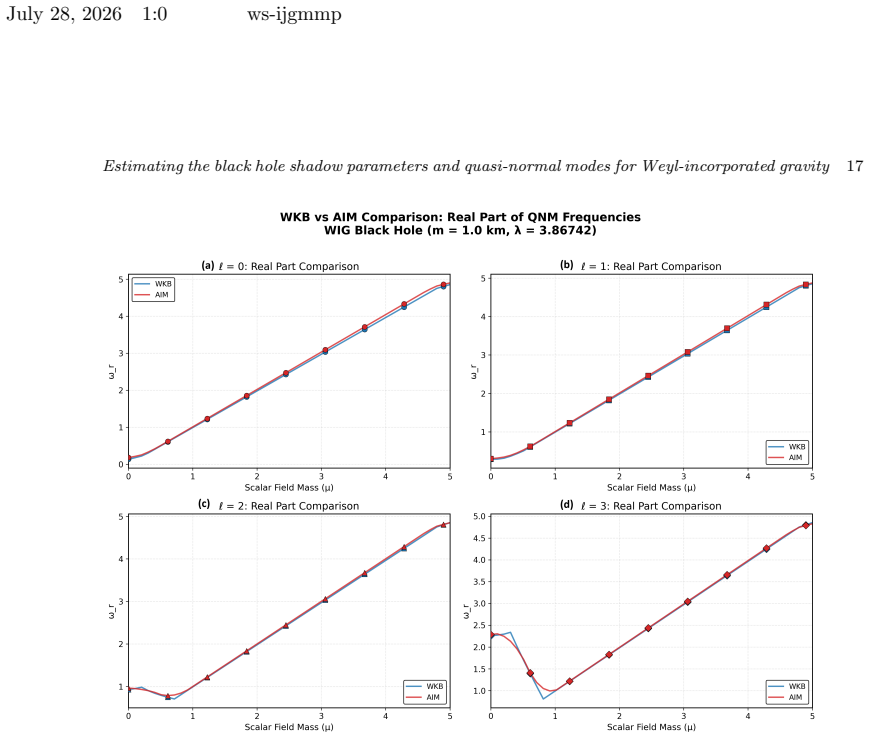
- [§5.2] §5: the ~30% WKB–AIM discrepancy for (ℓ=0, µ=0) is reported only in words. A small table of representative ω values for both methods would make the claimed '<1% agreement for µ > 1' verifiable and properly delimit the WKB results.
- [Figures] Fig. 2 caption: '3600' should be '360°'; 'homogenous' in Fig. 4 caption should be 'homogeneous'; 'yeild' above eq. (43); author name spelled 'Khokhar' on p.1 but 'Khookhar' in running heads.
- [§6] The claimed galactic value λ = 4.3125 ± 0.0012 from Ref. [23] and the black-hole values λ ≈ 3.5–3.9 differ by ~20% in a theory whose motivating hypothesis (§1) is that λ is unique. Even granting the different halo models, this tension should be stated explicitly and its implications for the uniqueness hypothesis discussed, including whether the units of λ in the two fits coincide.
Circularity Check
λ in Table 1 is solved from the horizon condition, not an independent input; shadows/QNMs on that background are real computations, not forced equalities.
-
fitted input called prediction
[§2.1, eqs. (21)–(28), Table 1 and surrounding text]
"Specifically, we determine the values of λ that satisfy the horizon condition f(1)(rs)=0 at the Schwarzschild radius rs. Table 1 presents the obtained λ values for black holes spanning several orders of magnitude in mass with a constant halo density ρc=0.5. For each mass configuration, we find a unique value of λ that preserves the horizon structure..."
λ is not varied independently and then used to predict horizons or shadows. It is solved for so that the horizon sits at rs for the chosen m and ρc. Table 1’s λ column is therefore the fit residual of that condition. Reporting rp, η+ζ², and Rs next to those λ values as the theory’s shadow parameters for those masses presents a tuned background’s outputs as a λ-dependence analysis; the ‘unique λ’ is unique only as the root of f^(1)(rs)=0, not as an external prediction.
-
self citation load bearing
[§1 Introduction; cf. also Results §6 discussion of unique λ]
"It was proposed that if WIG is truly a minimal extension to GR, the new coupling constant λ should be unique. ... Recently, for a sample of eight edge-on spiral galaxies in the local group, a single value of the coupling constant, λ=4.3125±0.0012, was shown to account for the asymptotic rotational velocities [23]."
The narrative that λ is a single universal constant is supported inside this paper only by citation [23] (overlapping authorship with the present work). That galactic fit is not used for the BH calculation (Table 1 uses λ∼3.5–3.9 from the horizon condition instead), so it does not force the shadow/QNM numbers, but it is the sole load-bearing external warrant for the ‘unique λ’ framing that motivates treating the horizon-tuned values as physically distinguished rather than model knobs.
full rationale
The load-bearing procedural step is that, for each mass m at fixed ρ_c=0.5, λ is chosen so that the first-order lapse satisfies f^(1)(r_s)=0. The paper then reports photon-sphere radii, impact parameters, shadow radii, plasma corrections, and test-field QNMs on exactly those backgrounds, and phrases the exercise as analyzing dependence on λ and finding unique λ per mass. That is a fitted-parameter study, not a first-principles prediction of λ, and the galactic uniqueness claim is only motivational self-citation ([23]) unused in the numerics. Once f^(1) is fixed, however, R_s=r_p/√f(r_p) and the scalar potential/QNMs are standard derived quantities and do not reduce by construction to the horizon fit (unlike fitting λ to shadow data and re-predicting shadows). The GR limit and the authors’ own caveats (conditional λ, uncontrolled δ∼1.9) are stated. Score 4 reflects partial circular framing of λ without collapse of the central observables.
Assumptions & free parameters
free parameters (4)
- λ (WIG coupling) =
≈3.57–3.87 (mass-dependent; ρ_c=0.5)
- ρ_c (constant halo density) =
0.5
- ρ_p (homogeneous plasma density) =
0.2 and 0.4
- r_0 (integration reference radius)
assumptions (7)
- domain assumption WIG field equations from varying √−g(R−2Λ−κT+λ C_αμβν T^αβ T^μν), with I_μν as given in eq. (3).
- ad hoc to paper Spherically symmetric static ansatz with a single lapse f(r)=A(r)=B(r), despite G^t_t≠G^r_r for the matter model.
- domain assumption Pressureless dust T_μν=ρ u_μ u_ν with constant ρ→ρ_c and static four-velocity.
- ad hoc to paper First-order iterative truncation: λρ_c small enough that f^(0)=1−2m/r and F^(1) built from E^(0) suffice.
- domain assumption Test-field approximation: scalar Φ on fixed g_μν, T_μν, I_μν; no backreaction or gravitational QNMs.
- ad hoc to paper Hawking temperature ≈1/(8πm) for energy-emission estimates.
- standard math Geometric units G=c=1; Carter separation for null geodesics; 6th-order WKB and AIM quantization as standard.
invented entities (1)
-
Weyl-matter coupling interaction λ C_αμβν T^αβ T^μν (WIG/MORD)
Cite this review
Pith. "Pith review of Black hole shadow parameters and quasi-normal modes for Weyl-incorporated gravity." pith.science (2026). https://pith.science/paper/7ILB6FKH
@misc{pith2026260723552,
  author       = {Pith},
  title        = {Pith review of: Black hole shadow parameters and quasi-normal modes for Weyl-incorporated gravity},
  year         = {2026},
  howpublished = {\url{https://pith.science/paper/7ILB6FKH}},
  note         = {Machine review of arXiv:2607.23552}
}
abstract
An additional term of the form $\lambda \mathbf{T} \cdot \mathbf{C} \cdot \mathbf{T}$ in the Einstein-Hilbert Lagrangian was introduced to explain the interaction between matter and pure gravitational field [H. W. Lee and A. Qadir, Motion of test particle for Weyl-interaction gravity, {\it Int. Jour. Mod. Phys. D} {\bf 28}(16) (2019) 2040014], the modified relativistic dynamics (MORD). In this paper, we estimate the shadow parameters of black hole in a spherically symmetric static spacetime within the MORD framework. As a first approximation, we assume that the black hole is surrounded by a constant-density baryonic matter halo. The analysis is then extended by introducing a homogeneous plasma background. We compute the shadow radii for various black hole masses and analyze their dependence on the WIG coupling parameter $\lambda$. In addition, we compute the fundamental quasi-normal mode (QNM) frequencies under test-field approximation, and perform a time-domain integration analysis.
Figures


Figures from the paper (4 more)



Reference graph
Works this paper leans on
- [23]
-
[1]
Kazunori, A
Event Horizon Telescope Collaboration: A. Kazunori, A. Antxon, A. Walter, et al. First M87 Event Horizon Telescope Results. I. The Shadow of the Supermassive Black Hole, Astrophys. J. Lett. 875 (2019) L1
2019
-
[2]
Kazunori, A
Event Horizon Telescope Collaboration: A. Kazunori, A. Antxon, A. Walter, et al. First Sagittarius A* Event Horizon Telescope Results. I. The Shadow of the Supermassive Black Hole in the Center of the Milky Way, Astrophys. J. Lett. 930 (2022) L12
2022
-
[3]
Michell, On the Means of Discovering the Distance, Magnitude, & c
J. Michell, On the Means of Discovering the Distance, Magnitude, & c. of the Fixed Stars, in Consequence of the Diminution of the Velocity of Their Light, in Case Such a Diminution Should be Found to Take Place in any of Them, and Such Other Data Should be Procured from Observations, as Would be Farther Necessary for That Purpose. By the Rev. John Michell...
-
[4]
P. S. De Laplace, Exposition du syst` eme du monde, (Cambridge University Press, 2010)
2010
-
[5]
Einstein, The Foundation of the General Theory of Relativity, The Principle of Relativity, (Dover Publications 1952)
A. Einstein, The Foundation of the General Theory of Relativity, The Principle of Relativity, (Dover Publications 1952)
1952
-
[6]
J. R. Oppenheimer and H. Snyder, On Continued Gravitational Contraction, Phys. Rev. 56 (1939) 455
1939
-
[7]
Ruffini and J
R. Ruffini and J. A. Wheeler, Introducing the black hole, Phys. Today 24 (1971) 30
1971
Show all 59 references
-
[8]
S. W. Hawking and R. Penrose, The Singularities of Gravitational Collapse and Cosmology, Proc. Roy. Soc. Lond. A 314 (1970) 529. July 28, 2026 1:0 ws-ijgmmp 22Noraiz Tahir, Mubasher Jamil, Kaynat Fatima, and Tajammal Hussain Khookhar
1970
-
[9]
Bambi, K
C. Bambi, K. Freese, S. Vagnozzi et al., Testing the rotational nature of the super- massive object M87* from the circularity and size of its first image, Phys. Rev. D 100 (2019) 044057
2019
-
[10]
Johannsen, Sgr A* and general relativity, Class
T. Johannsen, Sgr A* and general relativity, Class. Quant. Grav. 33 (2016) 113001
2016
-
[11]
Psaltis, F
D. Psaltis, F. Ozel, C. K. Chan et al., A General relativistic null hypothesis test with event horizon telescope observations of the black hole shadow in Sgr A*, Astrophys. J. 814 (2015) 115
2015
-
[12]
S. I. Kruglov, The shadow of M87* black hole within rational nonlinear electrody- namics, Mod. Phys. Lett. A 35 (2020) 2050291
2020
-
[13]
Bambi, Testing the Kerr nature of stellar-mass black hole candidates by combin- ing the continuum-fitting method and the power estimate of transient ballistic jets, Phys
C. Bambi, Testing the Kerr nature of stellar-mass black hole candidates by combin- ing the continuum-fitting method and the power estimate of transient ballistic jets, Phys. Rev. D 85 (2012) 043002
2012
-
[14]
H. M. Wang, and S. W., Wei, Shadow cast by Kerr-like black hole in the presence of plasma in Einstein-bumblebee gravity, arxiv.org/abs/2106.14602, (2021)
2021 arXiv
-
[15]
Yasmin, K
S. Yasmin, K. Jafarzade and M. Jamil, Shadow cast by the Kerr MOG black hole under the influence of plasma and constraints from EHT observations, Chin. Phys. C 49 (2025) 065107
2025
-
[16]
Jafarzade, S
K. Jafarzade, S. Shaymatov and M. Jamil, Shadows and Optical Appearances of Black Holes inR 2 Gravity, Astropart. Phys. 168 (2025) 10310
2025
-
[17]
Jusufi, S
K. Jusufi, S. Capozziello, S. Bahamonde et al., Testing Born–Infeldf(T) teleparallel gravity through Sgr A* observations, Eur. Phys. J. C 82 (2022) 1018
2022
-
[18]
Jafarzade, Z
K. Jafarzade, Z. Bazyar and M. Jamil, A Study of Black Holes inF(R)-ModMax Gravity: Gravitational Lensing and Constraints from EHT Observations, Phys. Lett. B 864 (2025) 139390
2025
-
[19]
Qadir, H
A. Qadir, H. W. Lee and K. Y. Kim, Modified relativistic dynamics, Int. J. Mod. Phys. D 26 (2017) 1741001
2017
-
[20]
H. W. Lee, and A. Qadir, Motion of test particles for Weyl-interaction modified gravity, Int. J. Mod. Phys. D. 28 (2019) 2040014
2019
-
[21]
Hofmann, F
S. Hofmann, F. Niedermann, and R. Schneider, Interpretation of the Weyl tensor, Phys. Rev. D 88 (2013) 064047
2013
-
[22]
J. T. Wheeler, Weyl geometry, Gen. Relativ. Gravit. 50 (2018) 80
2018
-
[24]
Planck Collaboration: P., A., R., Ade, N., Aghanim, M., Arnaud,et al., Planck 2015 results. XIII. cosmological parameters, Astron. Astrophys. 594 (2016) A13
2015
-
[25]
Planck Collaboration: N., Aghanim, Y., Akrami, M., Ashdown,et al., Planck 2018 results. VI. cosmological parameters, Astron. Astrophys. 641 (2020) A6
2018
-
[26]
K., F., Gunn, and P., A., Thomas, The baryon catastrophe and the multiphase intracluster medium, Mon. Not. R. Astron. Soc. 281 (1996) 1133
1996
-
[27]
O., Gerhard, and J., Silk, Solid H2 in interstellar medium, Astrophys. J. 472 (1996) 34
1996
-
[28]
A., Fraser-McKelvie, K., A., Pimbblet and J., S., Lazendic, Estimate of the electron density in filaments of galaxies atz∼0.1, Mon. Not. R. Astron. Soc. 415 (2011) 1961
2011
-
[29]
S. W. Hawking and G. F. R. Ellis, The Large Scale Structure of Space-Time, (Cam- bridge University Press, 1973)
1973
-
[30]
Penrose, Gravitational Collapse and Space-Time Singularities, Phys
R. Penrose, Gravitational Collapse and Space-Time Singularities, Phys. Rev. Lett. 14 (1965) 57
1965
-
[31]
Ashtekar and B
A. Ashtekar and B. Krishnan, Isolated and Dynamical Horizons and Their Appli- cations, Living Rev. Rel. 7 (2004) 10. July 28, 2026 1:0 ws-ijgmmp Estimating the black hole shadow parameters and quasi-normal modes for Weyl-incorporated gravity23
2004
-
[32]
J. M. M. Senovilla, Trapped surfaces, Int. J. Mod. Phys. D 20 (2011) 2139
2011
-
[33]
Visser, General relativistic energy conditions: The Hubble expansion in the epoch of galaxy formation, Phys
M. Visser, General relativistic energy conditions: The Hubble expansion in the epoch of galaxy formation, Phys. Rev. D 57 (1998) 7578
1998
-
[34]
Schwarzschild, On the gravitational field of a mass point according to Einstein’s theory, Sitzungsber
K. Schwarzschild, On the gravitational field of a mass point according to Einstein’s theory, Sitzungsber. Preuss. Akad. Wiss. Berlin (Math. Phys.) 1916 (1916) 189
1916
-
[35]
Penrose, Gravitational Collapse: the Role of General Relativity, Riv
R. Penrose, Gravitational Collapse: the Role of General Relativity, Riv. Nuovo Cim. 1 (1969) 252
1969
-
[36]
Carter, Global Structure of the Kerr Family of Gravitational Fields, Phys
B. Carter, Global Structure of the Kerr Family of Gravitational Fields, Phys. Rev. 174 (1968) 1559
1968
-
[37]
Hamil and B
B. Hamil and B. C. Lutfuoglu, Black Hole Shadows in Einstein-Bel-Robinson Grav- ity, Chin. Phys. C 48 (2024) 055102
2024
-
[38]
Adami, Stimulated emission of radiation and the black hole information problem, Ann
C. Adami, Stimulated emission of radiation and the black hole information problem, Ann. Phys. 468 (2024) 169739
2024
-
[39]
J. L. Synge, Relativity: The General Theory, (North-Holland Publishing, 1960)
1960
-
[40]
C. Liu, T. Zhu, Q. Wu et al., Shadow and Quasinormal Modes of a Rotating Loop Quantum Black Hole, Phys. Rev. D 101 (2020) 084001
2020
-
[41]
Jusufi, M
K. Jusufi, M. Azreg-A ¨ ınou, M. Jamil et al. Quasinormal modes, quasiperiodic oscilla- tions and shadow of rotating regular black holes in non-minimally coupled Einstein- Yang-Mills theory, Phys. Rev. D 103 (2021) 024013
2021
-
[42]
Ghasemi-Nodehi, M
M. Ghasemi-Nodehi, M. Azreg-A ¨ ınou, K. Jusufi et al. Shadow, quasinormal modes and quasiperiodic oscillations of rotating Kaluza-Klein black holes, Phys. Rev. D 102 (2020) 104032
2020
-
[43]
R. A. Konoplya, Quasinormal behavior of the d-dimensional Schwarzschild black hole and the higher order WKB approach, Phys. Rev. D 68 (2003) 024018
2003
-
[44]
Emanuele, C
B. Emanuele, C. Vitor Cardoso, and O. S. Andrei, Quasinormal modes of black holes and black branes, Class. Quantum Grav. 26 (2009) 163001
2009
-
[45]
H. T. Cho, A. S. Cornell, J. Doukas et al. Black hole quasinormal modes using the asymptotic iteration method, Class. Quant. Grav. 27 (2010) 155004
2010
-
[46]
S. E. Gralla, Can the EHT M87 results be used to test general relativity?, Phys. Rev. D 103 (2021) 024023
2021
-
[47]
Momennia, S
M. Momennia, S. H. Hendi, and F. S. Bidgoli, Stability and Quasinormal Modes of Black Holes in Conformal Weyl Gravity, arXiv:1807.01792 (2018)
2018 arXiv
-
[48]
Chandrasekhar, The Mathematical Theory of Black Holes, (Oxford University Press, 1983)
S. Chandrasekhar, The Mathematical Theory of Black Holes, (Oxford University Press, 1983)
1983
-
[49]
S. H. V¨ olkel, E. Barausse, N. Franchini et al. EHT tests of the strong-field regime of general relativity, Class. Quantum Grav. 38 (2021) 21LT01
2021
-
[50]
Kostas, and P
G. Kostas, and P. George, Can supermassive black hole shadows test the Kerr metric?, Phys. Rev. D 104 (2021) L081503
2021
-
[51]
Guillermo, S
L. Guillermo, S. H. V¨ olkel, and E. Barausse, Separating Astrophysics and Geometry in Black Hole Images, Phys. Rev. D 104 (2021) 124041
2021
-
[52]
A. M. Bauer, A. C´ ardenas-Avenda˜ no, Alejandro, C. F. Gammie et al. Spherical accretion in alternative theories of gravity, Astrophys. J. 925 (2022) 119
2022
-
[53]
Prashant, and R
K. Prashant, and R. Luciano, Distinguishing gravitational and emission physics in black-hole imaging: spherical symmetry, Mon. Not. R. Astron. Soc. 513 (2022) 1229
2022
-
[54]
Dimitry, Testing Gravity with Black Hole Shadow Subrings, Class
A. Dimitry, Testing Gravity with Black Hole Shadow Subrings, Class. Quantum Grav. 39 (2022) 105009
2022
-
[55]
X. M. Kuang, Z. Y. Tang, B. Wanget al.Constraining a modified gravity theory in strong gravitational lensing and black hole shadow observations, Phys. Rev. D 106 (2022) 064012
2022
-
[56]
Y. Tan, Y. Lu, and K. Song, Limiting the Yukawa Gravity through the Black Hole July 28, 2026 1:0 ws-ijgmmp 24Noraiz Tahir, Mubasher Jamil, Kaynat Fatima, and Tajammal Hussain Khookhar Shadows of Sgr A* and M87*, Phys. Dark Univ. 49 (2025) 102017
2026
-
[57]
Jafarzade, S
K. Jafarzade, S. H. Hendi, M. Jamilet al.Kerr-Newman Black Holes in Weyl-Cartan Theory: Shadows and EHT constraints, Phys. Dark Univ. 45 (2024) 101497
2024
-
[58]
J. R. Mureika and G. U. Varieschi, Black hole shadows in fourth-order conformal Weyl gravity, Can. J. Phys. 95 (2017) 1299
2017
-
[59]
J. M. Bardeen, W. H. Press and S. A. Teukolsky, Rotating Black Holes: Locally Non- rotating Frames, Energy Extraction, and Scalar Synchrotron Radiation, Astrophys. J. 178 (1972) 347
1972
Reviewed July 30, 2026 · model on record in the stance chip above.
Discussion (0). Continue with ORCID to comment.