REVIEW 4 major objections 6 minor 50 references
From MLIPs to Microstructure: A High-Throughput Computational Framework to Design Spinodal Alloys in High-Dimensional Composition Spaces via Analytic Derivatives of CALPHAD Model Predictions
T0 review · 4 major / 6 minor · reviewed 2026-08-01 · deepseek-v4-flash
Pith's one-line read An open-source workflow builds CALPHAD Gibbs energies from a machine-learned interatomic potential, computes Hessians analytically via Jansson derivatives, and adds coherency strain to map spinodal decomposition and microstructure across th
desk verdict A genuinely useful open-source integration of analytic Hessians, MLIP-derived CALPHAD, and elasto-chemical phase field, but the quaternary validation fails on the exact quantities the coherency correction is meant to predict, and the paper is honest about it. read the letter →
The pith
A machine-rendered reading of the paper's core claim, the machinery that carries it, and where it could break.
The reading
What carries the argument
The load-bearing object is the analytic Hessian of the molar Gibbs energy, computed on the composition simplex by the Jansson derivative method — an adjoint-like technique that differentiates single-phase equilibrium chemical potentials directly, avoiding finite-difference truncation error near the simplex edges. To this chemical Hessian the paper adds the Cahn coherency correction H^coh_ab = ∂²G/∂x_a∂x_b + 2 η_a η_b Y V_m, where η are lattice-parameter derivatives from a bond-length model and Y is a cubic-elasticity factor built from MLIP-computed C11, C12, C44. The gauge-invariant eigenvalues of this coherent Hessian locate the spinodal; the same Hessian, stored as smooth surrogates, drive
What would settle it
A direct DFT calculation of the cubic elastic constants of the CALPHAD tie-line matrix composition (about Nb30Hf37Ti31V2) at 0 K would settle the central elastic claims: if the Zener ratio A_Z comes out below 1, the predicted <100> modulation direction for the quaternary is an artifact of the MLIP; if A_Z exceeds 1, the framework's elastic machinery is corroborated, and the experimental <110> direction must be explained by thermal history. Equally decisive would be an equilibrated (long-annealed, not as-cast) specimen of equiatomic HfNbTiV, measuring whether Hf partitions to the precipitate as
Extended reading notes
Core claim
On its own terms, the paper establishes that spinodal stability and microstructure evolution in a quaternary refractory alloy can be predicted from a single open-source pipeline in which (i) a universal machine-learned interatomic potential supplies formation energies for special quasirandom structures, (ii) these are parameterized into a CALPHAD Gibbs energy model, (iii) gauge-invariant Hessian eigenvalues are computed analytically via the Jansson derivative method rather than by finite differences, and (iv) the Cahn coherency strain term, built from MLIP elastic constants and analytic bond-based lattice-parameter derivatives, is added to obtain the coherent spinodal. The authors show that
Load-bearing premise
The whole prediction rests on the untested assumption that the universal machine-learned interatomic potential yields quantitatively correct formation energies, bond lengths, and cubic elastic constants for this specific BCC Hf-Nb-Ti-V chemistry — the paper's Section 3.4 notes the quaternary SQS elastic constants have not been validated against DFT or experiment, and errors there flow directly into the coherency misfit and Zener-ratio predictions.
Editorial extensions
If this is right
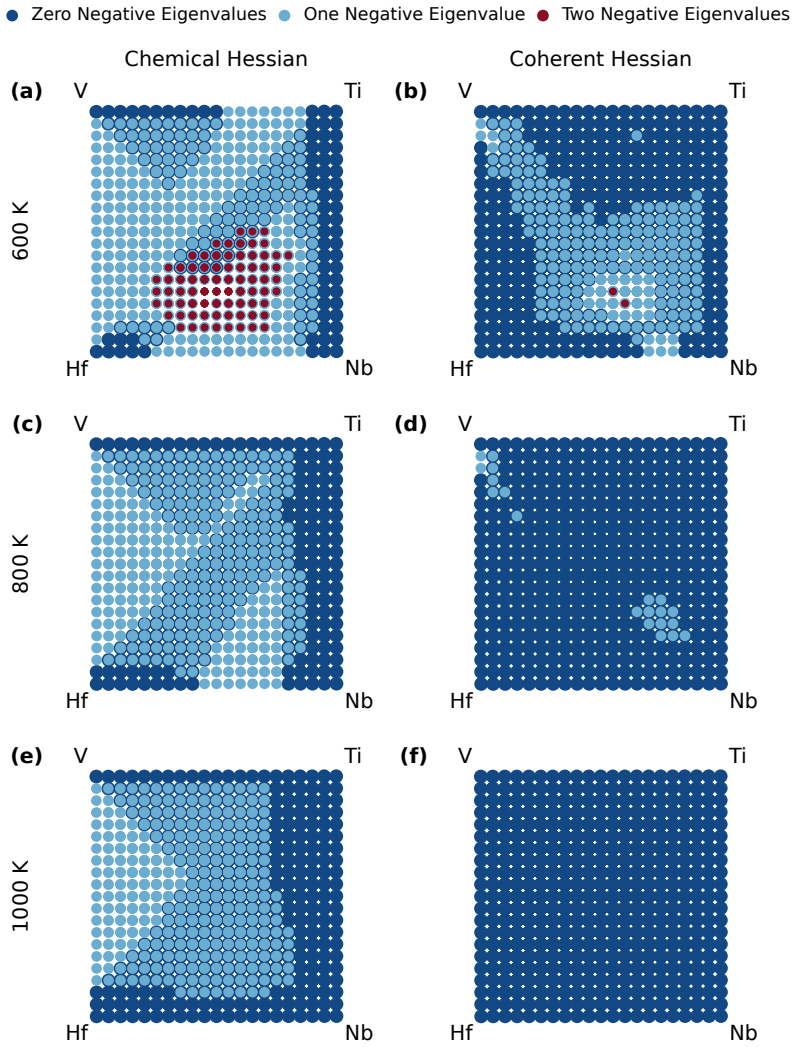
- Coherency strain can close a miscibility gap entirely at symmetric compositions (Nb50V50), so purely chemical spinodal maps overestimate instability in elastically stiff alloys; design maps must include the elastic term.
- Designers can now screen high-dimensional composition spaces for spinodal regions without commercial CALPHAD databases, using affine projections to visualize all instabilities on one 2D plot.
- Hf acts as a dual-action lever in Nb-V-based alloys: it deepens the chemical driving force while raising the coherency penalty, defining a composition window (x_Hf ≤ 0.25) in which spinodal microstructures are accessible.
- The analytic-Hessian phase-field surrogate eliminates finite-difference errors in spinodal wavelength (λ* ∝ |H|^{-1/2}) and stable time-step estimates, making predicted microstructural length scales more trustworthy.
- Three testable quantitative disagreements remain, each traced to a specific input: Hf partitioning, coherency misfit, and the Zener-anisotropy-driven modulation direction.
Reading between the lines
- If the Zener-anisotropy inversion is confirmed by DFT (A_Z > 1 at the tie-line matrix composition), Ti content becomes a design control for switching spinodal morphology between <110> lamellae and <100> basket patterns in refractory high-entropy alloys.
- Fine-tuning the universal potential on BCC Hf and Ti, or adding temperature-dependent elastic corrections from short molecular-dynamics runs, would likely bring the misfit and modulation-direction predictions into agreement without changing the framework's architecture.
- The same Hessian machinery could be extended to third-order derivatives via second-order Jansson derivatives, enabling analytic critical-point (consolute) searches in high-dimensional composition spaces.
- Because the workflow is open-source and whitebox, it invites inversion: instead of screening compositions for a given microstructure, one could optimize composition directly against coherent-Hessian eigenvalues as a target property.
Editorial analysis
A structured set of objections, weighed in public.
Referee Report
Summary. Kunselman et al. present an open-source workflow for predicting spinodal decomposition in multicomponent alloys. The workflow (i) constructs CALPHAD Gibbs-energy models from ORB-v2 MLIP SQS energies via PhaseForge; (ii) computes analytic Gibbs-energy Hessians using Jansson derivatives; (iii) adds a Cahn-type coherency correction using MLIP bond lengths and cubic elastic constants; (iv) visualizes stability via affine projections; and (v) feeds the CALPHAD model and elastic data into a surrogate-based elasto-chemical Cahn-Hilliard phase-field solver. The method is demonstrated on BCC Hf-Nb-Ti-V, progressing from binary Nb-V to the equiatomic quaternary, with comparison to the experiments of An et al. The authors report agreement in phase fraction (~1/3) and modulation wavelength (50-100 nm), while acknowledging discrepancies in Hf partitioning, coherency misfit (8.7% vs 1.6%/0.54%), and modulation direction (<100> vs <110>).
Significance. The paper's main strengths are the open-source implementation, the clear exposition of gauge-invariant Hessian analysis, and the use of analytic Jansson derivatives to sidestep finite-difference Hessian errors. The MLIP-to-CALPHAD coupling and the coherency-strain augmentation address a real gap in high-throughput spinodal design. If the method were quantitatively validated, it would be a useful tool for refractory multi-principal-element alloys. However, the decisive quaternary validation currently fails on the very quantities that the new coherency physics controls, and the surrogate 'exactness' demonstration is circular. The significance as a predictive design tool is therefore not yet established; the paper is more convincing as a methodological framework with an honest stress test.
major comments (4)
- [Sec. 2.3.5, Fig. 1, Table 1] The RMSE=0 result for Jansson/hybrid is circular. The 'CALPHAD data' markers are the same stored points used to construct the G, μ, and Jansson-derivative surrogates; any interpolant that passes through its training data yields zero error at those points by construction. This validates interpolation consistency, not derivative accuracy at off-grid compositions. Since the phase-field simulations (Eqs. 24-25) evaluate the surrogates at arbitrary grid points, the claim that the Jansson mode 'eliminates' derivative error needs a held-out or analytic-derivative comparison. Without it, the surrogate error budget for the phase-field results is unknown.
- [Sec. 3.4, Table 6, Eq. (16)] All three quantities controlled by the Cahn coherency correction disagree with experiment in the quaternary: coherency misfit 8.7% vs 1.6% (XRD)/0.54% (TEM), Zener ratio A_Z=1.52 predicting <100> modulation vs observed <110>, and Hf partitioned to the matrix instead of the precipitate. Section 3.4 explicitly states that the SQS/ORB-MLIP elastic constants 'have not been validated against DFT or experimental measurements for the specific quaternary compositions predicted by the CALPHAD tie-line.' Since these inputs enter the coherent Hessian, the stability maps (Fig. 3), eigenvalue curves (Fig. 4), and phase-field morphologies (Fig. 7) all shift with this unvalidated input. The central predictive claim is therefore unsupported at the decisive validation point; independent DFT validation of lattice parameters and elastic constants, or a substantial softening of the predictive claims, is req
- [Sec. 2.3.1, Figs. 5-7] The gradient-energy coefficients κ_i and mobilities M_ij are input parameters set to round numbers (e.g., κ=1e-12 J m^2/mol, M=5e-21 m^5 J^-1 s^-1) without calibration or sensitivity analysis. The predicted modulation wavelength scales as λ*=4π√(κ/|H|), so the reported 50-100 nm agreement depends directly on the arbitrary κ value. The phase-field morphology comparison therefore does not independently validate the thermodynamic/elastic model unless the sensitivity of the results to κ and M is quantified.
- [Sec. 3.4] The comparison is made between 500 °C equilibrium simulations and an as-cast experimental alloy. The paper attributes the Hf partitioning and possibly other discrepancies to non-equilibrium solidification, but this explanation is not tested. If the as-cast microstructure is not equilibrated at 500 °C, the partial agreement in phase fraction and wavelength may be partially fortuitous, and the disagreements do not cleanly test the model. A controlled isothermal-aging experiment or a solidification-aware initial condition would be needed to make the validation well-posed.
minor comments (6)
- [Table 1] The row entries list three numerical RMSE values (e.g., 302, 442, 219) but the header has only two RMSE columns (RMSE μ, RMSE H). Clarify the third quantity or correct the table.
- [Eq. (14)] The symbols C11, C12, C44 are used before being introduced; define the elastic constants at first use.
- [Eq. (29)] The stable time step uses |λ_max(H)| evaluated 'in a neighborhood of x0'; for a spinodal system the Hessian eigenvalues vary strongly with composition. State the precise sampling or use a global bound.
- [Fig. 8] The three composition paths are not fully specified; state the paths explicitly in the caption (e.g., exactly which compositions vary for each curve).
- [Sec. 2.3.2] The unconditional-stability claim for Eq. (33) is based on a local quadratic convex splitting with A_i taken at x0; off-diagonal bulk terms are explicit, so the scheme is not proven unconditionally stable in the global nonlinear setting. Rephrase as 'linearly stable' or provide a global construction.
- [Minor typographical issues] 'V oigt-Reuss-Hill' in Section 2.2, 'Anet al.' spacing throughout, and 'T emperature' in Figure 4 axis label should be corrected.
Circularity Check
RMSE=0 'validation' of the Jansson Hessian reduces by construction; the central spinodal/microstructure predictions remain independent and are openly tested against experiment.
-
fitted input called prediction
[Section 2.3.5, Fig. 1 and Table 1 (surrogate construction in Section 2.3.3)]
"Panel (b) shows the relative chemical potential µNb−µV: the fd mode deviates visibly from the CALPHAD reference (RMSE=302 J mol−1) while jansson and hybrid reproduce the stored values exactly (RMSE=0 J mol−1). Panel (c) ... the fd mode yields an RMSE of 442 kJ mol−1 relative to the CALPHAD reference, entirely due to truncation error amplification near the simplex boundaries, whereas jansson matches exactly."
Section 2.3.3 states that at each grid point the molar Gibbs energy, chemical potentials, and Jansson second derivatives are evaluated once with PyCalphad and 'stored in a structured HDF5 file'; these same stored values are then plotted as the 'CALPHAD reference' in Fig. 1/Table 1. The jansson/hybrid modes are interpolants (Clough-Tocher, RBF) built on exactly those grid points, so they reproduce the reference values at the nodes by construction. RMSE=0 therefore demonstrates interpolation self-consistency, not accuracy of the analytic Hessian or of the underlying MLIP/CALPHAD model. No independent reference outside the fitted data is used; the claim 'jansson matches exactly' restates how the surrogate was built.
full rationale
The main prediction chain — ORB-v2/SQS formation energies, PhaseForge CALPHAD TDB, Hessian eigenanalysis, coherent Cahn correction, Cahn-Hilliard phase field — is not circular: the spinodal maps and morphologies are model outputs compared against the experiments of An et al., not quantities fitted to those experiments. The paper explicitly reports three failures (Hf partitioned to matrix instead of precipitate; misfit overpredicted 8.7% vs 1.6%/0.54%; AZ=1.52 predicting <100> instead of observed <110>) and states in Section 3.4 that the SQS/ORB-MLIP elastic constants 'have not been validated against DFT or experimental measurements for the specific quaternary compositions predicted by the CALPHAD tie-line.' That is an acknowledged validation gap and a correctness risk, not circularity. The workflow leans heavily on the authors' own prior tools (Jansson [15], PhaseForge [16], MaterialsFramework [19], MLIP-CALPHAD benchmarks [22,23]), but these are open-source methods/benchmarks and no uniqueness or ansatz is smuggled in through them. The single genuine circularity is the RMSE=0 validation in Fig. 1/Table 1, where the 'CALPHAD reference' is identical to the data used to build the Jansson surrogates. This supports a score of 4 rather than 0 or 2: one constructed validation plus heavily self-cited infrastructure, while the central materials prediction retains independent content.
Assumptions & free parameters
free parameters (5)
- Redlich-Kister interaction parameters L^(ν)_A,B and ternary interaction parameters =
not reported; least-squares fitted to MLIP/SQS formation energies
- gradient energy coefficients κ_i =
κ = 1×10^-12 J m^2/mol in the reported simulations
- bare mobility coefficients M̊_ij =
5×10^-21 m^5 J^-1 s^-1 for Nb/V; Hf mobility roughly 10× lower
- composition-vector regularization offset =
1×10^-4
- convex-splitting stabilization constant A_i =
A_i ≥ max(0, -H_ii(x0))
assumptions (6)
- domain assumption SQS supercells faithfully represent random solid-solution thermodynamics across the composition space
- domain assumption ORB v2 universal MLIP gives accurate formation energies, lattice parameters, and elastic constants for BCC Hf-Nb-Ti-V, including metastable BCC Hf and Ti
- domain assumption CALPHAD/CEF formalism with SGTE unary data and ideal configurational entropy captures thermal contributions
- domain assumption Jansson derivative method correctly computes analytic partial derivatives of PyCalphad equilibrium chemical potentials
- domain assumption Cahn coherency-strain correction with cubic Y and bond-based Vegard-type lattice-parameter derivatives applies to the BCC phase
- domain assumption Phase-field gradient-energy and mobility parameters are sufficient and transferable for morphology prediction
Cite this review
Pith. "Pith review of From MLIPs to Microstructure: A High-Throughput Computational Framework to Design Spinodal Alloys in High-Dimensional Composition Spaces via Analytic Derivatives of CALPHAD Model Predictions." pith.science (2026). https://pith.science/paper/7RB5SVMI
@misc{pith2026260720077,
  author       = {Pith},
  title        = {Pith review of: From MLIPs to Microstructure: A High-Throughput Computational Framework to Design Spinodal Alloys in High-Dimensional Composition Spaces via Analytic Derivatives of CALPHAD Model Predictions},
  year         = {2026},
  howpublished = {\url{https://pith.science/paper/7RB5SVMI}},
  note         = {Machine review of arXiv:2607.20077}
}
read the original abstract
Identifying regions of design space subject to spinodal decomposition is a critical component of alloy design in high-dimensional composition spaces. In cases where designers are seeking to exploit spinodal microstructures to tailor alloy properties, prediction of microstructure evolution and morphology is also needed. In this work, we present a Machine Learning Interatomic Potential (MLIP)-trained, CALPHAD-based, open-source workflow for high-throughput microstructure stability analysis and visualization. In this workflow, coherent strain contributions are captured via high-throughput MLIP elastic constant calculations. To predict microstructure morphology for compositions of interest, MLIP-generated thermodynamic models are fed into an elasto-chemical phase field simulation. Both stability analyses and phase-field simulations utilize analytically-derived Gibbs energy Hessians to improve computational efficiency and accuracy over finite difference approximations. We demonstrate this workflow by investigating microstructure stability in the Hf-Nb-Ti-V quaternary system.
Figures


Figures from the paper (5 more)


Reference graph
Works this paper leans on
-
[1]
J. W. Cahn, On spinodal decomposition, Acta Metallur- gica 9 (9) (1961) 795–801
1961
-
[2]
S. Wang, J. Wang, D. Shu, P. Shi, M. Wu, D. Wang, C. Yang, G. Zhu, B. Sun, Spinodal decomposition in- duced brittleness of Zr-Ta containing medium-entropy al- loys, Materials Characterization 205 (2023) 113330
2023
-
[3]
Dasari, A
S. Dasari, A. Sharma, V . Soni, Z. Kloenne, H. Fraser, R. Banerjee, Crystallographic and compositional evolu- tion of ordered B2 and disordered BCC phases during isothermal annealing of refractory high-entropy alloys, Microscopy and Microanalysis 29 (1) (2023) 303–313
2023
-
[4]
Z. An, S. Mao, T. Yang, C. T. Liu, B. Zhang, E. Ma, H. Zhou, Z. Zhang, L. Wang, X. Han, Spinodal-modulated solid solution delivers a strong and ductile refractory high- entropy alloy, Materials Horizons 8 (3) (2021) 948–955
2021
-
[5]
S. W. Lee, H. Park, R. E. Kim, J. Kim, D. W. Lee, J. H. Lee, S. I. Hong, H.-S. Jang, Y .-U. Heo, H. S. Kim, Spinodal-assisted multiscale immiscibility enables supe- rior strength–ductility synergy in (CuFeMnNi) 96Al2Ti2 high-entropy alloy, Materials Science and Engineering: A (2025) 149582
2025
-
[6]
Zhang, Z
W. Zhang, Z. Ma, H. Zhao, L. Ren, Refinement strengthening, second phase strengthening and spinodal microstructure-induced strength-ductility trade-offin a high-entropy alloy, Materials Science and Engineering: A 847 (2022) 143343
2022
-
[7]
Z. Rao, B. Dutta, F. Körmann, W. Lu, X. Zhou, C. Liu, A. K. da Silva, U. Wiedwald, M. Spasova, M. Farle, et al., Beyond solid solution high-entropy alloys: tailoring mag- netic properties via spinodal decomposition, Advanced Functional Materials 31 (7) (2021) 2007668
2021
-
[8]
P. Dong, L. Zhang, L. Huang, Q. Yang, L. Li, L. Ma, Z. Zhong, J. Li, Cooperative regulation of mechanical properties and magnetoresistance effect in high-entropy alloys by spinodal decomposition, Journal of Alloys and Compounds 970 (2024) 172547
2024
Show all 50 references
-
[9]
S. Duan, X. Bao, J. Huang, R. Shi, L. Fei, W. Xue, H. Yao, X. Li, J. Wang, X. Liu, et al., Spinodal decomposition pro- moting high thermoelectric performance in half-Heusler, Joule 9 (4) (2025)
2025
-
[10]
Usanmaz, P
D. Usanmaz, P. Nath, J. J. Plata, G. L. Hart, I. Takeuchi, M. B. Nardelli, M. Fornari, S. Curtarolo, First principles thermodynamical modeling of the binodal and spinodal curves in lead chalcogenides, Physical Chemistry Chemi- cal Physics 18 (6) (2016) 5005–5011
2016
-
[11]
Divilov, H
S. Divilov, H. Eckert, C. Toher, R. Friedrich, A. C. Zettel, D. W. Brenner, W. G. Fahrenholtz, D. E. Wolfe, E. Zurek, J.-P. Maria, et al., A priori procedure to establish spin- odal decomposition in alloys, Acta Materialia 266 (2024) 119667
2024
-
[12]
S. R. Koneru, K. Kadirvel, Y . Wang, High-throughput de- sign of multi-principal element alloys with spinodal de- composition assisted microstructures, Journal of Phase Equilibria and Diffusion 43 (6) (2022) 753–763
2022
-
[13]
Kadirvel, S
K. Kadirvel, S. R. Koneru, Y . Wang, Exploration of spinodal decomposition in multi-principal element alloys (MPEAs) using CALPHAD modeling, Scripta Materialia 214 (2022) 114657
2022
-
[14]
Cao, S.-L
W. Cao, S.-L. Chen, F. Zhang, K. Wu, Y . Yang, Y . Chang, R. Schmid-Fetzer, W. Oates, PANDAT software with Pa- nEngine, PanOptimizer and PanPrecipitation for multi- component phase diagram calculation and materials prop- erty simulation, Calphad 33 (2) (2009) 328–342. 17
2009
-
[15]
Kunselman, B
C. Kunselman, B. Bocklund, A. van de Walle, R. Otis, R. Arróyave, Analytically differentiable metrics for phase stability, Calphad 86 (2024) 102705
2024
-
[16]
Sarıtürk, S
D. Sarıtürk, S. Zhu, R. Arróyave, PhaseForge (Jun. 2025). doi:10.5281/zenodo.15730911
2025 doi
-
[17]
J. W. Cahn, Coherent fluctuations and nucleation in isotropic solids, Acta Metallurgica 10 (10) (1962) 907– 913
1962
-
[18]
B. Vela, T. Hastings, M. Allen, R. Arróyave, Visualizing high entropy alloy spaces: methods and best practices, Digital Discovery 4 (1) (2025) 181–194
2025
-
[19]
Sarıtürk, R
D. Sarıtürk, R. Arróyave, MaterialsFramework (Jun. 2025).doi:10.5281/zenodo.15731044
2025 doi
-
[20]
Kunselman, S
C. Kunselman, S. Zhu, D. Sarıtürk, R. Arróyave, Construction and Tuning of CALPHAD Models Using Machine-Learned Interatomic Potentials and Experimen- tal Data: A Case Study of the Pt–W System, Journal of Phase Equilibria and Diffusion (2025) 1–9
2025
-
[21]
Bocklund, R
B. Bocklund, R. Otis, A. Egorov, A. Obaied, I. Roslyakova, Z.-K. Liu, ESPEI for efficient ther- modynamic database development, modification, and uncertainty quantification: application to Cu–Mg, MRS Communications 9 (2) (2019) 618–627
2019
-
[22]
S. Zhu, D. Sarıtürk, R. Arróyave, Accelerating CALPHAD-based phase diagram predictions in complex alloys using universal machine learning potentials: Opportunities and challenges, Acta Materialia 286 (2025) 120747
2025
-
[23]
S. Zhu, D. Sarıtürk, R. Arróyave, Machine learning poten- tials for alloys: a detailed workflow to predict phase dia- grams and benchmark accuracy, npj Computational Mate- rials 11 (2025) 340
2025
-
[24]
Zunger, S.-H
A. Zunger, S.-H. Wei, L. G. Ferreira, J. E. Bernard, Special quasirandom structures, Physical Review Letters 65 (3) (1990) 353–356
1990
-
[25]
van de Walle, M
A. van de Walle, M. Asta, G. Ceder, The alloy theoretic automated toolkit: A user guide, Calphad 26 (4) (2002) 539–553
2002
-
[26]
A. T. Dinsdale, SGTE data for pure elements, Calphad 15 (4) (1991) 317–425
1991
-
[27]
Neumann, J
M. Neumann, J. Gin, B. Rhodes, S. Bennett, Z. Li, H. Choubisa, A. Hussey, J. Godwin, Orb: A Fast, Scalable Neural Network Potential (2024).arXiv:2410.22570
2024 arXiv
-
[28]
B. Deng, P. Zhong, K. Jun, J. Riebesell, K. Han, C. J. Bar- tel, G. Ceder, CHGNet: Pretrained Universal Neural Net- work Potential for Charge-Informed Atomistic Modeling (2023).arXiv:2302.14231
2023 arXiv
-
[29]
Schmidt, N
J. Schmidt, N. Hoffmann, H.-C. Wang, P. Borlido, P. J. M. A. Carriço, T. F. T. Cerqueira, S. Botti, M. A. L. Marques, Machine-Learning-Assisted Determination of the Global Zero-Temperature Phase Diagram of Materi- als, Advanced Materials (2023).doi:10.1002/adma. 202210788
2023 doi
-
[30]
Otis, Z.-K
R. Otis, Z.-K. Liu, pycalphad: CALPHAD-based Compu- tational Thermodynamics in Python, in: Zentropy, Jenny Stanford Publishing, 2017, pp. 373–392
2017
-
[31]
J. W. Gibbs, On the equilibrium of heterogeneous sub- stances, American Journal of Science 3 (96) (1878) 441– 458
-
[32]
De Fontaine, A computer simulation of the evolution of coherent composition variations in solid solutions, Ph.D
D. De Fontaine, A computer simulation of the evolution of coherent composition variations in solid solutions, Ph.D. thesis, Northwestern University (1967)
1967
-
[33]
De Fontaine, An analysis of clustering and ordering in multicomponent solid solutions-I
D. De Fontaine, An analysis of clustering and ordering in multicomponent solid solutions-I. Stability criteria, Jour- nal of Physics and Chemistry of Solids 33 (2) (1972) 297– 310
1972
-
[34]
J. E. Morral, S. Chen, Stability of high entropy alloys to spinodal decomposition, Journal of Phase Equilibria and Diffusion 42 (5) (2021) 673–695
2021
-
[35]
Singh, A
P. Singh, A. V . Smirnov, D. D. Johnson, Atomic short- range order and incipient long-range order in high-entropy alloys, Physical Review B 91 (22) (2015) 224204
2015
-
[36]
D. De Fontaine, An analysis of clustering and ordering in multicomponent solid solutions—II fluctuations and ki- netics, Journal of Physics and Chemistry of Solids 34 (8) (1973) 1285–1304
1973
-
[37]
Tandoc, L
C. Tandoc, L. Qi, Y .-J. Hu, A bond-based model for accu- rate prediction of lattice parameters of bcc solid solution alloys, Materialia 40 (2025) 102410
2025
-
[38]
J. W. Cahn, J. E. Hilliard, Free energy of a nonuniform system. i. interfacial free energy, The Journal of chemical physics 28 (2) (1958) 258–267
1958
-
[39]
L. Q. Chen, J. Shen, Applications of semi-implicit fourier-spectral method to phase field equations, Com- puter Physics Communications 108 (2-3) (1998) 147–158
1998
-
[40]
D. J. Eyre, Unconditionally gradient stable time march- ing the cahn-hilliard equation, MRS online proceedings library (OPL) 529 (1998) 39
1998
-
[41]
J. Shen, X. Yang, Numerical approximations of allen-cahn and cahn-hilliard equations, Discrete Contin. Dyn. Syst 28 (4) (2010) 1669–1691
2010
-
[42]
R. W. Clough, Finite element stiffness matricess for analy- sis of plate bending, in: Proc. of the First Conf. on Matrix Methods in Struct. Mech., 1965, pp. 515–546. 18
1965
-
[43]
Virtanen, R
P. Virtanen, R. Gommers, T. E. Oliphant, M. Haber- land, T. Reddy, D. Cournapeau, E. Burovski, P. Peterson, W. Weckesser, J. Bright, et al., Scipy 1.0: fundamental al- gorithms for scientific computing in python, Nature meth- ods 17 (3) (2020) 261–272
2020
-
[44]
De Fontaine, Configurational thermodynamics of solid solutions, Solid state physics 34 (1979) 73–274
D. De Fontaine, Configurational thermodynamics of solid solutions, Solid state physics 34 (1979) 73–274
1979
-
[45]
Gururajan, T
M. Gururajan, T. Abinandanan, Phase field study of pre- cipitate rafting under a uniaxial stress, Acta Materialia 55 (15) (2007) 5015–5026
2007
-
[46]
Moulinec, P
H. Moulinec, P. Suquet, A numerical method for com- puting the overall response of nonlinear composites with complex microstructure, Computer methods in applied mechanics and engineering 157 (1-2) (1998) 69–94
1998
-
[47]
W. B. Pearson, A handbook of lattice spacings and struc- tures of metals and alloys: International series of mono- graphs on metal physics and physical metallurgy, V ol. 4, V ol. 4, Elsevier, 2013
2013
-
[48]
De Jong, W
M. De Jong, W. Chen, T. Angsten, A. Jain, R. Notes- tine, A. Gamst, M. Sluiter, C. Krishna Ande, S. Van Der Zwaag, J. J. Plata, et al., Charting the complete elastic properties of inorganic crystalline compounds, Scientific data 2 (1) (2015) 150009
2015
-
[49]
Söderlind, O
P. Söderlind, O. Eriksson, J. Wills, A. Boring, Theory of elastic constants of cubic transition metals and alloys, Physical Review B 48 (9) (1993) 5844
1993
-
[50]
Ikeda, B
Y . Ikeda, B. Grabowski, F. Körmann, Ab initio phase sta- bilities and mechanical properties of multicomponent al- loys: A comprehensive review for high entropy alloys and compositionally complex alloys, Materials Characteriza- tion 147 (2019) 464–511. 19
2019
Reviewed August 1, 2026 · model on record in the stance chip above.
Discussion (0). Continue with ORCID to comment.