REVIEW 3 major objections 6 minor 53 references
Automation of a Matching On-Shell Calculator
T0 review · 3 major / 6 minor · reviewed 2026-08-07 · deepseek-v4-flash
Pith's one-line read The paper introduces mosca, a package that automates the reduction of redundant effective-field-theory operator bases to physical bases by computing tree-level on-shell amplitudes in two equivalent Lagrangians and solving for the…
desk verdict A genuinely useful Mathematica package for automating on-shell basis reduction, with an overstated headline guarantee for RedBasis and a thin validation layer. read the letter →
The pith
A machine-rendered reading of the paper's core claim, the machinery that carries it, and where it could break.
The reading
What carries the argument
The load-bearing object is the diagrammatic on-shell matching equation: for each process, the physical amplitude computed from model1 is set equal to the amplitude computed from model2 after replacing bare masses with physical masses and multiplying by the wavefunction factors required by LSZ reduction. The named functions that carry this out are PropagatorAttributes (two-point attributes), AmplitudeMatching and MassReduction (per-process coefficient solutions), SolvePerturbative (order-by-order solution in $1/\Lambda$), and RedBasis (process-list generation, iteration, and assembly). The exactness of the numerical step comes from rational kinematics produced by a momentum-twistor construction, with symbolic masses kept independent, and isomorphism detection works on graph topologies via canonical forms and double cosets $H g A_0$, so only permutation-inequivalent diagrams are computed.
What would settle it
Take a dimension-six Green's basis for the standard-model EFT with a known physical basis, run RedBasis to order six, and compare with the field-redefinition reduction computed independently; the central claim fails if any physical coefficient still contains Green's-basis Wilson coefficients after all processes are processed, or if any coefficient disagrees with the independent reduction. A smaller version of the same test is to rerun the paper's six-operator example with a redundant operator's Wilson coefficient shifted by a known field-redefinition-invariant amount and check that the returned redefinition shifts exactly as the equivalence principle requires.
Extended reading notes
Core claim
On the paper's own terms, the discovery is that the on-shell matching algorithm, originally developed for matching a UV model to its EFT, can be repurposed as a basis-reduction engine. Two Lagrangians are equivalent at the level of physics when a local field redefinition transforms one into the other, and such equivalence implies equal tree-level S-matrix elements. mosca exploits this by computing physical masses, wavefunction factors, and modified propagators from each model's two-point functions; generating connected amputated on-shell amplitudes for a list of processes in both models; evaluating those amplitudes at random rational kinematic points; and solving the resulting equations order by order in $1/\Lambda$. The paper demonstrates the full reduction of a six-operator model containing scalar, fermion, and vector fields, with all five Wilson coefficients of the physical Lagrangian determined in terms of the Green's-basis coefficients, and it presents the algorithm as the core of the RedBasis function.
Load-bearing premise
The load-bearing premise is that the finite list of processes mosca chooses, together with the random rational kinematic points it evaluates, is enough to determine every Wilson coefficient of model2 uniquely up to the target EFT order; the paper shows examples but does not prove this completeness, and it notes cases where a returned coefficient still mixes WCs from both models.
Editorial extensions
If this is right
- RedBasis returns the Wilson-coefficient redefinition for any pair of same-theory Lagrangians related by a local field redefinition, up to the specified EFT order.
- Basis reduction via on-shell matching is exact order by order in $1/\Lambda$, unlike naive equations-of-motion replacement, which the paper cites as only an approximation beyond linear order.
- One amplitude can solve several coefficients at once, and the extra amplitude equations serve as built-in consistency checks.
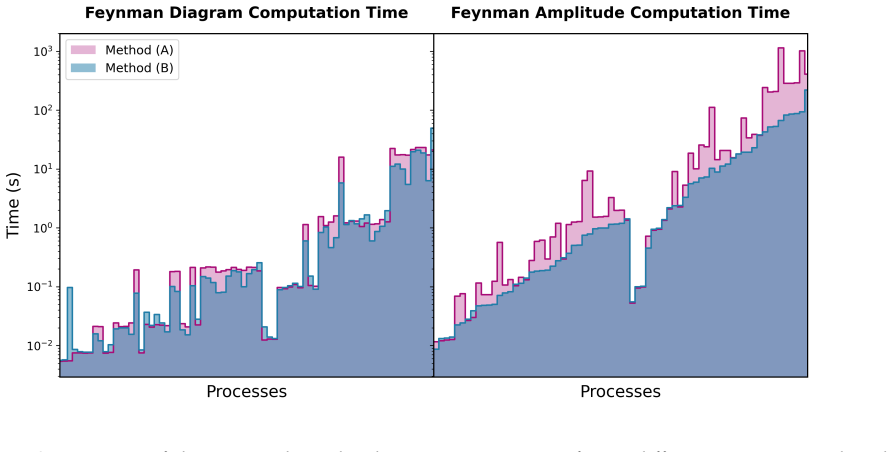
- Identifying isomorphic topologies before inserting fields reduces the number of amplitudes that must be computed, making some 76-process SMEFT calculations feasible where the full diagram set would exhaust memory.
- The automatic computation of physical masses, wavefunction factors, and modified propagators is what makes LSZ-correct on-shell amplitudes possible in an arbitrary redundant basis.
Reading between the lines
- A natural stress test would turn the completeness caveat into a theorem: for a basis with several redundant operators that only mix in high-multiplicity amplitudes, the process-ordering heuristic must provably generate enough independent equations; until then, users should check output for residual model2 coefficients.
- The same code path could be pointed at genuine UV-to-EFT matching without changing the matching equations, since tree-level on-shell matching does not care whether the two Lagrangians differ by a basis choice or by integrated-out heavy fields.
- The rational-kinematics generator is already decoupled from the amplitude machinery, so it could serve other exact numerical evaluations, such as helicity-summed cross-sections, outside basis reduction.
- If the planned one-loop extension succeeds, physical-basis renormalization and finite matching with evanescent contributions would remove the need for Green's bases altogether; that is the paper's outlook, not a demonstrated result.
Editorial analysis
A structured set of objections, weighed in public.
Referee Report
Summary. The paper introduces mosca, a Mathematica package that implements a numerical-exact tree-level on-shell matching procedure for effective field theories, specialized in this initial release to basis transformations and to the reduction of redundant Green's bases to physical bases. The authors describe the main building blocks: computation of 2-point attributes (physical masses, wave-function factors, and modified propagators), amplitude generation with graph-isomorphism-based diagram classification, generation and substitution of rational on-shell kinematics with symbolic masses, and the main function RedBasis, which is advertised as returning Wilson-coefficient redefinitions of one model in terms of another. Worked examples include a scalar model and a scalar-fermion-vector model with redundant operators, together with timing benchmarks for diagram and amplitude construction.
Significance. If the advertised output contract can be made precise, this would be a practically useful and conceptually clean contribution: it automates a step that is otherwise algebraically tedious (removing redundant operators via field redefinitions), and it preserves exactness through rational kinematics. The paper ships the package, models, and example notebooks, and the isomorphism pre-classification is a concrete efficiency improvement. The core idea of using on-shell matching for basis reduction is sound, and the package is one of the first automated implementations of this approach. However, the documented behavior of RedBasis falls short of the stated guarantee unless the caveats in Section 4 are resolved, so the significance of the contribution currently depends on a fix rather than on the manuscript as written.
major comments (3)
- [Section 3.5 / Section 4] The advertised output contract of RedBasis is not what the package is documented to deliver. Section 3.5 states that RedBasis "returns the redefinition of the WCs of model2 in terms of the WCs of model1 up to the dimension fixed by EFTOrder," but Section 4 explicitly says that an AmplitudeMatching output can have the form c1_model2 -> c1_model1 + r_model1 c2_model2, "revealing that the matching procedure was not able to disentangle c2 from c1," and that entries stored in Reduction can have RHSs depending on WCs of both models. The recommended cure is a repeated replacement of the reduction list over itself. Because RedBasis is the end-to-end function presented as the main result, the manuscript must either implement that post-processing automatically and check that no model2 WC remains on any RHS, or restate the weaker guarantee precisely; as written, the central claim is internally inconsistent.
- [Section 3.5 / Section 4] The completeness of the reduction is asserted operationally, not established. The statement that RedBasis "does not stop until it either matches every WC in the model or computes every available process" is not a completeness criterion, because "matched" is not defined as disentangled, and no argument is given that the finite list of automatically generated processes with random rational kinematics spans the space of WC redefinitions up to the target EFT order. The package should expose the solved linear system (or an equivalent algebraic rank test) so that a user can verify that every model2 WC has been eliminated, and it should state what happens when the rank is insufficient. This is especially important because the paper itself documents the need for repeated substitution arising from later-solved WCs.
- [Section 3.5, modelFull -> modelPhys example] The claimed reduction is only validated against the package's own amplitude computations. There is no independent check, for example against a direct field-redefinition calculation following [31,32] or against a known EOM reduction of the same Lagrangian. The message "Number of solved WCs: 5/5" demonstrates internal consistency of the solver, but it does not by itself establish that the mapping is the correct field-redefinition mapping. A comparison with an external calculation for at least one example would materially support the central claim that mosca correctly automates basis reduction.
minor comments (6)
- [Section 1] The displayed spinor-helicity formulas for polarization vectors contain apparent notation errors (for example, `\lambda_\alpha e_{\dot\mu} \sigma_{\alpha\dot\alpha} \lambda_\beta \mu^\beta` mixes the spinor variables and the index structure is incomplete); these formulas should be retyped correctly because they underlie the kinematic substitution routines.
- [Section 2.2] The installation instructions state that a manual edit of FeynArtsInterface.m (`>` replaced by `>=`) is required, while Patch2ptFunction is said to automate the 2-point modification; please clarify which steps remain manual and what happens if a model is generated without the patched interface.
- [Section 3.1] The output in In[11] contains malformed expressions such as `inv\Lambda\Lambda\Lambda2` and the internal symbol `Prop$23001`; the notebook export should be cleaned so that displayed results use the same notation as the text.
- [Section 3.3] In the double-coset discussion following Eq. (3.7), the index `k` in `a(k)_0` is introduced without definition, and the relation `gj = h gi a(k)_0` should be spelled out in words as well as in symbols.
- [Section 3.4] The text says that massive vector kinematic configurations are not supported (vector mass entries must be zero), but the introduction promises independent symbolic masses for each particle; this limitation should be stated in the overview as well.
- [Section 4 / Figure 2] The timing benchmark would be reproducible only with more environment information: Mathematica version, operating system, CPU, and available memory should be reported alongside the absolute timings.
Circularity Check
No significant circularity: the WC reductions are solved from amplitude equalities, not fitted or assumed; the only self-citation ([38]) is not load-bearing because the algorithm and its standard premise are restated in the paper.
full rationale
The derivation chain is self-contained. RedBasis computes tree-level on-shell amplitudes in both models and solves for the model2 Wilson coefficients from the matching equations (Sections 1 and 3.5, e.g. In[39]-In[45]), using SolvePerturbative to solve order by order (Section 3.6). The output reductions are therefore solutions of the equality of physical amplitudes, not quantities that were fitted to the claimed result or defined in terms of it. The citation to [38] for the statement that tree-level on-shell matching relates Lagrangians connected by a local field redefinition is a collaborative self-citation, but the paper itself summarizes the algorithm and the underlying equivalence-of-S-matrix principle, so the citation is not the sole load-bearing support. Section 4 documents a real limitation: an AmplitudeMatching output can be c1model2 -> c1model1 + rmodel1 c2model2, 'revealing that the matching procedure was not able to disentangle c2 from c1', and RedBasis terminates when processes are exhausted rather than when all RHSs are model1-only. This is an advertised-guarantee versus termination-condition gap (a completeness/correctness caveat), not a circular reduction: the solved coefficients still come from amplitude equalities, and the paper tells the user to resolve the remaining coupling by further processes or repeated substitutions. No pattern from the enumerated circularity classes is present, so the score is 1 rather than 0 only to acknowledge the minor self-citation.
Assumptions & free parameters
assumptions (5)
- domain assumption Two Lagrangians related by a local field redefinition produce identical on-shell amplitudes, so equating tree-level amplitudes determines the WC mapping.
- ad hoc to paper The automatically generated process list in RedBasis and the random rational kinematic configurations are sufficient to fully solve for all WCs up to the target EFT order.
- domain assumption The momentum twistor algorithm of [39] with the NumericalKinematics package produces rational, on-shell momenta with symbolic masses, and the spinor/polarization expressions are exact.
- domain assumption Landau gauge can be used for vector propagators without loss of generality for on-shell matching.
- domain assumption FeynArts/FeynCalc correctly generate and evaluate the needed amplitudes for the user-supplied models.
Cite this review
Pith. "Pith review of Automation of a Matching On-Shell Calculator." pith.science (2026). https://pith.science/paper/7SW7GFGJ
@misc{pith2026250521353,
  author       = {Pith},
  title        = {Pith review of: Automation of a Matching On-Shell Calculator},
  year         = {2026},
  howpublished = {\url{https://pith.science/paper/7SW7GFGJ}},
  note         = {Machine review of arXiv:2505.21353}
}
abstract
We introduce $\texttt{mosca}$, a $\texttt{Mathematica}$ package designed to facilitate on-shell calculations in effective field theories (EFTs). This initial release focuses on the reduction of Green's bases to physical bases, as well as transformations between arbitrary operator bases. The core of the package is based on a diagrammatic on-shell matching procedure, grounded in the equivalence of physical observables derived from both redundant and non-redundant Lagrangians. $\texttt{mosca}$ offers a complete set of tools for performing basis transformations, diagram isomorphism detection, numerical substitution of kinematic configurations, and symbolic manipulation of algebraic expressions. Planned future developments include extension to one-loop computations, thus providing support for EFT renormalization directly in a physical basis and automated computation of one-loop finite matching, including contributions from evanescent operators. The package, along with example notebooks and documentation, is available at: https://gitlab.com/matchingonshell/mosca.
Figures

Reference graph
Works this paper leans on
-
[38]
Mikael Chala et al. Efficient on-shell matching. 2024. arXiv: 2411.12798 [hep-ph]. url: https://arxiv. org/abs/2411.12798
arXiv 2024
-
[1]
A Monte Carlo global analysis of the Standard Model Effective Field The- ory: the top quark sector
Nathan P . Hartland et al. “A Monte Carlo global analysis of the Standard Model Effective Field The- ory: the top quark sector”. JHEP 04 (2019), 100. doi: 10.1007/JHEP04(2019)100 . arXiv: 1901.05965 [hep-ph]
arXiv 2019
-
[2]
The impact of flavour data on global fits of the MFV SMEFT
Rafael Aoude et al. “The impact of flavour data on global fits of the MFV SMEFT”. JHEP 12 (2020), 113. doi: 10.1007/JHEP12(2020)113. arXiv: 2003.05432 [hep-ph]
arXiv 2020
-
[3]
Putting standard model EFT fits to work
Sally Dawson, Samuel Homiller, and Samuel D. Lane. “Putting standard model EFT fits to work”. Phys. Rev. D 102.5 (2020), 055012. doi: 10.1103/PhysRevD.102.055012. arXiv: 2007.01296 [hep-ph]
arXiv 2020
-
[4]
Connecting electroweak-scale observables to BSM physics through EFT and Bayesian statistics
Anisha et al. “Connecting electroweak-scale observables to BSM physics through EFT and Bayesian statistics”. Phys. Rev. D 103.7 (2021), 076007. doi: 10.1103/PhysRevD.103.076007 . arXiv: 2010.04088 [hep-ph]
arXiv 2021
-
[5]
Comprehensive analysis of beta decays within and beyond the Standard Model
Adam Falkowski, Martín González-Alonso, and Oscar Naviliat-Cuncic. “Comprehensive analysis of beta decays within and beyond the Standard Model”. JHEP 04 (2021), 126. doi: 10.1007/JHEP04(2021)
-
[6]
Top, Higgs, Diboson and Electroweak Fit to the Standard Model Effective Field The- ory
John Ellis et al. “Top, Higgs, Diboson and Electroweak Fit to the Standard Model Effective Field The- ory”. JHEP 04 (2021), 279. doi: 10.1007/JHEP04(2021)279. arXiv: 2012.02779 [hep-ph]
arXiv 2021
-
[7]
Combined SMEFT interpretation of Higgs, diboson, and top quark data from the LHC
Jacob J. Ethier et al. “Combined SMEFT interpretation of Higgs, diboson, and top quark data from the LHC”. JHEP 11 (2021), 089. doi: 10.1007/JHEP11(2021)089. arXiv: 2105.00006 [hep-ph]
arXiv 2021
Show all 53 references
-
[8]
Global SMEFT Fits at Future Colliders
Jorge de Blas et al. “Global SMEFT Fits at Future Colliders”. Snowmass 2021. June 2022. arXiv: 2206. 08326 [hep-ph]
2021
-
[9]
Dimension-Six Terms in the Standard Model Lagrangian
B. Grzadkowski et al. “Dimension-Six Terms in the Standard Model Lagrangian”. JHEP 10 (2010), 085. doi: 10.1007/JHEP10(2010)085. arXiv: 1008.4884 [hep-ph]
2010 arXiv
-
[10]
Heavy Majorana Neutrinos in the Effective Lagrangian Description: Appli- cation to Hadron Colliders
Francisco del Aguila et al. “Heavy Majorana Neutrinos in the Effective Lagrangian Description: Appli- cation to Hadron Colliders”. Phys. Lett. B 670 (2009), 399–402. doi: 10.1016/j.physletb.2008.11.031. arXiv: 0806.0876 [hep-ph]. 36
2009 arXiv
-
[11]
Right-handed neutrino magnetic moments
Alberto Aparici et al. “Right-handed neutrino magnetic moments”. Phys. Rev. D 80 (2009), 013010. doi: 10.1103/PhysRevD.80.013010. arXiv: 0904.3244 [hep-ph]
2009 arXiv
-
[12]
Dimension-seven operators in the standard model with right handed neutrinos
Subhaditya Bhattacharya and José Wudka. “Dimension-seven operators in the standard model with right handed neutrinos”. Phys. Rev. D 94.5 (2016). [Erratum: Phys.Rev.D 95, 039904 (2017)], 055022. doi: 10.1103/PhysRevD.94.055022. arXiv: 1505.05264 [hep-ph]
2016 arXiv
-
[13]
Operators up to Dimension Seven in Standard Model Effective Field Theory Extended with Sterile Neutrinos
Yi Liao and Xiao-Dong Ma. “Operators up to Dimension Seven in Standard Model Effective Field Theory Extended with Sterile Neutrinos”. Phys. Rev. D 96.1 (2017), 015012. doi: 10.1103/PhysRevD. 96.015012. arXiv: 1612.04527 [hep-ph]
2017 arXiv
-
[14]
wilson: A package for renormalization group running in the SMEFT with Sterile Neutrinos
Jason Aebischer, Tejhas Kapoor, and Jacky Kumar. “wilson: A package for renormalization group running in the SMEFT with Sterile Neutrinos” (Nov. 2024). arXiv: 2411.07220 [hep-ph]
2024 arXiv
-
[15]
Low-Energy Effective Field Theory below the Electroweak Scale: Operators and Matching
Elizabeth E. Jenkins, Aneesh V . Manohar, and Peter Stoffer. “Low-Energy Effective Field Theory below the Electroweak Scale: Operators and Matching”. JHEP 03 (2018), 016. doi: 10.1007/JHEP03(2018)016. arXiv: 1709.04486 [hep-ph]
2018 arXiv
-
[16]
General neutrino interactions from an effective field theory perspective
Ingolf Bischer and Werner Rodejohann. “General neutrino interactions from an effective field theory perspective”. Nucl. Phys. B 947 (2019), 114746. doi: 10.1016/j.nuclphysb.2019.114746 . arXiv: 1905. 08699 [hep-ph]
2019
-
[17]
One-loop matching in the SMEFT extended with a sterile neutrino
Mikael Chala and Arsenii Titov. “One-loop matching in the SMEFT extended with a sterile neutrino”. JHEP 05 (2020), 139. doi: 10.1007/JHEP05(2020)139. arXiv: 2001.07732 [hep-ph]
2020 arXiv
-
[18]
General neutrino interactions with sterile neutrinos in light of coherent neutrino-nucleus scattering and meson invisible decays
Tong Li, Xiao-Dong Ma, and Michael A. Schmidt. “General neutrino interactions with sterile neutrinos in light of coherent neutrino-nucleus scattering and meson invisible decays”. JHEP 07 (2020), 152. doi: 10.1007/JHEP07(2020)152. arXiv: 2005.01543 [hep-ph]
2020 arXiv
-
[19]
Constraints on the charged currents in general neutrino interactions with sterile neutrinos
Tong Li, Xiao-Dong Ma, and Michael A. Schmidt. “Constraints on the charged currents in general neutrino interactions with sterile neutrinos”. JHEP 10 (2020), 115. doi: 10 . 1007 / JHEP10(2020 ) 115. arXiv: 2007.15408 [hep-ph]
2020 arXiv
-
[20]
An operator basis for the Standard Model with an added scalar singlet
Ben Gripaios and Dave Sutherland. “An operator basis for the Standard Model with an added scalar singlet”. JHEP 08 (2016), 103. doi: 10.1007/JHEP08(2016)103. arXiv: 1604.07365 [hep-ph]
2016 arXiv
-
[21]
Running in the ALPs
Mikael Chala et al. “Running in the ALPs”. Eur. Phys. J. C 81.2 (2021), 181. doi: 10.1140/epjc/s10052- 021-08968-2. arXiv: 2012.09017 [hep-ph]
2021 arXiv
-
[22]
The Low-Energy Effective Theory of Axions and ALPs
Martin Bauer et al. “The Low-Energy Effective Theory of Axions and ALPs”. JHEP 04 (2021), 063. doi: 10.1007/JHEP04(2021)063. arXiv: 2012.12272 [hep-ph]
2021 arXiv
-
[23]
Hilbert series for ALP EFTs
Christophe Grojean, Jonathan Kley, and Chang-Yuan Yao. “Hilbert series for ALP EFTs”. JHEP 11 (2023), 196. doi: 10.1007/JHEP11(2023)196. arXiv: 2307.08563 [hep-ph]
2023 arXiv
-
[24]
Dimension-8 operators in the Standard Model Effective Field Theory
Christopher W. Murphy. “Dimension-8 operators in the Standard Model Effective Field Theory”. JHEP 10 (2020), 174. doi: 10.1007/JHEP10(2020)174. arXiv: 2005.00059 [hep-ph]
2020 arXiv
-
[25]
Low-Energy Effective Field Theory below the Electroweak Scale: Dimension- 8 Operators
Christopher W. Murphy. “Low-Energy Effective Field Theory below the Electroweak Scale: Dimension- 8 Operators”. JHEP 04 (2021), 101. doi: 10.1007/JHEP04(2021)101. arXiv: 2012.13291 [hep-ph]
2021 arXiv
-
[26]
Low energy effective field theory operator basis at d ≤ 9
Hao-Lin Li et al. “Low energy effective field theory operator basis at d ≤ 9”. JHEP 06 (2021), 138. doi: 10.1007/JHEP06(2021)138. arXiv: 2012.09188 [hep-ph]
2021 arXiv
-
[27]
Complete set of dimension-eight operators in the standard model effective field theory
Hao-Lin Li et al. “Complete set of dimension-eight operators in the standard model effective field theory”. Physical Review D 104.1 (July 2021). issn: 2470-0029. doi: 10.1103/physrevd.104.015026. url: http://dx.doi.org/10.1103/PhysRevD.104.015026. 37
2021 doi
-
[28]
Operator bases in effective field theories with sterile neutrinos: d ≤ 9
Hao-Lin Li et al. “Operator bases in effective field theories with sterile neutrinos: d ≤ 9”. JHEP 11 (2021), 003. doi: 10.1007/JHEP11(2021)003. arXiv: 2105.09329 [hep-ph]
2021 arXiv
-
[29]
Operators for generic effective field theory at any dimension: on-shell amplitude basis construction
Hao-Lin Li et al. “Operators for generic effective field theory at any dimension: on-shell amplitude basis construction”. JHEP 04 (2022), 140. doi: 10.1007/JHEP04(2022)140. arXiv: 2201.04639 [hep-ph]
2022 arXiv
-
[30]
AutoEFT: Automated operator construction for effective field theories
Robert V . Harlander and Magnus C. Schaaf. “AutoEFT: Automated operator construction for effective field theories”. Comput. Phys. Commun. 300 (2024), 109198. doi: 10.1016/j.cpc.2024.109198 . arXiv: 2309.15783 [hep-ph]
2024
-
[31]
Reduced effective Lagrangians
Christopher Arzt. “Reduced effective Lagrangians”. Phys. Lett. B 342 (1995), 189–195. doi: 10.1016/ 0370-2693(94)01419-D. arXiv: hep-ph/9304230
1995 arXiv
-
[32]
Field redefinitions in effective theories at higher orders
J. C. Criado and M. Pérez-Victoria. “Field redefinitions in effective theories at higher orders”. JHEP 03 (2019), 038. doi: 10.1007/JHEP03(2019)038. arXiv: 1811.09413 [hep-ph]
2019 arXiv
-
[33]
A proof of concept for matchete: an automated tool for matching effective theories
Javier Fuentes-Martín et al. “A proof of concept for matchete: an automated tool for matching effective theories”. Eur. Phys. J. C 83.7 (2023), 662. doi: 10.1140/epjc/s10052-023-11726-1 . arXiv: 2212.04510 [hep-ph]
2023 arXiv
-
[34]
Matchmakereft: automated tree-level and one-loop matching
Adrian Carmona et al. “Matchmakereft: automated tree-level and one-loop matching”. SciPost Phys. 12.6 (2022), 198. doi: 10.21468/SciPostPhys.12.6.198. arXiv: 2112.10787 [hep-ph]
2022 arXiv
-
[35]
On-shell effective field theory
Howard Georgi. “On-shell effective field theory”. Nucl. Phys. B 361 (1991), 339–350. doi: 10.1016/0550- 3213(91)90244-R
1991 doi
-
[36]
One-loop Matching and Running via On-shell Amplitudes
Xu Li and Shun Zhou. “One-loop Matching and Running via On-shell Amplitudes” (Sept. 2023). arXiv: 2309.10851 [hep-ph]
2023 arXiv
-
[37]
EFT matching from analyticity and unitarity
Stefano De Angelis and Gauthier Durieux. “EFT matching from analyticity and unitarity”. SciPost Phys. 16 (2024), 071. doi: 10.21468/SciPostPhys.16.3.071. arXiv: 2308.00035 [hep-ph]
2024 arXiv
-
[39]
Amplitude bases in generic EFTs
Stefano De Angelis. “Amplitude bases in generic EFTs”. JHEP 08 (2022), 299. doi: 10.1007/JHEP08(20 22)299. arXiv: 2202.02681 [hep-th]
2022 arXiv
-
[40]
SpinorHelicity4D: a Mathematica toolbox for the four-dimensional spinor- helicity formalism
Manuel Accettulli Huber. “SpinorHelicity4D: a Mathematica toolbox for the four-dimensional spinor- helicity formalism” (Apr. 2023). arXiv: 2304.01589 [hep-th]
2023 arXiv
-
[41]
Scattering amplitudes for all masses and spins
Nima Arkani-Hamed, Tzu-Chen Huang, and Yu-tin Huang. “Scattering amplitudes for all masses and spins”. JHEP 11 (2021), 070. doi: 10.1007/JHEP11(2021)070. arXiv: 1709.04891 [hep-th]
2021 arXiv
-
[42]
Amplitudes and Spinor-Helicity in Six Dimensions
Clifford Cheung and Donal O’Connell. “Amplitudes and Spinor-Helicity in Six Dimensions”. JHEP 07 (2009), 075. doi: 10.1088/1126-6708/2009/07/075. arXiv: 0902.0981 [hep-th]
2009 arXiv
-
[43]
S@M, a Mathematica Implementation of the Spinor-Helicity Formalism
D. Maitre and P . Mastrolia. “S@M, a Mathematica Implementation of the Spinor-Helicity Formalism”. Comput. Phys. Commun. 179 (2008), 501–574. doi: 10 . 1016 / j . cpc . 2008 . 05 . 002. arXiv: 0710 . 5559 [hep-ph]
2008
-
[44]
Renormalization of Nonabelian Gauge Theories in a Background Field Gauge. 2. Gauge Invariant Operators
H. Kluberg-Stern and J. B. Zuber. “Renormalization of Nonabelian Gauge Theories in a Background Field Gauge. 2. Gauge Invariant Operators”.Phys. Rev. D12 (1975), 3159–3180. doi: 10.1103/PhysRevD. 12.3159
1975 doi
-
[45]
Effective Lagrangians with higher derivatives and equations of motion
Carsten Grosse-Knetter. “Effective Lagrangians with higher derivatives and equations of motion”. Phys. Rev. D 49 (1994), 6709–6719. doi: 10.1103/PhysRevD.49.6709. arXiv: hep-ph/9306321. 38
1994 arXiv
-
[46]
Electroweak effective Lagrangians
Jose Wudka. “Electroweak effective Lagrangians”. Int. J. Mod. Phys. A 9 (1994), 2301–2362. doi: 10 . 1142/S0217751X94000959. arXiv: hep-ph/9406205
1994 arXiv
-
[47]
Introduction to Effective Field Theories
Aneesh V . Manohar. “Introduction to Effective Field Theories” (Apr. 2018). Ed. by Sacha Davidson et al. doi: 10.1093/oso/9780198855743.003.0002. arXiv: 1804.05863 [hep-ph]
2018
-
[48]
Integrating out heavy scalars with modified equations of motion: Matching computation of dimension-eight SMEFT coefficients
Upalaparna Banerjee et al. “Integrating out heavy scalars with modified equations of motion: Matching computation of dimension-eight SMEFT coefficients”. Phys. Rev. D 107.5 (2023), 055007. doi: 10.1103/ PhysRevD.107.055007. arXiv: 2210.14761 [hep-ph]
2023 arXiv
-
[49]
FeynOnium: Using FeynCalc for automatic calculations in Nonrelativistic Ef- fective Field Theories
Nora Brambilla et al. “FeynOnium: Using FeynCalc for automatic calculations in Nonrelativistic Ef- fective Field Theories”. JHEP 11 (2020), 130. doi: 10 . 1007 / JHEP11(2020 ) 130. arXiv: 2006 . 15451 [hep-ph]
2020
-
[50]
Generating Feynman diagrams and amplitudes with FeynArts 3
Thomas Hahn. “Generating Feynman diagrams and amplitudes with FeynArts 3”. Comput. Phys. Com- mun. 140 (2001), 418–431. doi: 10.1016/S0010-4655(01)00290-9. arXiv: hep-ph/0012260
2001 arXiv
-
[51]
Eliminating spurious poles from gauge-theoretic amplitudes
Andrew Hodges. “Eliminating spurious poles from gauge-theoretic amplitudes”. JHEP 05 (2013), 135. doi: 10.1007/JHEP05(2013)135. arXiv: 0905.1473 [hep-th]
2013 arXiv
-
[52]
Automatized one loop calculations in four-dimensions and D-dimensions
T. Hahn and M. Perez-Victoria. “Automatized one loop calculations in four-dimensions and D-dimensions”. Comput. Phys. Commun. 118 (1999), 153–165. doi: 10 . 1016 / S0010 - 4655(98 ) 00173 - 8. arXiv: hep - ph/9807565. 39
1999
-
[126]
arXiv: 2010.13797 [hep-ph]
2010 arXiv
Reviewed August 7, 2026 · model on record in the stance chip above.
Discussion (0). Sign in to comment.