REVIEW 3 major objections 5 minor 28 references
Dissipation-enabled hydrodynamic conductivity in a tunable bandgap semiconductor
T0 review · 3 major / 5 minor · reviewed 2026-08-14 · deepseek-v4-flash
Pith's one-line read Electron-hole collisions set bilayer graphene's universal conductivity
desk verdict A high-quality experimental study whose central quantitative claim is undercut by a factor-of-34 arithmetic inconsistency in the theory as written. read the letter →
The pith
A machine-rendered reading of the paper's core claim, the machinery that carries it, and where it could break.
The reading
What carries the argument
The load-bearing object is the two-term Drude-like formula $\sigma = n_e e^2 \langle \tau\rangle_{eh}/m^* + n_h e^2 \langle \tau\rangle_{he}/m^*$, which expresses the conductivity as the sum of electron and hole contributions, each limited by scattering off the opposite carrier type. Around charge neutrality the two terms are equal, and the calculation reduces to the thermal carrier density $n_0 = 2m^* k_{\rm B}T \log 2/(\pi\hbar^2)$ and the G0W/RPA inverse lifetime $0.35\,k_{\rm B}T/\hbar$. The identity that carries the universality is that this inverse lifetime is a pure number times $k_{\rm B}T/\hbar$, independent of $m^*$, dielectric constant, and gap, so that the mass and temperature dependence of $n_0$ cancels in $\sigma_{\rm CNP}$. For finite gap, the same machinery gives the analytic formula (Eq. 3) in terms of $z = \Delta/(2k_{\rm B}T)$.
What would settle it
Measure the charge-neutral conductivity of a clean bilayer graphene device with a substantially different dielectric environment, such as a suspended device or one on a different substrate, and compare its plateau value to $\frac{2}{3}\log 2\, e^2/h$; alternatively, compute the full Boltzmann collision integral including vertex corrections and check whether the inverse lifetime $0.35\,k_{\rm B}T/\hbar$ and the resulting prefactor survive within experimental precision.
Extended reading notes
Core claim
The paper's central claim is that the electron-hole-limited conductivity of bilayer graphene is universal near charge neutrality: $\sigma_{\rm CNP} = \frac{2}{3}\log 2\, e^2/h$ in the gapless case, and $\sigma_{\rm CNP} = \frac{2}{3}\frac{e^2}{h}\left(\log f(z) + \frac{z}{f(-z)}\right)$ with $f(x)=1+e^{-x}$ and $z=\Delta/(2k_{\rm B}T)$ when a gap is present. This universality follows because both the thermally activated carrier density and the electron-hole scattering rate grow linearly with temperature, and because the inverse quasiparticle lifetime computed in the G0W approximation with a finite-temperature dynamical RPA dielectric function is $0.35\,k_{\rm B}T/\hbar$, independent of device-specific parameters. Away from neutrality, the conductivity remains a function only of the dimensionless ratios $\mu/k_{\rm B}T$ and $\Delta/k_{\rm B}T$, reproducing a single experimental curve as density, temperature, and gap are varied. The authors present this as evidence that bilayer graphene is a dissipation-enabled hydrodynamic semiconductor, with transport dominated by electron-hole collisions rather than impurities or phonons.
Load-bearing premise
The load-bearing premise is that the G0W approximation with a finite-temperature dynamical RPA dielectric function gives the inverse electron-hole quasiparticle lifetime exactly as $0.35\,k_{\rm B}T/\hbar$ at charge neutrality, and that the two-term Drude formula (Eq. 2) captures the conductivity without vertex corrections or a full Boltzmann solution.
Editorial extensions
If this is right
- At zero gap and charge neutrality, bilayer graphene conductivity should remain constant from roughly 20 K to room temperature, with magnitude near $\frac{2}{3}\log 2\, e^2/h$ rather than the linear-in-$T$ resistivity of a Planckian strange metal.
- Away from neutrality, electron-hole-limited conductivity depends only on $\mu/k_{\rm B}T$ at zero gap, so data at different temperatures and densities should collapse onto one curve, as observed.
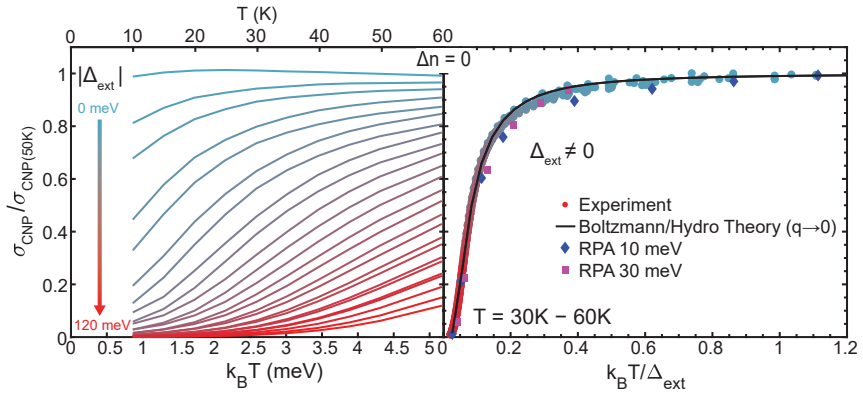
- With a tunable gap, charge-neutral conductivity should collapse as a function of $k_{\rm B}T/\Delta_{\rm ext}$, with insulating behavior at low temperature and recovery to the universal gapless value at high temperature.
- At high density the same theory predicts a crossover out of hydrodynamics: electron-hole scattering weakens exponentially and impurity or phonon scattering takes over, marked by conductivity growing linearly with carrier imbalance.
Reading between the lines
- Inference: The same cancellation that makes $\sigma_{\rm CNP}$ universal should apply to any two-band narrow-gap semiconductor with hyperbolically dispersing bands and dominant electron-hole scattering, so the $\frac{2}{3}\log 2\, e^2/h$ value is a prediction testable in gapped bilayer graphene variants and other clean narrow-gap systems.
- Inference: Since the inverse lifetime reaches $0.35\,k_{\rm B}T/\hbar$, the paper's mechanism implies bilayer graphene sits near the Planckian bound; one testable extension is to measure the Hall viscosity or the shear viscosity of the electron-hole fluid and check whether it saturates the holographic viscosity bound.
- Inference: A full numerical solution of the Boltzmann equation including vertex corrections would likely shift the prefactor $0.35$; if the measured value remains within a few percent of $\frac{2}{3}\log 2\, e^2/h$, that would strengthen the case for an exact self-dual structure in the collision integral.
- Inference: The collapse in Fig. 4(b) is predicted using the near-linear relation between gap and $\Delta_{\rm ext}$; at larger displacement fields where the relation is nonlinear, the universal curve should be tested against the true band gap rather than $\Delta_{\rm ext}$.
Signed reviews
Editorial analysis
A structured set of objections, weighed in public.
Referee Report
Summary. The paper combines a Boltzmann-transport theory of electron-hole limited conductivity in bilayer graphene with dual-gated transport experiments on hBN-encapsulated devices. For the gapless system the theory predicts a temperature-independent conductivity at charge neutrality, proportional to e^2/h, with a quasiparticle lifetime near the Planckian bound; for a finite gap it predicts a universal collapse of the charge-neutral conductivity as a function of kBT/Δ. The experiments show a nearly temperature-independent charge-neutral conductivity of roughly 20 e^2/h for Δ=0, a collapse of σ/σ_CNP when plotted against Δn/kBT, and a similar collapse against kBT/Δ_ext for finite gap. The paper claims the theory contains no adjustable parameters, while the abstract mentions four fitting parameters; the central theoretical expressions are given in Eq. (2) and Eq. (3).
Significance. If correct, this work would establish bilayer graphene as a model ambipolar hydrodynamic conductor in which the DC conductivity is controlled by electron-hole friction rather than impurity or phonon scattering, with a measured Planckian-scale scattering rate and a universal temperature-independent conductivity at charge neutrality. The experimental dataset is extensive and the central predictions are falsifiable and largely confirmed qualitatively: five devices, Hall-effect calibration of density and gap, multiple temperature sweeps, and collapse curves. The strength of the paper is that the microscopic lifetime is computed rather than fitted, and the comparison is made to independent transport measurements. However, the central quantitative claim, including the 'no adjustable parameters' magnitude, is not reproducible from the formulas as stated because of an apparent factor-of-about-34 inconsistency; this must be resolved before the significance can be assessed.
major comments (3)
- [Main text, paragraph after Eq. (2); Eq. (3); Fig. 3(a)] The central quantitative claim cannot be reproduced from the stated ingredients. With n0 = 2m*kBT log(2)/(πℏ^2), 1/τ0 = 0.35 kBT/ℏ, and two equal carrier species, Eq. (2) gives σ_CNP = 2n0e^2τ0/m* = [8 log(2)/0.35](e^2/h) ≈ 15.8 e^2/h. The text instead quotes σ_CNP = (2/3)log(2)e^2/h ≈ 0.46 e^2/h, which is smaller by a factor of about 34. The statement in Fig. 3(a) that the measured value (~20 e^2/h) is 'within ~40%' of the calculated value is therefore not consistent with the quoted formula. Conversely, the quoted 0.46 e^2/h would require 1/τ ≈ 12 kBT/ℏ, not 0.35 kBT/ℏ. This discrepancy must be resolved: if it is a typographical error, the corrected prefactor must be propagated through Eq. (3) and all derived collapse curves, and the 'within 40%' claim must be rechecked.
- [Abstract vs. main text (paragraph beginning 'Here we explore...')] There is a direct contradiction about the status of fitting parameters. The abstract states that 'a set of just four fitting parameters provides quantitative agreement between theory and experiment at all densities, temperatures, and gaps measured,' while the main text states that the theoretical predictions 'contain no adjustable parameters' and that the theoretical curves in Fig. 3 have 'no adjustable parameters.' If the four parameters are experimental calibration parameters (for example, gate capacitances, the Veff-to-μ conversion, the Δext calibration, or the disorder density), they should be explicitly listed and distinguished from theory parameters. As written, this ambiguity undermines the central 'no adjustable parameters' claim, which is otherwise a key selling point of the paper.
- [Eq. (2) and the universality claim] Eq. (2) is a simplified Drude-like two-fluid expression, and the text acknowledges that a full numerical solution of the Boltzmann equation would give only quantitative corrections. This is acceptable as a presentation device, but the claimed universality of the prefactor depends on two non-trivial inputs: the G0W/RPA value 0.35 kBT/ℏ and the neglect of vertex corrections. Since the main text does not show the derivation of the 0.35 factor, and the paper's quantitative comparison to experiment hinges on it, the authors should either display the key steps or give a precise pointer to the Supplementary section where the calculation can be verified, including its numerical uncertainty.
minor comments (5)
- [Main text, paragraph after Eq. (2)] There is a typo in 'yields a value of of 0.35 kBT/ℏ'; 'of' is repeated.
- [Eq. (3) and surrounding text] The fraction 2/3 appears in the plain text as '23' in two places; please ensure it is typeset correctly as a fraction.
- [Fig. 4 caption and axis labels] The axis label 'n (10 cm)' is missing superscripts and an exponent; it should read something like 'n (10^{10} cm^{-2})'.
- [Fig. 2 caption] The caption says 'conductivity measured against Veff ∝ Δn', but for finite gap Veff is proportional to Δn only approximately or in a specific calibration; please clarify the exact mapping used.
- [Discussion of Fig. 4] The text says Eq. (3) implies collapse as a function of kBT/Δext, but Eq. (3) is written in terms of Δ/2kBT; since the relation between Δ and Δext is only 'approximately linear', the collapse variable should be defined explicitly and the approximation quantified.
Circularity Check
No circular construction: the central σ_CNP prediction is a parameter-free G0W/RPA calculation benchmarked against independent transport data; only minor non-load-bearing self-citations appear.
full rationale
The derivation starts from the hyperbolic-band model (Eq. 1), the thermally activated carrier density n0 = 2m*kBT log(2)/(πℏ²), and a G0W/RPA computation of the inverse quasiparticle lifetime quoted as 0.35 kBT/ℏ. These are independent inputs: the lifetime is a microscopic many-body result, not obtained by inverting the measured conductivity, and the density follows from the assumed parabolic bands. The resulting charge-neutral conductivity and the gapped universal curve (Eq. 3) are then compared with DC transport measurements on five devices. The paper's self-citations to its authors' prior work [16] provide the phase diagram and phonon-scattering estimates, but they are not the load-bearing derivation of the central universal-conductivity claim, which is presented here and benchmarked externally. I find no step in which a prediction reduces by construction to its own input, no fitted parameter relabeled as prediction, no imported uniqueness theorem, and no ansatz smuggled in by self-citation. The paper does contain an apparent numerical inconsistency among the stated lifetime, density, and quoted σ_CNP formula; that is a correctness or typographical concern, not a circularity, and the abstract's reference to four fitting parameters appears to concern experimental calibrations rather than the adjustable-parameter-free transport theory emphasized in the main text.
Assumptions & free parameters
free parameters (2)
- Unspecified four fitting parameters (abstract) =
not stated
- Charge disorder density =
upper bound ~3 x 10^10 cm^-2
assumptions (5)
- domain assumption Boltzmann transport equation with independent quasiparticle lifetimes, Eq. (2), is a reliable description of electron-hole-limited conductivity.
- domain assumption The G0W approximation with finite-temperature dynamical RPA dielectric function gives inverse lifetime 0.35 kBT/hbar, independent of dielectric constant and effective mass.
- domain assumption The hyperbolic two-band approximation, Eq. (1), holds for the studied range of temperature, density, and gap.
- domain assumption The experimentally measured Delta_ext is approximately proportional to the true band gap Delta over the range used.
- domain assumption Electrons remain in thermal equilibrium with the lattice at measurement currents of 10-100 nA.
Cite this review
Pith. "Pith review of Dissipation-enabled hydrodynamic conductivity in a tunable bandgap semiconductor." pith.science (2026). https://pith.science/paper/7XIPFU36
@misc{pith2026190810921,
  author       = {Pith},
  title        = {Pith review of: Dissipation-enabled hydrodynamic conductivity in a tunable bandgap semiconductor},
  year         = {2026},
  howpublished = {\url{https://pith.science/paper/7XIPFU36}},
  note         = {Machine review of arXiv:1908.10921}
}
read the original abstract
Electronic transport in the regime where carrier-carrier collisions are the dominant scattering mechanism has taken on new relevance with the advent of ultraclean two-dimensional materials. Here we present a combined theoretical and experimental study of ambipolar hydrodynamic transport in bilayer graphene demonstrating that the conductivity is given by the sum of two Drude-like terms that describe relative motion between electrons and holes, and the collective motion of the electron-hole plasma. As predicted, the measured conductivity of gapless, charge-neutral bilayer graphene is sample- and temperature-independent over a wide range. Away from neutrality, the electron-hole conductivity collapses to a single curve, and a set of just four fitting parameters provides quantitative agreement between theory and experiment at all densities, temperatures, and gaps measured. This work validates recent theories for dissipation-enabled hydrodynamic conductivity and creates a link between semiconductor physics and the emerging field of viscous electronics.
Figures


Figures from the paper (2 more)

Reference graph
Works this paper leans on
-
[1]
R. N. Gurzhi, Soviet Physics Uspekhi 11, 255 (1968)
1968
-
[2]
B. N. Narozhny, I. V . Gornyi, M. Titov, M. Sch ¨utt, A. D. Mirlin, Physical Review B 91, 035414 (2015)
work page 2015
-
[3]
Dyakonov, Physical Review Letters 71, 2465 (1993)
M. Dyakonov, Physical Review Letters 71, 2465 (1993)
work page 1993
-
[4]
A. O. Govorov, J. J. Heremans, Physical Review Letters 92, 026803 (2004)
work page 2004
- [5]
-
[6]
M. M ¨uller, J. Schmalian, L. Fritz, Physical Review Letters 103, 025301 (2009). 17
work page 2009
-
[7]
S. A. Hartnoll, P. K. Kovtun, M. M¨uller, S. Sachdev,Physical Review B 76, 144502 (2007)
work page 2007
- [8]
Show all 28 references
-
[9]
Busza, K
W. Busza, K. Rajagopal, W. van der Schee,Annual Review of Nuclear and Particle Science 68, 339 (2018)
2018
-
[10]
M. V . Entin, et al., Journal of Experimental and Theoretical Physics 117, 933 (2013)
2013
-
[11]
W. G. Baber, Proc. R. .Soc. Lond. A 158, 0383 (1937)
1937
-
[12]
D. A. Bandurin, et al., Science 351, 1055 (2016)
2016
-
[13]
Crossno, et al., Science 351, 1058 (2016)
J. Crossno, et al., Science 351, 1058 (2016)
2016
-
[14]
A. I. Berdyugin, et al., Science 364, 162 (2019)
2019
-
[15]
Gallagher, et al., Science 364, 158 (2019)
P. Gallagher, et al., Science 364, 158 (2019)
2019
-
[16]
D. Y . H. Ho, I. Yudhistira, N. Chakraborty, S. Adam, Physical Review B 97, 121404 (2018)
2018
-
[17]
Nguyen, S
Glenn Wagner, Dung X. Nguyen, S. H. Simon, arXiv:1905.09835 [cond-mat.mes-hall]
1905 arXiv
-
[18]
Nam, D.-K
Y . Nam, D.-K. Ki, D. Soler-Delgado, A. F. Morpurgo,Nature Physics 13, 1207 (2017)
2017
-
[19]
Zhang, et al., Nature 459, 820 (2009)
Y . Zhang, et al., Nature 459, 820 (2009)
2009
-
[20]
S. A. Hartnoll, Nature Physics 11, 54 (2014)
2014
-
[21]
Zaanen, arXiv:1807.10951v3 [cond-mat] (2018)
J. Zaanen, arXiv:1807.10951v3 [cond-mat] (2018)
2018 arXiv
-
[22]
Kovtun, D
P. . Kovtun, D. T. Son, A. O. Starinets, Physical Review Letters 94, 111601 (2005)
2005
-
[23]
J. A. N. Bruin, H. Sakai, R. S. Perry, A. P. Mackenzie, Science 339, 804 (2013). 18
2013
-
[24]
Cao, et al., arXiv:1901.03710 [cond-mat] (2019)
Y . Cao, et al., arXiv:1901.03710 [cond-mat] (2019)
2019 arXiv
-
[25]
Zarenia, T
M. Zarenia, T. B. Smith, A. Principi, G. Vignale, Physical Review B 99, 161407 (2019)
2019
-
[26]
Wang, et al., Science 342, 614 (2013)
L. Wang, et al., Science 342, 614 (2013)
2013
-
[27]
Xue, et al., Nature Materials 10, 282 (2011)
J. Xue, et al., Nature Materials 10, 282 (2011)
2011
-
[28]
Das Sarma, S
S. Das Sarma, S. Adam, E. H. Hwang, E. Rossi, Reviews of Modern Physics 83, 407 (2011). Acknowledgments We acknowledge helpful discussions with Michael Fuhrer, Peijie Ong, Oleg Sushkov, James Teherani, Giovanni Vignale, and Mohammad Zarenia. Funding: The experimental work was ...
2011
Reviewed August 14, 2026 · model on record in the stance chip above.
Discussion (0). Continue with ORCID to comment.