REVIEW 2 major objections 6 minor 43 references
Inductive Construction of Variational Quantum Circuit for Constrained Combinatorial Optimization
T0 review · 2 major / 6 minor · reviewed 2026-08-10 · deepseek-v4-flash
Pith's one-line read Iterating a 'forwarding operation' that maps feasible states of subproblems into feasible states of larger subproblems constructs variational quantum circuits whose outputs always satisfy the constraints.
desk verdict The forwarding construction is sound for all three examples; the paper's weak spot is presentation and evidence, not the math. read the letter →
The pith
A machine-rendered reading of the paper's core claim, the machinery that carries it, and where it could break.
The reading
What carries the argument
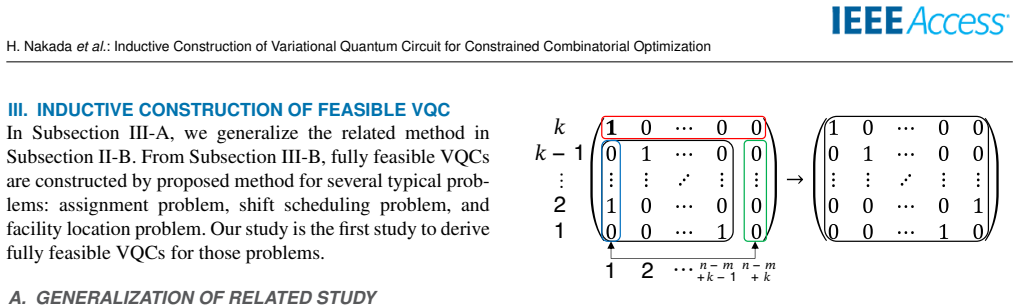
The load-bearing object is the forwarding operation, implemented with parameterized W states and Fredkin (controlled-SWAP) gates. A parameterized W state is a superposition of one-hot bitstrings with amplitudes controlled by variational parameters; it supplies the new column of the assignment matrix. The controlled-SWAP operations move an offending bit into an auxiliary position so that row and column constraints are restored without entangling the new state with infeasible configurations. The inductive argument—that each forwarding step multiplies the number of encoded feasible solutions by exactly the number of choices for the new column—is what guarantees the final circuit is fully feasible rather than merely feasible. The same machinery, with the base ansatz adjusted, handles assignment, shift scheduling, facility location, and, with minor modifications, cardinality and one-dimensional product constraints.
What would settle it
Enumerate every feasible solution of the facility location problem for a small case (e.g. m=n=3) and compute the exact state produced by the constructed circuit; if the support of that state is not exactly the set of feasible bitstrings, the full-feasibility claim is false. For the practical advantage, run the same 100 instances with penalty baselines whose lambda is tuned per instance by grid search rather than fixed at four shared values, and at larger sizes; if a tuned baseline matches or exceeds the 62.91% optimal probability, the reported advantage is an artifact of the baseline setup.
Extended reading notes
Core claim
The central claim is that a fully feasible variational quantum circuit—one whose output states are superpositions of all feasible solutions and no infeasible ones—can be constructed inductively for any constraint family admitting a forwarding operation. A forwarding operation maps the feasible set of a subproblem into the feasible set of a larger subproblem while preserving the already-encoded feasible states. Iterating these operations from a base ansatz gives a circuit for the original problem. The paper proves full feasibility by counting: for the assignment problem the number of distinct feasible solutions encoded at step k satisfies C_k=(n-m+k)C_{k-1}, with C_1=n-m+1, yielding C_m=nP_m, exactly the number of feasible assignments; the analogous recurrence for shift scheduling gives nP_m $2^{{n-m}}$; and for facility location the enumeration argument covers all x bitstrings and all y that satisfy y_i >= x_{i,j}. This is the first derivation of fully feasible VQCs for these three problems, generalizing an earlier construction for the traveling salesman problem built on permutation matrices.
Load-bearing premise
The numerical comparison assumes that 100 random instances at m=n=3 with penalty coefficients lambda in {5,10,15,20} and one initial parameter set per instance fairly represent the performance gap between the proposed circuit and penalty-based variational circuits.
Editorial extensions
If this is right
- Penalty coefficients and their tuning disappear for any constraint family with a forwarding operation, removing a frequent failure mode of variational optimization.
- The search space is restricted to feasible states, so the effective Hilbert space shrinks from 2^{mn+n} to the number of feasible solutions; the paper argues this reduction becomes more pronounced as problem size grows.
- The constructed circuits use fewer variational parameters than conventional l-layer VQEs and require gate counts that are polynomial (linear for facility location) in the number of qubits, making them plausible for near-term hardware.
- Because the circuits are fully feasible by construction, they can serve as structured initial states for warm-start QAOA-type solvers without a feasibility filter.
- The same inductive recipe extends, as the paper notes, to cardinality constraints by replacing the parameterized W state with an XY-mixer type operation.
Reading between the lines
- The inductive structure resembles a classical dynamic-programming decomposition of the constraint set, which suggests that the method is in effect translating a DP recurrence into a quantum circuit; constraints without such a recurrence may resist this treatment.
- A natural testable extension is to measure whether the 62.91% optimal probability persists as m and n grow beyond 3; nothing in the structural proof guarantees optimization quality, only feasibility.
- Because the guarantee is structural, the circuit remains feasible even under poor parameter training, but noise on near-term devices could still break feasibility at the measurement level; error mitigation would be needed.
- The method's expressivity is limited by the requirement that the base ansatz and forwarding operations are manually designed per constraint family; automating their synthesis from a constraint description is an open direction.
Editorial analysis
A structured set of objections, weighed in public.
Referee Report
Summary. The paper proposes an inductive method for constructing variational quantum circuits (VQCs) that output only feasible solutions of constrained combinatorial optimization problems. The method defines a "forwarding operation" that maps feasible states of a smaller subproblem to feasible states of a larger one; applying this operation repeatedly starting from a simple initial ansatz yields a fully feasible circuit for the original problem. The authors instantiate the framework for the assignment problem, the shift scheduling problem, and the facility location problem, analyze the required qubit counts, variational parameters, and CNOT gate counts, and report a numerical experiment on a 3x3 facility location instance in which the proposed circuit achieves 100% feasible and 62.91% optimal measurement probabilities, compared with penalty-based VQE baselines.
Significance. If the construction is correct, the paper provides a systematic alternative to penalty-based approaches for constrained combinatorial optimization on NISQ devices. The counting proofs for the assignment and shift scheduling circuits are clean and match the known numbers of feasible solutions, which is strong evidence for those two cases. The circuit-cost analysis is explicit and shows that the proposed circuits can be comparable or cheaper than generic hardware-efficient ansatze. The facility location example is the first fully feasible VQC construction for that problem, but its correctness is not established as rigorously as the other two cases. The numerical demonstration, while small, supports the practical potential of the approach.
major comments (2)
- [III-D] The proof of full feasibility for the facility location circuit is informal and insufficient as written. The sentence "By preparing parameterized W states at every rows, all possible bitstrings of the variables x are encoded. In addition, proposed method enumerates y satisfying the second constraint for each possible bitstring of x" asserts the result without demonstrating that (i) the CSWAP-based forwarding operation maps every feasible (k-1)-subproblem state to a feasible k-subproblem state, and (ii) every feasible (x,y) solution has at least one branch in the circuit that produces it. Unlike the assignment and shift scheduling cases, a simple counting recurrence cannot be used because the mapping from initial y bits and one-hot choices to final (x,y) is many-to-one: the same solution can be reached through different auxiliary-qubit histories or redundant y bits. A constructive surjectivity argument, or an explicit count of the preimage set, is needed to establish that the circuit is fully feasible. This point is load-bearing because the 100% feasible result in Table 2 and the claim of the first fully feasible VQC for facility location both rest on it.
- [V, Table 2] The numerical evidence for the claimed advantage over conventional VQE is weaker than the prose suggests. The probabilities in Table 2 are averages over 100 instances but are obtained from a single optimization run per instance with a single initial parameter set, as acknowledged in Section V, and no standard deviations are reported. The penalty coefficient lambda is taken from {5,10,15,20} after the authors "experimentally found" that smaller values shift the ground state, which introduces a subtle selection bias into the baseline. With only m=n=3, the 62.91% optimal probability could shrink on larger or harder instances or with more carefully tuned baselines. The authors should either provide error bars or multiple restarts, or moderate the empirical claim in the abstract and conclusion.
minor comments (6)
- [Abstract, II-A] The word "superposintioned" appears to be a typo for "superpositioned" or "superposed"; it occurs in the abstract and in Section II-A.
- [Fig. 1 caption] The word "anstaz" should be "ansatz".
- [Section V] The description of the lambda selection is ambiguous: it would be helpful to state explicitly whether the observation of ground-state shifts around lambda=4 was made on the same 100 instances used in the final comparison, and whether the reported results are stable within the range 5-20.
- [III-D] The paper should clarify the role of the auxiliary qubits in the definition of "fully feasible": the feasible solution space refers to the problem variables (x,y), while the auxiliary qubits may record multiple histories for the same solution. This does not affect the feasibility of measurement outcomes, but the distinction should be stated explicitly given the many-to-one nature of the mapping.
- [Table 1] The cost expressions are marked "at most"; since the decompositions of the parameterized W state and CSWAP gates are exact, "equal to" or "exactly" would be more precise for the leading-order terms.
- [IV] The relationship between the conventional VQE baseline in Table 1 and the cited reference [29] should be made more explicit, in particular how the layer count l maps to the number of variational parameters used in the comparison.
Circularity Check
No circularity: the feasibility claims are supported by explicit gate constructions and independent counting; numerical results come from variational optimization.
full rationale
The paper's central claim is an explicit inductive circuit construction, not a fitted prediction. For the assignment and shift scheduling problems, full feasibility is established by counting recurrences, C_k = (n-m+k)C_{k-1}, and comparing the resulting total with the independently known numbers of feasible solutions, nPm and nPm * 2^(n-m); this is a combinatorial check, not an assumption of the conclusion. For the facility location problem, the proof is terse, but the explicit gate definitions (parameterized W states for each customer column and CSWAPs controlled by x_{u,k} acting on r_u and a_k) directly implement the constraint x_{i,j} <= y_i, so any concern there is about proof rigor rather than circularity. The numerical results are obtained by variational optimization against a cost Hamiltonian, so the reported feasible and optimal solution probabilities are not fitted inputs renamed as predictions. The paper's self-citations are background references to the authors' prior tensor-network and Ising-machine work and are not load-bearing for the circuit construction; the main related construction [30] is by different authors. No uniqueness theorem or ansatz is imported from the authors' own prior work, and no target result is assumed in the derivation. Therefore there is no significant circularity.
Assumptions & free parameters
free parameters (2)
- Variational parameters in parameterized W states and Ry gates
- Penalty coefficient lambda in conventional VQE baseline =
5, 10, 15, 20
assumptions (4)
- domain assumption A d-qubit parameterized W state can be implemented with 2d-2 CNOT gates and d-1 angles, and it superposes all d one-hot basis states for generic angles.
- standard math A CSWAP gate can be decomposed into seven CNOT gates and nine SU(2) gates, as cited from [36].
- domain assumption The Qiskit statevector simulator with 2000 shots and COBYLA optimization faithfully represents measurement statistics for the reported experiment.
- ad hoc to paper For facility location, the forward operation with auxiliary qubits preserves full support on feasible (x,y) solutions even though the same solution can be produced through different auxiliary histories.
Cite this review
Pith. "Pith review of Inductive Construction of Variational Quantum Circuit for Constrained Combinatorial Optimization." pith.science (2026). https://pith.science/paper/A7PPNWNO
@misc{pith2026250103521,
  author       = {Pith},
  title        = {Pith review of: Inductive Construction of Variational Quantum Circuit for Constrained Combinatorial Optimization},
  year         = {2026},
  howpublished = {\url{https://pith.science/paper/A7PPNWNO}},
  note         = {Machine review of arXiv:2501.03521}
}
read the original abstract
In this study, we propose a new method for constrained combinatorial optimization using variational quantum circuits. Quantum computers are considered to have the potential to solve large combinatorial optimization problems faster than classical computers. Variational quantum algorithms, such as Variational Quantum Eigensolver (VQE), have been studied extensively because they are expected to work on noisy intermediate scale devices. Unfortunately, many optimization problems have constraints, which induces infeasible solutions during VQE process. Recently, several methods for efficiently solving constrained combinatorial optimization problems have been proposed by designing a quantum circuit so as to output only the states that satisfy the constraints. However, the types of available constraints are still limited. Therefore, we have started to develop variational quantum circuits that can handle a wider range of constraints. The proposed method utilizes a forwarding operation that maps from feasible states for subproblems to those for larger subproblems. As long as appropriate forwarding operations can be defined, iteration of this process can inductively construct variational circuits outputting feasible states even in the case of multiple and complex constraints. In this paper, the proposed method was applied to facility location problem and was found to increase the probability for measuring feasible solutions or optimal solutions. In addition, the cost of the obtained circuit was comparable to that of conventional variational circuits.
Figures


Figures from the paper (5 more)


Reference graph
Works this paper leans on
-
[1]
Quantum annealing in the transverse Ising model,
T. Kadowaki and H. Nishimori, “Quantum annealing in the transverse Ising model,” Physical Review E, vol. 58, pp. 5355-5363, Nov. 1998
work page 1998
-
[2]
Quantum computation by adiabatic evolution,
E. Farhi, J. Goldstone, S. Gutmann, and M. Sipser, “Quantum computation by adiabatic evolution,” arXiv preprint arXiv:quant-ph/0001106, 2000. [Online]. Available: https://arxiv.org/abs/quant-ph/0001106
arXiv 2000
-
[3]
Grover Adaptive Search for Constrained Polynomial Binary Optimization,
A. Gilliam, S. Woerner, and C. Gonciulea, “Grover Adaptive Search for Constrained Polynomial Binary Optimization,” Quantum, vol. 5, Apr. 2019, Art. no. 428
work page 2019
-
[4]
Evaluating the evidence for exponential quantum advantage in ground- state quantum chemistry,
S. Lee, J. Lee, H. Zhai, Y . Tong, A. M. Dalzell, A. Kumar et al., “Evaluating the evidence for exponential quantum advantage in ground- state quantum chemistry,” Nature Communications, vol. 14, Apr. 2023, Art. no. 1952
work page 2023
-
[5]
Quantum optimization using variational algorithms on near-term quantum devices,
N. Moll, P. Barkoutsos, L. S. Bishop, J. M. Chow, A. Cross, D. J. Egger et al., “Quantum optimization using variational algorithms on near-term quantum devices,” Quantum Science and Technology, vol. 3, no. 3, Jun. 2018, Art. no. 030503
work page 2018
-
[6]
Quantum Computing in the NISQ era and beyond,
J. Preskill, “Quantum Computing in the NISQ era and beyond,” Quantum, vol. 2, Aug. 2018, Art. no. 79
work page 2018
-
[7]
A variational eigenvalue solver on a photonic quantum processor,
A. Peruzzo, J. McClean, P. Shadbolt, M.-H. Yung et al., “A variational eigenvalue solver on a photonic quantum processor,” Nature Communica- tions, vol. 5, no. 1, pp. 1-7, Jul. 2014
work page 2014
-
[8]
The theory of variational hybrid quantum-classical algorithms,
J. R. McClean, J. Romero et al., “The theory of variational hybrid quantum-classical algorithms,” New Journal of Physics, vol. 18, no. 2, Feb. 2016, Art. no. 023023
work page 2016
Show all 43 references
-
[9]
Accelerated variational quantum eigensolver,
D. Wang, O. Higgott, and S. Brierley, “Accelerated variational quantum eigensolver,” Physical Review Letters, vol. 122, no. 14, Apr. 2019, Art. no. 230401
2019
-
[10]
Quantum computation of electronic transitions using a variational quan- tum eigensolver,
R. M. Parrish, E. G. Hohenstein, P. L. McMahon, and T. J. Martínez, “Quantum computation of electronic transitions using a variational quan- tum eigensolver,” Physical Review Letters, vol. 122, no. 23, Jun. 2019, Art. no. 140504
2019
-
[11]
Hardware-efficient variational quantum eigensolver for small molecules and quantum magnets,
A. Kandala, A. Mezzacapo, K. Temme, M. Takita, M. Brink, J. M. Chow, and J. M. Gambetta, “Hardware-efficient variational quantum eigensolver for small molecules and quantum magnets,” Nature, vol. 549, no. 7671, pp. 242-246, Sep. 2017
2017
-
[12]
A Quantum Approximate Op- timization Algorithm,
E. Farhi, J. Goldstone, and S. Gutmann, “A Quantum Approximate Op- timization Algorithm,” arXiv preprint arXiv:1411.4028, 2014. [Online]. Available: https://arxiv.org/abs/1411.4028
2014 arXiv
-
[13]
A Tutorial on Quantum Approximate Optimization Algorithm (QAOA): Fundamentals and Applications,
J. Choi and J. Kim, “A Tutorial on Quantum Approximate Optimization Algorithm (QAOA): Fundamentals and Applications,” in Proceedings of the IEEE International Conference on Information and Communication Technology Convergence (ICTC), Jeju, Korea (South), 2019, pp. 138-142
2019
-
[14]
Adapting Quantum Approximation Optimization Algorithm (QAOA) for Unit Commitment,
S. Koretsky, P. Gokhale, J. M. Baker, J. Viszlai, H. Zheng, N. Gurung, R. Burg, E. A. Paaso, A. Khodaei, R. Eskandarpour, and F. T. Chong, “Adapting Quantum Approximation Optimization Algorithm (QAOA) for Unit Commitment,” in Proceedings of the IEEE International Conference on...
2021
-
[15]
Benchmarking the performance of portfolio optimization with QAOA,
S. Brandhofer, D. Braun, V . Dehn, G. Hellstern, M. Hüls, Y . Ji, et al., “Benchmarking the performance of portfolio optimization with QAOA,” Quantum Information Processing, vol. 22, no. 1, pp. 1-27, Dec. 2022
2022
-
[16]
Constrained optimization and Lagrange multiplier meth- ods,
D. P. Bertsekas. “Constrained optimization and Lagrange multiplier meth- ods,” Cambridge, MA, USA:Academic Press, 1982
1982
-
[17]
Linear and Nonlinear Programming,
D. G. Luenberger and Y . Ye. “Linear and Nonlinear Programming,” New York, NY , USA:Springer, 2015
2015
-
[18]
Ising formulations of many NP problems,
A. Lucas, “Ising formulations of many NP problems,” Frontiers in Physics, vol. 2, Feb. 2014
2014
-
[19]
Quantum Spin Glasses, Annealing and Computation,
S. Tanaka, R. Tamura, and B. K. Chakrabarti. “Quantum Spin Glasses, Annealing and Computation,” Cambridge, U.K.:Cambridge Univ. Press, May 2017
2017
-
[20]
A Multiple Coefficients Trial Method to Solve Combinatorial Optimization Problems for Simulated-annealing-based Ising Machines,
K. Takehara, D. Oku, Y . Matsuda, S. Tanaka, and N. Togawa, “A Multiple Coefficients Trial Method to Solve Combinatorial Optimization Problems for Simulated-annealing-based Ising Machines,” in Proceedings of the IEEE International Conference on Consumer Electronics (ICCE), Ber...
2019
-
[21]
Performance Comparison of Typical Binary-Integer Encodings in an Ising Machine,
K. Tamura, T. Shirai, H. Katsura, S. Tanaka and N. Togawa, “Performance Comparison of Typical Binary-Integer Encodings in an Ising Machine,” IEEE Access, vol. 9, pp. 81032-81039, May 2021
2021
-
[22]
Application of Ising Machines and a Software Development for Ising Machines,
K. Tanahashi, S. Takayanagi, T. Motohashi, and S. Tanaka. “Application of Ising Machines and a Software Development for Ising Machines,” Journal of the Physical Society of Japan, vol. 88, no. 6, May 2019, Art. no. 061010
2019
-
[23]
PyQUBO: Python Library for Mapping Combinatorial Optimization Problems to QUBO Form,
M. Zaman, K. Tanahashi, and S. Tanaka. “PyQUBO: Python Library for Mapping Combinatorial Optimization Problems to QUBO Form,” IEEE Transactions on Computers, vol. 71, no. 4, pp. 838-850, Apr. 2022
2022
-
[24]
Quantum-classical compu- tational molecular design of deuterated high-efficiency OLED emitters,
Q. Gao, G. O. Jones, T. Kobayashi, M. Sugawara, H. Yamashita, H. Kawaguchi, S. Tanaka, and N. Yamamoto. “Quantum-classical compu- tational molecular design of deuterated high-efficiency OLED emitters,” Intelligent Computing, vol. 2, pp. 0037-1-10, Jun. 2023
2023
-
[25]
From the Quantum Approximate Optimization Algorithm to a Quantum Alternating Operator Ansatz,
S. Hadfield, Z. Wang, B. O’Gorman, E. G. Rieffel, D. Venturelli, and R. Biswas, “From the Quantum Approximate Optimization Algorithm to a Quantum Alternating Operator Ansatz,” Algorithms, vol. 12, no. 2, Feb. 2019, Art. no. 34
2019
-
[26]
XY mixers: Analytical and numerical results for the quantum alternating operator ansatz,
Z. Wang, N. C. Rubin, J. M. Dominy, and E. G. Rieffel, “XY mixers: Analytical and numerical results for the quantum alternating operator ansatz,” Phys. Rev. A, vol. 101, Jan. 2020, Art. no. 012320
2020
-
[27]
Grover Mixers for QAOA: Shifting Com- plexity from Mixer Design to State Preparation,
A. Bartschi and S. Eidenbenz, “Grover Mixers for QAOA: Shifting Com- plexity from Mixer Design to State Preparation,” in Proceedings of the IEEE International Conference on Quantum Computing and Engineering (QCE), Los Alamitos, CA, USA, 2020, pp. 72–82
2020
-
[28]
Quan- tum tree generator improves QAOA state-of-the-art for the knapsack problem,
P. Christiansen, L. Binkowski, D. Ramacciotti, and S. Wilkening, “Quan- tum tree generator improves QAOA state-of-the-art for the knapsack problem,” arXiv preprint arXiv:2411.00518, 2024. [Online]. Available: https://arxiv.org/abs/2411.00518
2024
-
[29]
A case study of variational quantum algorithms for a job shop scheduling problem,
D. Amaro, M. Rosenkranz, N. Fitzpatrick, K. Hirano, and M. Fiorentini, “A case study of variational quantum algorithms for a job shop scheduling problem,” EPJ Quantum Technology, vol. 9, no. 1, Feb. 2022, Art. no. 5
2022
-
[30]
Enhancing VQE Convergence for Optimization Problems with Problem-Specific Pa- rameterized Quantum Circuits,
A. Matsuo, Y . Suzuki, I. Hamamura, and S. Yamashita, “Enhancing VQE Convergence for Optimization Problems with Problem-Specific Pa- rameterized Quantum Circuits,” IEICE Transactions on Information and Systems, vol. E106.D, no. 11, pp. 1772-1782, 2023
2023
-
[31]
Modeling Linear Inequality Con- straints in Quadratic Binary Optimization for Variational Quantum Eigen- solver,
M. P. Quinones and C. Junqueira, “Modeling Linear Inequality Con- straints in Quadratic Binary Optimization for Variational Quantum Eigen- solver,” arXiv preprint arXiv:2007.13245, 2020. [Online]. Available: https://arxiv.org/abs/2007.13245
2007 arXiv
-
[32]
Deterministic construction of arbitrary W states with quadratically increasing number of two-qubit gates,
F. Diker, “Deterministic construction of arbitrary W states with quadratically increasing number of two-qubit gates,” arXiv preprint arXiv:1606.09290, 2016. [Online]. Available: https://arxiv.org/abs/1606.09290 12 VOLUME 4, 2016 H. Nakada et al.: Inductive Construction of Vari...
2016 arXiv
-
[33]
Conservative logic,
E. Fredkin and T. Toffoli, “Conservative logic,” International Journal of Theoretical Physics, vol. 21, pp. 219-253, Apr. 1982
1982
-
[34]
Holographic quantum algorithms for simulating correlated spin systems,
M. Foss-Feig, D. Hayes, J. M. Dreiling, C. Figgatt, J. P. Gaebler et al., “Holographic quantum algorithms for simulating correlated spin systems,” Phys. Rev. Research, vol. 3, Jul. 2021, Art. no. 033002
2021
-
[35]
A cross-disciplinary introduction to quantum annealing-based algorithms,
S. E. Venegas-Andraca, W. Cruz-Santos, C. McGeoch, and M. Lan- zagorta, “A cross-disciplinary introduction to quantum annealing-based algorithms,” Contemporary Physics, vol. 59, no. 2, pp. 174-197, Apr. 2018
2018
-
[36]
Shallow unitary decompositions of quantum Fredkin and Toffoli gates for connectivity-aware equivalent circuit averag- ing,
P. M. Q. Cruz and B. Murta, “Shallow unitary decompositions of quantum Fredkin and Toffoli gates for connectivity-aware equivalent circuit averag- ing,” APL Quantum, vol. 1, no. 1, Mar. 2024, Art. no. 016105
2024
-
[37]
Quick design of feasible tensor networks for constrained combinatorial optimization,
H. Nakada, K. Tanahashi, and S. Tanaka, “Quick design of feasible tensor networks for constrained combinatorial optimization,” arXiv preprint arXiv:2409.01699, 2024. [Online]. Available: https://arxiv.org/abs/2409.01699
2024 arXiv
-
[38]
Variational Quantum Algorithm-Preserving Feasible Space for Solving the Uncapacitated Facility Location Problem,
S.-S. Wang, H.-L. Liu, Y .-M. Li, F. Gao, S.-J. Qin, and Q.-Y . Wen, “Variational Quantum Algorithm-Preserving Feasible Space for Solving the Uncapacitated Facility Location Problem,” Advanced Quantum Tech- nologies, Sep. 2024, Art. no. 2400201
2024
-
[39]
Qiskit: An open-source framework for quantum computing,
G. Aleksandrowicz et al., “Qiskit: An open-source framework for quantum computing,” Jan. 2019
2019
-
[40]
A direct search optimization method that models the objective and constraint functions by linear interpolation,
M. J. D. Powell, “A direct search optimization method that models the objective and constraint functions by linear interpolation,” in Advances in Optimization and Numerical Analysis, Berlin:Springer-Verlag, pp. 51-67, 1994
1994
-
[41]
SciPy 1.0: Fundamental Algorithms for Scientific Computing in Python,
P. Virtanen, R. Gommers, T. E. Oliphant, M. Haberland, T. Reddy et al., “SciPy 1.0: Fundamental Algorithms for Scientific Computing in Python,” Nature Methods, vol. 17, pp. 261-272, Nov. 2020
2020
-
[42]
Warm-starting quantum opti- mization,
D. J. Egger, J. Mare ˇcek ,and S. Woerner, “Warm-starting quantum opti- mization,” Quantum, vol. 5, Jun. 2021, Art. no. 479. HYAKKA NAKADA received his B. Sci. and M. Sci. degrees from The University of Tokyo in 2014 and 2016, respectively. He is currently pursuing a Ph. D. de...
2021
-
[2015]
He also serves as a project manager for MITOU Target Program of the Information-Technology Promotion Agency (IPA)
He has experience working as a machine learning engineer at Recruit Co., Ltd., and is work- ing for Turing Inc., Tokyo, Japan. He also serves as a project manager for MITOU Target Program of the Information-Technology Promotion Agency (IPA). His research interests include math...
2003
Reviewed August 10, 2026 · model on record in the stance chip above.
Discussion (0). Continue with ORCID to comment.