REVIEW 3 major objections 4 minor 1 cited by
Qudit vs. Qubit: Simulated performance of error correction codes in higher dimensions
T0 review · 3 major / 4 minor · reviewed 2026-08-08 · deepseek-v4-flash
Pith's one-line read This paper shows that the five-qudit perfect code, when protected by a flag qudit and decoded with belief matching, sustains circuit-level error thresholds around $10^{-4}$ for qudits of dimension 2, 3, and 5, placing qutrits and ququints…
desk verdict Useful qudit decoder engineering, but the headline thresholds are fixed points of a power-law fit, not measured concatenated thresholds. read the letter →
The pith
A machine-rendered reading of the paper's core claim, the machinery that carries it, and where it could break.
The reading
What carries the argument
The load-bearing object is the five-qudit perfect code, the smallest stabilizer code that corrects an arbitrary single qudit error, generalized to every prime dimension $q$. Three mechanisms carry the argument: a general encoding circuit derived from the code's parity-check matrix; detector matching graphs in which each ancilla is replaced by $q-1$ nodes, one per nonzero eigenvalue, so that minimum-weight perfect matching and belief matching decoders can process qudit syndromes; and a flag qudit coupled to each ancilla that flags hook errors, with corrections stored in a lookup table. The threshold estimate itself rests on the power-law model $P_L(p_s)=a p_s^b$ for the circuit-level logical error rate, recursively applied to approximate concatenation levels $l=2$ and $l=3$ and intersected to read off the threshold.
What would settle it
Simulate the two-level concatenated 5-qudit code under circuit-level noise for $q=3$ (and ideally $q=5$) at physical error rates around the reported thresholds, then compare the observed logical error rate with the prediction obtained by composing the fitted power law; a significant mismatch would falsify the threshold claim.
Extended reading notes
Core claim
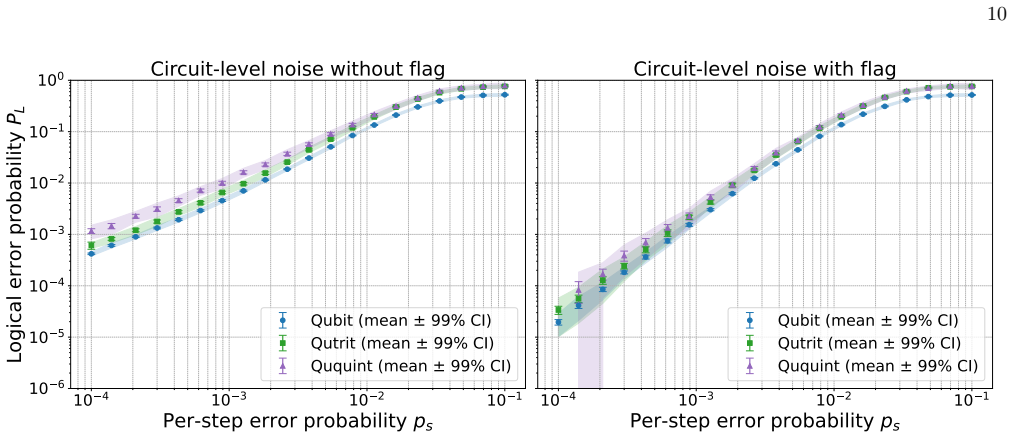
The central claim is that the circuit-level error threshold of the 5-qudit perfect code does not degrade sharply with dimension once hook errors are suppressed. With a flag qudit and the adapted Belief Matching decoder, the estimated thresholds are $4.95\times10^{-4}$ for $q=2$, $3.24\times10^{-4}$ for $q=3$, and $2.32\times10^{-4}$ for $q=5$. Hook errors—correlated errors spread from a noisy ancilla back onto data qudits—were the main obstacle; the flag qudit detects their occurrence and a brute-force lookup table supplies the correction. Without the flag qudit the thresholds are much worse, particularly for $q=5$ where the estimate drops to $4.36\times10^{-11}$. The threshold estimates are obtained by fitting a power law $P_L(p_s)=a p_s^b$ to one-level circuit-level simulations and composing it to represent concatenation levels two and three, rather than by directly simulating concatenated codes.
Load-bearing premise
The headline thresholds rest on the assumption that the logical error probability of one concatenation level can be modeled by composing the same fitted power law $P_L(p_s)=a p_s^b$ with itself, rather than by actually simulating concatenated codes; if first-level logical errors are correlated or the power law fails outside the fitted range, the threshold estimates are not established.
Editorial extensions
If this is right
- A physical implementation of the 5-qudit code with $q=3$ or $q=5$ would need a per-step error probability near $3\times10^{-4}$ or $2\times10^{-4}$ to sit below threshold, a target within roughly a factor of two of the qubit requirement.
- Two-qudit gates acting on qutrits or ququints can be noisier per step than their qubit counterparts by up to about a factor of two and still yield comparable logical error rates for this code.
- Without a flag qudit, the $q=5$ code is effectively unusable (threshold near $10^{-11}$), so hook-error correction is not an optional optimization for higher-dimensional qudit codes.
- The decoder construction using $q-1$ nodes per ancilla applies to any prime-dimensional stabilizer code, giving a general route to simulate and decode larger qudit codes with existing matching-based decoders.
- Smaller threshold gaps between dimensions imply that the overhead advantage promised by qudits is not erased by circuit-level noise, so comparisons at fixed logical error rate and fixed encoded information become the relevant next benchmark.
Reading between the lines
- Editorial inference: if the flag-qudit thresholds survive direct concatenation checks, qudit codes could encode more logical information per physical system without a proportional drop in threshold; a concrete test is to compare logical error rate per encoded qubit-equivalent for the $q=5$ code against the $q=2$ code at the same physical error rate.
- Editorial inference: the disconnected structure of the $q=5$ matching graph suggests the cheaper minimum-weight perfect matching decoder should become more competitive at higher dimensions, which could be checked by simulating MWPM with the flag qudit at $q=5$ and $q=7$.
- Editorial inference: the level-by-level concatenation extrapolation can be validated at modest cost for $q=3$ by simulating the two-level concatenated code at physical error rates near $3\times10^{-4}$; agreement would confirm the power-law recursion, while disagreement would indicate correlated logical errors.
- Editorial inference: the flag qudit is assumed to be measured and reinitialized fast enough not to add idle time on data qudits; hardware with slow mid-circuit measurement would need the threshold re-derived with a finite flag-reset duration included.
Editorial analysis
A structured set of objections, weighed in public.
Referee Report
Summary. This paper studies the smallest perfect quantum error-correcting code (five qudits) for q = 2, 3, and 5 under both standard depolarizing and circuit-level noise. The authors construct encoding and syndrome-extraction circuits valid for any prime qudit dimension, adapt the MWPM and belief-matching decoders to higher-dimensional codes, and introduce a flag qudit to handle hook errors. Their main quantitative claim is that, after the flag qudit is added, the error thresholds for q = 3 and q = 5 are comparable to the qubit threshold, on the order of 10^-4, with Table I reporting 4.95e-4, 3.24e-4, and 2.32e-4. These thresholds are not obtained from direct simulation of concatenated codes; instead, the paper fits the level-1 logical error probability to the power law P_L(p_s) = a p_s^b (Eq. 16) and recursively composes this fitted curve to represent higher concatenation levels, identifying the threshold as the intersection point of the resulting curves.
Significance. If the threshold comparison were firmly established, the paper would provide concrete evidence that qudit codes can achieve circuit-level thresholds comparable to qubits despite a noise model whose per-qudit error probability grows with dimension, which is of real practical interest for qudit-based platforms. The paper's strengths include a publicly available simulation extension on GitHub, a systematic generalization of matching-graph construction to prime qudit dimensions, and a careful level-1 circuit-level simulation with flag-qudit handling. The clean observation that the BM decoder outperforms MWPM on hyperedge errors at higher dimensions is also a useful contribution. The headline threshold claim, however, rests on a model-based extrapolation and is not directly simulated; this is the main weakness and the reason the paper requires revision.
major comments (3)
- [Sec. 5.4, Eq. (16), Table I] The reported thresholds are not measured concatenated thresholds. The text fits P_L(p_s) = a p_s^b to level-1 data and then defines higher concatenation levels by composing this same function: P_L^{(l+1)} = P_L ∘ P_L^{(l)}. For b > 1, all such curves intersect at the fixed point p* = a^{-1/(b-1)}, which is exactly the threshold listed in Table I. Thus the threshold is mathematically forced by the two fit parameters a and b; the intersection of the three curves carries no independent information. The paper provides no level-2 or level-3 simulation and no test of the assumption that the level-1 logical error channel behaves like an independent per-step depolarizing channel at the next concatenation level. Because the abstract's central claim of 'comparable error thresholds of the order of 10^-4' depends on this extrapolation, the claim is not empirically established. I recommend either adding a direct simulation of at least one level of concatenation (even for a few physical error rates and one dimension, e.g., qubit with flag) to validate the recursion, or substantially reframing the result as an extrapolated estimate whose systematic uncertainty is discussed explicitly.
- [Sec. 5.4, Table I, q=5 no-flag row] The no-flag q=5 threshold of 4.36e-11 is an artifact of the fitted exponent b = 1.149 being close to 1. Since p* = a^{-1/(b-1)}, a small change in b produces an enormous change in the fixed point; the reported uncertainty of ±2.9e-11 from Monte Carlo propagation of the fit parameters reflects only the covariance of the two-parameter fit and not the structural sensitivity of the fixed-point formula to the chosen functional form. This extreme fragility is itself evidence that composing Eq. (16) is unreliable for threshold estimation in this regime. At minimum, the authors should check whether the power-law fit is valid over the range of p_s values that contribute to the fixed point, or they should omit this row from the headline comparison.
- [Abstract and Sec. 6] The abstract states that 'comparable error thresholds of the order of 10^-4 are obtained', and the conclusion repeats that 'we found that the thresholds for qutrits and ququints were comparable to those of qubits'. Given that the thresholds are extrapolations from a single-level fit rather than direct simulation results, this wording overstates the status of the numbers. The manuscript should either add validation or change the phrasing to something like 'estimated thresholds under the level-by-level power-law assumption' in both the abstract and the conclusion.
minor comments (4)
- [Sec. 5.2 and Fig. 7 caption] The text in Sec. 5.2 says the error bars represent 90% confidence intervals, while the Figure 7 caption says they correspond to 99% confidence intervals. Please make these consistent.
- [Sec. 5.3 and Fig. 9 caption] The text in Sec. 5.3 says 'Error bars represent 99% confidence intervals', but the Figure 9 caption says 'Error bars indicate 90% confidence intervals'. One of these is a typo; please correct it.
- [Table I vs. Fig. 11] Table I lists the qutrit flag threshold as 3.24e-4, while Figure 11 (right panel) labels the threshold star as 3.29e-4. The discrepancy should be resolved.
- [Sec. 5.3, sample-count description] The sentence describing the parameter A ('A is assigned a value of 20 for qubits, 5 for qutrits, and 2 for all data points corresponding to ququints with a flag qudit, except for the left-most point') is difficult to parse. Please clarify which data points use which number of samples and how A was chosen to balance statistics and runtime.
Circularity Check
The reported thresholds are fixed points of the fitted level-1 power law, not independently simulated concatenated thresholds.
-
fitted input called prediction
[Section 5.4, Eq. (16), Table I, Figures 10-12]
"The curves for the subsequent concatenation levels on Figures 10, 11 and 12 are then obtained by plugging in the obtained logical probability as a per-step probability for the next concatenated level: P (l+1) L =P L(ps)◦P l L. By extrapolating these curves and determining the intersection point, we can get a good estimation of the threshold of these codes."
Under Eq. (16), the level-l curve is the l-fold iterate P_L^{(l)}(p)=a^{1+b+...+b^{l-1}} p^{b^l}. For b>1, the l=1 and l=2 curves intersect at p_* = a^{-1/(b-1)}, the same fixed point of the single-level fit. Table I's 'Threshold' column is therefore not a measured threshold of the concatenated [[5^l,1,3^l]] code; it is this analytic function of the fitted parameters (a,b). The recursive 'concatenation' is a composition of the same fitted curve, with no l=2 or l=3 simulation, so the claimed 10^-4 values are forced by the fit and by the assumed power-law form rather than by an independent simulation of larger codes.
full rationale
The only load-bearing circularity is in the threshold estimation. The raw circuit-level simulations (Figures 7 and 9) and decoder comparisons are self-contained; the code construction, syndrome circuits, and flag-qudit modification are not circular and do not rely on self-citations. The headline claim, however, comes from Section 5.4, where the higher-concatenation curves in Figures 10-12 are generated by recursively composing the same fitted power law P_L(p_s)=a p_s^b. Consequently the 'intersection point' that defines each threshold is the analytic fixed point p_* = a^{-1/(b-1)}, a direct function of the fitted parameters in Table I. The paper explicitly declines to re-run simulations at concatenation levels 2 or 3, so the l=2 and l=3 curves carry no new information; the threshold is a property of the fit and the assumed level-by-level ansatz taken from ref. [44]. Under the rubric this is a fitted input called a prediction rather than a self-citation chain. It is a partial circularity: the central quantitative claim (order-10^-4 thresholds, comparable across dimensions) reduces by construction to the fitted a and b, while the supporting circuit simulations remain independent evidence for the error-suppression effect of the flag qudit.
Assumptions & free parameters
free parameters (2)
- Power-law prefactor a (Eq. 16) =
q=2: 36.7 (no flag), 766 (flag); q=3: 58.7 (no flag), 1116 (flag); q=5: 35.3 (no flag), 792 (flag)
- Power-law exponent b (Eq. 16) =
q=2: 1.264 (no flag), 1.873 (flag); q=3: 1.288 (no flag), 1.870 (flag); q=5: 1.149 (no flag), 1.798 (flag)
assumptions (6)
- standard math Prime-dimension qudit stabilizer codes have n-k generators and correctable error set P_q = {omega^a X^r Z^s}.
- standard math The five-qudit code with stabilizers generated by I Z X X^dagger Z^dagger is a distance-3 perfect code that corrects all single-qudit errors.
- domain assumption Circuit-level noise is well modeled by single- and two-qudit depolarizing channels at each time step, plus ancilla bit-flip before readout.
- domain assumption The flag qudit can be measured and reinitialized fast enough that no additional idle periods are introduced on data qudits.
- domain assumption The logical error rate of a concatenation level can be treated as an independent physical error rate for the next level, and the level-1 power-law fit P_L=a p_s^b can be composed to predict higher levels.
- domain assumption Ancilla readout in the final syndrome extraction cycle is error-free.
Cite this review
Pith. "Pith review of Qudit vs. Qubit: Simulated performance of error correction codes in higher dimensions." pith.science (2026). https://pith.science/paper/ABAGBW3Q
@misc{pith2026250205992,
  author       = {Pith},
  title        = {Pith review of: Qudit vs. Qubit: Simulated performance of error correction codes in higher dimensions},
  year         = {2026},
  howpublished = {\url{https://pith.science/paper/ABAGBW3Q}},
  note         = {Machine review of arXiv:2502.05992}
}
abstract
Qudits can be described by a state vector in a $q$-dimensional Hilbert space, enabling a more extensive encoding and manipulation of information compared to qubits. This implies that conducting fault-tolerant quantum computations using qudits rather than qubits might entail less overhead. In this work, we investigate the viability of qudits in error correction codes by creating and simulating the quantum circuitry for the smallest qudit error correction code with a multidimensional circuit-level noise model and specifically adapted decoders. After introducing a flag qudit to protect the code from hook errors, comparable error thresholds of the order of $10^{-4}$ are obtained for qudits of dimensions $2$, $3$ and $5$.
Figures


Figures from the paper (10 more)




Forward citations
Cited by 1 Pith paper
-
Quantum logic operations and algorithms in a single 25-level atomic qudit
A single 137Ba+ ion acts as a 25-level qudit with 99.51% heralded SPAM fidelity, and runs Bernstein-Vazirani and Toffoli circuits on up to four virtual qubits.
Reference graph
Works this paper leans on
-
[44]
D. Gottesman, Fault-tolerant quantum computation with higher-dimensional systems, inQuantum Computing and Quantum Communications, edited by C. P. Williams (Springer Berlin Heidelberg, Berlin, Heidelberg, 1999) pp. 302–313
work page 1999
-
[1]
INTRODUCTION One of the main obstacles in advancing practical quan- tum computing lies in the significant susceptibility of quantum systems to noise [1]. At present, the most promising approach to address this issue is through the utilization of error correction codes, an approach recently proven to work effectively in experiments conducted by Google Quan...
-
[2]
MUL TILEVEL F AUL T TOLERANT QUANTUM COMPUTING: THEOR Y 2.1. Higher dimensional quantum computing For aq-dimensional qudit, basis states are indexed by an alphabet of sizeq, with the general state represented as |ψ⟩= Pq−1 i=0 αi |i⟩, whereα i ∈Cand Pq−1 i=0 |αi|2 = 1. A universal quantum gate set of dimensionqis defined as a collection of matricesU k ∈U(q...
arXiv 2025
-
[3]
PERFECT QUDIT CODES The smallest error correction code that can correct any single qudit error contains 5 data qudits. This number is determined by the quantum Hamming bound (qHb) and quantum Singleton bound (qSb)[29, 31]. The qHb is a condition generated by simply counting the amount of orthogonal subspaces required to accommo- date all errors. In qudit ...
-
[4]
At a later stage, this circuit is optimized to fit as many qudit gates as possible into each time step, minimizing idling time. It is important to note that for a code uti- lizingNancilla units, there areq N possible syndromes, which makes the use of a simple lookup table impractical and creates the necessity of using more efficient decoding procedures in...
-
[5]
DECODERS AND ADAPT A TIONS TO HIGHER DIMENSIONS In a realistic application of an error correction code, measurement errors can pose considerable problems as they can generate illusory faults and obscure genuine operational errors. Therefore, it is crucial to execute several syndrome measurement cycles and track actual detection events, which are character...
-
[6]
SIMULA TIONS To analyze how the qudit codes perform, their circuits were simulated withO(d) error syndrome cycles and two different noise models in the quantum circuit simulator Cirq [39]. Although Cirq is designed for qubits, it is ex- tendable to simulate quantum circuits involving qudits by creating custom higher-dimensional gates. We therefore added s...
-
[7]
CONCLUSION AND OUTLOOK In this work, we have created a general encoding circuit for the 5-qudit error correction code, proposed a general method to perform fault tolerant logical operations, performed simulations of syndrome measurements with two different noise models and provided evaluations of the error threshold under circuit-level noise. The extracte...
Show all 61 references
-
[8]
Error bars indicate 90% confidence intervals, and shaded regions represent one standard deviation
The left plot shows results without flag qudits, and the right plot shows results with flag qudits, both decoded using the BM decoder. Error bars indicate 90% confidence intervals, and shaded regions represent one standard deviation. 10 6 10 5 10 4 10 3 10 2 10 1 Per-step erro...
-
[9]
Extract theRstabilizers from the parity check ma- trix
-
[10]
Label them with the stabilizer and one of theq−1 possible eigenvalues
CreateR(q−1) nodes,q−1 for every stabilizer. Label them with the stabilizer and one of theq−1 possible eigenvalues
-
[11]
To determine the errors on the edges surrounding each node, raise the Pauli operator at indexito the power of the correspond- ing eigenvalueamoduloq
For each labeled node, create dangling edges and label them with the errors that give rise to the cor- responding eigenvalue. To determine the errors on the edges surrounding each node, raise the Pauli operator at indexito the power of the correspond- ing eigenvalueamoduloq. T...
-
[12]
Connect nodes that share a dangling edge repre- senting the same error. Steps two and three introduce and utilize the expanded set of eigenvalues inherent to qudits, distinguishing this approach from the established method used to construct matching graphs for qubit-based code...
-
[13]
This parity check matrix hasR= 4 rows. The first row represents ancillaA 1 measuring stabi- lizerS 1 =XX 2Z 2IZ, the second rowA 2 measur- ingS 2 =ZXX 2Z 2I, the third rowA 3 measuring S3 =IZXX 2Z 2 and the last rowA 4 measuring S4 =Z 2IZXX 2
-
[14]
The number above the stabilizer indicates a measure- ment outcome in the X basis of the corresponding ancilla
The 8 labeled nodes can be seen on Figure 13. The number above the stabilizer indicates a measure- ment outcome in the X basis of the corresponding ancilla. It represents thea’th eigenvalueω a with ω=e 2πi 3
-
[15]
Rais- ing this operator to the power of 1, followed by interchangingXandZ, and subsequently taking the inverse, results in the errorZ 2 on the qutrit located at index 0
The first Pauli operator in the first node isX. Rais- ing this operator to the power of 1, followed by interchangingXandZ, and subsequently taking the inverse, results in the errorZ 2 on the qutrit located at index 0. We therefore attach a dangling edge labeled byZ 2 0 to this...
-
[16]
It is worth not- ing that there are at most two dangling edges per error, as each column of the parity-check matrix contains at most two non-zero entries
Connecting the nodes that correspond to identical errors and subsequently reordering them yields the matching graph shown in Figure 5. It is worth not- ing that there are at most two dangling edges per error, as each column of the parity-check matrix contains at most two non-z...
-
[17]
W. H. Zurek, Decoherence and the transition from quan- tum to classical, Physics Today44, 3644 (1991)
1991
-
[18]
Acharya, et al., G
R. Acharya, et al., G. Q. AI, and Collaborators, Quantum error correction below the surface code threshold, Nature (2024)
2024
-
[19]
S. B. Bravyi, A. Y. Kitaev, and L. D. Landau, Quantum codes on a lattice with boundary, (1998), arXiv:quant- ph/9811052
1998
-
[20]
A. G. Fowler, M. Mariantoni, J. M. Martinis, and A. N. Cleland, Surface codes: Towards practical large-scale quantum computation, Phys. Rev. A86, 032324 (2012)
2012
-
[21]
Panteleev and G
P. Panteleev and G. Kalachev, Asymptotically good quantum and locally testable classical ldpc codes, inPro- ceedings of the 54th Annual ACM SIGACT Symposium on Theory of Computing, STOC 2022 (Association for Computing Machinery, New York, NY, USA, 2022) p. 375388
2022
-
[22]
Bravyi, A
S. Bravyi, A. W. Cross, J. M. Gambetta, D. Maslov, P. Rall, and T. J. Yoder, High-threshold and low- overhead fault-tolerant quantum memory, Nature627, 778782 (2024)
2024
-
[23]
Field and T
B. Field and T. Simula, Introduction to topological quan- tum computation with non-abelian anyons, Quantum Science and Technology3, 045004 (2018)
2018
-
[24]
Schotte, G
A. Schotte, G. Zhu, L. Burgelman, and F. Verstraete, Quantum error correction thresholds for the universal fi- bonacci turaev-viro code, Physical Review X12, 021012 (2022)
2022
-
[25]
Y. Wang, Z. Hu, B. C. Sanders, and S. Kais, Qudits and high-dimensional quantum computing, Frontiers in Physics8(2020)
2020
-
[26]
Huber and J
M. Huber and J. I. de Vicente, Structure of multidimen- sional entanglement in multipartite systems, Physical Re- view Letters110, 030501 (2013)
2013
-
[27]
Gokhale, J
P. Gokhale, J. M. Baker, C. Duckering, N. C. Brown, K. R. Brown, and F. T. Chong, Asymptotic improve- ments to quantum circuits via qutrits, inProceedings of the 46th International Symposium on Computer Archi- tecture(ACM, Phoenix Arizona, 2019) p. 554566
2019
-
[28]
E. T. Campbell, H. Anwar, and D. E. Browne, Magic- state distillation in all prime dimensions using quantum reed-muller codes, Physical Review X2, 041021 (2012)
2012
-
[29]
E. T. Campbell, Enhanced fault-tolerant quantum com- puting in d -level systems, Physical Review Letters113, 14 230501 (2014)
2014
-
[30]
Y. Chi, J. Huang, Z. Zhang, J. Mao, Z. Zhou, X. Chen, C. Zhai, J. Bao, T. Dai, H. Yuan, M. Zhang, D. Dai, B. Tang, Y. Yang, Z. Li, Y. Ding, L. K. Oxenlwe, M. G. Thompson, J. L. OBrien, Y. Li, Q. Gong, and J. Wang, A programmable qudit-based quantum processor, Nature Communicat...
2022
-
[31]
B. P. Lanyon, M. Barbieri, M. P. Almeida, T. Jennewein, T. C. Ralph, K. J. Resch, G. J. Pryde, J. L. OBrien, A. Gilchrist, and A. G. White, Simplifying quantum logic using higher-dimensional hilbert spaces, Nature Physics 5, 134140 (2009)
2009
-
[32]
Bianchetti, S
R. Bianchetti, S. Filipp, M. Baur, J. M. Fink, C. Lang, L. Steffen, M. Boissonneault, A. Blais, and A. Wallraff, Control and tomography of a three level superconduct- ing artificial atom, Physical Review Letters105, 223601 (2010)
2010
-
[33]
Kononenko, M
M. Kononenko, M. A. Yurtalan, S. Ren, J. Shi, S. Ash- hab, and A. Lupascu, Characterization of control in a superconducting qutrit using randomized benchmarking, Physical Review Research3, L042007 (2021)
2021
-
[34]
Fernndez de Fuentes, T
I. Fernndez de Fuentes, T. Botzem, M. A. I. Johnson, A. Vaartjes, S. Asaad, V. Mourik, F. E. Hudson, K. M. Itoh, B. C. Johnson, A. M. Jakob, J. C. McCallum, D. N. Jamieson, A. S. Dzurak, and A. Morello, Navigating the 16-dimensional hilbert space of a high-spin donor qudit wit...
2024
-
[35]
Godfrin, A
C. Godfrin, A. Ferhat, R. Ballou, S. Klyatskaya, M. Ruben, W. Wernsdorfer, and F. Balestro, Operating quantum states in single magnetic molecules: Implemen- tation of grovers quantum algorithm, Physical Review Letters119, 187702 (2017)
2017
-
[36]
Ringbauer, M
M. Ringbauer, M. Meth, L. Postler, R. Stricker, R. Blatt, P. Schindler, and T. Monz, A universal qudit quan- tum processor with trapped ions, Nature Physics18, 10531057 (2022)
2022
-
[37]
J. R. Weggemans, A. Urech, A. Rausch, R. Spreeuw, R. Boucherie, F. Schreck, K. Schoutens, J. Min, and F. Speelman, Solving correlation clustering with qaoa and a rydberg qudit system: a full-stack approach, Quan- tum6, 687 (2022)
2022
-
[38]
J. Ahn, T. C. Weinacht, and P. H. Bucksbaum, Informa- tion storage and retrieval through quantum phase, Sci- ence287, 463465 (2000)
2000
-
[39]
Laflamme, C
R. Laflamme, C. Miquel, J. P. Paz, and W. H. Zurek, Perfect quantum error correcting code, Phys. Rev. Lett. 77, 198 (1996)
1996
-
[40]
Muthukrishnan and C
A. Muthukrishnan and C. R. Stroud, Multivalued logic gates for quantum computation, Physical Review A62, 052309 (2000)
2000
-
[41]
Brennen, D
G. Brennen, D. OLeary, and S. Bullock, Criteria for exact qudit universality, Physical Review A71, 052318 (2005)
2005
-
[42]
Luo and X
M. Luo and X. Wang, Universal quantum computation with qudits, Science China: Physics, Mechanics and As- tronomy57, 17121717 (2014)
2014
-
[43]
J. E. Moussa, Transversal clifford gates on folded surface codes, Physical Review A94, 042316 (2016)
2016
-
[45]
Gottesman,Stabilizer Codes and Quantum Error Cor- rection, Ph.D
D. Gottesman,Stabilizer Codes and Quantum Error Cor- rection, Ph.D. thesis, California Institute of Technology (1997), arXiv:quant-ph/9705052
1997 arXiv
-
[46]
Gottesman, Theory of fault-tolerant quantum compu- tation, Physical Review A57, 127137 (1998)
D. Gottesman, Theory of fault-tolerant quantum compu- tation, Physical Review A57, 127137 (1998)
1998
-
[47]
Knill and R
E. Knill and R. Laflamme, Theory of quantum error- correcting codes, Phys. Rev. A55, 900 (1997)
1997
-
[48]
Grassl, M
M. Grassl, M. R. . Otteler, and T. Beth, Efficient quantum circuits for non-qubit quantum error-correcting codes, International Journal of Foundations of Computer Science (2002)
2002
-
[49]
A. W. Cross, D. P. DiVincenzo, and B. M. Terhal, A com- parative code study for quantum fault-tolerance (2009), arXiv:0711.1556 [quant-ph]
2009 arXiv
-
[50]
Higgott, Pymatching: A python package for decoding quantum codes with minimum-weight perfect matching, ACM Transactions on Quantum Computing3(2022)
O. Higgott, Pymatching: A python package for decoding quantum codes with minimum-weight perfect matching, ACM Transactions on Quantum Computing3(2022)
2022
-
[51]
A. V. Antipov, E. O. Kiktenko, and A. K. Fedorov, Real- izing a class of stabilizer quantum error correction codes using a single ancilla and circular connectivity, Phys. Rev. A107, 032403 (2023)
2023
-
[52]
Criger and I
B. Criger and I. Ashraf, Multi-path summation for de- coding 2d topological codes, Quantum2, 102 (2018)
2018
-
[53]
Roffe, D
J. Roffe, D. R. White, S. Burton, and E. Campbell, De- coding across the quantum low-density parity-check code landscape, Physical Review Research2, 10.1103/phys- revresearch.2.043423 (2020)
2020 doi
-
[54]
Higgott, T
O. Higgott, T. C. Bohdanowicz, A. Kubica, S. T. Flam- mia, and E. T. Campbell, Improved decoding of circuit noise and fragile boundaries of tailored surface codes, Physical Review X13, 031007 (2023)
2023
-
[55]
Developers, Cirq (2024)
C. Developers, Cirq (2024)
2024
-
[56]
Keppens, 5quditcodetutorial (2025), accessed: 2025- 07-31
J. Keppens, 5quditcodetutorial (2025), accessed: 2025- 07-31
2025
-
[57]
M. M. Wilde,Quantum Information Theory, 1st ed. (Cambridge University Press, 2013)
2013
-
[58]
Chao and B
R. Chao and B. W. Reichardt, Flag fault-tolerant er- ror correction for any stabilizer code, PRX Quantum1, 010302 (2020)
2020
-
[59]
A. R. Calderbank, E. M. Rains, P. W. Shor, and N. J. A. Sloane, Quantum error correction via codes over gf(4) (1997)
1997
-
[60]
Yoshida, S
S. Yoshida, S. Tamiya, and H. Yamasaki, Concatenate codes, save qubits (2025), arXiv:2402.09606 [quant-ph]
2025 arXiv
-
[61]
Gidney, Stim: a fast stabilizer circuit simulator, Quan- tum5, 497 (2021)
C. Gidney, Stim: a fast stabilizer circuit simulator, Quan- tum5, 497 (2021)
2021
Reviewed August 8, 2026 · model on record in the stance chip above.
Discussion (0). Continue with ORCID to comment.