REVIEW 2 major objections 3 minor 53 references
Long-distance genuine multipartite Entanglement between Magnetic Defects in Spin Chains
T0 review · 2 major / 3 minor · reviewed 2026-08-10 · deepseek-v4-flash
Pith's one-line read In an XX spin-1/2 chain, three localized magnetic defects create genuine multipartite entanglement among the defect spins, even in parameter regions where every two-qubit concurrence is zero.
desk verdict Solid extension of impurity-based entanglement to three defects, but the abstract's 'whole range' claim fails for h>2 below the bound-state occupation threshold. read the letter →
The pith
A machine-rendered reading of the paper's core claim, the machinery that carries it, and where it could break.
The reading
What carries the argument
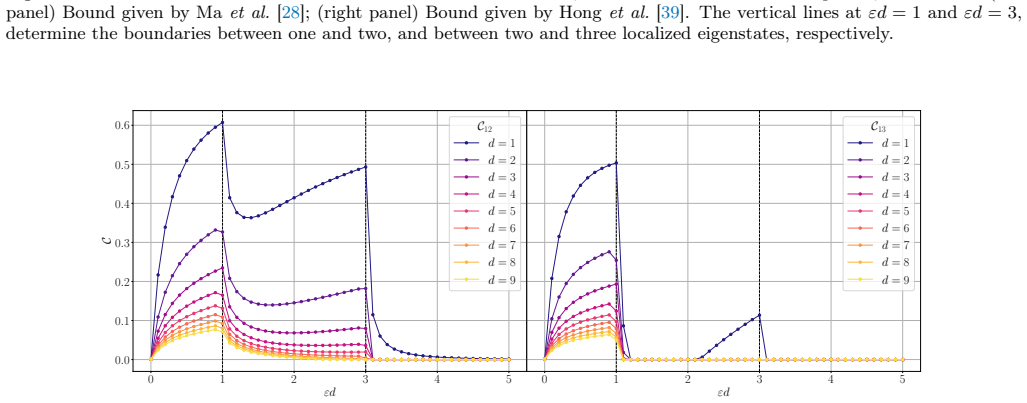
The central object is the reduced density matrix (RDM) of the three defect spins, obtained by tracing out the rest of the chain. Because the XX model maps to free fermions via the Jordan-Wigner transformation, the defect Hamiltonian is a single-particle impurity problem; the defects create up to three bound states exponentially localized at the defect sites, whose number is set by the inequalities 0<ε<1/d, 1/d<ε<3/d, and 3/d<ε. In the one-bound-state region the RDM is rank two and the convex-roof GME concurrence can be computed exactly, Eq. (20); in the higher-rank regions the paper uses numerical lower bounds due to Ma et al. and Hong et al., combined with a biseparability witness, to certify non-biseparability.
What would settle it
For any $h>2$ and $\varepsilon<\sqrt{h^2-4}$, construct the exact ground state of the fermionic Hamiltonian (5) by filling all negative single-particle levels; if the bound level is empty, the three-defect RDM is a product state. Checking whether the numerical GME bounds of Sec. IV A vanish in this region would falsify or confirm the claimed 'whole range' validity.
Extended reading notes
Core claim
For a transverse-field XX chain with equal-strength magnetic defects at three equally spaced sites, the ground-state reduced density matrix of the defect sites exhibits genuine multipartite entanglement at any defect separation d, for both the critical phase |h|≤2 and the paramagnetic phase h≥2. In the single-bound-state regime the reduced density matrix is ρ = p|gW⟩⟨gW| + (1−p)|000⟩⟨000|, and its GME concurrence is exactly C_GME(ρ) = 2 min{√2|ρ12|, √(|ρ14|(1−ρ00−|ρ14|))}, which is positive for all d. When two or three bound states appear, numerical lower bounds for the GME concurrence remain positive up to d=9, and a biseparability witness never detects separability, so the state cannot be decomposed into biseparable parts across any bipartition. The entanglement is of W type, with vanishing three-tangle, so the defects are an instance of long-distance multipartite entanglement in a translationally broken but nearest-neighbour Hamiltonian.
Load-bearing premise
For fields $h>2$, the analytic derivation assumes the single bound state is the one filled in the ground state; this holds only when $\varepsilon>\sqrt{h^2-4}$, and outside that region the defect subsystem is in a product state with zero GME, so the 'whole range' phrasing in the abstract overstates the actual domain of validity.
Editorial extensions
If this is right
- A single localized bound state suffices to sustain genuine tripartite entanglement between three distant sites, with the analytical GME concurrence decaying with distance but never reaching zero.
- Pairwise concurrence can vanish while GME persists, so measuring only two-spin entanglement would miss the resource present in the state.
- The defect-induced GME works in both the gapless critical phase and the gapped paramagnetic phase, so it does not rely on criticality.
- The method extends naturally (by the paper's own argument) to more than three defects, providing a route to higher SLOCC entanglement classes, and to the XY model, where GHZ-type states could be produced.
- Local magnetic control alone can create multipartite entanglement over distances that would be unattainable in a translation-invariant chain, which is relevant for quantum communication and quantum technology applications.
Reading between the lines
- For h>2, the paper's 'whole range' statement implicitly assumes the bound state is the occupied one; a reader can test that for small ε at large h the analytic formula (20) would overestimate the entanglement, since the exact ground state is then the product |000⟩⟨000|. This does not invalidate the mechanism, but it sharpens the parameter range.
- The persistence of GME with vanishing two-qubit concurrence suggests that the defect RDM belongs to a class of states that are tripartite-entangled yet pairwise-separable; this class (generalized W-type with a diagonal kernel) may be a useful resource for quantum repeaters where bistationary entanglement is undesired.
- One could test the prediction experimentally in a trapped-ion or superconducting-qubit simulator of the XX model by measuring the three-site correlation functions that enter Eq. (20) (the elements ρ12, ρ14, ρ00), rather than full state tomography.
Editorial analysis
A structured set of objections, weighed in public.
Referee Report
Summary. Consiglio et al. study an XX spin-1/2 chain with three equally spaced transverse-field magnetic defects and ask whether the reduced density matrix (RDM) of the three defect spins can carry long-distance genuine multipartite entanglement (GME). The model is mapped to free fermions; Green's-function methods are used to locate up to three localized single-particle bound states and to partition the (ε,d) plane into regions with one, two, or three such states. For the case of a single occupied bound state the RDM has rank two, for which the authors derive the closed-form GME concurrence C_GME(ρ)=2 min{√2|ρ12|, √(|ρ14|(1−ρ00−|ρ14|))}. For higher-rank cases they compute numerical lower bounds on C_GME at h=2 and h=1, and they apply a biseparability witness. The central reported finding is that long-distance GME persists for arbitrary defect separation, including regions where all two-qubit concurrences vanish.
Significance. The analytical part is a clean example of a parameter-free free-fermion calculation: the model has no fitting parameters, the bound-state thresholds are derived from Green's functions, and the rank-2 convex-roof evaluation leading to Eq. (20) is elegant and internally consistent. The numerical lower bounds at h=2 and h=1 provide useful corroboration, and the observation that W-type GME can coexist with vanishing pairwise concurrence is a worthwhile contribution to the literature on multipartite entanglement generation by local defects. The main weakness is an overbroad parameter-space claim: the argument as written applies to h=2 (or more generally to the region where the relevant bound state is occupied), not to the whole Hamiltonian parameter space.
major comments (2)
- [Abstract; Sec. IV A, Eqs. (6), (16), (20); Appendix A] The central claim that the defect RDM has non-zero GME "across the whole range of the Hamiltonian parameter space" is not correct for h>2 with small ε. The rank-2 ansatz in Eq. (16) assumes that the localized single-particle bound state is occupied in the ground state. This is automatic at h=2, where the lower band edge h−2 is zero, but for h>2 the band is shifted upward and a bound state below the band can still have positive energy. In the single-defect limit the bound-state energy is E_b = h − √(ε²+4), so it is negative only for ε > √(h²−4). Below this threshold the ground state is the fermion vacuum and the defect RDM is exactly |000⟩⟨000|, for which C_GME=0. The conditions in Eq. (6) and the pole analysis in Appendix A are existence conditions for localized eigenstates below the band, not occupation conditions. The Abstract, the sentence in Sec. IV A that ρ "always has a non-zero GME concurrence independently of the distance d", and the Conclusion should be qualified to h=2 or, more generally, to the region where the lowest pole of Eq. (A16) lies below zero.
- [Sec. IV B and Figs. 5, 8] The text moves from numerical results at h=2 and h=1 to statements such as "for any |h|≤2" and "non-zero long-distance entanglement is present for any value of εd". The numerical lower bounds are only shown for h=2 and h=1, and the analytic rank-2 treatment is specific to the occupied-bound-state case. If the authors intend to claim the result for all |h|≤2 or for all h≥2, they need either additional data or an argument that the lower bounds vary continuously with h. Otherwise the parameter-space statements in Sec. IV B and the Abstract should be restricted to the cases actually computed.
minor comments (3)
- [Sec. IV A, after Fig. 5] The sentence "we always found W ≥0, that is, the state is not separable for any bipartition" is too strong: the Hofmann criterion certifies biseparability when W<0, so W≥0 only means that the iterative procedure did not find a biseparable decomposition. It should be phrased as numerical evidence rather than as a proof of non-biseparability.
- [Fig. 3 and Eq. (6)] The labels "1/2/3 Localized States" in Fig. 3 should be accompanied by an explicit statement that these are thresholds for existence below the band, not for occupation in the ground state; the distinction is important for h>2.
- [Sec. IV A, Eq. (20) and Fig. 4] The phrase "independently of the distance d" would be more precise as "for every finite distance d", since Fig. 4 shows that the value of C_GME becomes vanishingly small as d increases.
Circularity Check
No circularity: the GME derivation follows from the Hamiltonian via Green's functions and convex-roof results; the h>2 occupancy concern is a scope issue, not a circular reduction.
full rationale
The paper's central derivation is self-contained. The model (Eqs. 1-4) is mapped by Jordan-Wigner to free fermions, the bound-state existence regions (Eqs. 6) are obtained from Green's-function pole analysis in Appendix A, and the three-defect RDM (Eq. 7) follows from the symmetries of the Hamiltonian (U(1) conservation, reflection symmetry, realness), not from assuming the target entanglement. The rank-2 form in Eq. (16) for 0<ε<1/d is a consequence of having one occupied localized single-particle state; the analytic GME concurrence in Eq. (20) is then computed via the convex-roof extension using external results (Refs. [46,47]), and the numerical lower bounds and witnesses are evaluated directly from the RDM rather than fitted to produce positivity. The self-citations in the paper ([19], [25-27], [35], [50], [52,53]) are background, method, or comparison citations and are not load-bearing for the central claim. The only substantive concern is that for h>2 with small ε the localized bound state may have positive energy and thus be unoccupied, making the defect RDM a product state; this is an unstated occupancy condition and a correctness/scoping issue, not a circular reduction of the prediction to its inputs. Therefore the paper exhibits no significant circularity and the derivation is independent of its conclusions.
Assumptions & free parameters
assumptions (5)
- standard math Jordan-Wigner transformation maps the spin chain to non-interacting fermions
- domain assumption Ground state is found by filling all single-fermion states with negative energy
- domain assumption The three-defect RDM has the block structure of Eq. (7), with real entries and reflection symmetry
- ad hoc to paper The defect-bound single-particle level is occupied for any h>=2 and epsilon>0
- ad hoc to paper The bound-state counting thresholds epsilon=1/d and 3/d are exact for the lattice model
Cite this review
Pith. "Pith review of Long-distance genuine multipartite Entanglement between Magnetic Defects in Spin Chains." pith.science (2026). https://pith.science/paper/ABGGUHWD
@misc{pith2026250112446,
  author       = {Pith},
  title        = {Pith review of: Long-distance genuine multipartite Entanglement between Magnetic Defects in Spin Chains},
  year         = {2026},
  howpublished = {\url{https://pith.science/paper/ABGGUHWD}},
  note         = {Machine review of arXiv:2501.12446}
}
abstract
We investigate the emergence and properties of long-distance genuine multipartite entanglement, induced via three localized magnetic defects, in a one-dimensional transverse-field XX spin-$1/2$ chain. Using both analytical and numerical techniques, we determine the conditions for the existence of bound states localized at the defects. We find that the reduced density matrix (RDM) of the defects exhibits long-distance genuine multipartite entanglement (GME) across the whole range of the Hamiltonian parameter space, including regions where the two-qubit concurrence is zero. We quantify the entanglement by using numerical lower bounds for the GME concurrence, as well as by analytically deriving the GME concurrence in regions where the RDM is of rank two. Our work provides insights into generating multipartite entanglement in many-body quantum systems via local control techniques.
Figures


Figures from the paper (5 more)



Reference graph
Works this paper leans on
- [1]
- [2]
-
[3]
Tóth, Phys
G. Tóth, Phys. Rev. A85, 022322 (2012)
2012
-
[4]
Raussendorf and H
R. Raussendorf and H. J. Briegel, Phys. Rev. Lett.86, 5188 (2001)
2001
-
[5]
W. Dür, G. Vidal, and J. I. Cirac, Physical Review A62, 062314 (2000)
2000
-
[6]
F. Verstraete, J. Dehaene, B. De Moor, and H. Ver- schelde, Phys. Rev. A65, 052112 (2002)
work page 2002
-
[7]
P. Horodecki, L. Rudnicki, and K. Życzkowski, Multipar- tite entanglement (2024), arXiv:2409.04566 [quant-ph]
arXiv 2024
-
[8]
M. Ma, Y. Li, and J. Shang, Fundamental Research https://doi.org/10.1016/j.fmre.2024.03.031 (2024)
Show all 53 references
-
[9]
Walter, D
M. Walter, D. Gross, and J. Eisert, Multipartite Entan- glement, in Quantum Information (John Wiley & Sons, Ltd, 2016) Chap. 14, pp. 293–330
2016
-
[10]
Eltschka and J
C. Eltschka and J. Siewert, Journal of Physics A: Math- ematical and Theoretical47, 424005 (2014)
2014
-
[11]
Bengtsson and K
I. Bengtsson and K. Życzkowski,Geometry of Quantum States (Cambridge University Press, Cambridge, 2017)
2017
-
[12]
Lepori, A
L. Lepori, A. Trombettoni, D. Giuliano, J. Kombe, 9 J. Yago Malo, A. J. Daley, A. Smerzi, and M. Luisa Chio- falo, Journal of Physics A: Mathematical and Theoretical 56, 305302 (2023)
2023
-
[13]
Wieśniak, Multipartite Entanglement versus Multi- particle Entanglement (2024), arXiv:2407.13348 [quant- ph]
M. Wieśniak, Multipartite Entanglement versus Multi- particle Entanglement (2024), arXiv:2407.13348 [quant- ph]
2024 arXiv
-
[14]
Jungnitsch, T
B. Jungnitsch, T. Moroder, and O. Gühne, Phys. Rev. Lett. 106, 190502 (2011)
2011
-
[15]
Cianciaruso, T
M. Cianciaruso, T. R. Bromley, and G. Adesso, npj Quantum Information 2, 16030 (2016)
2016
-
[16]
Sperling and W
J. Sperling and W. Vogel, Phys. Rev. Lett.111, 110503 (2013)
2013
-
[17]
Gühne, G
O. Gühne, G. Tóth, and H. J. Briegel, New Journal of Physics 7, 229 (2005)
2005
-
[18]
Amico, R
L. Amico, R. Fazio, A. Osterloh, and V. Vedral, Reviews of Modern Physics80, 517 (2008)
2008
-
[19]
S. M. Giampaolo and B. C. Hiesmayr, Phys. Rev. A88, 052305 (2013)
2013
-
[20]
Z. Liu, Y. Tang, H. Dai, P. Liu, S. Chen,et al., Phys. Rev. Lett. 129, 260501 (2022)
2022
-
[21]
Campos Venuti, C
L. Campos Venuti, C. Degli Esposti Boschi, and M. Roncaglia, Phys. Rev. Lett.96, 247206 (2006)
2006
-
[22]
S. M. Giampaolo and F. Illuminati, Phys. Rev. A80, 050301 (2009)
2009
-
[23]
Campos Venuti, S
L. Campos Venuti, S. M. Giampaolo, F. Illuminati, and P. Zanardi, Phys. Rev. A76, 052328 (2007)
2007
-
[24]
S. M. Giampaolo and F. Illuminati, New Journal of Physics 12, 025019 (2010)
2010
-
[25]
T. J. G. Apollaro and F. Plastina, Phys. Rev. A 74, 062316 (2006)
2006
-
[26]
Plastina and T
F. Plastina and T. J. G. Apollaro, Phys. Rev. Lett.99, 177210 (2007)
2007
-
[27]
Apollaro, A
T. Apollaro, A. Cuccoli, A. Fubini, F. Plastina, and P. Verrucchi, Physical Review A77, 062314 (2008)
2008
-
[28]
Ma, Z.-H
Z.-H. Ma, Z.-H. Chen, J.-L. Chen, C. Spengler, A. Gabriel, et al., Physical Review A83, 062325 (2011), arXiv:1101.2001
2011 arXiv
-
[29]
E. Lieb, T. Schultz, and D. Mattis, Annals of Physics16, 407 (1961)
1961
-
[30]
Damski and M
B. Damski and M. M. Rams, Journal of Physics A: Math- ematical and Theoretical47, 025303 (2014)
2014
-
[31]
Franchini, An Introduction to Integrable Tech- niques for One-Dimensional Quantum Systems , Vol
F. Franchini, An Introduction to Integrable Tech- niques for One-Dimensional Quantum Systems , Vol. 940 (Springer International Publishing, Cham, 2017) arxiv:1609.02100
2017 arXiv
-
[32]
De Pasquale, G
A. De Pasquale, G. Costantini, P. Facchi, G. Florio, S. Pascazio, et al., The European Physical Journal Spe- cial Topics160, 127 (2008)
2008
-
[33]
E. N. Economou,Green ’s Functions in Quantum Physics, 3rd ed., Springer Series in Solid-State Sciences (Springer- Verlag Berlin Heidelberg, 2006)
2006
-
[34]
P. W. Anderson, Phys. Rev.109, 1492 (1958)
1958
-
[35]
T. J. G. Apollaro, A. Cuccoli, A. Fubini, F. Plastina, and P. Verrucchi, International Journal of Quantum Informa- tion 06, 567 (2008)
2008
-
[36]
Coffman, J
V. Coffman, J. Kundu, and W. K. Wootters, Physical Review A 61, 052306 (1999), arXiv:9907047 [quant-ph]
1999
-
[37]
Horodecki, P
R. Horodecki, P. Horodecki, M. Horodecki, and K. Horodecki, Reviews of Modern Physics81, 865 (2009)
2009
-
[38]
A. Acín, D. Bruß, M. Lewenstein, and A. Sanpera, Phys- ical Review Letters87, 040401 (2001)
2001
-
[39]
Y. Hong, T. Gao, and F. Yan, Phys. Rev. A86, 062323 (2012)
2012
-
[40]
Nocedal and S
J. Nocedal and S. J. Wright, Numerical Optimization , 2nd ed. (Springer, New York, NY, USA, 2006)
2006
-
[41]
Virtanen, R
P. Virtanen, R. Gommers, T. E. Oliphant, M. Haberland, T. Reddy,et al., Nature Methods17, 261 (2020)
2020
-
[42]
Hofmann, A
M. Hofmann, A. Osterloh, and O. Gühne, Phys. Rev. B 89, 134101 (2014)
2014
-
[43]
Gurvits and H
L. Gurvits and H. Barnum, Phys. Rev. A 66, 062311 (2002)
2002
-
[44]
W. K. Wootters, Phys. Rev. Lett.80, 2245 (1998)
1998
-
[45]
L.Amico, A.Osterloh, F.Plastina, R.Fazio,andG.Mas- simo Palma, Phys. Rev. A69, 022304 (2004)
2004
-
[46]
Lohmayer, A
R. Lohmayer, A. Osterloh, J. Siewert, and A. Uhlmann, Phys. Rev. Lett.97, 260502 (2006)
2006
-
[47]
Eltschka, A
C. Eltschka, A. Osterloh, J. Siewert, and A. Uhlmann, New Journal of Physics10, 043014 (2008)
2008
-
[48]
Osterloh, J
A. Osterloh, J. Siewert, and A. Uhlmann, Phys. Rev. A 77, 032310 (2008)
2008
-
[49]
A. F. Abouraddy, B. E. A. Saleh, A. V. Sergienko, and M. C. Teich, Phys. Rev. A64, 050101 (2001)
2001
-
[50]
Pandya, O
P. Pandya, O. Sakarya, and M. Wieśniak, Phys. Rev. A 102, 012409 (2020)
2020
-
[51]
S. M. Hashemi Rafsanjani, M. Huber, C. J. Broadbent, and J. H. Eberly, Phys. Rev. A86, 062303 (2012)
2012
-
[52]
S. M. Giampaolo and B. C. Hiesmayr, New Journal of Physics 16, 093033 (2014)
2014
-
[53]
S. M. Giampaolo and B. C. Hiesmayr, Phys. Rev. A92, 012306 (2015)
2015
Reviewed August 10, 2026 · model on record in the stance chip above.
Discussion (0). Continue with ORCID to comment.