REVIEW 3 major objections 5 minor 41 references
Phenomenology of different cross-section models at DUNE
T0 review · 3 major / 5 minor · reviewed 2026-08-14 · deepseek-v4-flash
Pith's one-line read This paper argues that the choice of neutrino–nucleus cross-section model can change DUNE's projected oscillation sensitivities by 15–30%, with the HF-CRPA+BS combination outperforming the baseline tune.
desk verdict A competent but conditional DUNE simulation study: the HF-CRPA+BS numbers are new and internally consistent, but the headline 'improvement' only holds if that model is the true cross-section. read the letter →
The pith
A machine-rendered reading of the paper's core claim, the machinery that carries it, and where it could break.
The reading
What carries the argument
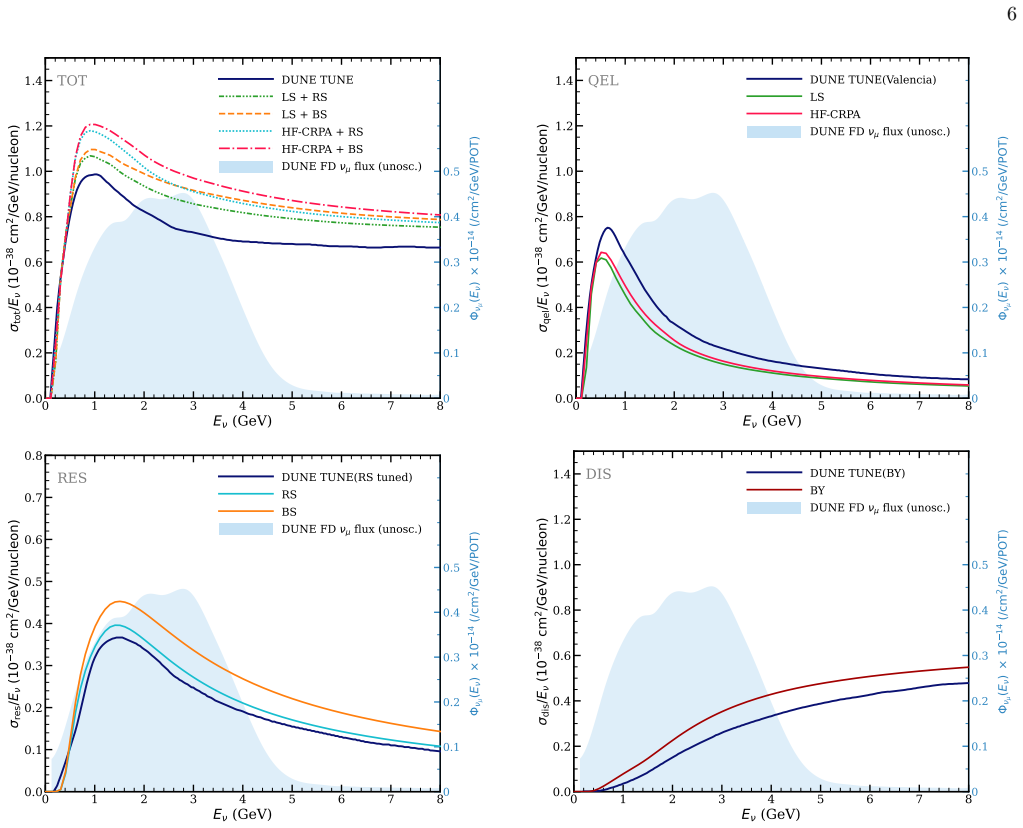
The machinery that carries the argument is the combination of GENIE cross-section models and the GLoBES DUNE simulation. The central objects are the two alternative QEL models—Llewellyn-Smith (LS) and the Hartree–Fock Continuum Random Phase Approximation (HF-CRPA), a microscopic nuclear-response model that includes long-range correlations and continuum final states, interpolated with SuSAv2 at large momentum transfer—and the two RES models—Rein–Sehgal (RS) and Berger–Sehgal (BS), the latter adding updated resonance parameters, non-resonant background, and explicit lepton-mass corrections to RS. The paper fixes all other channels (DIS, 2p2h, ground state) to the DUNE TDR configuration and isolates QEL and RES variations, then uses the Poisson log-likelihood with pull systematics to translate event-rate differences into $\Delta\chi^2$ sensitivities. The mechanism is straightforward: because the DUNE flux peaks near 2.5 GeV where RES dominates, the higher total cross-section of HF-CRPA+BS increases far-detector signal events by 27–37% (Table III), and that event surplus directly inflates the test statistic for every oscillation observable.
What would settle it
Measure the total charged-current neutrino–argon cross-section in the 1–5 GeV range (or the single-pion production cross-section that separates Rein–Sehgal from Berger–Sehgal) and compare the central value with the HF-CRPA+BS prediction; if the data match the DUNE-tune prediction instead, the quoted 25–30% sensitivity improvements will not materialize.
Extended reading notes
Core claim
The central claim is that within DUNE's official simulation framework, the configuration using HF-CRPA for quasi-elastic scattering and the Berger–Sehgal model for resonance production yields substantially better oscillation sensitivities than the baseline DUNE tune, because it predicts a larger neutrino–argon cross-section in the energy range that dominates the DUNE flux. Concretely, the authors report that HF-CRPA+BS raises the CP-violation sensitivity from $\Delta\chi^2 = 78.01$ to $100.96$ at $\delta_{\mathrm{CP}} \simeq 110^\circ$ (about 29.4%), the mass-ordering sensitivity from $\Delta\chi^2 = 558.3$ to $705.2$ near $\delta_{\mathrm{CP}} \simeq 270^\circ$ (about 26.3%), the octant sensitivity by about 25%, and shrinks the $3\sigma$ allowed widths of $\sin^2\theta_{23}$ and $\Delta m^2_{32}$ by about 20% and 15%, respectively. The gain is driven by the resonance region: although the Valencia QEL model has the strongest quasi-elastic cross-section, the DUNE tune's Rein–Sehgal resonance model is the weakest, and RES dominates the total cross-section where the beam peaks around 2.5 GeV. The paper therefore concludes that cross-section modeling in the quasi-elastic–resonance transition region is a source of 15–30% uncertainty in DUNE's projected oscillation sensitivity, and that validating these nuclear models is essential.
Load-bearing premise
The load-bearing premise is that GENIE's implementation of HF-CRPA and the Berger–Sehgal model reliably describe neutrino–argon interactions in DUNE's few-GeV energy range, so the larger cross-section they predict is real physics rather than a modeling artifact.
Editorial extensions
If this is right
- If HF-CRPA+BS is the correct model, DUNE's event rates will be roughly 27–37% higher than the TDR baseline, making the experiment's planned sensitivity to CP violation and mass ordering conservative.
- Since the DUNE tune is the weakest of the four configurations studied, the choice of cross-section model is not a minor technical detail: the spread across models defines an unquantified 15–30% systematic band on DUNE's headline oscillation results.
- The improvement is concentrated in the resonance region, so experimental validation of single-pion production models (BS versus RS) is a direct lever on DUNE's physics reach.
- Because all oscillation observables improve together, the cross-section model acts as a global enhancement of the oscillation information content rather than a channel-specific distortion.
Reading between the lines
- If the HF-CRPA+BS cross-section were reweighted to match published neutrino–argon scattering data, the 25–30% gain might shrink or vanish, since the improvement is driven entirely by a larger predicted cross-section rather than by reduced uncertainty or better data agreement.
- The authors compare against the DUNE TDR baseline but note that the current DUNE analysis uses a different tune; re-running the analysis against that current tune would show whether the model ranking persists.
- A testable prediction of the paper is that model differences should appear most strongly in the low-energy part of the reconstructed spectrum, where BS's lepton-mass corrections matter; DUNE's own data, once collected, could distinguish the models by spectral shape rather than total rate.
- Because the paper fixes the 2p2h and DIS treatments, the reported improvements are conditional on those choices; varying the 2p2h strength could substantially change the relative ranking of the QEL models.
Editorial analysis
A structured set of objections, weighed in public.
Referee Report
Summary. The paper studies how alternative neutrino-nucleus cross-section models affect DUNE's projected sensitivity to standard three-flavor oscillation parameters. For the quasi-elastic region the authors compare the DUNE TDR Valencia tune with the Llewellyn-Smith and Hartree-Fock Continuum Random Phase Approximation (HF-CRPA) models in GENIE; for the resonance region they compare Rein-Sehgal with Berger-Sehgal, using the Bodek-Ritchie ground state and Bodek-Yang DIS for all configurations. They compute total cross sections, far-detector event rates, and GLoBES-based oscillation sensitivities. They find that the HF-CRPA+BS combination gives the largest total cross section and event rates, and report 25--30% improvements in CP-violation, mass-ordering, and octant sensitivities and 15--20% improvements in the precision of sin^2(theta_23) and Delta m^2_32 relative to their implementation of the DUNE TDR tune.
Significance. If the reported numbers were robust, the result would be important: it would show that the choice of cross-section model changes DUNE's projected sensitivity to key oscillation parameters by roughly 15--30%, a potentially large previously underestimated effect. The simulation chain is sensible and uses standard, publicly available tools (GENIE and GLoBES), and the paper is honest in stating that the model-to-model spread implies large systematic errors when fitting data. The paper also correctly isolates the QEL and RES components and shows that the effect is not restricted to one observable. However, the headline improvement is currently presented as a DUNE sensitivity gain even though it is calculated assuming the cross-section model is exactly known and identical in the true and test spectra, with no cross-section-model nuisance parameter in the fit. The quantitative claim therefore needs to be either re-derived with a realistic treatment of cross-section uncertainties or explicitly reframed as a conditional model-scenario comparison. The paper would also be strengthened by validation of the HF-CRPA and Berger-Sehgal predictions against measured neutrino-argon data.
major comments (3)
- [Section III, Eq. (4); Tables III-IV] The reported 25-30% improvement is obtained under the assumption that the cross-section model is exactly known: the same model configuration populates both the true and test spectra in the chi^2 statistic, and the pull terms do not include any cross-section-model nuisance parameter. Under this construction the improvement is a mechanical consequence of the 27-37% event-rate increase in Table III rather than a projected sensitivity gain under realistic uncertainties. The paper's own Section V states that the model spread 'lead[s] to large systematic errors when fitting the actual data,' which directly undermines the abstract's presentation of the improvement as a DUNE sensitivity result. The authors should either marginalize or profile over a cross-section-model systematic (or a conservative normalization/shape uncertainty) and report the residual improvement, or explicitly re-label the numbers as conditional idealized comparisons.
- [Section II.A.3 and Section IV.A] The claim that HF-CRPA+BS is the 'best' configuration is not supported by any comparison with measured neutrino-argon cross-section data. The manuscript itself notes that HF-CRPA lacks full relativistic dynamics and is interpolated with SuSAv2 at large momentum transfer, so it is not established that this model is more accurate than the DUNE tune. Without validation against data (e.g., MicroBooNE, MINERvA, or T2K cross-section measurements), the headline improvement is conditional on an unvalidated model. I request at least a quantitative comparison of GENIE predictions with published argon cross-section data, or a clear caveat that the improvement is a model-scenario statement rather than an expected gain.
- [Section IV.A, first paragraph] The comparison with the DUNE TDR baseline is not apples-to-apples: the text states that the DUNE tune's RS and BY implementations differ from the authors' RS and BY models because of different GENIE versions and 'some specific tuning used in DUNE simulations.' The paper does not specify the GENIE version used, nor how the DUNE tune was reproduced. This ambiguity affects the quantitative baseline: the 15-30% numbers are relative to an approximate DUNE tune, not necessarily the official TDR configuration. Please provide the exact GENIE version and the tuned parameter values, and justify that the residual model differences do not bias the comparison.
minor comments (5)
- [Section IV.B, Table III] The table caption says 'at the parameter values' with no following period, and the row labels for beam modes and channels are inconsistent with the text (e.g., 'Neutrino (FHC)' versus 'neutrino mode').
- [Figures 4 and 5] The axis labels and y-axis titles are garbled; for example, the CP-violation panels show '= 2 3 5' and '= 2' instead of clear chi^2 definitions. Please clean up the figures so the quantitative axes are legible.
- [Section II.A.3, final sentence] The sentence beginning 'By combining the self-consistent mean field of HF...' is an incomplete sentence and should be finished or merged with the preceding paragraph.
- [Abstract and Section IV.C] The paper quotes '15-20%' improvement for sin^2(theta_23) and Delta m^2_32, but Table V shows specific reductions of 19.9% and 14.9%; please state the specific values to avoid a misleading range.
- [Reference [20]] Reference [20] is a presentation slide set; if the DUNE baseline model is cited, please also cite a peer-reviewed description (e.g., the DUNE TDR or a published tuning document) so readers can reproduce the comparison.
Circularity Check
No significant circularity: the sensitivity gains are a direct, non-circular consequence of GENIE event-rate differences.
full rationale
I walked the paper's derivation chain: GENIE cross-section models (Section II) produce far-detector event spectra (Section IV.B and Table III), and those spectra enter the Poisson chi-square of Eq. (4) to yield oscillation sensitivities (Section IV.C and Tables IV–V). No parameter is fitted to the target sensitivity, and no equation defines the claimed improvement in terms of itself. The HF-CRPA implementation rests on the external GENIE work of Dolan et al. [29], not on the present authors; the DUNE TDR GLoBES files are external benchmarks. The statement in Section V that 'large differences in the sensitivity due to different cross-section models... lead to large systematic errors when fitting the actual data' is a limitation on external validity, not a circular reduction: the 25–30% improvements are conditional scenarios obtained by using the same cross-section model for both true and test spectra, and they scale from the 27–37% event-rate increases in Table III. Whether HF-CRPA+BS is the true neutrino-argon cross-section is a model-validation question outside the paper's circularity. Since I found no equation that reduces to its input, no fitted parameter renamed as a prediction, and no load-bearing self-citation, the appropriate score is 0.
Assumptions & free parameters
assumptions (5)
- domain assumption GENIE cross-section model implementations are valid representations of neutrino-argon interactions in the 0.5-5 GeV range.
- domain assumption NuFIT v6.01 best-fit values describe the true oscillation parameters.
- domain assumption DUNE TDR GLoBES configuration files adequately model the DUNE beam, detector, and systematic uncertainties.
- domain assumption Cross-section model differences in event rates map directly into oscillation sensitivity changes without additional spectral shape systematics.
- ad hoc to paper The authors' GENIE version and model implementations are close enough to the DUNE TDR versions for a meaningful comparison.
Cite this review
Pith. "Pith review of Phenomenology of different cross-section models at DUNE." pith.science (2026). https://pith.science/paper/ABQRAQBD
@misc{pith2026260808609,
  author       = {Pith},
  title        = {Pith review of: Phenomenology of different cross-section models at DUNE},
  year         = {2026},
  howpublished = {\url{https://pith.science/paper/ABQRAQBD}},
  note         = {Machine review of arXiv:2608.08609}
}
abstract
In this paper, we study the impact of different cross-section models in the measurement of the neutrino oscillation parameters in DUNE. In particular, for the quasi-elastic (QEL) region, we considered the Llewellyn-Smith formalism (LS) and the Hartree-Fock Continuum Random Phase Approximation (HF-CRPA) and for the resonance (RES) region, we consider the Rein-Sehgal (RS) and the Berger-Sehgal (BS) models, and compare our results with the DUNE cross-section tune (Valencia model for QEL and RS model for RES), which was considered in their technical design report. Our results show that while the DUNE tune is best for QEL, the best model for RES is BS. As the DUNE energy region is mainly dominated by RES, for the total cross-section, the HF-CRPA+BS model provides the best strength in the cross-section, whereas the DUNE tune is the weakest among all the configurations considered in our work. Regarding the neutrino mass ordering, CP violation and octant sensitivity, the HF-CRPA+BS model provides $(25- 30)$% improvement, and regarding the precision of the $\theta_{23}$ and $\Delta m^2_{32}$, the same model provides $(15 - 20)$% improvement as compared to the DUNE tune.
Figures


Figures from the paper (2 more)


Reference graph
Works this paper leans on
-
[1]
Valencia Model Although the simplest nuclear model to describe the ground state of the nucleons is the Relativistic Fermi Gas (RFG), which assumes the nucleons to be freely moving (Fermi motion) inside the nucleus, correlated by Pauli’s principle, the Local Fermi Gas developed by the Valencia group [21] provides a more realistic description by incor- pora...
work page 2017
-
[2]
Llewellyn-Smith Formalism (LS) Llewellyn-Smith Formalism (LS) describes charged- current quasi-elastic (CCQE) neutrino-nucleon scatter- ing, mediated by aW ± boson. The hadronic weak cur- rent is formulated using Lorentz invariant form factors reflecting the internal structure of nucleons, and the dif- ferential cross section is given as dσ dQ2 = G2 F M 2...
-
[3]
Hartree–Fock continuum random phase approximation (HF-CRPA) The Continuum Random Phase Approximation (CRPA) provides a microscopic description of nuclear ex- citations and plays an important role in modeling lepton– nucleus scattering, especially in the low and intermediate energy regimes where collective nuclear effects cannot be ignored. Its development...
-
[4]
Rein Sehgal Model (RS) The Rein–Sehgal (RS) model offers a unified treatment of neutrino-induced baryon resonance production in the few-GeV energy range. Within this approach, an incom- ing neutrino excites a bound nucleon to a baryon reso- nanceRof invariant massW, which then decays (most commonly intoπNfinal states). The model is built upon the Feynman–...
-
[5]
It was introduced to address sev- eral well-known deficiencies of the original RS model
Berger Sehgal Model (BS) The Berger–Sehgal (BS) model is an improved ver- sionofthetraditionalRSframeworkforneutrino-induced single-pion production. It was introduced to address sev- eral well-known deficiencies of the original RS model. While the BS model preserves the core theoretical struc- ture of the RS approach, it adds three key refinements: (i) up...
work page 2024
-
[6]
Hyper-kamiokande design report,
Hyper-Kamiokande Proto-Collaboration, :, K. Abe, et al., “Hyper-kamiokande design report,” (2018), arXiv:1805.04163 [physics.ins-det]
arXiv 2018
-
[8]
The GENIE Neutrino Monte Carlo Generator,
C. Andreopouloset al., “The GENIE Neutrino Monte Carlo Generator,” Nucl. Instrum. Meth. A614, 87–104 (2010)
work page 2010
-
[9]
Simula- tions from a new neutrino event generator,
C. Juszczak, J. A. Nowak, and J. T. Sobczyk, “Simula- tions from a new neutrino event generator,” Nucl. Phys. B Proc. Suppl.159, 211–216 (2006)
work page 2006
Show all 41 references
-
[10]
Transport-theoretical De- scription of Nuclear Reactions,
O. Buss, T. Gaitanos, K. Gallmeister, H. van Hees, M. Kaskulov, O. Lalakulich, A. B. Larionov, T. Leit- ner, J. Weil, and U. Mosel, “Transport-theoretical De- scription of Nuclear Reactions,” Phys. Rept.512, 1–124 (2012)
2012
-
[11]
The NEUT neutrino in- teraction simulation program library,
Y. Hayato and L. Pickering, “The NEUT neutrino in- teraction simulation program library,” Eur. Phys. J. ST 230, 4469–4481 (2021)
2021
-
[12]
Pauli blocking for a relativistic fermi gas in quasielastic lepton nucleus scattering,
Arie Bodek, “Pauli blocking for a relativistic fermi gas in quasielastic lepton nucleus scattering,” (2021), arXiv:2111.03631 [nucl-th]
2021 arXiv
-
[13]
Final state interactions in neutrino–nucleus experiments,
S. Dytman, “Final state interactions in neutrino–nucleus experiments,” Acta Phys. Polon. B40, 2445–2460 (2009)
2009
-
[14]
NuSTEC White Paper: Status and Challenges of Neutrino– Nucleus Scattering,
L. Alvarez-Ruso, M. Sajjad Athar,et al., “NuSTEC White Paper: Status and Challenges of Neutrino– Nucleus Scattering,” Prog. Part. Nucl. Phys.100, 1–68 (2018)
2018
-
[15]
First measurement of the muon neutrino charged cur- rent quasielastic double differential cross section,
A. A. Aguilar-Arevaloet al.(MiniBooNE Collaboration), “First measurement of the muon neutrino charged cur- rent quasielastic double differential cross section,” Phys. Rev. D81, 092005 (2010)
2010
-
[16]
Unified approach for nucleon knock-out and coherent and incoherent pion production in neutrino interactions with nuclei,
M. Martini, M. Ericson, G. Chanfray, and J. Marteau, “Unified approach for nucleon knock-out and coherent and incoherent pion production in neutrino interactions with nuclei,” Phys. Rev. C80, 065501 (2009)
2009
-
[17]
Long-baseline neutrino oscillation physics po- tentialoftheDUNEexperiment,
Abiet al., “Long-baseline neutrino oscillation physics po- tentialoftheDUNEexperiment,” Eur.Phys.J.C80,978 (2020)
2020
-
[18]
CP-violation or Nuclear Excitation: Reviewing the Role of Neutrino Interaction Model Uncertainties on Accelerator-Based Neutrino Os- cillation Measurements,
Stephen Dolan, Luke Pickering, Patrick Stowell, Callum Wilkinson, and Clarence Wret, “CP-violation or Nuclear Excitation: Reviewing the Role of Neutrino Interaction Model Uncertainties on Accelerator-Based Neutrino Os- cillation Measurements,” (2026), arXiv:2605.28671 [hep- ex]
2026 arXiv
-
[19]
Neutrino reactions at accelerator energies,
C. H. Llewellyn Smith, “Neutrino reactions at accelerator energies,” Phys. Rept.3, 261–379 (1972)
1972
-
[20]
Continuum random phase approximation ap- proach to charged-current neutrino-nucleus scattering,
N. Jachowicz, K. Heyde, J. Ryckebusch, and S. Rom- bouts, “Continuum random phase approximation ap- proach to charged-current neutrino-nucleus scattering,” Phys. Rev. C65, 025501 (2002)
2002
-
[21]
Low-energy excitations and quasielas- tic contribution to electron-nucleus and neutrino-nucleus scattering in the continuum random-phase approxima- tion,
V. Pandey, N. Jachowicz, T. Van Cuyck, J. Ryckebusch, and M. Martini, “Low-energy excitations and quasielas- tic contribution to electron-nucleus and neutrino-nucleus scattering in the continuum random-phase approxima- tion,” Phys. Rev. C92, 024606 (2015)
2015
-
[22]
Neutrino Excitation of Baryon Resonances and Single Pion Production,
Dieter Rein and Lalit M. Sehgal, “Neutrino Excitation of Baryon Resonances and Single Pion Production,” Annals Phys.133, 79–153 (1981)
1981
-
[23]
Lepton mass effects in single pion production by neutrinos,
Ch. Berger and L. M. Sehgal, “Lepton mass effects in single pion production by neutrinos,” Phys. Rev. D76, 113004 (2007)
2007
-
[24]
Deep Underground Neu- trino Experiment (DUNE), Far Detector Technical De- sign Report, Volume II: DUNE Physics,
Babak Abiet al.(DUNE), “Deep Underground Neu- trino Experiment (DUNE), Far Detector Technical De- sign Report, Volume II: DUNE Physics,” (2020), 10.2172/1599307, arXiv:2002.03005 [hep-ex]
2020
-
[25]
DUNE Baseline Model and Uncertainties,
Stephen Dolan, Richard Gran, Jaesung Kim, and Laura Munteanu, “DUNE Baseline Model and Uncertainties,” Presentation slides, CERN Indico (2025), accessed: 2026- 08-06
2025
-
[26]
In- clusive Charged–Current Neutrino–Nucleus Reactions,
J. Nieves, I. Ruiz Simo, and M. J. Vicente Vacas, “In- clusive Charged–Current Neutrino–Nucleus Reactions,” Phys. Rev. C83, 045501 (2011). 13
2011
-
[27]
The GENIE Neutrino Monte Carlo Generator: Physics and User Manual,
Andreopouloset al., “The GENIE Neutrino Monte Carlo Generator: Physics and User Manual,” (2015), arXiv:1510.05494 [hep-ph]
2015 arXiv
-
[28]
Superscaling in inclusive electron–nucleus scattering,
T. W. Donnelly and I. Sick, “Superscaling in inclusive electron–nucleus scattering,” Phys. Rev. Lett.82, 3212– 3215 (1999)
1999
-
[29]
Scaling and superscaling in inclusive electron–nucleus scattering,
T. W. Donnelly and I. Sick, “Scaling and superscaling in inclusive electron–nucleus scattering,” Phys. Rev. C60, 065502 (1999)
1999
-
[30]
Electronscatteringfromatoms, nuclei and nucleons,
GeoffreyB.West,“Electronscatteringfromatoms, nuclei and nucleons,” Physics Reports18, 263–323 (1975)
1975
-
[31]
Superscaling analysis of inclusive electron scattering with relativistic effective mass,
J. A. Caballero, M. B. Barbaro, A. N. Antonov, M. V. Ivanov, and T. W. Donnelly, “Superscaling analysis of inclusive electron scattering with relativistic effective mass,” Phys. Rev. C81, 055502 (2010)
2010
-
[32]
Superscaling in inclusive electron scattering from nuclei with realistic spectral functions,
A. N. Antonov, M. V. Ivanov, J. A. Caballero, M. B. Barbaro, J. M. Udias, E. Moya de Guerra, and T. W. Donnelly, “Superscaling in inclusive electron scattering from nuclei with realistic spectral functions,” Phys. Rev. C83, 045504 (2011)
2011
-
[33]
Extensions of super- scaling from relativistic mean field theory: The susav2 model,
R. González-Jiménez, G. D. Megias, M. B. Barbaro, J. A. Caballero, and T. W. Donnelly, “Extensions of super- scaling from relativistic mean field theory: The susav2 model,” Phys. Rev. C90, 035501 (2014)
2014
-
[34]
Implementation of the contin- uum random phase approximation model in the genie generator and an analysis of nuclear effects in low-energy transferneutrinointeractions,
S.Dolan, A.Nikolakopoulos, O.Page, S.Gardiner, N.Ja- chowicz, and V. Pandey, “Implementation of the contin- uum random phase approximation model in the genie generator and an analysis of nuclear effects in low-energy transferneutrinointeractions,” Phys.Rev.D106,073001 (2022)
2022
-
[35]
Current matrix elements from a relativistic quark model,
R. P. Feynman, M. Kislinger, and F. Ravndal, “Current matrix elements from a relativistic quark model,” Phys. Rev. D3, 2706–2732 (1971)
1971
-
[36]
Simulation of long-baseline neutrino oscillation experiments with GLoBES (General Long Baseline Experiment Simula- tor),
P. Huber, M. Lindner, and W. Winter, “Simulation of long-baseline neutrino oscillation experiments with GLoBES (General Long Baseline Experiment Simula- tor),” Comput. Phys. Commun.167, 195–202 (2005)
2005
-
[37]
New features in the simulation of neutrino oscillation experiments with GLoBES 3.0: General Long Baseline Experiment Sim- ulator,
Patrick Huber, Joachim Kopp, Manfred Lindner, Mark Rolinec, and Walter Winter, “New features in the simulation of neutrino oscillation experiments with GLoBES 3.0: General Long Baseline Experiment Sim- ulator,” Comput. Phys. Commun.177, 432–438 (2007), arXiv:hep-ph/0701187
2007 arXiv
-
[38]
Experiment sim- ulation configurations approximating dune tdr,
B. Abiet al.(DUNE Collaboration), “Experiment sim- ulation configurations approximating dune tdr,” (2021), arXiv:2103.04797 [hep-ex]
2021
-
[39]
Further studies of fermi- motion effects in lepton scattering from nuclear targets,
A. Bodek and J. L. Ritchie, “Further studies of fermi- motion effects in lepton scattering from nuclear targets,” Phys. Rev. D24, 1400–1402 (1981)
1981
-
[40]
Neutrino–nucleus quasi-elastic and 2p2h interactions up to 10 GeV,
R. Gran, J. Nieves, F. Sanchez, and M. J. Vicente Vacas, “Neutrino–nucleus quasi-elastic and 2p2h interactions up to 10 GeV,” Phys. Rev. D88, 113007 (2013)
2013
-
[41]
Getting the most from the statistical anal- ysis of solar neutrino oscillations,
G. L. Fogli, E. Lisi, A. Marrone, D. Montanino, and A. Palazzo, “Getting the most from the statistical anal- ysis of solar neutrino oscillations,” Phys. Rev. D66, 053010 (2002)
2002
-
[42]
Superbeams ver- sus neutrino factories,
P. Huber, M. Lindner, and W. Winter, “Superbeams ver- sus neutrino factories,” Nucl. Phys. B645, 3–48 (2002)
2002
Reviewed August 14, 2026 · model on record in the stance chip above.
Discussion (0). Continue with ORCID to comment.