REVIEW 3 major objections 5 minor 32 references
Imaginary rotation lowers bare static quark free energies above Tc in a position-dependent way, while the zero-temperature potential shows no clear effect.
Reviewed by Pith at T0; open to challenge. T0 means a machine referee read the full paper against a public rubric. the ladder, T0–T4 →
T0 review · grok-4.5
2026-07-30 16:23 UTC pith:AJOFLZTX
load-bearing objection First lattice measurement of static QQ free energies under imaginary rotation: finite-T suppression with radial dependence is real and carefully framed; bare-action renormalization is the soft spot, not the method. the 3 major comments →
Static Quark-Antiquark Interactions Under Rotation
The pith
A machine-rendered reading of the paper's core claim, the machinery that carries it, and where it could break.
Core claim
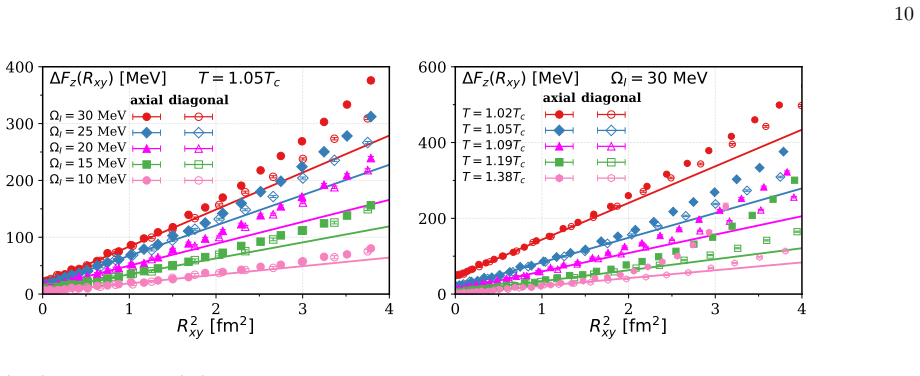
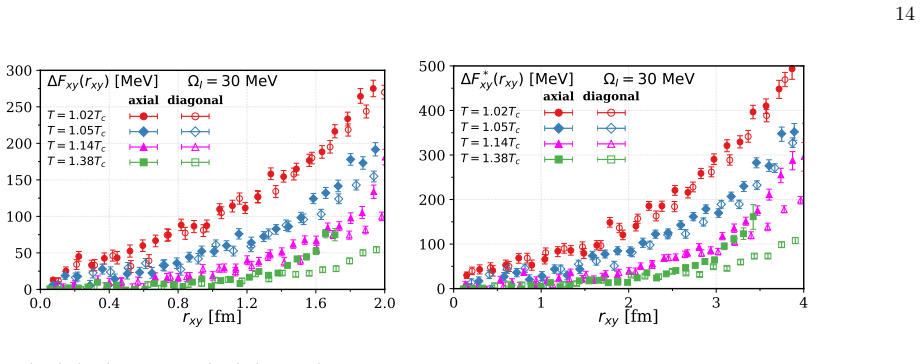
In quenched rotating SU(3) gluodynamics at imaginary angular velocity, bare color-averaged static free energies above Tc are suppressed by rotation in longitudinal and transverse source geometries. In a bulk region selected by axial–diagonal consistency, the large-distance longitudinal shift is well described by ΔF_z(R_xy)=A R_xy^2+B, with A and B growing with Ω_I and shrinking as temperature rises above Tc; transverse data show the same qualitative suppression and are compatible with a radial single-source free-energy shift. At T≃0 no significant rotation dependence or anisotropy is resolved.
What carries the argument
Rotation-induced free-energy differences ΔF_s = F_s(Ω_I=0) − F_s(Ω_I≠0) from Polyakov-loop correlators (and Wilson-loop potentials at T≃0), combined with axial–diagonal bulk selection under open transverse boundaries; the longitudinal bulk shift is parametrized as ΔF_z(R_xy)=A R_xy^2+B.
Load-bearing premise
The authors treat the additive renormalization of the bare free energies as depending only on temperature, not on rotation or radial position, so that zero-minus-nonzero rotation differences measure medium response rather than renormalization artifacts.
What would settle it
A continuum, short-distance-renormalized measurement of the same Polyakov free-energy differences in the bulk that finds no R_xy^2-dependent suppression above Tc, or finds that the reported ΔF shifts vanish once an Ω_I-dependent additive constant is removed.
If this is right
- Above Tc, imaginary rotation lowers bare static free energies more strongly nearer the transition and farther from the axis in the bulk.
- Transverse free-energy shifts largely track radial single-source shifts rather than a pure pair-separation effect once screening sets in.
- Any leading analytic continuation to real rotation would flip the sign of the quadratic Ω^2 term relative to the imaginary-Ω data.
- Zero-temperature static potentials need higher precision or larger Ω_I before a rotation-induced anisotropy can be claimed.
Where Pith is reading between the lines
- If the R_xy^2 bulk response survives renormalization and continuum limits, heavy-quark probes in rotating media should be treated as radially inhomogeneous observables, not single bulk potentials.
- The contrast between a null T≃0 result and a strong near-Tc response points to medium-dominated physics rather than a vacuum string modification under imaginary rotation.
- Full QCD with dynamical quarks could change both the size of ΔF and how fast it falls with T, especially if fermionic and gluonic rotation compete as in existing thermodynamics studies.
Editorial analysis
A structured set of objections, weighed in public.
Referee Report
Summary. The manuscript presents quenched lattice SU(3) simulations of static quark–antiquark interactions in the rotating-frame formulation at imaginary angular velocity. At T≃0, Wilson-loop potentials are extracted in three geometries (longitudinal, on-axis/off-axis transverse, and symmetric transverse); no significant Ω_I dependence or anisotropy is resolved up to 40 MeV. At T>Tc, color-averaged free energies from Polyakov-loop correlators are suppressed by imaginary rotation in all three geometries. Using axial–diagonal comparisons to define a bulk region with reduced open-boundary artifacts, the large-distance longitudinal shift is fitted to ΔF_z(R_xy)=A R_xy²+B, with A and B increasing in |Ω_I| and decreasing with T above Tc; a global phenomenological interpolation is also provided. Transverse channels show the same qualitative suppression and, in the bulk, are argued to be compatible with a radial single-source free-energy shift. The authors emphasize bare (unrenormalized) observables, quenched dynamics, and imaginary Ω, and caution against quantitative analytic continuation.
Significance. This is the first lattice study of static QQ potentials and free energies in rotating SU(3) gluodynamics, filling a gap relative to existing thermodynamic and Polyakov-loop studies of rotating Yang–Mills/QCD and to holographic predictions of orientation- and position-dependent heavy-quark observables. The multi-geometry setup, OBC-versus-PBC and Dirichlet diagnostics, axial–diagonal bulk selection, bootstrap error treatment, and explicit caveats on bare free energies and imaginary Ω are methodological strengths. If the finite-T radial response survives renormalization and continuum checks, the results would provide useful first-principles benchmarks for effective models and holography of vortical media. The zero-T null result is itself a useful control.
major comments (3)
- [Section V; Eqs. (14), (20), (21)] Sec. V (paragraph on unrenormalized free energies) and the interpretation of Eq. (21): the central finite-T claim treats Ω_I=0 minus Ω_I≠0 differences of bare Polyakov free energies as a position-dependent medium response, under the assumption that additive renormalization depends only on T (not on Ω_I or R_xy). The rotating-frame action (Eq. 14) multiplies spatial plaquettes by metric factors (1+r²Ω_I²), (1+x²Ω_I²), (1+y²Ω_I²) and adds Ω_I-dependent chair terms, so the local bare coupling—and thus the UV normalization of Polyakov loops—can vary with both R_xy and Ω_I. Axial–diagonal bulk cuts and the T≃0 Wilson-loop null result constrain boundary and some direct artifacts, but do not calibrate this local-action contamination. A residual piece can therefore enter the slope A in ΔF_z=A R_xy²+B (and the claimed radial dependence); the text already notes that intercept B may absorb Ω_I-depe
- [Section V.A; Eq. (25); Table II; Figs. 8–9] Sec. V.A and Table II: the global ansatz (25) has χ²/dof=2.35(10) over 896 points and six parameters, and the per-(T,Ω_I) bulk fits average χ²/dof≈1.98. The text correctly labels (25) a phenomenological interpolation, but Figs. 8–9 and the abstract still present A(T,Ω_I) and B(T,Ω_I) as quantitatively characterizing the radial response. The load-bearing statement should be restricted to the robust qualitative trends (suppression by imaginary Ω_I; growth with R_xy in the bulk; weakening with T), with the power-law/Ω² global form demoted to an optional compact description and with explicit sensitivity to bulk-window choice documented (e.g., a table of A,B under alternate axial–diagonal consistency cuts).
- [Section V.B; Eqs. (32)–(35); Fig. 12] Sec. V.B and Eq. (35): the single-source factorization test comparing ΔF*_xy(2r_xy)/2 to ΔF_z(R_xy=r_xy)/2 is an important cross-check, but it is shown only at Ω_I=30 MeV and is described as approximate over a finite bulk range where axial–diagonal consistency still holds. The manuscript should quantify the agreement (e.g., pointwise differences or a consistency metric versus r_xy and T) and state more sharply that the test constrains only the rotation-induced differences ΔF, not factorization of the full free energy at each Ω_I. Without that, the claim that transverse channels are “compatible with a radial single-source free-energy shift” overstates the present evidence.
minor comments (5)
- [Section III; Table I] Scale setting and T/Tc: Table I and the text give T/Tc values but do not state how a(β) and Tc(Ω_I=0) were converted for the Nτ=8 ensembles (beyond citing Refs. [29,32]). A short explicit sentence on the Tc determination (Gaussian fit to χ) and the a(β) formula used would aid reproducibility.
- [Section V.A; Fig. 5] Figure 5 caption and related text: F_z is plotted versus r_z for several R_xy, but the large-r_z plateau values used in ΔF_z(R_xy) are not tabulated. Providing the plateau fit ranges and extracted F_z(R_xy,∞) would make the subsequent A,B analysis easier to audit.
- [Section II] Notation: both r_xy and R_xy appear for transverse distances in different geometries; a single clarifying sentence early in Sec. II would reduce confusion when comparing F_z(R_xy), F_xy(r_xy), and F*_xy(r_xy).
- [Throughout] Typos / copy-editing: “RESUL TS”, “TEMPERA TURE”, “ROT A TION”, “ST A TIC” and similar spaced capitals appear in section headings; “Fakult¨ at” and related accent artifacts in the author block should be cleaned for the journal version.
- [Section III–IV] The zero-T ensembles are called T≃0 at T=73.5 MeV; briefly noting that this is ≪Tc and that no finite-T screening is resolved in the Wilson-loop plateaus would preempt pedantic confusion.
Circularity Check
No significant circularity: lattice measurement paper with data-driven ΔF shifts and explicitly phenomenological fits.
full rationale
The load-bearing chain is simulation → bare Polyakov/Wilson observables → Ω_I=0 minus Ω_I≠0 differences → bulk selection by axial–diagonal consistency → quadratic fit motivated by the rotating-frame velocity scale. ΔF_s is defined from measured correlators (Eqs. 7–10, 20, 29–30), not constructed to equal the claimed radial response. The form ΔF_z=A R_xy²+B (Eq. 21) and the global ansatz (Eq. 25) are fitted to those differences and are labeled a compact phenomenological interpolation (χ²/dof~2.35), not independent predictions forced by the fit inputs. Motivation from (Ω_I R_xy)² and evenness under Ω_I→−Ω_I follows from the external rotating-frame metric (Yamamoto–Hirono), not from a self-citation uniqueness theorem or a renamed prior result. Zero-T null results and transverse factorization checks are additional measurements, not tautologies. Renormalization assumptions (additive constant depends only on T) are a correctness risk, not circularity by construction. No self-definitional loop, fitted-input-as-prediction, or load-bearing self-citation chain is present.
Axiom & Free-Parameter Ledger
free parameters (4)
- A(T, Ω_I), B(T, Ω_I) in ΔF_z = A R_xy^2 + B =
T- and Ω_I-dependent; e.g. trends in Figs. 8–9
- Global interpolation parameters A2, a0, a2, B2, b0, b2 =
A2=489(11) MeV; a0=0.787(10); a2=2.336(91)e-4 MeV^-2; B2=8.92(70)e-4 MeV^-1; b0=1.303(27); b2=2.74(18)e-4 MeV^-2
- Bulk R_xy fit windows
- Wilson-loop effective-mass plateau windows
axioms (6)
- domain assumption Rotation is implemented via the Yamamoto–Hirono Euclidean metric with imaginary angular velocity Ω_I to avoid the sign problem.
- domain assumption Quenched SU(3) gluodynamics adequately captures the gluonic-medium response of static-source free energies under rotation.
- domain assumption Open boundary conditions in the transverse plane, with plaquettes/chairs omitted outside the volume, define a usable rotating ensemble once a bulk region is selected.
- ad hoc to paper Additive renormalization of Polyakov free energies depends only on T, not on Ω_I or R_xy, so bare differences isolate rotation effects.
- domain assumption Large-r_z Polyakov correlators above Tc are dominated by the product of single-loop expectation values up to exponentially small connected pieces.
- domain assumption Leading bulk response is even in Ω_I and organized by the local velocity scale (Ω_I R_xy)^2.
read the original abstract
We study static quark--antiquark interactions in rotating SU(3) gluodynamics using quenched lattice simulations at imaginary angular velocity. At zero temperature, we extract the static potential from Wilson loops for quark--antiquark pairs aligned with the rotation axis, for transverse pairs with one source on the rotation axis, and for symmetric transverse pairs across the rotation axis. Within the present accuracy, no significant rotation dependence or anisotropy is observed in the zero-temperature potential. At finite temperature, imaginary rotation suppresses the color-averaged free energies obtained from Polyakov-loop correlators in both longitudinal and transverse geometries. Axial-diagonal comparisons are used to identify a bulk region where open-boundary artifacts are reduced. In this region, the large-distance longitudinal free-energy shift is well described by $\Delta F_z(R_{xy})=A R_{xy}^2+B$. The transverse channels exhibit the same qualitative suppression, while their distance dependence additionally reflects the radial arrangement of the static sources and is compatible with a radial single-source free-energy shift in the bulk region. For the finite-temperature observables studied above $T_c$, the response weakens as the temperature is increased. These results provide lattice evidence for a position- and geometry-dependent response of bare static-source free energies to imaginary rotation in a gluonic medium.
Figures





Reference graph
Works this paper leans on
-
[1]
Adamczyket al.(STAR), Nature548, 62 (2017), arXiv:1701.06657 [nucl-ex]
L. Adamczyket al.(STAR), Nature548, 62 (2017), arXiv:1701.06657 [nucl-ex]
Pith/arXiv arXiv 2017
-
[2]
M. S. Abdallahet al.(STAR), Phys. Rev. C104, L061901 (2021), arXiv:2108.00044 [nucl-ex]
arXiv 2021
-
[3]
F. Becattini and M. A. Lisa, Ann. Rev. Nucl. Part. Sci.70, 395 (2020), arXiv:2003.03640 [nucl-ex]
Pith/arXiv arXiv 2020
-
[4]
D. E. Kharzeev, J. Liao, S. A. Voloshin, and G. Wang, Prog. Part. Nucl. Phys.88, 1 (2016), arXiv:1511.04050 [hep-ph]
Pith/arXiv arXiv 2016
-
[5]
K. Fukushima, Prog. Part. Nucl. Phys.107, 167 (2019), arXiv:1812.08886 [hep-ph]
Pith/arXiv arXiv 2019
-
[6]
A. Yamamoto and Y. Hirono, Phys. Rev. Lett.111, 081601 (2013), arXiv:1303.6292 [hep-lat]
Pith/arXiv arXiv 2013
-
[7]
V. V. Braguta, A. Y. Kotov, D. D. Kuznedelev, and A. A. Roenko, Pisma Zh. Eksp. Teor. Fiz.112, 9 (2020)
2020
-
[8]
V. V. Braguta, A. Y. Kotov, D. D. Kuznedelev, and A. A. Roenko, Phys. Rev. D103, 094515 (2021), arXiv:2102.05084 [hep-lat]
Pith/arXiv arXiv 2021
- [9]
-
[10]
V. V. Braguta, A. Kotov, A. Roenko, and D. Sychev, PoSLA TTICE2022, 190 (2023), arXiv:2212.03224 [hep-lat]
Pith/arXiv arXiv 2023
-
[11]
V. Braguta, M. Chernodub, E. Eremeev, I. Kudrov, A. Roenko, and D. Sychev (2025) arXiv:2512.04070 [hep-lat]
arXiv 2025
-
[12]
M. N. Chernodub, V. A. Goy, and A. V. Molochkov, Phys. Rev. D107, 114502 (2023), arXiv:2209.15534 [hep-lat]
Pith/arXiv arXiv 2023
-
[13]
V. V. Braguta, M. N. Chernodub, A. A. Roenko, and D. A. Sychev, Phys. Lett. B852, 138604 (2024), arXiv:2303.03147 [hep-lat]
Pith/arXiv arXiv 2024
-
[14]
V. V. Braguta, M. N. Chernodub, and A. A. Roenko, Phys. Lett. B855, 138783 (2024), arXiv:2312.13994 [hep-lat]
Pith/arXiv arXiv 2024
-
[15]
V. V. Braguta, M. N. Chernodub, Y. A. Gershtein, and A. A. Roenko, JHEP09, 079 (2025), arXiv:2411.15085 [hep-lat]
Pith/arXiv arXiv 2025
-
[16]
Y. Jiang and J. Liao, Phys. Rev. Lett.117, 192302 (2016), arXiv:1606.03808 [hep-ph]
Pith/arXiv arXiv 2016
-
[17]
M. N. Chernodub and S. Gongyo, JHEP01, 136 (2017), arXiv:1611.02598 [hep-th]
Pith/arXiv arXiv 2017
-
[18]
X. Wang, M. Wei, Z. Li, and M. Huang, Phys. Rev. D99, 016018 (2019), arXiv:1808.01931 [hep-ph]
Pith/arXiv arXiv 2019
-
[19]
H.-L. Chen, Z.-B. Zhu, and X.-G. Huang, Phys. Rev. D108, 054006 (2023), arXiv:2306.08362 [hep-ph]
Pith/arXiv arXiv 2023
-
[20]
F. Sun, K. Xu, and M. Huang, Phys. Rev. D108, 096007 (2023), arXiv:2307.14402 [hep-ph]
Pith/arXiv arXiv 2023
- [21]
-
[22]
F. Sun, J. Shao, R. Wen, K. Xu, and M. Huang, Phys. Rev. D109, 116017 (2024), arXiv:2402.16595 [hep-ph]
Pith/arXiv arXiv 2024
-
[23]
S. Chen, K. Fukushima, and Y. Shimada, Phys. Rev. Lett.129, 242002 (2022), arXiv:2207.12665 [hep-ph]
Pith/arXiv arXiv 2022
-
[24]
S. Chen, K. Fukushima, and Y. Shimada, Phys. Lett. B859, 139107 (2024), arXiv:2404.00965 [hep-ph]
Pith/arXiv arXiv 2024
-
[25]
K. Fukushima and Y. Shimada, Phys. Lett. B868, 139716 (2025), arXiv:2506.03560 [hep-ph]
Pith/arXiv arXiv 2025
-
[26]
S. Wang, J.-X. Chen, D. Hou, and H.-C. Ren, (2025), arXiv:2505.15487 [hep-ph]
Pith/arXiv arXiv 2025
-
[27]
J.-X. Chen, S. Wang, D. Hou, and H.-C. Ren, Phys. Rev. D111, 026020 (2025), arXiv:2410.04763 [hep-ph]
Pith/arXiv arXiv 2025
-
[28]
O. Kaczmarek and F. Zantow, Phys. Rev. D71, 114510 (2005), arXiv:hep-lat/0503017
Pith/arXiv arXiv 2005
-
[29]
Y. Burnier, H. T. Ding, O. Kaczmarek, A. L. Kruse, M. Laine, H. Ohno, and H. Sandmeyer, JHEP11, 206 (2017), arXiv:1709.07612 [hep-lat]
Pith/arXiv arXiv 2017
-
[30]
J.-X. Chen, D.-F. Hou, and H.-C. Ren, JHEP03, 171 (2024), arXiv:2308.08126 [hep-ph]
Pith/arXiv arXiv 2024
-
[31]
J. Zhou, S. Zhang, J. Chen, L. Zhang, and X. Chen, Phys. Lett. B844, 138116 (2023), arXiv:2310.15609 [hep-ph]
Pith/arXiv arXiv 2023
-
[32]
A. Francis, O. Kaczmarek, M. Laine, T. Neuhaus, and H. Ohno, Phys. Rev. D91, 096002 (2015), arXiv:1503.05652 [hep-lat]
Pith/arXiv arXiv 2015
discussion (0)
Sign in with ORCID, Apple, or X to comment. Anyone can read and Pith papers without signing in.