REVIEW 2 major objections 4 minor 51 references
From black hole interior to quantum complexity through operator rank
T0 review · 2 major / 4 minor · reviewed 2026-08-11 · deepseek-v4-flash
Pith's one-line read A black hole interior surface bounds quantum circuit depth from below.
desk verdict New early-time bound from operator rank to circuit depth is real; the non-unitary fix for the headline claim is postselected and unproven, so the paper needs revision but deserves refereeing. read the letter →
The pith
A machine-rendered reading of the paper's core claim, the machinery that carries it, and where it could break.
The reading
What carries the argument
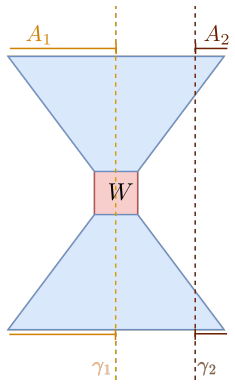
The central object is the operator Schmidt rank $\chi$ of the evolution operator $U = e^{-(\beta/2 + it)H}$: the number of non-zero singular values when $U$ is treated as a map from the past copy to the future copy after bending the thermofield-double tensor network. Its logarithm upper-bounds the entanglement entropy of $A_L \cup A_R$, and any cut through a brickwork circuit that separates that region from the rest gives $\log \chi \leq (\text{number of cut links}) \log D$. The Hartman–Maldacena surface is the geometric analogue of the connected temporal cut, and the paper's argument is the chain linking the surface area, $\log \chi$, and circuit depth.
What would settle it
For a small translationally invariant chaotic spin chain, compute the exact operator Schmidt rank $\chi$ of $U = e^{-(\beta/2 + it)H}$, then search over brickwork circuits of depth $d$ that prepare $U$; if any such circuit satisfies $C d < \log \chi$, the early-time inequality $\log \chi \leq C \times (\text{circuit depth})$ would be refuted.
Extended reading notes
Core claim
For a holographic conformal field theory on two copies in the thermofield-double state, the paper claims that the area of the Hartman–Maldacena surface traversing the black hole interior satisfies $A_{HM}/(4G_N) \leq C \times (\text{circuit depth})$, where $C = A_{\partial} (\log D) r^2 / 4$ is time-independent. At early times this follows from the chain $A_{HM}/(4G_N) = S_{\mathrm{vN}}(A_L \cup A_R) \leq \log \chi \leq C \times (\text{circuit depth})$, where $\chi$ is the operator Schmidt rank of $U = e^{-(\beta/2 + it)H}$; at late times the HM surface continues to exist and grow even after the rank saturates, so the inequality is conjectured to persist by identifying the HM surface with the temporal cut that measures circuit depth.
Load-bearing premise
The argument assumes the non-unitary operator $e^{-(\beta/2 + it)H}$ can be treated as a unitary quantum circuit of nearly the same depth, with the Euclidean factor $e^{-\beta H/2}$ contributing only a constant overhead and effectively replacing the ultraviolet cutoff by $\beta$.
Editorial extensions
If this is right
- Any quantum circuit that prepares the time-evolved thermofield-double state must have depth at least $A_{HM}/(4G_N C)$, so the complexity cannot be hidden by restructuring gates.
- The bound is gate-set independent: $\log \chi$ is an intrinsic property of the unitary, and any circuit gives an upper bound on it, so the inequality constrains the minimal circuit over all gate sets and connectivities.
- At early times, where the HM surface is the minimal extremal surface, the bound is rigorous up to $1/G_N$ corrections and ties entanglement entropy directly to circuit depth.
- The construction lends qualitative support to complexity = volume rather than complexity = action, since summing over codimension-two surfaces produces a volume-like measure.
- The operator rank $\log \chi$ inherits complexity-like properties, subadditivity and a switchback effect, so it behaves like a genuine complexity measure, not just an entanglement diagnostic.
Reading between the lines
- If the late-time conjecture holds, the HM surface area could serve as a computable geometric lower bound on circuit depth even after the operator rank saturates, potentially constraining scrambling times in systems where holography is not assumed.
- The Sz.-Nagy dilation used to justify treating $U$ as unitary suggests a concrete simulation strategy: append an ancilla, implement $e^{-\beta H/2}$ as part of the circuit, and measure operator entanglement to test the early-time chain in small spin systems.
- The same operator-rank argument could extend to open-system or dissipative dynamics, where the evolution is genuinely non-unitary, by defining circuit depth through the dilation.
- The paper establishes only a lower bound; showing a matching upper bound would convert the inequality into an equivalence between interior geometry and circuit complexity.
Editorial analysis
A structured set of objections, weighed in public.
Referee Report
Summary. The paper proposes a relation between the area of the Hartman–Maldacena surface in the black hole interior and the quantum circuit depth of the boundary time evolution, using the operator Schmidt rank as an intermediate quantity. For early times it claims to establish rigorously the chain AHM/(4GN) = SvN(AL∪AR) ≤ log χ ≤ C×(circuit depth), where χ is the operator Schmidt rank of U = e^{−(β/2+it)H}. At late times the paper conjectures that the HM surface area continues to lower-bound the circuit depth even after the entanglement entropy is captured by a disconnected surface. The argument combines holographic entanglement entropy, operator Schmidt rank, tensor-network cut counting, and an appendix showing that log χ satisfies subadditivity and a switchback-type inequality.
Significance. If the early-time bound is rigorous, it provides a concrete, gate-set-independent lower bound on circuit depth from a geometric quantity, which is a rare and potentially valuable result connecting quantum gravity and quantum information. The paper is transparent about the conjectural status of the late-time statement and correctly identifies log χ as an intrinsic complexity proxy with desirable formal properties. The main weakness is the treatment of the non-unitary operator U, which currently prevents the early-time result from being fully rigorous.
major comments (2)
- [Section 3, 'A comment on non-unitarity and UV-cutoff'] The paper assigns a circuit depth to the non-unitary operator U=e^{−(β/2+it)H}, but circuit depth is defined for unitaries. The proposed Sz.-Nagy dilation embeds U into a unitary V acting on the system plus an ancilla and then postselects the ancilla on a fixed state. This is a postselected protocol whose success probability is Z(2β)/Z(β), which is exponentially small in the system size for an extensive system at fixed β. Such a protocol does not yield a standard unitary circuit implementation of U, and postselection is known to allow non-unitary operations at much lower depth than any unitary implementation, so the lower bound log χ ≤ C×(circuit depth) for U does not follow from the dilation argument as stated. The additional assertion that e^{−βH/2} removes UV degrees of freedom and effectively reduces the cutoff to β is not derived from the dilation; it is an independent physical assumption. Because the chain (9) relies on log χ ≤ C×(circuit depth) for this U, the early-time inequality is not established as rigorously as claimed.
- [Section 2, eq. (8)] The bound log χ ≤ C×(circuit depth) is justified by representing U as a brickwork circuit and counting the number of cut links. However, e^{−(β/2+it)H} is not exactly a finite-depth local circuit; any exact circuit decomposition for a generic many-body system has depth exponential in the system size, while a Trotterized circuit only approximates U with a specified error. The paper does not specify the approximation error, the metric with respect to which the approximation is measured, or how the rank of the exact U is related to the rank of the approximating circuit. Without a precise statement of what 'circuit representation' means, the inequality (8) is under-specified, even setting aside the non-unitarity issue.
minor comments (4)
- [Abstract and Section 2, eq. (12)] The abstract and title present the inequality (1) as a general statement, while the late-time part is explicitly conjectural. The authors could state more prominently that the rigorous result is limited to early times and that the late-time extension is a conjecture, to avoid overstating the result.
- [Section 2, eq. (5)] The Schmidt decomposition in eq. (5) uses an approximate sign and a notation with repeated subscripts that is confusing; it should be written with explicit singular values and a clear definition of the cut with respect to which the Schmidt decomposition is taken.
- [Section 2, first paragraph] There is a typo in the first sentence ('defined' should be 'define'), and eq. (3) writes the Boltzmann factor as 'e(−β /2−it)En', which should be e^{−(β/2+it)E_n}.
- [Section 2, footnote and main text] The footnote stating that U is not unitary is placed in a footnote to the caption of Figure 2; the main text should define operator Schmidt rank for non-unitary operators and explain how the rank is computed, especially because this is the central technical quantity.
Circularity Check
No significant circularity: the early-time chain (9) is a sequence of independent inequalities (RT, Schmidt rank, circuit-cut bound), and the late-time claim (12) is explicitly conjectural. Self-citations [41] and [46] are not load-bearing.
full rationale
The central derivation, eq. (9), is AHM/(4GN) = SvN(AL∪AR) ≤ log χ ≤ C × (circuit depth). The first equality uses the standard Ryu–Takayanagi formula; the second uses the fact that entanglement entropy is bounded by the logarithm of the Schmidt rank; the third bounds the operator Schmidt rank by the number of links cut in any brickwork circuit. Each step is an independent mathematical inequality; no parameter is fitted and no equation is defined in terms of the target. The late-time inequality (12) is explicitly presented as a conjecture ('For late times it is a conjecture'), so it is not a claimed derivation that could be circular. The paper contains two self-citations: ref. [41] for the phrase 'entanglement in time' and ref. [46] for an explicit Sz.-Nagy dilation. Neither is load-bearing: the derivation is carried out with operator Schmidt rank, and the dilation theorem is a standard mathematical fact independent of [46]. The only substantive caveat is in Section 3, 'A comment on non-unitarity and UV-cutoff', where the claim that e^{-βH/2} 'removes the UV-degrees of freedom' and gives only a constant overhead is asserted as 'the idea is that...' rather than proved. This is a missing justification that affects rigor, but it is not an equivalence-by-construction or a fit; it is a correctness risk, not circularity. Under the stated criteria, no circular step can be exhibited.
Assumptions & free parameters
assumptions (7)
- domain assumption AdS/CFT dictionary: entanglement entropy of a boundary subregion equals the area of the minimal extremal bulk surface (HRT/RT formula).
- domain assumption The HM surface (connected extremal surface homologous to AL ∪ AR) exists, is the minimal surface at early times, and continues to exist and grow linearly at late times.
- domain assumption Translation invariance and finite system size with periodic boundary conditions, with AL and AR each roughly half the system.
- standard math The brickwork circuit representation of U = e^{-(β/2+it)H} with local gates and connectivity r, such that a temporal cut separates AL ∪ AR from the rest with at most C × depth links.
- domain assumption Interpretation of L and R as past and future of the same system (entanglement in time), so that the TFD state's operator Schmidt rank is the relevant quantity.
- ad hoc to paper The Euclidean factor e^{-βH/2} can be embedded into a unitary via Sz.-Nagy dilation with only constant overhead in depth, and it removes UV degrees of freedom so the effective cutoff is β.
- domain assumption At late times, circuit depth grows linearly until exponentially long times, tracking the HM surface growth.
Cite this review
Pith. "Pith review of From black hole interior to quantum complexity through operator rank." pith.science (2026). https://pith.science/paper/AK3IY33P
@misc{pith2026241215183,
  author       = {Pith},
  title        = {Pith review of: From black hole interior to quantum complexity through operator rank},
  year         = {2026},
  howpublished = {\url{https://pith.science/paper/AK3IY33P}},
  note         = {Machine review of arXiv:2412.15183}
}
read the original abstract
It has been conjectured that the size of the black hole interior captures the quantum gate complexity of the underlying boundary evolution. In this short note we aim to provide a further microscopic evidence for this by directly relating the area of a certain codimension-two surface traversing the interior to the depth of the quantum circuit. Our arguments are based on establishing such relation rigorously at early times using the notion of operator Schmidt rank and then extrapolating it to later times by mapping bulk surfaces to cuts in the circuit representation.
Figures


Figures from the paper (2 more)

Reference graph
Works this paper leans on
-
[41]
Observable and computable entanglement in time
Alexey Milekhin, Zofia Adamska, and John Preskill. “Observable and computable entanglement in time”. In: (Feb. 2025). arXiv: 2502.12240 [quant-ph]
arXiv 2025
-
[1]
Quantum complexity in gravity, quantum field theory, and quantum information science
Stefano Baiguera et al. “Quantum complexity in gravity, quantum field theory, and quantum information science”. In: (Mar. 2025). arXiv: 2503.10753 [hep-th]
arXiv 2025
-
[3]
Addendum to Computational Complexity and Black Hole Hori- zons
Leonard Susskind. “Addendum to Computational Complexity and Black Hole Hori- zons”. In: (2014). arXiv: 1403.5695 [hep-th]. 9
arXiv 2014
-
[4]
Adam R. Brown et al. “Complexity Equals Action”. In: (2015). arXiv: 1509.07876 [hep-th]
arXiv 2015
-
[5]
Complexity, Action, and Black Holes
Adam Brown et al. “Complexity, Action, and Black Holes”. In: (2015). arXiv: 1512. 04993 [hep-th]
work page 2015
-
[6]
Noether charge, black hole vol- ume, and complexity
Josiah Couch, Willy Fischler, and Phuc H. Nguyen. “Noether charge, black hole vol- ume, and complexity”. In: JHEP 03 (2017), p. 119. DOI: 10.1007/JHEP03(2017)
-
[7]
Holographic Complexity and V olume
Josiah Couch et al. “Holographic Complexity and V olume”. In: JHEP 11 (2018), p. 044. DOI: 10.1007/JHEP11(2018)044. arXiv: 1807.02186 [hep-th]
arXiv 2018
-
[8]
Holographic Complexity Equals Which Action?
Kanato Goto et al. “Holographic Complexity Equals Which Action?” In: JHEP 02 (2019), p. 160. DOI: 10.1007/JHEP02(2019)160. arXiv: 1901.00014 [hep-th]
arXiv 2019
Show all 51 references
-
[9]
Does Complexity Equal Anything?
Alexandre Belin et al. “Does Complexity Equal Anything?” In: Phys. Rev. Lett. 128.8 (2022), p. 081602. DOI: 10.1103/PhysRevLett.128.081602 . arXiv: 2111.02429 [hep-th]
2022 arXiv
-
[10]
Complexity equals anything II
Alexandre Belin et al. “Complexity equals anything II”. In: JHEP 01 (2023), p. 154. DOI: 10.1007/JHEP01(2023)154. arXiv: 2210.09647 [hep-th]
2023 arXiv
-
[11]
Complexity and Shock Wave Geometries
Douglas Stanford and Leonard Susskind. “Complexity and Shock Wave Geometries”. In: Phys. Rev. D90.12 (2014), p. 126007. DOI: 10 . 1103 / PhysRevD . 90 . 126007. arXiv: 1406.2678 [hep-th]
2014 arXiv
-
[12]
The volume of the black hole interior at late times
Luca V . Iliesiu, M ´ark Mezei, and G´abor S´arosi. “The volume of the black hole interior at late times”. In: JHEP 07 (2022), p. 073. DOI: 10.1007/JHEP07(2022)073. arXiv: 2107.06286 [hep-th]
2022 arXiv
-
[13]
Linear growth of quantum circuit complexity
Jonas Haferkamp et al. “Linear growth of quantum circuit complexity”. In: Nature Phys. 18.5 (2022), pp. 528–532. DOI: 10.1038/s41567- a022- a01539- a6. arXiv: 2106.05305 [quant-ph]
2022 arXiv
-
[14]
Gapless spin fluid ground state in a random, quan- tum Heisenberg magnet
Subir Sachdev and Jinwu Ye. “Gapless spin fluid ground state in a random, quan- tum Heisenberg magnet”. In: Phys. Rev. Lett. 70 (1993), p. 3339. DOI: 10 . 1103 / PhysRevLett.70.3339. arXiv: cond-amat/9212030 [cond-mat]
1993
-
[15]
http : / / online
Alexei Kitaev. http : / / online . kitp . ucsb . edu / online / joint98 / kitaev/. KITP seminar, Feb. 12, 2015
2015
-
[16]
Remarks on the Sachdev-Ye-Kitaev model
Juan Maldacena and Douglas Stanford. “Remarks on the Sachdev-Ye-Kitaev model”. In: Phys. Rev. D94.10 (2016), p. 106002. DOI: 10 . 1103 / PhysRevD . 94 . 106002. arXiv: 1604.07818 [hep-th]
2016 arXiv
-
[17]
The Spectrum in the Sachdev-Ye-Kitaev Model
Joseph Polchinski and Vladimir Rosenhaus. “The Spectrum in the Sachdev-Ye-Kitaev Model”. In: JHEP 04 (2016), p. 001. DOI: 10 . 1007 / JHEP04(2016 ) 001. arXiv: 1601.06768 [hep-th]
2016 arXiv
-
[18]
A bulk manifestation of Krylov complexity
E. Rabinovici et al. “A bulk manifestation of Krylov complexity”. In: JHEP 08 (2023), p. 213. DOI: 10.1007/JHEP08(2023)213. arXiv: 2305.04355 [hep-th]. 10
2023 arXiv
-
[19]
Krylov complexity of fermion chain in double-scaled SYK and power spectrum perspective
Takanori Anegawa and Ryota Watanabe. “Krylov complexity of fermion chain in double-scaled SYK and power spectrum perspective”. In: JHEP 11 (2024), p. 026. DOI: 10.1007/JHEP11(2024)026. arXiv: 2407.13293 [hep-th]
2024 arXiv
-
[20]
On Chord Dynamics and Complexity Growth in Double-Scaled SYK
Jiuci Xu. “On Chord Dynamics and Complexity Growth in Double-Scaled SYK”. In: (Nov. 2024). arXiv: 2411.04251 [hep-th]
2024 arXiv
-
[21]
Chord diagrams, exact correla- tors in spin glasses and black hole bulk reconstruction
Micha Berkooz, Prithvi Narayan, and Joan Sim ´on. “Chord diagrams, exact correla- tors in spin glasses and black hole bulk reconstruction”. In: Journal of High Energy Physics 2018.8 (2018), p. 192
2018
-
[22]
The bulk Hilbert space of double scaled SYK
Henry W. Lin. “The bulk Hilbert space of double scaled SYK”. In: JHEP 11 (2022), p. 060. DOI: 10.1007/JHEP11(2022)060. arXiv: 2208.07032 [hep-th]
2022 arXiv
-
[23]
A Universal Operator Growth Hypothesis
Daniel E. Parker et al. “A Universal Operator Growth Hypothesis”. In: Phys. Rev. X 9.4 (2019), p. 041017. DOI: 10.1103/ PhysRevX.9.041017 . arXiv: 1812.08657 [cond-mat.stat-mech]
2019 arXiv
-
[24]
Krylov complexity in conformal field the- ory
Anatoly Dymarsky and Michael Smolkin. “Krylov complexity in conformal field the- ory”. In: Phys. Rev. D 104.8 (2021), p. L081702. DOI: 10.1103/PhysRevD.104. L081702. arXiv: 2104.09514 [hep-th]
2021 arXiv
-
[25]
Geometry of Krylov complexity
Pawel Caputa, Javier M. Magan, and Dimitrios Patramanis. “Geometry of Krylov complexity”. In:Phys. Rev. Res.4.1 (2022), p. 013041.DOI: 10.1103/PhysRevResearch. 4.013041. arXiv: 2109.03824 [hep-th]
2022 arXiv
-
[26]
Krylov complexity in large q and double-scaled SYK model
Budhaditya Bhattacharjee, Pratik Nandy, and Tanay Pathak. “Krylov complexity in large q and double-scaled SYK model”. In: JHEP 08 (2023), p. 099. DOI: 10.1007/ JHEP08(2023)099. arXiv: 2210.02474 [hep-th]
2023 arXiv
-
[27]
Quantum chaos and the complexity of spread of states
Vijay Balasubramanian et al. “Quantum chaos and the complexity of spread of states”. In: Phys. Rev. D 106.4 (2022), p. 046007. DOI: 10.1103/PhysRevD.106.046007 . arXiv: 2202.06957 [hep-th]
2022 arXiv
-
[28]
Krylov complexity of modular Hamiltonian evolution
Pawel Caputa et al. “Krylov complexity of modular Hamiltonian evolution”. In: Phys. Rev. D 109.8 (2024), p. 086004. DOI: 10 . 1103 / PhysRevD . 109 . 086004. arXiv: 2306.14732 [hep-th]
2024 arXiv
-
[29]
Krylov complexity in open quantum sys- tems
Chang Liu, Haifeng Tang, and Hui Zhai. “Krylov complexity in open quantum sys- tems”. In: Phys. Rev. Res. 5.3 (2023), p. 033085. DOI: 10.1103/PhysRevResearch. 5.033085. arXiv: 2207.13603 [cond-mat.str-el]
2023 arXiv
-
[30]
Building Krylov complexity from circuit complexity
Chenwei Lv, Ren Zhang, and Qi Zhou. “Building Krylov complexity from circuit complexity”. In:Phys. Rev. Res.6.4 (2024), p. L042001.DOI: 10.1103/PhysRevResearch. 6.L042001. arXiv: 2303.07343 [quant-ph]
2024 arXiv
-
[31]
Time Evolution of Entanglement Entropy from Black Hole Interiors
Thomas Hartman and Juan Maldacena. “Time Evolution of Entanglement Entropy from Black Hole Interiors”. In:JHEP 05 (2013), p. 014.DOI: 10.1007/JHEP05(2013)
2013 doi
-
[32]
Holographic derivation of entanglement en- tropy from AdS/CFT
Shinsei Ryu and Tadashi Takayanagi. “Holographic derivation of entanglement en- tropy from AdS/CFT”. In: Phys. Rev. Lett. 96 (2006), p. 181602. DOI: 10 . 1103 / PhysRevLett.96.181602. arXiv: hep-ath/0603001 [hep-th]
2006
-
[33]
arXiv: 1303.1080 [hep-th]. 11
-
[34]
A geometric approach to quantum circuit lower bounds
Michael A. Nielsen. “A geometric approach to quantum circuit lower bounds”. In: Quant. Inf. Comput. 6.3 (2006), pp. 213–262. DOI: 10.26421/QIC6.3- a2. arXiv: quant-aph/0502070
2006
-
[35]
A Covariant holographic entanglement entropy proposal
Veronika E. Hubeny, Mukund Rangamani, and Tadashi Takayanagi. “A Covariant holographic entanglement entropy proposal”. In: JHEP 07 (2007), p. 062. DOI: 10. 1088/1126-a6708/2007/07/062. arXiv: 0705.0016 [hep-th]
2007 arXiv
-
[36]
Eternal black holes in anti-de Sitter
Juan Martin Maldacena. “Eternal black holes in anti-de Sitter”. In: JHEP 04 (2003), p. 021. DOI: 10 . 1088 / 1126 -a6708 / 2003 / 04 / 021. arXiv: hep -ath / 0106112 [hep-th]
2003
-
[37]
Entangling Power and Quantum Circuit Complexity
J. Eisert. “Entangling Power and Quantum Circuit Complexity”. In: Phys. Rev. Lett. 127.2 (2021), p. 020501. DOI: 10.1103/PhysRevLett.127.020501 . arXiv: 2104. 03332 [quant-ph]
2021 doi
-
[38]
Operator entanglement entropy of the time evolution operator in chaotic systems
Tianci Zhou and David J. Luitz. “Operator entanglement entropy of the time evolution operator in chaotic systems”. In: Physical Review B 95.9 (Mar. 2017). ISSN : 2469-
2017
-
[39]
Entangling power and operator entanglement in qudit systems
Xiaoguang Wang, Barry C. Sanders, and Dominic W. Berry. “Entangling power and operator entanglement in qudit systems”. In: Physical Review A 67.4 (Apr. 2003). ISSN : 1094-1622. DOI: 10.1103/physreva.67.042323 . URL: http://dx.doi. org/10.1103/PhysRevA.67.042323
2003 doi
-
[40]
Information scrambling versus quantum revival through the lens of operator entanglement
Kanato Goto et al. “Information scrambling versus quantum revival through the lens of operator entanglement”. In: JHEP 06 (2022), p. 100. DOI: 10.1007/JHEP06(2022)
2022 doi
-
[42]
Signature of quantum chaos in operator entanglement in 2d CFTs
Laimei Nie et al. “Signature of quantum chaos in operator entanglement in 2d CFTs”. In: J. Stat. Mech. 1909.9 (2019), p. 093107. DOI: 10.1088/1742- a5468/ab3a29 . arXiv: 1812.00013 [hep-th]
2019 arXiv
-
[43]
The entropy of bulk quantum fields and the entanglement wedge of an evaporating black hole
Ahmed Almheiri et al. “The entropy of bulk quantum fields and the entanglement wedge of an evaporating black hole”. In: JHEP 12 (2019), p. 063. DOI: 10.1007/ JHEP12(2019)063. arXiv: 1905.08762 [hep-th]
2019 arXiv
-
[44]
Replica Wormholes and the Entropy of Hawking Radiation
Ahmed Almheiri et al. “Replica Wormholes and the Entropy of Hawking Radiation”. In: JHEP 05 (2020), p. 013. DOI: 10.1007/JHEP05(2020)013 . arXiv: 1911.12333 [hep-th]. 12
2020 arXiv
-
[45]
Replica wormholes and the black hole interior
Geoff Penington et al. “Replica wormholes and the black hole interior”. In: (Nov. 2019). arXiv: 1911.11977 [hep-th]
2019 arXiv
-
[46]
Entanglement Wedge Reconstruction and the Information Para- dox
Geoffrey Penington. “Entanglement Wedge Reconstruction and the Information Para- dox”. In: (May 2019). arXiv: 1905.08255 [hep-th]
2019 arXiv
-
[47]
Operator Entanglement in Local Quan- tum Circuits I: Chaotic Dual-Unitary Circuits
Bruno Bertini, Pavel Kos, and Tomaz Prosen. “Operator Entanglement in Local Quan- tum Circuits I: Chaotic Dual-Unitary Circuits”. In: SciPost Phys. 8.4 (2020), p. 067. DOI: 10.21468/SciPostPhys.8.4.067. arXiv: 1909.07407 [cond-mat.stat-mech]
2020 arXiv
-
[48]
Operator entanglement in local quan- tum circuits II: solitons in chains of qubits
Bruno Bertini, Pavel Kos, and Tomaz Prosen. “Operator entanglement in local quan- tum circuits II: solitons in chains of qubits”. In:SciPost Phys. 8.4 (2020), p. 068. DOI: 10.21468/SciPostPhys.8.4.068. arXiv: 1909.07410 [cond-mat.stat-mech]. 13
2020 arXiv
-
[50]
Measurement-induced phase transition in tele- portation and wormholes
Alexey Milekhin and Fedor K. Popov. “Measurement-induced phase transition in tele- portation and wormholes”. In: SciPost Phys. 17.1 (2024), p. 020. DOI: 10 . 21468 / SciPostPhys.17.1.020. arXiv: 2210.03083 [hep-th]
2024 arXiv
-
[100]
arXiv: 2112.00802 [hep-th]
-
[119]
arXiv: 1610.02038 [hep-th]
-
[9969]
URL: http://dx.doi.org/10.1103/ PhysRevB.95.094206
DOI: 10.1103/physrevb.95.094206. URL: http://dx.doi.org/10.1103/ PhysRevB.95.094206
Reviewed August 11, 2026 · model on record in the stance chip above.
Discussion (0). Continue with ORCID to comment.