REVIEW 3 major objections 8 minor 1 cited by
Benchmarking TCL4: Assessing the Usability and Reliability of Fourth-Order Approximations
T0 review · 3 major / 8 minor · reviewed 2026-08-10 · deepseek-v4-flash
Pith's one-line read For a biased spin-boson system at low temperature, the fourth-order time-convolutionless master equation TCL4 matches exact numerics and cuts TCL2's population error from 15% to about 2%.
desk verdict A useful parameter-space map for TCL4's validity, with a real but addressable caveat about the TEMPO reference convergence. read the letter →
The pith
A machine-rendered reading of the paper's core claim, the machinery that carries it, and where it could break.
The reading
What carries the argument
The object that carries the argument is the fourth-order TCL generator $L_4(t)$, expressed so that the original time-ordered triple integral reduces to a single integration using precomputed timed spectral densities $\Gamma(\omega,t)$ and bath functions $F$, $C$, $R$ (one convolution and one simple integration). This makes parameter scans of TCL4 feasible. The second load-bearing element is the diagnostic norm ratio $\lambda^2\|L_4\|/\|L_2\|$, computed from the generators alone, which marks where the perturbative expansion breaks down; its peaks match the regions where TCL2 deviates most from TEMPO.
What would settle it
Recompute the same low-temperature biased spin-boson dynamics with an independent exact method that does not share TEMPO's Trotter discretization, such as HEOM with enough Matsubara modes to converge at $T=\Omega$ or a TEMPO calculation with $\Delta t=0.005$ extrapolated to $\Delta t\to 0$, and check whether the TCL4-vs-TEMPO trace distance below 0.005 persists; if TCL4's error rises to TCL2's level under the independent reference, the central claim is refuted.
Extended reading notes
Core claim
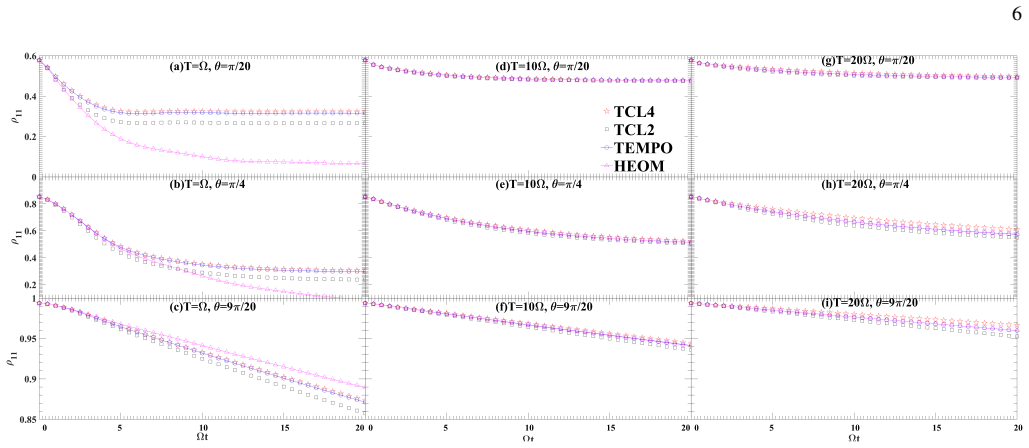
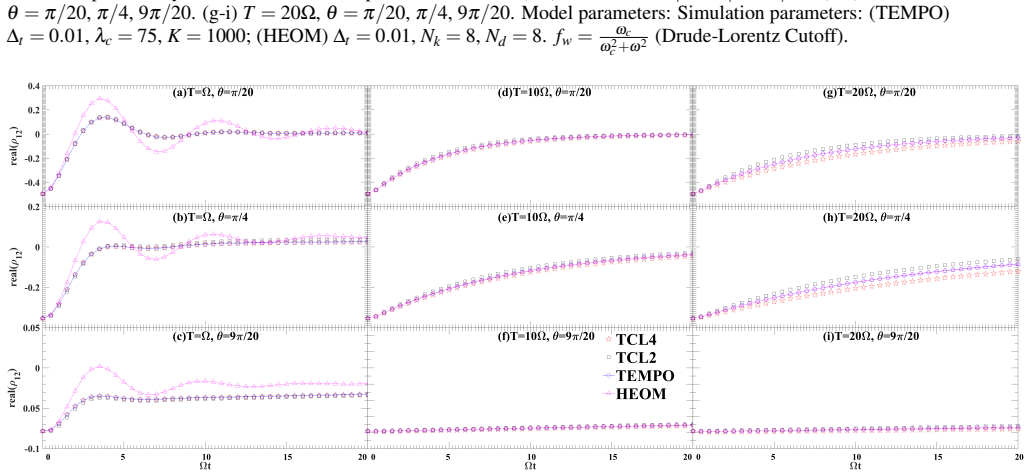
The paper's central claim is that the fourth-order TCL generator extends the validity of time-local master equations into the low-temperature regime near critical bath coupling. For an Ohmic bath with Drude-Lorentz cutoff, $\omega_c=10\Omega$, and $\lambda^2=1$, TCL4 reproduces TEMPO populations to about 2% at $T=\Omega$ while TCL2 is off by 15%, and the time-averaged trace distance between TCL4 and TEMPO stays under 0.005 for biases $\theta$ from 0 to $3\pi/8$, while TCL2 exceeds 0.02. The improvement is attributed to removal of positivity violations caused by the negative real part of the bath correlation function at early low-temperature times. The diagnostic norm ratio $\lambda^2\|L_4\|/\|L_2\|$ peaks exactly where TCL2's errors are largest, and beyond roughly $T=19\Omega$ TCL4 becomes worse than TCL2. In the pure-dephasing limit $\theta=\pi/2$, both TCL2 and TCL4 are exact.
Load-bearing premise
The paper's accuracy claims assume that the TEMPO results are numerically exact, with the TEMPO convergence parameters (time step $\Delta t=0.01$, singular-value cutoff $\lambda_c=75$ or $80$, memory length $K=1000$ or $4000$) checked only against each other; if TEMPO carries a systematic error that does not respond to those parameters, the reported TCL4 gains could be artifacts of the reference.
Editorial extensions
If this is right
- At low temperature and moderate bias, TCL4 can replace the numerically exact TEMPO method for spin-boson population and coherence dynamics, with a computational cost linear in simulation time whereas TEMPO's cost grows with simulation time.
- TCL4 corrects the equilibrium state and population dynamics that TCL2 gets wrong at low temperature, because the fourth-order term substantially mitigates TCL2's early-time positivity violations.
- The reliability boundary is temperature dependent: TCL4 is the better choice below about $T=5\Omega$, comparable through $T\approx19\Omega$, and worse than TCL2 at higher temperatures.
- In the pure-dephasing case $\theta=\pi/2$, TCL2 is already exact, so the fourth-order term is unnecessary there.
- With an exponential-cutoff bath the same low-temperature advantage holds, but a new high-temperature, high-bias region appears where TCL4's coherence oscillates around the exact result and adds error over TCL2.
Reading between the lines
- The norm-ratio diagnostic could be used prospectively inside a simulation: because it is computed from the TCL generators alone, a code could switch from TCL4 back to TCL2 when $\lambda^2\|L_4\|/\|L_2\|$ grows, without needing an exact reference.
- The constant-cost property suggests TCL4 could be applied to larger system sizes or longer simulation times than TEMPO at low temperature, provided the perturbative breakdown criterion is monitored; this extends the paper's efficiency argument beyond the single-qubit case.
- A testable extension is to map how the TCL4/TCL2 crossover temperature scales with coupling strength and cutoff frequency; the authors note that lower coupling should push the validity region to higher temperatures.
Signed reviews
Editorial analysis
A structured set of objections, weighed in public.
Referee Report
Summary. The paper benchmarks the fourth-order time-convolutionless (TCL4) master equation against second-order TCL (TCL2) and numerically exact TEMPO/HEOM for the biased spin-boson model. The authors report that TCL4 is substantially more accurate than TCL2 at low temperature (T=Ω), with population errors of approximately 2% versus 15% and time-averaged trace distance below 0.005 versus above 0.02, while remaining computationally inexpensive. At higher temperatures and biases, the TCL4 advantage diminishes and can reverse. The paper also examines the pure dephasing limit and an exponential-cutoff bath in an appendix, with HEOM comparisons where feasible.
Significance. If the central claim is correct, this is a valuable benchmark that identifies a practical regime (low temperature, Ohmic bath) where TCL4 offers a reliable, low-cost alternative to expensive exact methods. The paper includes an extensive parameter scan, a comparison with HEOM where applicable, and an auxiliary appendix for exponential cutoff spectral densities. The authors are candid about the limitations of HEOM at low temperature and about the conditions under which TCL4 breaks down. The main limitation is that all accuracy claims are measured against TEMPO, and the paper's validation of TEMPO convergence is incomplete; in particular, the fixed Trotter time step is not varied, so the numerical reference may carry a systematic error that the stated convergence heuristic cannot detect. Because the claims are quantitative differences between TCL and TEMPO, this concern is load-bearing and must be addressed before the conclusions can be fully accepted.
major comments (3)
- [Section II.D, Figs. 2-5] The TEMPO convergence heuristic varies only the singular-value cutoff λc and the memory length K, not the time step Δt. All TEMPO data in the paper use Δt=0.01, so a systematic Trotter error could shift the reference result without being detected by the stated heuristic. This is especially concerning at T=Ω, where the bath correlation function decays slowly and Trotter artifacts are expected to be largest. Because the paper's headline results (e.g., approximately 2% vs. 15% population error, time-averaged trace distance below 0.005 vs. above 0.02) are differences between the TCL result and TEMPO, an uncontrolled TEMPO error of the order of the TCL4-TCL2 gap would directly undermine the central conclusion. Please add a Δt-convergence test at representative points (e.g., T=Ω, θ=π/20 and θ=π/4) with smaller time steps such as Δt=0.005 and Δt=0.002, and report whether the TEMPO curves are stable.
- [Section II.D] The acceptance criterion for TEMPO parameters is defined relative to the discrepancies between TCL4 and TCL2: parameters are accepted when variations in K and λc are 'much smaller' than the observed TCL4-TCL2 difference. This makes the reference accuracy contingent on the very quantity the paper aims to improve. If TEMPO has an error that does not respond to K or λc changes (e.g., a Trotter error from the fixed Δt), the criterion cannot exclude it. Moreover, the paper itself notes that increasing K or λc can lead to unstable TEMPO data, so the absence of observed variation is not evidence of convergence to the continuum limit. Please adopt an independent convergence standard, such as checking that the TEMPO result is stable under simultaneous halving of Δt and doubling of K at several representative points, and report the resulting uncertainty in the reference.
- [Section III.A, Fig. 2] The claim that 'the population elements between TCL4 and TEMPO differ by approximately 2% at T=Ω, θ=π/20, whereas for TCL2, this difference is 15%' is not supported by a precise definition. The paper does not specify whether this is a pointwise error at a particular time, a time-averaged error, or a maximum error. Given that the trace-distance plots in Fig. 4 show time-dependent errors, the 2% and 15% figures are not reproducible from the data shown. Please define the error metric explicitly and state the time interval over which it is computed.
minor comments (8)
- [Section III.C] In the sentence 'The time-averaged trace distance between TCL2 and TEMPO is greater than 0.02 from π = 0 to 3π/8', the symbol π is used for the bias angle, which is inconsistent with the definition of θ earlier in the paper; this should read 'from θ=0 to θ=3π/8'.
- [Section III.B and Fig. 4] The text says the trace distance is shown 'at t = 10', but the caption of Fig. 4 states 't = 15/Ω'. Please clarify the exact time point used for the data in Fig. 4.
- [Appendix A] The word 'relexation' is a typo for 'relaxation' and appears multiple times, including 'relexation rate' in the text and in the caption of Fig. A.1.
- [Section II.B] The phrase 'Louiville-von Neumann equation' should be 'Liouville-von Neumann equation'.
- [Fig. 2 caption] The caption lists panels as '(d-e)' when the figure contains panels (d), (e), and (f); this should be '(d-f)'.
- [Section II.D, Methods] The paper does not state which specific TEMPO implementation or software version was used (e.g., the OQuPy package of Ref. [32] or the original Strathearn code). Please specify this for reproducibility.
- [Data Availability] For a benchmarking paper, 'available from the corresponding author upon reasonable request' is a weak data-availability statement. Consider depositing the raw data and analysis scripts in a public repository so that the figures can be independently reproduced.
- [Section IV, complexity discussion] The claim that TCL4 is 'computationally effective' and 'more efficient' than exact methods is based on the complexity estimates in Appendix B, but no actual runtime measurements are reported. A brief timing comparison at a representative parameter point would strengthen the usability claim.
Circularity Check
No significant circularity: TCL4 accuracy is measured against independent TEMPO/HEOM benchmarks, not derived from its own inputs.
full rationale
The paper's central claim—that TCL4 is more accurate than TCL2 at low temperature—is an empirical comparison to TEMPO, an independent numerically exact method, and to HEOM where applicable. No parameter of TCL4 is fitted to the TEMPO data, and no equation defining the TCL4-TEMPO distance is equivalent by construction to the input. The TCL4 generator is taken from the authors' prior work (Crowder et al., Ref. 23), a self-citation, but it is not load-bearing for the accuracy conclusion: the formula is a standard fourth-order TCL expansion, and its quality is tested ex post by the TEMPO comparison. The TEMPO convergence heuristic in Sec. II.D defines acceptable parameters by requiring K/λc variations to be much smaller than the TCL4-TCL2 discrepancy; this is a stability test with a threshold set by the observed signal, not a fit that forces the reported agreement. The text itself notes possible TEMPO instability at higher accuracy and that parameter effects cannot be evaluated a priori, and the fixed Trotter step Δt is a genuine convergence limitation for the reference. But these are correctness risks about the reference, not circularity: the TCL4-TEMPO agreement is a measured outcome, and the paper does not rename an input as a prediction. The paper is self-contained against external benchmarks, so the correct circularity finding is none.
Assumptions & free parameters
free parameters (8)
- TEMPO time step Δt =
0.01
- TEMPO singular value cutoff λc =
75 (80 for some runs)
- TEMPO memory length K =
1000 (4000 for exponential cutoff)
- HEOM hierarchy depth Nk =
8
- HEOM number of exponentials Nd =
8
- Model coupling strength λ² =
1
- Cutoff frequency ωc =
10Ω
- Initial state =
Excited eigenstate of HS
assumptions (5)
- domain assumption The bath is treated as Gaussian so that odd-order TCL terms vanish.
- domain assumption The system and bath start in a factorized initial state ρ = ρS ⊗ ρB.
- domain assumption The spectral density is Ohmic with Drude-Lorentz or exponential cutoff.
- domain assumption TEMPO results with the chosen parameters are treated as numerically exact references.
- ad hoc to paper The TCL4 generator expression (Eq. 18) and its fast implementation from ref 23 are correct.
Cite this review
Pith. "Pith review of Benchmarking TCL4: Assessing the Usability and Reliability of Fourth-Order Approximations." pith.science (2026). https://pith.science/paper/AVLXO3C2
@misc{pith2026250104192,
  author       = {Pith},
  title        = {Pith review of: Benchmarking TCL4: Assessing the Usability and Reliability of Fourth-Order Approximations},
  year         = {2026},
  howpublished = {\url{https://pith.science/paper/AVLXO3C2}},
  note         = {Machine review of arXiv:2501.04192}
}
read the original abstract
The non-Markovian dynamics of an open quantum system can be rigorously derived using the Feynman-Vernon influence functional approach. Although this formalism is exact, practical numerical implementations often require compromises. The time-convolutionless (TCL) master equation offers an exact framework, yet its application typically relies on a perturbative expansion of both the time forward and time backward state propagators. Due to the significant computational effort involved - and the scarcity of analytical solutions for most open quantum systems - the fourth-order perturbative TCL generator (TCL4) has only been benchmarked on a limited range of systems and parameter spaces. Recent advancements, however, have made the computation of TCL4 faster and more accessible. In this paper, we benchmark the TCL4 master equation against numerically exact methods for the biased spin-boson model. We focus on the regime near critical bath coupling where perturbative master equations are expected to become inaccurate. Our findings reveal that the TCL4 approach is most reliable at low temperature and more efficient than the numerical exact methods. This study aims to delineate the conditions under which the TCL4 perturbative master equation enhances the accuracy of the TCL2.
Figures

Figures from the paper (2 more)


Forward citations
Cited by 1 Pith paper
-
Making Non-Markovian master equations accessible with approximate environments
Approximating the bath correlation function by damped exponentials turns non-Markovian master-equation decay rates and Lamb-shift terms into closed algebraic expressions, with the Lamb-shift shown to matter for heat currents.
Reference graph
Works this paper leans on
-
[1]
author author E. T. \ Jaynes \ and\ author F. W. \ Cummings ,\ title title Comparison of quantum and semiclassical radiation theories with application to the beam maser , \ @noop journal journal Proceedings of the IEEE \ volume 51 ,\ pages 89--109 ( year 1963 ) NoStop
1963
-
[2]
author author A. Strathearn , author P. Kirton , author D. Kilda , author J. Keeling , \ and\ author B. W. \ Lovett ,\ title title Efficient non-markovian quantum dynamics using time-evolving matrix product operators , \ @noop journal journal Nature communications \ volume 9 ,\ pages 3322 ( year 2018 ) NoStop
work page 2018
-
[3]
author author A. Strathearn ,\ @noop title Modelling non-Markovian quantum systems using tensor networks \ ( publisher Springer Nature ,\ year 2020 ) NoStop
work page 2020
-
[4]
author author Y. Tanimura ,\ title title Numerically “exact” approach to open quantum dynamics: The hierarchical equations of motion (heom) , \ @noop journal journal The Journal of chemical physics \ volume 153 ( year 2020 ) NoStop
work page 2020
-
[5]
author author A. J. \ Leggett , author S. Chakravarty , author A. T. \ Dorsey , author M. P. \ Fisher , author A. Garg , \ and\ author W. Zwerger ,\ title title Dynamics of the dissipative two-state system , \ @noop journal journal Reviews of Modern Physics \ volume 59 ,\ pages 1 ( year 1987 ) NoStop
work page 1987
-
[6]
author author D. Davidovi \'c ,\ title title Completely positive, simple, and possibly highly accurate approximation of the redfield equation , \ @noop journal journal Quantum \ volume 4 ,\ pages 326 ( year 2020 ) NoStop
work page 2020
-
[7]
author author A. Nazir ,\ title title Correlation-dependent coherent to incoherent transitions in resonant energy transfer dynamics , \ 10.1103/PhysRevLett.103.146404 journal journal Phys. Rev. Lett. \ volume 103 ,\ pages 146404 ( year 2009 ) NoStop
-
[8]
author author F. Nathan \ and\ author M. S. \ Rudner ,\ title title Universal lindblad equation for open quantum systems , \ @noop journal journal Physical Review B \ volume 102 ,\ pages 115109 ( year 2020 ) NoStop
work page 2020
Show all 32 references
-
[9]
Kubo ,\ title title Stochastic liouville equations , \ @noop journal journal Journal of Mathematical Physics \ volume 4 ,\ pages 174--183 ( year 1963 ) NoStop
author author R. Kubo ,\ title title Stochastic liouville equations , \ @noop journal journal Journal of Mathematical Physics \ volume 4 ,\ pages 174--183 ( year 1963 ) NoStop
1963
-
[10]
Chaturvedi \ and\ author F
author author S. Chaturvedi \ and\ author F. Shibata ,\ title title Time-convolutionless projection operator formalism for elimination of fast variables. applications to brownian motion , \ @noop journal journal Zeitschrift f \"u r Physik B Condensed Matter \ volume 35 ,\ page...
1979
-
[11]
\ Breuer \ and\ author F
author author H.-P. \ Breuer \ and\ author F. Petruccione ,\ @noop title The theory of open quantum systems \ ( publisher OUP Oxford ,\ year 2002 ) NoStop
2002
-
[12]
\ Breuer , author A
author author H.-P. \ Breuer , author A. Ma , \ and\ author F. Petruccione ,\ title title Time-local master equations: influence functional and cumulant expansion , \ @noop journal journal Quantum computing and quantum bits in mesoscopic systems \ ,\ pages 263--271 ( year 2004...
2004
-
[13]
Nan , author Q
author author G. Nan , author Q. Shi , \ and\ author Z. Shuai ,\ title title Nonperturbative time-convolutionless quantum master equation from the path integral approach , \ @noop journal journal The Journal of chemical physics \ volume 130 ( year 2009 ) NoStop
2009
-
[14]
Ishizaki \ and\ author G
author author A. Ishizaki \ and\ author G. R. \ Fleming ,\ title title On the adequacy of the redfield equation and related approaches to the study of quantum dynamics in electronic energy transfer , \ @noop journal journal The Journal of chemical physics \ volume 130 ( year 2...
2009
-
[15]
author author C. Timm ,\ title title Tunneling through molecules and quantum dots: Master-equation approaches , \ @noop journal journal Physical Review B \ volume 77 ,\ pages 195416 ( year 2008 ) NoStop
2008
-
[16]
Nestmann \ and\ author C
author author K. Nestmann \ and\ author C. Timm ,\ title title Time-convolutionless master equation: Perturbative expansions to arbitrary order and application to quantum dots , \ @noop journal journal arXiv preprint arXiv:1903.05132 \ ( year 2019 ) NoStop
1903 arXiv
-
[17]
Bhattacharyya , author S
author author A. Bhattacharyya , author S. Brahma , author S. S. \ Haque , author J. S. \ Lund , \ and\ author A. Paul ,\ title title The early universe as an open quantum system: complexity and decoherence , \ @noop journal journal Journal of High Energy Physics \ volume 2024...
2024
-
[18]
\ Breuer , author B
author author H.-P. \ Breuer , author B. Kappler , \ and\ author F. Petruccione ,\ title title Stochastic wave-function method for non-markovian quantum master equations , \ @noop journal journal Physical Review A \ volume 59 ,\ pages 1633 ( year 1999 ) NoStop
1999
-
[19]
\ Breuer , author B
author author H.-P. \ Breuer , author B. Kappler , \ and\ author F. Petruccione ,\ title title The time-convolutionless projection operator technique in the quantum theory of dissipation and decoherence , \ @noop journal journal Annals of Physics \ volume 291 ,\ pages 36--70 (...
2001
-
[20]
Xia , author J
author author Z. Xia , author J. Garcia-Nila , \ and\ author D. Lidar ,\ title title Markovian and non-markovian master equations versus an exactly solvable model of a qubit in a cavity , \ @noop journal journal arXiv preprint arXiv:2403.09944 \ ( year 2024 ) NoStop
2024 arXiv
-
[21]
Fruchtman , author N
author author A. Fruchtman , author N. Lambert , \ and\ author E. M. \ Gauger ,\ title title When do perturbative approaches accurately capture the dynamics of complex quantum systems? \ @noop journal journal Scientific Reports \ volume 6 ,\ pages 28204 ( year 2016 ) NoStop
2016
-
[22]
Su \'a rez , author M
author author G. Su \'a rez , author M. obejko , \ and\ author M. Horodecki ,\ title title Dynamics of the nonequilibrium spin-boson model: A benchmark of master equations and their validity , \ @noop journal journal Physical Review A \ volume 110 ,\ pages 042428 ( year 2024 ) NoStop
2024
-
[23]
Crowder , author L
author author E. Crowder , author L. Lampert , author G. Manchanda , author B. Shoffeitt , author S. Gadamsetty , author Y. Pei , author S. Chaudhary , \ and\ author D. Davidovi \'c ,\ title title Invalidation of the bloch-redfield equation in the sub-ohmic regime via a practi...
2024
-
[24]
Kubo ,\ title title Statistical-mechanical theory of irreversible processes
author author R. Kubo ,\ title title Statistical-mechanical theory of irreversible processes. i. general theory and simple applications to magnetic and conduction problems , \ @noop journal journal Journal of the physical society of Japan \ volume 12 ,\ pages 570--586 ( year 1...
1957
-
[25]
author author J. R. \ Johansson , author P. D. \ Nation , \ and\ author F. Nori ,\ title title Qutip: An open-source python framework for the dynamics of open quantum systems , \ @noop journal journal Computer physics communications \ volume 183 ,\ pages 1760--1772 ( year 2012...
2012
-
[26]
Lambert , author T
author author N. Lambert , author T. Raheja , author S. Cross , author P. Menczel , author S. Ahmed , author A. Pitchford , author D. Burgarth , \ and\ author F. Nori ,\ title title Qutip-bofin: A bosonic and fermionic numerical hierarchical-equations-of-motion library with ap...
2023
-
[27]
Pirvu , author V
author author B. Pirvu , author V. Murg , author J. I. \ Cirac , \ and\ author F. Verstraete ,\ title title Matrix product operator representations , \ @noop journal journal New Journal of Physics \ volume 12 ,\ pages 025012 ( year 2010 ) NoStop
2010
-
[28]
author author R. Or \'u s ,\ title title A practical introduction to tensor networks: Matrix product states and projected entangled pair states , \ @noop journal journal Annals of physics \ volume 349 ,\ pages 117--158 ( year 2014 ) NoStop
2014
-
[29]
author author T. P. \ Fay ,\ title title A simple improved low temperature correction for the hierarchical equations of motion , \ @noop journal journal The Journal of Chemical Physics \ volume 157 ( year 2022 ) NoStop
2022
-
[30]
author author J. M. \ Moix \ and\ author J. Cao ,\ title title A hybrid stochastic hierarchy equations of motion approach to treat the low temperature dynamics of non-markovian open quantum systems , \ @noop journal journal The Journal of chemical physics \ volume 139 ( year 2...
2013
-
[31]
Tang , author X
author author Z. Tang , author X. Ouyang , author Z. Gong , author H. Wang , \ and\ author J. Wu ,\ title title Extended hierarchy equation of motion for the spin-boson model , \ @noop journal journal The Journal of Chemical Physics \ volume 143 ( year 2015 ) NoStop
2015
-
[32]
author author G. E. \ Fux , author P. Fowler-Wright , author J. Beckles , author E. P. \ Butler , author P. R. \ Eastham , author D. Gribben , author J. Keeling , author D. Kilda , author P. Kirton , author E. D. \ Lawrence , et al. ,\ title title Oqupy: A python package to ef...
2024
Reviewed August 10, 2026 · model on record in the stance chip above.
Discussion (0). Continue with ORCID to comment.