REVIEW 2 major objections 5 minor 33 references
Anomalous Spectroscopical Effects in an Antiferromagnetic Semiconductor
T0 review · 2 major / 5 minor · reviewed 2026-08-12 · deepseek-v4-flash
Pith's one-line read Optical magnetic circular dichroism is measured in a collinear antiferromagnet, MnTe, and attributed to broken-symmetry magnetic order rather than field-induced magnetization.
desk verdict First optical MOKE in a collinear antiferromagnet, with an honest but unproven mechanism: the domain-imbalance explanation fits the spectrum after a free scaling factor, and the paper itself concedes crossed B×order terms remain possible. read the letter →
The pith
A machine-rendered reading of the paper's core claim, the machinery that carries it, and where it could break.
The reading
What carries the argument
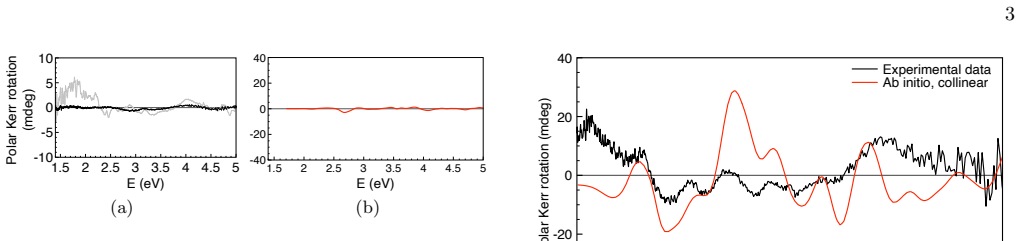
The central mechanism is the symmetry-allowed linear magneto-optical response of a collinear antiferromagnet whose magnetic point group breaks space-time inversion (PT) and combined translation-time-reversal (tT) symmetries, the same symmetry condition underlying the anomalous Hall effect in altermagnets. Experimentally, the argument is carried by polar Kerr rotation spectra measured with a rotating-analyzer setup on a 35 nm MnTe film grown on InP, using a superconducting magnet with field applied perpendicular to the film. Theoretically, the optical conductivity tensor is computed from density-functional electronic structure via the standard linear-response expression for the conductivity, and converted into the Kerr response with a 4x4 transfer-matrix formalism for anisotropic multilayer stacks that includes the InP substrate. The decisive comparison is that a calculation with canted moments significantly underestimates the measured signal, while a perfectly collinear calculation reproduces the spectrum's shape when scaled down by a factor of 2, interpreted as a 75% field-driven domain imbalance.
What would settle it
Measure the polar Kerr rotation of a MnTe sample with perfectly balanced antiferromagnetic domains while a magnetic field is applied: if a field-dependent MOKE signal persists in the compensated state, the domain-imbalance explanation is falsified and a canting or crossed-term contribution must be present.
Extended reading notes
Core claim
The central claim is that the optical magneto-optical Kerr rotation measured in thin-film MnTe below its magnetic ordering temperature originates from the collinear antiferromagnetic order itself, not from a net magnetization produced by field-induced canting. The paper presents the first polar Kerr rotation spectra for a collinear antiferromagnet: a structured signal between 1.5 and 5 eV that is an odd function of the applied out-of-plane field and disappears above the ordering temperature. Density-functional calculations with canted moments produce a spectrum significantly smaller than the measured signal, whereas a calculation with perfectly collinear moments reproduces the measured shape when scaled by a factor of 2, which the authors attribute to a 75% imbalance between antiferromagnetic domains of opposite polarity. The effect is therefore assigned to the same broken-symmetry mechanism invoked for the anomalous Hall effect in MnTe, and the paper concludes that non-collinear magnetic order is not essential for such magneto-optical effects.
Load-bearing premise
The interpretation assumes the measured Kerr rotation can be separated into a part depending on the magnetic field and a part depending on magnetic order, with no significant product of the two; the paper explicitly states that such a crossed term cannot be excluded from the present experiments.
Editorial extensions
If this is right
- Polar Kerr rotation becomes a tabletop probe of magnetic order in collinear antiferromagnets, offering higher energy resolution than x-ray techniques near the band gap.
- Because the effect tracks field-induced domain imbalance rather than field-induced magnetization, the response remains stable under externally applied magnetic fields.
- The symmetry condition (broken PT and tT symmetries) ties MnTe's optical MOKE to the altermagnet class, implying other collinear antiferromagnets with the same symmetry should show similar effects.
- Field-dependent MOKE spectra give a quantitative basis for extracting antiferromagnetic domain imbalance, as in the fitted 75% value at 6 T.
- A strong, blue-shifting feature appears near the MnTe band gap; the paper leaves its origin (MnTe band-gap sensitivity vs. InP substrate) for future work, proposing bulk MnTe experiments to distinguish them.
Reading between the lines
- Editorial inference: a comparative MOKE study of other collinear antiferromagnetic semiconductors (for example MnSe or MnS in the right structural phase) could test whether broken PT and tT symmetries are the governing design rule, rather than a property unique to MnTe.
- Editorial inference: the fitted domain-imbalance parameter could be mapped as a function of field and compared with direct domain-imaging measurements, providing a non-local optical proxy for antiferromagnetic domain populations.
- Editorial inference: the near-band-gap feature, if intrinsic, might serve as a high-field magneto-optical sensor; a bulk MnTe measurement would separate this from the InP substrate contribution and is the natural next experiment.
Editorial analysis
A structured set of objections, weighed in public.
Referee Report
Summary. The paper reports polar Kerr rotation (MOKE) spectra of the collinear antiferromagnetic semiconductor MnTe in an applied out-of-plane magnetic field. The signal is odd in field, vanishes above the Néel temperature, and shows spectral structure in the visible range that the authors compare with ab initio calculations. Using DFT-based Kubo conductivity and a Yeh multilayer optical model, they find that a perfectly collinear magnetic state reproduces the measured spectral shape after an overall scaling by a factor of two, which they interpret as a 75% imbalance of opposite antiferromagnetic domains. In contrast, a calculation with canted Mn moments gives a much smaller Kerr rotation. From this comparison the authors conclude that the observed MOKE originates from the collinear altermagnetic order with broken P T and tT symmetries via domain imbalance, rather than from field-induced canting.
Significance. If the interpretation holds, this is the first optical MOKE measurement in a collinear antiferromagnet and it provides a concrete connection between altermagnetic symmetry and magneto-optical response. A notable strength is that the paper includes a genuine falsification attempt: the canted-moment calculation produces a much smaller signal, and the collinear DFT calculation captures the spectral shape. The comparison is not purely circular because only a single overall amplitude scaling is used. However, the central mechanism claim relies on an additivity assumption between field-dependent and order-dependent contributions that the authors themselves explicitly flag as unverified, and the amplitude scale is set by an unmeasured domain imbalance. These issues leave the central attribution defensible but not fully established.
major comments (2)
- [Section II and Fig. 4] The only quantitative evidence for the domain-imbalance interpretation is the factor-of-two scaling of the collinear DFT spectrum in Fig. 4, described in Appendix B as corresponding to a 75% domain imbalance. This imbalance is not measured in the present experiment, and Ref. 21 states that it is not presently clear how much the imbalance is promoted by increasing magnetic field. Because the amplitude is a free parameter, Fig. 4 demonstrates spectral-shape agreement but does not by itself fix the domain population. The authors should provide an independent estimate of the domain imbalance, for example a remanent (B = 0) Kerr rotation measurement after field poling, to validate the scaling factor.
- [Section II, 'word of caution' paragraph] The central attribution to collinear order with domain imbalance assumes that the measured MOKE can be decomposed into a term depending on B and a term depending on magnetic order. The authors explicitly concede that the present experiments cannot exclude a crossed term that is a product of a magnetic-order variable and B. Such a crossed term that is odd in both order and field would have the same B-odd symmetry as both the canting contribution and the domain-imbalance contribution, so the field-reversal data in Fig. 1 cannot separate the three possibilities. This is load-bearing for the conclusion. The manuscript should either provide a concrete test that distinguishes these contributions (for example, a B = 0 remanence measurement or a systematic field dependence at fixed energy) or substantially soften the mechanism claim.
minor comments (5)
- [Section II, text after Fig. 2] The phrase 'canted by as much as 5 deg' should be tied to an explicit upper bound for the field of 6 T, since the canted calculation in Fig. 2(b) is performed at that angle and the argument 'cannot possibly explain' depends on it.
- [Appendix B] The canted-moment calculation is performed with GGA + Hubbard U = 4 eV (Dudarev scheme), but the sensitivity of the resulting MOKE amplitude to U is not discussed; a brief statement of robustness would strengthen the comparison.
- [Abstract and Introduction] There is a typo 'XCMD' in the Introduction where 'XMCD' is clearly intended; this should be corrected.
- [Figure 2 caption] The caption of Fig. 2(b) does not state the canting angle or the value of U used; adding these parameters would make the figure self-contained.
- [Section III, Conclusions] The statement that the experiment 'demonstrated that non-collinear order is not essential' is stronger than what the data strictly show, since only one non-collinear configuration (canted moments) was tested; this wording could be moderated to 'is not required to account for the observed signal'.
Circularity Check
No significant circularity: the mechanism claim is supported by a first-principles spectral comparison and a falsified alternative model, not by fitted or self-cited inputs.
full rationale
The paper's central claim is that the observed polar Kerr rotation in collinear MnTe originates from the collinear antiferromagnetic order (via domain imbalance) rather than from field-induced canting. The load-bearing evidence is Fig. 4, where an ab initio collinear DFT spectrum is compared with the measured spectrum using only one overall scaling factor. This scaling fixes the amplitude, interpreted as 75% domain imbalance, but it does not determine the spectral shape; the shape agreement is an independent, non-trivial result. The alternative canted-moment model is a genuinely falsifiable competitor, and the paper shows that even an overestimated 5-degree canting produces a Kerr rotation significantly smaller than the measured signal. No parameter is fitted to a subset of data and then presented as a prediction of a closely related quantity: the scaling factor is explicitly a scaling, not a prediction of the spectrum. Self-citations to Refs. 9, 11, 17, 24, and 33 provide experimental context and prior AHE/XMCD observations; they are not used to prove the central MOKE mechanism. The paper also honestly concedes the additivity assumption and the possibility of crossed terms, stating 'Based on the present experiments, we cannot exclude the possibility of MOKE being governed by some kind of such product between a variable related to magnetic order and B.' This is a limitation of the decomposition, not a circular derivation. The central result—collinear order can produce the measured optical MOKE—is supported by a self-contained DFT calculation and an external experimental comparison. Therefore, no circular step is present.
Assumptions & free parameters
free parameters (2)
- MOKE scaling factor (domain imbalance) =
2 (corresponding to 75% domain imbalance)
- Hubbard U (Dudarev scheme) =
4 eV
assumptions (5)
- standard math Kubo formula relates conductivity to MOKE
- standard math Yeh 4x4 formalism for anisotropic multilayers
- domain assumption Collinear magnetic order is the ground state of MnTe at low temperature
- domain assumption DFT (GGA, PAW) captures the relevant electronic structure and optical transitions
- ad hoc to paper No significant crossed term between magnetic field and magnetic order in MOKE
Cite this review
Pith. "Pith review of Anomalous Spectroscopical Effects in an Antiferromagnetic Semiconductor." pith.science (2026). https://pith.science/paper/B34EXYLE
@misc{pith2026241111673,
  author       = {Pith},
  title        = {Pith review of: Anomalous Spectroscopical Effects in an Antiferromagnetic Semiconductor},
  year         = {2026},
  howpublished = {\url{https://pith.science/paper/B34EXYLE}},
  note         = {Machine review of arXiv:2411.11673}
}
read the original abstract
Following the recent observation of anomalous Hall effect in antiferromagnetic hexagonal MnTe thin films, related phenomena at finite frequencies have come into focus. Magnetic circular dichroism (MCD) is the key material property here. In the x-ray range, the XMCD has already been demonstrated and used to visualise domains via photoemission electron microscopy (PEEM). Here we report on MCD in optical range and discuss its microscopic mechanism.
Figures


Reference graph
Works this paper leans on
-
[1]
J W Allen, G. Lucovsky and J.C. Mikkelsen, Jr., Sol. St. Comm. 24, 367 (1977)
work page 1977
-
[2]
N Nagaosa, J Sinova, S Onoda, A H MacDonald, and N P Ong, Rev. Mod. Phys. 82, 1539 (2010)
work page 2010
-
[3]
R. Mathieu, A. Asamitsu, H. Yamada, K. S. Takahashi, M. Kawasaki, Z. Fang, N. Nagaosa, and Y. Tokura, Phys. Rev. Lett. 93, 016602 (2004)
work page 2004
-
[4]
Jakub Zelezn\'y, Yuta Yahagi, Carles Gomez-Olivella, Yang Zhang and Yan Sun, npj Computational Materials 9, 151 (2023)
work page 2023
-
[5]
J. D. Wasscher, Sol. St. Comm. 3, 169 (1965)
work page 1965
-
[6]
Shindou and N
R. Shindou and N. Nagaosa, Phys. Rev. Lett. 87, 116801 (2001)
2001
-
[7]
Hua Chen, Qian Niu and A.H. MacDonald, Phys. Rev. Lett. 112, 017205 (2014)
work page 2014
-
[8]
L. Smejkal, A.H. MacDonald, Jairo Sinova, S. Nakatsuji, T. Jungwirth, Nat. Rev. 7, 482 (2022)
work page 2022
Show all 33 references
-
[9]
R. D. Gonz\'alez Betancourt et al., Phys. Rev. Lett. 130, 036702 (2023)
2023
-
[10]
Fields, Nicholas G
Sara Bey, Shelby S. Fields, Nicholas G. Combs, Bence G. M\'arkus, D\'avid Beke, Jiashu Wang, Anton V. Ievlev, Maksym Zhukovskyi, Tatyana Orlova, L\'aszl\'o Forr\'o, Steven P. Bennett, Xinyu Liu, Badih A. Assaf, preprint 2409.04567
-
[11]
Kluczyk et al., Phys
K. Kluczyk et al., Phys. Rev. B 110, 155201 (2024)
2024
-
[12]
Grzybowski, C
Another member of the family, MnSe has recently been found to exist also in the wurtzite phase, see Micha J. Grzybowski, C. Autieri et al., Nanoscale 16, 6259 (2024)
2024
-
[13]
Smejkal, Jairo Sinova and T
L. Smejkal, Jairo Sinova and T. Jungwirth, Phys. Rev. X 12, 031042 (2022)
2022
-
[14]
Higo et al., Nat
T. Higo et al., Nat. Photon. 12, 73 (2018)
2018
-
[15]
Johnson et al., Phys
F. Johnson et al., Phys. Rev. B 107, 014404 (2023)
2023
-
[16]
Hariki, T
A. Hariki, T. Yamaguchi, D. Kriegner, K. W. Edmonds, P. Wadley, S. S. Dhesi, G. Springholz, L. Smejkal, K. V\'yborn\'y, T. Jungwirth, J. Kune s, preprint 2305.03588v1 to ref. Hariki:2024_a where experimental XMCD data were not yet available
-
[17]
Hariki et al., Phys
A. Hariki et al., Phys. Rev. Lett. 132, 176701 (2024)
2024
- [18]
-
[19]
Tesa rov\'a et al., Phys
N. Tesa rov\'a et al., Phys. Rev. B 89, 085203 (2014)
2014
-
[20]
Kriegner et al., Phys
D. Kriegner et al., Phys. Rev. B 96, 214418 (2017)
2017
-
[21]
Magnetic field applied c prefers domains of one polarity over the other one (180 ^ -rotated pairs). While the remanent state and its domain imbalance has already been investigated Kluczyk:2024_a , it is not presently clear how much the imbalance gets promoted upon further incr...
-
[22]
Kriegner et al., Nat
D. Kriegner et al., Nat. Commun. 7: 11623 (2016)
2016
-
[23]
de Faria Jr
Paulo E. de Faria Jr. et al., Phys. Rev. B 107, L100417 (2023)
2023
-
[24]
Mazin, Phys
I. Mazin, Phys. Rev. B 107, L100418 (2023)
2023
-
[25]
Mazin, Phys
I. Mazin, Phys. Rev. X 12, 040002 (2022)
2022
-
[26]
Bimberg et al., Physica B+C 89, 139 (1977)
1977
-
[27]
Veis et al., J
M. Veis et al., J. Appl. Phys. 115, 17A936 (2014)
2014
-
[28]
Mistrik et al., J. Appl. Phys. 99, 08Q317 (2006)
2006
-
[29]
Yeh, Surf
P. Yeh, Surf. Sci. 96, 41 (1980)
1980
-
[30]
P G Radaelli, preprint 2407.13548
-
[31]
V. A. Zyuzin, Phys. Rev. B 104, L140407 (2021)
2021
-
[32]
S. L. Dudarev, G. A. Botton, S. Y. Savrasov, C. J. Humphreys, and A. P. Sutton, Phys. Rev. B 57, 1505 (1998)
1998
-
[33]
et al., npj Spintronics 2, 45 (2024)
Gonzalez Betancourt, R.D., Zubáč, J., Geishendorf, K. et al., npj Spintronics 2, 45 (2024)
2024
Reviewed August 12, 2026 · model on record in the stance chip above.
Discussion (0). Continue with ORCID to comment.