REVIEW 3 major objections 5 minor 2 cited by
Multi-step Strong First-Order Electroweak Phase Transitions in the Inverted Type-I 2HDM: Parameter Space, Gravitational Waves, and Collider Phenomenology
T0 review · 3 major / 5 minor · reviewed 2026-08-07 · deepseek-v4-flash
Pith's one-line read This paper claims that in the inverted Type-I two-Higgs-doublet model, the parameter regions for one-step and two-step strong first-order electroweak phase transitions are significantly separated, so a few collider measurements could…
desk verdict First systematic map of one- vs two-step SFOEWPT parameter space in the inverted Type-I 2HDM, with a genuinely interesting LISA preference for two-step transitions; the quantitative separation ranges in Eq. (28) are scan-dependent and should be softened until coverage is shown. read the letter →
The pith
A machine-rendered reading of the paper's core claim, the machinery that carries it, and where it could break.
The reading
What carries the argument
The mechanism that carries the argument is the one-loop finite-temperature effective potential $V_{\mathrm{eff}}(w_1,w_2,w_3,T)$ of the inverted Type-I 2HDM, with its temperature-dependent local minima traced to classify each transition step $PT_i^{(n\text{-}step)}$. For a general step, the critical temperature $T_c$ is where two neighbouring minima become degenerate, and the order parameter is the magnitude of the VEV jump between the two minima divided by $T_c$, with $\xi_c>1.3$ defining a strong transition. The separation of one-step and two-step regions emerges because a direct transition from the symmetric vacuum to the electroweak vacuum imposes different barriers and curvature conditions on the scalar potential than a path that first passes through an intermediate metastable minimum, and these conditions translate into different allowed ranges for $m_{H^\pm}$ and $\tan\beta$ after all theoretical and experimental constraints are imposed.
What would settle it
Run a substantially denser scan or an analytic boundary tracker over $m_{H^\pm}\in[280,360]$ GeV, $\tan\beta\in[4,9]$, $m_h\in[60,120]$ GeV and count SFOEWPT points by transition type; one-step points below $m_{H^\pm}=295$ GeV or two-step points above 351 GeV in appreciable numbers would refute the claimed separation. A direct collider measurement of $m_{H^\pm}<295$ GeV in a universe where a strong electroweak transition occurred would also falsify the one-step window.
Extended reading notes
Core claim
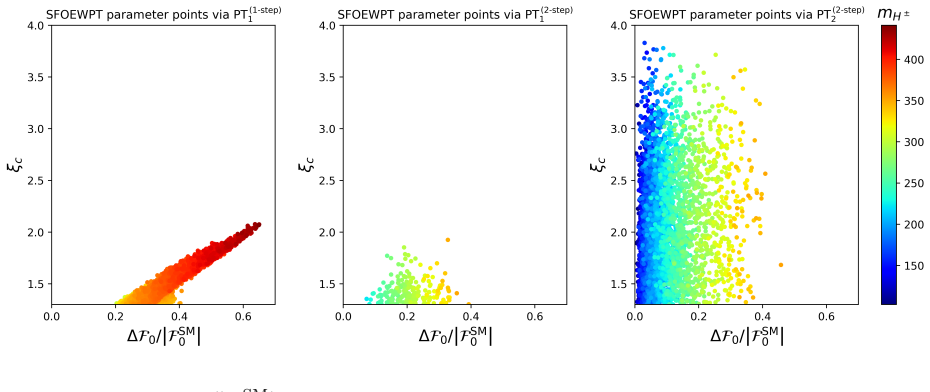
The central claim is a partial but significant separation between the parameter regions supporting a strong first-order electroweak phase transition (SFOEWPT) in one step and those supporting it in two steps, within the inverted Type-I 2HDM with $m_H=125$ GeV. With the SFOEWPT criterion $\xi_c>1.3$, one-step transitions confine the charged Higgs to $m_{H^\pm}\in[295,441]$ GeV and $\tan\beta\in[4.2,8.8]$, whereas the second step of a two-step transition permits $m_{H^\pm}\in[100,350]$ GeV and $\tan\beta\in[2.5,45.4]$; the overlap is only near $m_{H^\pm}\in[295,351]$ GeV. Negative $\sin(\beta-\alpha)$ arises almost exclusively in one-step scenarios, so its measured sign would favour the one-step reading. The paper also reports that LISA-detectable gravitational-wave signals ($\mathrm{SNR}>10$) come predominantly from two-step transitions (114 scan points versus 1) even though one-step SFOEWPT points are more numerous (5343 versus 4486), that the $\Delta F_0$--$\xi_c$ correlation known from one-step transitions breaks down in multi-step histories, and that $e^+e^-\to H^+H^-\to W^+W^-hh$ with the final states $W^+W^-b\bar b\tau^+\tau^-$ and $W^+W^-b\bar b\gamma\gamma$ offers the strongest collider test at the 1.5 TeV CLIC.
Load-bearing premise
The paper's exclusion intervals rest on a finite random scan over the ranges in Eq. (22), so 'no point found' is treated as 'region excluded' without a proof that the scan is dense, and the transition classification depends on the specific minimum-tracing algorithm chosen.
Editorial extensions
If this is right
- If the paper is right, a charged Higgs discovered with $m_{H^\pm}>351$ GeV would imply that any associated strong electroweak transition must have been one-step, whereas $m_{H^\pm}<295$ GeV would force a two-step or higher history.
- A measured negative $\sin(\beta-\alpha)$ would favour the one-step scenario, since multi-step SFOEWPT points are almost exclusively positive in this quantity.
- A LISA detection with SNR above 10 would most naturally be the gravitational-wave echo of a two-step transition, and every such detectable point in the scan has $\xi_c>2$; a LISA null would therefore not exclude a strong one-step transition.
- At the 1.5 TeV CLIC, charged-Higgs pair production followed by $H^\pm\to W^\pm h$ would yield tens of signal events in at least one of the two golden final states $W^+W^-b\bar b\tau^+\tau^-$ and $W^+W^-b\bar b\gamma\gamma$, with Standard Model backgrounds below roughly one event.
- The breakdown of the $\Delta F_0$--$\xi_c$ correlation in multi-step histories means a full finite-temperature calculation is required to certify transition strength whenever intermediate vacua are present.
Reading between the lines
- If the claimed boundary is real, denser scans should sharpen it into a sharp frontier; a dedicated scan of $m_{H^\pm}\in[280,360]$ GeV that populates the supposedly empty regions would force the dichotomy to be recast as a preference rather than an exclusion.
- The near absence of negative $\sin(\beta-\alpha)$ in two-step points suggests a direct test: a future Higgs-factory measurement of the sign of the light-Higgs coupling deviations would, within this model, select one cosmological history over another, a link the paper does not state explicitly.
- Because the LISA-detectable points are almost all two-step while one-step points are numerically dominant, future LISA upper limits could be reinterpreted as weak evidence for a one-step history, directing searches toward the lighter-charged-Higgs region and the $h\to\gamma\gamma$ final state.
- The near-background-free CLIC estimates imply that even a handful of events in the $W^+W^-b\bar b\gamma\gamma$ channel would be informative; a natural follow-up would be a full detector-level background study including tau fakes and photon conversions to test how much of the discovery power survives.
Editorial analysis
A structured set of objections, weighed in public.
Referee Report
Summary. The paper investigates the electroweak phase transition (EWPT) in the inverted Type-I 2HDM, where the observed 125 GeV Higgs boson is identified as the heavier CP-even scalar H. Using public codes (2HDMC, ScannerS, HiggsTools, BSMPT) a random scan over the parameter ranges in Eq. (22) yields 2.36e6 physical parameter points, of which 5343 support a one-step SFOEWPT and 4486 support a two-step SFOEWPT via the second step; three-step cases are rare. The central quantitative claims are that the one-step and two-step SFOEWPT parameter spaces are partially yet significantly separated (Eq. 28: one-step mH± in [295,441] GeV, tanβ in [4.2,8.8]; two-step mH± in [100,350] GeV, tanβ in [2.5,45.4]), that negative sin(β−α) occurs almost exclusively in one-step scenarios, that LISA-detectable GW signals (SNR>10) come predominantly from two-step transitions (114 points vs 1, Eq. 29), and that the ∆F0–ξc correlation persists for one-step but breaks down for multi-step transitions. A collider analysis at the 1.5 TeV CLIC identifies e+e− → H+H− → W+W−hh as a promising channel, with two complementary final states motivated by enhanced h→γγ for negative sin(β−α).
Significance. If the quantitative separation in Eq. (28) and the GW counts in Eq. (29) are robust, the paper establishes a striking cosmology–collider complementarity: measuring mH± and tanβ at a future collider could discriminate one-step from multi-step EWPT histories, and a LISA detection would favor two-step transitions. The analysis uses standard public codes and provides reproducible numerics, benchmark points, and explicit transition-step classifications, which are strengths. The observation that the vacuum-uplifting measure ∆F0 correlates with ξc in one-step transitions but fails in multi-step cases is a useful caution for the community, since it shows that a zero-temperature proxy cannot replace a full finite-temperature computation when intermediate vacua are present. The claimed overlap structure between one-step and two-step regions is the central new result; however, as detailed below, the finite-scan derivation of exclusion intervals and the fixed bubble-wall-velocity assumption currently leave the quantitative claims insufficiently supported. The paper is therefore of moderate-to-high significance contingent on the robustness checks requested.
major comments (3)
- [Section IV.B (paragraph after Fig. 2)] The statement 'if an observation yielded mH± < 295 GeV, only a two-step transition could have facilitated the SFOEWPT' is not supported by the paper's own samples. The three-step SFOEWPT benchmark BP3-step in Eq. (23) has mH± = 184.3 GeV, and the targeted scan in Section IV.B produced PT(3-step)_3 SFOEWPT points with mH± in [160,240] GeV. Thus a charged Higgs below 295 GeV can be associated with a three-step SFOEWPT, not only a two-step one. The authors should either report the ranges for all transition classes (including PT(2-step)_1 and PT(3-step)_3) in Eq. (28), or explicitly restrict the claim to 'the two dominant transition types' and avoid the unconditional wording. This is load-bearing because the abstract and introduction advertise the one-step/two-step separation as the key discriminator.
- [Section IV.A and Eq. (28)] The exclusion intervals in Eq. (28) are the extrema of a finite random scan over the ranges in Eq. (22), with no convergence or coverage test to demonstrate that 'no points found' outside these intervals implies exclusion. The footnote attached to Eq. (27) explicitly states that the SFOEWPT counts depend on the BSMPT default minimum-tracing algorithm. Since the 'partial but significant separation' is an under-occupancy claim, the authors should (i) repeat the scan with at least two different sample sizes (e.g., 10^6 and 10^7 physical points) and show that the intervals stabilize; (ii) perform targeted scans in the boundary windows near mH± = 295 GeV and mH± = 351 GeV and at large tanβ, where sparse occupation is visible in Figures 3–5; and (iii) test the classification with an alternative minima-tracing setting (e.g., a different BSMPT mode or PhaseTracer). Without these, the precise boundaries in Eq. (28) cannot be interpreted as robust exclusion ranges, and the stronger reading of the separation as a reliable collider discriminator is not justified.
- [Section IV.D, Eq. (29) and Figs. 8–10] The GW SNR values and the central statement that detectable LISA signals (SNR > 10) arise predominantly from two-step transitions (114 points vs 1) assume a fixed bubble wall velocity vw = 0.95. The paper correctly notes in Section III.D that vw is an input parameter not predicted from first principles. Since the sound-wave peak amplitude in Eq. (20) scales with max(vw, cs) (squared in one regime), a change in vw can shift points across the SNR > 10 threshold by an order-one factor. The authors should repeat the SNR calculation for at least two other plausible values (e.g., vw = 0.5 and vw = 1.0) and show how the counts in Eq. (29) change. If the strong dominance of two-step transitions persists, the qualitative conclusion is robust; otherwise the claim should be softened.
minor comments (5)
- [Section V.B, Eq. (33)] The assertion that the SM backgrounds for W+W−bbτ+τ− and W+W−bbγγ are 'well below 1 ab' is based on an extrapolation from simplified parton-level processes, not on a full background computation; the authors should either provide a conservative quantitative upper bound from Monte Carlo tools or explicitly state that the background estimate is an expectation, not a simulated result.
- [Section IV.C, Fig. 7] The claims of a 'clear positive correlation' between ξc and ∆F0 for one-step transitions and its absence for multi-step transitions are made from visual inspection; reporting Spearman or Pearson correlation coefficients and p-values would make the comparison quantitative and more persuasive.
- [Section IV.A, footnote to Eq. (27)] The footnote stating that the SFOEWPT counts depend on the BSMPT default minimum-tracing algorithm is important and should be elevated to the main text, since it directly qualifies the central quantitative results.
- [Eq. (28) and abstract] The two-step charged-Higgs range is quoted as mH± ∈ [102.7, 351.4] GeV in Eq. (28) but as [100,350] GeV in the abstract and Section IV.B; the rounding should be made consistent.
- [Section V.B, Eq. (34)] When the expected background is zero, the Poisson significance in Eq. (34) is ill-defined; the decision to quote only signal event counts is reasonable, but the paper should make clear that discovery claims in the Nbg ≈ 0 regime rely on the background estimate and Poisson statistics, not on a quoted significance value.
Circularity Check
No significant circularity: the SFOEWPT, GW, and collider results are computed from the finite-temperature effective potential and standard formulas, with self-citations only contextual.
full rationale
The paper's central claims—the one-step/two-step separation in Eq. (28), the DeltaF0-xi_c correlation breakdown, the LISA SNR distribution, and the CLIC signal yields—are all obtained by direct numerical evaluation of the one-loop finite-temperature effective potential (Eqs. (6)-(9)) and standard GW/collider formulas, not by fitting a parameter to the target quantity. The SFOEWPT criterion xi_c > 1.3 (Eq. (12)) is a threshold adopted from the literature and motivated by GW detectability; it is not chosen so as to force the reported separation of m_Hpm and tan-beta ranges, which emerge from the scan. The ranges in Eq. (28) are extrema of the scanned SFOEWPT points, so the absence of points outside them is a scan-coverage statement; the paper's own footnote that the counts depend on BSMPT's minimum-tracing algorithm is a robustness caveat, not evidence of circularity. The DeltaF0 correlation from Ref. [106] is tested rather than assumed, and its breakdown in multi-step cases is a genuine computed result. The few self-citations ([109]-[111], [180]) support background constraints, model motivation, or the existence of Higgs-phobic regions; none of them supplies the load-bearing derivation of the SFOEWPT parameter space, the GW SNRs, or the collider channels. Therefore no step reduces by construction to its inputs, and the circularity score is 1.
Assumptions & free parameters
free parameters (3)
- Scan parameter window in Eq. (22) =
mh 30-120 GeV; mA 30-700 GeV; mH+ 80-700 GeV; sin(beta-alpha) -0.5 to 0.5; tan beta 1-50; m12^2 0-2e4 GeV^2
- Bubble wall velocity v_w =
0.95
- SFOEWPT threshold xi_c =
1.3
assumptions (5)
- domain assumption The one-loop finite-temperature effective potential with daisy resummation (Eqs. 6-9) is an adequate approximation for determining the order, critical temperature, and strength of the phase transition.
- domain assumption The BSMPT v3.0.7 minimum-tracer algorithm correctly traces all relevant vacuum branches and transition steps.
- domain assumption The random scan over Eq. (22) is dense enough that empty regions represent excluded parameter space.
- domain assumption Bubble wall velocity is constant at v_w=0.95.
- domain assumption SM backgrounds for W+W-bbbar tau+tau- and W+W-bbbar gamma gamma are negligible based on parton-level estimates.
Cite this review
Pith. "Pith review of Multi-step Strong First-Order Electroweak Phase Transitions in the Inverted Type-I 2HDM: Parameter Space, Gravitational Waves, and Collider Phenomenology." pith.science (2026). https://pith.science/paper/B4XAIU5S
@misc{pith2026250603260,
  author       = {Pith},
  title        = {Pith review of: Multi-step Strong First-Order Electroweak Phase Transitions in the Inverted Type-I 2HDM: Parameter Space, Gravitational Waves, and Collider Phenomenology},
  year         = {2026},
  howpublished = {\url{https://pith.science/paper/B4XAIU5S}},
  note         = {Machine review of arXiv:2506.03260}
}
abstract
We investigate the electroweak phase transition (EWPT) within the inverted Type-I two-Higgs-doublet model, where the observed $125\,\text{GeV}$ Higgs boson is identified as the heavier \textit{CP}-even scalar $H$. Through a comprehensive parameter-space scan consistent with current theoretical and experimental constraints, we identify regions supporting strong first-order EWPTs (SFOEWPTs), including multi-step transitions. We find that two-step SFOEWPTs occur as frequently as one-step transitions, while three-step transitions can occur, albeit rarely. Crucially, the parameter spaces inducing one-step and two-step transitions are partially yet significantly separated: one-step transitions restrict the charged Higgs mass and $\tan\beta$ to $m_{H^\pm}\in[295,441]\,\text{GeV}$ and $\tan\beta\in[4.2,8.8]$, whereas two-step transitions allow $m_{H^\pm}\in[100,350]\,\text{GeV}$ and $\tan\beta\in[2.5,45.4]$. Notably, negative values of $\sin(\beta-\alpha)$ arise almost exclusively in one-step scenarios. We present the calculation of gravitational wave (GW) signal-to-noise ratios (SNRs) at LISA for multi-step EWPTs, finding that detectable GW signals ($\text{SNR}>10$) predominantly emerge from two-step transitions. Furthermore, we demonstrate that the correlation between the vacuum uplifting measure $\Delta F_0$ and $\xi_c$ persists in one-step transitions and breaks down in multi-step cases. Finally, we perform a dedicated collider analysis for representative SFOEWPT parameter points at the $1.5\,\text{TeV}$ CLIC, identifying $e^+ e^- \to H^+ H^- \to W^+ W^- hh$ as a promising discovery channel. Enhanced $h\to\gamma\gamma$ branching ratios for negative $\sin(\beta-\alpha)$ motivate two complementary golden final states, $W^+ W^- b\bar{b} \tau^+ \tau^-$ and $W^+ W^- b\bar{b}\gamma\gamma$, which demonstrate high discovery potential due to negligible Standard Model backgrounds.
Figures


Figures from the paper (12 more)




Forward citations
Cited by 2 Pith papers
-
Strong First-Order Electroweak Phase Transitions and Gravitational Waves in the Normal Two-Higgs-Doublet Model: A Comparative Study of the Four Yukawa Types and Thermal Resummation Schemes
In the Normal 2HDM, SFOEWPTs are single-step and alignment-favoring across all four Yukawa types, yet Parwani versus Arnold–Espinosa resummation changes the viable heavy-mass range from ~1.6 TeV to ≲800 GeV and leaves...
-
Electroweak Baryogenesis: Advances in Sphaleron Rate Calculations and Implications of Thermal Phase Transitions
Sphaleron rates can be computed gauge-invariantly in 3D thermal EFT, yielding a new baryon-washout criterion x = lambda3/g3^2 that replaces v_c/T_c > 1 for electroweak baryogenesis.
Reference graph
Works this paper leans on
-
[1]
Planck collaboration, P. A. R. Ade et al., Planck 2015 results. XIII. Cosmological parame- ters, Astron. Astrophys. 594 (2016) A13, [ 1502.01589]
arXiv 2016
-
[2]
A. D. Sakharov, Violation of CP Invariance, C asymmetry, and baryon asymmetry of the universe, Pisma Zh. Eksp. Teor. Fiz. 5 (1967) 32–35
1967
-
[3]
P. Huet and E. Sather, Electroweak baryogenesis and standard model CP violation , Phys. Rev. D 51 (1995) 379–394, [ hep-ph/9404302]
arXiv 1995
-
[4]
K. Kajantie, M. Laine, K. Rummukainen and M. E. Shaposhnikov, Is there a hot electroweak phase transition at mH ≳ mW ?, Phys. Rev. Lett. 77 (1996) 2887–2890, [ hep-ph/9605288]
arXiv 1996
- [5]
-
[6]
Trodden, Electroweak baryogenesis , Rev
M. Trodden, Electroweak baryogenesis , Rev. Mod. Phys. 71 (1999) 1463–1500, [hep-ph/9803479]
arXiv 1999
-
[7]
A. G. Cohen, D. B. Kaplan and A. E. Nelson, Progress in electroweak baryogenesis , Ann. Rev. Nucl. Part. Sci. 43 (1993) 27–70, [ hep-ph/9302210]
arXiv 1993
- [8]
Show all 197 references
-
[9]
D. E. Morrissey and M. J. Ramsey-Musolf, Electroweak baryogenesis, New J. Phys. 14 (2012) 125003, [1206.2942]
2012 arXiv
-
[10]
D. J. Weir, Gravitational waves from a first order electroweak phase transition: a brief review, Phil. Trans. Roy. Soc. Lond. A 376 (2018) 20170126, [ 1705.01783]. [Erratum: Phil.Trans.Roy.Soc.Lond.A 381, 20230212 (2023)]
2018 arXiv
-
[11]
Caprini and D
C. Caprini and D. G. Figueroa, Cosmological Backgrounds of Gravitational Waves, Class. Quant. Grav. 35 (2018) no.16, 163001, [ 1801.04268]
2018 arXiv
-
[12]
Amaro-Seoane et al., Laser Interferometer Space Antenna , 1702.00786
LISA collaboration, P. Amaro-Seoane et al., Laser Interferometer Space Antenna , 1702.00786
-
[13]
Cutting, M
D. Cutting, M. Hindmarsh and D. J. Weir, Gravitational waves from vacuum first-order phase transitions: from the envelope to the lattice , Phys. Rev. D 97 (2018) 123513, [ 1802.05712]
2018 arXiv
-
[14]
H.-K. Guo, K. Sinha, D. Vagie and G. White, Phase Transitions in an Expanding Universe: Stochastic Gravitational Waves in Standard and Non-Standard Histories , JCAP 01 (2021) 001, [2007.08537]
2021 arXiv
-
[15]
Schmitz, New Sensitivity Curves for Gravitational-Wave Signals from Cosmological Phase Transitions, JHEP 01 (2021) 097, [ 2002.04615]
K. Schmitz, New Sensitivity Curves for Gravitational-Wave Signals from Cosmological Phase Transitions, JHEP 01 (2021) 097, [ 2002.04615]
2021 arXiv
-
[16]
Carena, Z
M. Carena, Z. Liu and M. Riembau, Probing the electroweak phase transition via enhanced di-Higgs boson production, Phys. Rev. D 97 (2018) 095032, [ 1801.00794]
2018 arXiv
-
[17]
J. M. Cline and K. Kainulainen, Electroweak baryogenesis and dark matter from a singlet 46 Higgs, JCAP 01 (2013) 012, [ 1210.4196]
2013 arXiv
-
[18]
J. M. Cline, K. Kainulainen and D. Tucker-Smith, Electroweak baryogenesis from a dark sector, Phys. Rev. D 95 (2017) 115006, [ 1702.08909]
2017 arXiv
-
[19]
Carena, M
M. Carena, M. Quir´ os and Y. Zhang,Electroweak Baryogenesis from Dark-Sector CP Viola- tion, Phys. Rev. Lett. 122 (2019) 201802, [ 1811.09719]
2019 arXiv
-
[20]
J. M. Cline, G. Laporte, H. Yamashita and S. Kraml, Electroweak Phase Transition and LHC Signatures in the Singlet Majoron Model , JHEP 07 (2009) 040, [ 0905.2559]
2009 arXiv
-
[21]
Profumo, M
S. Profumo, M. J. Ramsey-Musolf, C. L. Wainwright and P. Winslow, Singlet-catalyzed elec- troweak phase transitions and precision Higgs boson studies , Phys. Rev. D 91 (2015) 035018, [1407.5342]
2015 arXiv
-
[22]
Curtin, P
D. Curtin, P. Meade and C.-T. Yu, Testing Electroweak Baryogenesis with Future Colliders , JHEP 11 (2014) 127, [ 1409.0005]
2014 arXiv
-
[23]
F. P. Huang and C. S. Li, Electroweak baryogenesis in the framework of the effective field theory, Phys. Rev. D 92 (2015) 075014, [ 1507.08168]
2015 arXiv
-
[24]
A. V. Kotwal, M. J. Ramsey-Musolf, J. M. No and P. Winslow, Singlet-catalyzed electroweak phase transitions in the 100 TeV frontier , Phys. Rev. D 94 (2016) 035022, [ 1605.06123]
2016 arXiv
-
[25]
Vaskonen, Electroweak baryogenesis and gravitational waves from a real scalar singlet , Phys
V. Vaskonen, Electroweak baryogenesis and gravitational waves from a real scalar singlet , Phys. Rev. D 95 (2017) 123515, [ 1611.02073]
2017 arXiv
-
[26]
Beniwal, M
A. Beniwal, M. Lewicki, J. D. Wells, M. White and A. G. Williams, Gravitational wave, collider and dark matter signals from a scalar singlet electroweak baryogenesis , JHEP 08 (2017) 108, [ 1702.06124]
2017 arXiv
-
[27]
Kurup and M
G. Kurup and M. Perelstein, Dynamics of Electroweak Phase Transition In Singlet-Scalar Extension of the Standard Model , Phys. Rev. D 96 (2017) 015036, [ 1704.03381]
2017 arXiv
-
[28]
Chiang, M
C.-W. Chiang, M. J. Ramsey-Musolf and E. Senaha, Standard Model with a Complex Scalar Singlet: Cosmological Implications and Theoretical Considerations , Phys. Rev. D 97 (2018) 015005, [1707.09960]
2018 arXiv
-
[29]
Alves, T
A. Alves, T. Ghosh, H.-K. Guo, K. Sinha and D. Vagie, Collider and Gravitational Wave Complementarity in Exploring the Singlet Extension of the Standard Model , JHEP 04 (2019) 052, [1812.09333]
2019 arXiv
-
[30]
H.-L. Li, M. Ramsey-Musolf and S. Willocq, Probing a scalar singlet-catalyzed electroweak phase transition with resonant di-Higgs boson production in the 4b channel, Phys. Rev. D 100 (2019) 075035, [ 1906.05289]
2019 arXiv
-
[31]
N. F. Bell, M. J. Dolan, L. S. Friedrich, M. J. Ramsey-Musolf and R. R. Volkas, Elec- troweak Baryogenesis with Vector-like Leptons and Scalar Singlets , JHEP 09 (2019) 012, [1903.11255]
2019 arXiv
-
[32]
Grzadkowski and D
B. Grzadkowski and D. Huang, Spontaneous CP -Violating Electroweak Baryogenesis and Dark Matter from a Complex Singlet Scalar , JHEP 08 (2018) 135, [ 1807.06987]
2018 arXiv
-
[33]
F. P. Huang, Z. Qian and M. Zhang, Exploring dynamical CP violation induced baryogenesis 47 by gravitational waves and colliders , Phys. Rev. D 98 (2018) 015014, [ 1804.06813]
2018 arXiv
-
[34]
Ghosh, T
P. Ghosh, T. Ghosh and S. Roy, Interplay among gravitational waves, dark matter and collider signals in the singlet scalar extended type-II seesaw model , JHEP 10 (2023) 057, [2211.15640]
2023 arXiv
-
[35]
Roy, Dilution of dark matter relic abundance due to first order electroweak phase transi- tion in the singlet scalar extended type-II seesaw model , Phys
S. Roy, Dilution of dark matter relic abundance due to first order electroweak phase transi- tion in the singlet scalar extended type-II seesaw model , Phys. Rev. D 111 (2025) 015037, [2212.11230]
2025 arXiv
-
[36]
Azatov, G
A. Azatov, G. Barni, S. Chakraborty, M. Vanvlasselaer and W. Yin, Ultra-relativistic bubbles from the simplest Higgs portal and their cosmological consequences , JHEP 10 (2022) 017, [2207.02230]
2022 arXiv
-
[37]
Inoue, G
S. Inoue, G. Ovanesyan and M. J. Ramsey-Musolf, Two-Step Electroweak Baryogenesis, Phys. Rev. D 93 (2016) 015013, [ 1508.05404]
2016 arXiv
-
[38]
Niemi, H
L. Niemi, H. H. Patel, M. J. Ramsey-Musolf, T. V. I. Tenkanen and D. J. Weir, Electroweak phase transition in the real triplet extension of the SM: Dimensional reduction , Phys. Rev. D 100 (2019) 035002, [ 1802.10500]
2019 arXiv
-
[39]
Chala, M
M. Chala, M. Ramos and M. Spannowsky, Gravitational wave and collider probes of a triplet Higgs sector with a low cutoff , Eur. Phys. J. C 79 (2019) 156, [ 1812.01901]
2019 arXiv
-
[40]
R. Zhou, W. Cheng, X. Deng, L. Bian and Y. Wu, Electroweak phase transition and Higgs phenomenology in the Georgi-Machacek model , JHEP 01 (2019) 216, [ 1812.06217]
2019 arXiv
-
[41]
M. J. Kazemi and S. S. Abdussalam, Electroweak Phase Transition in an Inert Complex Triplet Model, Phys. Rev. D 103 (2021) 075012, [ 2103.00212]
2021 arXiv
-
[42]
Addazi, A
A. Addazi, A. Marciano, A. P. Morais, R. Pasechnik and H. Yang, CDF II W-mass anomaly faces first-order electroweak phase transition , Eur. Phys. J. C 83 (2023) 207, [ 2204.10315]
2023 arXiv
-
[43]
Crivellin, S
A. Crivellin, S. Ashanujjaman, S. Banik, G. Coloretti, S. P. Maharathy and B. Mellado, Growing evidence for a Higgs triplet* , Chin. Phys. C 49 (2025) 053107, [ 2404.14492]
2025 arXiv
-
[44]
Borah, P
P. Borah, P. Ghosh and A. K. Saha, Prospecting bipartite dark matter through gravitational waves, JCAP 05 (2025) 035, [ 2412.17141]
2025 arXiv
-
[45]
C.-T. Lu, Y. Wu and S. Xu, Dark Matter and Electroweak Phase Transition in the Z2 Symmetric Georgi-Machacek Model, 2504.10930
-
[46]
Borah and P
P. Borah and P. Ghosh, Unveiling the inert Triplet desert region with a pNGB Dark Matter and its Gravitational Wave signatures , 2505.16521
-
[47]
J. M. Cline, M. Jarvinen and F. Sannino, The Electroweak Phase Transition in Nearly Con- formal Technicolor, Phys. Rev. D 78 (2008) 075027, [ 0808.1512]
2008 arXiv
-
[48]
L. Bian, Y. Wu and K.-P. Xie, Electroweak phase transition with composite Higgs models: calculability, gravitational waves and collider searches , JHEP 12 (2019) 028, [ 1909.02014]
2019 arXiv
-
[49]
K.-P. Xie, L. Bian and Y. Wu, Electroweak baryogenesis and gravitational waves in a com- posite Higgs model with high dimensional fermion representations , JHEP 12 (2020) 047, [2005.13552]. 48
2020 arXiv
-
[50]
J. M. Cline, M. Joyce and K. Kainulainen, Supersymmetric electroweak baryogenesis in the WKB approximation , Phys. Lett. B 417 (1998) 79–86, [ hep-ph/9708393]. [Erratum: Phys.Lett.B 448, 321–321 (1999)]
1998 arXiv
-
[51]
Menon, D
A. Menon, D. E. Morrissey and C. E. M. Wagner, Electroweak baryogenesis and dark matter in the nMSSM , Phys. Rev. D 70 (2004) 035005, [ hep-ph/0404184]
2004 arXiv
-
[52]
Carena, N
M. Carena, N. R. Shah and C. E. M. Wagner, Light Dark Matter and the Electroweak Phase Transition in the NMSSM , Phys. Rev. D 85 (2012) 036003, [ 1110.4378]
2012 arXiv
-
[53]
X.-J. Bi, L. Bian, W. Huang, J. Shu and P.-F. Yin, Interpretation of the Galactic Center excess and electroweak phase transition in the NMSSM , Phys. Rev. D 92 (2015) 023507, [1503.03749]
2015 arXiv
-
[54]
S. V. Demidov, D. S. Gorbunov and D. V. Kirpichnikov, Split NMSSM with electroweak baryogenesis, JHEP 11 (2016) 148, [ 1608.01985]. [Erratum: JHEP 08, 080 (2017)]
2016 arXiv
-
[55]
Huang, Z
W. Huang, Z. Kang, J. Shu, P. Wu and J. M. Yang, New insights in the electroweak phase transition in the NMSSM , Phys. Rev. D 91 (2015) 025006, [ 1405.1152]
2015 arXiv
-
[56]
Cheung, T.-J
K. Cheung, T.-J. Hou, J. S. Lee and E. Senaha, Singlino-driven Electroweak Baryogenesis in the Next-to-MSSM , Phys. Lett. B 710 (2012) 188–191, [ 1201.3781]
2012 arXiv
-
[57]
Bal´ azs, A
C. Bal´ azs, A. Mazumdar, E. Pukartas and G. White,Baryogenesis, dark matter and inflation in the Next-to-Minimal Supersymmetric Standard Model , JHEP 01 (2014) 073, [1309.5091]
2014 arXiv
-
[58]
S. J. Huber, T. Konstandin, T. Prokopec and M. G. Schmidt, Electroweak Phase Transition and Baryogenesis in the nMSSM , Nucl. Phys. B 757 (2006) 172–196, [ hep-ph/0606298]
2006 arXiv
-
[59]
Bian, H.-K
L. Bian, H.-K. Guo and J. Shu, Gravitational Waves, baryon asymmetry of the universe and electric dipole moment in the CP-violating NMSSM , Chin. Phys. C 42 (2018) 093106, [1704.02488]. [Erratum: Chin.Phys.C 43, 129101 (2019)]
2018 arXiv
-
[60]
Kozaczuk, S
J. Kozaczuk, S. Profumo, L. S. Haskins and C. L. Wainwright, Cosmological Phase Transi- tions and their Properties in the NMSSM , JHEP 01 (2015) 144, [ 1407.4134]
2015 arXiv
-
[61]
A. Katz, M. Perelstein, M. J. Ramsey-Musolf and P. Winslow, Stop-Catalyzed Baryogenesis Beyond the MSSM , Phys. Rev. D 92 (2015) 095019, [ 1509.02934]
2015 arXiv
-
[62]
Akula, C
S. Akula, C. Bal´ azs, L. Dunn and G. White, Electroweak baryogenesis in the Z3 -invariant NMSSM, JHEP 11 (2017) 051, [ 1706.09898]
2017 arXiv
-
[63]
C. Lee, V. Cirigliano and M. J. Ramsey-Musolf, Resonant relaxation in electroweak baryoge- nesis, Phys. Rev. D 71 (2005) 075010, [ hep-ph/0412354]
2005 arXiv
-
[64]
Balazs, M
C. Balazs, M. Carena, A. Menon, D. E. Morrissey and C. E. M. Wagner, The Supersymmetric origin of matter , Phys. Rev. D 71 (2005) 075002, [ hep-ph/0412264]
2005 arXiv
-
[65]
Liebler, S
S. Liebler, S. Profumo and T. Stefaniak, Light Stop Mass Limits from Higgs Rate Measure- ments in the MSSM: Is MSSM Electroweak Baryogenesis Still Alive After All? , JHEP 04 (2016) 143, [ 1512.09172]
2016 arXiv
-
[66]
Chatterjee, A
A. Chatterjee, A. Datta and S. Roy, Electroweak phase transition in the Z 3-invariant NMSSM: Implications of LHC and Dark matter searches and prospects of detecting the grav- 49 itational waves , JHEP 06 (2022) 108, [ 2202.12476]
2022 arXiv
-
[67]
Borah, P
P. Borah, P. Ghosh, S. Roy and A. K. Saha, Electroweak phase transition in a right-handed neutrino superfield extended NMSSM , JHEP 08 (2023) 029, [ 2301.05061]
2023 arXiv
-
[68]
Kobakhidze, L
A. Kobakhidze, L. Wu and J. Yue, Electroweak Baryogenesis with Anomalous Higgs Cou- plings, JHEP 04 (2016) 011, [ 1512.08922]
2016 arXiv
-
[69]
M. J. Ramsey-Musolf, P. Winslow and G. White, Color Breaking Baryogenesis , Phys. Rev. D 97 (2018) 123509, [ 1708.07511]
2018 arXiv
-
[70]
Yaser Ayazi and A
S. Yaser Ayazi and A. Mohamadnejad, Conformal vector dark matter and strongly first-order electroweak phase transition, JHEP 03 (2019) 181, [ 1901.04168]
2019 arXiv
-
[71]
Mohamadnejad, Gravitational waves from scale-invariant vector dark matter model: Prob- ing below the neutrino-floor , Eur
A. Mohamadnejad, Gravitational waves from scale-invariant vector dark matter model: Prob- ing below the neutrino-floor , Eur. Phys. J. C 80 (2020) 197, [ 1907.08899]
2020 arXiv
-
[72]
A. I. Bochkarev, S. V. Kuzmin and M. E. Shaposhnikov, Electroweak baryogenesis and the Higgs boson mass problem , Phys. Lett. B 244 (1990) 275–278
1990
-
[73]
G. C. Dorsch, S. J. Huber and J. M. No, A strong electroweak phase transition in the 2HDM after LHC8 , JHEP 10 (2013) 029, [ 1305.6610]
2013 arXiv
-
[74]
Basler, M
P. Basler, M. Krause, M. Muhlleitner, J. Wittbrodt and A. Wlotzka, Strong First Order Electroweak Phase Transition in the CP-Conserving 2HDM Revisited , JHEP 02 (2017) 121, [1612.04086]
2017 arXiv
-
[75]
Fuyuto, W.-S
K. Fuyuto, W.-S. Hou and E. Senaha, Electroweak baryogenesis driven by extra top Yukawa couplings, Phys. Lett. B 776 (2018) 402–406, [ 1705.05034]
2018 arXiv
-
[76]
Bernon, L
J. Bernon, L. Bian and Y. Jiang, A new insight into the phase transition in the early Universe with two Higgs doublets , JHEP 05 (2018) 151, [ 1712.08430]
2018 arXiv
-
[77]
Kainulainen, V
K. Kainulainen, V. Keus, L. Niemi, K. Rummukainen, T. V. I. Tenkanen and V. Vaskonen, On the validity of perturbative studies of the electroweak phase transition in the Two Higgs Doublet model, JHEP 06 (2019) 075, [ 1904.01329]
2019 arXiv
-
[78]
Bittar, S
P. Bittar, S. Roy and C. E. M. Wagner, Self Consistent Thermal Resummation: A Case Study of the Phase Transition in 2HDM , 2504.02024
-
[79]
G. C. Branco, P. M. Ferreira, L. Lavoura, M. N. Rebelo, M. Sher and J. P. Silva, Theory and phenomenology of two-Higgs-doublet models , Phys. Rept. 516 (2012) 1–102, [ 1106.0034]
2012 arXiv
-
[80]
S. L. Glashow and S. Weinberg, Natural Conservation Laws for Neutral Currents, Phys. Rev. D 15 (1977) 1958
1977
-
[81]
E. A. Paschos, Diagonal Neutral Currents , Phys. Rev. D 15 (1977) 1966
1977
-
[82]
H. E. Haber and Y. Nir, Multiscalar Models With a High-energy Scale , Nucl. Phys. B 335 (1990) 363–394
1990
-
[83]
H. E. Haber and D. O’Neil, Basis-independent methods for the two-Higgs-doublet model. II. The Significance of tan β, Phys. Rev. D 74 (2006) 015018, [ hep-ph/0602242]. [Erratum: Phys.Rev.D 74, 059905 (2006)]
2006 arXiv
-
[84]
D. M. Asner et al., ILC Higgs White Paper, in Snowmass 2013: Snowmass on the Mississippi , 50 10, 2013, 1310.0763
2013 arXiv
-
[85]
J. F. Gunion and H. E. Haber, The CP conserving two Higgs doublet model: The Approach to the decoupling limit , Phys. Rev. D 67 (2003) 075019, [ hep-ph/0207010]
2003 arXiv
-
[86]
Quiros, Finite temperature field theory and phase transitions , in ICTP Summer School in High-Energy Physics and Cosmology , pp
M. Quiros, Finite temperature field theory and phase transitions , in ICTP Summer School in High-Energy Physics and Cosmology , pp. 187–259, 1, 1999, hep-ph/9901312
1999 arXiv
-
[87]
Niemi, P
L. Niemi, P. Schicho and T. V. I. Tenkanen, Singlet-assisted electroweak phase transition at two loops , Phys. Rev. D 103 (2021) 115035, [ 2103.07467]. [Erratum: Phys.Rev.D 109, 039902 (2024)]
2021 arXiv
-
[88]
H. Bahl, M. Carena, A. Ireland and C. E. M. Wagner, Improved thermal resummation for multi-field potentials, JHEP 09 (2024) 153, [ 2404.12439]
2024 arXiv
-
[89]
Masina and M
I. Masina and M. Quiros, An introduction to effective potential methods in field theory , 2501.12713
-
[90]
W. Su, A. G. Williams and M. Zhang, Strong first order electroweak phase transition in 2HDM confronting future Z & Higgs factories , JHEP 04 (2021) 219, [ 2011.04540]
2021 arXiv
-
[91]
Haller, A
J. Haller, A. Hoecker, R. Kogler, K. M¨ onig, T. Peiffer and J. Stelzer, Update of the global electroweak fit and constraints on two-Higgs-doublet models , Eur. Phys. J. C 78 (2018) no.8, 675, [1803.01853
2018 arXiv
-
[92]
Misiak, A
M. Misiak, A. Rehman and M. Steinhauser, Towards B → Xsγ at the NNLO in QCD without interpolation in m c, JHEP 06 (2020) 175, [ 2002.01548]
2020 arXiv
-
[93]
Biek¨ otter, D
T. Biek¨ otter, D. Fontes, M. M¨ uhlleitner, J. C. Rom˜ ao, R. Santos and J. a. P. Silva,Impact of new experimental data on the C2HDM: the strong interdependence between LHC Higgs data and the electron EDM , JHEP 05 (2024) 127, [ 2403.02425]
2024 arXiv
-
[94]
Biek¨ otter and M
T. Biek¨ otter and M. O. Olea-Romacho, Benchmarking a fading window: electroweak baryo- genesis in the C2HDM, LHC constraints after Run 2 and prospects for LISA , 2505.09670
-
[95]
M. Aoki, T. Komatsu and H. Shibuya, Possibility of a multi-step electroweak phase transition in the two-Higgs doublet models , PTEP 2022 (2022) 063B05, [ 2106.03439]
2022 arXiv
-
[96]
Gon¸ calves, A
D. Gon¸ calves, A. Kaladharan and Y. Wu,Electroweak phase transition in the 2HDM: Collider and gravitational wave complementarity , Phys. Rev. D 105 (2022) 095041, [ 2108.05356]
2022 arXiv
-
[97]
Si, H.-x
Z.-g. Si, H.-x. Wang, L. Wang and Y. Zhang, Exploring multi-step electroweak phase transi- tions in the 2HDM +a, Eur. Phys. J. C 85 (2025) 273, [ 2410.15975]
2025 arXiv
-
[98]
Land and E
D. Land and E. D. Carlson, Two stage phase transition in two Higgs models , Phys. Lett. B 292 (1992) 107–112, [ hep-ph/9208227]
1992 arXiv
-
[99]
H. H. Patel and M. J. Ramsey-Musolf, Stepping Into Electroweak Symmetry Breaking: Phase Transitions and Higgs Phenomenology , Phys. Rev. D 88 (2013) 035013, [ 1212.5652]
2013 arXiv
-
[100]
Blinov, J
N. Blinov, J. Kozaczuk, D. E. Morrissey and C. Tamarit, Electroweak Baryogenesis from Exotic Electroweak Symmetry Breaking, Phys. Rev. D 92 (2015) 035012, [ 1504.05195]
2015 arXiv
-
[101]
Chao, H.-K
W. Chao, H.-K. Guo and J. Shu, Gravitational Wave Signals of Electroweak Phase Transition Triggered by Dark Matter , JCAP 09 (2017) 009, [ 1702.02698]. 51
2017 arXiv
-
[102]
A. P. Morais and R. Pasechnik, Probing multi-step electroweak phase transition with multi- peaked primordial gravitational waves spectra, JCAP 04 (2020) 036, [ 1910.00717]
2020 arXiv
-
[103]
Fabian, F
S. Fabian, F. Goertz and Y. Jiang, Dark matter and nature of electroweak phase transition with an inert doublet , JCAP 09 (2021) 011, [ 2012.12847]
2021 arXiv
-
[104]
Angelescu and P
A. Angelescu and P. Huang, Multistep Strongly First Order Phase Transitions from New Fermions at the TeV Scale , Phys. Rev. D 99 (2019) 055023, [ 1812.08293]
2019 arXiv
-
[105]
Niemi, M
L. Niemi, M. J. Ramsey-Musolf, T. V. I. Tenkanen and D. J. Weir, Thermodynamics of a Two-Step Electroweak Phase Transition, Phys. Rev. Lett. 126 (2021) 171802, [ 2005.11332]
2021 arXiv
-
[106]
G. C. Dorsch, S. J. Huber, K. Mimasu and J. M. No, The Higgs Vacuum Uplifted: Revis- iting the Electroweak Phase Transition with a Second Higgs Doublet , JHEP 12 (2017) 086, [1705.09186]
2017 arXiv
-
[107]
Song and Y
J. Song and Y. W. Yoon, W γdecay of the elusive charged Higgs boson in the two-Higgs- doublet model with vectorlike fermions , Phys. Rev. D 100 (2019) 055006, [ 1904.06521]
2019 arXiv
-
[108]
Chang, S
S. Chang, S. K. Kang, J.-P. Lee and J. Song, Higgs potential and hidden light Higgs scenario in two Higgs doublet models , Phys. Rev. D 92 (2015) 075023, [ 1507.03618]
2015 arXiv
-
[109]
Jueid, J
A. Jueid, J. Kim, S. Lee and J. Song, Type-X two-Higgs-doublet model in light of the muon g-2: Confronting Higgs boson and collider data , Phys. Rev. D 104 (2021) 095008, [ 2104.10175]
2021 arXiv
-
[110]
Cheung, A
K. Cheung, A. Jueid, J. Kim, S. Lee, C.-T. Lu and J. Song, Comprehensive study of the light charged Higgs boson in the type-I two-Higgs-doublet model , Phys. Rev. D 105 (2022) 095044, [2201.06890]
2022 arXiv
-
[111]
S. Lee, K. Cheung, J. Kim, C.-T. Lu and J. Song, Status of the two-Higgs-doublet model in light of the CDF mW measurement , Phys. Rev. D 106 (2022) 075013, [ 2204.10338]
2022 arXiv
-
[112]
J. R. Espinosa, M. Quiros and F. Zwirner, On the nature of the electroweak phase transition , Phys. Lett. B 314 (1993) 206–216, [ hep-ph/9212248]
1993 arXiv
-
[113]
Herring, S
N. Herring, S. Cao and D. Boyanovsky, Is the finite temperature effective potential effective for dynamics? , Phys. Rev. D 111 (2025) 016028, [ 2410.21633]
2025 arXiv
-
[114]
Chakrabortty and S
J. Chakrabortty and S. Mohanty, One Loop Thermal Effective Action , 2411.14146
-
[115]
P. M. Ferreira and B. Swiezewska, One-loop contributions to neutral minima in the inert doublet model, JHEP 04 (2016) 099, [ 1511.02879]
2016 arXiv
-
[116]
S. R. Coleman and E. J. Weinberg, Radiative Corrections as the Origin of Spontaneous Symmetry Breaking, Phys. Rev. D 7 (1973) 1888–1910
1973
-
[117]
Dolan and R
L. Dolan and R. Jackiw, Symmetry Behavior at Finite Temperature , Phys. Rev. D 9 (1974) 3320–3341
1974
-
[118]
M. E. Carrington, The Effective potential at finite temperature in the Standard Model , Phys. Rev. D 45 (1992) 2933–2944
1992
-
[119]
P. B. Arnold and O. Espinosa, The Effective potential and first order phase transitions: Be- yond leading-order, Phys. Rev. D 47 (1993) 3546, [hep-ph/9212235]. [Erratum: Phys.Rev.D 50, 6662 (1994)]. 52
1993 arXiv
-
[120]
S. R. Coleman, The Fate of the False Vacuum. 1. Semiclassical Theory , Phys. Rev. D 15 (1977) 2929–2936. [Erratum: Phys.Rev.D 16, 1248 (1977)]
1977
-
[121]
A. D. Linde, Fate of the False Vacuum at Finite Temperature: Theory and Applications , Phys. Lett. B 100 (1981) 37–40
1981
-
[122]
C. P. D. Harman and S. J. Huber, Does zero temperature decide on the nature of the elec- troweak phase transition?, JHEP 06 (2016) 005, [ 1512.05611]
2016 arXiv
-
[123]
T. V. I. Tenkanen and J. van de Vis, Speed of sound in cosmological phase transitions and effect on gravitational waves , JHEP 08 (2022) 302, [ 2206.01130]
2022 arXiv
-
[124]
Caprini et al., Detecting gravitational waves from cosmological phase transitions with LISA: an update , JCAP 03 (2020) 024, [ 1910.13125]
C. Caprini et al., Detecting gravitational waves from cosmological phase transitions with LISA: an update , JCAP 03 (2020) 024, [ 1910.13125]
2020 arXiv
-
[125]
Caldwell et al., Detection of early-universe gravitational-wave signatures and fundamental physics, Gen
R. Caldwell et al., Detection of early-universe gravitational-wave signatures and fundamental physics, Gen. Rel. Grav. 54 (2022) 156, [ 2203.07972]
2022 arXiv
-
[126]
Auclair et al., Cosmology with the Laser Interferometer Space Antenna, Living Rev
LISA Cosmology Working Groupcollaboration, P. Auclair et al., Cosmology with the Laser Interferometer Space Antenna, Living Rev. Rel. 26 (2023) 5, [ 2204.05434]
2023 arXiv
-
[127]
Basler, L
P. Basler, L. Biermann, M. M¨ uhlleitner, J. M¨ uller, R. Santos and J. a. Viana,BSMPT v3 A Tool for Phase Transitions and Primordial Gravitational Waves in Extended Higgs Sectors , 2404.19037
-
[128]
Chen and Y
H. Chen and Y. Jiang, A Comprehensive Framework for Electroweak Phase Transitions: Thermal History and Dynamics from Bubble Nucleation to Percolation , 2503.00421
-
[129]
Hindmarsh, S
M. Hindmarsh, S. J. Huber, K. Rummukainen and D. J. Weir, Numerical simulations of acoustically generated gravitational waves at a first order phase transition , Phys. Rev. D 92 (2015) 123009, [ 1504.03291]
2015 arXiv
-
[130]
Hindmarsh, S
M. Hindmarsh, S. J. Huber, K. Rummukainen and D. J. Weir, Shape of the acoustic grav- itational wave power spectrum from a first order phase transition , Phys. Rev. D 96 (2017) 103520, [1704.05871]. [Erratum: Phys.Rev.D 101, 089902 (2020)]
2017 arXiv
-
[131]
Caprini et al., Science with the space-based interferometer eLISA
C. Caprini et al., Science with the space-based interferometer eLISA. II: Gravitational waves from cosmological phase transitions, JCAP 04 (2016) 001, [ 1512.06239]
2016 arXiv
-
[132]
Grojean and G
C. Grojean and G. Servant, Gravitational Waves from Phase Transitions at the Electroweak Scale and Beyond , Phys. Rev. D 75 (2007) 043507, [ hep-ph/0607107]
2007 arXiv
-
[133]
Leitao and A
L. Leitao and A. Megevand, Gravitational waves from a very strong electroweak phase tran- sition, JCAP 05 (2016) 037, [ 1512.08962]
2016 arXiv
-
[134]
Ellis, M
J. Ellis, M. Lewicki and J. M. No, On the Maximal Strength of a First-Order Electroweak Phase Transition and its Gravitational Wave Signal , JCAP 04 (2019) 003, [ 1809.08242]
2019 arXiv
-
[135]
W.-Y. Ai, B. Garbrecht and C. Tamarit, Bubble wall velocities in local equilibrium , JCAP 03 (2022) 015, [ 2109.13710]
2022 arXiv
-
[136]
G. C. Dorsch, S. J. Huber and T. Konstandin, A sonic boom in bubble wall friction , JCAP 04 (2022) 010, [ 2112.12548]
2022 arXiv
-
[137]
Jiang, F
S. Jiang, F. P. Huang and X. Wang, Bubble wall velocity during electroweak phase transition 53 in the inert doublet model , Phys. Rev. D 107 (2023) 095005, [ 2211.13142]
2023 arXiv
-
[138]
De Curtis, L
S. De Curtis, L. D. Rose, A. Guiggiani, A. G. Muyor and G. Panico, Bubble wall dynamics at the electroweak phase transition , JHEP 03 (2022) 163, [ 2201.08220]
2022 arXiv
-
[139]
W.-Y. Ai, B. Laurent and J. van de Vis, Model-independent bubble wall velocities in local thermal equilibrium, JCAP 07 (2023) 002, [ 2303.10171]
2023 arXiv
-
[140]
De Curtis, L
S. De Curtis, L. Delle Rose, A. Guiggiani, A. Gil Muyor and G. Panico, Collision integrals for cosmological phase transitions , JHEP 05 (2023) 194, [ 2303.05846]
2023 arXiv
-
[141]
Krajewski, M
T. Krajewski, M. Lewicki and M. Zych, Bubble-wall velocity in local thermal equilibrium: hydrodynamical simulations vs analytical treatment , JHEP 05 (2024) 011, [ 2402.15408]
2024 arXiv
-
[142]
Wang, Q.-S
D.-W. Wang, Q.-S. Yan and M. Huang, Bubble wall velocity and gravitational wave in the minimal left-right symmetric model , Phys. Rev. D 110 (2024) 076011, [ 2405.01949]
2024 arXiv
-
[143]
De Curtis, L
S. De Curtis, L. Delle Rose, A. Guiggiani, A. Gil Muyor and G. Panico, Non-linearities in cosmological bubble wall dynamics , JHEP 05 (2024) 009, [ 2401.13522]
2024 arXiv
-
[144]
Branchina, A
C. Branchina, A. Conaci, S. De Curtis and L. Delle Rose, Electroweak Phase Transition and Bubble Wall Velocity in Local Thermal Equilibrium , 2504.21213
-
[145]
Lewicki, M
M. Lewicki, M. Merchand and M. Zych, Electroweak bubble wall expansion: gravitational waves and baryogenesis in Standard Model-like thermal plasma , JHEP 02 (2022) 017, [2111.02393]
2022 arXiv
-
[146]
Laurent and J
B. Laurent and J. M. Cline, First principles determination of bubble wall velocity , Phys. Rev. D 106 (2022) 023501, [ 2204.13120]
2022 arXiv
-
[147]
Biek¨ otter, S
T. Biek¨ otter, S. Heinemeyer, J. M. No, M. O. Olea-Romacho and G. Weiglein, The trap in the early Universe: impact on the interplay between gravitational waves and LHC physics in the 2HDM , JCAP 03 (2023) 031, [ 2208.14466]
2023 arXiv
-
[148]
M. J. Ramsey-Musolf, V. Q. Tran and T.-C. Yuan, Gravitational waves and dark matter in the gauged two-Higgs doublet model , JHEP 01 (2025) 129, [ 2408.05167]
2025 arXiv
-
[149]
Caprini and R
C. Caprini and R. Durrer, Gravitational wave production: A Strong constraint on primordial magnetic fields , Phys. Rev. D 65 (2001) 023517, [ astro-ph/0106244]
2001 arXiv
-
[150]
D. G. Figueroa, M. Hindmarsh and J. Urrestilla, Exact Scale-Invariant Background of Grav- itational Waves from Cosmic Defects , Phys. Rev. Lett. 110 (2013) 101302, [ 1212.5458]
2013 arXiv
-
[151]
Hindmarsh, Sound shell model for acoustic gravitational wave production at a first-order phase transition in the early Universe , Phys
M. Hindmarsh, Sound shell model for acoustic gravitational wave production at a first-order phase transition in the early Universe , Phys. Rev. Lett. 120 (2018) 071301, [ 1608.04735]
2018 arXiv
-
[152]
Navas et al., Review of particle physics, Phys
Particle Data Groupcollaboration, S. Navas et al., Review of particle physics, Phys. Rev. D 110 (2024) 030001
2024
-
[153]
Athron, C
P. Athron, C. Bal´ azs, A. Fowlie, L. Morris and L. Wu, Cosmological phase transitions: From perturbative particle physics to gravitational waves, Prog. Part. Nucl. Phys. 135 (2024) 104094, [2305.02357]
2024 arXiv
-
[154]
Athron, C
P. Athron, C. Bal´ azs, A. Fowlie and Y. Zhang,PhaseTracer: tracing cosmological phases and calculating transition properties, Eur. Phys. J. C 80 (2020) 567, [ 2003.02859]. 54
2020 arXiv
-
[155]
J. R. Espinosa, T. Konstandin, J. M. No and G. Servant, Energy Budget of Cosmological First-order Phase Transitions, JCAP 06 (2010) 028, [ 1004.4187]
2010 arXiv
-
[156]
P. J. Steinhardt, Relativistic Detonation Waves and Bubble Growth in False Vacuum Decay , Phys. Rev. D 25 (1982) 2074
1982
-
[157]
Kamionkowski, A
M. Kamionkowski, A. Kosowsky and M. S. Turner, Gravitational radiation from first order phase transitions, Phys. Rev. D 49 (1994) 2837–2851, [ astro-ph/9310044]
1994 arXiv
-
[158]
Caprini, D
C. Caprini, D. G. Figueroa, R. Flauger, G. Nardini, M. Peloso, M. Pieroni et al., Recon- structing the spectral shape of a stochastic gravitational wave background with LISA , JCAP 11 (2019) 017, [ 1906.09244]
2019 arXiv
-
[159]
Babak, A
S. Babak, A. Petiteau and M. Hewitson, LISA Sensitivity and SNR Calculations , 2108.01167
-
[160]
Barroso, P
A. Barroso, P. M. Ferreira, I. P. Ivanov and R. Santos, Metastability bounds on the two Higgs doublet model, JHEP 06 (2013) 045, [ 1303.5098]
2013 arXiv
-
[161]
I. P. Ivanov and J. P. Silva, Tree-level metastability bounds for the most general two Higgs doublet model, Phys. Rev. D 92 (2015) 055017, [ 1507.05100]
2015 arXiv
-
[162]
I. P. Ivanov, General two-order-parameter Ginzburg-Landau model with quadratic and quartic interactions, Phys. Rev. E 79 (2009) 021116, [ 0802.2107]
2009 arXiv
-
[163]
Barroso, P
A. Barroso, P. M. Ferreira, I. P. Ivanov, R. Santos and J. P. Silva, Evading death by vacuum , Eur. Phys. J. C 73 (2013) 2537, [ 1211.6119]
2013 arXiv
-
[164]
I. P. Ivanov, Minkowski space structure of the Higgs potential in 2HDM , Phys. Rev. D 75 (2007) 035001, [ hep-ph/0609018]. [Erratum: Phys.Rev.D 76, 039902 (2007)]
2007 arXiv
-
[165]
A. Arhrib, Unitarity constraints on scalar parameters of the standard and two Higgs doublets model, in Workshop on Noncommutative Geometry, Superstrings and Particle Physics , 12, 2000, hep-ph/0012353
2000 arXiv
-
[166]
M. E. Peskin and T. Takeuchi, Estimation of oblique electroweak corrections , Phys. Rev. D 46 (1992) 381–409
1992
-
[167]
H.-J. He, N. Polonsky and S.-f. Su, Extra families, Higgs spectrum and oblique corrections , Phys. Rev. D 64 (2001) 053004, [ hep-ph/0102144]
2001 arXiv
-
[168]
Grimus, L
W. Grimus, L. Lavoura, O. M. Ogreid and P. Osland, The Oblique parameters in multi- Higgs-doublet models, Nucl. Phys. B 801 (2008) 81–96, [ 0802.4353]
2008 arXiv
-
[169]
Eriksson, J
D. Eriksson, J. Rathsman and O. Stal, 2HDMC: Two-Higgs-Doublet Model Calculator Physics and Manual , Comput. Phys. Commun. 181 (2010) 189–205, [ 0902.0851]
2010 arXiv
-
[170]
Arbey, F
A. Arbey, F. Mahmoudi, O. Stal and T. Stefaniak, Status of the Charged Higgs Boson in Two Higgs Doublet Models , Eur. Phys. J. C 78 (2018) 182, [ 1706.07414]
2018 arXiv
-
[171]
Sanyal, Limits on the Charged Higgs Parameters in the Two Higgs Doublet Model using CMS √s = 13 TeV Results, Eur
P. Sanyal, Limits on the Charged Higgs Parameters in the Two Higgs Doublet Model using CMS √s = 13 TeV Results, Eur. Phys. J. C 79 (2019) 913, [ 1906.02520]
2019 arXiv
-
[172]
Misiak and M
M. Misiak and M. Steinhauser, Weak radiative decays of the B meson and bounds on MH ± in the Two-Higgs-Doublet Model , Eur. Phys. J. C 77 (2017) 201, [ 1702.04571]. 55
2017 arXiv
-
[173]
Horiguchi et al., Evidence for Isospin Violation and Measurement of CP Asymmetries in B → K∗(892)γ, Phys
Belle collaboration, T. Horiguchi et al., Evidence for Isospin Violation and Measurement of CP Asymmetries in B → K∗(892)γ, Phys. Rev. Lett. 119 (2017) 191802, [ 1707.00394]
2017 arXiv
-
[174]
Dutta et al., Search for B0 s → γγ and a measurement of the branch- ing fraction for B0 s → ϕγ, Phys
Belle collaboration, D. Dutta et al., Search for B0 s → γγ and a measurement of the branch- ing fraction for B0 s → ϕγ, Phys. Rev. D 91 (2015) 011101, [ 1411.7771]
2015 arXiv
-
[175]
M¨ uhlleitner, M
M. M¨ uhlleitner, M. O. P. Sampaio, R. Santos and J. Wittbrodt, ScannerS: parameter scans in extended scalar sectors , Eur. Phys. J. C 82 (2022) 198, [ 2007.02985]
2022 arXiv
-
[176]
H. Bahl, T. Biek¨ otter, S. Heinemeyer, C. Li, S. Paasch, G. Weiglein et al., HiggsTools: BSM scalar phenomenology with new versions of HiggsBounds and HiggsSignals , Comput. Phys. Commun. 291 (2023) 108803, [ 2210.09332]
2023 arXiv
-
[177]
C. L. Wainwright, CosmoTransitions: Computing Cosmological Phase Transition Tempera- tures and Bubble Profiles with Multiple Fields , Comput. Phys. Commun. 183 (2012) 2006– 2013, [1109.4189]
2012 arXiv
-
[178]
Basler and M
P. Basler and M. M¨ uhlleitner,BSMPT (Beyond the Standard Model Phase Transitions): A tool for the electroweak phase transition in extended Higgs sectors , Comput. Phys. Commun. 237 (2019) 62–85, [ 1803.02846]
2019 arXiv
-
[179]
Basler, M
P. Basler, M. M¨ uhlleitner and J. M¨ uller,BSMPT v2 a tool for the electroweak phase tran- sition and the baryon asymmetry of the universe in extended Higgs Sectors , Comput. Phys. Commun. 269 (2021) 108124, [ 2007.01725]
2021 arXiv
-
[180]
J. Kim, S. Lee, P. Sanyal and J. Song, CDF W-boson mass and muon g-2 in a type-X two- Higgs-doublet model with a Higgs-phobic light pseudoscalar , Phys. Rev. D 106 (2022) 035002, [2205.01701]
2022 arXiv
-
[181]
Adli et al., The Compact Linear e +e− Collider (CLIC) , 2503.24168
E. Adli et al., The Compact Linear e +e− Collider (CLIC) , 2503.24168
-
[182]
Djouadi, The Anatomy of electro-weak symmetry breaking
A. Djouadi, The Anatomy of electro-weak symmetry breaking. II. The Higgs bosons in the minimal supersymmetric model , Phys. Rept. 459 (2008) 1–241, [ hep-ph/0503173]
2008 arXiv
-
[183]
Bernon, J
J. Bernon, J. F. Gunion, H. E. Haber, Y. Jiang and S. Kraml, Scrutinizing the alignment limit in two-Higgs-doublet models: m h=125 GeV , Phys. Rev. D 92 (2015) 075004, [ 1507.00933]
2015 arXiv
-
[184]
J. Gu, H. Li, Z. Liu, S. Su and W. Su, Learning from Higgs Physics at Future Higgs Factories, JHEP 12 (2017) 153, [ 1709.06103]
2017 arXiv
-
[185]
Alwall, M
J. Alwall, M. Herquet, F. Maltoni, O. Mattelaer and T. Stelzer, MadGraph 5 : Going Beyond , JHEP 06 (2011) 128, [ 1106.0522]
2011 arXiv
-
[186]
Belyaev, N
A. Belyaev, N. D. Christensen and A. Pukhov, CalcHEP 3.4 for collider physics within and beyond the Standard Model , Comput. Phys. Commun. 184 (2013) 1729–1769, [ 1207.6082]
2013 arXiv
-
[187]
ATLAS collaboration, Formulae for Estimating Significance , [ATL-PHYS-PUB-2020-025]
2020
-
[188]
Bierlich et al., A comprehensive guide to the physics and usage of PYTHIA 8.3 , SciPost Phys
C. Bierlich et al., A comprehensive guide to the physics and usage of PYTHIA 8.3 , SciPost Phys. Codeb. 2022 (2022) 8, [ 2203.11601]
2022 arXiv
-
[189]
de Favereau, C
DELPHES 3 collaboration, J. de Favereau, C. Delaere, P. Demin, A. Giammanco, V. Lema ˆ ıtre, A. Mertens et al., DELPHES 3, A modular framework for fast simulation of a generic collider experiment , JHEP 02 (2014) 057, [ 1307.6346]. 56
2014 arXiv
-
[190]
Boronat, J
M. Boronat, J. Fuster, I. Garcia, E. Ros and M. Vos, A robust jet reconstruction algorithm for high-energy lepton colliders , Phys. Lett. B 750 (2015) 95–99, [ 1404.4294]
2015 arXiv
-
[191]
Boronat, J
M. Boronat, J. Fuster, I. Garcia, P. Roloff, R. Simoniello and M. Vos, Jet reconstruction at high-energy electron–positron colliders, Eur. Phys. J. C 78 (2018) 144, [ 1607.05039]
2018 arXiv
-
[192]
Cacciari, G
M. Cacciari, G. P. Salam and G. Soyez, FastJet User Manual , Eur. Phys. J. C 72 (2012) 1896, [1111.6097]
2012 arXiv
-
[193]
CMS collaboration, G. L. Bayatian et al., CMS technical design report, volume II: Physics performance, J. Phys. G 34 (2007) 995–1579
2007
-
[194]
Bagliesi, Tau tagging at Atlas and CMS , in 17th Symposium on Hadron Collider Physics 2006 (HCP 2006) , 7, 2007, 0707.0928
G. Bagliesi, Tau tagging at Atlas and CMS , in 17th Symposium on Hadron Collider Physics 2006 (HCP 2006) , 7, 2007, 0707.0928
2006 arXiv
-
[195]
CMS collaboration, A. M. Sirunyan et al., Performance of reconstruction and identification of τ leptons decaying to hadrons and ντ in pp collisions at √s = 13 TeV, JINST 13 (2018) P10005, [1809.02816]
2018 arXiv
-
[196]
Proissl, Dijet Invariant Mass Studies in the Higgs boson H → b¯b resonance search in association with a W/Z boson using the ATLAS detector , Ph.D
M. Proissl, Dijet Invariant Mass Studies in the Higgs boson H → b¯b resonance search in association with a W/Z boson using the ATLAS detector , Ph.D. thesis, Edinburgh U., 2014, CERN-THESIS-2014-275]
2014
-
[197]
Abramowicz et al., Higgs physics at the CLIC electron–positron linear collider , Eur
H. Abramowicz et al., Higgs physics at the CLIC electron–positron linear collider , Eur. Phys. J. C 77 (2017) 475, [ 1608.07538]. 57
2017 arXiv
Reviewed August 7, 2026 · model on record in the stance chip above.
Discussion (0). Sign in to comment.