REVIEW 3 major objections 5 minor 2 cited by
Explicit symplectic integrators with adaptive time steps in curved spacetimes
T0 review · 3 major / 5 minor · reviewed 2026-08-12 · deepseek-v4-flash
Pith's one-line read The paper claims that a small symmetric modification of a time-transformed explicit symplectic integrator makes its physical step size adaptive while preserving the scheme's symplectic structure.
desk verdict The adaptive scheme is clever and the numerics look good, but the symplecticity argument fails: Eq. (16) treats an orbit-level total derivative as a Hamilton partial derivative, so the central claim is unproven. read the letter →
The pith
A machine-rendered reading of the paper's core claim, the machinery that carries it, and where it could break.
The reading
What carries the argument
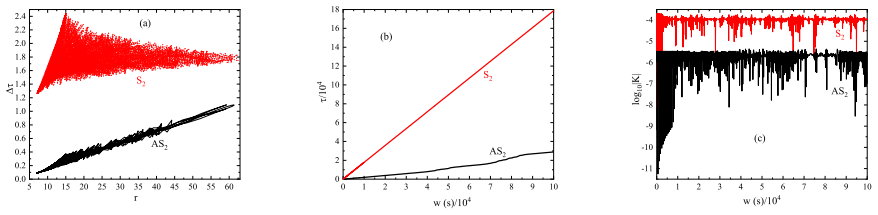
The construction is carried by the split Hamiltonian $F = K/\Phi + g\ln(\Phi/\varphi)$ with $\varphi = j/r$, together with the composition $AS_2(h) = F_1(h/2)\, F_2(h/2)\, S_2(h/\Phi)\, F_2(h/2)\, F_1(h/2)$. Here $\Phi$ is the momentum conjugate to the old time $\tau$, treated as an additional coordinate; $F_1$ and $F_2$ are the flows of $-g\ln\varphi$ and $g\ln\Phi$, and $S_2$ is the existing second-order symmetric integrator built from explicitly integrable sub-Hamiltonians of $K$. The two logarithmic terms isolate the step-size control in two scalar flows, so the adaptive integrator needs only two extra updates per step, and the frozen-$\Phi$ solve of $S_2(h/\Phi)$ yields the time-step law $d\tau = (r/j) g\, ds$. This split is what makes adaptive stepping compatible with explicit symplectic integration instead of requiring an implicit solve.
What would settle it
Integrate a simple Schwarzschild geodesic with an independent high-accuracy solver and compare $d\Phi/ds$ from Eq. (24) with $-\partial F/\partial\tau = g\, d\ln(j/r)/d\tau$ evaluated from that independently computed $r(\tau)$; a systematic discrepancy at first order in the step would settle that the adaptive flow is not the Hamiltonian flow of $F$.
Extended reading notes
Core claim
The paper's central claim is that the extended-phase-space Hamiltonian $F = K/\Phi + g\ln(\Phi/\varphi)$, with $\varphi = j/r$, supports an explicit second-order symplectic integrator with adaptive steps in the original time. Writing $F_1 = -g\ln\varphi$ and $F_2 = g\ln\Phi$, the symmetric composition $AS_2(h) = F_1(h/2)\, F_2(h/2)\, S_2(h/\Phi)\, F_2(h/2)\, F_1(h/2)$ advances the spatial coordinates with the existing integrator $S_2$ while $\Phi$ and $\tau$ receive half-step scalar updates at the edges. $\Phi$ is frozen during the spatial solve and advanced by $\Phi(s) = \Phi_0 - s\, g\, g^{rr} p_r / r$, acting only as a rescaling of the time step, which keeps the implementation cheap. Because the step $h$ in the new time $s$ is fixed, the paper argues that the symplectic structure is preserved, while the old-time step $d\tau = (r/j) g\, ds$ varies with the orbit. Tests on Schwarzschild, Kerr, and Schwarzschild-Melvin spacetimes, for both particles and photons, show Hamiltonian errors about two orders smaller than $S_2$, and the two methods disagree on one Schwarzschild-Melvin orbit that $AS_2$ labels weakly chaotic.
Load-bearing premise
The load-bearing premise is that the orbit-level change of $\varphi = j/r$ can be treated as an explicit partial derivative of the Hamiltonian with respect to the time coordinate, as Eq. (16) does; if that step is not a legitimate Hamiltonian equation, the method's symplectic property is unproved.
Editorial extensions
If this is right
- Long-term integrations of particle and photon geodesics in non-integrable spacetimes can use variable physical step sizes without giving up an explicit symplectic integrator.
- For the Schwarzschild-Melvin parameters tested, $AS_2$ changes the inferred dynamics of one orbit from regular to weakly chaotic, so published portraits of chaos computed with nonadaptive $S_2$ may need re-examination near black-hole horizons.
- The method inherits the applicability of $S_2$: any spacetime whose Hamiltonian, or time-transformed Hamiltonian, splits into explicitly integrable terms can use $AS_2$ with no structural changes.
- Ray-tracing codes can choose $j$ near the observer distance, obtaining small steps near the photon sphere where shadow structure is decided and larger steps far away.
Reading between the lines
- If the derivation of Eq. (16) is legitimate, the same frozen-$\Phi$ trick should compose with higher-order symmetric integrators, giving adaptive versions of fourth- and sixth-order explicit symplectic schemes.
- A practical extension would be an automatic or adaptive choice of $j$, since the paper's recommended range $(r_{\min}+r_{\max})/2 \le j \le r_{\max}$ is orbit-dependent and trading accuracy against the $\tau$-$s$ drift is currently a manual decision.
- The $S_2$-versus-$AS_2$ disagreement on Orbit 1 is a testable warning: re-running earlier chaotic-transition scans near Schwarzschild-Melvin horizons with an adaptive scheme may shift apparent critical magnetic-field strengths.
Editorial analysis
A structured set of objections, weighed in public.
Referee Report
Summary. The paper proposes an explicit adaptive-time-step integrator AS2 for Hamiltonian geodesic motion in curved spacetimes. The construction combines the authors' earlier time-transformed explicit symplectic schemes with the Preto–Saha auxiliary momentum Φ: the Hamiltonian F = K/Φ + g ln(Φ/φ), with φ = j/r, is split as F = (1/Φ)Σ K_i + F1 + F2, and a symmetric composition AS2(h) = F1(h/2) F2(h/2) S2(h/Φ) F2(h/2) F1(h/2) is used with fixed step h in the new time s and adaptive steps in the old time τ. The paper claims that AS2 is symplectic in the extended phase space, costs only two extra scalar updates per step compared to S2, and typically gives two orders of magnitude smaller Hamiltonian errors. Tests are presented for Schwarzschild, Kerr, and Schwarzschild–Melvin spacetimes, including particle and photon orbits, and the method is applied to detect weak chaos in a Schwarzschild–Melvin orbit that appears regular under S2.
Significance. A simple, cheap, adaptive explicit symplectic integrator for curved spacetimes would be a valuable tool for long-term geodesic integrations, ray tracing, and chaos studies. The numerical demonstrations show consistent improvements in Hamiltonian-error size for the reported orbits, and the method is broad in principle because it inherits the splitting compatibility of the earlier S2 schemes. However, the central theoretical claim — that AS2 is symplectic and that the adaptive mechanism follows from Hamilton's equations — is not valid as derived, and the numerical evidence alone does not establish symplecticity. Since the title, abstract, and the main novelty of the paper rest on this claim, the contribution's central foundation needs to be reassessed.
major comments (3)
- [§2.2, Eq. (16)] The derivation of the adaptive mechanism is inconsistent with Hamiltonian mechanics. With φ = j/r, the Hamiltonian F in Eq. (15) has no explicit dependence on the coordinate τ because r and θ are independent phase-space coordinates; therefore ∂F/∂τ = 0 and Hamilton's equation gives dΦ/ds = 0, not the nonzero expression in Eq. (16). The manuscript obtains dΦ/ds = g d ln φ/dτ by differentiating φ along the orbit, which is a total derivative along the solution, not a partial derivative of F at fixed phase-space point. This invalidates Eqs. (19)–(21) and the crucial relation Φ/φ = 1, and hence the step-size adaptation mechanism itself is not a consequence of the Hamiltonian F.
- [§2.2, Steps 1–5 and Eq. (24)] The maps labeled F1(h/2) and F2(h/2) in Eq. (26) are not exact Hamiltonian flows of the sub-Hamiltonians defined by F1 = −g ln φ and F2 = g ln Φ. The implementation in Steps 1, 2, 4, and 5 freezes r, θ, and the momenta p_r, p_θ during the substeps governed by these terms, so that (for example) the update of Φ in Eq. (24) treats g, r, and p_r as constants. The exact flow of −g(r,θ) ln φ would also evolve r and θ through derivatives of g and φ. Consequently AS2(h) is a composition of non-Hamiltonian maps and is not a symplectic splitting of F; the assertion in Point 4 that 'the integrator AS2 remains symplectic' is therefore unsupported.
- [§2.2, Eq. (27)] The claimed old-time/new-time relation dτ = (r/j) g ds depends on the combination of Eq. (17) and Eq. (21). Since Eq. (21) relies on the invalid Eq. (16), the derivation of Eq. (27) does not follow from Hamilton's equations for F. Even if the adaptive update is retained as a time-step control heuristic, the paper does not provide a symplectic interpretation of the resulting map, and the method's good numerical energy behavior cannot be attributed to preservation of the canonical structure of F.
minor comments (5)
- [§1, paragraph after Eq. (14)] The phrase 'gives place to another form' should be 'gives way to another form,' and the sentence containing 'j ≥ rmax is possibly admitted' is unclear about whether j = rmax is allowed.
- [§2.2, footnote 5] Footnote 5 acknowledges the nontrivial relation between r, θ, and τ in φ, but the coordinate dependence is exactly the point that breaks Eq. (16); the footnote does not resolve the inconsistency and should be expanded or removed.
- [§3.3.1, Figure 5a] The orbits referred to as Orbit 1 through Orbit 7 are not explicitly defined in the text or figure; the description of which curves correspond to which initial radii would help reproducibility.
- [Tables 1 and 2] The tables list only orders of magnitude for the Hamiltonian error, without stating the norm or the exact time at which the error is measured (except for the final time); a precise definition would make the comparisons more reproducible.
- [References] The reference list contains formatting inconsistencies, such as 'Virbhadra1, K. S.' and 'Kop ´aˇcek, O.', and several entries lack complete page numbers or article numbers; these should be corrected before publication.
Circularity Check
No significant circularity: the adaptive step-size law is a designed property of the constructed Hamiltonian F, not a fitted or self-cited prediction, and the numerical comparisons are externally anchored.
full rationale
The paper's derivation is a standard Hamiltonian-splitting construction: F is decomposed as K/Phi plus F1 and F2, and AS2 is the symmetric composition of explicitly stated sub-flow updates. No parameter is fitted to the target accuracy measurements; the free parameter j is varied in an honest parameter study (Tables 1-2), and the reported accuracy comparisons are numerical demonstrations rather than predictions derived from fitted inputs. The adaptive step-size relation dtau = (r/j)g ds (Eq. 27) is indeed an intended consequence of choosing phi = j/r (Eq. 22) and arranging Phi/phi = 1 (Eqs. 19-21); this is legitimate algorithm design, not a disguised fit or a renamed empirical result. Reliance on prior work by the same group (Wang et al. 2021; Wu et al. 2021, 2022) is for explicit time-transformation functions and integrable splits, which are external, parameter-free inputs with stated assumptions and are not used as a uniqueness argument to force the present method. The Schwarzschild-Melvin chaos result is also checked against an independent earlier study (Li & Wu 2019), providing external anchoring. The formal concern that Eq. (16) uses a total derivative along the orbit where a partial derivative at fixed phase-space point is required is a mathematical-rigor issue about symplecticity, not a circularity of the derivation chain.
Assumptions & free parameters
free parameters (2)
- j, scale parameter in φ = j/r =
j = 100 (bound/falling), j = 1000 (escaping photon); recommended range (rmin+rmax)/2 ≤ j ≤ rmax
- Step size h in the new time s =
h = 1 (most tests), 0.1 (escaping photon), 0.001 (falling photon)
assumptions (5)
- domain assumption The geodesic motion in each spacetime is governed by the Hamiltonian H = (1/2) g^{αβ} p_α p_β of Eq. (2) with the given metric components.
- domain assumption For each spacetime a time transformation function g exists such that K = g(H + p0) splits into l explicitly integrable sub-Hamiltonians K_i (Eqs. 6-7).
- standard math The extended phase space with τ as a coordinate and Φ as its conjugate momentum, with F = K/Φ + g ln(Φ/φ), is a valid Hamiltonian whose dynamics implement the desired time rescaling.
- ad hoc to paper The constraint Φ/φ = 1 (Eq. 21) can be imposed initially and is preserved along the integration.
- domain assumption The time transformation functions approach 1 (or a constant) for large r, so that g is approximately 1 far from the black hole and S2 uses nearly constant old-time steps.
Cite this review
Pith. "Pith review of Explicit symplectic integrators with adaptive time steps in curved spacetimes." pith.science (2026). https://pith.science/paper/BDWAEIHO
@misc{pith2026241201045,
  author       = {Pith},
  title        = {Pith review of: Explicit symplectic integrators with adaptive time steps in curved spacetimes},
  year         = {2026},
  howpublished = {\url{https://pith.science/paper/BDWAEIHO}},
  note         = {Machine review of arXiv:2412.01045}
}
abstract
Recently, our group developed explicit symplectic methods for curved spacetimes that are not split into several explicitly integrable parts, but are via appropriate time transformations. Such time-transformed explicit symplectic integrators should have employed adaptive time steps in principle, but they are often difficult in practical implementations. In fact, they work well if time transformation functions cause the time-transformed Hamiltonians to have the desired splits and approach 1 or constants for sufficiently large distances. However, they do not satisfy the requirement of step-size selections in this case. Based on the step-size control technique proposed by Preto $\&$ Saha, the nonadaptive time step time-transformed explicit symplectic methods are slightly adjusted as adaptive ones. The adaptive methods have only two additional steps and a negligible increase in computational cost as compared with the nonadaptive ones. Their implementation is simple. Several dynamical simulations of particles and photons near black holes have demonstrated that the adaptive methods typically improve the efficiency of the nonadaptive methods. Because of the desirable property, the new adaptive methods are applied to investigate the chaotic dynamics of particles and photons outside the horizon in a Schwarzschild-Melvin spacetime. The new methods are widely applicable to all curved spacetimes corresponding to Hamiltonians or time-transformed Hamiltonians with the expected splits. Also application to the backwards ray-tracing method for studying the motion of photons and shadows of black holes is possible.
Figures


Figures from the paper (5 more)


Forward citations
Cited by 2 Pith papers
-
Mutual Information for particle pair and its application to diagnose Chaos in Curved Spacetime
Mutual information between two nearby particle trajectories distinguishes regular from chaotic orbits in Schwarzschild and Kerr spacetimes, matching the fast Lyapunov indicator.
-
Chaotic motion of the charged test particle in a Kerr-MOG black hole with explicit symplectic algorithms
Chaos grows with energy, magnetic field, and the MOG parameter, and shrinks with spin and angular momentum, for a charged particle in a magnetized Kerr-MOG black hole.
Reference graph
Works this paper leans on
-
[1]
Y., & Sironi, L
Bacchini, F., Ripperda, B., Chen, A. Y., & Sironi, L. 2018, ApJS, 237, 6
2018
-
[2]
Bacchini, F., Ripperda, B., Chen, A. Y., & Sironi, L. 2019, ApJS, 240, 40
work page 2019
- [3]
-
[4]
Blanes, S., Casas, F., & Escorihuela-Tom\` a s, A. 2024, Appl. Numer. Math. 204, 86
work page 2024
- [5]
- [6]
-
[7]
Blanes, S., & Moan, P. C. 2002, JCoAM, 142, 313
work page 2002
-
[8]
Brown, J. D. 2006, PhRvD, 73, 024001
work page 2006
Show all 81 references
-
[9]
2024, Eur
Cao, W., Wu, X., & Lyv, J. 2024, Eur. Phys. J. C, 84, 435
2024
-
[10]
2014, PhRvD, 89, 084038
Cisterna, A., & Erices, C. 2014, PhRvD, 89, 084038
2014
-
[11]
2021, PhRvD, 103, 044020
Contreras, E., Ovalle, J., & Casadio, R. 2021, PhRvD, 103, 044020
2021
-
[12]
Cunha, P. V. P., Herdeiro, C. A. R., Radu, E., & R\' u narsson, H. F. 2015, PhRvL, 115, 211102
2015
-
[13]
Cunha, P. V. P., Herdeiro, C. A. R., Radu, E., R\' u narsson, H. F., & Wittig, A. 2016, PhRvD, 94, 104023
2016
-
[14]
R., & Shipley, J
Dolan, S. R., & Shipley, J. O. 2016, PhRvD, 94, 044038
2016
-
[15]
2019, ApJL, 875, L1
EHT Collaboration, et al. 2019, ApJL, 875, L1
2019
-
[16]
Emel'yanenko, V. V. 2007, Celest. Mech. Dyn. Astron., 98, 191
2007
-
[17]
Ernst, F. J. 1976, J. Math. Phys., 17, 54
1976
-
[18]
1986, JCM, 44, 279
Feng, K. 1986, JCM, 44, 279
1986
-
[19]
Gao, B., & Deng, X. M. 2021, Eur. Phys. J. C, 81, 983
2021
-
[20]
1995, PhRvL, 74, 1276
Garc\' i a, A., Galtsov, D., & Kechkin, O. 1995, PhRvL, 74, 1276
1995
-
[21]
2023, Symmetry, 15, 1848
He, G., Huang, G., & Hu, A. 2023, Symmetry, 15, 1848
2023
-
[22]
Hou, Y., Zhang, Z., Yan, H., Guo, M., & Chen, B.2022, PhRvD, 106, 064058
2022
-
[23]
2022,Universe, 8, 369
Hu, A., & Huang, G.. 2022,Universe, 8, 369
2022
-
[24]
2023,Symmetry, 15, 1094
Hu, A., & Huang, G. 2023,Symmetry, 15, 1094
2023
-
[25]
Huang, L., & Deng, X. M. 2024, PhRvD,109, 124005
2024
-
[26]
Huang, Z., Huang, G., & Hu, A.2022, ApJ, 925, 158
2022
-
[27]
U., Kumar, J., Walia, R
Islam, S. U., Kumar, J., Walia, R. K., & Ghosh, S. G. 2023, ApJ, 943, 22
2023
-
[28]
2023, Mathematics of Computation, 92, 251
Jayawardana, B., & Ohsawa, T. 2023, Mathematics of Computation, 92, 251
2023
-
[29]
2013, ApJ, 777, 170
Johannsen, T. 2013, ApJ, 777, 170
2013
-
[30]
Junior, H. C. D. L., Cunha, P. V. P., Herdeiro, C. A. R., & Crispino, L. C. B. 2021, PhRvD, 104, 044018
2021
-
[31]
1992, General Relativity and Gravitation, 24, 729
Karas, V., & Vokrouhlick\' y , D. 1992, General Relativity and Gravitation, 24, 729
1992
-
[32]
Kawashima, T., Ohsuga, K., Takahashi, H. R. 2023, ApJ, 949, 101
2023
-
[33]
Kerr, R. P. 1963, PhRvL, 11, 237
1963
-
[34]
2018, ApJ, 853, 53
Kop\' a c ek, O., & Karas, V. 2018, ApJ, 853, 53
2018
-
[35]
2010, ApJ, 722, 1240
Kop\' a c ek, O., Karas, V., Kov\' a r, J., & Stuchl\' i k, Z. 2010, ApJ, 722, 1240
2010
-
[36]
2021, PhRvD, 103, 024021
Kolo s , M., Tursunov, A., & Stuchl\' i k, Z. 2021, PhRvD, 103, 024021
2021
-
[37]
U., & Ghosh, S
Kumar, J., Islam, S. U., & Ghosh, S. 2022, JCAP, 2022, 032
2022
-
[38]
2019, European Physical Journal Plus, 134, 96
Li, D., & Wu, X. 2019, European Physical Journal Plus, 134, 96
2019
-
[39]
2023, Universe, 9, 365
Liu, C., & Wu, X. 2023, Universe, 9, 365
2023
-
[40]
2024, Universe, 10, 277
Lu, J., & Wu, X. 2024, Universe, 10, 277
2024
-
[41]
Melvin, M. A. 1965, Phys. Rev. B, 139, 225
1965
-
[42]
1997, Celest
Mikkola, S. 1997, Celest. Mech. Dyn. Ast., 67, 145
1997
-
[43]
1999, Celest
Mikkola, S., & Tanikawa, K. 1999, Celest. Mech. Dyn. Ast., 74, 287
1999
-
[44]
2013, New Astronomy, 20, 38
Mikkola, S., & Tanikawa, K. 2013, New Astronomy, 20, 38
2013
-
[45]
2023, SIAM Journal on Numerical Analysis, 61 (3), 1293
Ohsawa, T. 2023, SIAM Journal on Numerical Analysis, 61 (3), 1293
2023
-
[46]
2019, Eur
P\' a nis, R., Kolo s , M., & Stuchl\' i k, Z. 2019, Eur. Phys. J. C, 79, 479
2019
-
[47]
2022, MNRAS, 515, 1316
Pelle, J., Reula, O., Carrasco, F., Bederian, C. 2022, MNRAS, 515, 1316
2022
-
[48]
2015, Celestial Mech
Pihajoki, P. 2015, Celestial Mech. Dynam. Astronom., 121, 211
2015
-
[49]
2009, ApJ, 703, 1743
Preto, M., & Saha, P. 2009, ApJ, 703, 1743
2009
-
[50]
1999, AJ, 118, 2532
Preto, M., & Tremaine, S. 1999, AJ, 118, 2532
1999
-
[51]
2016, ApJ, 820, 105
Pu, H., Yun, K., Younsi, Z., & Yoon, S. 2016, ApJ, 820, 105
2016
-
[52]
Ruth, R. D. 1983, ITNS, 30, 2669
1983
-
[53]
2012, PhRvD, 86, 124013
Seyrich, J., & Lukes-Gerakopoulos, G. 2012, PhRvD, 86, 124013
2012
-
[54]
Kolo s , M
Stuchl\' i k, Z., M. Kolo s , M. 2016, Eur. Phys. J. C, 76, 32
2016
-
[55]
2021a, Eur
Sun, W., Wang, Y., Liu, F., & Wu, X. 2021a, Eur. Phys. J. C, 81, 785
-
[56]
2021b, Universe, 7, 410
Sun, X., Wu, X., Wang, Y., Deng, C., Liu, B., & Liang, E. 2021b, Universe, 7, 410
-
[57]
2009, ApJ, 693, 472
Takahashi, M., & Koyama, H. 2009, ApJ, 693, 472
2009
-
[58]
R., Stein, L
Tsang, D., Galley, C. R., Stein, L. C., & Turner, A. 2015, ApJL, 809, L9
2015
-
[59]
2016, PhRvD, 93, 084012
Tursunov, A., Stuchl\' i k, Z., & Kolo s , M. 2016, PhRvD, 93, 084012
2016
-
[60]
2020, ApJ, 895, 14
Tursunov, A., Stuchl\' i k, Z., Kolo s , M., Dadhich, N., & Ahmedov, B. 2020, ApJ, 895, 14
2020
-
[61]
Virbhadra, K. S. 2024, PhRvD, 109, 124004
2024
-
[62]
S., Narasimha, D., & Chitre, S
Virbhadra1, K. S., Narasimha, D., & Chitre, S. M. 1998, Astron. Astrophys., 337, 1
1998
-
[63]
Wald, R. M. 1974, PhRvD, 10, 1680
1974
-
[64]
2021d, PhRvD, 104, 084021
Wang, M., Chen, S., & Jing, J. 2021d, PhRvD, 104, 084021
-
[65]
2021a, ApJ, 907, 66
Wang Y., Sun W., Liu F., Wu X. 2021a, ApJ, 907, 66
-
[66]
Wang Y., Sun W., Liu F., Wu X., 2021b, ApJ, 909, 22
-
[67]
2021c, ApJS, 254, 8
Wang Y., Sun W., Liu F., Wu, X. 2021c, ApJS, 254, 8
-
[68]
White, C. J. 2022, ApJS, 262, 28
2022
-
[69]
1982, AJ, 87, 577
Wisdom, J. 1982, AJ, 87, 577
1982
-
[70]
1991, AJ, 102, 1528
Wisdom, J., & Holman, M. 1991, AJ, 102, 1528
1991
-
[71]
Wu, X., Wang, Y., Sun, W., & Liu, F. Y. 2021, ApJ, 914, 63
2021
-
[72]
Y, & Han, W
Wu, X., Wang, Y., Sun, W., Liu, F. Y, & Han, W. B. 2022, ApJ, 940, 166
2022
-
[73]
2022, Universe, 8, 320
Yang, D., Cao, W., Zhou, N., Zhang, H., Liu, W., & Wu, X. 2022, Universe, 8, 320
2022
-
[74]
2023, Eur
Yang, D., Liu, W., & Wu, X. 2023, Eur. Phys. J. C, 83, 357
2023
-
[75]
2023, Eur
Yang, D., & Wu, X. 2023, Eur. Phys. J. C, 83, 789
2023
-
[76]
1990, Phys
Yoshida, H. 1990, Phys. Lett. A, 150, 262
1990
-
[77]
2023, ApJ, 942, 47
Younsi, Z., Psaltis, D., \" O zel, F. 2023, ApJ, 942, 47
2023
-
[78]
2022, Eur
Zhang, J., & Xie, Y. 2022, Eur. Phys. J. C, 82, 854
2022
-
[79]
2021, Universe, 7, 488
Zhang, H., Zhou, N., Liu, W., & Wu, X. 2021, Universe, 7, 488
2021
-
[80]
2022, General Relativity and Gravitation, 54, 110
Zhang, H., Zhou, N., Liu, W., & Wu, X. 2022, General Relativity and Gravitation, 54, 110
2022
-
[81]
2022, ApJ, 927, 160; 2023, ApJ, 947, 94
Zhou, N., Zhang, H., Liu, W., Wu, X. 2022, ApJ, 927, 160; 2023, ApJ, 947, 94
2022
Reviewed August 12, 2026 · model on record in the stance chip above.
Discussion (0). Continue with ORCID to comment.