REVIEW 4 major objections 6 minor 1 cited by
Most random quantum circuits form approximate 2-designs in logarithmic depth, while the bridge graph provably requires quadratically more gates; the paper gives an exact recipe for the optimal experiment that distinguishes any such circuit
Reviewed by Pith at T0; open to challenge. T0 means a machine referee read the full paper against a public rubric. the ladder, T0–T4 →
T0 review · deepseek-v4-flash
2026-08-04 07:50 UTC pith:BLRDCL4G
load-bearing objection Worth taking seriously, but the two headline quantitative claims—the brickwork constant and the fastest-architecture result—rest on assumptions the paper itself leaves unresolved; needs a focused revision, not a desk reject. the 4 major comments →
Apparent Universal Behavior in Second Moments of Random Quantum Circuits
The pith
A machine-rendered reading of the paper's core claim, the machinery that carries it, and where it could break.
Core claim
The central claim is Theorem 1: for any circuit ensemble that is invariant under single-site unitaries and whose vectorized second-moment operator has positive-semidefinite difference from Haar, the multiplicative error is exactly the maximum over product states built from |00> and the singlet state. This is a substantial simplification because the multiplicative error is defined as the best possible experiment—a maximization over arbitrary inputs and measurements—and previous approaches only bounded it. The same theorem shows that the collision probability (anticoncentration) is just one particular choice of the optimal experiment, which is why the two notions sometimes coincide. Using this
What carries the argument
The load-bearing object is the vectorized second-moment operator vec(Φ_ε) expressed in the permutation basis, where Schur-Weyl duality gives each site a two-dimensional commutant spanned by the identity and swap states. Theorem 1 shows that the multiplicative error is the maximum over a∈{0,1}^n of the ratio ⟨Ψ(a)|vec(Φ_ε−Φ_Haar)|Ψ(a)⟩ / normalization, where |Ψ(a)> is a product of the corresponding cobasis states; physically this is the experiment that prepares |00> or the singlet on each site. The proof uses the PSD-vectorization assumption to establish diagonal dominance, so the maximum occurs at a diagonal element. The computational engine is exact tensor-network contraction of the transfe
Load-bearing premise
Everything hinges on the assumption that vec(Φ_ε−Φ_Haar) is positive semidefinite for the ensembles studied: if that fails, the optimal experiment need not be a product of |00> and singlet states, and the exact depths and the Ω(n²) bridge lower bound would not follow.
What would settle it
Brute-force search over all input states and measurements for a 4-qubit even-depth permuted brickwork (where PSD-ness is explicitly unclear): if some non-product/singlet experiment beats the best product/singlet experiment, Theorem 1's assumption is violated for that ensemble. Alternatively, computing exact depths for bridge graphs at n=6,8,10 and checking whether they grow like n(n−2)/4·log(1/ε) would test the lower bound.
If this is right
- Exact 2-design depths can now be computed for locally invariant circuits, replacing loose spectral-gap bounds with numbers that match the true multiplicative error.
- Most graph-sampled circuits form ε-approximate 2-designs in O(log n) depth, and the 1D brickwork's depth is ~log((3/π²)n/ε)/log(5/4).
- The bridge graph requires Ω(n²) gates, so there is no universal gate-count asymptotic for all graph architectures; poor connectivity is the culprit.
- Anticoncentration does not imply unitary 2-design-ness: the star graph anticoncentrates much faster than it forms a 2-design.
- Only ten to twenty layers are needed for approximate 2-designs in realistic parameter ranges, a constant-factor improvement over earlier constructions.
Where Pith is reading between the lines
- If Theorem 1 extends to t>2, the same product/singlet reduction could make higher-moment design depths exact, potentially closing the gap between known O(log n) upper bounds and Ω(log n) lower bounds.
- The geometry-dependence of the optimal experiment suggests a testable principle: the hardest experiment for a circuit to mimic is typically the one that places entangled states near bottlenecks (edges or connections), not in the bulk. One could probe this by varying the graph's cut structure and tracking which a∈{0,1}^n wins.
- The near-flat depth-vs-n curve for permuted brickwork hints that some structured ensembles might scramble in sub-logarithmic or even constant depth; verifying that would require a spectral gap argument the authors do not provide.
- The bridge-graph lower bound should generalize to any architecture with a sample-probability bottleneck; replacing the single bridge edge with multiple parallel bridges of increasing width would test how the Ω(n²) scaling degrades.
Editorial analysis
A structured set of objections, weighed in public.
Referee Report
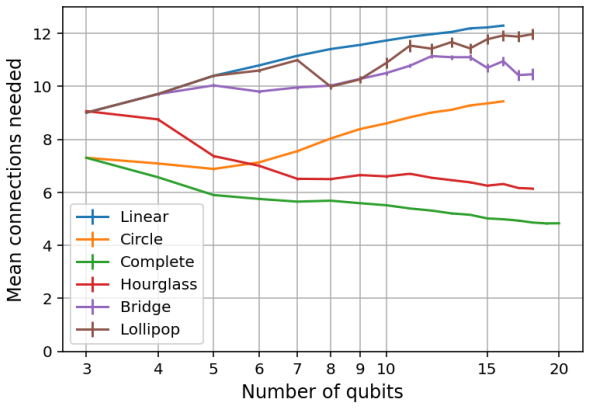
Summary. The paper develops a method to compute exactly the t=2 multiplicative error between a random circuit ensemble and the Haar measure, by reducing the optimal distinguishing experiment to a maximum over tensor products of |00> and singlet states (Theorem 1, Eq. 8) under local invariance and PSD vectorization. Using tensor-network contraction, it reports exact 2-design depths up to n=50 for graph-sampled circuits, a semi-empirical brickwork depth formula (Eq. 1), an Ω(n²) lower bound for the bridge graph (Theorem 2), and numerical results for fast parallel architectures. It also studies when collision probability is the optimal experiment, finding cases (star graph, open-boundary brickwork) where anticoncentration and 2-design depths differ.
Significance. If the PSD hypothesis holds, Theorem 1 gives a valuable exact algorithm for multiplicative errors, replacing loose spectral-gap bounds. The numerical results support several conjectures (graph scaling, complete graph fastest, connection-count universality) and the bridge bound answers a question from ref. [1] negatively, conditional on an imported lemma. The brickwork formula provides explicit constants. However, the paper ships no code/data, the headline brickwork formula is deferred, and the fastest-architecture claim rests on an unverified PSD assumption for even depths; these weaknesses currently prevent full certification.
major comments (4)
- [§5.2, Appendix A.9, Fig. 11] The claim that permuted brickwork is the fastest scrambler rests on Theorem 1, which requires vec(Φε − ΦHaar) to be positive semidefinite. The text states in §5.2 that it is 'unclear if the vectorization is PSD at even depths' for permuted brickwork, and Appendix A.8 only proves PSD for odd-depth permuted brickwork. Since the numerical errors in Fig. 11 are computed with Eq. 8 (via §2.3), and the PSD condition is used in Appendix A.9 to argue that the maximum is on the diagonal, the reported even-depth results are not covered. No numerical check of PSD for even depths is reported. Provide a proof, a PSD verification, or label the even-depth results as not rigorously justified by Theorem 1.
- [Appendix A.11, Theorem 2] The lower bound for the bridge graph relies on Lemma 5, which invokes 'the results of ref. [14]' that composing with tensor-product Haar unitaries cannot increase the multiplicative error. Since ref. [14] is an unpublished/parallel work by the same group and the lemma is not stated or proved here, the Ω(n²) lower bound is conditional. If the monotonicity lemma fails, Theorem 2 collapses. Please include a self-contained proof or a precise theorem statement with conditions, or explicitly mark Theorem 2 as conditional.
- [§4.2, Eq. (18)–(19), Fig. 10] The brickwork approximate-2-design depth formula is a headline numerical result (Eq. 1 in the abstract), but its derivation is deferred to 'a future work' and the paper states it is semi-empirical. The formula is used to draw conclusions about constants and layer counts. To be assessable, the derivation or at least the assumptions behind the 'rather tedious calculation' must be included, or the formula must be clearly labeled as a conjecture with supporting numerics rather than a result.
- [§5.3, §C] The fast-architecture results in Fig. 11 are obtained by sampling over circuit realizations (Appendix C) but no error bars or statistical confidence intervals are given, and no code or data are provided. Since the paper's main contributions are numerical and the flat-depth claim is an extrapolation, this makes the numerical evidence difficult to verify. Provide error bars for the sampled magnitudes, and release the code/data or a detailed reproducibility statement.
minor comments (6)
- [Abstract, §3.4.1] The abstract states 'at least Ω(n) gates per site' while Theorem 2 states Ω(n²) total gates; please reconcile the wording for clarity.
- [§5.2] Uses first-person 'I'll call it' in a multi-author paper; change to 'we call it'.
- [Acknowledgements] Typo: 'niversit' should be 'Université'.
- [Fig. 10 caption] The caption says the 'entangled boundaries bound is tight everywhere tested' but the text says it is a lower bound; clarify the distinction between a proven lower bound and a numerically observed tightness.
- [Eq. (11)–(12)] The arrow '∼' discarding e^{-O(n)} terms is abrupt; specify the limit in which the approximation is valid.
- [§2.2] The PSD vectorization condition is used crucially but never formally defined; consider adding a definition in the text.
Circularity Check
Theorem 2 imports its key monotonicity lemma from the authors' own ref. [14]; otherwise the central Theorem 1 and numerical depths are self-contained.
specific steps
-
self citation load bearing
[Appendix A.11 (Lemma 5 proof), used by Theorem 2 (Section 3.4.1)]
"Let us compose Φ /C with a tensor product of Haar-random unitaries acting on all the qudits on each side of the cut to obtain Φ Haarm ⊗ Φ Haar (n−m). By the results of ref. [14], this composition cannot increase the multiplicative error."
The Ω(n^2)-gate lower bound for the bridge graph (Theorem 2) depends on Lemma 5, whose proof imports the monotonicity statement that composing with Haar unitaries cannot increase multiplicative error from ref. [14]. Ref. [14] is the same three authors' prior preprint (Belkin, Allen, Clark, arXiv:2502.15995), cited without proof or independent verification here. Without that imported lemma, Lemma 5 and Theorem 2 collapse; the claimed theorem is thus supported by a self-citation rather than by a self-contained derivation. This is load-bearing but not definitional, since Theorem 1 and the numerical content are otherwise derived in-paper.
full rationale
The central reduction (Theorem 1, Eq. 8) is proved in-paper in Appendices A.2–A.10 under explicit assumptions (local invariance and PSD vectorization), and the reported 2-design depths are direct tensor-network evaluations of that formula; no fitted constant is relabeled as a prediction. The one load-bearing circularity is the bridge lower bound: Appendix A.11's Lemma 5 proof invokes ref. [14] for the essential monotonicity statement, and that reference is by the same authors and is not independently verified. I weigh this as score 4 rather than higher because the rest of the paper has independent content. I also explicitly flag two non-circular limitations required by the reviewing rule: (i) Sec. 5.2 and App. A.8 state that PSD-ness is 'unclear' for even-depth permuted brickwork, yet Fig. 11 applies Eq. 8 to that architecture; if PSD fails, those 'exact' fast-architecture errors are not covered by Theorem 1. (ii) Eq. 18 for the brickwork leading-order depth is said to follow from a 'rather tedious calculation' with details deferred to future work, so the asymptotic formula is semi-empirical rather than fully derived in this manuscript. Neither is a circularity, but both are assumption/derivation gaps in the chain.
Axiom & Free-Parameter Ledger
axioms (6)
- standard math Schur-Weyl duality: the single-site commutant of U(q)^⊗t is spanned by permutation states
- domain assumption For all studied ensembles, vec(Φε − ΦHaar) is positive-semidefinite
- domain assumption Composing with tensor-product Haar unitaries on each side of a cut cannot increase multiplicative error
- domain assumption Exact spectral gap for 1D brickwork from Deneris et al. [18]
- ad hoc to paper The greedy 'connection count' (Appendix B) is the right metric for universal scrambling bounds
- domain assumption Finite-size numerical trends persist asymptotically
invented entities (2)
-
connection count (greedy definition, Appendix B)
no independent evidence
-
Permuted brickwork (PB) and permuted-brickwork with fixed evens (PBFE)
independent evidence
Cite this review
Pith. "Pith review of Apparent Universal Behavior in Second Moments of Random Quantum Circuits." pith.science (2026). https://pith.science/paper/BLRDCL4G
@misc{pith2026251023726,
  author       = {Pith},
  title        = {Pith review of: Apparent Universal Behavior in Second Moments of Random Quantum Circuits},
  year         = {2026},
  howpublished = {\url{https://pith.science/paper/BLRDCL4G}},
  note         = {Machine review of arXiv:2510.23726}
}
read the original abstract
Just how fast does the brickwork circuit form an approximate 2-design? Is there any difference between anticoncentration and being a 2-design? Does geometry matter? How deep a circuit will I need in practice? We tell you everything you always wanted to know about second moments of random quantum circuits, but were too afraid to compute. Our answers generally take the form of numerical results for up to 50 qubits. Our first contribution is a strategy to determine explicitly the optimal experiment which distinguishes any given ensemble from the Haar measure. With this formula and some computational tricks, we are able to compute $t = 2$ multiplicative errors exactly out to modest system sizes. As expected, we see that most families of circuits form $\epsilon$-approximate $2$-designs in depth proportional to $\log n$. For the 1D brickwork, we work out the leading-order constants explicitly. For graphs, we find some exceptions which are much slower, proving that they require at least $\Omega(n^2)$ gates. This answers a question asked by ref. 1 in the negative. We explain these exceptional architectures in terms of connectedness. Based on this intuition we conjecture universal upper and lower bounds for graph-sampled circuit ensembles. For many architectures, the optimal experiment which determines the multiplicative error corresponds exactly to the collision probability (i.e. anticoncentration). However, we find that the star graph anticoncentrates much faster than it forms an $\epsilon$-approximate $2$-design. Finally, we show that one needs only ten to twenty layers to construct an approximate $2$-design for realistic parameter ranges. This is a large constant-factor improvement over previous constructions. The parallel complete-graph architecture is not quite the fastest scrambler, partially resolving a question raised by ref. 2.
Figures




Forward citations
Cited by 1 Pith paper
-
Unitary Designs from Doped Matchgate Circuits
Doped matchgate circuits achieve approximate parity-preserving 2-designs in polylogarithmic depth using a sparse number of non-Gaussian gates, with the design formation mapped exactly to a birth-death Markov chain.
Reference graph
Works this paper leans on
-
[1]
S. Mittal and N. Hunter-Jones,Local random quantum circuits form approximate designs on arbitrary archi- tectures, arXiv:2310.19355 [quant-ph], Oct. 2023
Pith/arXiv arXiv 2023
-
[2]
Random Quantum Circuits Anticoncentrate in Log Depth
A. M. Dalzell, “Random Quantum Circuits Anticoncentrate in Log Depth”, PRX Quantum3,10.1103/ PRXQuantum.3.010333(2022)
2022
-
[3]
L. Cui, T. Schuster, L. Mao, H.-Y. Huang, and F. Brandao,Random unitaries from Hamiltonian dynamics, arXiv:2510.08434, Oct. 2025
arXiv 2025
-
[4]
R. Suzuki, H. Katsura, Y. Mitsuhashi, T. Soejima, J. Eisert, and N. Yoshioka,More global randomness from less random local gates, arXiv:2410.24127 [quant-ph], Apr. 2025
Pith/arXiv arXiv 2025
-
[5]
T. Schuster, J. Haferkamp, and H.-Y. Huang,Random unitaries in extremely low depth, arXiv:2407.07754 [quant-ph], Jan. 2025
Pith/arXiv arXiv 2025
-
[6]
N. LaRacuente and F. Leditzky,Approximate Unitary$k$-Designs from Shallow, Low-Communication Cir- cuits, arXiv:2407.07876 [quant-ph], July 2024
arXiv 2024
-
[7]
Quantum t-designs: t-wise Independence in the Quantum World
A. Ambainis and J. Emerson, “Quantum t-designs: t-wise Independence in the Quantum World”, English, in, ISSN: 1093-0159 (June 2007), pp. 129–140
2007
-
[8]
Local Random Quantum Circuits are Approximate Polynomial-Designs
F. G. S. L. Brand˜ ao, A. W. Harrow, and M. Horodecki, “Local Random Quantum Circuits are Approximate Polynomial-Designs”, en, Communications in Mathematical Physics346, 397–434 (2016)
2016
-
[9]
A. Harrow and S. Mehraban, “Approximate unitary$t$-designs by short random quantum circuits using nearest-neighbor and long-range gates”, Communications in Mathematical Physics401, arXiv:1809.06957 [quant-ph], 1531–1626 (2023)
Pith/arXiv arXiv 2023
-
[10]
Ap- proximate t -Designs in Generic Circuit Architectures
D. Belkin, J. Allen, S. Ghosh, C. Kang, S. Lin, J. Sud, F. T. Chong, B. Fefferman, and B. K. Clark, “Ap- proximate t -Designs in Generic Circuit Architectures”, en, PRX Quantum5, 040344 (2024). 17
2024
-
[11]
C.-F. Chen, J. Haah, J. Haferkamp, Y. Liu, T. Metger, and X. Tan,Incompressibility and spectral gaps of random circuits, arXiv:2406.07478 [quant-ph], Dec. 2024
Pith/arXiv arXiv 2024
-
[12]
J. Allen, D. Belkin, and B. K. Clark,Conditional t-independent spectral gap for random quantum circuits and implications for t-design depths, arXiv:2411.13739 [quant-ph], Feb. 2025
Pith/arXiv arXiv 2025
-
[13]
Epsilon-Nets, Unitary Designs, and Random Quantum Cir- cuits
M. Oszmaniec, A. Sawicki, and M. Horodecki, “Epsilon-Nets, Unitary Designs, and Random Quantum Cir- cuits”, IEEE Transactions on Information Theory68, 989–1015 (2022)
2022
-
[14]
D. Belkin, J. Allen, and B. K. Clark,Absence of censoring inequalities in random quantum circuits, arXiv:2502.15995 [quant-ph], May 2025
Pith/arXiv arXiv 2025
-
[15]
Heinrich, J
M. Heinrich, J. Haferkamp, I. Roth, and J. Helsen,Anti-concentration is (almost) all you need, Oct. 2025
2025
-
[16]
Random quantum circuits are approximate unitary$t$-designs in depth$O\left(ntˆ{5+o(1)}\right)$
J. Haferkamp, “Random quantum circuits are approximate unitary$t$-designs in depth$O\left(ntˆ{5+o(1)}\right)$”, en-GB, Quantum6, Publisher: Verein zur F¨ orderung des Open Access Publizierens in den Quantenwis- senschaften, 795 (2022)
2022
-
[17]
J. Haferkamp, “Improved spectral gaps for random quantum circuits: Large local dimensions and all-to-all interactions”, Physical Review A104,10.1103/PhysRevA.104.022417(2021)
-
[18]
A. E. Deneris, P. Bermejo, P. Braccia, L. Cincio, and M. Cerezo,Exact spectral gaps of random one- dimensional quantum circuits, arXiv:2408.11201 [quant-ph], Aug. 2024
arXiv 2024
-
[19]
Solvable non-Hermitian skin effect in many-body unitary dynamics
M. Znidaric, “Solvable non-Hermitian skin effect in many-body unitary dynamics”, Physical Review Research 4, arXiv:2205.01321 [quant-ph], 033041 (2022)
Pith/arXiv arXiv 2022
-
[20]
T. Metger, A. Poremba, M. Sinha, and H. Yuen,Simple constructions of linear-depth t-designs and pseudo- random unitaries, arXiv:2404.12647 [quant-ph], Apr. 2024
Pith/arXiv arXiv 2024
-
[21]
L. Cui, T. Schuster, F. Brandao, and H.-Y. Huang,Unitary designs in nearly optimal depth, arXiv:2507.06216 [quant-ph], July 2025
Pith/arXiv arXiv 2025
-
[22]
L. Grevink, J. Haferkamp, M. Heinrich, J. Helsen, M. Hinsche, T. Schuster, and Z. Zimbor´ as,Will it glue? On short-depth designs beyond the unitary group, arXiv:2506.23925 [quant-ph], Sept. 2025
arXiv 2025
-
[23]
M. West, D. Garc ´ ıa-Mart ´ ın, N. L. Diaz, M. Cerezo, and M. Larocca,No-go theorems for sublinear-depth group designs, arXiv:2506.16005 [quant-ph], June 2025
Pith/arXiv arXiv 2025
-
[24]
H. Liu, A. Hulse, and I. Marvian,Unitary Designs from Random Symmetric Quantum Circuits, arXiv:2408.14463 [quant-ph], Oct. 2024
Pith/arXiv arXiv 2024
-
[25]
Unitary Designs of Symmetric Local Random Circuits
Y. Mitsuhashi, R. Suzuki, T. Soejima, and N. Yoshioka, “Unitary Designs of Symmetric Local Random Circuits”, Physical Review Letters134, arXiv:2408.13472 [quant-ph], 180404 (2025). A Multiplicative errors att= 2 A.1 Basic setup Suppose we havensites, each with a local Hilbert space of dimensionq. We have some distributionεover the unitary group of which w...
Pith/arXiv arXiv 2025
-
[26]
If two consecutive gates act in disjoint locations, then we can swap their ordering
-
[27]
We may split any gate into two consecutive copies of itself. For example, given four qubits labeleda, b, c, d, the following two architectures are equivalent: ab, ad, bc ab, ad, bc, ad B.2 Naive and greedy algorithms We do not know of a guaranteed way to compute the connection count, as defined above, since there may be many possible ways to rearrange and...
discussion (0)
Sign in with ORCID, Apple, or X to comment. Anyone can read and Pith papers without signing in.