REVIEW 3 major objections 4 minor 2 cited by
Thermodynamic Uncertainty Relations for Coherent Transport
T0 review · 3 major / 4 minor · reviewed 2026-08-08 · deepseek-v4-flash
Pith's one-line read For coherent fermionic conductors, the entropy-production rate is bounded from below by a measured current and its fluctuations, through the inequality Q_qu ≥ 1, which holds at arbitrary bias in any multi-terminal geometry.
desk verdict A clean, self-contained derivation of a universal TUR for coherent fermionic transport; the main bound holds, with minor caveats about the broken-TRS constant and the probe-terminal claims. read the letter →
The pith
A machine-rendered reading of the paper's core claim, the machinery that carries it, and where it could break.
The reading
What carries the argument
The load-bearing object is the inequality Q_qu = (S_α/J_α) $\sinh$[σ/(2 k_B J_α)] ≥ 1, derived through the scattering formalism. The proof rewrites the entropy production σ in terms of transmission functions and Fermi functions, introduces the convex function Φ[x] = x·arsinh(x), applies a tangent-line (Jensen) bound at an optimally chosen point X = J_α/(2N_α), and then uses the relation S_α ≥ 2N_α ≥ S_α^th to eliminate the auxiliary quantity N_α. For broken time-reversal symmetry, a similar argument with a concavity bound on the binary entropy function yields the same form with the numerical factor ψ_0 ≃ 0.85246 inserted into the argument of the hyperbolic sine.
What would settle it
Construct a multi-terminal fermionic conductor with time-reversal-symmetric scattering but with finite interactions or inelastic collisions inside the sample, then measure J_α, S_α, and the true total entropy production, and check whether the quantity (S_α/J_α) sinh[σ/(2 k_B J_α)] drops below 1 wherever those internal processes dissipate energy.
Extended reading notes
Core claim
The central discovery is that, for fermionic coherent conductors, the classical thermodynamic uncertainty relation Q_cl = σS/(2 k_B $J^{2}$) ≥ 1 is replaced by Q_qu = (S_α/J_α) $\sinh$[σ/(2 k_B J_α)] ≥ 1. Unlike its classical counterpart, this inequality is never violated by energy filtering and Pauli blocking; it holds arbitrarily far from equilibrium and for any multi-terminal geometry. The proof uses only the Landauer–Büttiker scattering formalism, the reservoir-only entropy balance σ = −∑_α Q_α/T_α, and convexity of x·arsinh(x). In linear response, the hyperbolic sine linearizes and the classical bound is recovered; with a numerical prefactor ψ_0 ≃ 0.85246, the bound extends to samples with broken time-reversal symmetry.
Load-bearing premise
The proof assumes that all entropy is produced in the reservoirs, so no inelastic scattering or interactions inside the sample generate additional dissipation; if they do, the bound constrains only the reservoir part and may miss the physically relevant total entropy production.
Editorial extensions
If this is right
- A two-terminal thermoelectric heat engine obeys the trade-off relation Q_qu^HE ≥ 1, implying that ideal Carnot efficiency is attainable only with vanishing power output or diverging power fluctuations.
- A two-terminal thermoelectric refrigerator satisfies a similar trade-off, and its efficiency can be estimated from current mean and fluctuations alone, bypassing difficult heat-current measurements.
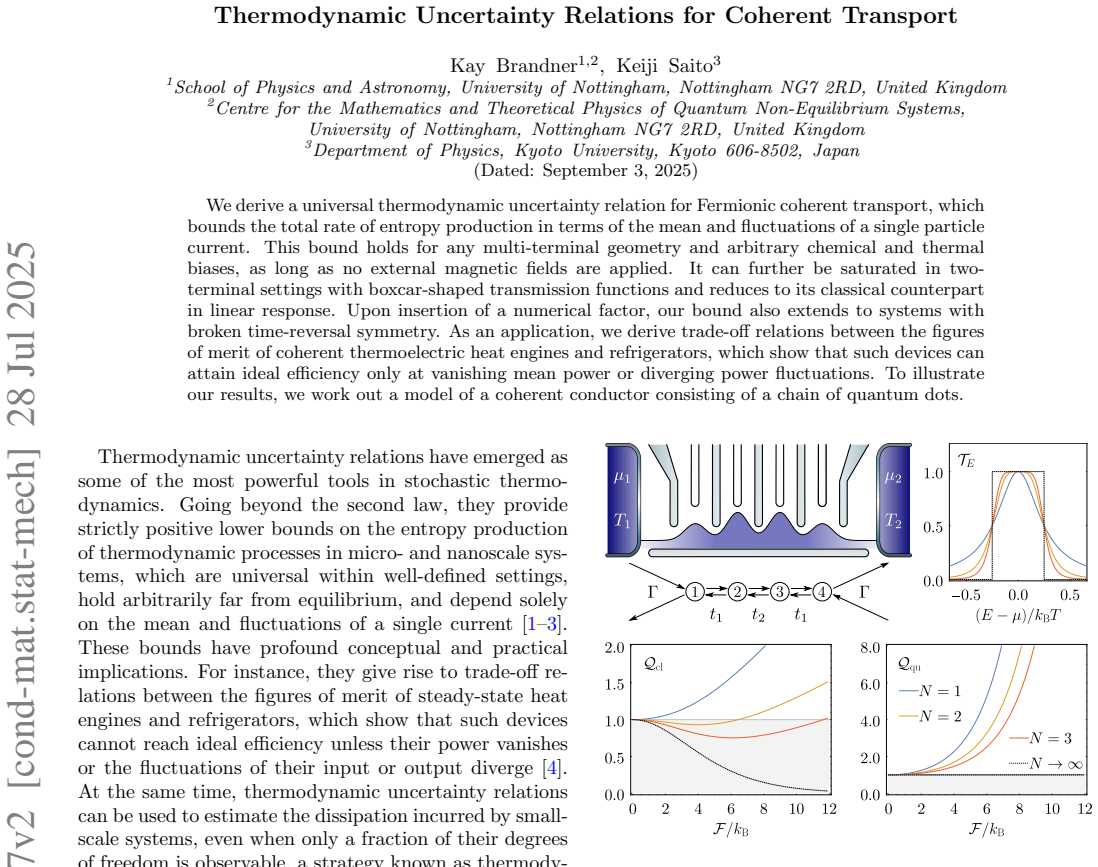
- A chain of quantum dots with specially tuned hopping amplitudes and reservoir couplings produces a nearly boxcar transmission function, essentially saturating the quantum bound while strongly violating the classical one.
- The bound extends to time-reversal-broken systems, including chiral quantum Hall edge states, at the cost of only a numerical factor ψ_0 in the dissipation estimate.
- The authors expect (but do not prove) that the bound remains robust against moderate dephasing, internal dissipation, and carrier interactions when these are modeled by probe terminals.
- In the linear-response limit, the bound reduces exactly to the classical thermodynamic uncertainty relation, showing that violations of the classical bound are a far-from-equilibrium effect.
Reading between the lines
- Beyond the paper: if the probe-terminal expectation holds, the bound could serve as a general dissipation-inference tool for interacting quantum dot arrays, where heat currents are hard to measure.
- Beyond the paper: the appearance of the symmetry-dependent prefactor ψ_0 suggests a possible family of uncertainty relations with prefactors tied to the degree of time-reversal breaking, which could be explored numerically for partially symmetric scattering matrices.
- Beyond the paper: the tightness at boxcar transmission profiles invites searches for finite-parameter transmission shapes that nearly saturate the bound at small N, potentially guiding the design of high-precision, low-dissipation mesoscopic devices.
- Beyond the paper: the same convexity-based proof strategy might extend to heat-current fluctuations, although the paper notes that an additional parameter would be needed to match physical dimensions.
Editorial analysis
A structured set of objections, weighed in public.
Referee Report
Summary. The paper derives a universal thermodynamic uncertainty relation for fermionic coherent transport, Eq. (2): Q_qu = (S_alpha/J_alpha) sinh[sigma/(2 k_B J_alpha)] >= 1, where J_alpha and S_alpha are the mean and zero-frequency fluctuations of the particle current entering terminal alpha and sigma is the total rate of entropy production. The proof uses Landauer-Buttiker expressions for currents and noise, rewrites sigma as an integral of a convex function x arsinh x, applies a tangent bound, and eliminates the channel-overlap factor N_alpha using the AM-GM inequality. The paper also gives a broken-time-reversal version with a numerical constant psi_0, derives power-efficiency-fluctuation trade-offs for heat engines and refrigerators, and illustrates the results with a quantum dot chain whose transmission function approaches a boxcar shape.
Significance. The central result is significant: it provides a parameter-free lower bound on dissipation from a single measured current and its noise, valid arbitrarily far from equilibrium and for arbitrary multi-terminal geometries, and it is tight for narrow boxcar transmissions. The derivation is elegant and self-contained, and the thermoelectric trade-off relations are practically useful. The main limitations are the restriction to non-interacting coherent transport without internal dissipation and the reliance of the broken-TRS extension on a numerically determined constant rather than a fully analytic proof.
major comments (3)
- [Section 2 (second remark) and Eq. (9)] The claim that Eq. (2) 'still applies' to systems with incoherent or inelastic scattering and interactions through probe terminals is not derived. The entropy balance sigma = -sum_alpha Q_alpha/T_alpha is exact only when no entropy is produced inside the sample; a probe with zero net particle and heat current can model elastic dephasing but not inelastic dissipation, which requires a nonzero heat flow into the probe and therefore adds a positive contribution to sigma. Since the paper only states 'we expect' robustness, this passage should be explicitly labeled as a conjecture, or a proof should be given that the probe heat contribution cannot make the bound fail.
- [Supplemental Material, Eq. (S5) and Eq. (16)] The broken-time-reversal bound Eq. (16) rests on the numerical statement psi[x,y] >= psi_0 = 0.85246 over [0,1]^2. No analytical certificate or interval-arithmetic verification is provided, so the advertised extension to systems with broken time-reversal symmetry is not fully proven. In addition, the step from the psi_0 replacement to Eq. (16) is only sketched ('along the lines described in the main text'), although the variable Y = (f_alpha - f_beta)/(g_alphaalpha + g_betabeta) and the weight differ from the time-reversal-symmetric case; the cancellation condition is Y_0 = J_alpha/S_th^alpha. Please provide a rigorous lower bound on psi and spell out the analog of the tangent argument.
- [Eq. (2) and surrounding statement] The derivation requires g^alpha_beta_E = f^alpha_E(1 - f^beta_E) > 0, which holds only for finite reservoir temperatures. At T = 0 the quantities N_alpha and S_alpha can vanish while J_alpha stays nonzero (for example, a perfectly transmitting channel), so Eq. (2) as written is not defined and the proof's tangent argument breaks down. The theorem should be stated for finite reservoir temperatures, with the zero-temperature limit discussed separately.
minor comments (4)
- [Eqs. (2) and (16)] The ratios S_alpha/J_alpha are written without absolute values; for J_alpha < 0 the expression is nevertheless positive because the hyperbolic sine has the same sign as J_alpha. To avoid confusion for the reader, it would be clearer to write |J_alpha| in the prefactor.
- [Supplemental Material, after Eq. (S5)] The numerical minimization of psi is not documented; please state the method (grid size, precision, or certified interval arithmetic) or provide the code or data used to obtain psi_0.
- [Eq. (24)] The notation 'iGamma = t0 = tN' appears to contain a typo; presumably t0 and tN denote boundary hopping amplitudes and the reservoir coupling is Gamma. Please clarify the notation.
- [Eq. (2) and limiting cases] The cases J_alpha = 0 and zero temperature are not discussed; the inequality is singular in both cases, and the limiting statements should be made precise if these cases are meant to be included.
Circularity Check
No significant circularity: Eq. (2) is derived from Landauer–Büttiker formulas and convexity, with no fitted parameter or load-bearing self-citation.
full rationale
The central inequality (2) is derived directly from the Landauer–Büttiker expressions (3)–(8), the reservoir entropy balance (9), an algebraic rearrangement into the convex function x·arsinh(x), and elementary inequalities. In particular, Eq. (10) is rewritten via the identity relating log-ratios of Fermi functions to arsinh of X, and the choice X = J_alpha/(2 N_alpha) makes the first-order term in the convexity bound vanish by construction. The replacement of 2N_alpha by S_alpha uses only 2N_alpha <= Sth_alpha <= S_alpha and monotonicity of arsinh; nothing is fitted to force the inequality. The secondary bound (16) involves a numerically minimized universal constant psi0, which is a mathematical lower bound for a fixed function, not a parameter fitted to the target result. Self-citations (Refs. 17, 21, 24, 45, 82) appear only as background, context, or illustrations of saturation and classical-bound violations; the proof of Eq. (2) does not rely on these citations as premises. The quantum-dot chain is an illustrative model, and the transmission formula (25) is verified by computer algebra rather than assumed for the main derivation. The statement that probe terminals should make the bound robust against dephasing and dissipation is explicitly labeled an expectation ('We therefore expect'), which is a limitation or open point, not a circular step. Overall, the derivation is self-contained and does not reduce any output to its input by construction.
Assumptions & free parameters
assumptions (5)
- domain assumption Landauer-Buttiker scattering formulas (Eqs. 3-8) describe currents and zero-frequency noise of noninteracting coherent fermionic conductors.
- domain assumption All entropy production occurs in the reservoirs, sigma = -sum_alpha Q_alpha/T_alpha (Eq. 9), with no dissipation inside the conductor.
- domain assumption Time-reversal symmetry implies reciprocity T^{alpha beta}_E = T^{beta alpha}_E; for broken TRS, unitarity gives sum rules sum_beta T^{alpha beta}_E = sum_beta T^{beta alpha}_E.
- standard math Phi(x) = x arsinh x is convex on the real line, so a tangent-line bound applies.
- ad hoc to paper The bound psi[x,y] >= psi_0 = 0.85246 holds on [0,1]^2, asserted by numerical minimization in the SM.
Cite this review
Pith. "Pith review of Thermodynamic Uncertainty Relations for Coherent Transport." pith.science (2026). https://pith.science/paper/BSA6XJAK
@misc{pith2026250207917,
  author       = {Pith},
  title        = {Pith review of: Thermodynamic Uncertainty Relations for Coherent Transport},
  year         = {2026},
  howpublished = {\url{https://pith.science/paper/BSA6XJAK}},
  note         = {Machine review of arXiv:2502.07917}
}
read the original abstract
We derive a universal thermodynamic uncertainty relation for Fermionic coherent transport, which bounds the total rate of entropy production in terms of the mean and fluctuations of a single particle current. This bound holds for any multi-terminal geometry and arbitrary chemical and thermal biases, as long as no external magnetic fields are applied. It can further be saturated in two-terminal settings with boxcar-shaped transmission functions and reduces to its classical counterpart in linear response. Upon insertion of a numerical factor, our bound also extends to systems with broken time-reversal symmetry. As an application, we derive trade-off relations between the figures of merit of coherent thermoelectric heat engines and refrigerators, which show that such devices can attain ideal efficiency only at vanishing mean power or diverging power fluctuations. To illustrate our results, we work out a model of a coherent conductor consisting of a chain of quantum dots.
Figures

Forward citations
Cited by 2 Pith papers
-
Impact of Nonlinearities on Local Kinetic and Thermokinetic Uncertainty Relations in Bosonic Transport
Local kinetic and thermokinetic precision bounds are shown to break in the nonlinear spin-boson model due to antibunching, while a susceptibility-based kinetic uncertainty relation continues to hold.
-
Fluctuation-dissipation bounds for time-dependently driven conductors
Out-of-equilibrium zero-frequency charge noise in periodically driven multi-terminal conductors is bounded by a weighted sum of Floquet-band currents, with an often tighter alternative bound based on effective electro...
Reference graph
Works this paper leans on
-
[1]
Using this formalism, it was shown early on that Eq
Under these conditions, which can be realized in experiments with semiconductor nano-structures [ 30–33], atomic junctions [34–37] or ultracold atomic gases [ 38–41], the resulting transport process admits a simple and physically trans- parent description in terms of single-particle scattering amplitudes [ 42–44]. Using this formalism, it was shown early ...
-
[2]
[ 45–50], see Fig. 1. Following this ob- servation, various relations between dissipation, current fluctuations and other quantities have been established for Fermionic coherent transport in the recent literature [ 51–56]. Still, the question whether there exists a univer- sal thermodynamic uncertainty relation for this class of systems that involves the s...
-
[3]
We therefore expect the bound (
is derived here within the framework of coherent transport, it still applies in situations where incoherent or inelastic scattering events and interactions between carriers can be described effectively through probe terminals, i.e., virtual reservoirs whose intensive parameters are adjusted such that they do not exchange any heat or particles with the syst...
-
[4]
to be robust against moderate dephasing, internal dissipation and carrier in- teractions. Third, close to equilibrium, the particle and heat currents entering the sample, Jα and Qα , become linear functions of the affinities Fα = (µ α −µ )/T and Aα = 1/T − 1/T α , where µ α and Tα denote the chemi- cal potential and temperature of the reservoir α , and µ an...
-
[5]
As a result, we recover the classical relation ( 1)
can be replaced with its linear approximation. As a result, we recover the classical relation ( 1). This obser- vation shows that violations of the bound ( 1) can occur only beyond the linear-response regime. Finally, we note that the bound (
-
[6]
becomes an equality for an isother- mal two-terminal system with a narrow boxcar-shaped transmission function centered between the chemical po- tentials of the reservoirs, as was observed in Ref. [ 45]. To derive the relation ( 2) and to discuss its impli- cations quantitatively, we briefly review the scatter- ing approach to coherent transport, where we f...
-
[7]
T. Koyuk and U. Seifert, Operationally Accessible Bounds on Fluctuations and Entropy Production in Pe- riodically Driven Systems, Phys. Rev. Lett. 122, 230601 (2019)
work page 2019
-
[8]
As our second key result, we find that this restriction can be removed by introducing a numerical factor
is no longer applicable. As our second key result, we find that this restriction can be removed by introducing a numerical factor. Upon re- placing the symmetry T αβ E = T βα E with the sum rules∑ β T αβ E = ∑ β T βα E , which reflect the principle of cur- rent conservation and hold regardless of how the system behaves under time reversal [ 42–44], we obtai...
Show all 102 references
-
[9]
for the rate of entropy production σ and the first law P =Q1 +Q2, we obtain the trade-off relations QHE qu = SP P (µ 2 −µ 1) sinh [ (ηC −η)(µ 2 −µ 1) 2kBT2η ] g 1, (17) QRF qu = SPε Q(µ 2 −µ 1) sinh [ (εC −ε)(µ 2 −µ 1) 2kBT1εC ] g 1, (18) for heat engines and refrigerators, resp...
-
[10]
Di Terlizzi and M
I. Di Terlizzi and M. Baiesi, Kinetic uncertainty relation, J. Phys. A: Math. Theor. 52, 02LT03 (2019)
2019
-
[11]
J. Yan, A. Hilfinger, G. Vinnicombe, and J. Paulsson, Ki- netic Uncertainty Relations for the Control of Stochastic Reaction Networks, Phys. Rev. Lett. 123, 108101 (2019)
2019
-
[12]
The key fea- ture of this system is that its transmission function can 4 FIG. 2. Chain of quantum dots as a coherent refrigerator. T op left: Solid lines show the normalized efficiency ε/ε C as a function of the temperature ratio T1/T 2 for different num- bers N of dots; dashed l...
-
[13]
To realize these effects in an experimentally relevant set- ting, chains of quantum dots provide a natural starting point [ 74–80]
[48, 50]. To realize these effects in an experimentally relevant set- ting, chains of quantum dots provide a natural starting point [ 74–80]. The basic idea here is to generate a band- structured transmission spectrum with sharply bounded transmission windows through a spatiall...
-
[14]
Second, the classical trade-off relation (
provides a loose but non-trivial estimate of the efficiency of the device for a significant range of model parameters. Second, the classical trade-off relation (
-
[15]
remains valid after replacing 2Nα withSα , which leads to Eq. ( 2). The above derivation uses the relation T αβ E = T βα E , which holds in general only if the micro-dynamics of the system are symmetric under time reversal [ 42–44]. If this symmetry is broken, for instance due...
-
[16]
Kwon, H.-M
E. Kwon, H.-M. Chun, H. Park, and J. S. Lee, Fluctuation-response inequalities for kinetic and entropic perturbations (2024), arXiv:2411.18108
2024
-
[17]
The relations (
and ( 18) can be rearranged as η/η C f 1/ (1 +T2X ) and ε/ε C f 1 +T1X, (21) where the parameter X = 2kB · arsinh[J1/S 1]/ (µ 2 −µ 1) depends only on the mean J1 and fluctuations S1 of the particle current, and the intensive properties of the reser- voirs. The relations (
-
[18]
and ( 20) can be achieved in more elaborate models and experimentally relevant sys- tems, and whether their quantum counterparts (
-
[19]
We leave it to future research to establish whether stronger violations of the classical relations (
and ( 20) can be violated shows that coherent thermal devices can offer a thermodynamic ad- vantage over their classical counterparts. We leave it to future research to establish whether stronger violations of the classical relations (
-
[20]
To understand why these violations are small, we recall that the temperatures of the reservoirs are encoded in the broadening of their Fermi functions
can be violated for suf- ficiently small temperature gradients and N g 4 dots. To understand why these violations are small, we recall that the temperatures of the reservoirs are encoded in the broadening of their Fermi functions. To generate a strong thermoelectric response, a...
-
[21]
With these insights, which constitute our third main result, we conclude the general part of this article and move on to the specific setup of Fig
thus make it possible to estimate the efficiency of thermal machines without measuring any heat currents, which is often difficult in practice. With these insights, which constitute our third main result, we conclude the general part of this article and move on to the specific setup of Fig
-
[22]
and (18) can be strengthened by taking into account further practical constraints. 5 From a more general perspective, it remains to be seen whether the bounds ( 2) and ( 16) can be extended to en- ergy or heat fluxes, which would require either structural changes or the incorpo...
-
[23]
Seifert, Stochastic thermodynamics: From principles to the cost of precision, Physica A 504, 176 (2018)
U. Seifert, Stochastic thermodynamics: From principles to the cost of precision, Physica A 504, 176 (2018)
2018
-
[24]
Seifert, From Stochastic Thermodynamics to Thermo- dynamic Inference, Annu
U. Seifert, From Stochastic Thermodynamics to Thermo- dynamic Inference, Annu. Rev. Condens. Matter Phys. 10, 171 (2019)
2019
-
[25]
J. M. Horowitz and T. R. Gingrich, Thermodynamic uncertainty relations constrain non-equilibrium fluctua- tions, Nat. Phys. 16, 15 (2020)
2020
-
[26]
Pietzonka and U
P. Pietzonka and U. Seifert, Universal Trade-Off between Power, Efficiency, and Constancy in Steady-State Heat Engines, Phys. Rev. Lett. 120, 190602 (2018)
2018
-
[27]
A. C. Barato and U. Seifert, Thermodynamic Uncer- tainty Relation for Biomolecular Processes, Phys. Rev. Lett. 114, 158101 (2015)
2015
-
[28]
T. R. Gingrich, J. M. Horowitz, N. Perunov, and J. L. England, Dissipation Bounds All Steady-State Current Fluctuations, Phys. Rev. Lett. 116, 120601 (2016)
2016
-
[29]
Koyuk and U
T. Koyuk and U. Seifert, Thermodynamic Uncertainty Relation for Time-Dependent Driving, Phys. Rev. Lett. 125, 260604 (2020)
2020
-
[30]
J. P. Garrahan, Simple bounds on fluctuations and un- certainty relations for first-passage times of counting ob- servables, Phys. Rev. E 95, 032134 (2017)
2017
-
[31]
Hiura and S.-i
K. Hiura and S.-i. Sasa, Kinetic uncertainty relation on first-passage time for accumulated current, Phys. Rev. E 103, L050103 (2021)
2021
-
[32]
Dechant and S.-i
A. Dechant and S.-i. Sasa, Fluctuation–response inequal - ity out of equilibrium, Proc. Natl. Acad. Sci. U.S.A. 117, 6430 (2020)
2020
-
[33]
Wang, Sub-Gaussian and subexponential fluctuation- response inequalities, Phys
Y. Wang, Sub-Gaussian and subexponential fluctuation- response inequalities, Phys. Rev. E 102, 052105 (2020)
2020
-
[34]
Chun and J
H.-M. Chun and J. M. Horowitz, Trade-offs between number fluctuations and response in nonequilibrium chemical reaction networks, The Journal of Chemical Physics 158, 174115 (2023)
2023
-
[35]
Macieszczak, K
K. Macieszczak, K. Brandner, and J. P. Garrahan, Uni- fied Thermodynamic Uncertainty Relations in Linear Re- sponse, Phys. Rev. Lett. 121, 130601 (2018)
2018
-
[36]
Carollo, R
F. Carollo, R. L. Jack, and J. P. Garrahan, Unraveling the Large Deviation Statistics of Markovian Open Quan- tum Systems, Phys. Rev. Lett. 122, 130605 (2019)
2019
-
[37]
Guarnieri, G
G. Guarnieri, G. T. Landi, S. R. Clark, and J. Goold, Thermodynamics of precision in quantum nonequilib- rium steady states, Phys. Rev. Research 1, 033021 (2019)
2019
-
[38]
Hasegawa, Quantum Thermodynamic Uncertainty Relation for Continuous Measurement, Phys
Y. Hasegawa, Quantum Thermodynamic Uncertainty Relation for Continuous Measurement, Phys. Rev. Lett. 125, 050601 (2020)
2020
-
[39]
Potanina, C
E. Potanina, C. Flindt, M. Moskalets, and K. Brandner, Thermodynamic bounds on coherent transport in period- ically driven conductors, Phys. Rev. X 11, 021013 (2021)
2021
-
[40]
Hasegawa, Thermodynamic Uncertainty Relation for General Open Quantum Systems, Phys
Y. Hasegawa, Thermodynamic Uncertainty Relation for General Open Quantum Systems, Phys. Rev. Lett. 126, 010602 (2021)
2021
-
[41]
Rignon-Bret, G
A. Rignon-Bret, G. Guarnieri, J. Goold, and M. T. Mitchison, Thermodynamics of precision in quantum nanomachines, Phys. Rev. E 103, 012133 (2021)
2021
-
[42]
Menczel, E
P. Menczel, E. Loisa, K. Brandner, and C. Flindt, Ther- modynamic uncertainty relations for coherently driven open quantum systems, J. Phys. A: Math. Theor. 54, 314002 (2021)
2021
-
[43]
Van Vu and K
T. Van Vu and K. Saito, Thermodynamics of Precision in Markovian Open Quantum Dynamics, Phys. Rev. Lett. 128, 140602 (2022)
2022
-
[44]
Prech, P
K. Prech, P. Johansson, E. Nyholm, G. T. Landi, C. Ver- dozzi, P. Samuelsson, and P. P. Potts, Entanglement and thermokinetic uncertainty relations in coherent meso- scopic transport, Phys. Rev. Research 5, 023155 (2023)
2023
-
[45]
T. V. Vu, Fundamental bounds on precision and response for quantum trajectory observables (2024), arXiv:2411.19546
2024 arXiv
-
[46]
S. V. Moreira, M. Radaelli, A. Candeloro, F. C. Binder, and M. T. Mitchison, Precision bounds for multiple cur- rents in open quantum systems (2024), arXiv:2411.09088
2024 arXiv
-
[47]
Kwon and J
E. Kwon and J. S. Lee, A unified framework for classi- cal and quantum uncertainty relations using stochastic representations (2024), arXiv:2412.04988
2024 arXiv
-
[48]
B. J. Van Wees, H. Van Houten, C. W. J. Beenakker, J. G. Williamson, L. P. Kouwenhoven, D. Van Der Marel, and C. T. Foxon, Quantized conductance of point con- tacts in a two-dimensional electron gas, Phys. Rev. Lett. 60, 848 (1988)
1988
-
[49]
D. A. Wharam, T. J. Thornton, R. Newbury, M. Pep- per, H. Ahmed, J. E. F. Frost, D. G. Hasko, D. C. Pea- 6 cock, D. A. Ritchie, and G. A. C. Jones, One-dimensional transport and the quantisation of the ballistic resistance, J. Phys. C: Solid State Phys. 21, L209 (1988)
1988
-
[50]
Schwab, E
K. Schwab, E. A. Henriksen, J. M. Worlock, and M. L. Roukes, Measurement of the quantum of thermal con- ductance, Nature 404, 974 (2000)
2000
-
[51]
Matthews, F
J. Matthews, F. Battista, D. S´ anchez, P. Samuelsson, and H. Linke, Experimental verification of reciprocity re- lations in quantum thermoelectric transport, Phys. Rev. B 90, 165428 (2014)
2014
-
[52]
J. M. Krans, J. M. Van Ruitenbeek, V. V. Fisun, I. K. Yanson, and L. J. De Jongh, The signature of conduc- tance quantization in metallic point contacts, Nature 375, 767 (1995)
1995
-
[53]
H. E. Van Den Brom and J. M. Van Ruitenbeek, Quan- tum Suppression of Shot Noise in Atom-Size Metallic Contacts, Phys. Rev. Lett. 82, 1526 (1999)
1999
-
[54]
L. Cui, W. Jeong, S. Hur, M. Matt, J. C. Kl¨ ockner, F. Pauly, P. Nielaba, J. C. Cuevas, E. Meyhofer, and P. Reddy, Quantized thermal transport in single-atom junctions, Science 355, 1192 (2017)
2017
-
[55]
O. S. Lumbroso, L. Simine, A. Nitzan, D. Segal, and O. Tal, Electronic noise due to temperature differences in atomic-scale junctions, Nature 562, 240 (2018)
2018
-
[56]
Brantut, J
J.-P. Brantut, J. Meineke, D. Stadler, S. Krinner, and T. Esslinger, Conduction of Ultracold Fermions Through a Mesoscopic Channel, Science 337, 1069 (2012)
2012
-
[57]
Brantut, C
J.-P. Brantut, C. Grenier, J. Meineke, D. Stadler, S. Krinner, C. Kollath, T. Esslinger, and A. Georges, A Thermoelectric Heat Engine with Ultracold Atoms, Sci- ence 342, 713 (2013)
2013
-
[58]
Krinner, D
S. Krinner, D. Stadler, D. Husmann, J.-P. Brantut, and T. Esslinger, Observation of quantized conductance in neutral matter, Nature 517, 64 (2015)
2015
-
[59]
Lebrat, P
M. Lebrat, P. Griˇ sins, D. Husmann, S. H¨ ausler, L. Cor- man, T. Giamarchi, J.-P. Brantut, and T. Esslinger, Band and Correlated Insulators of Cold Fermions in a Mesoscopic Lattice, Phys. Rev. X 8, 011053 (2018)
2018
-
[60]
Sivan and Y
U. Sivan and Y. Imry, Multichannel Landauer formula for thermoelectric transport with application to ther- mopower near the mobility edge, Phys. Rev. B 33, 551 (1986)
1986
-
[61]
B¨ uttiker, Scattering theory of current and intensity noise correlations in conductors and wave guides, Phys
M. B¨ uttiker, Scattering theory of current and intensity noise correlations in conductors and wave guides, Phys. Rev. B 46, 12485 (1992)
1992
-
[62]
Benenti, G
G. Benenti, G. Casati, K. Saito, and R. S. Whitney, Fun- damental aspects of steady-state conversion of heat to work at the nanoscale, Physics Reports 694, 1 (2017)
2017
-
[63]
Brandner, T
K. Brandner, T. Hanazato, and K. Saito, Thermody- namic Bounds on Precision in Ballistic Multiterminal Transport, Phys. Rev. Lett. 120, 090601 (2018)
2018
-
[64]
B. K. Agarwalla, and D. Segal, Assessing the validity of the thermodynamic uncertainty relation in quantum systems, Phys. Rev. B 98, 155438 (2018)
2018
-
[65]
Saryal, H
S. Saryal, H. M. Friedman, D. Segal, and B. K. Agar- walla, Thermodynamic uncertainty relation in thermal transport, Phys. Rev. E 100, 042101 (2019)
2019
-
[66]
Ehrlich and G
T. Ehrlich and G. Schaller, Broadband frequency filters with quantum dot chains, Phys. Rev. B 104, 045424 (2021)
2021
-
[67]
Gerry and D
M. Gerry and D. Segal, Absence and recovery of cost- precision tradeoff relations in quantum transport, Phys. Rev. B 105, 155401 (2022)
2022
-
[68]
A. M. Timpanaro, G. Guarnieri, and G. T. Landi, The most accurate quantum thermoelectric (2024), arXiv:2106.10205
2024 arXiv
-
[69]
Eriksson, M
J. Eriksson, M. Acciai, L. Tesser, and J. Splettstoesser, General Bounds on Electronic Shot Noise in the Absence of Currents, Phys. Rev. Lett. 127, 136801 (2021)
2021
-
[70]
Tesser, M
L. Tesser, M. Acciai, C. Sp ˚ ansl¨ att, J. Monsel, and J. Splettstoesser, Charge, spin, and heat shot noises in the absence of average currents: Conditions on bounds at zero and finite frequencies, Phys. Rev. B 107, 075409 (2023)
2023
-
[71]
Tesser and J
L. Tesser and J. Splettstoesser, Out-of-Equilibrium Fluctuation-Dissipation Bounds, Phys. Rev. Lett. 132, 186304 (2024)
2024
-
[72]
Acciai, L
M. Acciai, L. Tesser, J. Eriksson, R. S´ anchez, R. S. Whit- ney, and J. Splettstoesser, Constraints between entropy production and its fluctuations in nonthermal engines, Phys. Rev. B 109, 075405 (2024)
2024
-
[73]
Palmqvist, L
D. Palmqvist, L. Tesser, and J. Splettstoesser, Ki- netic uncertainty relations for quantum transport (2024), arXiv:2410.10793
2024 arXiv
-
[74]
Blasi, R
G. Blasi, R. R. Rodr ´ ıguez, M. Moskalets, R. L´ opez, and G. Haack, Quantum kinetic uncertainty relations in mesoscopic conductors at strong coupling (2025), arXiv:2505.13200
2025 arXiv
-
[75]
Hasegawa and T
Y. Hasegawa and T. Van Vu, Fluctuation Theorem Un- certainty Relation, Phys. Rev. Lett. 123, 110602 (2019)
2019
-
[76]
A. M. Timpanaro, G. Guarnieri, J. Goold, and G. T. Landi, Thermodynamic Uncertainty Relations from Ex- change Fluctuation Theorems, Phys. Rev. Lett. 123, 090604 (2019)
2019
-
[77]
P. P. Potts and P. Samuelsson, Thermodynamic uncer- tainty relations including measurement and feedback, Phys. Rev. E 100, 052137 (2019)
2019
-
[78]
Falasco, M
G. Falasco, M. Esposito, and J.-C. Delvenne, Unifying thermodynamic uncertainty relations, New J. Phys. 22, 053046 (2020)
2020
-
[79]
B¨ uttiker, Coherent and sequential tunneling in series barriers, IBM J
M. B¨ uttiker, Coherent and sequential tunneling in series barriers, IBM J. Res. & Dev. 32, 63 (1988)
1988
-
[80]
See Supplemental Material at [URL will be inserted by publisher] for further details on the derivations of the bounds (2) and (16)
-
[81]
Nenciu, Independent electron model for open quantum systems: Landauer-B¨ uttiker formula and strict positivity of the entropy production, J
G. Nenciu, Independent electron model for open quantum systems: Landauer-B¨ uttiker formula and strict positivity of the entropy production, J. Math. Phys. 48, 033302 (2007)
2007
-
[82]
Y. Ji, Y. Chung, D. Sprinzak, M. Heiblum, D. Mahalu, and H. Shtrikman, An electronic Mach–Zehnder interfer- ometer, Nature 422, 415 (2003)
2003
-
[83]
Granger, J
G. Granger, J. P. Eisenstein, and J. L. Reno, Observation of Chiral Heat Transport in the Quantum Hall Regime, Phys. Rev. Lett. 102, 086803 (2009)
2009
-
[84]
S.-G. Nam, E. H. Hwang, and H.-J. Lee, Thermoelec- tric Detection of Chiral Heat Transport in Graphene in the Quantum Hall Regime, Phys. Rev. Lett. 110, 226801 (2013)
2013
-
[85]
Jezouin, F
S. Jezouin, F. D. Parmentier, A. Anthore, U. Gennser, A. Cavanna, Y. Jin, and F. Pierre, Quantum Limit of Heat Flow Across a Single Electronic Channel, Science 342, 601 (2013)
2013
-
[86]
B¨ auerle, D
C. B¨ auerle, D. Christian Glattli, T. Meunier, F. Portier, P. Roche, P. Roulleau, S. Takada, and X. Waintal, Co- herent control of single electrons: A review of current progress, Rep. Prog. Phys. 81, 056503 (2018)
2018
-
[87]
Sivre, H
E. Sivre, H. Duprez, A. Anthore, A. Aassime, F. D. 7 Parmentier, A. Cavanna, A. Ouerghi, U. Gennser, and F. Pierre, Electronic heat flow and thermal shot noise in quantum circuits, Nat. Commun. 10, 5638 (2019)
2019
-
[88]
R. S. Whitney, Most Efficient Quantum Thermoelectric at Finite Power Output, Phys. Rev. Lett. 112, 130601 (2014)
2014
-
[89]
R. S. Whitney, Finding the quantum thermoelectric with maximal efficiency and minimal entropy production at given power output, Phys. Rev. B 91, 115425 (2015)
2015
-
[90]
Tesser, R
L. Tesser, R. S. Whitney, and J. Splettstoesser, Ther- modynamic Performance of Hot-Carrier Solar Cells: A Quantum Transport Model, Phys. Rev. Applied 19, 044038 (2023)
2023
-
[91]
Mishra and C
S. Mishra and C. Benjamin, Reaching the Van den Broeck limit in linear response and the Whitney limit in nonlinear response in edge mode quantum thermo- electrics and refrigeration, Phys. Rev. B 110, 235430 (2024)
2024
-
[92]
C. Volk, A. M. J. Zwerver, U. Mukhopadhyay, P. T. Een- debak, C. J. Van Diepen, J. P. Dehollain, T. Hensgens, T. Fujita, C. Reichl, W. Wegscheider, and L. M. K. Van- dersypen, Loading a quantum-dot based “Qubyte” regis- ter, npj Quantum Inf. 5, 29 (2019)
2019
-
[93]
A. R. Mills, D. M. Zajac, M. J. Gullans, F. J. Schupp, T. M. Hazard, and J. R. Petta, Shuttling a single charge across a one-dimensional array of silicon quantum dots, Nat. Commun. 10, 1063 (2019)
2019
-
[94]
A. R. Mills, M. M. Feldman, C. Monical, P. J. Lewis, K. W. Larson, A. M. Mounce, and J. R. Petta, Computer- automated tuning procedures for semiconductor quan- tum dot arrays, Appl. Phys. Lett. 115, 113501 (2019)
2019
-
[95]
H. Qiao, Y. P. Kandel, K. Deng, S. Fallahi, G. C. Gard- ner, M. J. Manfra, E. Barnes, and J. M. Nichol, Coherent Multispin Exchange Coupling in a Quantum-Dot Spin Chain, Phys. Rev. X 10, 031006 (2020)
2020
-
[96]
Hsiao, C
T.-K. Hsiao, C. Van Diepen, U. Mukhopadhyay, C. Re- ichl, W. Wegscheider, and L. Vandersypen, Efficient Or- thogonal Control of Tunnel Couplings in a Quantum Dot Array, Phys. Rev. Applied 13, 054018 (2020)
2020
-
[97]
Y. P. Kandel, H. Qiao, S. Fallahi, G. C. Gardner, M. J. Manfra, and J. M. Nichol, Adiabatic quantum state transfer in a semiconductor quantum-dot spin chain, Nat. Commun. 12, 2156 (2021)
2021
-
[98]
C. J. Van Diepen, T.-K. Hsiao, U. Mukhopadhyay, C. Re- ichl, W. Wegscheider, and L. M. K. Vandersypen, Quan- tum Simulation of Antiferromagnetic Heisenberg Chain with Gate-Defined Quantum Dots, Phys. Rev. X 11, 041025 (2021)
2021
-
[99]
, 10 and numerically for N = 11,
We have verified this result using computer algebra for N = 1, . . . , 10 and numerically for N = 11, . . . , 100
-
[100]
Brandner, Coherent Transport in Periodically Driven Mesoscopic Conductors: From Scattering Amplitudes to Quantum Thermodynamics, Z
K. Brandner, Coherent Transport in Periodically Driven Mesoscopic Conductors: From Scattering Amplitudes to Quantum Thermodynamics, Z. Naturforsch. 75, 483 (2020)
2020
-
[101]
D. C. Ohnmacht, J. C. Cuevas, W. Belzig, R. L´ opez, J. S. Lim, and K. W. Kim, Thermodynamic uncer- tainty relations in superconducting junctions (2024), arXiv:2408.01281. Thermodynamic Uncertainty Relations for Coherent Transport: Supplemental Material Kay Brandner 1,2, Keiji...
2024
-
[102]
Nenciu, Independent electron model for open quantum sys tems: Landauer-B¨ uttiker formula and strict positivity of the entropy production, J
G. Nenciu, Independent electron model for open quantum sys tems: Landauer-B¨ uttiker formula and strict positivity of the entropy production, J. Math. Phys. 48, 033302 (2007)
2007
Reviewed August 8, 2026 · model on record in the stance chip above.
Discussion (0). Continue with ORCID to comment.