REVIEW 3 major objections 5 minor 36 references
Temperature and pressure reconstruction in turbulent Rayleigh-B\'enard convection by Lagrangian velocities using PINN
T0 review · 3 major / 5 minor · reviewed 2026-08-16 · deepseek-v4-flash
Pith's one-line read A physics-informed neural network reconstructs temperature and pressure from Lagrangian velocity data in turbulent Rayleigh-Bénard convection, matching DNS ground truth at 90% correlation.
desk verdict A credible extension of PINN-based temperature/pressure reconstruction to hard-turbulence RBC, but the DNS-calibrated mean profile makes the headline validation less independent than it looks. read the letter →
The pith
A machine-rendered reading of the paper's core claim, the machinery that carries it, and where it could break.
The reading
What carries the argument
The central object is a modified PINN output: the MLP emits a temperature fluctuation $T'$ and pressure $p$, and the true temperature is assembled as $T = T_{\mathrm{mean}}(Z,a) + (Z^2 - Z)T'$, where $T_{\mathrm{mean}}(Z,a)$ is an empirical two-sided exponential vertical profile. This form enforces the top and bottom temperature boundary conditions exactly and converts the hard part of the problem, steep wall gradients and a well-mixed bulk, into a fluctuation-learning task. The parameter $a$ is fixed by the Nusselt number through $Nu = a/(2 - 2e^{-0.5a}) \approx a/2$, set to $a = 126$ from the DNS value $Nu \approx 63$. The rest of the machinery is a standard equation-constrained MLP training loop: Adam optimization of a loss combining velocity data, momentum and energy and divergence residuals, pressure centering, and velocity boundary conditions, with sine activation functions that help the network represent many wavenumbers.
What would settle it
Place a vertical rake of fine thermistors in the experimental cell, time-average their readings over many large-scale-circulation periods, and compare the resulting mean temperature profile with $T_{\mathrm{mean}}(Z, a=126)$. If the measured profile deviates beyond boundary-layer uncertainty, the reconstructed temperature field and derived heat-transport number are set by the assumed prior rather than by the data.
Extended reading notes
Core claim
On the paper's own terms, the discovery is that hard-turbulence Rayleigh-Bénard convection ($Ra = 10^9$, $Pr \approx 7$) is no longer out of reach for PINN-based assimilation: once the network is tasked with learning only temperature fluctuations around an empirical mean profile instead of the full temperature field, a single multilayer perceptron with sine activations can infer both temperature and pressure from Lagrangian velocity data. In the DNS validation this yields Pearson correlations around 0.90 for temperature and pressure at particle positions, with mean absolute errors near $10^{-2}$ for temperature and $10^{-3}$ for pressure. On experimental PTV data with the same nominal parameters, the same recipe produces thermal plumes, a large-scale circulation, and pressure extrema at the expected locations, and it visibly smooths measurement noise in the camera-direction velocity component.
Load-bearing premise
The reconstruction leans on an assumed mean temperature profile calibrated to the simulation's heat-transport level remaining valid in the experimental cell, whose glass sidewalls lose about 20 percent of the heat; the much lower heat-transport estimate the network produces for the experiment (34.6 versus the assumed 63) suggests the premise is already strained.
Editorial extensions
If this is right
- With only tracer-particle velocities spanning about 2.5 free-fall times, the network reproduces temperature and pressure structures at roughly 90% correlation with DNS ground truth at particle positions.
- Experimental PTV data can be upgraded from velocity-only to velocity-temperature-pressure fields, revealing thermal plumes, the large-scale circulation, and pressure minima in corner and central circulations.
- The equation-constrained velocity output acts as a denoiser, particularly along the camera axis where PTV errors are largest.
- The reconstructed flow can be used to estimate the Nusselt number, yielding 61.8 for DNS (close to 63.4) and a heat-loss-reduced value for the experiment that rises to about 55 after the authors' 1.6 velocity-scale correction.
- Since the network is released as open-source code and plugs into the tracking workflow used for the experiment, the pipeline can be applied to other convection experiments without new hardware.
Reading between the lines
- Editorial inference: because $a$ is fixed from DNS rather than learned, the method is not fully data-driven; treating $a$ as a trainable parameter or inferring it from sparse temperature measurements would make the pipeline self-calibrating in setups with unknown heat loss.
- Editorial inference: the 90% correlation is scored on particle positions, where boundary layers are absent; the paper's own error maps show the largest deviations near the heating and cooling plates, so an Eulerian grid-based validation including boundary layers would likely report a lower correlation.
- Editorial inference: the same mean-profile trick should transfer to other wall-bounded convective flows whenever a reliable analytic mean-temperature form exists; flows without such a form would need a different boundary-condition prior.
- Editorial inference: combining Lagrangian velocity with sparse point thermometry, such as a few thermistors or thermochromic particles, would provide a direct experimental check and could extend the method's accuracy beyond the reported bulk-focused metrics.
Signed reviews
Editorial analysis
A structured set of objections, weighed in public.
Referee Report
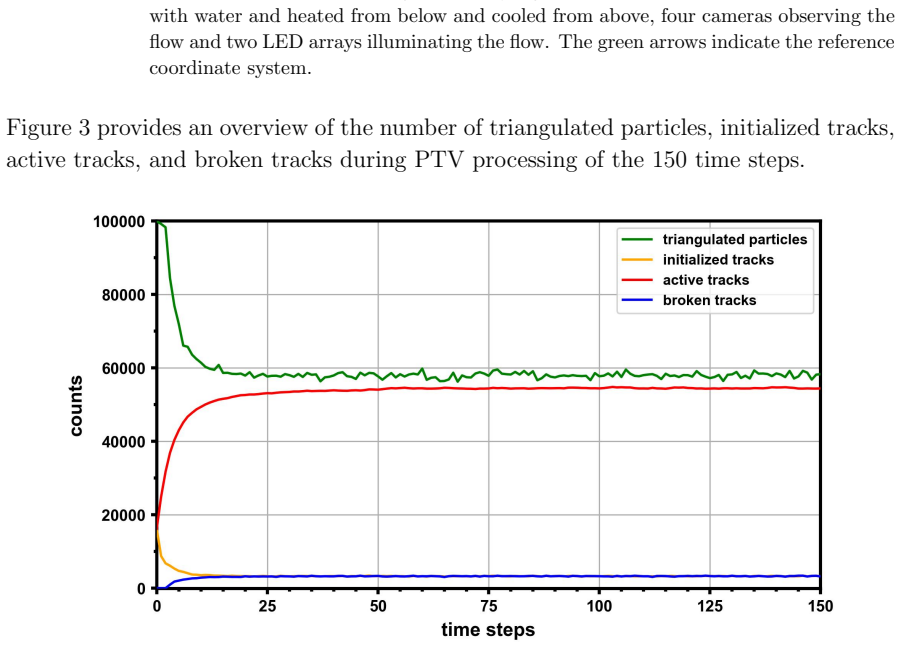
Summary. The paper presents a physics-informed neural network (PINN) method to reconstruct temperature and pressure fields from Lagrangian velocity data in turbulent Rayleigh-Bénard convection at Ra=10^9 and Pr=6.9. The network, a multilayer perceptron with sine activation, is trained on DNS-generated particle tracks (150,000 particles) and on experimental PTV tracks (about 50,000 active particles per time step). A key ingredient is an empirical mean temperature profile Tmean(Z,a) with parameter a set to 2Nu, which imposes the wall boundary conditions and reduces the difficulty of the near-wall gradients. In the DNS validation, the reconstructed temperature and pressure reach Pearson correlations of about 90% and mean absolute errors around 10^-2 and 10^-3, respectively; the reconstructed Nusselt number is 61.8 compared with 63.4 in the DNS. For the experiment, the same a=126 is used, yielding a Nusselt number of 34.6, later corrected to 55.3 using a velocity-scale factor. The paper claims the method can provide temperature and pressure fields in the hard-turbulence regime from PTV data alone, and it makes the PINN code available open-source. I also checked the internal consistency of Eq. (7): the printed mean-temperature profile does satisfy Tmean(0)=+0.5, Tmean(1)=-0.5, and yields Eq. (8) by differentiating at Z=0, so the stress-test concern about Eq. (7) does not land.
Significance. If the result holds, the method would be a practical step toward measuring all three key fields (velocity, temperature, pressure) in turbulent thermal convection using only particle-tracked velocity data. The DNS validation is quantitative, with high correlation on temperature and pressure, and the open-source code is a strength for reproducibility. The use of a prescribed mean profile is a reasonable way to overcome the hard-turbulence difficulty, and the experimental demonstration is a useful proof of concept, though it lacks ground-truth temperature or pressure data. The main value of the paper lies in showing that the approach works in a regime (Ra=10^9) that previously had only been demonstrated at lower Rayleigh numbers.
major comments (3)
- [Section 4, evaluation metrics (Fig. 8)] The PCC and MAE values are computed on the last 10 time steps of the DNS dataset, which are part of the 125 time steps used for training the PINN through the data-loss term. Because the manuscript does not describe a held-out validation partition, the 90% correlation does not establish that the PINN can reconstruct temperature and pressure from velocity data outside the training interval. Please either train on the first 115 time steps and evaluate on the final 10, or explicitly state that the reported correlation is a training-fidelity metric rather than a generalization metric.
- [Section 4, Nusselt-number validation] The mean temperature profile parameter a is set to 2Nu with Nu=63.4 taken from the DNS, so the reported Nu_PINN=61.8 is largely constrained by the prescribed mean profile and is not an independent physical validation. The manuscript should present this as a consistency check. Additionally, reporting the correlation and MAE for the temperature fluctuation field T' alone, which is the part actually learned by the network, would strengthen the validation and clarify how much of the 90% correlation is attributable to the prescribed mean profile.
- [Section 5, experimental reconstruction] In the experimental case there is no measured temperature or pressure ground truth, and the mean temperature profile is prescribed with a=126 based on the DNS Nusselt number. The reconstructed Nu_PINN=34.6 deviates strongly from the assumed value of 63, and the correction factor of 1.6 is derived solely from the ratio of maximum vertical velocities, not from an independent heat-flux measurement. The manuscript should either obtain or cite an experimental Nusselt number for the cell, or explicitly label the experimental temperature and pressure fields as model-dependent reconstructions whose accuracy is not yet validated.
minor comments (5)
- [Section 2.2, paragraph on track visualization] The text states the maximum observed velocity is about ±10 m/s, which is inconsistent with the later statement that the maximum normalized vertical velocity is about 0.18 in the experiment (with a reference velocity of about 50 mm/s). The units appear to be a typo and should be corrected (e.g., ±0.10 m/s or ±10 cm/s).
- [Section 3.1, discussion of Eq. (7)] The statement that a=1 results in a linear temperature profile is only approximately true; the profile is exponential, and for a=1 the deviations from a straight line connecting the boundary values are small but visible. Consider rephrasing to 'approximately linear' or 'close to linear'.
- [Section 3.1, Eq. (6)] The factor (Z^2 - Z) multiplying the temperature fluctuation is introduced without explanation. It would be helpful to state explicitly that this factor forces the fluctuation to vanish at the top and bottom plates, so that the boundary conditions are exactly satisfied by Tmean alone.
- [Figure 7 caption] The caption says the profile is 'predicted in the DNS', but the figure shows the empirical function Tmean(Z,a) for increasing a. Clarify that the DNS data are used to motivate the value a=126, while the curves are from Eq. (7).
- [References] The reference to Barta et al. (2023) is marked 'under review'; if a published version is available, it should be updated.
Circularity Check
Nusselt validation reduces to the a=2Nu mean-profile calibration, and part of the 90% temperature correlation inherits the prescribed profile; pressure and fluctuation fields remain independent.
-
fitted input called prediction
[Sec. 3.1, Eq. (8); Sec. 4, Nusselt verification paragraph]
"The physical meaning of a is derived by evaluating equation (5) on the heating or cooling plate where the velocity is zero, and using the derivative of equation (6) with respect to Z. Thus, we can relate the parameter a with the Nusselt number: Nu = a/(2−2e^{−0.5a}) ≃ a/2, if a≫1, and set a = 2 Nu = 126 throughout the paper, because we know that the average Nusselt number is Nu = 63 obtained from DNS in our case, see section 2.1. ..."
The mean profile Tmean(Z,a) in Eqs. (6)-(7) fixes the mean vertical temperature gradient and, through the wall values, the dominant Nusselt-number integrand of Eq. (5). Setting a = 2Nu = 126 from the DNS makes Nu ≈ a/2 by Eq. (8) by construction. Recomputing Nu from the reconstructed temperature field and reporting Nu_PINN = 61.8 as validation is therefore a consistency check of the calibration, not an independent inference. The learned fluctuation field and pressure are independent content, but this Nusselt-number agreement is forced by the input value.
-
self definitional
[Sec. 3.1, Eq. (6); Sec. 4, correlation results]
"Equation (6) is chosen empirically and ensures that the temperature boundary conditions are satisfied exactly. ... The parameter a = 126 is chosen to mimic the mean temperature profile and the temperature boundary conditions at the top and bottom plates for the considered case with a Nusselt number Nu = 63. ... the reconstructed temperature and pressure fields also reach correlation values of about 90% with respect to the ground truth at the end of training."
Because the network output is defined as T = Tmean(Z,a) + (Z^2 − Z)T′, the vertical mean profile and wall temperatures are injected from the same DNS that supplies Nu = 63 used to set a. The reported 90% temperature correlation is therefore partly a measure of how well the prescribed mean profile fits the DNS mean, rather than purely a test of the learned reconstruction. The fluctuation field T′ is still inferred from velocity data, so the circularity is partial; the pressure correlation is independent of this construction.
full rationale
The reconstruction pipeline is not entirely circular: the PINN genuinely learns pressure and temperature fluctuations from the Lagrangian velocity data, and the pressure field is not tied to the a calibration. However, in the DNS validation the mean vertical temperature profile and its wall gradient are prescribed from the DNS Nusselt number through a = 2Nu = 126, and Eq. (8) makes Nu ≈ a/2 by construction. The paper's Nusselt verification, Nu_PINN = 61.8 versus DNS Nu = 63, is therefore a consistency check of that input calibration rather than an independent prediction. The 90% temperature correlation also inherits this prescribed mean profile, although the learned fluctuation component is genuine. The experimental section transfers the same a from DNS to the PTV cell and later attributes the resulting Nu_PINN = 34.6 to sidewall heat loss; that is an external transfer assumption rather than a circular step, but it inherits the same calibration. Self-citations to Mommert et al. (2024) and Volk et al. (2025) supply architecture, loss weights, and evaluation practices, but the equations in this paper state the mechanism and are not themselves the source of the partial circularity. Overall, the central temperature/Nusselt validation is partially forced by the fitted mean-temperature profile, while the pressure reconstruction and the fluctuation field retain independent content.
Assumptions & free parameters
free parameters (3)
- a (mean temperature profile parameter) =
126 (a=2Nu with Nu=63 from DNS)
- Sidewall heat-loss correction factor =
1.6
- Loss weights lambda_data, lambda_NS, lambda_EE, lambda_div, lambda_C, lambda_BC =
1.0, 0.1, 0.01, 0.001, 0.001, 0.0001
assumptions (5)
- domain assumption The Oberbeck-Boussinesq equations (1)-(3) with incompressibility govern the flow.
- ad hoc to paper The empirical mean temperature profile Tmean(Z,a) in Eq. (6)-(7) is an adequate representation of the true mean field.
- ad hoc to paper The experimental Nusselt number is approximately 63, the same as the DNS, so a=126 is used for the experiment.
- domain assumption No-slip and impermeable boundary conditions apply at all walls.
- domain assumption The PINN loss landscape is smooth enough that minimizing the weighted residuals (Eq. 9) yields the physical solution rather than a spurious local minimum.
Cite this review
Pith. "Pith review of Temperature and pressure reconstruction in turbulent Rayleigh-B\'enard convection by Lagrangian velocities using PINN." pith.science (2026). https://pith.science/paper/CMVBVCWT
@misc{pith2026250502580,
  author       = {Pith},
  title        = {Pith review of: Temperature and pressure reconstruction in turbulent Rayleigh-B\'enard convection by Lagrangian velocities using PINN},
  year         = {2026},
  howpublished = {\url{https://pith.science/paper/CMVBVCWT}},
  note         = {Machine review of arXiv:2505.02580}
}
abstract
Velocity, pressure, and temperature are the key variables for understanding thermal convection, and measuring them all is a complex task. In this paper, we demonstrate a method to reconstruct temperature and pressure fields based on given Lagrangian velocity data. A physics-informed neural network (PINN) based on a multilayer perceptron architecture and a periodic sine activation function is used to reconstruct both the temperature and the pressure for two cases of turbulent Rayleigh-B\'enard convection (Pr = 6.9, Ra = $10^9$). The first dataset is generated with DNS and it includes Lagrangian velocity data of 150000 tracer particles. The second contains a PTV experiment with the same system parameters in a water-filled cubic cell, and we observed about 50000 active particle tracks per time step with the open-source framework proPTV. A realistic temperature and pressure field could be reconstructed in both cases, which underlines the importance of PINNs also in the context of experimental data. In the case of the DNS, the reconstructed temperature and pressure fields show a 90\% correlation over all particles when directly validated against the ground truth. Thus, the proposed method, in combination with particle tracking velocimetry, is able to provide velocity, temperature, and pressure fields in convective flows even in the hard turbulence regime. The PINN used in this paper is compatible with proPTV and is part of an open source project. It is available on request at https://github.com/DLR-AS-BOA.
Figures


Figures from the paper (13 more)


Reference graph
Works this paper leans on
-
[1]
Mart \' n Abadi, Ashish Agarwal, Paul Barham, Eugene Brevdo, Zhifeng Chen, Craig Citro, Greg S. Corrado, Andy Davis, Jeffrey Dean, Matthieu Devin, Sanjay Ghemawat, Ian Goodfellow, Andrew Harp, Geoffrey Irving, Michael Isard, Yangqing Jia, Rafal Jozefowicz, Lukasz Kaiser, Manjunath Kudlur, Josh Levenberg, Dan Mane, Rajat Monga, Sherry Moore, Derek Murray, ...
-
[2]
Robin Barta and Claus Wagner. Large-scale reorientation in cubic rayleigh--b \'e nard convection measured with particle tracking velocimetry. Journal of Turbulence, pages 1--14, 2025. URL https://doi.org/10.1080/14685248.2024.2436843
arXiv 2025
-
[3]
proptv: A probability-based particle tracking velocimetry framework
Robin Barta, Christian Bauer, Sebastian Herzog, Daniel Schiepel, and Claus Wagner. proptv: A probability-based particle tracking velocimetry framework. Journal of computational physics, 2023. URL (under review)
work page 2023
-
[4]
Physics-informed neural networks (pinns) for fluid mechanics: A review
Shengze Cai, Zhiping Mao, Zhicheng Wang, Minglang Yin, and George Em Karniadakis. Physics-informed neural networks (pinns) for fluid mechanics: A review. Acta Mechanica Sinica, 37 0 (12): 0 1727--1738, 2021 a . URL https://doi.org/10.1007/s10409-021-01148-1
-
[5]
Shengze Cai, Zhicheng Wang, Frederik Fuest, Young Jin Jeon, Callum Gray, and George Em Karniadakis. Flow over an espresso cup: inferring 3-d velocity and pressure fields from tomographic background oriented S chlieren via physics-informed neural networks. Journal of Fluid Mechanics, 915, 2021 b . URL https://doi.org/10.1017/jfm.2021.135
-
[6]
Scaling of hard thermal turbulence in rayleigh-b \'e nard convection
Bernard Castaing, Gemunu Gunaratne, Francois Heslot, and Gianluigi Zanetti. Scaling of hard thermal turbulence in rayleigh-b \'e nard convection. Journal of Fluid Mechanics, 204: 0 1--30, 1989. URL https://doi.org/10.1017/S0022112089001643
-
[7]
Keras, 2015
Fran c ois Chollet et al. Keras, 2015. URL https://keras.io
2015
-
[8]
Patricio Clark Di Leoni, Lokahith Agasthya, Michele Buzzicotti, and Luca Biferale. Reconstructing rayleigh--b \'e nard flows out of temperature-only measurements using physics-informed neural networks. The European Physical Journal E, 46 0 (3): 0 16, 2023. URL https://doi.org/10.1140/epje/s10189-023-00276-9
Show all 36 references
-
[9]
The validity of the boussinesq approximation for liquids and gases
Donald D Gray and Aldo Giorgini. The validity of the boussinesq approximation for liquids and gases. International Journal of Heat and Mass Transfer, 19 0 (5): 0 545--551, 1976. URL https://doi.org/10.1016/0017-9310(76)90168-X
1976 doi
-
[10]
Scaling in thermal convection: A unifying theory
Siegfried Grossmann and Detlef Lohse. Scaling in thermal convection: A unifying theory. Journal of Fluid Mechanics, 407: 0 27--56, 2000. URL https://doi.org/10.1017/S0022112099007545
-
[11]
Thermal convection for large prandtl numbers
Siegfried Grossmann and Detlef Lohse. Thermal convection for large prandtl numbers. Physical Review Letters, 86: 0 3316--3319, 2001. URL https://doi.org/10.1103/PhysRevLett.86.3316
2001 doi
-
[12]
Prandtl and Rayleigh number dependence of the Reynolds number in turbulent thermal convection
Siegfried Grossmann and Detlef Lohse. Prandtl and Rayleigh number dependence of the Reynolds number in turbulent thermal convection. Physical Review E, 66, 2002. URL https://doi.org/10.1103/PhysRevE.66.016305
2002 doi
-
[13]
Fluctuations in turbulent Rayleigh - Bénard convection: The role of plumes
Siegfried Grossmann and Detlef Lohse. Fluctuations in turbulent Rayleigh - Bénard convection: The role of plumes. Physics of Fluids, 16: 0 4462--4472, 2004. URL https://doi.org/10.1063/1.1807751
2004 doi
-
[14]
u nther Gr \
G \"u nther Gr \"o tzbach. Spatial resolution requirements for direct numerical simulation of the Rayleigh - Bénard convection. Journal of Computational Physics, 49: 0 241--264, 1983. URL https://doi.org/10.1016/0021-9991(83)90125-0
1983 doi
-
[15]
A probabilistic particle tracking framework for guided and brownian motion systems with high particle densities
Sebastian Herzog, Daniel Schiepel, Isabella Guido, Robin Barta, and Claus Wagner. A probabilistic particle tracking framework for guided and brownian motion systems with high particle densities. SN Computer Science, 2: 0 1--20, 2021. URL https://doi.org/10.1007/s42979-021-00879-z
2021 doi
-
[16]
Enhancing pinns for solving pdes via adaptive collocation point movement and adaptive loss weighting
Jie Hou, Ying Li, and Shihui Ying. Enhancing pinns for solving pdes via adaptive collocation point movement and adaptive loss weighting. Nonlinear Dynamics, 111 0 (16): 0 15233--15261, 2023. URL https://doi.org/10.1007/s11071-023-08654-w
2023 doi
-
[17]
Volumetric lagrangian temperature and velocity measurements with thermochromic liquid crystals
T K \"a ufer and C Cierpka. Volumetric lagrangian temperature and velocity measurements with thermochromic liquid crystals. Measurement Science and Technology, 35 0 (3): 0 035301, 2023. URL https://doi.org/10.1088/1361-6501/ad16d1
2023 doi
- [18]
-
[19]
Simple computational strategies for more effective physics-informed neural networks modeling of turbulent natural convection
Didier Lucor, Atul Agrawal, and Anne Sergent. Simple computational strategies for more effective physics-informed neural networks modeling of turbulent natural convection. Journal of Computational Physics, 456: 0 111022, 2022. URL https://doi.org/10.1016/j.jcp.2022.111022
2022
-
[20]
Particle tracking velocimetry in three-dimensional flows
HG Maas, A Gruen, and D Papantoniou. Particle tracking velocimetry in three-dimensional flows. Experiments in Fluids, 15: 0 133--146, 1993. URL https://doi.org/10.1007/BF00190953
1993 doi
-
[21]
Particle tracking velocimetry in three-dimensional flows
NA Malik, Th Dracos, and DA Papantoniou. Particle tracking velocimetry in three-dimensional flows. Experiments in Fluids, 15: 0 279--294, 1993. URL https://doi.org/10.1007/BF00223406
1993 doi
-
[22]
Periodically activated physics-informed neural networks for assimilation tasks for three-dimensional rayleigh–bénard convection
Michael Mommert, Robin Barta, Christian Bauer, Marie-Christine Volk, and Claus Wagner. Periodically activated physics-informed neural networks for assimilation tasks for three-dimensional rayleigh–bénard convection. Computers and Fluids, 283: 0 106419, 2024. URL https://doi.or...
2024
-
[23]
Physics-informed neural networks: A deep learning framework for solving forward and inverse problems involving nonlinear partial differential equations
Maziar Raissi, Paris Perdikaris, and George E Karniadakis. Physics-informed neural networks: A deep learning framework for solving forward and inverse problems involving nonlinear partial differential equations. Journal of Computational physics, 378: 0 686--707, 2019. URL http...
2019 doi
-
[24]
On convection currents in a horizontal layer of fluid, when the higher temperature is on the under side
Lord Rayleigh. On convection currents in a horizontal layer of fluid, when the higher temperature is on the under side. The London, Edinburgh, and Dublin Philosophical Magazine and Journal of Science, 32 0 (192): 0 529–546, 1916. URL https://doi.org/10.1080/14786441608635602
1916 doi
-
[25]
On the impact of larger batch size in the training of physics informed neural networks
Shyam Sankaran, Hanwen Wang, Leonardo Ferreira Guilhoto, and Paris Perdikaris. On the impact of larger batch size in the training of physics informed neural networks. In The Symbiosis of Deep Learning and Differential Equations II, 2022. URL https://openreview.net/forum?id=THCvohg1RV
2022
-
[26]
Resolving the fine-scale structure in turbulent rayleigh--b \'e nard convection
Janet D Scheel, Mohammad S Emran, and J \"o rg Schumacher. Resolving the fine-scale structure in turbulent rayleigh--b \'e nard convection. New Journal of Physics, 15 0 (11): 0 113063, 2013. URL https://doi.org/10.1088/1367-2630/15/11/113063
2013 doi
-
[27]
Numerical and experimental study of aerosol dispersion in the D o728 aircraft cabin
Daniel Schmeling, Andrei Shishkin, Daniel Schiepel, and Claus Wagner. Numerical and experimental study of aerosol dispersion in the D o728 aircraft cabin. CEAS Aeronautical Journal, 14: 0 509526, 2023. https://doi.org/10.1007/s13272-023-00644-3
2023 doi
-
[28]
3d Lagrangian particle tracking in fluid mechanics
Andreas Schr \"o der and Daniel Schanz. 3d Lagrangian particle tracking in fluid mechanics. Annual Review of Fluid Mechanics, 55, 2023. URL https://doi.org/10.1146/annurev-fluid-031822-041721
2023 doi
-
[29]
Boundary layer structure in turbulent thermal convection and its consequences for the required numerical resolution
Olga Shishkina, Richard J A M Stevens, Siegfried Grossmann, and Detlef Lohse. Boundary layer structure in turbulent thermal convection and its consequences for the required numerical resolution. New Journal of Physics, 12, 2010. URL https://doi.org/10.1088/1367-2630/12/7/075022
2010 doi
- [30]
-
[31]
Distortion compensation for generalized stereoscopic particle image velocimetry
Steven M Soloff, Ronald J Adrian, and Zi-Chao Liu. Distortion compensation for generalized stereoscopic particle image velocimetry. Measurement Science and Technology, 8, 1997. URL https://doi.org/10.1088/0957-0233/8/12/008
1997 doi
-
[32]
Inferring turbulent velocity and temperature fields and their statistics from lagrangian velocity measurements using physics-informed kolmogorov-arnold networks
Juan Diego Toscano, Theo Käufer, Zhibo Wang, Martin Maxey, Christian Cierpka, and George Em Karniadakis. Inferring turbulent velocity and temperature fields and their statistics from lagrangian velocity measurements using physics-informed kolmogorov-arnold networks. arXiv prep...
-
[33]
A pinn methodology for temperature field reconstruction in the piv measurement plane: Case of rayleigh-b 'enard convection
Marie-Christine Volk, Anne Sergent, Didier Lucor, Michael Mommert, Christian Bauer, and Claus Wagner. A pinn methodology for temperature field reconstruction in the piv measurement plane: Case of rayleigh-b 'enard convection. arXiv preprint arXiv:2503.23801, 2025
2025 arXiv
-
[34]
Comments on the numerical investigation of Rayleigh and Marangoni convection in a vertical circular cylinder
Claus Wagner, Rainer Friedrich, and Ranga Narayanan. Comments on the numerical investigation of Rayleigh and Marangoni convection in a vertical circular cylinder. Physics of Fluids, 6: 0 1425--1433, 1994. URL https://doi.org/10.1063/1.868257
1994 doi
-
[35]
What rayleigh numbers are achievable under oberbeck–boussinesq conditions? Journal of Fluid Mechanics, 986 0 (R2), 2024
S Weiss, Ms Emran, and O Shishkina. What rayleigh numbers are achievable under oberbeck–boussinesq conditions? Journal of Fluid Mechanics, 986 0 (R2), 2024. URL https://doi.org/10.1017/jfm.2024.389
2024 doi
-
[36]
Volume self-calibration for 3d particle image velocimetry
B Wieneke. Volume self-calibration for 3d particle image velocimetry. Experiments in Fluids, 45: 0 549--556, 2008. URL https://doi.org/10.1007/s00348-008-0521-5
2008 doi
Reviewed August 16, 2026 · model on record in the stance chip above.
Discussion (0). Continue with ORCID to comment.