REVIEW 3 major objections 3 minor 109 references
Charged Penrose Extraction in RN--AdS Black Holes with Dark Energy: Ergosphere Geometry and Rigorous Efficiency Bounds
T0 review · 3 major / 3 minor · reviewed 2026-08-08 · deepseek-v4-flash
Pith's one-line read In a charged AdS black hole with a dark-energy halo, the ergosphere boundary is unique and the escaping-energy ceiling is proven.
desk verdict Useful parametric study of charged Penrose extraction in a Kiselev-corrected RN-AdS background, but the 'rigorous' uniqueness proof has a sign error and the finite-radius reception criterion is overclaimed for q2 ≠ 0. read the letter →
The pith
A machine-rendered reading of the paper's core claim, the machinery that carries it, and where it could break.
The reading
What carries the argument
The load-bearing object is the generalized electrostatic ergosphere condition $|q|\Psi(r)=\sqrt{f(r)}$, equivalently the sign change of $G(r)=|q|\Psi(r)-\sqrt{f(r)}$, together with the radial effective potential $V_{\rm eff}(r)=f(r)(1+L^2/r^2)-(E-q\Psi(r))^2$. Monotonicity of the lapse and potential makes $G'(r)<0$, forcing a single ergosphere boundary, and makes $V'_{\rm eff}(r)<0$ along the negative-energy segment, forcing a single turning point and inevitable capture. The identical competition between electrostatic work and gravitational redshift reappears in the efficiency bound, so one mechanism controls the ergosphere radius, the turning point, and the extraction ceiling.
What would settle it
A numerical scan over a wider exterior parameter grid than Table 1 that finds any point with $f'(r)\le 0$ or $\Psi'(r)\ge 0$ would invalidate the global uniqueness claims, since $G(r)$ or $V_{\rm eff}(r)$ could then acquire multiple zeros. A second check is to evaluate the reception inequality with $q_2\neq 0$: the claimed minimization of $H(r)=\Xi_2^2-f$ at $R_{\rm obs}$ is only guaranteed for $q_2=0$, so a counterexample there would falsify the finite-radius reception criterion.
Extended reading notes
Core claim
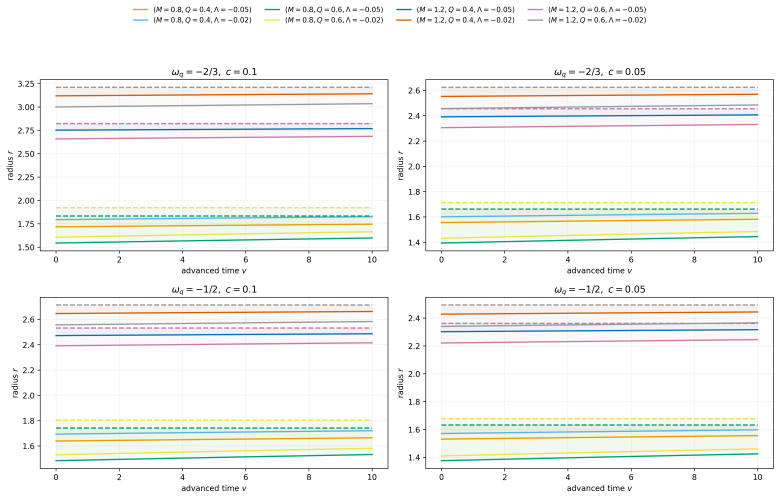
On the fixed RN–AdS–Kiselev geometry, with a negatively charged test particle in a monotone electrostatic potential $\Psi(r)$, the paper establishes three claims. The generalized electrostatic ergosphere defined by $|q|\Psi(r_E)=\sqrt{f(r_E)}$ has a unique exterior boundary, and this boundary moves outward with increasing charge magnitude, mass, black-hole charge, quintessence amplitude, and more negative state parameter. Any negative-energy trajectory has a unique turning point and then moves monotonically inward to the horizon, so the infalling fragment cannot return. The energy of the escaping fragment is locally bounded by $E_{2,\max}=E_0+|q_1|\Psi(r_*)-\sqrt{f(r_*)}$, with efficiency ceiling $\eta_{\max}=(|q_1|\Psi(r_*)-\sqrt{f(r_*)})/E_0$, and combining this with a finite-radius reception inequality gives a sufficient condition for extraction to a detector at radius $R_{\rm obs}$. The paper also presents first-order adiabatic laws showing that, under slow Maxwell discharge at fixed mass, the horizon moves outward while the electrostatic boundary stays nearly stationary, so the negative-energy layer thins; with simultaneous accretion both surfaces move outward.
Load-bearing premise
The entire argument rests on the assumption that outside the horizon the redshift factor $f(r)$ is strictly increasing and the electrostatic potential $\Psi(r)$ is strictly decreasing across the whole region sampled by negative-energy orbits; the paper checks these signs numerically for its plotted parameter windows rather than proving them analytically for the full claimed domain.
Editorial extensions
If this is right
- In any parameter window satisfying the monotonicity assumptions, the negative-energy domain is a single radial shell between the horizon and $r_E$, not a fragmented set.
- Every negative-energy fragment is inevitably captured, so successful extraction requires the outgoing fragment to carry at least $E_0+|q_1|\Psi(r_*)-\sqrt{f(r_*)}$; decays deeper inside the ergosphere yield the largest ceilings.
- For Maxwell electrodynamics the ergosphere radius grows as $\sqrt{|q|Q L_{\rm AdS}}$ in the asymptotic AdS region, so a larger AdS length or stronger charge pushes the extraction layer outward.
- Under slow monotone discharge at fixed mass, the outer horizon expands while the electrostatic boundary stays nearly fixed for the Maxwell case, narrowing the accessible negative-energy layer; adding accretion moves both surfaces outward.
- The extremal-locus analysis shows that quintessence with $\omega_q\in(-1,-1/3)$ reduces the allowed extremal charge but enlarges the black-hole region in the mass–charge plane at fixed horizon radius.
Reading between the lines
- Beyond the paper: the same monotonicity framework should extend to any static, spherically symmetric geometry with a monotone lapse and monotone electrostatic potential, so the uniqueness and ceiling results are probably not specific to the Kiselev family.
- Beyond the paper: the finite-radius reception test could be converted into a practical diagnostic by mapping, for each charge split, the largest detector radius that still admits extraction; the paper does not tabulate this.
- Beyond the paper: adding rotation, which the paper flags as future work, should widen the negative-energy shell through frame-dragging effects on top of the electrostatic layer studied here.
- Beyond the paper: because the near-horizon ceiling grows as $\sqrt{f(r_*)}\to 0$ toward extremality, the adiabatic discharge paths of Section 5 suggest that charge loss moves a black hole away from extremality and thereby suppresses the most optimistic efficiency ceilings; this could be tested against fully nonlinear evolutions.
Editorial analysis
A structured set of objections, weighed in public.
Referee Report
Summary. The manuscript studies charged test-particle kinematics and Penrose energy extraction in Reissner–Nordström anti-de Sitter spacetimes with a Kiselev anisotropic dark-energy term. It defines a generalized electrostatic ergosphere by |q|Ψ(r_E)=√f(r_E), claims uniqueness of the ergosphere boundary and of the turning point of negative-energy orbits under monotonicity assumptions, derives a local efficiency ceiling E_{2,max}=E_0+|q_1|Ψ(r_*)−√f(r_*), proposes a finite-radius reception criterion for AdS asymptotics, maps parameter dependence across (M,Q,Λ,c,ω_q), and introduces first-order adiabatic discharge/accretion evolution laws.
Significance. If fully established, the paper would provide a useful kinematic framework for charged Penrose extraction in a less commonly studied background. The efficiency bound in Eqs. (29)–(30) is a direct algebraic consequence of energy conservation at the decay point, and the parametric trends for the ergosphere radius are coherent with the stated monotonicity assumptions. The authors are commendably explicit about the test-particle, adiabatic, and monotonicity limitations, and they separate local kinematic ceilings from backreaction and stability issues. The numerical protocol is transparent, with bracketed root finding and tolerance checks. However, the central rigorous theorem on uniqueness of the turning point and inevitable capture rests on a proof with internal sign errors, and the general reception criterion contains an unproven minimization step. These issues are load-bearing and must be repaired before the paper's main claims can be accepted.
major comments (3)
- [Section 3, Eqs. (22)–(26)] The proof of uniqueness of the turning point contains two algebraic sign errors that invalidate the conclusion. For a negative-energy trajectory with q=−|q| and Ψ>0, Eq. (9) gives E = −|q|Ψ + sqrt(f(1+L²/r²)+ṙ²), so Ξ = E−qΨ = E+|q|Ψ = sqrt(f(1+L²/r²)+ṙ²) > √f; hence Θ = Ξ²−f > 0, the opposite of the assertion below Eq. (25). Substituting the bound L²/r² ≤ (Ξ²−f)/f into Eq. (21) yields V'_eff = (f′/f)Ξ² − (2/r)(Ξ²−f) − 2ΞΞ′, not the expression written in Eq. (23). With the correct signs, the right-hand side of Eq. (25) is not sign-definite; for L=0, V'_eff = f′ − 2ΞΞ′ > 0, which contradicts Eq. (26). The paper's unique-turning-point and inevitable-capture theorem is therefore not proved. A corrected argument works for L=0 (V_eff(r_+) < 0 and V'_eff > 0), but the L>0 case requires additional control on L²/r².
- [Section 4, Eq. (34)] The claim that H(r)=Ξ₂²−f is minimized at R_obs under f′>0 and Ψ′<0 is not correct for q₂≠0. In fact H′ = −f′ − 2q₂Ξ₂Ψ′, which is indefinite in sign when q₂>0. Therefore the pointwise condition (E₂−q₂Ψ(R_obs))² ≥ f(R_obs) is not by itself sufficient to guarantee that fragment 2 can reach R_obs; it could encounter a turning point at some r < R_obs. The argument is valid for q₂=0, which is the case used in the numerical feasibility plots, but the general statement in the text should be corrected or restricted to q₂=0.
- [Section 4, after Eq. (33)] The qualitative claim that larger Q increases η_max is not supported by the displayed derivative. For the Maxwell case Ψ=Q/r, Eq. (33) gives ∂_Q η_max = (|q_1|√f − Q/r)/(E_0 r√f), which is negative for r sufficiently close to r_+ (where √f → 0) even when the ergosphere condition |q_1|Q/r > √f holds. Thus the parametric ordering stated in the abstract and conclusions (larger Q widens extraction and raises efficiency) is not universal; it should be qualified to the parameter windows actually displayed or proven with additional bounds.
minor comments (3)
- [Section 2, Eq. (6)] The symbol L is used both for the Lagrangian on the left-hand side of Eq. (6) and for the conserved angular momentum defined immediately afterward; this notational collision should be fixed, for example by writing the Lagrangian as \mathcal{L}.
- [Section 3, paragraph after Eq. (26)] The proof invokes f′(r)>0 as verified for the Table 1 parameter windows; since the theorem is presented as rigorous, the authors should either give an analytic proof of f′>0 on the relevant exterior intervals or explicitly state that the theorem is conditional on a numerically checked monotonicity assumption.
- [Section 4, Eq. (35)] The sufficient reception condition should state explicitly that it is derived under the choices L_1=0, \dot r_1=0, and L_2=0; for nonvanishing L_2 the pointwise test at R_obs is not sufficient even when q_2=0, because the radial kinetic term acquires a centrifugal barrier.
Circularity Check
No circularity: all central bounds follow algebraically from the stated metric, conserved charges, and explicit monotonicity assumptions.
full rationale
The paper's central results (unique ergosphere boundary, unique turning point, local efficiency ceiling in Eq. (29), finite-radius reception criterion in Eqs. (34)-(35), and adiabatic evolution laws in Eqs. (48)-(52)) are derived directly from the metric function f(r), the electrostatic potential Psi(r), the conserved energy and angular momentum, and the explicitly stated assumptions f'(r)>0 and Psi'(r)<0 in the exterior. The generalized ergosphere condition |q|Psi(r_E)=sqrt(f(r_E)) is not an input fitted to the output; it is the definition of the boundary of the negative-energy domain, computed from E_min = qPsi + sqrt(f). The efficiency bound eta_max=(|q1|Psi-sqrt(f))/E0 is an algebraic rearrangement of E0=E1+E2 with E1,min=q1Psi-sqrt(f), not a quantity calibrated to any data subset. The reception criterion and the time-dependent tracking equations are likewise algebraic consequences of the radial equation and implicit differentiation of the defining relations. No parameter in the paper is fitted to the predicted bounds, and no external uniqueness theorem is imported from the authors' prior work. The paper explicitly states its monotonicity assumptions and that f'(r)>0 was verified numerically within the plotted parameter windows; this limits the analytic proof's domain but is not circular reasoning. The Section 3 turning-point argument contains an apparent sign inconsistency: for E<0 with q=-|q| one has Xi=E+|q|Psi>sqrt(f), so Theta=Xi^2-f>0, contrary to the assertion below Eq. (25), and Eq. (23) has a sign slip in the angular-momentum term. These are correctness defects, not circularity, because the desired conclusion is not assumed by construction. The derivation chain is therefore self-contained and receives a circularity score of 0.
Assumptions & free parameters
free parameters (4)
- E0 =
1
- Robs =
10
- gamma =
5e-3
- mu =
5e-3
assumptions (6)
- domain assumption The background is the static RN-AdS-Kiselev metric (1)-(2) with the effective anisotropic stress tensor (3)-(4).
- domain assumption The electrostatic potential satisfies Psi(infinity)=0 and Psi'(r)<0 (Eq. 5).
- domain assumption The lapse function satisfies f(r)>0 and f'(r)>0 for r>r+ in the parameter windows considered.
- domain assumption Test particle approximation: fragment stress energy, radiation reaction, and the response of the Kiselev medium are neglected.
- domain assumption First order adiabatic evolution with the slow-roll conditions in Eq. (44).
- domain assumption The time-dependent section specializes to the Maxwell potential Psi(v,r)=Q(v)/r (Eq. 43).
Cite this review
Pith. "Pith review of Charged Penrose Extraction in RN--AdS Black Holes with Dark Energy: Ergosphere Geometry and Rigorous Efficiency Bounds." pith.science (2026). https://pith.science/paper/CQFINTTC
@misc{pith2026260805641,
  author       = {Pith},
  title        = {Pith review of: Charged Penrose Extraction in RN--AdS Black Holes with Dark Energy: Ergosphere Geometry and Rigorous Efficiency Bounds},
  year         = {2026},
  howpublished = {\url{https://pith.science/paper/CQFINTTC}},
  note         = {Machine review of arXiv:2608.05641}
}
read the original abstract
We develop a quantitative framework for charge assisted Penrose extraction in Reissner--Nordstr\"om Anti-de Sitter black holes surrounded by a Kiselev type anisotropic dark energy sector. The generalized electrostatic ergosphere is defined by the balance between redshift and electrostatic work. Under explicitly stated monotonicity assumptions on the lapse and electrostatic potential, we prove uniqueness of the exterior ergosphere boundary and of the turning point of negative energy trajectories. We derive a local upper bound on the escaping energy, formulate a finite radius reception criterion appropriate to AdS asymptotics, and map the allowed extraction domains in terms of the mass, charge, cosmological constant, Kiselev normalization, and state parameter. We also introduce first order adiabatic discharge and accretion laws for slowly varying mass and charge, clarifying the regime in which the evolving horizon and ergosphere can be tracked consistently. The results provide controlled analytic and numerical diagnostics for charged Penrose extraction in RN--AdS backgrounds with a dark energy environment, while clearly separating local kinematic bounds from backreaction, radiative losses, and near extremal stability effects.
Figures


Figures from the paper (3 more)


Reference graph
Works this paper leans on
-
[1]
The Event Horizon Telescope Collaboration, First M87 Event Hori- zon Telescope results. I. The shadow of the supermassive black hole, Astrophys. J. Lett.875(2019) L1
2019
-
[2]
The Event Horizon Telescope Collaboration, First M87 Event Horizon Telescope results. II. Array and instrumentation, Astrophys. J. Lett. 875(2019) L2
2019
-
[3]
Akiyamaet al.(Event Horizon Telescope Collaboration), First Sagittarius A* Event Horizon Telescope results
K. Akiyamaet al.(Event Horizon Telescope Collaboration), First Sagittarius A* Event Horizon Telescope results. I. The shadow of the supermassive black hole in the center of the Milky Way, Astrophys. J. Lett.930(2022) L12
2022
-
[4]
Penrose, Gravitational collapse and space-time singularities, Phys
R. Penrose, Gravitational collapse and space-time singularities, Phys. Rev. Lett.14(1965) 57
1965
-
[5]
P. S. Joshi,Gravitational Collapse and Spacetime Singularities, Cam- bridge University Press, 2007
2007
-
[6]
P. S. Joshi, D. Malafarina, Recent developments in gravitational col- lapse and spacetime singularities, Int. J. Mod. Phys. D20(2011) 2641. 26
2011
-
[7]
D. Dey, K. Mosani, P. S. Joshi, Global visibility of a strong curvature singularity in non-marginally bound dust collapse, Phys. Rev. D102 (2020) 044037
2020
-
[8]
D. Dey, K. Mosani, P. S. Joshi, V. Vertogradov, Causal structure of singularity in non-spherical gravitational collapse, Eur. Phys. J. C82 (2022) 431
2022
Show all 109 references
-
[9]
M. D. Mkenyeleye, R. Goswami, S. D. Maharaj, Gravitational collapse of generalized Vaidya spacetime, Phys. Rev. D92(2015) 024041
2015
-
[10]
Vertogradov, The eternal naked singularity formation in the grav- itational collapse of generalized Vaidya spacetime, Int
V. Vertogradov, The eternal naked singularity formation in the grav- itational collapse of generalized Vaidya spacetime, Int. J. Mod. Phys. A33(2018) 1850102
2018
-
[11]
Vertogradov, The structure of the generalized Vaidya spacetime containing the eternal naked singularity, Int
V. Vertogradov, The structure of the generalized Vaidya spacetime containing the eternal naked singularity, Int. J. Mod. Phys. A37(2022) 2250185
2022
-
[12]
N. F. Naidu, R. S. Bogadi, A. Kaisavelu, M. Govender, Stability and horizon formation during dissipative collapse, Gen. Relativ. Gravit.52 (2020) 79
2020
-
[13]
S. M. C. V. Goncalves, S. Jhingan, Singularities in gravitational col- lapse with radial pressure, Gen. Relativ. Gravit.33(2001) 2125-2149
2001
-
[14]
Harko, Gravitational collapse of a Hagedorn fluid in Vaidya geome- try, Phys
T. Harko, Gravitational collapse of a Hagedorn fluid in Vaidya geome- try, Phys. Rev. D68(2003) 064005
2003
-
[15]
V. D. Vertogradov, Does a primary hair have an impact on the naked singularity formation in hairy Vaidya spacetime?, Phys. Complex Syst. 5(2024) 83-90
2024
-
[16]
Vertogradov, The generalized Vaidya spacetime with polytropic equation of state, Gen
V. Vertogradov, The generalized Vaidya spacetime with polytropic equation of state, Gen. Relativ. Gravit.56(2024) 59
2024
-
[17]
C. Lan, H. Yang, Y. Guo, Y.-G. Miao, Regular black hole metrics: A review, Int. J. Theor. Phys.62(2023) 202
2023
-
[18]
M. A. Markov, Limiting density of matter as a universal law, JETP Lett.36(1982) 214–216. 27
1982
-
[19]
V. P. Frolov, M. A. Markov, V. F. Mukhanov, Black holes as possible sources of closed and semiclosed worlds, Phys. Rev. D41(1990) 383
1990
-
[20]
V. P. Frolov, Notes on nonsingular models of black holes, Phys. Rev. D94(2016) 104056
2016
-
[21]
A. H. Chamseddine, V. Mukhanov, Resolving cosmological singulari- ties, Eur. Phys. J. C77(2017) 183
2017
-
[22]
S. W. Hawking, G. F. R. Ellis,The Large Scale Structure of Space- Time, Cambridge University Press, (orig. 1973; reprint 2023)
1973
-
[23]
R. M. Wald,General Relativity, University of Chicago Press, 1984
1984
-
[24]
A. D. Sakharov, The initial stage of an expanding Universe and the appearance of a nonuniform distribution of matter, Sov. Phys. JETP 22(1966) 241
1966
-
[25]
E. B. Gliner, Algebraic properties of the energy–momentum tensor and vacuum-like states of matter, Sov. Phys. JETP22(1966) 378
1966
-
[26]
Bardeen, Non-singular general-relativistic gravitational collapse, in: Proc
J. Bardeen, Non-singular general-relativistic gravitational collapse, in: Proc. GR5(Tbilisi, USSR), 1968, p. 174
1968
-
[27]
Kumar, R
A. Kumar, R. K. Walia, S. G. Ghosh, Regular Bardeen black holes in 4D Einstein-Gauss-Bonnet gravity, Universe8(2022) 232
2022
-
[28]
Stuchlik, J
Z. Stuchlik, J. Schee, Circular geodesic motion in Bardeen and Ayon- Beato-Garcia spacetimes, Int. J. Mod. Phys. D24(2015) 1550020
2015
-
[29]
Kumar, D
A. Kumar, D. Veer Singh, S. G. Ghosh, Shadow and deflection angle of rotating regular black holes, Eur. Phys. J. C79(2019) 275
2019
-
[30]
S. G. Ghosh, M. Amir, Horizon structure of rotating Bardeen black hole and particle acceleration, Eur. Phys. J. C75(2015) 553
2015
-
[31]
Ayon-Beato, A
E. Ayon-Beato, A. Garcia, The Bardeen model as a nonlinear magnetic monopole, Phys. Lett. B493(2000) 149–152
2000
-
[32]
S.A.Hayward, Formationandevaporationofregularblackholes, Phys. Rev. Lett.96(2006) 031103. 28
2006
-
[33]
K. A. Bronnikov, Regular magnetic black holes and monopoles from nonlinear electrodynamics, Phys. Rev. D63(2001) 044005
2001
-
[34]
Regular Black Hole in General Rel- ativity Coupled to Nonlinear Electrodynamics
K. A. Bronnikov, Comment on “Regular Black Hole in General Rel- ativity Coupled to Nonlinear Electrodynamics”, Phys. Rev. Lett.85 (2000) 4641
2000
-
[35]
K. A. Bronnikov, Regular black holes and related topics, Int. J. Mod. Phys. D27(2018) 1841005
2018
-
[36]
Contreras, A
E. Contreras, A. Rincon, B. Koch, P. Bargueno, Black hole solutions sourced by a scale-dependent electromagnetic field, Int. J. Mod. Phys. D27(2018) 1850032
2018
-
[37]
Panotopoulos, A
G. Panotopoulos, A. Rincon, Thermodynamics of regular black holes with nonlinear electrodynamics, Eur. Phys. J. Plus134(2019) 300
2019
-
[38]
Eichhorn, A
A. Eichhorn, A. Held, Image features of spinning regular black holes based on a locality principle, Eur. Phys. J. C81(2021) 933
2021
-
[39]
M. E. Rodrigues, M. V. de Sousa Silva, Regular black holes inf(R) gravity coupled to nonlinear electrodynamics, JCAP06(2018) 025
2018
-
[40]
Misyura, A
M. Misyura, A. Rincon, V. Vertogradov, Regular black holes and phase transitions in modified gravity, Phys. Dark Univ.46(2024) 101717
2024
-
[41]
G. J. Olmo, D. Rubiera-Garcia, Regular black holes in Palatini gravity, arXiv:2209.05061 (2022)
2022 arXiv
-
[42]
Bonanno, D
A. Bonanno, D. Malafarina, A. Panassiti, Black holes with quantum- improved cores, Phys. Rev. Lett.132(2024) 031401
2024
-
[43]
H. C. D. Lima Jr., R. B. Magalhaes, G. J. Olmo, D. Rubiera- Garcia, Resolving space-time singularities in spherically symmetric black holes: Geodesic completeness, curvature scalars, and tidal forces, arXiv:2506.17918 (2025)
2025 arXiv
-
[44]
Spallucci, A
E. Spallucci, A. Smailagic, Regular black holes from noncommutative geometry: A review, Int. J. Mod. Phys. D26(2017) 1730013. 29
2017
-
[45]
Balart, G
L. Balart, G. Panotopoulos, A. Rincon, Black holes with nonlinear electrodynamics: new aspects and constraints, Ann. Phys.473(2025) 169865
2025
-
[46]
Ovgun, R
A. Ovgun, R. C. Pantig, A. Rincon, Shadows and quasinormal modes of regular black holes: a comparative analysis, Ann. Phys.463(2024) 169625
2024
-
[47]
Balart, G
L. Balart, G. Panotopoulos, A. Rincon, Regular black holes: thermo- dynamics and phenomenology, Fortschr. Phys.71(2023) 2300075
2023
-
[48]
A.Rincon, V.Santos, Extendedthermodynamicsofregularblackholes, Eur. Phys. J. C80(2020) 910
2020
-
[49]
Javed, S
W. Javed, S. Riaz, A. Ovgun, Weak gravitational lensing by regular black holes, Universe8(2022) 262
2022
-
[50]
Z.-Y. Fan, X. Wang, Construction of regular black holes in general relativity, Phys. Rev. D94(2016) 124027
2016
-
[51]
R. V. Konoplich, S. G. Rubin, A. S. Sakharov, M. Yu. Khlopov, For- mation of black holes in first-order phase transitions as a cosmological test of symmetry breaking mechanisms, Phys. Atom. Nucl.62(1999) 1593-1600; Yad. Fiz.62(1999) 1705-1713
1999
-
[52]
M. Yu. Khlopov, R. V. Konoplich, S. G. Rubin, A. S. Sakharov, First- order phase transitions as a source of black holes in the early Universe, Grav. Cosmol.6(2000) 153-156
2000
-
[53]
M. Yu. Khlopov, Primordial black holes, Res. Astron. Astrophys.10 (2010) 495-528
2010
-
[54]
K. M. Belotskyet al., Signatures of primordial black hole dark matter, Mod. Phys. Lett. A29(2014) 1440005
2014
-
[55]
Dymnikova, M
I. Dymnikova, M. Yu. Khlopov, Regular black hole remnants and gravi- atoms with de Sitter interior as heavy dark matter candidates, Int. J. Mod. Phys. D24(2015) 1545002
2015
-
[56]
Vertogradov, A
V. Vertogradov, A. Ovgun, Exact regular black hole solutions with de Sitter cores and Hagedorn fluid, arXiv:2408.02699 (2024). 30
2024 arXiv
-
[57]
A. A. Grib, Yu. V. Pavlov, Rotating black holes as sources of high energy particles, Phys. Complex Syst.1(2020) 40-49
2020
-
[58]
Penrose, R
R. Penrose, R. M. Floyd, Extraction of rotational energy from a black hole, Nature Phys. Sci.229(1971) 177
1971
-
[59]
A. A. Grib, Yu. V. Pavlov, V. D. Vertogradov, Geodesics with negative energy in the ergosphere of rotating black holes, Mod. Phys. Lett. A 29(2014) 1450145
2014
-
[60]
V. D. Vertogradov, Geodesics with negative energy in the ergosphere of rotating black holes, Grav. Cosmol.21(2015) 171-174
2015
-
[61]
O. B. Zaslavskii, On geodesics with negative energies in the ergoregions of dirty black holes, Mod. Phys. Lett. A30(2015) 1550047
2015
-
[62]
Vertogradov, L
V. Vertogradov, L. Shleiger, On geodesic motion of particles with zero energy in Kerr and rotating dirty black holes, arXiv:2410.05198 (2024)
2024 arXiv
-
[63]
Ruffini, G
R. Ruffini, G. Denardo, On the energetics of Reissner-Nordström ge- ometries, Phys. Lett. B45(1973) 259-262
1973
-
[64]
O. B. Zaslavskii, Negative energy states in the Reissner-Nordström metric, Mod. Phys. Lett. A36(2021) 2150120
2021
-
[65]
S. W. Hawking, Particle creation by black holes, Commun. Math. Phys. 43(1975) 199–220
1975
-
[66]
K. Lee, V. P. Nair, E. J. Weinberg, Black holes in magnetic monopoles, Phys. Rev. D45(1992) 2751
1992
-
[67]
Carballo-Rubio, F
R. Carballo-Rubio, F. Di Filippo, S. Liberati, C. Pacilio, M. Visser, On the viability of regular black holes, J. High Energy Phys.07(2018) 023
2018
-
[68]
Arrechea, G
J. Arrechea, G. Neri, S. Liberati, Inner horizon instability via the trace anomaly effective action, arXiv:2411.14964 [gr-qc] (2024)
2024 arXiv
-
[69]
Y. C. Ong, On black hole thermodynamics, singularity, and gravita- tional entropy, Gen. Relativ. Gravit.54(2022) 132. 31
2022
-
[70]
Perlmutter et al., Measurements ofΩandΛfrom 42 High-Redshift Supernovae, Astrophys
S. Perlmutter et al., Measurements ofΩandΛfrom 42 High-Redshift Supernovae, Astrophys. J.517(1999) 565-586
1999
-
[71]
A. G. Riess et al., Observational Evidence from Supernovae for an Ac- celeratingUniverseandaCosmologicalConstant, Astron.J.116(1998) 1009-1038; BVRI Light Curves for 22 Type Ia Supernovae, Astron. J. 117(1999) 707-724
1998
-
[72]
D. N. Spergel et al., Three-Year Wilkinson Microwave Anisotropy Probe (WMAP) Observations: Implications for Cosmology, Astrophys. J. Suppl. Ser.170(2007) 377-408
2007
-
[73]
Tegmark et al., Cosmological parameters from SDSS and WMAP, Phys
M. Tegmark et al., Cosmological parameters from SDSS and WMAP, Phys. Rev. D69(2004) 103501-103527
2004
-
[74]
U. Seljak et al., Cosmological parameter analysis including SDSS Lyα forest and galaxy bias: Constraints on the primordial spectrum of fluc- tuations, neutrino mass, and dark energy, Phys. Rev. D71(2005) 103515-103535
2005
-
[75]
Padmanabhan, Cosmological constant—the weight of the vacuum, Phys
T. Padmanabhan, Cosmological constant—the weight of the vacuum, Phys. Rep.380(2003) 235–320
2003
-
[76]
S. M. Carroll, Quintessence and the Rest of the World: Suppressing Long-Range Interactions, Phys. Rev. Lett.81(1998) 3067–3070
1998
-
[77]
E. J. Copeland, M. Sami, S. Tsujikawa, Dynamics of dark energy, Int. J. Mod. Phys. D15(2006) 1753–1936
2006
-
[78]
Tsujikawa, Quintessence: a review, Class
S. Tsujikawa, Quintessence: a review, Class. Quantum Grav.30(2013) 214003-214020
2013
-
[79]
V. V. Kiselev, Quintessence and black holes, Class. Quantum Grav.20 (2003) 1187
2003
-
[80]
Visser, The Kiselev black hole is neither perfect fluid, nor is it quintessence, Class
M. Visser, The Kiselev black hole is neither perfect fluid, nor is it quintessence, Class. Quantum Grav.37(2020) 045001
2020
-
[81]
Nicolini, Noncommutative black holes, the final appeal to quantum gravity: a review, Int
P. Nicolini, Noncommutative black holes, the final appeal to quantum gravity: a review, Int. J. Mod. Phys. A24(2009) 1229. 32
2009
-
[82]
Schneider, A
M. Schneider, A. De Benedictis, Noncommutative black holes of various genera in the connection formalism, Phys. Rev. D102(2020) 024030
2020
-
[83]
Bastos, O
C. Bastos, O. Bertolami, N. C. Dias, et al., Noncommutative black holes, J. Phys. Conf. Ser.222(2010) 012033
2010
-
[84]
Ovalle, R
J. Ovalle, R. Casadio, A. Giusti, Regular hairy black holes through Minkowski deformation, Phys. Lett. B844(2023) 138085
2023
-
[85]
Pedrotti, S
D. Pedrotti, S. Vagnozzi, Quasinormal modes-shadow correspondence for rotating regular black holes, Phys. Rev. D110(2024) 084075
2024
-
[86]
J. T. S. S. Junior, F. S. N. Lobo, M. E. Rodrigues, (Regular) Black holes in conformal Killing gravity coupled to nonlinear electrodynamics and scalar fields, Class. Quantum Grav.41(2024) 055012
2024
-
[87]
Zhang, L
X.-Y. Zhang, L. Zhao, Y.-Q. Wang, Bardeen-Dirac stars in Anti-de Sitter spacetime, J. Cosmol. Astropart. Phys.01(2025) 117
2025
-
[88]
Capozziello, S
S. Capozziello, S. De Bianchi, E. Battista, Avoiding singularities in Lorentzian-Euclidean black holes: The role of atemporality, Phys. Rev. D109(2024) 104060
2024
-
[89]
De Bianchi, S
S. De Bianchi, S. Capozziello, E. Battista, Atemporality from Conser- vation Laws of Physics in Lorentzian-Euclidean Black Holes, Found. Phys.55(2025) 1
2025
-
[90]
Nicolini, A
P. Nicolini, A. Smailagic, E. Spallucci, Remarks on regular black holes, Int. J. Geom. Methods Mod. Phys.15(2017) 1850018
2017
-
[91]
Vertogradov, A
V. Vertogradov, A. Övgün, D. Shatov, Formation of regular black hole from baryonic matter, Chin. Phys. C49(2025) 115103
2025
-
[92]
Vertogradov, Regular Black Hole from gravitational collapse of dust and radiation, Phys
V. Vertogradov, Regular Black Hole from gravitational collapse of dust and radiation, Phys. Dark Universe48(2025) 101881
2025
-
[93]
Calza, M
M. Calza, M. Rinaldi, S. Zerbini, Topological regular black holes with- out a Cauchy horizon, Phys. Rev. D112(2025) 024024
2025
-
[94]
Abbas, R
G. Abbas, R. H. Ali, G. Mustafa, Thermodynamical analysis with ex- tended phase transition of AdS hairy black hole in gravitational decou- pling theory, Phys. Scr.99(2024) 045025. 33
2024
-
[95]
Bueno, P
P. Bueno, P. A. Cano, R. A. Hennigar, et al., Regular black holes from thin-shell collapse, Phys. Rev. D111(2025) 104009
2025
-
[96]
Huang, X.-P
H. Huang, X.-P. Rao, Regular black holes and their singular families, Phys. Rev. D111(2025) 104040
2025
-
[97]
Bueno, P
P. Bueno, P. A. Cano, R. A. Hennigar, Regular black holes from pure gravity, Phys. Lett. B861(2025) 139260
2025
-
[98]
V. P. Frolov, A. Koek, J. P. Soto, et al., Regular black holes inspired by quasitopological gravity, Phys. Rev. D111(2025) 044034
2025
-
[99]
Bueno, P
P. Bueno, P. A. Cano, R. A. Hennigar, et al., Dynamical Formation of Regular Black Holes, Phys. Rev. Lett.134(2025) 181401
2025
-
[100]
L. M. Sokołowski, The bizarre anti-de Sitter spacetime, Int. J. Geom. Methods Mod. Phys.13(2016) 1630016
2016
-
[101]
TASI lectures on AdS/CFT,
J. Penedones, “TASI lectures on AdS/CFT,” inNew Frontiers in Fields and Strings (TASI 2015), eds. J. Polchinski, P. Vieira, O. DeWolfe (World Scientific, 2017), pp. 75–136
2015
-
[102]
Gibbons, Anti-de Sitter spacetime and its uses, inMathematical and Quantum Aspects of Relativity and Cosmology, eds
G.W. Gibbons, Anti-de Sitter spacetime and its uses, inMathematical and Quantum Aspects of Relativity and Cosmology, eds. S. Cotsakis and G.W. Gibbons, Lecture Notes in Physics537, Springer, Berlin (2000), pp. 102–142
2000
-
[103]
Skenderis, Asymptotically Anti-de Sitter spacetimes and their stress energy tensor, Int
K. Skenderis, Asymptotically Anti-de Sitter spacetimes and their stress energy tensor, Int. J. Mod. Phys. A16(2001) 740-749
2001
-
[104]
Natsuume,AdS/CFT Duality User Guide, Lecture Notes in Physics 903, Springer, Tokyo (2015)
M. Natsuume,AdS/CFT Duality User Guide, Lecture Notes in Physics 903, Springer, Tokyo (2015)
2015
-
[105]
Nicolini, G
P. Nicolini, G. Torrieri, The Hawking-Page crossover in noncommuta- tive anti-de Sitter space, JHEP08(2011) 097
2011
-
[106]
Smailagic, E
A. Smailagic, E. Spallucci, Thermodynamical phases of a regular SAdS black hole, Int. J. Mod. Phys. D22(2013) 1350010
2013
-
[107]
Narzilloev, J
B. Narzilloev, J. Rayimbaev, S. Shaymatov, A. Abdujabbarov, B. Ahmedov, C. Bambi, Dynamics of test particles around a Bardeen black hole surrounded by perfect fluid dark matter, Phys. Rev. D102 (2020) 104062. 34
2020
-
[108]
Aretakis, Horizon instability of extremal black holes, Adv
S. Aretakis, Horizon instability of extremal black holes, Adv. Theor. Math. Phys.19(2015) 507
2015
-
[109]
Lucietti, K
J. Lucietti, K. Murata, H. S. Reall, N. Tanahashi, On the horizon in- stability of an extreme Reissner–Nordström black hole, J. High Energy Phys.03(2013) 035. 35
2013
Reviewed August 8, 2026 · model on record in the stance chip above.
Discussion (0). Continue with ORCID to comment.