REVIEW 4 major objections 6 minor 50 references
Arbitrary control of the temporal waveform of photons during spontaneous emission
T0 review · 4 major / 6 minor · reviewed 2026-08-03 · deepseek-v4-flash
Pith's one-line read The paper claims that the temporal envelope of a photon emitted during spontaneous emission can be made to follow any desired waveform, regardless of the emitter's natural lifetime, by modulating the amplitude and flipping the phase (by π)
desk verdict A useful proof-of-principle for in-situ temporal shaping of single photons, but the 'any waveform, any emitter' claim outruns the evidence. read the letter →
The pith
A machine-rendered reading of the paper's core claim, the machinery that carries it, and where it could break.
The reading
What carries the argument
Parity-phase control of the driving field: during a single excitation pulse the laser phase is advanced by π, which swaps the sign of the Rabi frequency Ω(t). In the rotating frame this reverses the direction of population motion between ground and excited states, acting as a coherent de-excitation that can truncate or reshape the photon envelope faster than the lifetime-limited exponential tail. The photon flux is then I(t) ∝ Γ ρ11(t), where ρ11(t) is computed from the Lindblad master equation; the sign flips are realized experimentally by advancing the RF waveform driving an acousto-optic modulator by half a period.
What would settle it
Take a target waveform with a sharp upward step in photon flux (faster than the Rabi period) and run the numerical optimization with the stated 250 MHz Rabi bound; if no driving field with only 0/π phase flips reproduces the waveform to a chosen fidelity, the universal-reachability claim fails. Equivalently, an experiment that tries to generate such a step and observes a rate-limited rise would refute the claim.
Extended reading notes
Core claim
The central discovery is that binary control of the laser phase — allowing the Rabi frequency to switch sign — removes the apparent lifetime limit on photon shape. A π phase step acts as a coherent de-excitation: in the rotating frame it reverses the direction of population transfer, draining the excited state faster than spontaneous decay alone. Together with amplitude modulation, this sign-switching drive lets the excited-state population ρ11(t), and therefore the emitted photon envelope, be steered along an arbitrary normalized curve. The paper finds numerically that amplitude modulation alone suffices for 'long' photons but fails for 'short' or 'weird' (non-monotonic) ones, while phase-p
Load-bearing premise
The load-bearing assumption is that flipping the laser phase by π at the right moments, together with amplitude modulation, is enough to steer the excited-state population along any target curve; the paper demonstrates this numerically but does not prove it, so the reachability of every waveform rests on that untested premise.
Editorial extensions
If this is right
- Two emitters with different excited-state lifetimes can be made to emit photons with identical temporal envelopes, enabling remote entanglement between distinct qubit platforms without temporal gating losses.
- Gaussian-shaped photons, which are robust to path-length fluctuations, become available; the paper estimates this can reduce the photon-indistinguishability error from timing jitter by more than a factor of 100.
- Time-reversed exponential waveforms can be produced, maximizing the probability that a photon emitted by one node is absorbed by another in quantum state transfer.
- The Monte Carlo trajectory tools allow quantitative trade-off between photon generation rate (mean photon number ⟨N⟩) and fidelity of single-photon heralding, and support time-of-detection post-selection to reject multi-photon events.
- For the Yb+ demonstration, measured waveform fidelities exceed 0.99 and the feedforward estimate of achievable fidelity is 0.996, with remaining error attributed to uncompensated micromotion rather than the shaping method itself.
Reading between the lines
- The paper's reachability claim is supported by numerical search rather than an existence proof; if a target waveform required unbounded Rabi frequency or continuous phase beyond 0/π, the 'limited only by timing resolution' statement would need qualification. A formal control-theoretic analysis would settle this.
- Since the method shapes the population of the excited state, it should transfer to any emitter with an addressable dipole transition, including solid-state emitters, with the same two-control recipe; the main quantity that changes is the branching ratio and the dephasing time, which enter the derived bound on ⟨N⟩.
- The same phase-flip mechanism suggests a protocol for deterministic photon truncation: an arbitrarily short photon could, in principle, be carved by a sufficiently fast π flip, making 'short photon' generation a function of modulator speed rather than atomic lifetime — a testable prediction of the paper's approach.
Editorial analysis
A structured set of objections, weighed in public.
Referee Report
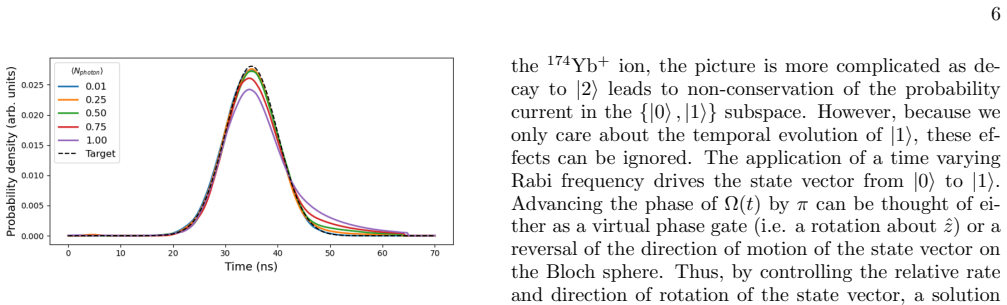
Summary. The manuscript proposes a method to control the temporal waveform of single photons emitted during spontaneous emission by modulating the amplitude and the phase-parity (sign) of the driving Rabi frequency that couples a ground state to an excited state. The excited-state population ρ11(t), and hence the photon envelope |g(t)|² ∝ Γρ11(t), is steered toward a desired temporal profile. The method is modeled with a three-level Λ-system master equation, numerically optimized for 174Yb+ with an 8 ns lifetime and a 250 MHz Rabi-frequency cap, and demonstrated experimentally in a trapped 174Yb+ ion. The paper also develops quantum Monte Carlo trajectory tools to characterize multi-photon emission statistics and to design time-of-arrival post-selection thresholds. Experimentally measured photon histograms show shaped waveforms, including a decay faster than the natural lifetime, and the authors estimate an achievable waveform-preparation fidelity of at least 0.996 after accounting for micromotion.
Significance. If the central claim—arbitrary temporal waveform from emitters of any lifetime—were established, the technique would be a valuable and broadly applicable tool for hybrid quantum networks, state transfer, and interferometric stabilization. The paper's strengths are its use of a standard master-equation framework, the absence of fitted parameters (known Yb+ constants are used), the development of trajectory-based tools for multi-photon statistics, and the experimental demonstration of phase-controlled de-excitation. However, the central claim is substantially broader than the evidence presented. The generality of 'any waveform, any lifetime' rests on numerical search for a single emitter system with a specific Rabi-frequency cap, and no controllability or scaling analysis is provided. The fidelity estimate is model-based and self-referential. These issues affect the paper's main conclusion and require attention.
major comments (4)
- [Abstract and Sec. II.C] The abstract claims 'any temporal waveform from emitters of any excited state lifetime, limited only by the timing resolution of control hardware.' The body supports this only by numerical exploration for one system (174Yb+, 8 ns lifetime, maximum Rabi frequency 250 MHz). No existence theorem, reachability analysis, or scaling law is given. In particular, producing a feature much shorter than 1/Γ requires stimulated-emission depopulation at a rate set by Ω(t); with a bounded Ω_max there is a minimum feature duration that depends on the available Rabi amplitude, not merely on timing resolution. The statement 'limited only by timing resolution' is therefore an extrapolation. I ask for either a controllability analysis (e.g., the reachable set of ρ11(t) for bounded Ω with binary phase control) or a qualified claim that reflects the finite-Ω constraint.
- [Sec. II.C, item 3 vs. claim of 'weird' photons] The manuscript states in Sec. II.C item 3 that 'decay dynamics cannot be inverted without a coherent π pulse of unphysically short duration preventing turning points or discontinuities in P1(t).' This directly conflicts with the later claim that bit-wise phase control permits 'photons of any relative temporal waveform,' including 'weird' photons with discontinuities or non-monotonic features. The Fabry-Perot analogy is qualitative and does not resolve the conflict. Please reconcile these statements and provide a concrete numerical or experimental example of a discontinuous or sharply turning target to support the 'weird photon' claim.
- [Appendix A, Eq. (A2)] The upper bound on ⟨N⟩ in Eq. (A2) appears not to follow from the model. If P1(t) = s·g(t) is the instantaneous excited-state population, then the mean number of photons emitted into mode q is Γ_q∫P1(t)dt = Γ_q·s, because the emission rate at time t is Γ_q P1(t). The factor [1−e^{−Γ(tf−t)}] in Eq. (A2) is not obtained from the master equation; it describes the probability that population present at time t later decays, but that decay is already included in P1(t). As written, the bound is ad hoc. Since this appendix is used to motivate the classification of waveform regimes and to assert limits on achievable ⟨N⟩, the derivation should be corrected or the bound should be stated as a heuristic conjecture.
- [Sec. IV.B and Fig. 11] The claim of an 'achievable photon shaping fidelity' of at least 0.996 is not a measured process fidelity. The estimate is obtained by feeding the measured excitation pulse into the master equation, computing a predicted photon distribution, and comparing that prediction with a phase-averaged histogram from the same system. The optical phase is not independently verified (Sec. IV.A), and the comparison uses the same model that generates the prediction. The agreement therefore demonstrates model self-consistency rather than the actual overlap between the emitted single-photon state and the target. In addition, no statistical uncertainty or explicit fidelity metric (mode overlap? normalized chi-square?) is defined. Please either provide an independent validation or reword the estimate as a model-based projection.
minor comments (6)
- [Sec. II.C] The sentence 'amplitude modulation is sufficient to produce long photons of any ⟨N⟩ with arbitrarily high fidelities' is inconsistent with Fig. 2 and Table I, which show that fidelity degrades as ⟨N⟩ increases. Please qualify 'any ⟨N⟩' and separate the target value of ⟨N⟩ from the achievable fidelity.
- [Figs. 3, 4, and 7] Axis labels, units, and normalization of the Rabi-frequency plots are unclear. Define what 'in- and out-of-phase Rabi frequency relative amplitudes' means and specify the normalization. The fidelity reported in the text (e.g., 'greater than 0.99') should also be defined precisely.
- [Fig. 9] The background-subtracted histograms show apparent negative photon counts. Negative amplitudes are unphysical and indicate either oversubtraction or an undocumented normalization. Please show raw counts with error bars and state the background subtraction procedure explicitly.
- [Sec. IV.A] Two different 'fidelity' measures are used: cosine similarity for laser-pulse synthesis (0.995–0.999) and mode overlap for photon waveforms (>0.99). Clarify the relationship between these metrics and avoid ambiguity in the conclusions.
- [Table I] The table reports emission statistics but does not state the number of trajectories used in the quantum Monte Carlo simulation or the specific pulse parameters. Add these details so the statistics can be reproduced.
- [Sec. III.B] The threshold post-selection procedure is described qualitatively. Please provide the explicit formula for the conditional probability P(N≥2 | click at time t) and state how the trajectory ensemble is used to estimate it.
Circularity Check
No significant circularity: the central derivation is a forward master-equation model with known Yb+ parameters; the 'any waveform' claim rests on an unproven controllability assumption, not on a circular reduction.
full rationale
I walked the claimed derivation chain: Eqs. (5)-(7) define the photon envelope as Γρ11(t)/⟨N⟩ from a Lindblad master equation with independently known constants (Γ≈123 MHz, 2:1 σ+/π branching). The synthesis procedure in Sec. II.A optimizes Ω(t) so that this forward model reproduces a target g(t); the target is an input and the simulated output is a normal forward calculation, so there is no self-definitional reduction. The Sec. II.C claim that amplitude plus bit-wise π-phase control 'should permit the production of photons of any relative temporal waveform' is supported only by numerical search and the Fabry-Perot/Bloch-sphere analogy; no controllability theorem is given and the abstract's 'limited only by timing resolution' is an extrapolation beyond the demonstrated 250 MHz cap. That is a correctness/evidence gap, not circularity. The Appendix A bound on ⟨N⟩ is a derived inequality, not an assumed result. The experimental fidelity estimate in Sec. IV.B ('We arrive at this estimate by measuring an applied laser pulse, predicting the expected photon distribution for this pulse and comparing to the phase averaged distribution') is model-mediated but not circular: the measured pulse is an input, Γ and branching are known, and no parameter is fitted to the phase-averaged photon histogram. Prior self-citations (Refs. [2,7,15]) are contextual experimental/protocol references and carry no load-bearing uniqueness theorem or ansatz. The manuscript itself honestly lists limitations (hardware bandwidth, micromotion, no direct phase verification), which further indicates the authors are not disguising a fit as a prediction. I therefore find no step where a result reduces by construction to its own inputs.
Assumptions & free parameters
free parameters (1)
- Maximum Rabi frequency Ω_max =
2π × 250 MHz (chosen from available laser power)
assumptions (5)
- standard math Rotating wave approximation (RWA) is valid for the laser-atom interaction.
- domain assumption Spontaneous emission is Markovian and described by Lindblad collapse operators L1, L2 with rates Γσ and Γπ, and no other decay channels.
- domain assumption The branching ratio between σ+ and π decay is 2:1 (Clebsch-Gordan), and the |2⟩ state is dark to the driving field.
- ad hoc to paper Binary phase-parity control (Ω(t) can be positive or negative) is sufficient to realize any desired ρ11(t) profile.
- ad hoc to paper The upper bound on ⟨N⟩ in Appendix A assumes P1(t)=s·g(t) and neglects re-excitation and dephasing effects.
Cite this review
Pith. "Pith review of Arbitrary control of the temporal waveform of photons during spontaneous emission." pith.science (2026). https://pith.science/paper/CUH3QZ22
@misc{pith2026251123462,
  author       = {Pith},
  title        = {Pith review of: Arbitrary control of the temporal waveform of photons during spontaneous emission},
  year         = {2026},
  howpublished = {\url{https://pith.science/paper/CUH3QZ22}},
  note         = {Machine review of arXiv:2511.23462}
}
read the original abstract
Control of the temporal waveform of photons produced during spontaneous emission from single quantum emitters provides a crucial tool in the establishment of hybrid quantum systems, optimization of quantum state transfer protocols and mitigation of effects due interferometric instability for network architectures based on flying qubits. We describe a method to generate photons of any temporal waveform from emitters of any excited state lifetime, limited only by the timing resolution of control hardware. We show how the temporal waveform of photons can be controlled by deterministically varying the population of an excited state which undergoes spontaneous emission. Our broadly applicable approach has only two requirements for a candidate quantum emitter: modulation of the (1) amplitude and (2) relative phase of a field coupling a ground state to the excited manifold. We detail how to identify optimal excitation pulses by employing variational algorithms to feed back on atomic populations. Additionally, we develop Quantum Monte Carlo based tools to determine photon-number statistics and establish techniques to identify optimal excitation strengths and post-selection thresholds for photon generation protocols. We situate our work in the context of other prior research on bespoke single photon sources and networking including post-emission pulse shaping, temporal gating and cavity-based methods. In comparison, our free-space process has greater flexibility in producing any waveform, requires less infrastructure, and can be readily applied across a wide range of quantum emitters. We discuss the applications and limits of this technique, including how increasing photon emission probabilities affects achievable temporal-mode overlap fidelities between emitted and target photon waveforms.
Figures


Figures from the paper (6 more)


Reference graph
Works this paper leans on
-
[12]
J. D. Siverns, J. Hannegan, and Q. Quraishi, Physical Review Applied11, 014044 (2019)
2019
-
[1]
Experimen- tally, this is achieved by the application of circu- larly polarized light with a k-vector perpendicular to the quantization axis
Initialize the system in the|0⟩state. Experimen- tally, this is achieved by the application of circu- larly polarized light with a k-vector perpendicular to the quantization axis
-
[2]
Experimen- tally, this represents a temporally shaped, resonant, and circularly polarized laser pulse of the opposite handedness used to perform optical pumping
Define an interaction Hamiltonian which represents aσ + driving field coupling|0⟩to|1⟩. Experimen- tally, this represents a temporally shaped, resonant, and circularly polarized laser pulse of the opposite handedness used to perform optical pumping. In order to simulate realistic parameters, we restrict the maximum Rabi frequency to 250 MHz based on stand...
-
[3]
As |1⟩undergoes spontaneous emission, the temporal distribution of the resulting photon follows the ex- cited state population
Solve the system time-evolution to findρ 11(t). As |1⟩undergoes spontaneous emission, the temporal distribution of the resulting photon follows the ex- cited state population. This process is described by solving the Lindblad master equation. Numeri- cally, this is achieved by modeling the system using Qutip. Experimentally, the laser pulse is applied and...
-
[4]
Once the form of the emitted photon is determined, iteratively updateH int, or equivalently, the laser pulse shape, utilizing a variational algorithm until the predicted or measured photon shape converges with the desired distribution. Depending on the application of photon shaping, par- ticular details of wavefunction optimization will vary; however, the...
-
[5]
This error grows with⟨N⟩and is minimized for emitters with a small|0⟩:|2⟩branching ratio
The contribution of spontaneous emission to|0⟩at times early in the excitation process leads to some amplitude of incoherent re-excitation. This error grows with⟨N⟩and is minimized for emitters with a small|0⟩:|2⟩branching ratio. This contribution is also minimized for small ratios of photon width to excited state lifetime,τ, as such distributions suppres...
-
[6]
This also leads to a contribution of in- coherent excitation with an amplitude which grows with⟨N⟩
Intrinsic dephasing time between|0⟩ → |1⟩lim- ited, in the absence of any environmental noise, by the relaxation rate of the excited state can alterna- tively be understood as a loss of coherence between the qudit transition and the driving field leading to an inability to coherently control the excited state population. This also leads to a contribution ...
-
[7]
For a given atomic system, points (1) and (2) are un- avoidable and result from the fundamental characteris- tic of the transition employed in photon shaping
Decay dynamics cannot be inverted without a co- herentπpulse of unphysically short duration pre- venting turning points or discontinuities inP 1(t). For a given atomic system, points (1) and (2) are un- avoidable and result from the fundamental characteris- tic of the transition employed in photon shaping. The magnitude of their contributions to infidelit...
Show all 50 references
-
[8]
Olmschenk, D
S. Olmschenk, D. Hayes, D. N. Matsukevich, P. Maunz, D. L. Moehring, and C. Monroe, International Journal of Quantum Information08, 337 (2010)
2010
-
[9]
J. F. Lilieholm, V. Niaouris, A. Kato, K.-M. C. Fu, and B. B. Blinov, Applied Physics Letters117, 154002 (2020), eprint: https://pubs.aip.org/aip/apl/article- pdf/doi/10.1063/5.0019892/14541946/154002 1 online.pdf
2020 doi
-
[10]
Y. Chu, J. D. Pritchard, H. Wang, and M. Wei- des, Applied Physics Letters118, 240401 (2021), eprint: https://pubs.aip.org/aip/apl/article- pdf/doi/10.1063/5.0057740/14548794/240401 1 online.pdf
2021 doi
-
[11]
H. K. Beukers, M. Pasini, H. Choi, D. Englund, R. Han- son, and J. Borregaard, PRX Quantum5, 010202 (2024)
2024
-
[13]
S. Yu, K. Lee, S. Park, K. Kim, J. Goo, J. Park, and T. Kim, Applied Physics Letters126, 084001 (2025)
2025
-
[14]
B. B. Blinov, D. L. Moehring, L.-M. Duan, and C. Mon- roe, Nature428, 153 (2004)
2004
-
[15]
McKeever, A
J. McKeever, A. Boca, A. D. Boozer, R. Miller, J. R. Buck, A. Kuzmich, and H. J. Kimble, Science303, 1992 (2004)
1992
-
[16]
Knall, C
E. Knall, C. Knaut, R. Bekenstein, D. Assump- cao, P. Stroganov, W. Gong, Y. Huan, P.-J. Stas, B. Machielse, M. Chalupnik, D. Levonian, A. Suleyman- zade, R. Riedinger, H. Park, M. Lonˇ car, M. Bhaskar, and M. Lukin, Physical Review Letters129, 053603 (2022)
2022
-
[17]
Stephenson, D
L. Stephenson, D. Nadlinger, B. Nichol, S. An, P. Dr- mota, T. Ballance, K. Thirumalai, J. Goodwin, D. Lucas, and C. Ballance, Physical Review Letters124, 110501 (2020)
2020
-
[18]
Sosnova,Mixed-Species Ion Chains for Quantum Net- works, Ph.D
K. Sosnova,Mixed-Species Ion Chains for Quantum Net- works, Ph.D. thesis, University of Maryland, College Park
-
[19]
Faorlin, B
T. Faorlin, B. Yadin, Y. Weiser, G. Araneda, S. Nimm- richter, L. Panzl, T. Lafenthaler, R. Blatt, T. Monz, and G. Cerchiari, Controlling the spontaneous emission of trapped ions (2025), version Number: 2
2025
-
[20]
Slodiˇ cka, G
L. Slodiˇ cka, G. H´ etet, N. R¨ ock, P. Schindler, M. Hen- nrich, and R. Blatt, Physical Review Letters110, 083603 (2013), publisher: American Physical Society
2013
-
[21]
S. L. N. Hermans, M. Pompili, L. D. Santos Martins, A. R-P Montblanch, H. K. C. Beukers, S. Baier, J. Borre- gaard, and R. Hanson, New Journal of Physics25, 013011 (2023)
2023
-
[22]
L.-M. Duan, B. Blinov, D. Moehring, and C. Monroe, Quantum Information and Computation4, 165 (2004)
2004
-
[23]
Van Leent, M
T. Van Leent, M. Bock, F. Fertig, R. Garthoff, S. Eppelt, Y. Zhou, P. Malik, M. Seubert, T. Bauer, W. Rosenfeld, W. Zhang, C. Becher, and H. Weinfurter, Nature607, 69 (2022)
2022
-
[24]
Bernien, B
H. Bernien, B. Hensen, W. Pfaff, G. Koolstra, M. S. Blok, L. Robledo, T. H. Taminiau, M. Markham, D. J. Twitchen, L. Childress, and R. Hanson, Nature497, 86 (2013)
2013
-
[25]
Krutyanskiy, M
V. Krutyanskiy, M. Galli, V. Krcmarsky, S. Baier, D. Fioretto, Y. Pu, A. Mazloom, P. Sekatski, M. Can- teri, M. Teller, J. Schupp, J. Bate, M. Meraner, N. San- gouard, B. Lanyon, and T. Northup, Physical Review Letters130, 050803 (2023)
2023
-
[26]
Craddock, J
A. Craddock, J. Hannegan, D. Ornelas-Huerta, J. Siverns, A. Hachtel, E. Goldschmidt, J. Porto, Q. Quraishi, and S. Rolston, Physical Review Letters 123, 213601 (2019)
2019
-
[27]
Stobi´ nska, G
M. Stobi´ nska, G. Alber, and G. Leuchs, EPL (Euro- physics Letters)86, 14007 (2009)
2009
-
[28]
Golla, B
A. Golla, B. Chalopin, M. Bader, I. Harder, K. Mantel, R. Maiwald, N. Lindlein, M. Sondermann, and G. Leuchs, The European Physical Journal D66, 190 (2012)
2012
-
[29]
J. I. Cirac, P. Zoller, H. J. Kimble, and H. Mabuchi, Physical Review Letters78, 3221 (1997)
1997
-
[30]
S. Saha, M. Shalaev, J. O’Reilly, I. Goetting, G. Toh, A. Kalakuntla, Y. Yu, and C. Monroe, Nature Commu- nications16, 2533 (2025)
2025
-
[31]
Maunz, D
P. Maunz, D. L. Moehring, S. Olmschenk, K. C. Younge, D. N. Matsukevich, and C. Monroe, Nature Physics3, 538 (2007), publisher: Nature Publishing Group
2007
-
[32]
P. P. Rohde, T. C. Ralph, and M. A. Nielsen, Physical Review A72, 052332 (2005), publisher: American Phys- ical Society
2005
-
[33]
So´ snicki, M
F. So´ snicki, M. Miko lajczyk, A. Golestani, and M. Karpi´ nski, Nature Photonics17, 761 (2023)
2023
-
[34]
Kolchin, C
P. Kolchin, C. Belthangady, S. Du, G. Y. Yin, and S. E. Harris, Physical Review Letters101, 103601 (2008)
2008
-
[35]
L. J. Wright, M. Karpi´ nski, C. S¨ oller, and B. J. Smith, Physical Review Letters118, 023601 (2017)
2017
-
[36]
So´ snicki and M
F. So´ snicki and M. Karpi´ nski, Optics Express26, 31307 (2018)
2018
-
[37]
R. L. Lecamwasam, M. R. Hush, M. R. James, and A. R. R. Carvalho, Physical Review A95, 013828 (2017)
2017
-
[38]
Keller, B
M. Keller, B. Lange, K. Hayasaka, W. Lange, and H. Walther, Nature431, 1075 (2004)
2004
-
[39]
You and Y.-M
X. You and Y.-M. He, Physical Review Research7, L012016 (2025)
2025
-
[40]
J. P. Covey, H. Weinfurter, and H. Bernien, npj Quantum Information9, 90 (2023)
2023
-
[41]
G. S. Vasilev, D. Ljunggren, and A. Kuhn, New Journal of Physics12, 063024 (2010)
2010
-
[42]
A. Kuhn, M. Hennrich, and G. Rempe, Physical Review Letters89, 067901 (2002)
2002
-
[43]
P. B. R. Nisbet-Jones, J. Dilley, A. Holleczek, O. Barter, and A. Kuhn, New Journal of Physics15, 053007 (2013)
2013
-
[44]
D. L. Moehring, P. Maunz, S. Olmschenk, K. C. Younge, D. N. Matsukevich, L.-M. Duan, and C. Monroe, Nature 449, 68 (2007)
2007
-
[45]
Cabrillo, J
C. Cabrillo, J. I. Cirac, P. Garc ´ ıa-Fern´ andez, and P. Zoller, Physical Review A59, 1025 (1999)
1999
-
[46]
Hofmann, M
J. Hofmann, M. Krug, N. Ortegel, L. G´ erard, M. Weber, W. Rosenfeld, and H. Weinfurter, Science337, 72 (2012)
2012
- [47]
-
[48]
S. L. N. Hermans, M. Pompili, H. K. C. Beukers, S. Baier, J. Borregaard, and R. Hanson, Nature605, 663 (2022)
2022
- [49]
-
[50]
D. N. Matsukevich, P. Maunz, D. L. Moehring, S. Olm- schenk, and C. Monroe, Physical Review Letters100, 13 150404 (2008)
2008
Reviewed August 3, 2026 · model on record in the stance chip above.
Discussion (0). Continue with ORCID to comment.