REVIEW 3 major objections 5 minor 18 references
Beyond Attention: Signed Integrated Gradients Attribution in a BiomeGPT-Style Microbiome Transformer
T0 review · 3 major / 5 minor · reviewed 2026-08-15 · deepseek-v4-flash
Pith's one-line read Signed attribution of the IBD–healthy margin replaces unsigned attention in feature-tokenized transformer explanations.
desk verdict The baseline derivation is correct and worth stealing; the empirical case for the biological claims is thin and the straight-line path assumption needs work. read the letter →
The pith
A machine-rendered reading of the paper's core claim, the machinery that carries it, and where it could break.
The reading
What carries the argument
The load-bearing object is the source-derived baseline $T' = S + A_0$, with $A_0 = \mathrm{MLP}_{AB}(0)$ the learned zero-abundance embedding. Integrated Gradients of the margin $F(S,A) = z_{\mathrm{IBD}} - z_{\mathrm{Healthy}}$ are computed along the interpolation $S_\alpha = S$, $A_\alpha = A_0 + \alpha(A - A_0)$; the identity-map fusion makes $\partial F/\partial S = \partial F/\partial A = \partial F/\partial T$ along the path, so the displacement factor $(A - A_0)$ alone distinguishes abundance-source attribution, and fused-token IG collapses to abundance IG. The species embedding is never removed; it stays in the forward pass and conditions the gradients, while the reported $G_A = \int_0^1 (\partial F/\partial A)(S, A_\alpha)\,d\alpha$ offers a non-complete sensitivity diagnostic that is not weighted by abundance displacement.
What would settle it
A concrete test: on the same trained classifier, compute abundance attributions with the source-derived baseline, with an all-zero fused-token baseline, and with an integration path that runs through the learned abundance encoder rather than straight-line in embedding space; if the sign assignments for the top-ranked species or the aggregate true-positive/true-negative mean signs are not stable across baselines and paths, the claimed directional evidence is an artifact of the chosen baseline rather than a property of the model.
Extended reading notes
Core claim
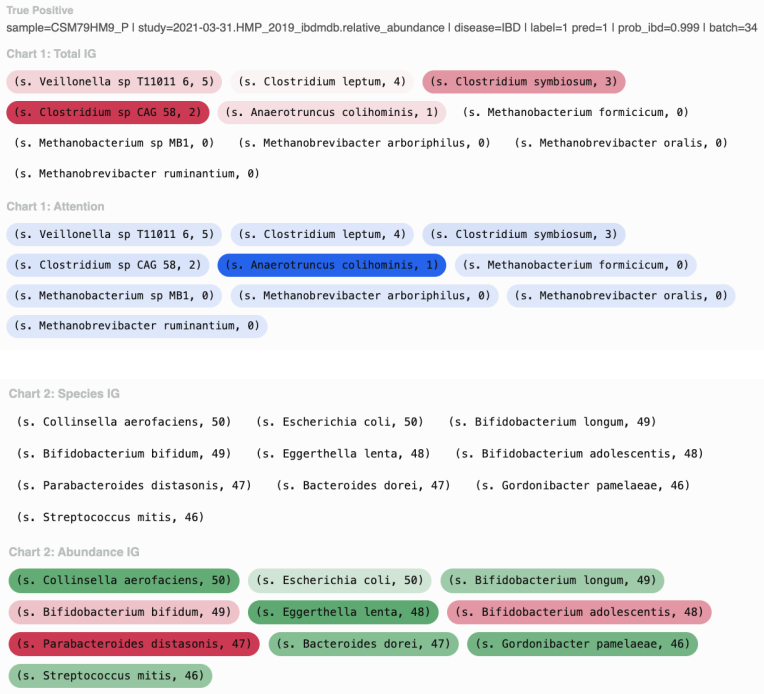
The central claim is that signed attribution of the IBD–healthy margin recovers directional species-abundance evidence that unsigned attention cannot express. In the author's construction, the baseline is derived from the token sources rather than set to zero: with $T = S + A$ and $A_0 = \mathrm{MLP}_{AB}(0)$, the baseline is $T' = S + A_0$, so the path moves abundance from its zero state to its observed value while the species embedding remains fixed. Because both sources enter the fusion additively with identity Jacobians, the path-averaged gradients of $F$ with respect to $S$ and $A$ coincide, and the fused-token IG equals the abundance-source IG; species attribution is zero by construction yet species identity conditions every gradient along the path. Empirically the author reports that across 7,382 samples true-positive samples carry positive mean attribution and true-negative samples negative mean attribution, and that several of the highest-[CLS]-attention species are among the strongest health-supporting signals rather than IBD drivers. The paper also introduces path-averaged abundance sensitivity $G_A$ and abundance-attribution response profiles as diagnostics.
Load-bearing premise
The argument rests on treating the learned zero-abundance embedding $A_0$ as a meaningful 'absence of signal' baseline and on assuming that straight-line interpolation in abundance-embedding space passes through regions where the model's gradients remain semantically interpretable, so a failure of either assumption would strip the signed attributions of biological meaning.
Editorial extensions
If this is right
- Attention rankings should not be read as disease-driver rankings in feature-tokenized models, because the paper's results show top-attention species can be health-supporting.
- The signed margin attribution gives each species-abundance observation a direction relative to the IBD–healthy decision, enabling lists of IBD-supporting versus health-supporting taxa from a single trained model.
- Path-averaged abundance sensitivity $G_A$ can surface low-abundance species with high per-unit influence that full IG ranks low and attention ignores entirely.
- Abundance-attribution response profiles show non-monotonic and context-dependent species effects, motivating segmented or path-resolved IG as the next diagnostic.
- The baseline construction transfers to any additively fused feature-tokenized transformer, where the fixed identity embedding is preserved and only the value embedding is interpolated.
Reading between the lines
- If the additive-fusion equivalence is generic, then every additively fused feature-tokenized model inherits the same baseline rule: keep the feature's learned zero-value embedding fixed while preserving the feature identity, making the method portable beyond microbiome data.
- The observation that high-attention species are often health-supporting suggests that attention-based biomarker extraction in other disease classifiers may systematically invert rankings; this is testable by rerunning the same signed-margin analysis on other fine-tuned feature-tokenized models.
- The use of embedding-space interpolation is the delicate step; a tokenizer-aware path through the abundance encoder would give a direct robustness check and may change sign assignments for rare species.
- The proposed second-order Integrated Hessian score $\Gamma^A_{ij}$ could be computed per species pair as a community-interaction map, offering a model-based alternative to correlation networks for candidate microbial interactions.
Signed reviews
Editorial analysis
A structured set of objections, weighed in public.
Referee Report
Summary. The manuscript proposes a source-derived Integrated Gradients baseline, T' = S + A0, for feature-tokenized transformers with additive token fusion, where S is a fixed species embedding and A is a sample-dependent abundance embedding. It proves that, under additive fusion, fused-token IG with this baseline is equivalent to abundance-source IG, with zero species attribution by construction. The method is then applied to a reimplemented BiomeGPT-style microbiome transformer for IBD versus healthy classification, and the paper reports signed attribution differences from [CLS] attention, path-averaged sensitivity diagnostics, and abundance-attribution response profiles. The central argument is that signed IG separates disease-supporting from health-supporting evidence where unsigned attention weights cannot, and the paper proposes second-order Integrated Hessians as a future extension for species-abundance interactions.
Significance. If the empirical and path-interpretation issues are resolved, the paper makes a clean and useful contribution: the derivation in Section 3.4 is correct and self-contained, and the source-derived baseline generalizes naturally to other additive feature-tokenized architectures such as FT-Transformer. The availability of code and the detailed reimplementation description are strengths. However, the empirical demonstration is currently preliminary: aggregate statistics are reported without uncertainty, the tested model is a reimplementation rather than the released BiomeGPT, and the biological interpretation of the attribution signs depends on an unvalidated straight-line path in embedding space. These issues limit the strength of the claims that the method 'uncovers species-abundance directional relationships' and 'separates pathogenic from protective microbial signals.'
major comments (3)
- [Section 3.4 and Section 6] The central interpretative claim, that IGA measures the effect of moving species abundance from zero to its observed value, requires the linear path A0 + alpha*(A - A0) to traverse abundance-embedding points that correspond to valid abundance variation. The paper itself cites UDIG (Ref. 13) for the concern that straight-line interpolation is poorly matched to tokenized models and explicitly defers a tokenizer-aware path to future work in Section 6, yet no experiment checks whether intermediate path points decode to valid abundance inputs, whether A0 is in-distribution, or whether the attribution signs are stable under an alternative path. Without such diagnostics, the signed rankings in Figures 4 and 6 may be artifacts of off-manifold interpolation rather than evidence about actual abundance effects, so the biological interpretation is not yet established.
- [Section 5] The quantitative evidence for the central empirical claim is thin. The only aggregate attribution numbers are the overall mean (-0.0011), the true-positive mean (0.0027), and the true-negative mean (-0.0045), all reported without standard deviations, confidence intervals, or significance tests, and the baseline margin F(S, A0) is never reported. Completeness only relates the total attribution sum to F(x) - F(x'), so these aggregate means carry little per-species information. The claimed 'clear contrast' between attention and IG, and the directional species rankings in Figure 4, require per-species distributions, effect sizes, and preferably a statistical comparison. Please report the baseline margin, per-species and per-sample attribution distributions, and appropriate uncertainty estimates.
- [Section 4 and Abstract/Conclusion] The experiments use 'a BiomeGPT-style microbiome transformer encoder' rather than the actual released BiomeGPT model, but the abstract and conclusion attribute the empirical findings to 'BiomeGPT' without qualification. The manuscript does not state whether the reimplementation matches the released BiomeGPT tokenizer, architecture, pretraining corpus, or pretrained weights, nor whether any external validation was performed. Because the empirical results are the only support for the biological directional claims, please specify exactly which components are shared with BiomeGPT and which are new, and adjust the abstract and conclusion claims so they refer to the reimplementation unless the released model is actually used.
minor comments (5)
- [Section 3.4] The sentence 'preserves the fixed identity feature coordinate component and interpolate only the component encoding the observed value' has a grammatical subject-verb disagreement; it should read '...and interpolates only the component encoding the observed value.'
- [Section 4] The all-zero baseline is written as 'T' = 0 in R^512', but the fused input is a sequence of 1663 tokens each of dimension 512; please clarify whether the baseline is a per-token vector or a full sequence tensor.
- [Section 5] Please define 'True Positive' and 'True Negative' explicitly as correctly classified IBD samples and correctly classified healthy samples, respectively, since these terms could otherwise be confused with clinical ground truth.
- [Section 3.1] Please clarify whether abundance bin 0 is an actual discrete input bin in the tokenizer vocabulary or a special out-of-vocabulary input; the definition of A0 = MLP_AB(0) depends on this distinction.
- [Section 2] The claim that prior applications of IG to feature-tokenized architectures 'have not been explicitly derived or documented' is strong; please soften it to 'to the best of our knowledge' after a more thorough literature search, or cite the specific prior work that was checked.
Circularity Check
No significant circularity: the baseline and equivalence are derived from the model's tokenization equation, not from the target result or fitted data.
full rationale
The paper's central derivation in Section 3.4 is a mathematical identity, not a circular prediction. The fused-token baseline T' = S + A0 is defined from the model's additive tokenization T = S + A and the learned zero-abundance embedding A0 = MLPAB(0); it does not depend on the attribution target F or on any fitted attribution quantity. The claimed equivalence IGT = (T-T') * integral(dF/dT) = (A-A0) * integral(dF/dA) = IGA follows directly from the chain rule under additive fusion (dT/dS = dT/dA = I), and the paper states the zero species attribution as a consequence of holding species identity fixed rather than as an empirical discovery. The sign semantics (positive supports IBD, negative supports healthy) are explicitly tied to the chosen logit contrast F = z_IBD - z_Healthy, so the observed sign consistency in Section 5 is a restatement of the target definition, not an independent prediction. No parameter is fitted to the data to define the baseline, and no prediction is forced by construction: the empirical comparisons to [CLS] attention, the G_A sensitivity diagnostic, and the abundance-response profiles are computed from the model and are not assumed by the derivation. The related-work discussion cites UDIG to acknowledge that straight-line paths may be poorly matched to tokenized models, and Section 6 explicitly disclaims biological causality and defers tokenizer-aware paths; these are correctness or generalization limitations, not circularity. There are no load-bearing self-citations: the author cites external work for IG, Captum, UDIG, Integrated Hessians, and BiomeGPT, with no uniqueness theorem imported from the author's own prior work. Overall the derivation is self-contained and does not reduce to its inputs.
Assumptions & free parameters
free parameters (2)
- IG integration discretization
- Bottom-5% abundance cutoff =
5%
assumptions (6)
- domain assumption Feature tokens are additively fused as T = S + A (species embedding plus abundance embedding).
- domain assumption A0 = MLP_AB(0) is a meaningful zero-abundance baseline representing absence of the species.
- standard math The trained model is smooth and differentiable enough for path integration of gradients.
- standard math Integrated Gradients completeness holds up to numerical error.
- domain assumption The reimplemented 'BiomeGPT-style' model is a faithful proxy for BiomeGPT.
- domain assumption Validation accuracy around 0.93 indicates the model learned an IBD-discriminative signal suitable for attribution.
Cite this review
Pith. "Pith review of Beyond Attention: Signed Integrated Gradients Attribution in a BiomeGPT-Style Microbiome Transformer." pith.science (2026). https://pith.science/paper/CZ6GBDBM
@misc{pith2026260806486,
  author       = {Pith},
  title        = {Pith review of: Beyond Attention: Signed Integrated Gradients Attribution in a BiomeGPT-Style Microbiome Transformer},
  year         = {2026},
  howpublished = {\url{https://pith.science/paper/CZ6GBDBM}},
  note         = {Machine review of arXiv:2608.06486}
}
read the original abstract
In a feature-tokenized transformer (arXiv:2106.11959) such as BiomeGPT (doi:10.64898/2026.01.05.697599), each input token is built by fusing a fixed identity with a sample-specific measurement: a fixed species and a variable abundance, T = S + A. To interpret downstream classification in such models, prior work inspects the attention weights of the special [CLS] token (arXiv:2106.11959, arXiv:1810.04805, BiomeGPT) to rank sample tokens by importance. These weights have two critical limitations: they are nonnegative, so they cannot separate disease-supporting from health-supporting evidence (arXiv:2201.12114), and they act after token fusion, obscuring how the input sources S and A each affect the output. To address this we use Integrated Gradients (arXiv:1703.01365), a signed, fusion-aware attribution method, and propose a source-derived baseline T' = S + A_0 for feature-tokenized models such as BiomeGPT, which preserves species identity as a fixed biological coordinate while isolating the effect of abundance variation. Applied to a disease-versus-health decision margin, it yields polarity that explicitly separates pathogenic from protective microbial signals. We show that this gradient-based approach uncovers species-abundance directional relationships and sensitivity diagnostics entirely obscured by unsigned [CLS] attention weights. We further recommend second-order Integrated Hessians (arXiv:2002.04138) to expose microbiome community interaction rules: how a perturbation in one member alters the model's sensitivity to another, and which other species drive ambiguous cases toward disease or health at a given abundance level. This provides a principled approach to explainability in BiomeGPT that generalizes to other smooth and differentiable feature-tokenized transformers. Code is available at https://github.com/nohren/token-source-attribution
Figures


Figures from the paper (3 more)


Reference graph
Works this paper leans on
-
[1]
Towards better understanding of gradient-based attribution methods for deep neural networks
Marco Ancona, Enea Ceolini, Cengiz Öztireli, and Markus Gross. Towards better understanding of gradient-based attribution methods for deep neural networks. InInternational Conference on Learning Representations, 2018. URLhttps://arxiv.org/abs/1711.06104. arXiv:1711.06104
arXiv 2018
-
[2]
Aitor Blanco-Míguez, Francesco Beghini, Fabio Cumbo, Lauren J. McIver, Kelsey N. Thompson, Moreno Zolfo, Paolo Manghi, Leonard Dubois, Kun D. Huang, Andrew Maltez Thomas, William A. Nickols, Gianmarco Piccinno, Elisa Piperni, Michal Punˇcocháˇr, Mireia Valles-Colomer, Adrian Tett, Francesca Gior- dano, Richard Davies, Jonathan Wolf, Sarah E. Berry, Tim D....
-
[3]
Haotian Cui, Chloe Wang, Hassaan Maan, Kuan Pang, Fengning Luo, Nan Duan, and Bo Wang. scGPT: toward building a foundation model for single-cell multi-omics using generative AI.Nature Meth- ods, 21:1470–1480, 2024. doi: 10.1038/s41592-024-02201-0. URL https://doi.org/10.1038/ s41592-024-02201-0
-
[4]
Bert: Pre-training of deep bidi- rectional transformers for language understanding
Jacob Devlin, Ming-Wei Chang, Kenton Lee, and Kristina Toutanova. Bert: Pre-training of deep bidi- rectional transformers for language understanding. InProceedings of the 2019 conference of the North American chapter of the association for computational linguistics: human language technologies, volume 1 (long and short papers), pages 4171–4186, 2019
2019
-
[5]
Revisiting deep learning models for tabular data
Yury Gorishniy, Ivan Rubachev, Valentin Khrulkov, and Artem Babenko. Revisiting deep learning models for tabular data. InAdvances in Neural Information Processing Systems (NeurIPS), vol- ume 34, pages 18932–18943, 2021. URL https://proceedings.neurips.cc/paper/2021/hash/ 9d86d83f925f2149e9edb0ac3b49229c-Abstract.html. 14
work page 2021
-
[6]
Sarthak Jain and Byron C. Wallace. Attention is not explanation. InProceedings of the 2019 Conference of the North American Chapter of the Association for Computational Linguistics, pages 3543–3556, 2019. URLhttps://arxiv.org/abs/1902.10186. arXiv:1902.10186
arXiv 2019
-
[7]
Explaining Explanations: Axiomatic Feature Interactions for Deep Networks
Joseph D. Janizek, Pascal Sturmfels, and Su-In Lee. Explaining explanations: Axiomatic feature interac- tions for deep networks.arXiv preprint arXiv:2002.04138, 2020. doi: 10.48550/arXiv.2002.04138. URL https://arxiv.org/abs/2002.04138. arXiv:2002.04138
work page Pith review arXiv doi:10.48550/arxiv.2002.04138 2002
-
[8]
Captum: A unified and generic model interpretability library for pytorch, 2020
Narine Kokhlikyan, Vivek Miglani, Miguel Martin, Edward Wang, Bilal Alsallakh, Jonathan Reynolds, Alexander Melnikov, Natalia Kliushkina, Carlos Araya, Siqi Yan, and Orion Reblitz-Richardson. Captum: A unified and generic model interpretability library for pytorch, 2020. URL https://arxiv.org/abs/ 2009.07896. arXiv:2009.07896
arXiv 2020
Show all 18 references
-
[9]
Rethinking attention- model explainability through faithfulness violation test
Yibing Liu, Haoliang Li, Yangyang Guo, Chenqi Kong, Jing Li, and Shiqi Wang. Rethinking attention- model explainability through faithfulness violation test. InProceedings of the 39th International Conference on Machine Learning, pages 13858–13871. PMLR, 2022
2022
-
[10]
Medearis, Siyao Zhu, and Ali R
Nicholas A. Medearis, Siyao Zhu, and Ali R. Zomorrodi. Biomegpt: A foundation model for the human gut microbiome.bioRxiv, 2026. doi: 10.64898/2026.01.05.697599. URL https://doi.org/10.64898/ 2026.01.05.697599
2026 doi
-
[11]
Dowd, Curtis Huttenhower, Martin Morgan, Nicola Segata, and Levi Waldron
Edoardo Pasolli, Lucas Schiffer, Paolo Manghi, Audrey Renson, Valerie Obenchain, Duy Tin Truong, Francesco Beghini, Faizan Malik, Marcel Ramos, Jennifer B. Dowd, Curtis Huttenhower, Martin Morgan, Nicola Segata, and Levi Waldron. Accessible, curated metagenomic data through Ex...
2017 doi
-
[12]
David, and Xiaoli Fern
Quintin Pope, Rohan Varma, Christine Tataru, Maude M. David, and Xiaoli Fern. Learning a deep language model for microbiomes: The power of large scale unlabeled microbiome data.PLOS Computational Biology, 21(5):e1011353, 2025. doi: 10.1371/journal.pcbi.1011353. URL https://doi...
2025 doi
-
[13]
Uniform discretized integrated gradients: An effective attribution based method for explaining large language models, 2024
Swarnava Sinha Roy and Ayan Kundu. Uniform discretized integrated gradients: An effective attribution based method for explaining large language models, 2024. URLhttps://arxiv.org/abs/2412.03886. arXiv:2412.03886
2024 arXiv
-
[14]
Axiomatic attribution for deep networks
Mukund Sundararajan, Ankur Taly, and Qiqi Yan. Axiomatic attribution for deep networks. InInternational Conference on Machine Learning, pages 3319–3328, 2017. URL https://arxiv.org/abs/1703. 01365. arXiv:1703.01365
2017 arXiv
-
[15]
Theodoris, Ling Xiao, Anant Chopra, Mark D
Christina V . Theodoris, Ling Xiao, Anant Chopra, Mark D. Chaffin, Zeina R. Al Sayed, Matthew C. Hill, Helene Mantineo, Elizabeth M. Brydon, Zexian Zeng, X. Shirley Liu, and Patrick T. Ellinor. Transfer learning enables predictions in network biology.Nature, 618(7965):616–624,...
2023 doi
-
[16]
Attention is not not explanation
Sarah Wiegreffe and Yuval Pinter. Attention is not not explanation. InProceedings of the 2019 Conference on Empirical Methods in Natural Language Processing, pages 11–20, 2019. URL https://arxiv.org/ abs/1908.04626. arXiv:1908.04626
2019 arXiv
-
[17]
scBERT as a large-scale pretrained deep language model for cell type annotation of single-cell RNA-seq data.Nature Machine Intelligence, 4:852–866, 2022
Fan Yang, Wenchuan Wang, Fang Wang, Yuan Fang, Duyu Tang, Junzhou Huang, Hui Lu, and Jianhua Yao. scBERT as a large-scale pretrained deep language model for cell type annotation of single-cell RNA-seq data.Nature Machine Intelligence, 4:852–866, 2022. doi: 10.1038/s42256-022-0...
2022 doi
-
[2023]
URLhttps://doi.org/10.1038/s41587-023-01688-w
doi: 10.1038/s41587-023-01688-w. URLhttps://doi.org/10.1038/s41587-023-01688-w
Reviewed August 15, 2026 · model on record in the stance chip above.
Discussion (0). Continue with ORCID to comment.