REVIEW 3 major objections 5 minor 1 cited by
Machine learning can estimate the higher-order cumulants of the chiral condensate at roughly a quarter of the current measurement cost, using only about 1% of configurations as labeled data, provided the leading trace Tr M^{-1} is kept exac
Reviewed by Pith at T0; open to challenge. T0 means a machine referee read the full paper against a public rubric. the ladder, T0–T4 →
T0 review · deepseek-v4-flash
2026-08-02 20:58 UTC pith:D4Z63T2Y
load-bearing objection Fin scheme looks like a real cost saver for kurtosis at the transition point, but the abstract's claims about susceptibility and skewness are not supported by the shown plots. the 3 major comments →
Machine Learning-Based Estimation of Cumulants of Chiral Condensate via Multi-Ensemble Reweighting with Deborah.jl
The pith
A machine-rendered reading of the paper's core claim, the machinery that carries it, and where it could break.
Core claim
The authors report that a bias-corrected supervised regression estimator, applied to stochastic estimates of Tr M^{-n} on Wilson-clover ensembles with the Iwasaki gauge action, reproduces the conventional full-measurement results for the cumulants of the chiral condensate. In the Fin configuration, where the full set of measured Tr M^{-1} values is retained and only higher powers are predicted, the multi-ensemble reweighting yields Bhattacharyya coefficients near 1 across the scanned labeled/training fractions, including the extreme case of 1% labeled data. This corresponds to reducing the dominant matrix-inversion cost to roughly 26% of the original measurement budget. In the Fex configurat
What carries the argument
The load-bearing mechanism is the bias-corrected estimator P1: predictions from a supervised regression model on the unlabeled set are added to the mean of (exact value minus prediction) over a separate bias-correction set, which cancels systematic model bias without exact inversions on every configuration. This estimator is wrapped in a multi-ensemble Ferrenberg-Swendsen reweighting procedure that combines five ensembles at different quark masses (kappa values) to interpolate observables and the transition point. The cumulants of the chiral condensate are built from the quark-loop operators Q1-Q4, which are polynomial combinations of Tr M^{-n}; the paper defines the Fin setup, which keeps T
Load-bearing premise
The cost and fidelity claims rest on the assumption that the cumulants are dominated by the exactly measured Tr M^{-1}, so errors in the machine-learned higher traces do not shift the result.
What would settle it
Run the Fin pipeline on an ensemble or at a parameter point where the Tr M^{-4} contribution to the kurtosis is sizable (for instance, closer to the critical endpoint or at a smaller volume), and compare the ML-reweighted kurtosis to the fully measured baseline; if the difference exceeds the statistical error, the dominance assumption fails.
If this is right
- If the Fin result holds, lattice QCD can compute the susceptibility, skewness, and kurtosis of the chiral condensate at roughly a quarter of the current cost without changing the statistical conclusions.
- The 26% cost bound follows directly from the claim that Tr M^{-1} dominates the cumulants, so the exact measurement of the lowest trace cannot be avoided.
- The Fex results imply that a fully feature-based ML pipeline for these observables would require roughly 20% labeled data and an explicit bias-correction stage to be reliable.
- Bias correction is not optional when ML outputs feed into multi-ensemble reweighting: the no-bias-correction column shows multi-standard-deviation deviations in the kurtosis at the transition point.
- The same bias-corrected estimator could be applied to other fermionic observables that enter higher-order fluctuation analyses near the critical endpoint.
Where Pith is reading between the lines
- If the dominance of Tr M^{-1} persists on larger volumes and physical quark masses, the 26% figure could become a practical default for fluctuation measurements, but the current evidence is restricted to the ensembles studied.
- The weak correlation of Tr M^{-4} with Tr M^{-1} in the lightest-quark ensemble suggests that the Fin approach would break down for observables where the fourth trace term is not subleading; a direct test would be to compute baryon-number cumulants or isospin fluctuations with the same pipeline.
- The Fex result suggests a cheap screening strategy for identifying critical-endpoint candidates, but the large sensitivity to bias correction means one could test whether adding the Polyakov loop as a feature changes the convergence pattern and the poor low-label behavior.
Editorial analysis
A structured set of objections, weighed in public.
Referee Report
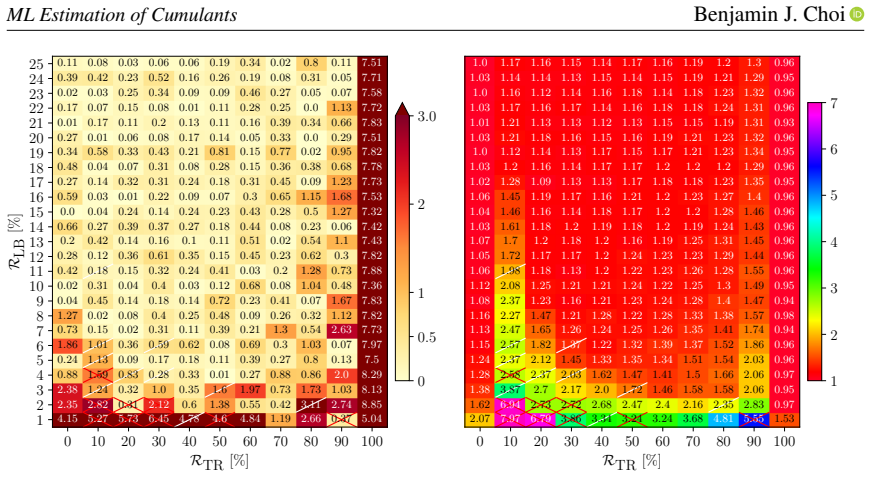
Summary. The paper proposes a bias-corrected machine-learning scheme to estimate the higher-power traces Tr M^{-n} (n=2,3,4) of the Wilson-clover Dirac operator, with two feature scenarios: Fin, which uses the exactly measured Tr M^{-1} both as a physical input to the cumulant construction and as an ML feature, and Fex, which uses only gauge observables (plaquette, rectangle). The traces are combined into cumulants of the chiral condensate and analyzed through multi-ensemble reweighting across five κ values. The main quantitative result is the Bhattacharyya-coefficient map for the kurtosis at the transition point (Fig. 2): Fin gives C_B ≈ 1 across almost the entire (R_LB, R_TR) scan, while Fex requires a sufficiently large labeled fraction and explicit bias correction to avoid multi-standard-deviation deviations. The abstract claims that susceptibility, skewness, and kurtosis are all statistically consistent with fully measured baselines at ~1% labeled data and ~26% cost.
Significance. If the claimed consistency holds for all three cumulants, the Fin scheme would reduce the measurement cost for higher-order cumulants from 400 CG solves per configuration to ~103 solves (25.75%), without statistically changing the results on this dataset. The bias-correction framework is well motivated by AMA and the paper provides reproducible code (Deborah.jl), which strengthens the work. The Fex result, showing that removing bias correction leads to large distortions once the ML outputs are fed into multi-stage reweighting, is a useful cautionary finding for the lattice-ML community.
major comments (3)
- [Abstract, Sec. 4, Fig. 2] The abstract and Sec. 4 claim that the Fin setup yields statistically consistent susceptibility, skewness, and kurtosis at ~1% labeled data. However, the only quantitative evidence displayed is the C_B map for the kurtosis K(κ_t) in Fig. 2(b) and the x/r diagnostics in Fig. 3. No C_B, x, or r results are shown for χ = C_2/V or S = C_3/C_2^{3/2} under either Fin or Fex. This is a support gap in the central claim: the 26% cost reduction and the 'statistically consistent' statement are made without qualification. The authors should either add the corresponding C_B maps/tables for χ and S, or revise the abstract and conclusion to state that consistency is demonstrated specifically for the kurtosis on this dataset.
- [Sec. 4, Eq. (2), Fig. 1] The cost figure 25.75% is arithmetic, but the fidelity claim relies on the assertion that 'the cumulants are dominated by this observable' (Tr M^{-1}). The paper does not quantify the relative contributions of the different trace terms to C_2, C_3, and C_4. In particular, the kurtosis expression for Q_4 (Eq. 2) contains the term -6 N_f Tr M^{-4}, and Fig. 1 shows that Tr M^{-4} has a substantially weaker correlation with Tr M^{-1} (0.78 and 0.41 for the two representative ensembles). The empirical C_B ≈ 1 in Fig. 2(b) suggests the approximation works for this dataset, but the conclusion presents the dominance as a general property. Please provide a quantitative decomposition of the cumulants' mean/variance by trace term, or explicitly state that the dominance is an assumption validated only for the kappa values, volume, and action used here.
- [Sec. 2.7, Eq. (7)] The evaluation metric C_B is based on a Gaussian approximation of the sampling distributions of the final reweighted observables. For higher-order cumulants such as skewness and kurtosis near a first-order transition, the distributions may be significantly non-Gaussian, and the Bhattacharyya coefficient computed from only the mean and variance may not capture the agreement faithfully. The paper does not test this Gaussian assumption for the observables in Figs. 2-3. This is load-bearing because C_B is the primary figure of merit throughout. Please either justify the Gaussianity (e.g., with quantile-quantile plots or higher-moment checks) or use a metric that does not rely on it.
minor comments (5)
- [General] The manuscript contains numerous typos, most notably '/github' appearing in the abstract and Sec. 1 instead of a full URL or DOI. The code link should be given in standard form.
- [Table 2] The table formatting is garbled; the row identifiers (e.g., 'L12T4b1.60k13575') are merged with the column headers, making the ensemble parameters hard to read.
- [Sec. 2.6] The block-bootstrap procedure is described only verbally. Specify the block length selection, the number of bootstrap resamples, and whether the block length is scale-dependent.
- [Fig. 3 caption] The caption says the left half of the panel shows x and the right half shows r, but the figure appears to contain two separate heatmaps with different color scales. Clarify the layout and label the color axes directly in the figure.
- [Sec. 3, Fig. 2(a)] The statement that the problematic region 'largely disappears once R_LB ≳ 20%' is not fully consistent with the heatmap: several cells with R_LB < 10% show C_B ≥ 0.9, and some cells with R_LB between 15% and 20% at R_TR = 90% show C_B ≈ 0.85–0.94. Define the threshold used for 'problematic' or discuss the non-monotonicity.
Circularity Check
No significant circularity: the ML predictions are validated against independent full-CG baselines, and the Fin setup's reliance on exact Tr M^{-1} is an explicitly stated limitation rather than a circular construction.
full rationale
The paper's central comparison is between bias-corrected ML estimates of Tr M^{-n} and conventional full-statistics CG measurements on the same ensembles. No parameter is fitted to the final cumulant baselines; the ML model is trained on trace targets and then evaluated through multi-ensemble reweighting. The Fin setup intentionally retains the full set of measured Tr M^{-1} values and uses ML only for the higher powers, with the paper explicitly stating: 'the full set of measured Tr M^{-1} values is kept, and the cumulants are dominated by this observable.' This is a honest explanation of why Fin is robust, and it is a limitation on how much the cumulant agreement tests the higher-trace predictions, but it is not a circular reduction: the cumulants are not defined in terms of the ML outputs, and the consistency with baselines is a genuine measurement outcome, not a fitted equality. The Fex setup uses only gauge observables (plaquette and rectangle) as features, so its predictions are independent of the target traces by construction. The bias-correction framework is imported from Ref. [9], which is an external work with no author overlap, and Ref. [17] is mentioned only as a non-used alternative estimator, so no load-bearing self-citation is present. The dataset of Ref. [11] is used for its configurations, which is data provenance rather than an argument. There is no uniqueness theorem invoked, no ansatz smuggled in via citation, and no renaming of a known result. The main concern in the paper is an evidentiary gap: the abstract claims consistency for susceptibility, skewness, and kurtosis, while the displayed quantitative maps (Figs. 2 and 3) show only kurtosis at the transition point. That is a correctness/support issue, not circularity.
Axiom & Free-Parameter Ledger
free parameters (1)
- ML model weights/architecture/hyperparameters
axioms (5)
- standard math Stochastic (Hutchinson) trace estimators give unbiased estimates of Tr M^-n on each configuration
- domain assumption The Wilson-clover + Iwasaki action ensembles (Nf=4) are a valid arena for studying the chiral transition and its cumulants
- standard math Multi-ensemble Ferrenberg-Swendsen reweighting is valid for interpolating across the quark-mass values in Table 2
- domain assumption Block bootstrap with synchronized subsets correctly estimates statistical errors of the ML estimators
- domain assumption Bhattacharyya coefficient with Gaussian distributions is an appropriate figure of merit
read the original abstract
We investigate a bias-corrected machine learning (ML) strategy for estimating traces of the inverse Dirac operator, $\text{Tr}\, M^{-n}$ ($n=1,2,3,4$), motivated by the need for higher-order cumulants of the chiral condensate near the finite-temperature QCD critical endpoint. Our supervised regression framework is trained on Wilson-clover ensembles with the Iwasaki gauge action, and we explore two input feature scenarios: one using $\text{Tr}\, M^{-1}$ and another relying solely on gauge observables (plaquette and rectangle), enabling a fully feature-based prediction pipeline. Using $\text{Tr}\, M^{-1}$ both as a physical input to cumulant construction and as a feature for predicting higher powers, we find that even with $\sim1\%$ labeled data, the resulting susceptibility, skewness, and kurtosis remain statistically consistent with fully measured baselines, reducing computational cost to about $26\%$. In the feature-only approach, where correlations rather than explicit stochastic traces drive the predictions, bias correction plays a more pronounced role. We quantify this impact through multi ensemble reweighting across nearby quark masses. Our results demonstrate that bias-corrected ML estimates can significantly reduce measurement overhead while preserving the stability of higher-order observables relevant for locating the QCD critical endpoint. Code for this work is available at https://github.com/saintbenjamin/Deborah.jl .
Figures


Forward citations
Cited by 1 Pith paper
-
Testing machine-learned distributions against Monte Carlo data for the QCD chiral phase transition
Conditional MAFs interpolate QCD chiral phase structure across coupling, mass, and volume, reproducing reweighting while cutting required ensembles despite bias near transitions.
Reference graph
Works this paper leans on
-
[1]
PhilipsenSymmetry13(2021) 2079 [2111.03590]
O. PhilipsenSymmetry13(2021) 2079 [2111.03590]
Pith/arXiv arXiv 2021
- [2]
- [3]
- [4]
-
[5]
S.-J. Dong and K.-F. LiuPhys. Lett. B328(1994) 130 [hep-lat/9308015]
Pith/arXiv arXiv 1994
-
[6]
A. TomiyaJ. Phys. Soc. Jap.94(2025) 031006
2025
-
[7]
G.S.Bali,S.CollinsandA.SchaferComput. Phys. Commun.181(2010)1570[0910.3970]
Pith/arXiv arXiv 2010
-
[8]
T. Blum, T. Izubuchi and E. ShintaniPhys. Rev. D88(2013) 094503 [1208.4349]
Pith/arXiv arXiv 2013
-
[9]
B. Yoon, T. Bhattacharya and R. GuptaPhys. Rev. D100(2019) 014504 [1807.05971]
Pith/arXiv arXiv 2019
-
[10]
B.J. Choi,Deborah.jl, Feb., 2026. 10.5281/zenodo.18755146
- [11]
- [12]
- [13]
-
[14]
Sheikholeslami and R
B. Sheikholeslami and R. WohlertNucl. Phys. B259(1985) 572
1985
-
[15]
IwasakiNucl
Y. IwasakiNucl. Phys. B258(1985) 141
1985
- [16]
-
[17]
B.J. Choiet al. PoSLATTICE2024(2024) 033 [2411.18170]. [18]RBC, UKQCDcollaborationPhys. Rev. D111(2025) 074514 [2409.11379]
Pith/arXiv arXiv 2024
-
[19]
Ferrenberg and R.H
A.M. Ferrenberg and R.H. SwendsenPhys. Rev. Lett.61(1988) 2635
1988
-
[20]
Ferrenberg and R.H
A.M. Ferrenberg and R.H. SwendsenPhys. Rev. Lett.63(1989) 1195. 10
1989
discussion (0)
Sign in with ORCID, Apple, or X to comment. Anyone can read and Pith papers without signing in.