REVIEW 4 major objections 4 minor 82 references
Tensor-Var: Efficient Four-Dimensional Variational Data Assimilation
T0 review · 4 major / 4 minor · reviewed 2026-08-10 · deepseek-v4-flash
Pith's one-line read Tensor-Var linearizes nonlinear data-assimilation dynamics in a learned feature space, making 4D-Var convex, consistent, and 10-20x faster.
desk verdict A promising empirical DA pipeline built on a linearization idea whose headline consistency guarantee does not yet hold; worth refereeing, but only with an expectation of major revision. read the letter →
The pith
A machine-rendered reading of the paper's core claim, the machinery that carries it, and where it could break.
The reading
What carries the argument
The central machinery is the conditional mean embedding (CME) operator: from samples $\{(s_i, o_i, h_i)\}$, the paper estimates $\hat{C}_{S+|S} = \Phi_{S+}(K_S+\lambda I)^{-1}\Phi_S^\top$ for the dynamics and $\hat{C}_{S|OH} = \Phi_S(K_{OH}+\lambda I)^{-1}\Phi_{OH}^\top$ for the inverse observation model. These operators are the best linear approximators of the nonlinear maps in a reproducing kernel Hilbert space, and they make the 4D-Var objective a convex quadratic program in the feature sequence $z_{0:T}$. The theoretical guarantee rests on the KKL observer conditions: the feature map must be injective with a Lipschitz left inverse, and the feature-space dynamics must be governed by a Hurwitz matrix $A$, so that the feature trajectory tracks the original trajectory exponentially. For scalability, the paper replaces fixed kernels with learned deep features $\phi_{\theta_S}, \phi_{\theta_O}, \phi_{\theta_H}$, trained so that the same linear operators and a preimage network can reconstruct the state.
What would settle it
Check the eigenvalues of the matrix $(\hat{C}_{S+|S} - I)/\Delta t$ estimated on a long test trajectory: if any have nonnegative real part, or if the feature map fails to be injective on the attractor, the consistency guarantee of Theorem C.9 does not apply to the trained model; the paper's own one-year roll-out already shows divergence after roughly 800 assimilation steps.
Extended reading notes
Core claim
Tensor-Var's central discovery is that a dynamical system with nonlinear transition $F$ and observation map $G$ can be embedded, via the conditional mean embedding operator, into a reproducing kernel Hilbert space where both maps become linear operators $\hat{C}_{S+|S}$ and $\hat{C}_{S|OH}$. The resulting cost function in that feature space is convex, so that 4D-Var becomes a quadratic program solvable by standard convex solvers. The paper proves, using the Kazantzis-Kravaris/Luenberger observer framework, that if the feature map is a suitable state transformation, the feature-space minimizer converges to the same solution as the original 4D-Var problem. To handle incomplete observations, it augments the observation feature with historical observations, learning an inverse operator that maps the current observation-plus-history to the state feature. To make the method practical, the features are learned by neural networks rather than fixed kernels, with the same linear-dynamics losses used in training.
Load-bearing premise
The learned deep feature map must actually satisfy the KKL observer conditions — injectivity with a Lipschitz left inverse and a Hurwitz linear generator — even though the training loss does not enforce them.
Editorial extensions
If this is right
- If the linearization is accurate, variational data assimilation becomes a convex problem with a globally optimal solution in feature space.
- Because the dynamics are linear, the solver converges linearly and each iteration is cheaper, which is the reported 10x to 20x speedup.
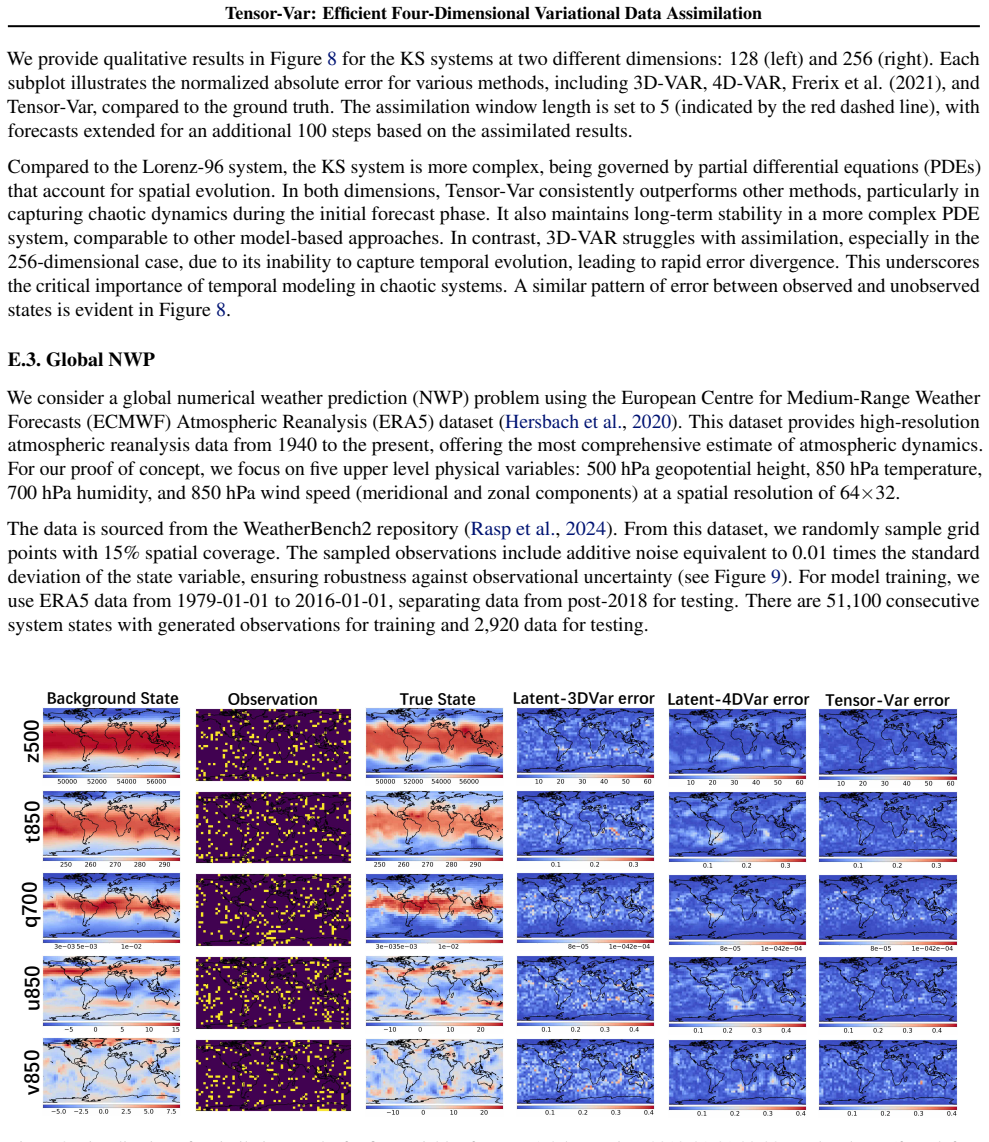
- The history-augmented inverse observation operator enables assimilation with low spatial coverage (15% or less), where standard 4D-Var leaves unobserved directions poorly constrained.
- Forecasting after assimilation proceeds by iterating the learned linear operator in feature space and mapping back through the preimage network, forming a self-contained forecast-assimilation system.
- The same framework should apply to other state-estimation problems with partial, noisy observations, such as ocean circulation or energy-system forecasting.
Reading between the lines
- If the KKL conditions are not satisfied by the learned features, the feature-space optimum could diverge from the original 4D-Var solution; the paper's own one-year roll-out shows instability after roughly 800 assimilation steps, consistent with such a gap.
- The use of history to disambiguate incomplete observations points to a general recipe for other underdetermined inverse problems where temporal context is available.
- The convex formulation suggests that the same linearization could support efficient uncertainty quantification or ensemble generation in feature space, which the paper does not explore.
- A stricter test would be to monitor the eigenvalues of the effective linear operator $A$ during training and regularize the feature map so that $A$ remains Hurwitz, which could close the observed long-horizon instability.
Editorial analysis
A structured set of objections, weighed in public.
Referee Report
Summary. The paper proposes Tensor-Var, a 4D-Var formulation in a learned feature space using conditional mean embeddings (CMEs). It claims that nonlinear dynamics and observation operators can be represented by linear operators in a kernel/deep feature space, making the variational cost convex and solvable by quadratic programming. The paper further claims theoretical guarantees of consistency between the original-space 4D-Var solution and the feature-space solution, and reports 10–20x speedups with improved accuracy over conventional and ML-hybrid 4D-Var baselines on Lorenz-96, Kuramoto–Sivashinsky, and global ERA5 NWP experiments.
Significance. If the consistency guarantee held, Tensor-Var would be a significant contribution: a convex 4D-Var formulation with linear convergence and a clear complexity advantage over existing variational DA. The experimental scope is broad (chaotic ODEs, a chaotic PDE, and two NWP settings), the ablation study is useful, and the authors honestly disclose long-run instability in Appendix E.4.3. However, the central theoretical claim is not established by the provided theorem, and the main experimental comparison is confounded by the weak-constraint versus strong-constraint mismatch. At present the contribution is an empirically promising method with an unproven theoretical wrapper, rather than a certified equivalence result.
major comments (4)
- [§3.3, Theorem C.9, Eqs. (2) and (5)] Theorem C.9 bounds the distance between a KKL observer trajectory and the true state trajectory. It does not state or prove that the minimizer of the feature-space cost (5), pulled back through the preimage map, is close to the minimizer of the original cost (2). The two optimization problems are different objectives: the observation term in (5) compares z_t to the CME estimate C_{S|OH} φ_OH(o_t,h_t), and the dynamics and background terms are expressed in feature space. Because φ is nonlinear and the preimage is learned with finite error (acknowledged in Appendix B), the pulled-back minimizer of (5) need not solve (2). The proof in Appendix C operates entirely on trajectories and never relates the minimizers of the two cost functions. Thus the abstract's claim of 'theoretical guarantees of consistent assimilation results between the original and feature spaces' is not supported by the provided analysis.
- [§3.2, Theorem C.9 assumptions] The KKL theorem requires T to solve the PDE ∂T/∂s f(s) = A T(s) + B G(s) with Hurwitz A and controllable (A,B), and to be uniformly injective with a Lipschitz left inverse. The training loss in Section 3.2 (one-step feature regression plus preimage reconstruction) imposes none of these conditions. In the deployed deep-feature model, the dynamics are given by an empirical matrix C_{S+|S} obtained by least-squares regression; no verification is offered that this matrix corresponds to exp(A Δt) for a Hurwitz A, nor that the learned feature map φ_θ is injective with a Lipschitz left inverse. Consequently, Theorem C.9 does not apply to the model used in the experiments, and the claimed consistency guarantee is not connected to the trained system.
- [Table 2 caption and §4.1] The caption states that all baselines use the strong-constraint 4D-Var objective, while Tensor-Var uses the weak-constraint 4D-Var objective. These are different optimization problems: weak-constraint 4D-Var introduces a model-error term and optimizes over the full state trajectory, which can reduce analysis RMSE even without better dynamics. The reported accuracy improvements over the baselines are therefore not a controlled comparison of the linearization or convexification. To support the empirical claim, the authors should either run weak-constraint baselines (with the same model-error covariance structure) or implement a strong-constraint variant of Tensor-Var, and report both settings.
- [Appendix E.4.3] The one-year roll-out experiment shows instability after approximately 800 assimilation steps, which the authors attribute to the linear dynamical structure. Since Section 4.3 presents Tensor-Var as suitable for continuous, operational DA, this instability is directly relevant to the practical claim. Moreover, Theorem C.9 does not address closed-loop DA cycles; it bounds the error of a single KKL observer trajectory, not the stability of repeated analysis–forecast cycles. The paper should either provide a stability analysis for the cyclic application or state this limitation more prominently in the main text rather than only in the appendix.
minor comments (4)
- [§4 vs. Appendix E.1] The main text says that only 20% of states are observed, while Appendix E.1 states 25% and then describes observing every 5th and 10th variable for the 40- and 80-dimensional systems, which corresponds to 20% and 12.5% coverage. These numbers should be reconciled.
- [Appendix D.1, footnote 5] The footnote 'This error should decay monotonically over time and stabilize after a sufficiently long time horizon' is a fragment; it does not complete the sentence or state which error is meant.
- [Algorithm 1 vs. §3.2] Algorithm 1 lists the losses as separate terms, but the training loss in Section 3.2 combines the dynamics regression loss and the preimage loss with a weighting coefficient w. The algorithm as written does not show the weighted combined objective used in the text.
- [Table 3, left column] The sentence 'All three features are Gaussian kernels' is unclear because the table compares deep features of various dimensions against a Gaussian kernel feature, not three Gaussian kernels.
Circularity Check
The empirical Tensor-Var pipeline is not itself circular, but the headline theoretical guarantee of consistency between the feature-space and original 4D-Var solutions is imported from KKL observer existence theorems whose hypotheses the paper admits are unproven, making the central claim an assumed ansatz rather than a derived result.
-
ansatz smuggled in via citation
[Section 3.3 / Appendix C.2 (Theorem C.9)]
"However, there are two parts that have not been proven: 1). Does the global linear dynamical system exist? 2) Is the embedding space in C.7 properly defined? ... According to the condition of KKL observer, we guarantee (1) the existence of such linear system and (2) the solutions in the original space and feature space has consistent convergence properties, with respect to the cost functions (2) and 5, and convergent exponentially to the unique solution."
The central consistency guarantee is precisely that minimizers of the feature-space cost (5) converge to the unique minimizer of the original 4D-Var cost (2). The paper's sole support is Theorem C.9, a KKL observer result whose hypotheses require an embedding T satisfying the KKL PDE and a Lipschitz left inverse. Those hypotheses are exactly the two items the quoted passage admits are 'not been proven.' The actually trained features and CME operators from Section 3.2 are regression fits with no constraint enforcing the KKL PDE, the Hurwitz condition, or the Lipschitz left inverse. Citing an existence theorem therefore does not transfer its conclusion to the deployed model; the guarantee is assumed rather than derived.
-
self definitional
[Appendix C.2, Theorem C.7 proof, Eq. (13)-(15)]
"Following the work from (Romanoff, 1947; Bobrowski, 2016; Cheng et al., 2023b), we define A := lim_{t→0+} (C_{S+|S} − Id)/t, where C_{S+|S} is the conditional covariance operator between future and current states in the RKHS. Given the smoothness of the kernel function and the differentiability of the system dynamics, the linear operator A exists and is well-defined in this context."
Theorem C.7 hypothesis (b) requires the existence of a Hurwitz matrix A with dφ_S/dt = A φ_S. In the proof, A is simply defined as the generator of the CME operator C_{S+|S}, where C_{S+|S} is itself the least-squares linear regression fit in feature space. Thus the 'linear representation' of the nonlinear dynamics is true by construction only if one accepts the CME operator as the dynamics; the nontrivial question—whether the learned feature satisfies the KKL PDE and whether the minimizer of (5) matches the minimizer of (2)—is not established. The linearity is definitional, not a demonstrated property of the trained system.
full rationale
This is a partial-circularity finding rather than a full one. The empirical contributions are independently evaluated: the chaotic-system experiments use newly generated initial conditions and the NWP experiments use a held-out post-2018 test period, so the reported accuracy and speed gains are not forced by construction. The covariance matrices R and Q are estimated as residual covariances of the same fitted operators, which can understate uncertainty, but that is a statistical overfitting risk, not a reduction of the prediction to the fit. The genuinely circular element is the theoretical guarantee. The paper's Section 3.3 and Appendix C claim 'consistent convergence' of feature-space and original-space 4D-Var solutions by invoking KKL observer theory, yet the quoted passage explicitly concedes that the two key facts—existence of the global linear system and proper definition of the embedding—are 'not been proven,' and then asserts them from the KKL conditions. Since the trained deep features and empirical CME operators are never shown to satisfy those conditions, the headline consistency theorem is an assumed ansatz imported via citation, not a derived consequence. This does not invalidate the experimental comparison, but it means the paper's central theoretical claim is not supported by the provided derivation chain.
Assumptions & free parameters
free parameters (7)
- Feature dimensions ds, do, dh =
ds=60 (Lorenz-40), 120 (Lorenz-80); NWP values not reported
- History length m =
10 in main experiments; ablation C=0,1,2,4,8 with m≈C log ns
- CME regularization λ =
Not reported
- Preimage weight w =
Not reported
- Gaussian kernel length scale γ =
1.0 (cross-validated over 0.5-2.0)
- Training hyperparameters =
200 epochs, Adam, batch sizes 256-1024, architecture widths 4ns
- Empirical CME operators and covariances B, R, Q =
Learned from training data
assumptions (6)
- standard math RKHS technical conditions: characteristic kernels, injective CSS, ES|o[f(S)|O=o] ∈ HS for all f, o (footnote 1)
- domain assumption The dynamical model F is first-order differentiable and the kernel features are first-order differentiable
- ad hoc to paper Existence of a KKL embedding T satisfying the PDE ∂T/∂s f(s) = A T(s) + B G(s) with Hurwitz A and controllable (A,B), uniformly injective with Lipschitz left inverse
- domain assumption State space is compact, system is forward complete, and the original 4D-Var cost (2) has a unique solution
- standard math Empirical CME converges to the true CME with enough samples (Fukumizu et al.)
- domain assumption Training data includes full state observations (s_i) to learn dynamics and inverse observation operators
Cite this review
Pith. "Pith review of Tensor-Var: Efficient Four-Dimensional Variational Data Assimilation." pith.science (2026). https://pith.science/paper/D5PGTM32
@misc{pith2026250113312,
  author       = {Pith},
  title        = {Pith review of: Tensor-Var: Efficient Four-Dimensional Variational Data Assimilation},
  year         = {2026},
  howpublished = {\url{https://pith.science/paper/D5PGTM32}},
  note         = {Machine review of arXiv:2501.13312}
}
read the original abstract
Variational data assimilation estimates the dynamical system states by minimizing a cost function that fits the numerical models with the observational data. Although four-dimensional variational assimilation (4D-Var) is widely used, it faces high computational costs in complex nonlinear systems and depends on imperfect state-observation mappings. Deep learning (DL) offers more expressive approximators, while integrating DL models into 4D-Var is challenging due to their nonlinearities and lack of theoretical guarantees in assimilation results. In this paper, we propose Tensor-Var, a novel framework that integrates kernel conditional mean embedding (CME) with 4D-Var to linearize nonlinear dynamics, achieving convex optimization in a learned feature space. Moreover, our method provides a new perspective for solving 4D-Var in a linear way, offering theoretical guarantees of consistent assimilation results between the original and feature spaces. To handle large-scale problems, we propose a method to learn deep features using neural networks within the Tensor-Var framework. Experiments on chaotic systems and global weather prediction with real-time observations show that Tensor-Var outperforms conventional and DL hybrid 4D-Var baselines in accuracy while achieving a 10- to 20-fold speed improvement.
Figures


Figures from the paper (13 more)




Reference graph
Works this paper leans on
-
[1]
and Praly, L
Andrieu, V. and Praly, L. On the existence of a kazantzis--kravaris/luenberger observer. SIAM Journal on Control and Optimization, 45 0 (2): 0 432--456, 2006
2006
-
[2]
Data assimilation: methods, algorithms, and applications
Asch, M., Bocquet, M., and Nodet, M. Data assimilation: methods, algorithms, and applications. SIAM, 2016
2016
-
[3]
Baker, C. R. Joint measures and cross-covariance operators. Transactions of the American Mathematical Society, 186: 0 273--289, 1973
work page 1973
-
[4]
Baydin, A. G., Pearlmutter, B. A., Radul, A. A., and Siskind, J. M. Automatic differentiation in machine learning: a survey. Journal of machine learning research, 18 0 (153): 0 1--43, 2018
work page 2018
-
[5]
Berg, C., Christensen, J. P. R., and Ressel, P. Harmonic analysis on semigroups, volume 100. Springer-Verlag New York, 1984
work page 1984
-
[6]
Berlinet, A. and Thomas-Agnan, C. Reproducing kernel Hilbert spaces in probability and statistics. Springer Science & Business Media, 2011
work page 2011
-
[7]
Pangu-weather: A 3d high-resolution model for fast and accurate global weather forecast
Bi, K., Xie, L., Zhang, H., Chen, X., Gu, X., and Tian, Q. Pangu-weather: A 3d high-resolution model for fast and accurate global weather forecast. arXiv preprint arXiv:2211.02556, 2022
arXiv 2022
-
[8]
Convergence of one-parameter operator semigroups, volume 30
Bobrowski, A. Convergence of one-parameter operator semigroups, volume 30. Cambridge University Press, 2016
work page 2016
Show all 82 references
-
[9]
Surrogate modeling for the climate sciences dynamics with machine learning and data assimilation
Bocquet, M. Surrogate modeling for the climate sciences dynamics with machine learning and data assimilation. Frontiers in Applied Mathematics and Statistics, 9: 0 1133226, 2023
2023
-
[10]
S., Durand, C., Cheng, S., Chen, Y., Pasmans, I., and Carrassi, A
Bocquet, M., Farchi, A., Finn, T. S., Durand, C., Cheng, S., Chen, Y., Pasmans, I., and Carrassi, A. Deep learning-based sequential data assimilation for chaotic dynamics identifies local instabilities from single state forecasts. arXiv preprint arXiv:2408.04739, 2024
2024 arXiv
-
[11]
Boyd, S. P. and Vandenberghe, L. Convex optimization. Cambridge university press, 2004
2004
-
[12]
J., Leary, C., Maclaurin, D., Necula, G., Paszke, A., VanderPlas, J., Wanderman-Milne, S., and Zhang, Q
Bradbury, J., Frostig, R., Hawkins, P., Johnson, M. J., Leary, C., Maclaurin, D., Necula, G., Paszke, A., VanderPlas, J., Wanderman-Milne, S., and Zhang, Q. JAX : Composable transformations of Python + NumPy programs. http://github.com/google/jax, 2018. Version 0.3.13
2018
-
[13]
A., De Rosnay, P., Zuo, H., Bennett, A., and Dawson, A
Browne, P. A., De Rosnay, P., Zuo, H., Bennett, A., and Dawson, A. Weakly coupled ocean--atmosphere data assimilation in the ecmwf nwp system. Remote Sensing, 11 0 (3): 0 234, 2019
2019
-
[14]
Butcher, J. C. A history of runge-kutta methods. Applied numerical mathematics, 20 0 (3): 0 247--260, 1996
1996
-
[15]
Fengwu: Pushing the skillful global medium-range weather forecast beyond 10 days lead
Chen, K., Han, T., Gong, J., Bai, L., Ling, F., Luo, J.-J., Chen, X., Ma, L., Zhang, T., Su, R., et al. Fengwu: Pushing the skillful global medium-range weather forecast beyond 10 days lead. arXiv preprint arXiv:2304.02948, 2023
2023
-
[16]
T., Rubanova, Y., Bettencourt, J., and Duvenaud, D
Chen, R. T., Rubanova, Y., Bettencourt, J., and Duvenaud, D. K. Neural ordinary differential equations. Advances in neural information processing systems, 31, 2018
2018
-
[17]
Machine learning with data assimilation and uncertainty quantification for dynamical systems: a review
Cheng, S., Quilodr \'a n-Casas, C., Ouala, S., Farchi, A., Liu, C., Tandeo, P., Fablet, R., Lucor, D., Iooss, B., Brajard, J., et al. Machine learning with data assimilation and uncertainty quantification for dynamical systems: a review. IEEE/CAA Journal of Automatica Sinica, ...
2023
-
[18]
Torchda: A python package for performing data assimilation with deep learning forward and transformation functions
Cheng, S., Min, J., Liu, C., and Arcucci, R. Torchda: A python package for performing data assimilation with deep learning forward and transformation functions. Computer Physics Communications, pp.\ 109359, 2024
2024
-
[19]
Keec: Embed to control on an equivariant geometry
Cheng, X., Yang, Y., Jiang, W., and Hu, Y. Keec: Embed to control on an equivariant geometry. arXiv preprint arXiv:2312.01544, 2023 b
2023 arXiv
-
[20]
Learning chaos in a linear way
Cheng, X., He, Y., Yang, Y., Xue, X., Cheng, S., Giles, D., Tang, X., and Hu, Y. Learning chaos in a linear way. In The Thirteenth International Conference on Learning Representations, 2025
2025
-
[21]
Artificial intelligence for weather forecasting
Conti, S. Artificial intelligence for weather forecasting. Nature Reviews Electrical Engineering, 1 0 (1): 0 8--8, 2024
2024
-
[22]
Coveney, P. V. Sharkovskii’s theorem and the limits of digital computers for the simulation of chaotic dynamical systems. Journal of Computational Science, 83: 0 102449, 2024
2024
-
[23]
Cox, S. M. and Matthews, P. C. Exponential time differencing for stiff systems. Journal of Computational Physics, 176 0 (2): 0 430--455, 2002
2002
-
[24]
L., and Siminos, E
Cvitanovi \'c , P., Davidchack, R. L., and Siminos, E. On the state space geometry of the kuramoto--sivashinsky flow in a periodic domain. SIAM Journal on Applied Dynamical Systems, 9 0 (1): 0 1--33, 2010
2010
-
[25]
and Boyd, S
Diamond, S. and Boyd, S. Cvxpy: A python-embedded modeling language for convex optimization. Journal of Machine Learning Research, 17 0 (83): 0 1--5, 2016
2016
-
[26]
A framework for four-dimensional variational data assimilation based on machine learning
Dong, R., Leng, H., Zhao, J., Song, J., and Liang, S. A framework for four-dimensional variational data assimilation based on machine learning. Entropy, 24 0 (2): 0 264, 2022
2022
-
[27]
Learning variational data assimilation models and solvers
Fablet, R., Chapron, B., Drumetz, L., M \'e min, E., Pannekoucke, O., and Rousseau, F. Learning variational data assimilation models and solvers. Journal of Advances in Modeling Earth Systems, 13 0 (10): 0 e2021MS002572, 2021
2021
-
[28]
Multimodal 4dvarnets for the reconstruction of sea surface dynamics from sst-ssh synergies
Fablet, R., Febvre, Q., and Chapron, B. Multimodal 4dvarnets for the reconstruction of sea surface dynamics from sst-ssh synergies. IEEE Transactions on Geoscience and Remote Sensing, 61: 0 1--14, 2023
2023
-
[29]
Variational data assimilation with a learned inverse observation operator
Frerix, T., Kochkov, D., Smith, J., Cremers, D., Brenner, M., and Hoyer, S. Variational data assimilation with a learned inverse observation operator. In International Conference on Machine Learning, pp.\ 3449--3458. PMLR, 2021
2021
-
[30]
R., and Jordan, M
Fukumizu, K., Bach, F. R., and Jordan, M. I. Dimensionality reduction for supervised learning with reproducing kernel hilbert spaces. Journal of Machine Learning Research, 5 0 (Jan): 0 73--99, 2004
2004
-
[31]
Kernel bayes' rule
Fukumizu, K., Song, L., and Gretton, A. Kernel bayes' rule. Advances in neural information processing systems, 24, 2011
2011
-
[32]
Kernel bayes' rule: Bayesian inference with positive definite kernels
Fukumizu, K., Song, L., and Gretton, A. Kernel bayes' rule: Bayesian inference with positive definite kernels. The Journal of Machine Learning Research, 14 0 (1): 0 3753--3783, 2013
2013
-
[33]
and Qureshi, M
Gajic, Z. and Qureshi, M. T. J. Lyapunov matrix equation in system stability and control. Courier Corporation, 2008
2008
-
[34]
H., Kupcsik, A., and Neumann, G
Gebhardt, G. H., Kupcsik, A., and Neumann, G. The kernel kalman rule: Efficient nonparametric inference by recursive least-squares and subspace projections. Machine Learning, 108 0 (12): 0 2113--2157, 2019
2019
-
[35]
Geer, A. J. Learning earth system models from observations: machine learning or data assimilation? Philosophical Transactions of the Royal Society A, 379 0 (2194): 0 20200089, 2021
2021
-
[36]
Y., Dimet, F.-X
Gejadze, I. Y., Dimet, F.-X. L., and Shutyaev, V. On analysis error covariances in variational data assimilation. SIAM Journal on Scientific Computing, 30 0 (4): 0 1847--1874, 2008
2008
-
[37]
A tutorial on the adjoint method for inverse problems
Givoli, D. A tutorial on the adjoint method for inverse problems. Computer Methods in Applied Mechanics and Engineering, 380: 0 113810, 2021
2021
-
[38]
Chaos meets attention: Transformers for large-scale dynamical prediction
He, Y., Yang, Y., Cheng, X., Wang, H., Xue, X., Chen, B., and Hu, Y. Chaos meets attention: Transformers for large-scale dynamical prediction. In Forty-second International Conference on Machine Learning, 2025. URL https://openreview.net/forum?id=Rxg8vCZSee
2025
-
[39]
J., Hólm, E., Janisková, M., Keeley, S., Laloyaux, P., Lopez, P., Lupu, C., Radnoti, G., de Rosnay, P., Rozum, I., Vamborg, F., Villaume, S., and Thépaut, J.-N
Hersbach, H., Bell, B., Berrisford, P., Hirahara, S., Horányi, A., Muñoz-Sabater, J., Nicolas, J., Peubey, C., Radu, R., Schepers, D., Simmons, A., Soci, C., Abdalla, S., Abellan, X., Balsamo, G., Bechtold, P., Biavati, G., Bidlot, J., Bonavita, M., De Chiara, G., Dahlgren, P....
1999
-
[40]
and Richard, C
Honeine, P. and Richard, C. Preimage problem in kernel-based machine learning. IEEE Signal Processing Magazine, 28 0 (2): 0 77--88, 2011
2011
-
[41]
Offline reinforcement learning as one big sequence modeling problem
Janner, M., Li, Q., and Levine, S. Offline reinforcement learning as one big sequence modeling problem. Advances in neural information processing systems, 34: 0 1273--1286, 2021
2021
-
[42]
Filtering with state-observation examples via kernel monte carlo filter
Kanagawa, M., Nishiyama, Y., Gretton, A., and Fukumizu, K. Filtering with state-observation examples via kernel monte carlo filter. Neural computation, 28 0 (2): 0 382--444, 2016
2016
-
[43]
Kingma, D. P. Adam: A method for stochastic optimization. arXiv preprint arXiv:1412.6980, 2014
2014 arXiv
-
[44]
Eigendecompositions of transfer operators in reproducing kernel hilbert spaces
Klus, S., Schuster, I., and Muandet, K. Eigendecompositions of transfer operators in reproducing kernel hilbert spaces. Journal of Nonlinear Science, 30: 0 283--315, 2020
2020
-
[45]
R., Novelli, P., Grazzi, R., Lounici, K., and Pontil, M
Kostic, V. R., Novelli, P., Grazzi, R., Lounici, K., and Pontil, M. Deep projection networks for learning time-homogeneous dynamical systems. arXiv preprint arXiv:2307.09912, 2023
2023 arXiv
-
[46]
Neural operator: Learning maps between function spaces with applications to pdes
Kovachki, N., Li, Z., Liu, B., Azizzadenesheli, K., Bhattacharya, K., Stuart, A., and Anandkumar, A. Neural operator: Learning maps between function spaces with applications to pdes. Journal of Machine Learning Research, 24 0 (89): 0 1--97, 2023
2023
-
[47]
Fourcastnet: Accelerating global high-resolution weather forecasting using adaptive fourier neural operators
Kurth, T., Subramanian, S., Harrington, P., Pathak, J., Mardani, M., Hall, D., Miele, A., Kashinath, K., and Anandkumar, A. Fourcastnet: Accelerating global high-resolution weather forecasting using adaptive fourier neural operators. In Proceedings of the platform for advanced...
2023
-
[48]
and Tsang, I.-H
Kwok, J.-Y. and Tsang, I.-H. The pre-image problem in kernel methods. IEEE transactions on neural networks, 15 0 (6): 0 1517--1525, 2004
2004
-
[49]
Graphcast: Learning skillful medium-range global weather forecasting
Lam, R., Sanchez-Gonzalez, A., Willson, M., Wirnsberger, P., Fortunato, M., Alet, F., Ravuri, S., Ewalds, T., Eaton-Rosen, Z., Hu, W., et al. Graphcast: Learning skillful medium-range global weather forecasting. arXiv preprint arXiv:2212.12794, 2022
2022 arXiv
-
[50]
Data assimilation
Law, K., Stuart, A., and Zygalakis, K. Data assimilation. Cham, Switzerland: Springer, 214: 0 52, 2015
2015
-
[51]
Fourier neural operator for parametric partial differential equations
Li, Z., Kovachki, N., Azizzadenesheli, K., Liu, B., Bhattacharya, K., Stuart, A., and Anandkumar, A. Fourier neural operator for parametric partial differential equations. arXiv preprint arXiv:2010.08895, 2020
2010 arXiv
-
[52]
A machine learning approach to the observation operator for satellite radiance data assimilation
Liang, J., Terasaki, K., and Miyoshi, T. A machine learning approach to the observation operator for satellite radiance data assimilation. Journal of the Meteorological Society of Japan. Ser. II, 101 0 (1): 0 79--95, 2023
2023
-
[53]
When is partially observable reinforcement learning not scary? In Conference on Learning Theory, pp.\ 5175--5220
Liu, Q., Chung, A., Szepesv \'a ri, C., and Jin, C. When is partially observable reinforcement learning not scary? In Conference on Learning Theory, pp.\ 5175--5220. PMLR, 2022
2022
-
[54]
Lorenz, E. N. Predictability: A problem partly solved. In Proc. Seminar on predictability, volume 1. Reading, 1996
1996
-
[55]
Manchester, I. R. and Slotine, J.-J. E. Control contraction metrics: Convex and intrinsic criteria for nonlinear feedback design. IEEE Transactions on Automatic Control, 62 0 (6): 0 3046--3053, 2017
2017
-
[56]
McShane, E. J. Extension of range of functions. 1934
1934
-
[57]
and Zaplotnik, Z
Melinc, B. and Zaplotnik, Z . Neural-network data assimilation using variational autoencoder. arXiv preprint arXiv:2308.16073, 2023
2023 arXiv
-
[58]
Hourly 4d-var in the met office ukv operational forecast model
Milan, M., Macpherson, B., Tubbs, R., Dow, G., Inverarity, G., Mittermaier, M., Halloran, G., Kelly, G., Li, D., Maycock, A., et al. Hourly 4d-var in the met office ukv operational forecast model. Quarterly Journal of the Royal Meteorological Society, 146 0 (728): 0 1281--1301, 2020
2020
-
[59]
Kernel mean embedding of distributions: A review and beyond
Muandet, K., Fukumizu, K., Sriperumbudur, B., Sch \"o lkopf, B., et al. Kernel mean embedding of distributions: A review and beyond. Foundations and Trends in Machine Learning , 10 0 (1-2): 0 1--141, 2017
2017
-
[60]
and Fablet, R
Nguyen, D. and Fablet, R. A transformer network with sparse augmented data representation and cross entropy loss for ais-based vessel trajectory prediction. IEEE Access, 2024
2024
-
[61]
and Wright, S
Nocedal, J. and Wright, S. J. Quadratic programming. Numerical optimization, pp.\ 448--492, 2006
2006
-
[62]
Papageorgiou, D. T. and Smyrlis, Y. S. The route to chaos for the kuramoto-sivashinsky equation. Theoretical and Computational Fluid Dynamics, 3 0 (1): 0 15--42, 1991
1991
-
[63]
Parks, P. C. A new proof of the Routh-Hurwitz stability criterion using the second method of Liapunov . In Mathematical Proceedings of the Cambridge Philosophical Society, volume 58, pp.\ 694--702. Cambridge University Press, 1962
1962
-
[64]
A 4d-var method with flow-dependent background covariances for the shallow-water equations
Paulin, D., Jasra, A., Beskos, A., and Crisan, D. A 4d-var method with flow-dependent background covariances for the shallow-water equations. Statistics and Computing, 32 0 (4): 0 65, 2022
2022
-
[65]
Scikit-learn: Machine learning in python
Pedregosa, F., Varoquaux, G., Gramfort, A., Michel, V., Thirion, B., Grisel, O., Blondel, M., Prettenhofer, P., Weiss, R., Dubourg, V., et al. Scikit-learn: Machine learning in python. the Journal of machine Learning research, 12: 0 2825--2830, 2011
2011
-
[66]
Latent space data assimilation by using deep learning
Peyron, M., Fillion, A., G \"u rol, S., Marchais, V., Gratton, S., Boudier, P., and Goret, G. Latent space data assimilation by using deep learning. Quarterly Journal of the Royal Meteorological Society, 147 0 (740): 0 3759--3777, 2021
2021
-
[67]
Weatherbench 2: A benchmark for the next generation of data-driven global weather models
Rasp, S., Hoyer, S., Merose, A., Langmore, I., Battaglia, P., Russell, T., Sanchez-Gonzalez, A., Yang, V., Carver, R., Agrawal, S., et al. Weatherbench 2: A benchmark for the next generation of data-driven global weather models. Journal of Advances in Modeling Earth Systems, 1...
2024
-
[68]
On one-parameter groups of linear transformations
Romanoff, N. On one-parameter groups of linear transformations. i. Annals of Mathematics, 48 0 (2): 0 216--233, 1947
1947
-
[69]
Nonlinear systems: analysis, stability, and control, volume 10
Sastry, S. Nonlinear systems: analysis, stability, and control, volume 10. Springer Science & Business Media, 2013
2013
-
[70]
and Smola, A
Sch \"o lkopf, B. and Smola, A. J. Learning with kernels: support vector machines, regularization, optimization, and beyond. MIT press, 2002
2002
-
[71]
Neural-kernel conditional mean embeddings
Shimizu, E., Fukumizu, K., and Sejdinovic, D. Neural-kernel conditional mean embeddings. arXiv preprint arXiv:2403.10859, 2024
2024 arXiv
-
[72]
Hilbert space embeddings of conditional distributions with applications to dynamical systems
Song, L., Huang, J., Smola, A., and Fukumizu, K. Hilbert space embeddings of conditional distributions with applications to dynamical systems. In Proceedings of the 26th Annual International Conference on Machine Learning, pp.\ 961--968, 2009
2009
-
[73]
Kernel embeddings of conditional distributions: A unified kernel framework for nonparametric inference in graphical models
Song, L., Fukumizu, K., and Gretton, A. Kernel embeddings of conditional distributions: A unified kernel framework for nonparametric inference in graphical models. IEEE Signal Processing Magazine, 30 0 (4): 0 98--111, 2013
2013
-
[74]
Tran, G. Q. B. and Bernard, P. Arbitrarily fast robust kkl observer for nonlinear time-varying discrete systems. IEEE Transactions on Automatic Control, 2023
2023
-
[75]
N., Kaiser, ., and Polosukhin, I
Vaswani, A., Shazeer, N., Parmar, N., Uszkoreit, J., Jones, L., Gomez, A. N., Kaiser, ., and Polosukhin, I. Attention is all you need. Advances in neural information processing systems, 30, 2017
2017
-
[76]
P., Andersson, T
Vaughan, A., Markou, S., Tebbutt, W., Requeima, J., Bruinsma, W. P., Andersson, T. R., Herzog, M., Lane, N. D., Hosking, J. S., and Turner, R. E. Aardvark weather: end-to-end data-driven weather forecasting. arXiv preprint arXiv:2404.00411, 2024
2024 arXiv
-
[77]
Wang, Y., Shi, X., Lei, L., and Fung, J. C.-H. Deep learning augmented data assimilation: Reconstructing missing information with convolutional autoencoders. Monthly Weather Review, 150 0 (8): 0 1977--1991, 2022
1977
-
[78]
Wright, S. J. Numerical optimization, 2006
2006
-
[79]
Towards a self-contained data-driven global weather forecasting framework
Xiao, Y., Bai, L., Xue, W., Chen, H., Chen, K., Chen, K., Han, T., and Ouyang, W. Towards a self-contained data-driven global weather forecasting framework. In Proceedings of the 41st International Conference on Machine Learning, volume 235 of Proceedings of Machine Learning R...
2024
-
[80]
Importance weighted kernel bayes’ rule
Xu, L., Chen, Y., Doucet, A., and Gretton, A. Importance weighted kernel bayes’ rule. In International Conference on Machine Learning, pp.\ 24524--24538. PMLR, 2022
2022
-
[81]
W., Arora, A., Khan, S., Hayat, M., Khan, F
Zamir, S. W., Arora, A., Khan, S., Hayat, M., Khan, F. S., and Yang, M.-H. Restormer: Efficient transformer for high-resolution image restoration. In Proceedings of the IEEE/CVF conference on computer vision and pattern recognition, pp.\ 5728--5739, 2022
2022
-
[82]
write newline
" write newline "" before.all 'output.state := FUNCTION n.dashify 't := "" t empty not t #1 #1 substring "-" = t #1 #2 substring "--" = not "--" * t #2 global.max substring 't := t #1 #1 substring "-" = "-" * t #2 global.max substring 't := while if t #1 #1 substring * t #2 gl...
Reviewed August 10, 2026 · model on record in the stance chip above.
Discussion (0). Continue with ORCID to comment.