REVIEW 2 major objections 6 minor 1 cited by
Neutral Current Neutrino-Nucleus Scattering. Theory
T0 review · 2 major / 6 minor · reviewed 2026-08-14 · deepseek-v4-flash
Pith's one-line read The review concludes that nuclear effects, not a larger axial mass, explain neutrino-nucleus data, and that multi-nucleon and two-body current contributions must be included explicitly.
desk verdict Useful, balanced NC QE scattering review, but the 'impossible axial mass' conclusion is more conditional than the abstract/conclusions suggest once you factor in the NuWro np-nh fit and MiniBooNE's reconstructed-Q2 caveats. read the letter →
The pith
A machine-rendered reading of the paper's core claim, the machinery that carries it, and where it could break.
The reading
What carries the argument
The machinery is the contraction of the leptonic tensor with a hadronic tensor $W^{\mu\nu}$, built from the single-nucleon weak current whose axial form factor is a dipole in $Q^2$ with mass $M_A$ and whose isoscalar component can carry strange form factors. Around this current, the review compares competing descriptions of the nucleus: relativistic impulse approximation with plane or distorted waves, spectral functions with short-range correlations, the superscaling approach built from electron-scattering data, RPA treatments with np-nh excitations, and Green's-function formulations of final-state interactions. The load-bearing observables are flux-averaged cross sections and, above all, ratios (proton-to-neutron, neutrino-to-antineutrino, NC-to-CC) that cancel nuclear-model uncertainties.
What would settle it
A single high-statistics experiment measuring CCQE and NCE on the same nucleus with a well understood flux, analyzed with one model that includes two-body currents and the world-average $M_A$, would settle it: success would confirm the review's diagnosis, and failure would show the missing physics is elsewhere.
Extended reading notes
Core claim
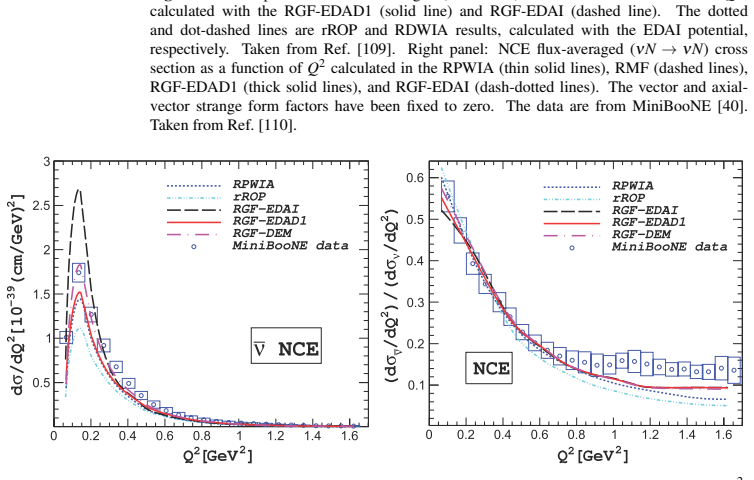
The review's central claim is that the apparent discrepancy between the axial mass extracted from deuterium data ($M_A\simeq 1.03$ GeV) and the larger values needed to fit carbon-target data is not a property of the nucleon but a symptom of missing nuclear physics. One-nucleon knockout models, even with sophisticated final-state interactions, underestimate the measured neutral-current elastic cross sections; models that add collective RPA correlations, multi-nucleon (np-nh) excitations, and two-body meson-exchange currents can describe the same data with the standard axial mass. The review further claims that charged-current and neutral-current data cannot both be fit with a single $M_A$ inside one-body models, and that cross-section ratios are the observables that best isolate the strange axial form factor of the nucleon.
Load-bearing premise
The conclusions assume that the selected numerical examples and data comparisons, many from the authors' prior work, are representative of the broader literature and are folded with correct flux normalizations and detector efficiencies; if the neutral-current sample or the model inputs are not representative, the claimed axial-mass discrepancy could be an artifact.
Editorial extensions
If this is right
- Oscillation analyses must treat the 'quasielastic' sample as a mix of one-nucleon and multi-nucleon events; otherwise the reconstructed neutrino energy is biased.
- Adding the same two-body current to both CCQE and NCE predictions should remove the need for separate effective axial masses, making the two channels consistent.
- Cross-section ratios such as $R(p/n)$ and the $\nu$-$\bar\nu$ asymmetry become primary tools for strange form factors because nuclear effects largely cancel.
- Models that pass the electron-scattering test are necessary but not sufficient; neutrino data impose additional constraints from the axial channel.
- New detectors with better final-state resolution will constrain hadronic observables and flux, reducing the model dependence highlighted here.
Reading between the lines
- If the axial-mass discrepancy is caused by missing two-body currents, then effective $M_A$ values extracted from CCQE and NCE should converge once the same 2p-2h model is used; this convergence is a quantitative test that future combined fits can perform.
- The review's RGF results suggest final-state inelasticity can mimic two-body current strength; a model that tracks explicit final-state channels could separate the two and remove a possible double-counting.
- For argon targets, building the spectral function from a dedicated $(e,e'p)$ measurement would test whether short-range correlations in argon differ enough from carbon to change NC neutrino event rates in next-generation detectors.
Editorial analysis
A structured set of objections, weighed in public.
Referee Report
Summary. Giusti and Ivanov review the theoretical description of neutral-current (NC) quasielastic neutrino-nucleus scattering in the kinematic regime of accelerator neutrino experiments. They present the general NC/CC formalism and the single-nucleon weak current (Section 2), then survey the main model families: relativistic impulse approximation and optical-potential approaches, spectral-function models, superscaling (SuSA), RPA and np-nh treatments, and meson-exchange currents (Section 3). They discuss the strange nucleon form factors and proposed ratios/asymmetries for extracting them (Section 4), and compare model predictions with BNL E734 and MiniBooNE neutral-current elastic data, paying attention to flux averaging and to the difference between true and reconstructed Q2 (Section 5). The concluding remarks emphasize that one-body IA models without multi-nucleon channels underpredict data unless an enhanced axial mass is used, that no single axial mass describes both CCQE and NCE data within such models, and that consistent treatment of multi-nucleon and two-body current contributions is needed for DUNE and Hyper-K.
Significance. The manuscript is a comprehensive and generally balanced topical review. Its strengths are the systematic organization of a large and technically diverse literature, the explicit caveats attached to model families (notably the warning that the RGF treatment is designed for inclusive observables and may include channels absent in semi-inclusive NCE measurements), the reproducible presentation of the flux-averaging equations, and the extensive reference list. It does not present new derivations or machine-checked results; its conclusions are literature-based judgments, but that is appropriate for the review format. If the axial-mass conclusion is qualified as proposed below, the review will serve as a useful reference for both specialists and non-specialists and as a basis for systematic studies in DUNE and Hyper-K.
major comments (2)
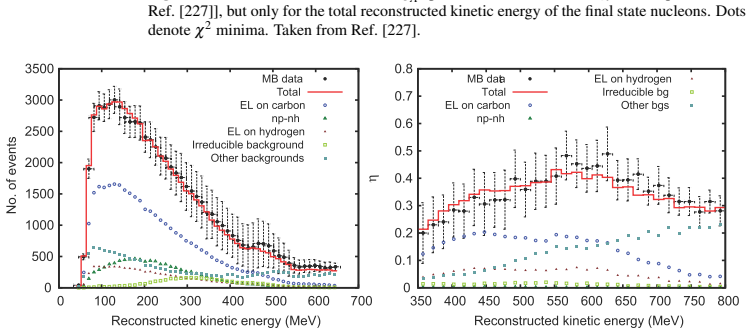
- [Section 6, concluding remarks (fourth bullet)] The concluding statement that 'it is generally impossible to describe, within the same model, both CCQE and NCE data using the same value of MA' is stronger than the evidence assembled in Section 5.2 and should be qualified. The comparisons underlying this conclusion are not uniform in the measured observable: Eq. (32) introduces per-channel efficiency functions C_i for the CH2 cross section, Eq. (34) defines the reconstructed variable Q2_QE = 2mT with T the sum of all final-state nucleon kinetic energies, and the figures mix true and reconstructed quantities (e.g., Fig. 24 shows true Q2 in the left panel and reconstructed energy in the right panel), with detector smearing applied only in some calculations (Refs. [67], [227]). In addition, the NuWro analysis in Fig. 32, which includes np-nh contributions and detector response, yields MA = 1.10^{+0.13}_{-0.15} GeV, consistent with the deuterium world average; this is a same-model counterexample if the claim is not restricted to IA one-nucleon-knockout models. I recommend rewriting the bullet to say explicitly that the impossibility claim applies to one-body-current IA models without multi-nucleon/background channels, and to acknowledge that a model-independent no-go conclusion is not established because no single analysis treats all models with identical unfolding and efficiency corrections.
- [Section 5.2, Eq. (32) and Figs. 20-28] The comparison figures would be much easier to interpret if each panel explicitly stated whether the plotted quantity is true Q2, reconstructed Q2_QE = 2mT (Eq. (34)), or nucleon kinetic energy T, and whether efficiency corrections and migration matrices were applied. The current text mixes these definitions: Fig. 20 uses Eq. (32) with efficiency functions C_i, Fig. 22 uses Q2_QE, Fig. 24 shows true energy (left) and reconstructed energy (right), and Fig. 28 compares several models without a unified folding prescription. As a result, the reader cannot determine how much of the spread between model and data is due to physics rather than to the treatment of detector response. A short summary table or an explicit sentence per figure would materially strengthen the evidentiary basis of the Section 6 conclusions.
minor comments (6)
- [Section 5.2, Eq. (32)] Equation (32) as printed contains a duplicated term: the carbon-neutron contribution 3/7 C_{nu n,C} dsigma_{nu n,C}/dQ2 appears twice, and the bound-proton contribution is absent. The intended decomposition for CH2 should contain one 3/7 term for carbon protons and one 3/7 term for carbon neutrons.
- [Section 2.5, text before Eq. (20)] The sentence listing the strange form factors reads 'F s 1 , F s 1 , and G s A'; the second entry should be F s 2 (the strange vector magnetic form factor).
- [Section 3.3, p. 14] The phrase 'An example in shown in figure 4' contains a typo; 'in' should be 'is'.
- [Section 3.6, p. 26] The phrase 'nuclei wih A > 4' contains a typo; 'wih' should be 'with'.
- [Section 5.2, Fig. 28 caption] The caption's error-bar sentence 'in the nu(nu) case' should read 'in the nu(bar nu) case'; the same typo appears in the text describing the antineutrino panel.
- [Section 5.2, p. 46] The word 'understimanted' should be 'underestimated'.
Circularity Check
No significant circularity: the paper is a review that reports external model-data comparisons rather than deriving predictions from fitted inputs.
full rationale
This is a topical review, not a derivation paper. The formalism in Section 2 is standard and is used only to define cross sections and observables; no output quantity is defined in terms of a quantity it is supposed to predict. The survey in Sections 3 and 4 presents model comparisons and sensitivity studies, with the numerical examples taken from the cited literature. Fitted parameters such as M_A and g_s^A are reported from external analyses of external data sets (BNL E734, MiniBooNE, and NuWro), and those fits are not renamed as predictions of this paper. The central concluding claim that a single axial mass cannot describe both CCQE and NCE data is supported by cited comparisons with MiniBooNE data from Refs. [68, 69] and by the NuWro analysis of Ref. [227], which are independent of the present authors' own calculations. Although the authors cite their own previous work for some illustrative model results (e.g., RGF and RDWIA comparisons in Refs. [109, 110, 222]), those self-citations are not load-bearing: the conclusions do not reduce to an unverified assertion from the authors' prior papers, and the underlying comparisons are checkable against public MiniBooNE data. No equation in this paper exhibits a reduction of a predicted quantity to a fitted input, and no uniqueness or ansatz is imported solely through self-citation. Therefore the paper is self-contained as a review and has no significant circularity.
Assumptions & free parameters
free parameters (3)
- Axial mass MA =
1.03 GeV (world average), 1.35 GeV (MiniBooNE fit), various in comparisons
- Strange axial coupling gs_A (or Delta s) =
0, +/-0.15, ranges from COMPASS/HERMES
- Strange vector form factors rho_s and mu_s =
0 or specific values like mu_s=-0.5, rho_s=+2
assumptions (5)
- domain assumption One-boson exchange approximation (OBEA) with a single Z0 boson is valid for neutral-current neutrino-nucleus scattering.
- domain assumption The impulse approximation, where the neutrino interacts with a single nucleon and the residual nucleus acts as a spectator, is valid in the quasielastic region.
- domain assumption The weak neutral current of the nucleon is described by vector and axial form factors with dipole parametrizations for the Q2 dependence.
- standard math Standard Model values for the Weinberg angle and Fermi constant are correct.
- domain assumption The experimental data sets (MiniBooNE, BNL E734) are correctly normalized and their reported uncertainties are reliable.
Cite this review
Pith. "Pith review of Neutral Current Neutrino-Nucleus Scattering. Theory." pith.science (2026). https://pith.science/paper/D655WG7T
@misc{pith2026190808603,
  author       = {Pith},
  title        = {Pith review of: Neutral Current Neutrino-Nucleus Scattering. Theory},
  year         = {2026},
  howpublished = {\url{https://pith.science/paper/D655WG7T}},
  note         = {Machine review of arXiv:1908.08603}
}
read the original abstract
The treatment of nuclear effects in neutrino-nucleus interactions is one of the main sources of systematic uncertainty for the analysis and interpretation of data of neutrino oscillation experiments. Neutrinos interact with nuclei via charged or neutral currents and both cases must be studied to obtain a complete information. We give an overview of the theoretical work that has been done to describe nuclear effects in neutral-current neutrin onucleus scattering in the kinematic region ranging between beam energies of a few hundreds MeV to a few GeV, which is typical of most ongoing and future accelerator-based neutrino experiments, and where quasielastic scattering is the main interaction mechanism. We review the current status and challenges of the theoretical models, the role and relevance of the contributions of different nuclear effects, and the present status of the comparison between the numerical predictions of the models as well as the available experimental data. We discuss also the sensitivity to the strange form factors of the nucleon and the methods and observables that can allow one to obtain evidence for a possible strange quark contribution from measurements of neutrino and antineutrino-nucleus scattering.
Figures


Figures from the paper (32 more)





Forward citations
Cited by 1 Pith paper
-
Radiative corrections in neutral-current (anti)neutrino elastic scattering at $\text{GeV}$ energies I: Nucleon targets
Radiative corrections to neutral-current (anti)neutrino-nucleon elastic scattering are computed within low-energy EFT and reach a few percent, comparable to the strange-quark effects they must be disentangled from.
Reference graph
Works this paper leans on
-
[67]
A. V . Butkevich and D. Perevalov, Phys. Rev. C84, 015501 (2011)
2011
- [227]
-
[1]
Fukudaet al
Y . Fukudaet al. (Super-Kamiokande Collaboration), Phys. Rev. Lett. 81, 1562 (1998)
1998
-
[2]
Q. R. Ahmad et al. (SNO Collaboration), Phys. Rev. Lett. 87, 071301 (2001)
2001
-
[3]
Eguchi et al
K. Eguchi et al. (KamLAND Collaboration), Phys. Rev. Lett. 90, 021802 (2003)
2003
-
[4]
Kajita and A
T. Kajita and A. B. McDonald, The Nobel Prize in Physics 2015
2015
-
[5]
R. Acciarri et al. (DUNE), (2016), arXiv:1601.05471 [physics.ins-det] . REFERENCES 55
arXiv 2016
- [6]
Show all 227 references
-
[7]
Abe et al
K. Abe et al. (Hyper-Kamiokande Proto-Collaboration), PTEP 2015, 053C02 (2015), arXiv:1502.05199 [hep-ex]
2015 arXiv
-
[8]
S. L. Glashow, A. Salam, and S. Weinberg, The Nobel Prize in Physics 1979
1979
-
[9]
Hasert et al., Physics Letters B 46, 138 (1973)
F. Hasert et al., Physics Letters B 46, 138 (1973)
1973
-
[10]
Gallagher, G
H. Gallagher, G. Garvey, and G. P. Zeller, Ann. Rev. Nucl. Part. Sci. 61, 355 (2011)
2011
-
[11]
J. G. Morfin, J. Nieves, and J. T. Sobczyk, Adv. High Energy Phys. 2012, 934597 (2012), arXiv:1209.6586 [hep-ex]
2012 arXiv
-
[12]
Alvarez-Ruso, Y
L. Alvarez-Ruso, Y . Hayato, and J. Nieves, New J. Phys. 16, 075015 (2014), arXiv:1403.2673 [hep-ph]
2014 arXiv
-
[13]
G. T. Garvey, D. A. Harris, H. A. Tanaka, R. Tayloe, and G. P. Zeller, Phys. Rept.580, 1 (2015), arXiv:1412.4294 [hep-ex]
2015 arXiv
-
[14]
Mosel, Ann
U. Mosel, Ann. Rev. Nucl. Part. Sci. 66, 171 (2016), arXiv:1602.00696 [nucl-th]
2016 arXiv
-
[15]
Katori and M
T. Katori and M. Martini, J. Phys. G45, 013001 (2018)
2018
-
[16]
Benhar, P
O. Benhar, P. Huber, C. Mariani, and D. Meloni, Phys. Rept. 700, 1 (2017)
2017
-
[17]
Alvarez-Ruso et al., Progress in Particle and Nuclear Physics 100, 1 (2018)
L. Alvarez-Ruso et al., Progress in Particle and Nuclear Physics 100, 1 (2018)
2018
-
[18]
Tayloe, J
R. Tayloe, J. Phys. G (2019)
2019
-
[19]
Bolognesi, J
S. Bolognesi, J. Phys. G (2019)
2019
-
[20]
Nieves, E
J. Nieves, E. Hernandez, M. J. Vicente Vacas, L. Alvarez-Ruso, and J. T. Sobczyk, J. Phys. G (2019)
2019
-
[21]
Donnelly, Progress in Particle and Nuclear Physics 13, 183 (1985)
T. Donnelly, Progress in Particle and Nuclear Physics 13, 183 (1985)
1985
-
[22]
S. Boffi, C. Giusti, and F. D. Pacati, Phys. Rept. 226, 1 (1993)
1993
-
[23]
S. Boffi, C. Giusti, F. D. Pacati, and M. Radici, Electromagnetic Response of Atomic Nuclei, Oxford Studies in Nuclear Physics, V ol. 20 (Clarendon Press, Oxford, 1996)
1996
-
[24]
Walecka, in Muon Physics, edited by V
J. Walecka, in Muon Physics, edited by V . W. Hughes and C. Wu (Academic Press,
-
[25]
Meucci, C
A. Meucci, C. Giusti, and F. D. Pacati, Nuclear Physics A 739, 277 (2004)
2004
-
[26]
Meucci, C
A. Meucci, C. Giusti, and F. D. Pacati, Nucl. Phys. A744, 307 (2004)
2004
-
[27]
Van Der Ventel and J
B. Van Der Ventel and J. Piekarewicz, Phys. Rev. C 69, 035501 (2004)
2004
-
[28]
Benhar, D
O. Benhar, D. Day, and I. Sick, Rev. Mod. Phys. 80, 189 (2008)
2008
-
[29]
T. W. Donnelly, Adv. Nucl. Phys. 22, 37 (1996)
1996
-
[30]
M. C. Mart ´ınez, P. Lava, N. Jachowicz, J. Ryckebusch, K. Vantournhout, and J. M. Ud´ıas, Phys. Rev. C73, 024607 (2006)
2006
-
[31]
A. V . Butkevich and S. A. Kulagin, Phys. Rev. C76, 045502 (2007)
2007
-
[32]
Gonz ´alez-Jim´enez, J
R. Gonz ´alez-Jim´enez, J. A. Caballero, and T. W. Donnelly, Phys. Rept. 524, 1 (2013)
2013
-
[33]
W. M. Alberico, S. M. Bilenky, and C. Maieron, Phys. Rept. 358, 227 (2002)
2002
-
[34]
M. J. Musolf and T. W. Donnelly, Nucl. Phys.A546, 509 (1992), [Erratum: Nucl. Phys. A550, 564 (1992)]
1992
-
[35]
Patrignani et al
C. Patrignani et al. (Particle Data Group), Chin. Phys. C40, 100001 (2016)
2016
-
[36]
J. Liu, R. D. McKeown, and M. J. Ramsey-Musolf, Phys. Rev. C 76, 025202 (2007)
2007
-
[37]
D. H. Beck and R. D. McKeown, Annual Review of Nuclear and Particle Science 51, 189 (2001). REFERENCES 56
2001
-
[38]
M. J. Musolf, T. W. Donnelly, J. Dubach, S. J. Pollock, S. Kowalski, and E. J. Beise, Phys. Rept. 239, 1 (1994)
1994
-
[39]
Bernard, L
V . Bernard, L. Elouadrhiri, and U.-G. Meissner, J. Phys. G28, R1 (2002)
2002
-
[40]
Aguilar-Arevalo et al
A. Aguilar-Arevalo et al. (MiniBooNE Collaboration), Phys. Rev. D 81, 092005 (2010)
2010
-
[41]
A. S. Meyer, M. Betancourt, R. Gran, and R. J. Hill, Phys. Rev. D 93, 113015 (2016)
2016
-
[42]
J. E. Amaro and E. Ruiz Arriola, Phys. Rev. D 93, 053002 (2016)
2016
-
[43]
K. A. Olive et al. (Particle Data Group), Chin. Phys. C38, 090001 (2014)
2014
-
[44]
A. S. Meyer, R. J. Hill, A. S. Kronfeld, R. Li, and J. N. Simone, Proceedings, 34th International Symposium on Lattice Field Theory (Lattice 2016): Southampton, UK, July 24-30, 2016, PoS LA TTICE2016, 179 (2016)
2016
-
[45]
Alexandrou, M
C. Alexandrou, M. Constantinou, K. Hadjiyiannakou, K. Jansen, C. Kallidonis, G. Koutsou, and A. Vaquero Avil´es-Casco, Phys. Rev. D 97, 094504 (2018)
2018
-
[46]
A. W. Thomas and W. Weise, The Structure of the Nucleon (Wiley, Germany, 2001)
2001
-
[47]
R. A. Smith and E. J. Moniz, Nucl. Phys. B43, 605 (1972), [Erratum: Nucl. Phys.B101, 547 (1975)]
1972
-
[48]
W. M. Alberico, A. Molinari, T. W. Donnelly, E. L. Kronenberg, and J. W. Van Orden, Phys. Rev. C 38, 1801 (1988)
1988
-
[49]
C. J. Horowitz, H. Kim, D. P. Murdock, and S. Pollock, Phys. Rev. C 48, 3078 (1993)
1993
-
[50]
W. M. Alberico, M. B. Barbaro, S. M. Bilenky, J. A. Caballero, C. Giunti, C. Maieron, E. Moya de Guerra, and J. M. Ud ´ıas, Nucl. Phys.A623, 471 (1997)
1997
-
[51]
B. D. Serot and J. D. Walecka, Adv. Nucl. Phys. 16, 1 (1986)
1986
-
[52]
P. G. Reinhard, Rep. Prog. Phys. 52, 439 (1989)
1989
-
[53]
Ring, Prog
P. Ring, Prog. Part. Nucl. Phys. 37, 193 (1996)
1996
-
[54]
G. A. Lalazissis, J. K ¨onig, and P. Ring, Phys. Rev. C 55, 540 (1997)
1997
-
[55]
B. D. Serot and J. D. Walecka, Int. J. Mod. Phys. E6, 515 (1997)
1997
-
[56]
E. D. Cooper, S. Hama, and B. C. Clark, Phys. Rev. C 80, 034605 (2009)
2009
-
[57]
E. D. Cooper, S. Hama, B. C. Clark, and R. L. Mercer, Phys. Rev. C 47, 297 (1993)
1993
-
[58]
J. M. Ud ´ıas, P. Sarriguren, E. Moya de Guerra, and J. A. Caballero, Phys. Rev. C 53, R1488 (1996)
1996
-
[59]
J. M. Ud ´ıas, P. Sarriguren, E. Moya de Guerra, E. Garrido, and J. A. Caballero, Phys. Rev. C 48, 2731 (1993)
1993
-
[60]
Gao et al
J. Gao et al. (The Jefferson Lab Hall A Collaboration), Phys. Rev. Lett.84, 3265 (2000)
2000
-
[61]
Meucci, C
A. Meucci, C. Giusti, and F. D. Pacati, Phys. Rev. C 64, 014604 (2001)
2001
-
[62]
W. M. Alberico, M. B. Barbaro, S. M. Bilenky, J. A. Caballero, C. Giunti, C. Maieron, E. Moya de Guerra, and J. M. Ud ´ıas, Phys. Lett.B438, 9 (1998)
1998
-
[63]
Maieron, M
C. Maieron, M. C. Martinez, J. A. Caballero, and J. M. Ud´ıas, Phys. Rev. C68, 048501 (2003)
2003
-
[64]
Meucci, C
A. Meucci, C. Giusti, and F. D. Pacati, Nucl. Phys. A773, 250 (2006)
2006
-
[65]
K. S. Kim, B. G. Yu, M. K. Cheoun, T. K. Choi, and M. T. Chung, J. Phys. G34, 2643 (2007)
2007
-
[66]
K. S. Kim, M.-K. Cheoun, and B. G. Yu, Phys. Rev. C 77, 054604 (2008). REFERENCES 57
2008
-
[68]
Benhar, P
O. Benhar, P. Coletti, and D. Meloni, Phys. Rev. Lett. 105, 132301 (2010)
2010
-
[69]
Benhar and G
O. Benhar and G. Veneziano, Phys. Lett. B702, 433 (2011)
2011
-
[70]
A. M. Ankowski and J. T. Sobczyk, Phys. Rev. C 74, 054316 (2006)
2006
-
[71]
A. M. Ankowski, Phys. Rev. C 86, 024616 (2012)
2012
-
[72]
A. M. Ankowski and O. Benhar, Phys. Rev. D 88, 093004 (2013)
2013
-
[73]
A. M. Ankowski, M. B. Barbaro, O. Benhar, J. A. Caballero, C. Giusti, R. Gonz ´alez- Jim´enez, G. D. Megias, and A. Meucci, Phys. Rev. C 92, 025501 (2015)
2015
-
[74]
Benhar and A
O. Benhar and A. Lovato, Int. J. Mod. Phys. E24, 1530006 (2015)
2015
-
[75]
Rocco, A
N. Rocco, A. Lovato, and O. Benhar, Phys. Rev. Lett. 116, 192501 (2016)
2016
-
[76]
Benhar, Proceedings, 10th International Workshop on Neutrino-Nucleus Interac- tions in the Few GeV Region (NuInt15): Osaka, Japan, November 16-21, 2015 , JPS Conf
O. Benhar, Proceedings, 10th International Workshop on Neutrino-Nucleus Interac- tions in the Few GeV Region (NuInt15): Osaka, Japan, November 16-21, 2015 , JPS Conf. Proc. 12, 010001 (2016)
2016
-
[77]
Vagnoni, O
E. Vagnoni, O. Benhar, and D. Meloni, Phys. Rev. Lett. 118, 142502 (2017)
2017
-
[78]
Rocco, C
N. Rocco, C. Barbieri, O. Benhar, A. De Pace, and A. Lovato, Phys. Rev. C99, 025502 (2019)
2019
-
[79]
A. N. Antonov, M. V . Ivanov, J. A. Caballero, M. B. Barbaro, J. M. Udias, E. Moya de Guerra, and T. W. Donnelly, Phys. Rev. C 83, 045504 (2011)
2011
-
[80]
M. V . Ivanov, A. N. Antonov, J. A. Caballero, G. D. Megias, M. B. Barbaro, E. Moya de Guerra, and J. M. Ud ´ıas, Phys. Rev. C89, 014607 (2014)
2014
-
[81]
M. V . Ivanov, A. N. Antonov, M. B. Barbaro, C. Giusti, A. Meucci, J. A. Caballero, R. Gonz´alez-Jim´enez, E. Moya de Guerra, and J. M. Ud ´ıas, Phys. Rev. C91, 034607 (2015)
2015
-
[82]
M. V . Ivanov, A. N. Antonov, G. D. Megias, J. A. Caballero, M. B. Barbaro, J. E. Amaro, I. Ruiz Simo, T. W. Donnelly, and J. M. Ud ´ıas, Phys. Rev. C 99, 014610 (2019)
2019
-
[83]
Benhar, N
O. Benhar, N. Farina, H. Nakamura, M. Sakuda, and R. Seki, Phys. Rev. D 72, 053005 (2005)
2005
-
[84]
Benhar, A
O. Benhar, A. Fabrocini, and S. Fantoni, Phys. Rev. C 41, R24 (1990)
1990
-
[85]
Benhar, A
O. Benhar, A. Fabrocini, S. Fantoni, and I. Sick, Nuclear Physics A 579, 493 (1994)
1994
-
[86]
Antonello et al
M. Antonello et al. (MicroBooNE, LAr1-ND, ICARUS-W A104), (2015), arXiv:1503.01520 [physics.ins-det]
2015
-
[87]
Benhar et al., (2014), arXiv:1406.4080 [nucl-ex]
O. Benhar et al., (2014), arXiv:1406.4080 [nucl-ex]
2014 arXiv
-
[88]
W. H. Dickhoff and C. Barbieri, Prog. Part. Nucl. Phys. 52, 377 (2004)
2004
-
[89]
Barbieri and A
C. Barbieri and A. Carbone, Lect. Notes Phys. 936, 571 (2017)
2017
-
[90]
G. Co’, C. Bleve, I. De Mitri, and D. Martello, Proceedings, 1st International Workshop on Neutrino-nucleus interactions in the few GeV region (NuInt 01): Tsukuba, Japan, December 13-16, 2001, Nucl. Phys. Proc. Suppl. 112, 210 (2002)
2002
-
[91]
Benhar, A
O. Benhar, A. Fabrocini, S. Fantoni, G. A. Miller, V . R. Pandharipande, and I. Sick, Phys. Rev. C 44, 2328 (1991)
1991
-
[92]
A. M. Ankowski, O. Benhar, and M. Sakuda, Phys. Rev. D 91, 033005 (2015). REFERENCES 58
2015
-
[93]
Giusti, A
C. Giusti, A. Meucci, F. D. Pacati, J. A. Caballero, and J. M. Udias, Proceedings, 6th International Workshop on Neutrino-nucleus interactions in the few GeV region (NUINT 09): Sitges, Spain, May 18-22, 2009, AIP Conf. Proc. 1189, 107 (2009)
2009
-
[94]
Ryckebusch, D
J. Ryckebusch, D. Debruyne, P. Lava, S. Janssen, B. Van Overmeire, and T. Van Cauteren, Nuclear Physics A728, 226 (2003)
2003
-
[95]
Horikawa, F
Y . Horikawa, F. Lenz, and N. C. Mukhopadhyay, Phys. Rev. C 22, 1680 (1980)
1980
-
[96]
J. A. Caballero, Phys. Rev. C 74, 015502 (2006)
2006
-
[97]
J. A. Caballero, J. E. Amaro, M. B. Barbaro, T. W. Donnelly, C. Maieron, and J. M. Udias, Phys. Rev. Lett. 95, 252502 (2005)
2005
-
[98]
Capuzzi, C
F. Capuzzi, C. Giusti, and F. D. Pacati, Nuclear Physics A 524, 681 (1991)
1991
-
[99]
Capuzzi, C
F. Capuzzi, C. Giusti, F. D. Pacati, and D. N. Kadrev, Annals of Physics (N.Y .) 317, 492 (2005)
2005
-
[100]
Meucci, F
A. Meucci, F. Capuzzi, C. Giusti, and F. D. Pacati, Phys. Rev. C 67, 054601 (2003)
2003
-
[101]
Meucci, C
A. Meucci, C. Giusti, and F. D. Pacati, Nucl. Phys. A756, 359 (2005)
2005
-
[102]
Meucci, J
A. Meucci, J. A. Caballero, C. Giusti, F. D. Pacati, and J. M. Ud ´ıas, Phys. Rev. C80, 024605 (2009)
2009
-
[103]
Meucci, M
A. Meucci, M. V orabbi, C. Giusti, F. D. Pacati, and P. Finelli, Phys. Rev. C87, 054620 (2013)
2013
-
[104]
Meucci, M
A. Meucci, M. B. Barbaro, J. A. Caballero, C. Giusti, and J. M. Ud´ıas, Phys. Rev. Lett. 107, 172501 (2011)
2011
-
[105]
Meucci, J
A. Meucci, J. A. Caballero, C. Giusti, and J. M. Ud ´ıas, Phys. Rev. C 83, 064614 (2011)
2011
-
[106]
Meucci and C
A. Meucci and C. Giusti, Phys. Rev. D 85, 093002 (2012)
2012
-
[107]
Meucci, C
A. Meucci, C. Giusti, and M. V orabbi, Phys. Rev. D 88, 013006 (2013)
2013
-
[108]
Meucci and C
A. Meucci and C. Giusti, Phys. Rev. D 89, 117301 (2014)
2014
-
[109]
Meucci, C
A. Meucci, C. Giusti, and F. D. Pacati, Phys. Rev. D 84, 113003 (2011)
2011
-
[110]
Gonz ´alez-Jim´enez, J
R. Gonz ´alez-Jim´enez, J. A. Caballero, A. Meucci, C. Giusti, M. B. Barbaro, M. V . Ivanov, and J. M. Ud´ıas, Phys. Rev. C88, 025502 (2013)
2013
-
[112]
M. V . Ivanov, J. R. Vignote, R. `Alvarez-Rodr´ıguez, A. Meucci, C. Giusti, and J. M. Ud´ıas, Phys. Rev. C94, 014608 (2016)
2016
-
[113]
Nieves, J
J. Nieves, J. E. Amaro, and M. Valverde, Phys. Rev. C 70, 055503 (2004), [Erratum: Phys. Rev.C72,019902(2005)]
2004
-
[114]
Nieves, M
J. Nieves, M. Valverde, and M. J. Vicente Vacas, Phys. Rev. C 73, 025504 (2006)
2006
-
[115]
Nieves, F
J. Nieves, F. S ´anchez, I. R. Simo, and M. J. V . Vacas, Phys. Rev. D85, 113008 (2012)
2012
-
[116]
R. Gran, J. Nieves, F. Sanchez, and M. J. V . Vacas, Phys. Rev. D88, 113007 (2013)
2013
-
[117]
Leitner, L
T. Leitner, L. Alvarez-Ruso, and U. Mosel, Phys. Rev. C 73, 065502 (2006)
2006
-
[118]
Leitner, L
T. Leitner, L. Alvarez-Ruso, and U. Mosel, Phys. Rev. C 74, 065502 (2006)
2006
-
[119]
Leitner, O
T. Leitner, O. Buss, L. Alvarez-Ruso, and U. Mosel, Phys. Rev. C 79, 034601 (2009)
2009
-
[120]
O. Buss, T. Gaitanos, K. Gallmeister, H. van Hees, M. Kaskulov, O. Lalakulich, A. B. Larionov, T. Leitner, J. Weil, and U. Mosel, Phys. Rept. 512, 1 (2012)
2012
-
[121]
Gallmeister, U
K. Gallmeister, U. Mosel, and J. Weil, Phys. Rev. C 94, 035502 (2016). REFERENCES 59
2016
-
[122]
T. W. Donnelly and I. Sick, Phys. Rev. Lett. 82, 3212 (1999)
1999
-
[123]
T. W. Donnelly and I. Sick, Phys. Rev. C 60, 065502 (1999)
1999
-
[124]
Maieron, T
C. Maieron, T. W. Donnelly, and I. Sick, Phys. Rev. C 65, 025502 (2002)
2002
-
[125]
Gonz ´alez-Jim´enez, M
R. Gonz ´alez-Jim´enez, M. Ivanov, M. Barbaro, J. Caballero, and J. Udias, Physics Letters B 718, 1471 (2013)
2013
-
[126]
M. C. Mart ´ınez, J. A. Caballero, T. W. Donnelly, and J. M. Ud´ıas, Phys. Rev. Lett.100, 052502 (2008)
2008
-
[127]
M. C. Mart ´ınez, J. A. Caballero, T. W. Donnelly, and J. M. Ud ´ıas, Phys. Rev. C 77, 064604 (2008)
2008
-
[128]
J. E. Amaro, M. B. Barbaro, J. A. Caballero, and T. W. Donnelly, Phys. Rev. C 73, 035503 (2006)
2006
-
[129]
J. E. Amaro, M. B. Barbaro, J. A. Caballero, and T. W. Donnelly, Phys. Rev. Lett. 98, 242501 (2007)
2007
-
[130]
J. E. Amaro, M. B. Barbaro, J. A. Caballero, T. W. Donnelly, and J. M. Udias, Phys. Rev. C 75, 034613 (2007)
2007
-
[131]
G. D. Megias, M. V . Ivanov, R. Gonz ´alez-Jim´enez, M. B. Barbaro, J. A. Caballero, T. W. Donnelly, and J. M. Ud´ıas, Phys. Rev. D89, 093002 (2014)
2014
-
[132]
Gonz ´alez-Jim´enez, G
R. Gonz ´alez-Jim´enez, G. D. Megias, M. B. Barbaro, J. A. Caballero, and T. W. Donnelly, Phys. Rev. C90, 035501 (2014)
2014
-
[133]
J. E. Amaro et al., Phys. Rev. C 71, 015501 (2005)
2005
-
[134]
Caballero, J
J. Caballero, J. Amaro, M. Barbaro, T. Donnelly, and J. Ud ´ıas, Physics Letters B653, 366 (2007)
2007
-
[135]
J. M. Finn, R. W. Lourie, and B. H. Cottman, Phys. Rev. C 29, 2230 (1984)
1984
-
[136]
Ivanov, R
M. Ivanov, R. Gonz ´alez-Jim´enez, J. Caballero, M. Barbaro, T. Donnelly, and J. Ud´ıas, Physics Letters B 727, 265 (2013)
2013
-
[137]
G. D. Megias, J. E. Amaro, M. B. Barbaro, J. A. Caballero, and T. W. Donnelly, Phys. Rev. D 94, 013012 (2016)
2016
-
[138]
M. B. Barbaro, J. A. Caballero, A. De Pace, T. W. Donnelly, R. Gonz´alez-Jim´enez, and G. D. Megias, Phys. Rev. C99, 042501 (2019)
2019
-
[139]
G. D. Megias, T. W. Donnelly, O. Moreno, C. F. Williamson, J. A. Caballero, R. Gonz ´alez-Jim´enez, A. De Pace, M. B. Barbaro, W. M. Alberico, M. Nardi, and J. E. Amaro, Phys. Rev. D 91, 073004 (2015)
2015
-
[140]
G. D. Megias, M. B. Barbaro, J. A. Caballero, J. E. Amaro, T. W. Donnelly, I. R. Simo, and J. W. V . Orden, Journal of Physics G: Nuclear and Particle Physics 46, 015104 (2018)
2018
-
[141]
G. D. Megias, J. E. Amaro, M. B. Barbaro, J. A. Caballero, T. W. Donnelly, and I. R. Simo, Phys. Rev. D 94, 093004 (2016)
2016
-
[142]
Ruiz Simo, J
I. Ruiz Simo, J. E. Amaro, M. B. Barbaro, A. De Pace, J. A. Caballero, and T. W. Donnelly, J. Phys. G44, 065105 (2017), arXiv:1604.08423 [nucl-th]
2017 arXiv
-
[143]
J. W. Van Orden and T. W. Donnelly, Annals Phys.131, 451 (1981)
1981
-
[144]
De Pace, M
A. De Pace, M. Nardi, W. M. Alberico, T. W. Donnelly, and A. Molinari, Nucl. Phys. A726, 303 (2003)
2003
-
[145]
J. E. Amaro, C. Maieron, M. B. Barbaro, J. A. Caballero, and T. W. Donnelly, Phys. Rev. C 82, 044601 (2010). REFERENCES 60
2010
-
[146]
A. N. Antonov, M. V . Ivanov, M. B. Barbaro, J. A. Caballero, E. Moya de Guerra, and M. K. Gaidarov, Phys. Rev. C75, 064617 (2007)
2007
-
[147]
A. N. Antonov, P. E. Hodgson, and I. Z. Petkov, Nucleon Momentum and Density Distributions in Nuclei (Clarendon Press, Oxford, 1988)
1988
-
[148]
A. N. Antonov, P. E. Hodgson, and I. Z. Petkov, Nucleon Correlations in Nuclei (Springer-Verlag, Berlin-Heidelberg-New York, 1993)
1993
-
[149]
A. N. Antonov, M. K. Gaidarov, D. N. Kadrev, M. V . Ivanov, E. Moya de Guerra, and J. M. Udias, Phys. Rev. C 69, 044321 (2004)
2004
-
[150]
A. N. Antonov, M. K. Gaidarov, M. V . Ivanov, D. N. Kadrev, E. Moya de Guerra, P. Sarriguren, and J. M. Udias, Phys. Rev. C 71, 014317 (2005)
2005
-
[151]
A. N. Antonov, M. V . Ivanov, M. K. Gaidarov, E. Moya de Guerra, P. Sarriguren, and J. M. Udias, Phys. Rev. C 73, 047302 (2006)
2006
-
[152]
A. N. Antonov, M. V . Ivanov, M. K. Gaidarov, E. Moya de Guerra, J. A. Caballero, M. B. Barbaro, J. M. Udias, and P. Sarriguren, Phys. Rev. C 74, 054603 (2006)
2006
-
[153]
A. N. Antonov, M. V . Ivanov, M. K. Gaidarov, and E. Moya de Guerra, Phys. Rev. C 75, 034319 (2007)
2007
-
[154]
M. V . Ivanov, M. B. Barbaro, J. A. Caballero, A. N. Antonov, E. Moya de Guerra, and M. K. Gaidarov, Phys. Rev. C77, 034612 (2008)
2008
-
[155]
A. N. Antonov, M. V . Ivanov, M. B. Barbaro, J. A. Caballero, and E. Moya de Guerra, Phys. Rev. C 79, 044602 (2009)
2009
-
[156]
J. A. Caballero, M. B. Barbaro, A. N. Antonov, M. V . Ivanov, and T. W. Donnelly, Phys. Rev. C 81, 055502 (2010)
2010
-
[157]
L ¨owdin, Phys
P.-O. L ¨owdin, Phys. Rev. 97, 1474 (1955)
1955
-
[158]
M. V . Stoitsov, A. N. Antonov, and S. S. Dimitrova, Phys. Rev. C48, 74 (1993)
1993
-
[159]
R. C. Carrasco and E. Oset, Nucl. Phys. A536, 445 (1992)
1992
-
[160]
A. Gil, J. Nieves, and E. Oset, Nucl. Phys. A627, 599 (1997)
1997
-
[161]
A. Gil, J. Nieves, and E. Oset, Nucl. Phys. A627, 543 (1997)
1997
-
[162]
Martini, M
M. Martini, M. Ericson, G. Chanfray, and J. Marteau, Phys. Rev. C 80, 065501 (2009)
2009
-
[163]
Martini, M
M. Martini, M. Ericson, G. Chanfray, and J. Marteau, Phys. Rev. C 81, 045502 (2010), 1002.4538
2010 arXiv
-
[164]
Martini, M
M. Martini, M. Ericson, and G. Chanfray, Phys. Rev. C 84, 055502 (2011)
2011
-
[165]
W. M. Alberico, M. Ericson, and A. Molinari, Annals Phys. 154, 356 (1984)
1984
-
[166]
Oset and L
E. Oset and L. L. Salcedo, Nucl. Phys. A468, 631 (1987)
1987
-
[167]
Botrugno and G
A. Botrugno and G. Co’, Nucl. Phys. A761, 200 (2005)
2005
-
[168]
Jachowicz, S
N. Jachowicz, S. Rombouts, K. Heyde, and J. Ryckebusch, Phys. Rev. C 59, 3246 (1999)
1999
-
[169]
Jachowicz, K
N. Jachowicz, K. Heyde, J. Ryckebusch, and S. Rombouts, Phys. Rev. C 65, 025501 (2002)
2002
-
[170]
Pandey, N
V . Pandey, N. Jachowicz, J. Ryckebusch, T. Van Cuyck, and W. Cosyn, Phys. Rev. C 89, 024601 (2014)
2014
-
[171]
Pandey, N
V . Pandey, N. Jachowicz, T. Van Cuyck, J. Ryckebusch, and M. Martini, Phys. Rev. C 92, 024606 (2015). REFERENCES 61
2015
-
[172]
Nikolakopoulos, M
A. Nikolakopoulos, M. Martini, M. Ericson, N. Van Dessel, R. Gonz´alez-Jim´enez, and N. Jachowicz, Phys. Rev. C 98, 054603 (2018)
2018
-
[173]
Co’ and S
G. Co’ and S. Krewald, Nuclear Physics A 433, 392 (1985)
1985
-
[174]
De Haro, S
R. De Haro, S. Krewald, and J. Speth, Nuclear Physics A 388, 265 (1982)
1982
-
[175]
Ryckebusch, K
J. Ryckebusch, K. Heyde, D. V . Neck, and M. Waroquier, Nuclear Physics A503, 694 (1989)
1989
-
[176]
Ryckebusch, M
J. Ryckebusch, M. Waroquier, K. Heyde, J. Moreau, and D. Ryckbosch, Nuclear Physics A 476, 237 (1988)
1988
-
[177]
Martini, N
M. Martini, N. Jachowicz, M. Ericson, V . Pandey, T. Van Cuyck, and N. Van Dessel, Phys. Rev. C 94, 015501 (2016)
2016
-
[178]
A. V . Butkevich and S. V . Luchuk, Phys. Rev.C97, 045502 (2018)
2018
-
[179]
Umino, J
Y . Umino, J. M. Udias, and P. J. Mulders, Phys. Rev. Lett. 74, 4993 (1995)
1995
-
[180]
Umino and J
Y . Umino and J. M. Udias, Phys. Rev. C52, 3399 (1995)
1995
-
[181]
Chemtob and M
M. Chemtob and M. Rho, Nuclear Physics A 163, 1 (1971)
1971
-
[182]
Van Cuyck, N
T. Van Cuyck, N. Jachowicz, R. Gonz´alez-Jim´enez, J. Ryckebusch, and N. Van Dessel, Phys. Rev. C 95, 054611 (2017)
2017
-
[183]
Benhar, A
O. Benhar, A. Lovato, and N. Rocco, Phys. Rev. C 92, 024602 (2015)
2015
-
[184]
Hernandez, J
E. Hernandez, J. Nieves, and M. Valverde, Phys. Rev. D76, 033005 (2007)
2007
-
[185]
R. B. Wiringa, V . G. J. Stoks, and R. Schiavilla, Phys. Rev. C 51, 38 (1995)
1995
-
[186]
S. C. Pieper, V . R. Pandharipande, R. B. Wiringa, and J. Carlson, Phys. Rev. C 64, 014001 (2001)
2001
-
[187]
Ekstr ¨om, G
A. Ekstr ¨om, G. R. Jansen, K. A. Wendt, G. Hagen, T. Papenbrock, B. D. Carlsson, C. Forss´en, M. Hjorth-Jensen, P. Navr´atil, and W. Nazarewicz, Phys. Rev. C91, 051301 (2015)
2015
-
[188]
Lovato, S
A. Lovato, S. Gandolfi, J. Carlson, E. Lusk, S. C. Pieper, and R. Schiavilla, Phys. Rev. C 97, 022502 (2018)
2018
-
[189]
S. C. Pieper and R. B. Wiringa, Annual Review of Nuclear and Particle Science 51, 53 (2001)
2001
-
[190]
Lovato, S
A. Lovato, S. Gandolfi, J. Carlson, S. C. Pieper, and R. Schiavilla, Phys. Rev. Lett. 117, 082501 (2016)
2016
-
[191]
Lovato, S
A. Lovato, S. Gandolfi, J. Carlson, S. C. Pieper, and R. Schiavilla, Phys. Rev. C 91, 062501 (2015)
2015
-
[192]
Lovato, S
A. Lovato, S. Gandolfi, J. Carlson, S. C. Pieper, and R. Schiavilla, Phys. Rev. Lett. 112, 182502 (2014)
2014
-
[193]
Shimizu and A
K. Shimizu and A. Faessler, Nucl. Phys. A333, 495 (1980)
1980
-
[194]
I. R. Simo, C. Albertus, J. E. Amaro, M. B. Barbaro, J. A. Caballero, and T. W. Donnelly, Phys. Rev. D90, 033012 (2014)
2014
-
[195]
Ashman et al
J. Ashman et al. (European Muon Collaboration), Nucl. Phys. B B328, 1 (1989)
1989
-
[196]
Van Der Ventel and J
B. Van Der Ventel and J. Piekarewicz, Phys. Rev. C 73, 025501 (2006)
2006
-
[197]
Cheoun and K
M.-K. Cheoun and K. S. Kim, Journal of Physics G: Nuclear and Particle Physics 35, 065107 (2008)
2008
-
[198]
M. B. Barbaro, A. De Pace, T. W. Donnelly, A. Molinari, and M. J. Musolf, Phys. Rev. C 54, 1954 (1996). REFERENCES 62
1996
-
[199]
Jachowicz, P
N. Jachowicz, P. Vancraeyveld, P. Lava, C. Praet, and J. Ryckebusch, Phys. Rev. C76, 055501 (2007)
2007
-
[200]
S. F. Pate, Phys. Rev. Lett. 92, 082002 (2004)
2004
-
[201]
L. A. Ahrens et al., Phys. Rev. D 35, 785 (1987)
1987
-
[202]
G. T. Garvey, W. C. Louis, and D. H. White, Phys. Rev. C 48, 761 (1993)
1993
-
[203]
Alexakhinet al., Physics Letters B 647, 8 (2007)
V . Alexakhinet al., Physics Letters B 647, 8 (2007)
2007
-
[204]
Airapetian et al
A. Airapetian et al. (HERMES Collaboration), Phys. Rev. D 75, 012007 (2007)
2007
-
[205]
W. M. Alberico, S. M. Bilenky, C. Giunti, and C. Maieron, Z. Phys. C70, 463 (1996)
1996
-
[206]
Garvey, E
G. Garvey, E. Kolbe, K. Langanke, and S. Krewald, Phys. Rev. C 48, 1919 (1993)
1993
-
[207]
A. A. Aguilar-Arevalo et al. (MiniBooNE Collaboration), Phys. Rev. D 82, 092005 (2010)
2010
-
[208]
L. A. Ahrens et al., Phys. Rev. D 34, 75 (1986)
1986
-
[209]
A. A. Aguilar-Arevalo et al. (MiniBooNE Collaboration), Phys. Rev. D 79, 072002 (2009)
2009
-
[210]
Abe et al
K. Abe et al. (T2K Collaboration), Phys. Rev. D 87, 012001 (2013)
2013
-
[211]
Aliaga et al
L. Aliaga et al. (MINERνA Collaboration), Phys. Rev. D 94, 092005 (2016)
2016
-
[212]
Abe et al., Phys
K. Abe et al., Phys. Rev. Lett. 56, 1107 (1986)
1986
-
[213]
A. A. Aguilar-Arevalo et al. (MiniBooNE Collaboration), Phys. Rev. D 91, 012004 (2015)
2015
-
[214]
Alberico, M
W. Alberico, M. Barbaro, S. Bilenky, J. Caballero, C. Giunti, C. Maieron, E. Moya de Guerra, and J. Udas, Nuclear Physics A 651, 277 (1999)
1999
- [215]
-
[216]
Casper, Nuclear Physics B - Proceedings Supplements 112, 161 (2002)
D. Casper, Nuclear Physics B - Proceedings Supplements 112, 161 (2002)
2002
-
[217]
Takei, Measurement of Neutrino-Nucleon Neutral-Current Elastic Scattering Cross- section at SciBooNE, Ph.D
H. Takei, Measurement of Neutrino-Nucleon Neutral-Current Elastic Scattering Cross- section at SciBooNE, Ph.D. thesis, Tokyo Institute of Technology (2009)
2009
-
[218]
Lyubushkinet al
V . Lyubushkinet al. (NOMAD Collaboration), Eur. Phys. J. C 63, 355 (2009)
2009
-
[219]
A. A. Aguilar-Arevalo et al. (MiniBooNE Collaboration), Phys. Rev. Lett.100, 032301 (2008)
2008
-
[220]
Miniboone neutral current elastic data release for ref. [207],
“Miniboone neutral current elastic data release for ref. [207],” (2010), https:// www-boone.fnal.gov/for_physicists/data_release/ncel/
2010
-
[221]
Perevalov, Neutrino-nucleus neutral current elastic interactions measurement in MiniBooNE, Ph.D
D. Perevalov, Neutrino-nucleus neutral current elastic interactions measurement in MiniBooNE, Ph.D. thesis, The University of Alabama, Tuscaloosa, Alabama (2009)
2009
-
[222]
Meucci and C
A. Meucci and C. Giusti, Phys. Rev. D 89, 057302 (2014)
2014
-
[223]
Leitner and U
T. Leitner and U. Mosel, Phys. Rev. C 81, 064614 (2010)
2010
-
[224]
K. S. Kim, M.-K. Cheoun, and W. Y . So, Phys. Rev. C 88, 044615 (2013)
2013
-
[225]
Horowitz and B
C. Horowitz and B. D. Serot, Nuclear Physics A 368, 503 (1981)
1981
-
[226]
Hedayatipoor, J
M. Hedayatipoor, J. Finlay, S. Massoudi, C. Nokes, and M. de Montigny, Journal of Physics G: Nuclear and Particle Physics 45, 025201 (2017)
2017
-
[228]
Bodek, H
A. Bodek, H. S. Budd, and M. E. Christy, The European Physical Journal C 71, 1726 (2011)
2011
Reviewed August 14, 2026 · model on record in the stance chip above.
Discussion (0). Continue with ORCID to comment.