REVIEW 4 major objections 4 minor 43 references
Reinforcement Learning on Dyads to Enhance Medication Adherence
T0 review · 4 major / 4 minor · reviewed 2026-08-09 · deepseek-v4-flash
Pith's one-line read This paper claims that a dyadic multi-agent reinforcement learning framework, assigning one agent to each of three intervention components and using surrogate rewards derived from a causal diagram, learns faster than a flattened agent and…
desk verdict A well-documented MARL simulation study for dyadic mHealth; the 3% claim is about the simulated world, not the clinic. read the letter →
The pith
A machine-rendered reading of the paper's core claim, the machinery that carries it, and where it could break.
The reading
What carries the argument
The central machinery is a three-agent decomposition of Randomized Least Squares Value Iteration (RLSVI), one agent per intervention component, each using agent-specific features derived from a causal DAG of the dyad. The relationship and care-partner agents are trained on engineered surrogate rewards: for the relationship agent, a two-step greedy linear prediction of the coming week's total adherence, and for the care-partner agent, a linear prediction of end-of-week relationship quality. These surrogates convert delayed and indirect effects into more immediate learning signals, which is what the paper claims accelerates learning relative to using raw adherence as every agent's reward.
What would settle it
Run the upcoming ADAPTS-HCT trial with the MultiAgent+SurrogateRwd policy and compare its average cumulative adherence to the random-delivery arm; if the difference is not approximately 3% or is negative, the simulator's imputed treatment effects did not transfer. A cheaper check is to test whether the step-count proxy for adherence correlates with actual medication event monitoring data in a subsample of Roadmap 2.0 participants.
Extended reading notes
Core claim
The central claim is that decomposing the decision problem into three coordinated reinforcement learning agents — one for the twice-daily AYA messages, one for the daily care-partner messages, and one for the weekly relationship game — yields faster and more effective learning than a single agent that outputs all three actions. The decomposition exploits conditional independence structure captured in a causal diagram of the dyad: the care-partner and relationship interventions affect adherence only through delayed mediators such as relationship quality and burden, which motivates surrogate reward functions that predict these mediators rather than waiting for the delayed adherence signal. In a simulated dyadic environment calibrated to real clinical data, the multi-agent algorithm with surrogate rewards achieves approximately 3% higher cumulative medication adherence compared to random intervention delivery, with the gain growing as the assumed standardized treatment effect increases.
Load-bearing premise
The load-bearing premise is that the dyadic simulator faithfully represents the real ADAPTS-HCT intervention, because the simulator imputes all treatment effects from a single tuned hyperparameter and uses step counts, sleep, and mood as proxies for adherence, distress, and relationship quality.
Editorial extensions
If this is right
- If correct, the upcoming ADAPTS-HCT trial can use the MultiAgent+SurrogateRwd policy rather than random delivery, with an expected adherence gain near 3%.
- The three-agent decomposition makes each intervention component's policy interpretable to clinicians, since each agent's features and reward reflect a hypothesized causal pathway.
- The surrogate-reward design principle — predict the mediator that blocks delayed effects — can be applied to other dyadic or multi-scale digital interventions.
- Because the improvement is largest at higher standardized treatment effects, the framework is most valuable when intervention effects are moderate to large.
Reading between the lines
- The simulator's treatment effects are imputed through a single global hyperparameter tuned to hit standardized effect sizes of 0.15, 0.3, and 0.5; if true effect sizes are smaller, the 3% gain may shrink or vanish.
- The step-count proxy for adherence could be tested directly in Roadmap 2.0 by checking whether step counts track pill-taking or electronic medication monitoring data in a sub-study.
- A natural extension would be to replace the imputed treatment effects with micro-randomized trial data, once available, and re-estimate the surrogate reward coefficients.
- The MARL framework assumes the causal diagram's conditional independences; the paper's ablation study shows the surrogate-reward advantage disappears when mediator effects are removed, making the mediator assumptions testable.
Editorial analysis
A structured set of objections, weighed in public.
Referee Report
Summary. The paper develops a multi-agent reinforcement learning framework for the ADAPTS-HCT dyadic digital intervention, with three agents operating at twice-daily, daily, and weekly timescales, using RLSVI with linear features informed by a signed causal diagram. It introduces surrogate reward functions for the care-partner and relationship agents that encode the same domain knowledge. The method is evaluated in a dyadic simulator built from Roadmap 2.0 baseline data, with treatment effects imputed and calibrated to standardized treatment effects of 0.15, 0.3, and 0.5. The authors report that the multi-agent decomposition learns faster than a flattened single agent and that the surrogate-reward variant yields approximately 3% greater cumulative medication adherence than random intervention delivery.
Significance. If the simulation results are taken at face value, the paper makes a useful algorithmic contribution: decomposing a multi-timescale dyadic intervention into per-component agents, with surrogate rewards for delayed effects, is interpretable and appears to improve simulation performance. The ablation in Appendix D.1 showing that the surrogate-reward advantage disappears when the mediator effects are removed is a genuine mechanistic check, and the supplementary code and environment specification support reproducibility. However, the headline claims are currently supported only inside a simulator whose treatment-response surface is largely imputed rather than estimated from clinical data. The strength of the real-world prediction therefore rests on assumptions that the paper itself identifies but does not verify with reported robustness results. The paper is a reasonable simulation-study contribution, but its abstract overstates the evidence for the upcoming trial.
major comments (4)
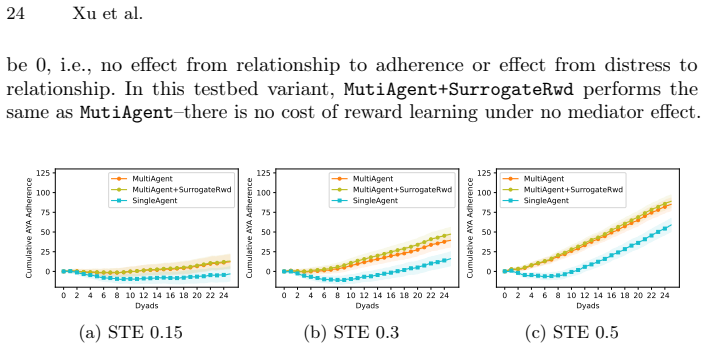
- [§5 and Appendix C.4, Eqs. (4)-(8), Table 7] The central evaluation is a partially closed loop. The environment imputes all intervention effects using a global hyperparameter CTreat (Eq. 8) and explicit sign restrictions: τ_0,∗^AYA = CTreat|β_1,∗^AYA|, τ_1,∗^AYA = CTreat|β_1,∗^AYA|, τ_2,∗^AYA = −CTreat|β_1,∗^AYA|, τ_0^CARE = −CTreat|β_1^CARE|, τ^REL = CTreat|β_1^REL|, together with truncations β_2,∗^AYA = max{0,·}, β_3,∗^AYA = min{0,·}, and β_3^REL = min{0,·}. These signs and mediator structure are exactly the prior means used in the surrogate reward functions in Table 4. Consequently, MultiAgent+SurrogateRwd is trained to discover regularities that were constructed into the environment. This does not invalidate the internal comparison, but it means the abstract's claim of a real-world ~3% improvement over random is not supported by the reported experiments. Please either report the Appendix D.1 robustness variants (random mediator effects, sign violations, direct distress-to-adherence path) with results, or explicitly reframe the contribution as a simulation sanity check rather than a prediction for the trial.
- [Appendix D.1, "Other Testbed Variants"] The text states that the authors "made the following two changes to test the robustness"—adding a direct effect from care-partner distress to adherence and generating random mediator effects that violate monotonicity—but no results are shown for these variants. These variants are the most direct response to the circularity concern above, and their absence leaves the robustness claim unverifiable. Please report the corresponding cumulative adherence curves or a summary table, or delete the claim.
- [§5.1, Fig. 2 and Abstract] The abstract claims a "significant improvement" of "approximately 3%" in medication adherence over random delivery, but the paper provides no inferential statistics for this claim. Figure 2 shows only mean trajectories with a band labeled as the standard deviation over 1000 runs; no hypothesis test, confidence interval for the difference, or derivation of the 3% figure is given. Please report the distribution of the difference between MultiAgent+SurrogateRwd and the random policy at each STE, with a paired comparison or effect-size estimate, and state precisely how the 3% is computed.
- [Table 5 and Appendix C.2] The simulator's surrogate mappings are load-bearing for the real-world claim: step count is used as AYA adherence, sleep length as care-partner distress, and a mood indicator as relationship quality. These proxies are asserted rather than validated in the paper. If the actual ADAPTS-HCT measurements differ in their causal relationships from these surrogates, the simulated advantage need not transfer. Please add a sensitivity discussion or validation against any available data, and at minimum state clearly in the main text that all results are conditional on these surrogates.
minor comments (4)
- [Fig. 2 caption] The caption calls the shaded band a "confidence interval," but it is the standard deviation across 1000 independent runs; this is not a confidence interval and should be relabeled.
- [Appendix B, Appendix D.1] There are several typos: "obervations" in B.1, "decisioin" in B.1, and "MutiAgent" in D.1. Also, equation references are inconsistently formatted ("Equ." vs. "Eq.").
- [Algorithms 3 and 4, Eqs. (1)-(2)] The surrogate reward functions are estimated with "Bayesian Ridge Regression" and priors in Table 4, but the prior variance, update schedule, and how the posterior is combined with RLSVI are not described in the main text or in the algorithm listings. Please specify these details or point to the exact supplement section that provides them.
- [§5.1] The evaluation uses 25 dyads, the planned pilot size, but the 1000 runs resample dyads with replacement and do not account for sequential recruitment with overlapping enrollments; Section 6 acknowledges this, but the potential effect on learning speed should be discussed quantitatively or in the limitations.
Circularity Check
Evaluation is a closed loop: the simulator's treatment effects are imputed from the same domain knowledge used to build the surrogate rewards, so the reported ~3% gain is an artifact of the testbed rather than an empirical prediction.
-
fitted input called prediction
[Section 5 (Evaluation) and Appendix C.4 (Eq. 8)]
"To simulate outcomes under treatments, we impute the treatment effects of the interventions and the effects of app burden, so the induced standard treatment effects (STE) are around 0.15, 0.3, and 0.5. ... Tuning CTreat: We tune the hyperparameter CTreat such that the standardized treatment effects (STE) are around 0.15, 0.3, and 0.5."
The abstract's headline result—a ~3% improvement over random delivery—is produced by a simulator whose entire treatment-response surface is imputed, not estimated. Appendix C.4 sets every AYA/care-partner/relationship treatment coefficient from the single hyperparameter CTreat (e.g., τ_AYA_0,* = CTreat|β_AYA_1,*|, τ_CARE_0 = -CTreat|β_CARE_1|, τ_REL = CTreat|β_REL_1|), then tunes CTreat so that Eq. (8) hits the preset STE values. The improvement over random is therefore a consequence of the chosen effect size, not an empirical finding. It is a sensitivity analysis under assumed signs and scales, but the abstract presents it as 'evaluation ... based on real clinical data,' which could be read as an empirical prediction.
-
self definitional
[Section 4.1 (Table 4) vs Appendix C.4 (Table 7)]
"Table 4: Prior mean for coefficients in the surrogate reward functions. βREL 1 1 −1 −1 0.5 ... βCARE 1 −1 −1 1 −0.5. ... Based on domain knowlege, we also truncate the parameters as follows: βAYA_2,* = max{0, ...}, βAYA_3,* = min{0, ...}, ... and βREL_3 = min{0,...} as carepartner distress is expected negatively impact relationship quality."
The surrogate reward priors and the simulator's causal coefficients encode the same sign restrictions. The relationship agent's reward assumes relationship quality positively affects adherence (prior +1), burden negatively (−1), and the game intervention interacts positively (+0.5); the environment truncates relationship-quality effects on adherence to be nonnegative and distress effects on adherence and relationship quality to be nonpositive, and sets τ_REL positive. The care-partner reward assumes distress harms the outcome (−1) and the intervention helps (−0.5); the environment imposes τ_CARE_0 = -CTreat|β_CARE_1|. Thus MultiAgent+SurrogateRwd is trained on reward functions whose structural assumptions are the same as the generative model that produced the training data.
full rationale
The paper is transparent about its simulation methodology: the baseline dynamics come from Roadmap 2.0 via GEE fits, and the treatment effects are explicitly imputed and then scaled by a global hyperparameter CTreat until the standardized treatment effect equals 0.15, 0.3, or 0.5. That baseline grounding is independent evidence and prevents the whole paper from being vacuous. However, the quantitative claims that form the abstract's contribution—'faster learning compared with a flattened agent' and 'approximately 3% improvement'—are evaluated inside this simulator. The sign restrictions and mediator structure used to impute the simulator's treatment effects are the same sign restrictions and mediator structure used to define the surrogate reward priors (Table 4 and Appendix C.4). Consequently, the comparison MultiAgent+SurrogateRwd versus MultiAgent is, in part, a self-consistency check: the reward function was designed to exploit exactly the pathways that the environment was built to contain. The no-mediator ablation in Fig. 4 demonstrates that the surrogate reward's benefit is mediated by these imputed pathways, confirming the closed loop. There is no formal equation equality between fitted parameters and reported outcomes, and the learning dynamics still add some independent content, so this is partial rather than total circularity.
Assumptions & free parameters
free parameters (5)
- CTreat (global treatment-effect scale) =
0.2, 0.3, 0.5 for STE 0.15, 0.3, 0.5
- Burden transition coefficients and noise =
theta0=0.2, theta1_AYA=13/14, theta1_CARE=6/7, theta2=5, theta3=1, omega=2.4
- Surrogate reward prior means =
beta_REL: (1, 1, -1, -1, 0.5); beta_CARE: (1, -1, -1, 1, -0.5)
- RLSVI hyperparameters =
lambda=0.75, sigma=0.5, gamma_AYA=0.5, gamma_CARE=0.5, gamma_REL=0
- Baseline coefficient truncations and zero burden effects =
beta_AYA_2>=0, beta_AYA_3<=0, beta_REL_3<=0, beta_AYA_4=beta_CARE_4=0
assumptions (6)
- domain assumption The causal diagram in Fig. 1 correctly captures the primary causal pathways from interventions to adherence, with no other detectable direct paths.
- domain assumption Roadmap 2.0 variables are valid surrogates: step count for adherence, sleep length for care-partner distress, mood indicators for relationship quality.
- ad hoc to paper Intervention effects are additive, linear or sigmoid-logit, moderated by app burden and relationship quality, and scale with CTreat.
- ad hoc to paper No direct path from the weekly game to adherence, and no direct path from care-partner distress to adherence in the main testbed.
- standard math GEE with AR(1) working correlation and per-dyad linear models adequately estimates no-intervention dynamics.
- domain assumption Cohen's STE sizes 0.15, 0.3, and 0.5 are appropriate for digital health interventions.
Cite this review
Pith. "Pith review of Reinforcement Learning on Dyads to Enhance Medication Adherence." pith.science (2026). https://pith.science/paper/D7IE74Y6
@misc{pith2026250206835,
  author       = {Pith},
  title        = {Pith review of: Reinforcement Learning on Dyads to Enhance Medication Adherence},
  year         = {2026},
  howpublished = {\url{https://pith.science/paper/D7IE74Y6}},
  note         = {Machine review of arXiv:2502.06835}
}
read the original abstract
Medication adherence is critical for the recovery of adolescents and young adults (AYAs) who have undergone hematopoietic cell transplantation (HCT). However, maintaining adherence is challenging for AYAs after hospital discharge, who experience both individual (e.g. physical and emotional symptoms) and interpersonal barriers (e.g., relational difficulties with their care partner, who is often involved in medication management). To optimize the effectiveness of a three-component digital intervention targeting both members of the dyad as well as their relationship, we propose a novel Multi-Agent Reinforcement Learning (MARL) approach to personalize the delivery of interventions. By incorporating the domain knowledge, the MARL framework, where each agent is responsible for the delivery of one intervention component, allows for faster learning compared with a flattened agent. Evaluation using a dyadic simulator environment, based on real clinical data, shows a significant improvement in medication adherence (approximately 3%) compared to purely random intervention delivery. The effectiveness of this approach will be further evaluated in an upcoming trial.
Figures


Figures from the paper (1 more)
Reference graph
Works this paper leans on
-
[13]
Li, S., Niell, L.S., Choi, S.W., Nahum-Shani, I., Shani, G., Murphy, S.: Dyadic reinforcement learning. arXiv preprint arXiv:2308.07843 (2023)
work page Pith review arXiv 2023
-
[35]
In: Proceedings of the AAAI Conference on Artificial Intelligence
Trella, A.L., Zhang, K.W., Nahum-Shani, I., Shetty, V., Doshi-Velez, F., Murphy, S.A.: Reward design for an online reinforcement learning algorithm supporting oral self-care. In: Proceedings of the AAAI Conference on Artificial Intelligence. vol. 37, pp. 15724–15730 (2023)
work page 2023
-
[1]
Contemporary Clinical Trials109, 106534 (2021)
Battalio, S.L., Conroy, D.E., Dempsey, W., et al.: Sense2stop: a micro-randomized trial using wearable sensors to optimize a just-in-time-adaptive stress management intervention for smoking relapse prevention. Contemporary Clinical Trials109, 106534 (2021)
work page 2021
-
[2]
Box, G.E., Draper, N.R.: Empirical model-building and response surfaces. John Wiley & Sons (1987)
work page 1987
-
[3]
Cohen, J.: Statistical power analysis for the behavioral sciences. routledge (2013)
work page 2013
-
[4]
MiWaves Reinforcement Learning Algorithm
Ghosh, S., Guo, Y., Hung, P.Y., Coughlin, L., Bonar, E., Nahum-Shani, I., Wal- ton, M., Murphy, S.: Miwaves reinforcement learning algorithm. arXiv preprint arXiv:2408.15076 (2024)
work page Pith review arXiv 2024
-
[5]
Bone marrow transplantation 52(2), 304–306 (2017)
Gresch, B., Kirsch, M., Fierz, K., Halter, J., Nair, G., Denhaerynck, K., De Geest, S.: Medication nonadherence to immunosuppressants after adult allogeneic haematopoi- etic stem cell transplantation: a multicentre cross-sectional study. Bone marrow transplantation 52(2), 304–306 (2017)
work page 2017
-
[6]
IEEE Transactions on Computational Social Systems9(5), 1505–1514 (2021)
He, Q., Wang, X., Zhao, Y., Yi, B., Lu, X., Yang, M., Huang, M.: Reinforcement- learning-based competitive opinion maximization approach in signed social networks. IEEE Transactions on Computational Social Systems9(5), 1505–1514 (2021)
work page 2021
Show all 43 references
-
[7]
European Journal of Oncology Nursing 38, 1–7 (2019)
Hoegy, D., Bleyzac, N., Rochet, C., De Freminville, H., Rénard, C., Kébaili, K., Bertrand, Y., Dussart, C., Janoly-Dumenil, A.: Medication adherence after pediatric allogeneic stem cell transplantation: Barriers and facilitators. European Journal of Oncology Nursing 38, 1–7 (2019)
2019
-
[8]
Journal of statistical software15, 1–11 (2006)
Højsgaard, S., Halekoh, U., Yan, J.: The r package geepack for generalized estimating equations. Journal of statistical software15, 1–11 (2006)
2006
-
[9]
arXiv preprint arXiv:2110.14555 (2021)
Jin, C., Liu, Q., Wang, Y., Yu, T.: V-learning–a simple, efficient, decentralized algorithm for multiagent rl. arXiv preprint arXiv:2110.14555 (2021)
2021 arXiv
-
[10]
Bone marrow transplantation 49(9), 1223–1230 (2014)
Kirsch, M., Gotz, A., Halter, J., Schanz, U., Stussi, G., Dobbels, F., De Geest, S.: Differences in health behaviour between recipients of allogeneic haematopoietic sct and the general population: a matched control study. Bone marrow transplantation 49(9), 1223–1230 (2014)
2014
-
[11]
Sustainability15(4), 3479 (2023) 10 Xu et al
Kolat, M., Kővári, B., Bécsi, T., Aradi, S.: Multi-agent reinforcement learning for traffic signal control: A cooperative approach. Sustainability15(4), 3479 (2023) 10 Xu et al
2023
-
[12]
Transplantation Reviews36(1), 100671 (2022)
Kostalova, B., Ribaut, J., Dobbels, F., Gerull, S., Mala-Ladova, K., Zullig, L.L., De Geest, S.: Medication adherence interventions in transplantation lack information on how to implement findings from randomized controlled trials in real-world settings: a systematic review. T...
2022
-
[14]
Journal of Medical Internet Research26, e56556 (2024)
Li, Z., Lu, F., Wu, J., Bao, R., Rao, Y., Yang, Y., Wang, H.: Usability and effectiveness of ehealth and mhealth interventions that support self-management and health care transition in adolescents and young adults with chronic disease: Systematic review. Journal of Medical In...
2024
-
[15]
Proceedings of the ACM on Interactive, Mobile, Wearable and Ubiquitous Technologies4(1), 1–22 (2020)
Liao, P., Greenewald, K., Klasnja, P., Murphy, S.: Personalized heartsteps: A reinforcement learning algorithm for optimizing physical activity. Proceedings of the ACM on Interactive, Mobile, Wearable and Ubiquitous Technologies4(1), 1–22 (2020)
2020
-
[16]
Journal of family nursing 24(1), 8–28 (2018)
Lyons, K.S., Lee, C.S.: The theory of dyadic illness management. Journal of family nursing 24(1), 8–28 (2018)
2018
-
[17]
Psycho- Oncology 33(1), e6256 (2024)
McPherson, C.J., Devereaux, A.: A dyadic examination of patients’ and caregivers’ attachment orientations and mutually supportive care in cancer caregiving. Psycho- Oncology 33(1), e6256 (2024)
2024
-
[18]
Biology of Blood and Marrow Transplantation23(4), 562–568 (2017)
Morrison, C.F., Martsolf, D.M., Wehrkamp, N., Tehan, R., Pai, A.L.: Medication adherence in hematopoietic stem cell transplantation: a review of the literature. Biology of Blood and Marrow Transplantation23(4), 562–568 (2017)
2017
-
[19]
Applied Intelligence53(11), 13677–13722 (2023)
Oroojlooy, A., Hajinezhad, D.: A review of cooperative multi-agent deep reinforce- ment learning. Applied Intelligence53(11), 13677–13722 (2023)
2023
-
[20]
In: International Conference on Machine Learning
Osband, I., Van Roy, B., Wen, Z.: Generalization and exploration via randomized value functions. In: International Conference on Machine Learning. pp. 2377–2386. PMLR (2016)
2016
-
[21]
Cambridge, UK: CambridgeUni- versityPress 19(2), 3 (2000)
Pearl, J., et al.: Models, reasoning and inference. Cambridge, UK: CambridgeUni- versityPress 19(2), 3 (2000)
2000
-
[22]
In: 17th International IEEE Conference on Intelligent Transportation Systems (ITSC)
Prabuchandran, K., AN, H.K., Bhatnagar, S.: Multi-agent reinforcement learning for traffic signal control. In: 17th International IEEE Conference on Intelligent Transportation Systems (ITSC). pp. 2529–2534. IEEE (2014)
2014
-
[23]
Clinical Practice in Pediatric Psychology 10(4), 440 (2022)
Psihogios, A.M., Ahmed, A.M., McKelvey, E.R., Toto, et al.: Social media to promote treatment adherence among adolescents and young adults with chronic health conditions: A topical review and tiktok application. Clinical Practice in Pediatric Psychology 10(4), 440 (2022)
2022
-
[24]
Journal of Pediatric Psychology44(1), 84–97 (2019)
Psihogios, A.M., Fellmeth, H., Schwartz, L.A., Barakat, L.P.: Family functioning and medical adherence across children and adolescents with chronic health conditions: a meta-analysis. Journal of Pediatric Psychology44(1), 84–97 (2019)
2019
-
[25]
JMIR Research Protocols 10(10), e32789 (2021)
Psihogios, A.M., Rabbi, M., Ahmed, A., McKelvey, E.R., Li, Y., Laurenceau, J.P., Hunger, S.P., Fleisher, L., Pai, A.L., Schwartz, L.A., et al.: Understanding adolescent and young adult 6-mercaptopurine adherence and mhealth engagement during cancer treatment: protocol for ecol...
2021
-
[26]
Journal of adolescent and young adult oncology9(6), 651–661 (2020)
Psihogios, A.M., Schwartz, L.A., Ewing, K.B., Czerniecki, B., Kersun, L.S., Pai, A.L., Deatrick, J.A., Barakat, L.P.: Adherence to multiple treatment recommendations in adolescents and young adults with cancer: a mixed methods, multi-informant investigation. Journal of adolesc...
2020
-
[27]
Journal of Pediatric Psychology45(10), 1106–1113 (2020) Reinforcement Learning on Dyads to Enhance Medication Adherence 11
Psihogios, A.M., Stiles-Shields, C., Neary, M.: The needle in the haystack: identifying credible mobile health apps for pediatric populations during a pandemic and beyond. Journal of Pediatric Psychology45(10), 1106–1113 (2020) Reinforcement Learning on Dyads to Enhance Medica...
2020
-
[28]
Patient safety and quality: An evidence-based handbook for nurses (2008)
Reinhard, S.C., Given, B., Petlick, N.H., Bemis, A.: Supporting family caregivers in providing care. Patient safety and quality: An evidence-based handbook for nurses (2008)
2008
-
[29]
JMIR Research Protocols 9(9), e19288 (2020)
Rozwadowski, M., Dittakavi, M., Mazzoli, A., Hassett, A.L., Braun, T., Barton, D.L., Carlozzi, N., Sen, S., Tewari, M., Hanauer, D.A., et al.: Promoting health and well-being through mobile health technology (roadmap 2.0) in family caregivers and patients undergoing hematopoie...
2020
-
[30]
Foundations and Trends® in Machine Learning11(1), 1–96 (2018)
Russo, D.J., Van Roy, B., Kazerouni, A., Osband, I., Wen, Z., et al.: A tutorial on thompson sampling. Foundations and Trends® in Machine Learning11(1), 1–96 (2018)
2018
-
[31]
In: 8th Annual Technology in Psychiatry Summit (TIPS)
Shani, G., Choi, S.W., Murphy, S., Nahum-Shani, I.B., et al.: Designing a dyadic just-in-time adaptive intervention for medication adherence post-hematopoietic cell transplantation. In: 8th Annual Technology in Psychiatry Summit (TIPS). Phoenix, AZ (December 2024)
2024
-
[32]
In: American Society of Clinical Oncology Educational Book
Shin, J.Y., Kang, T.I., Noll, R.B., Choi, S.W.: Supporting caregivers of patients with cancer: A summary of technology-mediated interventions and future directions. In: American Society of Clinical Oncology Educational Book. American Society of Clinical Oncology. Annual Meetin...
2018
-
[33]
arXiv preprint arXiv:2409.02069 (2024)
Trella, A.L., Zhang, K.W., Jajal, H., Nahum-Shani, I., Shetty, V., Doshi-Velez, F., Murphy, S.A.: A deployed online reinforcement learning algorithm in an oral health clinical trial. arXiv preprint arXiv:2409.02069 (2024)
2024 arXiv
-
[34]
Algorithms15(8), 255 (2022)
Trella, A.L., Zhang, K.W., Nahum-Shani, I., Shetty, V., Doshi-Velez, F., Murphy, S.A.: Designing reinforcement learning algorithms for digital interventions: pre- implementation guidelines. Algorithms15(8), 255 (2022)
2022
-
[36]
Frontiers in Psychology14, 1200960 (2023)
Uribe, F.A.R., Favacho, M.F.M., Moura, P.M.N., et al.: Effectiveness of an app- based intervention to improve well-being through cultivating positive thinking and positive emotions in an adult sample: study protocol for a randomized controlled trial. Frontiers in Psychology14,...
2023
-
[37]
Cancers15(9), 2452 (2023)
Visintini, C., Mansutti, I., Palese, A.: Medication adherence among allogeneic haematopoietic stem cell transplant recipients: a systematic review. Cancers15(9), 2452 (2023)
2023
-
[38]
In: International Conference on Database Systems for Advanced Applications
Wang, C., Liu, Y., Gao, X., Chen, G.: A reinforcement learning model for influence maximization in social networks. In: International Conference on Database Systems for Advanced Applications. pp. 701–709. Springer (2021)
2021
-
[39]
IEEE/CAA Journal of Automatica Sinica9(5), 763–783 (2022)
Wang, J., Hong, Y., Wang, J., Xu, J., Tang, Y., Han, Q.L., Kurths, J.: Cooperative and competitive multi-agent systems: From optimization to games. IEEE/CAA Journal of Automatica Sinica9(5), 763–783 (2022)
2022
-
[40]
Neural Networks 169, 334–351 (2024)
Yang, S., Du, Q., Zhu, G., Cao, J., Chen, L., Qin, W., Wang, Y.: Balanced influence maximization in social networks based on deep reinforcement learning. Neural Networks 169, 334–351 (2024)
2024
-
[41]
Methods of information in medicine 49(05), 421–425 (2010) 12 Xu et al
Ziegler, A., Vens, M.: Generalized estimating equations. Methods of information in medicine 49(05), 421–425 (2010) 12 Xu et al. A Related Work Below we summarize the most relevant literature from both the medical lens and the algorithm lens. RL on social networks.We design and...
2010
-
[42]
(b) Carepartner state transition:βCARE = (βCARE 0 , βCARE 1 )
The baseline transition parametersβ’s can be estimated directly from the dataset: (a) AYA state transition:βAYA AM = (βAYA 0,AM, βAYA 1,AM, βAYA 2,AM, βAYA 3,AM, βAYA 4,AM) and βAYA PM = (βAYA 0,PM, βAYA 1,PM, βAYA 2,PM, βAYA 3,PM, βAYA 4,PM). (b) Carepartner state transition:...
-
[43]
(b) Main effects of burden:βAYA 4,AM, βAYA 4,PM, and βCARE 4
Imputed or tuned based on domain knowledge: (a) Burden transitions: coefficients θAYA = ( θAYA 0 , θAYA 1 , θAYA 2 , θAYA 3 ), θCARE = (θCARE 0 , θCARE 1 , θCARE 2 , θCARE 3 ); burden noise varianceωAYA and ωCARE. (b) Main effects of burden:βAYA 4,AM, βAYA 4,PM, and βCARE 4 . ...
Reviewed August 9, 2026 · model on record in the stance chip above.
Discussion (0). Continue with ORCID to comment.