REVIEW 2 major objections 5 minor 62 references
Strong electrostatic confinement can raise valley splitting above 4 K in buried silicon quantum wells while keeping disorder low.
Reviewed by Pith at T0; open to challenge. T0 means a machine referee read the full paper against a public rubric. the ladder, T0–T4 →
T0 review · grok-4.5
2026-07-13 02:03 UTC pith:DDG5NBKP
load-bearing objection Clean experimental result: gate confinement systematically lifts single-electron valley splitting to ~0.4–0.76 meV inside the same low-disorder Si/SiGe wells already used for shuttling, with the numbers cross-checked by multiple spectroscopies. the 2 major comments →
Confinement drives valley splitting above 4K in buried silicon quantum wells
The pith
A machine-rendered reading of the paper's core claim, the machinery that carries it, and where it could break.
Core claim
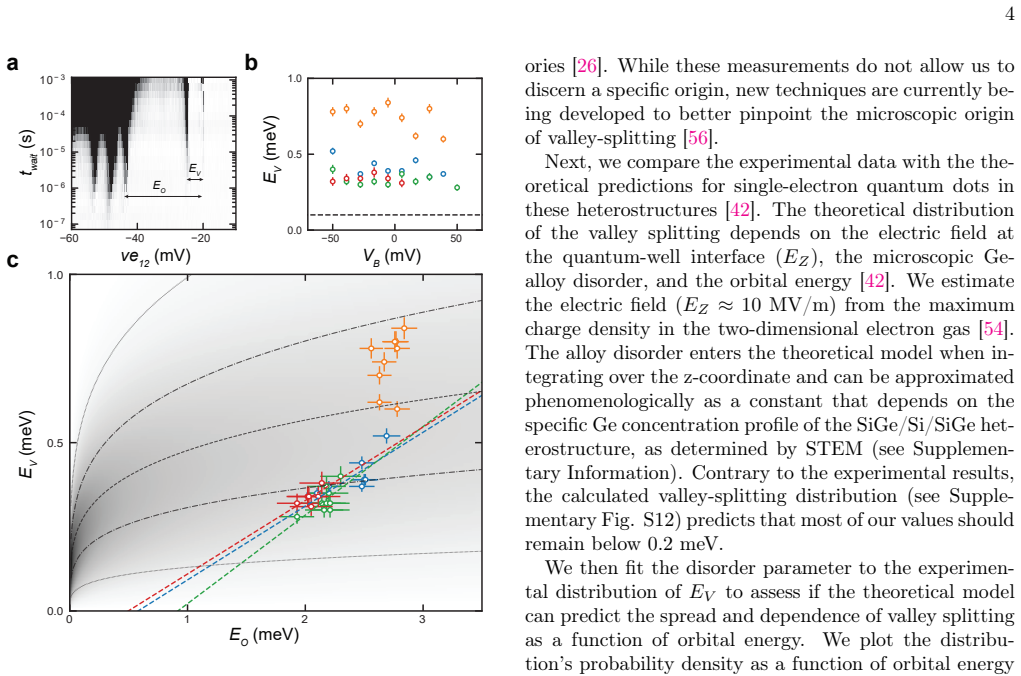
In low-disorder buried 28Si/SiGe quantum wells, electrostatic confinement alone can raise single-electron valley splitting by several hundred microelectronvolts. Three of four dots show a strong linear correlation (average coefficient ≈0.22 meV/meV) between valley splitting and orbital energy; the fourth reaches a record 0.76(2) meV with little correlation. Average values across the array are EV = 0.40(6) meV and EST = 0.24(7) meV, placing the valley gap above the thermal energy of liquid-helium temperatures.
What carries the argument
The measured linear relation EV ≈ α EO + b (with α ≈ 0.22 meV/meV) obtained from detuning-axis pulsed spectroscopy while the barrier voltages systematically vary the orbital energy EO. The slope quantifies how strongly tighter in-plane confinement increases the electron wave-function's sampling of Ge alloy disorder at the Si/SiGe interface.
Load-bearing premise
The paper assumes that the rise in valley splitting with orbital energy is caused mainly by stronger confinement making the electron sample more Ge alloy disorder at the interface; other microscopic sources such as local pinning centers are not ruled out for the highest-splitting dot.
What would settle it
A systematic series of devices fabricated on the same heterostructure but with deliberately varied plunger-gate widths (or barrier voltages) that produce a wide range of orbital energies; if the EV-versus-EO slope remains near 0.22 meV/meV and the absolute EV values stay high, the confinement-driven mechanism is confirmed; a flat or vanishing slope would falsify it.
Editorial analysis
A structured set of objections, weighed in public.
Referee Report
Summary. The manuscript reports spectroscopic measurements of single- and two-electron energy scales in a four-dot array fabricated on shallow, low-disorder 28Si/SiGe quantum wells. Using detuning-axis pulsed spectroscopy (DAPS), temperature-activated lever arms, magnetospectroscopy, and Pauli spin blockade, the authors extract average orbital energy EO = 2.4(2) meV, single-electron valley splitting EV = 0.40(6) meV, and two-electron singlet-triplet splitting EST = 0.24(7) meV (the latter averaged over 17 lithographically identical dots). In three dots they find a strong EV–EO correlation with linear coefficient ≈0.22 meV/meV; the remaining dot (P2) shows the highest EV = 0.76(2) meV with weak correlation. They conclude that electrostatic confinement can systematically raise valley splitting in buried wells, supporting shuttling and sparse-occupation architectures without intentionally enhancing alloy disorder.
Significance. Valley leakage remains a central obstacle for scaling and shuttling in Si/SiGe spin qubits. Demonstrating gate-tunable EV of several hundred µeV—and a peak of 0.76 meV—in conventional low-disorder buried wells is of clear practical importance and is on par with the best SiMOS values. Strengths include multiple independent spectroscopies on the same devices, lever-arm cross-checks (temperature activation vs magnetospectroscopy), an expanded EST statistics set across devices and wafers, and public data/code deposition. The experimental energy scales and their gate dependence are the load-bearing results; if they hold, the work supplies a concrete co-design path that preserves the low-disorder environment of buried wells while addressing the valley problem.
major comments (2)
- [Fig. 2c and Methods] Fig. 2c and Methods (valley-splitting correlations): the theoretical probability density is obtained only after fitting a single phenomenological disorder parameter η_yz ≈ 4.12 meV²·nm to the same experimental EV distribution that the theory is then said to match; the unfitted calculation under-predicts most values below 0.2 meV. The overlay therefore demonstrates consistency of spread and EO dependence under a fitted scale, not an a-priori validation of alloy-disorder theory. The manuscript should state this limitation explicitly in the main text (not only Methods) and separate the experimental EV–EO correlation claim from the secondary microscopic interpretation.
- [Results / Discussion] Results (Single-electron spectroscopy) and Discussion: the high-EV outlier under P2 (0.76(2) meV, correlation ≈0.3) is central to the benchmark claim, yet the text leaves open whether it arises from deterministic enhancement beyond alloy disorder or from local pinning/disorder centers. Given that the architectural conclusion leans on consistently large EV, the paper should either (i) quantify how often such outliers appear across the 17-dot EST set or additional devices, or (ii) clearly mark the outlier as not yet microscopically assigned and avoid implying that the same confinement strategy will routinely produce EV ≳ 0.7 meV.
minor comments (5)
- [Throughout] Several section headings and figure labels show residual formatting artifacts (e.g., “T wo-electron spectroscopy”, “RESUL TS”, “DA T A A V AILABILITY”). Clean these for production.
- [Fig. 4] Fig. 4: the dashed temperature lines (1.6 K, 4.0 K) are useful, but the caption should note that EST ≈ 0.24 meV still limits spin-to-charge readout below ~3 K even when EV exceeds 4 K, so that the title’s “above 4K” claim is not over-read as applying to all relevant energy scales.
- [Abstract / Fig. 2c] Abstract and main text quote α_EV/EO ≈ 0.22 (meV/meV) while the Fig. 2c fit reports 0.22(4) [eV/eV]; units are equivalent but the notation should be made consistent (and the intercept b = −0.12(8) meV discussed briefly, since a negative intercept is unphysical at EO → 0).
- [Results (Single-electron spectroscopy)] Supplementary Table S2 is cited for Pearson coefficients and p-values but is not in the main manuscript; ensure the table is available to referees and that the main text quotes the actual coefficients (~0.7 for P1/P3/P4, ~0.3 for P2) with uncertainties or sample sizes.
- [Methods] Eq. (1) in Methods (magnetospectroscopy fit) is dense; a short statement of which parameters are free (α, EST, Te) versus fixed (g = 2) would aid reproducibility.
Circularity Check
Primary claims are independent experimental measurements of EV/EO/EST; mild secondary circularity only in the alloy-disorder theory overlay, whose overall scale is fitted to the same EV data it is then said to match.
specific steps
-
fitted input called prediction
[Results (Single-electron spectroscopy, Fig. 2c) + Methods (Valley splitting correlations)]
"We then fit the disorder parameter to the experimental distribution of EV to assess if the theoretical model can predict the spread and dependence of valley splitting as a function of orbital energy. We plot the distribution’s probability density … as a shaded area in Fig. 2(c) … η_yz = σ^{2}_Δ / ∫ dx |ψ(x; EOS)|^{4} ≈ 4.12 meV^{2} · nm. σ^{2}_Δ is computed using maximum likelihood approximation to fit a Rayleigh distribution to the measured values of EVS."
η_yz (the sole free scale of the alloy-disorder model) is obtained directly from the same measured EV (and EO) values that the theory is subsequently overlaid upon. Once the scale is fixed by construction, the shaded probability density necessarily reproduces the average height and the observed spread of the data points; only the functional rise with EO remains a non-trivial model prediction. The paper presents this overlay as confirmation that “the theoretical model can predict the spread and dependence,” which is therefore partly circular.
full rationale
The load-bearing results (average EV = 0.40(6) meV, EO = 2.4(2) meV, linear coefficient ≈0.22 meV/meV for three dots, peak EV = 0.76(2) meV on P2, EST = 0.24(7) meV) are obtained from independent spectroscopies (DAPS, temperature-activated lever arms, magnetospectroscopy, PSB) and do not depend on any theoretical fit. The sole circular step is interpretive: the unfitted alloy-disorder model under-predicts absolute EV, so a single phenomenological constant η_yz is extracted from the measured EV distribution (Rayleigh MLE for σ^{2}_Δ plus average EOS) and the resulting probability density is overlaid on Fig. 2c as if the theory now “matches” the data. The EO dependence of the wave-function integral remains a model prediction, but the absolute scale and therefore the visual agreement are fixed by construction. This is secondary to the experimental claim that confinement raises EV and does not force the headline numbers or the architectural conclusion. No self-definitional loops, uniqueness theorems, or ansatz smuggling appear in the derivation chain.
Axiom & Free-Parameter Ledger
free parameters (3)
- disorder strength η_yz =
≈4.12 meV²·nm
- linear coefficient α_EV/EO =
0.22(4) meV/meV
- plunger lever arms α =
0.08–0.12 eV/V
axioms (3)
- domain assumption Valley splitting in Si/SiGe is dominated by random Ge alloy disorder whose matrix element scales with the envelope amplitude at the interfaces.
- domain assumption Electron temperature equals mixing-chamber temperature for T_MC > 0.5 K when extracting lever arms from Fermi-edge broadening.
- domain assumption The two-electron singlet-triplet gap is limited by Wigner-molecule formation rather than the single-electron valley gap when EST < EV.
read the original abstract
Controlling the energy scales of a quantum system is essential for defining robust qubits. In silicon spin qubits, the nearly degenerate conduction-band valleys create a leakage channel from the single-spin computational basis, posing a challenge to scaling and to shuttling-based architectures. Here, we measure the relevant energy scales of single-electron spin qubits in buried silicon quantum wells co-designed for low disorder and high valley splitting. Across a linear array of four quantum dots with an average orbital energy of 2.4(2) meV, we report an average single-electron valley splitting of 0.40(6) meV and an average two-electron singlet-triplet splitting of 0.24(7) meV. In three dots, we observe a strong correlation between valley splitting and orbital energy, with an average linear coefficient of $\approx 0.22$ (meV/meV), demonstrating that electrostatic confinement can increase the valley splitting by several hundred microelectronvolts. In contrast, the remaining dot exhibits the highest valley splitting of 0.76(2) meV and low correlation, suggesting excellent characteristics for spin-qubit operation. Our findings demonstrate that strong confinement can be exploited in buried quantum wells to effectively enhance the valley splitting, thereby establishing a viable path toward the realization of shuttling and sparse-occupation-based architectures in low-disorder heterostructures.
Figures



Reference graph
Works this paper leans on
-
[1]
Burkard, T
G. Burkard, T. D. Ladd, A. Pan, J. M. Nichol, and J. R. Petta, Reviews of Modern Physics95, 025003 (2023)
2023
-
[2]
Stano and D
P. Stano and D. Loss, Nature Reviews Physics4, 672 (2022)
2022
-
[3]
X. Xue, M. Russ, N. Samkharadze, B. Undseth, A. Sam- mak, G. Scappucci, and L. M. K. Vandersypen, Nature 601, 343 (2022)
2022
-
[4]
Y.-H. Wu, L. C. Camenzind, P. Bütler, I. K. Jin, A. Noiri, K. Takeda, T. Nakajima, T. Kobayashi, G. Scappucci, H.-S. Goan,et al., Preprint at https://arxiv.org/abs/2507.11918 (2025), 10.48550/arXiv.2507.11918
-
[5]
De Smet, Y
M. De Smet, Y. Matsumoto, A.-M. J. Zwerver, L. Try- puten, S. L. de Snoo, S. V. Amitonov, S. R. Katiraee- Far, A. Sammak, N. Samkharadze, Ö. Gül,et al., Nature Nanotechnology20, 866 (2025)
2025
-
[6]
Matsumoto, M
Y. Matsumoto, M. De Smet, L. Tryputen, S. L. de Snoo, S.V.Amitonov, A.Sammak, M.Rimbach-Russ, G.Scap- pucci, and L. M. K. Vandersypen, Nature653, 391 (2026)
2026
-
[7]
Yoneda, W
J. Yoneda, W. Huang, M. Feng, C. H. Yang, K. W. Chan, T. Tanttu, W. Gilbert, R. C. C. Leon, F. E. Hud- son, K. M. Itoh,et al., Nature Communications12, 4114 (2021)
2021
-
[8]
Fujita, T
T. Fujita, T. A. Baart, C. Reichl, W. Wegscheider, and L. M. K. Vandersypen, npj Quantum Information3, 22 (2017)
2017
-
[9]
Fernández de Fuentes, E
I. Fernández de Fuentes, E. Raymenants, B. Undseth, O. Pietx-Casas, S. Philips, M. Mądzik, S. L. de Snoo, S. V. Amitonov, L. Tryputen, A. T. Schmitz,et al., PRX Quantum7, 010308 (2026)
2026
-
[10]
Capannelli, B
K. Capannelli, B. Undseth, I. Fernández de Fuentes, E. Raymenants, F. K. Unseld, O. Pietx-Casas, S. G. J. Philips, M. T. Mądzik, S. V. Amitonov, L. Tryputen, et al., npj Quantum Information11, 192 (2025)
2025
-
[11]
B. Undseth, N. Meggiato, Y.-H. Wu, S. R. Katiraee- Far, L. Tryputen, S. L. de Snoo, D. Degli Esposti, G. Scappucci, E. Greplová, and L. M. K. Vandersypen, Preprint at https://arxiv.org/abs/2601.23267 (2026), 10.48550/arXiv.2601.23267
-
[12]
J. C. Marcks, E. Eagen, E. C. Brann, M. P. Losert, T. Oh, J. Reily, C. S. Wang, D. Keith, F. A. Mo- hiyaddin, F. Luthi,et al., Nature Communications16, 11381 (2025)
2025
-
[13]
M. T. Mądzik, F. Luthi, G. G. Guerreschi, F. A. Mo- hiyaddin, F. Borjans, J. D. Chadwick, M. J. Curry, J. Ziegler, S. Atanasov, P. L. Bavdaz,et al., Nature647, 870 (2025)
2025
-
[14]
H. C. George, M. T. Mądzik, E. M. Henry, A. J. Wagner, M. M. Islam, F. Borjans, E. J. Connors, J. Corrigan, M. Curry, M. K. Harper,et al., Nano Letters25, 793 (2025)
2025
-
[15]
Steinacker, N
P. Steinacker, N. Dumoulin Stuyck, W. H. Lim, T. Tanttu, M. Feng, S. Serrano, A. Nickl, M. Candido, J. D. Cifuentes, E. Vahapoglu,et al., Nature646, 81 7 (2025)
2025
-
[16]
I. Fattal, J. Van Damme, B. Raes, C. God- frin, G. Jaliel, K. Chen, T. Van Caekenberghe, A. Loenders, S. Kubicek, S. Massar,et al., Preprint at https://arxiv.org/abs/2504.05016 (2025), 10.48550/arXiv.2504.05016
-
[17]
Neyens, O
S. Neyens, O. K. Zietz, T. F. Watson, F. Luthi, A. Neth- wewala, H. C. George, E. Henry, M. Islam, A. J. Wagner, F. Borjans,et al., Nature629, 80 (2024)
2024
-
[18]
T. Koch, C. Godfrin, V. Adam, J. Ferrero, D. Schroller, N. Glaeser, S. Kubicek, R. Li, R. Loo, S. Massar,et al., npj Quantum Information11, 59 (2025)
2025
-
[19]
A. M. J. Zwerver, T. Krähenmann, T. F. Watson, L. Lampert, H. C. George, R. Pillarisetty, S. A. Bojarski, P. Amin, S. V. Amitonov, J. M. Boter,et al., Nature Electronics5, 184 (2022)
2022
-
[20]
F. A. Zwanenburg, A. S. Dzurak, A. Morello, M. Y. Sim- mons, L. C. L. Hollenberg, G. Klimeck, S. Rogge, S. N. Coppersmith, and M. A. Eriksson, Reviews of Modern Physics85, 961 (2013)
2013
-
[21]
Siegel, Z
A. Siegel, Z. Cai, H. Jnane, B. Koczor, S. Pexton, A. Strikis, and S. Benjamin, PRX Quantum7, 010339 (2026)
2026
-
[22]
J. A. Krzywda, Y. Matsumoto, M. De Smet, L. Try- puten, S. L. de Snoo, S. V. Amitonov, E. van Nieuwen- burg, G. Scappucci, and L. M. K. Vandersypen, Preprint at https://arxiv.org/abs/2602.09179 (2026), 10.48550/arXiv.2602.09179
-
[23]
R. Li, V. Levajac, C. Godfrin, S. Kubicek, G. Simion, B. Raes, S. Beyne, I. Fattal, A. Loenders, W. De Roeck, M. Mongillo, D. Wan, and K. De Greve, Scientific Re- ports16, 16526 (2026)
2026
-
[24]
Künne, A
M. Künne, A. Willmes, M. Oberländer, C. Gorjaew, J. D. Teske, H. Bhardwaj, M. Beer, E. Kammerloher, R. Ot- ten, I. Seidler,et al., Nature Communications15, 4977 (2024)
2024
-
[25]
Volmer, T
M. Volmer, T. Struck, A. Sala, B. Chen, M. Oberlän- der, T. Offermann, R. Xue, L. Visser, J.-S. Tu, S. Trel- lenkamp,et al., npj Quantum Information10, 61 (2024)
2024
-
[26]
M. P. Losert, M. Oberländer, J. D. Teske, M. Volmer, L. R. Schreiber, H. Bluhm, S. N. Coppersmith, and M. Friesen, PRX Quantum5, 040322 (2024)
2024
-
[27]
Kawakami, P
E. Kawakami, P. Scarlino, D. R. Ward, F. R. Braakman, D. E. Savage, M. G. Lagally, M. Friesen, S. N. Copper- smith, M. A. Eriksson, and L. M. K. Vandersypen, Na- ture Nanotechnology9, 666 (2014)
2014
-
[28]
S. G. J. Philips, M. T. Mądzik, S. V. Amitonov, S. L. de Snoo, M. Rimbach-Russ, N. Kalhor, C. Volk, W. I. L. Lawrie, D. Brousse, L. Tryputen, B. Paquelet Wuetz, A. Sammak, M. Veldhorst, G. Scappucci, and L. M. K. Vandersypen, Nature609, 919 (2022)
2022
-
[29]
Degli Esposti, L
D. Degli Esposti, L. E. A. Stehouwer, Ö. Gül, N. Samkharadze, C. Déprez, M. Meyer, I. N. Meijer, L. Tryputen, S. Karwal, M. Botifoll,et al., npj Quan- tum Information10, 32 (2024)
2024
-
[30]
M. G. Borselli, R. S. Ross, A. A. Kiselev, E. T. Croke, K. S. Holabird, P. W. Deelman, L. D. Warren, I. Alvarado-Rodriguez, I. Milosavljevic, F. C. Ku, W. S. Wong, A. E. Schmitz, M. Sokolich, M. F. Gyure, and A. T. Hunter, Applied Physics Letters98, 123118 (2011)
2011
-
[31]
Z. Shi, C. B. Simmons, J. R. Prance, J. K. Gamble, M. Friesen, D. E. Savage, M. G. Lagally, S. N. Copper- smith, and M. A. Eriksson, Applied Physics Letters99, 233108 (2011)
2011
-
[32]
X. Mi, C. G. Péterfalvi, G. Burkard, and J. R. Petta, Physical Review Letters119, 176803 (2017)
2017
-
[33]
Hollmann, T
A. Hollmann, T. Struck, V. Langrock, A. Schmidbauer, F. Schauer, T. Leonhardt, K. Sawano, H. Riemann, N. V. Abrosimov, D. Bougeard, and L. R. Schreiber, Physical Review Applied13, 034068 (2020)
2020
-
[34]
McJunkin, E
T. McJunkin, E. R. MacQuarrie, L. Tom, S. F. Neyens, J. P. Dodson, B. Thorgrimsson, J. Corrigan, H. E. Ercan, D. E. Savage, M. G. Lagally, R. Joynt, S. N. Copper- smith, M. Friesen, and M. A. Eriksson, Physical Review B104, 085406 (2021)
2021
-
[35]
E. H. Chen, K. Raach, A. Pan, A. A. Kiselev, E. Acuna, J. Z. Blumoff, T. Brecht, M. D. Choi, W. Ha, D. R. Hulbert, M. P. Jura, T. E. Keating, R. Noah, B. Sun, B. J. Thomas, M. G. Borselli, C. A. C. Jackson, M. T. Rakher, and R. S. Ross, Physical Review Applied15, 044033 (2021)
2021
-
[36]
J. P. Dodson, H. E. Ercan, J. Corrigan, M. P. Losert, N. Holman, T. McJunkin, L. F. Edge, M. Friesen, S. N. Coppersmith, and M. A. Eriksson, Physical Review Let- ters128, 146802 (2022)
2022
-
[37]
A. O. Denisov, S. W. Oh, G. Fuchs, A. R. Mills, P. Chen, C. R. Anderson, M. F. Gyure, A. W. Barnard, and J. R. Petta, Nano Letters22, 4807 (2022)
2022
-
[38]
C. H. Yang, A. Rossi, R. Ruskov, N. S. Lai, F. A. Mo- hiyaddin, S. Lee, C. Tahan, G. Klimeck, A. Morello, and A. S. Dzurak, Nature Communications4, 2069 (2013)
2069
-
[39]
A. Nickl, N. Dumoulin Stuyck, P. Steinacker, J. D. Cifuentes, S. Serrano, M. Feng, E. Vahapoglu, F. E. Hudson, K. W. Chan, S. Kubicek,et al., Preprint at https://arxiv.org/abs/2512.10174 (2025), 10.48550/arXiv.2512.10174
-
[40]
J. Y. Huang, R. Y. Su, W. H. Lim, M. Feng, B. Van Straaten, B. Severin, W. Gilbert, N. Du- moulin Stuyck, T. Tanttu, S. Serrano,et al., Nature627, 772 (2024)
2024
-
[41]
Paquelet Wuetz, M
B. Paquelet Wuetz, M. P. Losert, S. Koelling, L. E. A. Stehouwer, A.-M. J. Zwerver, S. G. J. Philips, M. T. Mądzik, X. Xue, G. Zheng, M. Lodari, S. V. Amitonov, N. Samkharadze, A. Sammak, L. M. K. Vandersypen, R. Rahman, S. N. Coppersmith, O. Moutanabbir, M. Friesen, and G. Scappucci, Nature Communications 13, 7730 (2022)
2022
-
[42]
M. P. Losert, M. A. Eriksson, R. Joynt, R. Rahman, G. Scappucci, S. N. Coppersmith, and M. Friesen, Phys- ical Review B108, 125405 (2023)
2023
-
[43]
Friesen, S
M. Friesen, S. Chutia, C. Tahan, and S. N. Coppersmith, Physical Review B75, 115318 (2007)
2007
-
[44]
Culcer, X
D. Culcer, X. Hu, and S. Das Sarma, Physical Review B82, 205315 (2010)
2010
-
[45]
Hosseinkhani and G
A. Hosseinkhani and G. Burkard, Physical Review Re- search2, 043180 (2020)
2020
-
[46]
T. Salamone, B. M. Diaz, J. Li, L. Cvitkovich, and Y.- M. Niquet, Preprint at https://arxiv.org/abs/2511.20153 (2025), 10.48550/arXiv.2511.20153
-
[47]
Feng and R
Y. Feng and R. Joynt, Physical Review B106, 085304 (2022)
2022
-
[48]
McJunkin, B
T. McJunkin, B. Harpt, Y. Feng, M. P. Losert, R. Rah- man, J. P. Dodson, M. A. Wolfe, D. E. Savage, M. G. Lagally, S. N. Coppersmith, M. Friesen, R. Joynt, and M.A.Eriksson,NatureCommunications13,7777(2022)
2022
-
[49]
L. E. A. Stehouwer, M. P. Losert, M. Rigot, D. Degli Es- posti, S. Martí-Sánchez, M. Rimbach-Russ, J. Arbiol, M. Friesen, and G. Scappucci, Nano Letters25, 12892 8 (2025)
2025
-
[50]
A. Thayil, L. Ermoneit, L. R. Schreiber, T. Koprucki, and M. Kantner, Preprint at https://arxiv.org/abs/2512.18064 (2025), 10.48550/arXiv.2512.18064
-
[51]
Zhang, J.-W
L. Zhang, J.-W. Luo, A. Saraiva, B. Koiller, and A. Zunger, Nature Communications4, 2396 (2013)
2013
-
[52]
S. F. Neyens, R.H. Foote, B. Thorgrimsson, T. J. Knapp, T. McJunkin, L. M. K. Vandersypen, P. Amin, N. K. Thomas, J. S. Clarke, D. E. Savage, M. G. Lagally, M. Friesen, S. N. Coppersmith, and M. A. Eriksson, Applied Physics Letters112, 243107 (2018)
2018
-
[53]
Wang, Z.-G
G. Wang, Z.-G. Song, J.-W. Luo, and S.-S. Li, Physical Review B105, 165308 (2022)
2022
-
[54]
Sammak, and G
D.DegliEsposti, B.PaqueletWuetz, V.Fezzi, M.Lodari, A. Sammak, and G. Scappucci, Applied Physics Letters 120, 184003 (2022)
2022
-
[55]
Undseth, O
B. Undseth, O. Pietx-Casas, E. Raymenants, M. Mehmandoost, M. T. Mądzik, S. G. J. Philips, S. L. de Snoo, D. J. Michalak, S. V. Amitonov, L. Try- puten, B. Paquelet Wuetz, V. Fezzi, D. Degli Esposti, A. Sammak, G. Scappucci, and L. M. K. Vandersypen, Physical Review X13, 041015 (2023)
2023
-
[56]
B. D. Woods, M. P. Losert, N. R. Elston, M. Eriksson, S. Coppersmith, R. Joynt, and M. Friesen, arXiv preprint arXiv:2507.05160 (2025), 10.48550/arXiv.2503.10601
-
[57]
M. G. Borselli, K. Eng, E. T. Croke, B. M. Maune, B. Huang, R. S. Ross, A. A. Kiselev, P. W. Deelman, I. Alvarado-Rodriguez, A. E. Schmitz, M. Sokolich, K. S. Holabird, T. M. Hazard, M. F. Gyure, and A. T. Hunter, Applied Physics Letters99, 063109 (2011)
2011
-
[58]
J. C. Abadillo-Uriel, B. Martinez, M. Filippone, and Y.-M. Niquet, Physical Review B104, 195305 (2021)
2021
-
[59]
H. E. Ercan, S. N. Coppersmith, and M. Friesen, Phys- ical Review B104, 235302 (2021)
2021
-
[60]
Corrigan, J
J. Corrigan, J. P. Dodson, H. E. Ercan, J. C. Abadillo- Uriel, B. Thorgrimsson, T. J. Knapp, N. Holman, T. McJunkin, S. F. Neyens, E. R. MacQuarrie, R. H. Foote, L. F. Edge, M. Friesen, S. N. Coppersmith, and M. A. Eriksson, Physical Review Letters127, 127701 (2021)
2021
-
[61]
Members of the HRL Quantum Team, Collabora- tors, M. Abraham, E. Acuna, T. S. Adams, M. Ak- mal, M. R. Alfaro, I. Alvarado, J. Amontree, C. Andrews, R. W. Andrews, M. Antcliffe,et al., Preprint at https://arxiv.org/abs/2604.16216 (2026), 10.48550/arXiv.2604.16216
-
[62]
D. Sabbagh, N. Thomas, J. Torres, R. Pillarisetty, P. Amin, H. C. George, K. Singh, A. Budrevich, M. Robinson, D. Merrill, L. Ross, J. Roberts, L. Lam- pert, L.Massa, S.V.Amitonov, J.M.Boter, G.Droulers, H. G. J. Eenink, M. van Hezel, D. Donelson, M. Veld- horst, L. M. K. Vandersypen, J. S. Clarke, and G. Scap- pucci, Physical Review Applied12, 014013 (20...
work page doi:10.4121/6bea90c0-1801-4aaf-a052-07c0dbbd0920 2019
discussion (0)
Sign in with ORCID, Apple, or X to comment. Anyone can read and Pith papers without signing in.