REVIEW 2 major objections 5 minor 90 references
Observational constraints on fractional holographic dark energy in the light of DESI DR2
T0 review · 2 major / 5 minor · reviewed 2026-08-11 · deepseek-v4-flash
Pith's one-line read Among the three fractional holographic dark energy variants, only the future-event-horizon one survives CMB distance priors, and even it is statistically disfavored compared with ΛCDM.
desk verdict Honest DESI DR2 constraints on three FHDE cutoffs, but the 'strongly ruled out' claim for FHDEH/FHDEP is weakened by fixed Planck redshifts in the CMB distance priors. read the letter →
The pith
A machine-rendered reading of the paper's core claim, the machinery that carries it, and where it could break.
The reading
What carries the argument
The central object is the fractional holographic dark-energy density ρ_de = $3C²L^{{(2-3α)/α}}$, Eq. (1), inherited from fractional entropy, with L the infrared cutoff and α ∈ (1,2] the fractional parameter; choosing L = 1/H, the future event horizon R_F, or the particle horizon R_P gives the three models FHDEH, FHDEF, and FHDEP. The argument runs by substituting this density into the Friedmann and conservation equations to solve for each model's equation of state ω_de, which fixes the expansion history E(z) used in the SN, OHD, DESI DR2 BAO, and CMB distance-prior likelihoods, and also feeds the autonomous dynamical system whose critical points deliver the attractor structure.
What would settle it
Re-run the MCMC analysis with the full Planck 2018 CMB likelihood instead of the three distance priors (R, l_A, Ω_b h²); if the FHDEH and FHDEP best-fit χ² come within about 10 of ΛCDM, the claimed strong exclusion is an artifact of the compressed prior. Alternatively, measure ω_de across z ≳ 2 with future BAO data; if ω_de never drops below −1, the FHDEF phantom crossing and big-rip future are ruled out.
Extended reading notes
Core claim
The central claim is that viability of fractional holographic dark energy depends sharply on which infrared cutoff defines the horizon length in the density formula. With only low-redshift data (SN+OHD+DESI DR2), all three variants—Hubble-horizon FHDEH, future-event-horizon FHDEF, and particle-horizon FHDEP—fit about as well as ΛCDM, each giving a marginally lower χ²_min. Adding Planck CMB distance priors changes the picture: FHDEH and FHDEP are strongly excluded (Δχ²_min = 200.2 and 250.5) because their comoving sound horizon at recombination deviates badly from the Planck value, while FHDEF remains statistically compatible (Δχ²_min = −0.8) yet is still penalized by BIC (ΔBIC = 14) for its extra parameters. Dynamically, FHDEF reproduces the ΛCDM matter and dark-energy density evolutions across cosmic history, but its equation of state has recently crossed the phantom divide, and the attractor analysis shows the universe passes through a Λ-like saddle point before heading to a different stable late-time attractor and, ultimately, a big rip.
Load-bearing premise
All three models inherit the energy density formula ρ_de = $3C²L^{{(2-3α)/α}}$, which the paper takes as given from the fractional-entropy framework of Refs. [24] and [25] rather than re-deriving from fractional quantum mechanics; if that formula does not apply to a cosmological horizon, every constraint and conclusion in this paper collapses.
Editorial extensions
If this is right
- Including CMB distance priors excludes the Hubble-horizon and particle-horizon variants at very high significance, because their predicted comoving sound horizon at recombination is incompatible with Planck.
- The future-event-horizon variant is the only one of the three that remains compatible with the full combined dataset, although the Bayesian Information Criterion still strongly prefers ΛCDM.
- The FHDEF model is dynamically nearly indistinguishable from ΛCDM in the past and present, but its equation of state has crossed the phantom divide, so its future evolution diverges and ends in a big rip.
- An attractor analysis identifies a stable late-time dark-energy-dominated point distinct from the Λ-like point, meaning the universe passes through a ΛCDM-like stage without settling there.
- Introducing an interaction between dark energy and pressureless matter is suggested by the authors as a possible way to rescue the excluded Hubble-horizon and particle-horizon variants.
Reading between the lines
- The sharp divide between horizon choices suggests that the infrared cutoff, not the fractional entropy itself, is what makes or breaks agreement with CMB data; other entropy-based dark energy models may show a similar cutoff-dependent pattern.
- With low-redshift data alone, the fractional parameter α is essentially unconstrained for FHDEF, so higher-redshift BAO or CMB lensing data could either confirm or destroy the model's apparent viability.
- If the fractional entropy density formula is correct, the FHDEF phantom future gives a distinctive, in-principle distinguishable fate from ΛCDM, even though the two models are currently indistinguishable in the observed past.
- An interacting FHDEP model, not tested here, could plausibly evade the strong CMB exclusion; its parameter space would be a direct observational target for the same datasets.
Editorial analysis
A structured set of objections, weighed in public.
Referee Report
Summary. This paper extends the fractional holographic dark energy (FHDE) framework, originally proposed with the Hubble horizon as the infrared cutoff (FHDEH), to the future event horizon (FHDEF) and particle horizon (FHDEP). Using Pantheon+ SNe Ia, cosmic chronometer OHD data, DESI DR2 BAO, and Planck 2018 CMB distance priors, the authors perform MCMC fits of the three models and compare them with ΛCDM via χ²_min, AIC, and BIC. They find that with low-redshift data alone all three models fit comparably to ΛCDM, with no significant preference after penalizing extra parameters. Adding the CMB distance priors strongly disfavors FHDEH and FHDEP (Δχ²_min ≈ 200 and 250), while FHDEF remains close to ΛCDM in χ² but is penalized by BIC. The paper then studies the background evolution of these models and performs a dynamical-systems analysis of FHDEF, identifying a stable attractor and a future phantom behavior leading to a big rip.
Significance. Should the constraints hold, the paper would provide a clear observational ranking of IR-cutoff choices in FHDE and a concrete dynamical distinction from ΛCDM. The model equations appear internally consistent: the EoS parameters (15), (18), (23) follow from differentiating the energy density, and the dynamical systems (11)–(12), (20), (25) are algebraically correct. The MCMC pipeline is standard, the autocorrelation-based convergence checks are described, and the AIC/BIC statistics are reported consistently. However, the headline exclusion of FHDEH/FHDEP is only as reliable as the compressed CMB distance priors at fixed Planck redshifts; the paper does not yet demonstrate that this approximation is valid for backgrounds whose best-fit H0 and Ωm differ substantially from ΛCDM. The FHDEF 'survival' conclusion is also weaker than the abstract suggests, since ΔBIC = 14 still strongly favors ΛCDM.
major comments (2)
- [III.B, Eqs. (39)–(40)] The strong claim that FHDEH and FHDEP are ruled out by the SN+OHD+DESI DR2+CMB dataset (Δχ²_min = 200.2 and 250.5) rests on the CMB distance priors being evaluated at the fixed Planck 2018 values z_* = 1089.92 and z_drag = 1059.94, as stated in Section III.B. For non-ΛCDM backgrounds, the decoupling and drag redshifts should be recomputed from each model's own expansion history, especially since the FHDEH/FHDEP best fits have H0 ≈ 62 km s⁻¹ Mpc⁻¹ and Ωm ≈ 0.36–0.37, far from the ΛCDM calibration of those priors. The resulting distortion of R and l_A is not quantified; without a model-consistent computation of z_* and z_drag (or a full CMB likelihood), the enormous Δχ² values may be an artifact of the compressed-prior approximation. Please repeat the analysis with self-consistent redshifts and report how Δχ², ΔAIC, and ΔBIC change.
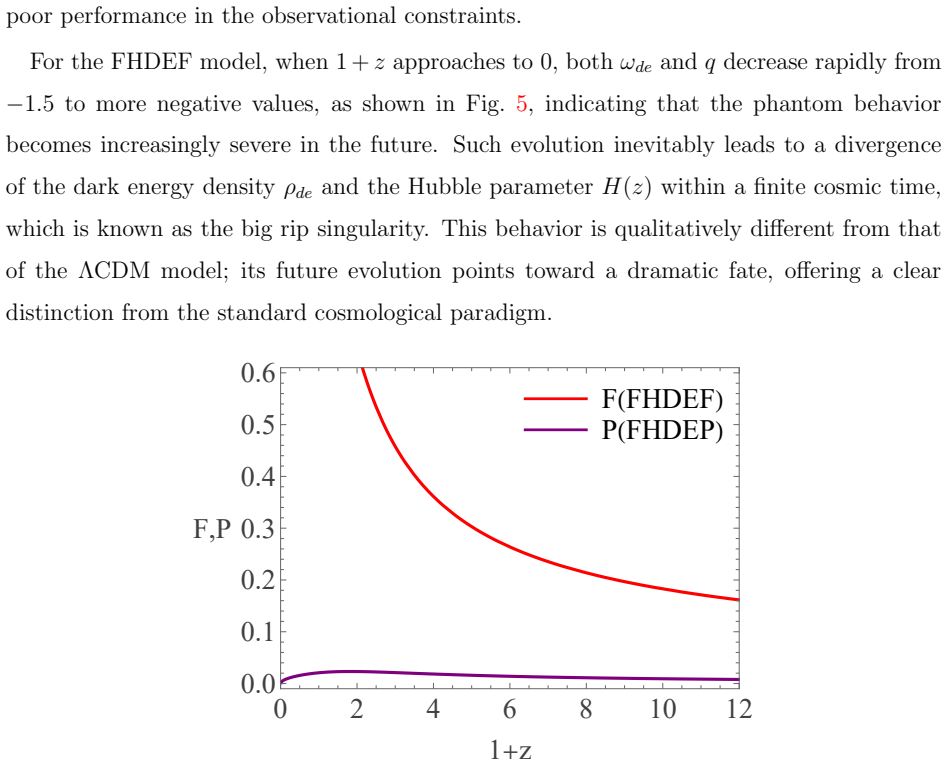
- [II.B, Eq. (19); II.C, Eq. (24)] The definition of the auxiliary variable relating F (and P) to the model parameters appears to have the ratio inverted. For FHDEF, substituting α = 2 into the displayed relation F = 1/C^{α/(2−3α)} with C = 1/(κ² C² H^{(2−α)/α} Ωde) yields F = 1/(κ C Ωde^{1/2}), whereas direct calculation from ρde = 3C² R_F^{-2} and Ωde = κ² ρde/(3H²) gives F = Ωde^{1/2}/(κ C). The same issue appears in Eq. (24) for the FHDEP model. Please correct the definition (e.g., C = Ωde H^{(2−α)/α}/(κ² C²)) and ensure the dynamical equations and numerical code are consistent with the corrected formula.
minor comments (5)
- [Table II] Upper limits such as α < 1.164 and α < 1.002 are reported without specifying the confidence level; please state whether these are 68% or 95% limits and describe how the limits are derived from the posterior.
- [Section III.A, Eq. (26)] Equation (26) includes Ωr,0, but the text never gives its value or whether it is fixed; please state the value used (e.g., from Planck) and describe how Ωb h² is handled in the CMB prior and in the computation of r_s and r_d.
- [Abstract and Section V] The word 'survives' for FHDEF is misleading given ΔBIC = 14; please rephrase to avoid implying that the model is preferred, or explicitly qualify it as 'not catastrophically excluded'.
- [Section II.B] The auxiliary variable in Eq. (19) is typeset with the same symbol C as the model parameter; use a distinct symbol (e.g., mathcal{C}) to avoid the confusion identified in the major comment.
- [Abstract] Minor grammar: 'its deceleration parameter q deviate' should be 'its deceleration parameter q deviates'.
Circularity Check
No significant circularity: the central observational constraints are external-data fits, and the cited prior work is not load-bearing.
full rationale
After reviewing the derivation chain, I find no step in which a claimed result is equivalent by construction to its inputs. The FHDE energy density, Eq. (1), is imported from Refs. [24,25], which are external prior works by different author groups; treating this as a model input is not circular, and the paper does not present it as a new derivation. The new FHDEF and FHDEP equations of state, Eqs. (18) and (23), are algebraically derived from Eq. (1) together with the horizon definitions and conservation equations, and the observational constraints are standard MCMC fits to external SN, OHD, DESI DR2, and CMB data. The Section IV evolutionary curves are computed from the best-fit mean parameter values and therefore are model consequences rather than independent predictions; this is an overstatement of predictiveness but not a fitted quantity being renamed as a prediction in the sense of the rubric. The only self-citations are Ref. [81], used to motivate a possible interacting extension as future work, and Refs. [83,84,89,90], used for the standard linear-stability analysis; none carries the paper's central conclusion. The fixed-redshift CMB distance-prior treatment is a consistency approximation that could bias Delta-chi-squared, but that is a correctness issue, not circular reasoning.
Assumptions & free parameters
free parameters (6)
- fractional parameter α =
FHDEF with CMB: α<1.103 (upper limit); FHDEH/FHDEP with CMB: α<1.002
- FHDE coefficient C =
FHDEF with CMB: 1.062 ± 0.08
- H0 =
FHDEF with CMB: 68.2±1.6 km/s/Mpc
- Ωm,0 =
FHDEF with CMB: 0.309±0.005
- M (SN absolute magnitude) =
not quoted in Table II
- rd =
147.0±3.3 Mpc for ΛCDM; not quoted for FHDE models
assumptions (6)
- standard math Flat FRW metric and Friedmann equations (Eqs. 2-3)
- domain assumption Conservation equations for radiation, matter, and dark energy (Eqs. 4-6)
- domain assumption FHDE energy density formula ρde = 3C²L^{(2-3α)/α} (Eq. 1)
- domain assumption Fractional entropy framework from fractional quantum mechanics (Ref [25])
- ad hoc to paper CMB distance priors with fixed z_*=1089.92 and z_drag=1059.94 from Planck
- ad hoc to paper MCMC prior ranges (H0 in [50,80], Ωm in [0.1,0.5], Ωde in [0.5,0.9], α in [1.0,2.0], C in [0,2], M in [-20,-18], rd in [130,160])
Cite this review
Pith. "Pith review of Observational constraints on fractional holographic dark energy in the light of DESI DR2." pith.science (2026). https://pith.science/paper/DEAIJEOR
@misc{pith2026260809379,
  author       = {Pith},
  title        = {Pith review of: Observational constraints on fractional holographic dark energy in the light of DESI DR2},
  year         = {2026},
  howpublished = {\url{https://pith.science/paper/DEAIJEOR}},
  note         = {Machine review of arXiv:2608.09379}
}
abstract
Based on the fractional entropy from fractional quantum mechanics, fractional holographic dark energy (FHDE) has been proposed with the Hubble horizon as the IR cutoff (FHDEH). We extend this framework by adopting the future event horizon and the particle horizon as the IR cutoff, proposing the FHDEF and FHDEP models. Using the SN+OHD+DESI DR2 dataset to constrain these models, we find that all three models provide a marginally lower $\chi^{2}_{min}$ compared to $\Lambda$CDM but without significant preference according to AIC and BIC. When CMB distance priors are included, the FHDEH and FHDEP models are strongly ruled out. We further analyze the cosmological evolution for these models, and find that only the FHDEF model predicts nearly identical evolutions of $\Omega_{m}$ and $\Omega_{de}$ to those of the $\Lambda$CDM model across cosmic history, but its deceleration parameter $q$ deviate from the $\Lambda$CDM model in the future, indicating richer late time dynamics beyond the standard $\Lambda$CDM cosmology.
Figures


Figures from the paper (5 more)




Reference graph
Works this paper leans on
-
[1]
Perlmutter, G
S. Perlmutter, G. Aldering, G. Goldhaberet al., Astrophys. J.,517: 565 (1999)
1999
-
[2]
Riess, A
A. Riess, A. Filippenko, P. Challiset al., Astron. J.,116: 1009 (1998)
1998
-
[3]
Spergel, L
D. Spergel, L. Verde, H. Peiriset al., Astrophys. J. Suppl.,148: 175 (2003)
2003
-
[4]
Spergel, R
D. Spergel, R. Bean, O. Doreet al., Astrophys. J. Suppl.170: 377 (2007)
2007
-
[5]
Tegmark, M
M. Tegmark, M. Strauss, M. Blantonet al., Phys. Rev. D,69: 103501 (2004)
2004
-
[6]
Eisenstein, I
D. Eisenstein, I. Zehavi, D. Hogget al., Astron. J.,633: 560 (2005)
2005
-
[7]
Peebles and B
P. Peebles and B. Ratra, Rev. Mod. Phys.,75: 559 (2003)
2003
-
[8]
Aghanimet al.(Planck Collaboration), A&A,641: A6 (2020)
N. Aghanimet al.(Planck Collaboration), A&A,641: A6 (2020)
2020
Show all 90 references
-
[9]
Weinberg, Rev
S. Weinberg, Rev. Mod. Phys.,61: 1 (1989)
1989
-
[10]
Steinhardt, L
P. Steinhardt, L. Wang, and I. Zlatev, Phys. Rev. D,59: 123504 (1999)
1999
-
[11]
Cohen, D
A. Cohen, D. Kaplan, and A. Nelson, Phys. Rev. Lett.,82: 4971 (1999)
1999
-
[12]
Hsu, Phys
S. Hsu, Phys. Lett. B,594: 13 (2004)
2004
-
[13]
Li, Phys
M. Li, Phys. Lett. B,603: 1 (2004)
2004
-
[14]
Horvat, Phys
R. Horvat, Phys. Rev. D,70: 087301 (2004)
2004
-
[15]
S. Wang, Y. Wang, and M. Li, Phys. Rep.,696: 1 (2017)
2017
-
[16]
Zhang and F
X. Zhang and F. Wu, Phys. Rev. D,72: 043524 (2005)
2005
-
[17]
M. Li, X. Li, S. Wang, and X. Zhang, JCAP,06: 036 (2009)
2009
-
[18]
T. Li, Y. Li, G. Du, P. Wu, L. Feng, J. Zhang, and X. Zhang, Eur. Phys. J. C85: 608 (2025)
2025
-
[19]
Li and S
J. Li and S. Wang, JCAP,07: 047 (2025). 24
2025
-
[20]
Zhang, Int.J.Mod.Phys.D,14: 1597 (2005)
X. Zhang, Int.J.Mod.Phys.D,14: 1597 (2005)
2005
-
[21]
Huang and M
Q. Huang and M. Li, JCAP,08: 013 (2004)
2004
-
[22]
Tavayef, A
M. Tavayef, A. Sheykhi, K. Bamba, and H. Moradpour, Phys. Lett. B,781: 195 (2018)
2018
-
[23]
Saridakis, Phys
E. Saridakis, Phys. Rev. D,102: 123525 (2020)
2020
-
[24]
Trivedi, A
O. Trivedi, A. Bidlan, and P. Moniz, Phys. Lett. B,858: 139074 (2024)
2024
-
[25]
Jalalzadeh, F
S. Jalalzadeh, F. da Silva, and P. Moniz, Eur. Phys. J. C,81: 1 (2021)
2021
-
[26]
Riess, W
A. Riess, W. Yuan, and L. Macriet al., Astrophys. J. Lett.,934: L7 (2022)
2022
-
[27]
Brout, D
D. Brout, D. Scolnic, and B.Popovicet al., Astrophys. J.,938: 110 (2022)
2022
-
[28]
Scolnic, D
D. Scolnic, D. Brout, A. Carret al., Astrophys. J.,938: 113 (2022)
2022
-
[29]
Cao and B
S. Cao and B. Ratra, Mon. Not. R. Astron. Soc.,513: 5686 (2022)
2022
-
[30]
X. Shen, B. Xu, K. Zhanget al., Eur. Phys. J. C,85: 992 (2025)
2025
-
[31]
J. Wang, H. Yu, and P. Wu, Eur. Phys. J. C,85: 853 (2025)
2025
-
[32]
Y. Liu, H. Yu, and P. Wu, Phys. Rev. D,110: L021304 (2024)
2024
-
[33]
Y. Liu, B. Wang, H. Yu, and P. Wu, Mon. Not. R. Astron. Soc.,533: 244 (2024)
2024
-
[34]
Arora and P
S. Arora and P. Sahoo, Phys. Dark Universe,45: 101510 (2024)
2024
-
[35]
Oliveros and M
A. Oliveros and M. Acero, Int. J. Mod. Phys. D,33: 2450004 (2024)
2024
-
[36]
D. Wang, M. Koussour, A. Malik, N. Myrzakulov, and G. Mustafa, Eur. Phys. J. C,83: 670 (2023)
2023
-
[37]
Mukherjee and N
P. Mukherjee and N. Banerjee, Phys. Dark Universe,36: 100998 (2022)
2022
-
[38]
Mukherjee and N
P. Mukherjee and N. Banerjee, Phys. Rev. D,105: 063516 (2022)
2022
-
[39]
S. Cao, J. Ryan, and B. Ratra, Mon. Not. R. Astron. Soc.,504: 300 (2021)
2021
-
[40]
Pacif, S
S. Pacif, S. Arora, and P. Sahoo, Phys. Dark Universe,32: 100804 (2021)
2021
-
[41]
S. Cao, T. Zhang, X. Wang, and T. Zhang, Universe,7: 57 (2021)
2021
-
[42]
Akarsu, J
O. Akarsu, J. Barrow, L. Escamilla, and J. Vazquez, Phys. Rev. D,101: 063528 (2020)
2020
-
[43]
Yang and Y
Y. Yang and Y. Gong, JCAP,6: 59 (2020)
2020
-
[44]
Y. Liu, R. Guo, J. Zhang, and X. Zhang, JCAP,5: 016 (2019)
2019
-
[45]
Jimenez, R
J. Jimenez, R. Lazkoz, D.Saez-Gomez, and V. Salzano, Eur. Phys. J. C,76: 631 (2016)
2016
-
[46]
Y. Gong, Q. Gao, and Z. Zhu, Mon. Not. R. Astron. Soc.,430: 3142 (2013). 25
2013
-
[47]
Q. Su, Z. Tuo, and R. Cai, Phys. Rev. D,84: 103519 (2011)
2011
-
[48]
Y. Gong, R. Cai, Y. Chen, and Z. Zhu, JCAP,01: 019 (2010)
2010
-
[49]
Wu and H
P. Wu and H. Yu, Phys. Lett. B,693: 415 (2010)
2010
-
[50]
Gong and A
Y. Gong and A. Wang, Phys. Rev. D,73: 083506 (2006)
2006
-
[51]
Wu and H
P. Wu and H. Yu, Phys. Lett. B,643: 315 (2006)
2006
-
[52]
Abdul Karim, J
M. Abdul Karim, J. Aguilar, S. Ahlenet al.,(DESI Collaboration) Phys. Rev. D,112: 083515 (2025)
2025
-
[53]
T. Li, G. Du, Y. Li, P. Wu, S. Jin, J. Zhang, and X. Zhang, Sci. China Phys. Mech. Astron., 69: 210413 (2026)
2026
-
[54]
T. Li, G. Du, S. Zhou, Y. Li, J. Zhang, and X. Zhang, Phys. Dark Universe,52: 102254 (2026)
2026
-
[55]
T. Li, W. Giare, G. Du, Y. Li, E. Valentino, J. Zhang, and X. Zhang, arXiv: 2601.07361
-
[56]
T. Li, G. Du, H. Wang, Y. Li, J. Zhang, and X. Zhang, Res. Astron. Astrophys.,26: 084002 (2026)
2026
-
[57]
G. Du, T. Li, T. Liu, J. Zhang, and X. Zhang, Sci. China Phys. Mech. Astron.,69: 280411 (2026)
2026
-
[58]
X. Ren, S. Li, Y. Liu, Y. Cai, H. Li, and X. Zhang, Res. Astron. Astrophys.,26: 084001 (2026)
2026
-
[59]
Wang and Y
H. Wang and Y. Piao, Phys.Lett.B,873: 140180 (2026)
2026
-
[60]
J. Wang, R. Cai, Z. Guo, and S. Wang, Phys. Rev. D,113: 083534 (2026)
2026
-
[61]
G. Du, T. Li, P. Wu, J. Zhang, and X. Zhang, arXiv: 2507.16589
-
[62]
T. Li, P. Wu, G. Du, S. Jin, H. Li, J. Zhang, and X. Zhang, ApJ,976: 1 (2024)
2024
-
[63]
Y. Pang, X. Zhang, and Q. Huang, Sci.China Phys.Mech.Astron.,68: 280410 (2025)
2025
-
[64]
Wang and Y
H. Wang and Y. Piao, arXiv: 2511.16606
-
[65]
Yadav, A
M. Yadav, A. Dixit, M. Barak, and A. Pradhan, JHEAp,50: 100514 (2026)
2026
-
[66]
Z. Zhu, Q. Jiang, Y. Liu, P. Wu, and N. Liang, JHEAp,51: 100377 (2026)
2026
-
[67]
Plaza, G
F. Plaza, G. Leon, and L. Kraiselburd, Eur. Phys. J. C,85: 1262 (2025)
2025
-
[68]
Petri, V
V. Petri, V. Marra, and R. Marttens, Phys. Rev. D,113: 023504 (2026). 26
2026
-
[69]
T. Li, P. Wu, G. Duet al., Phys. Dark Universe,50: 102068 (2025)
2025
-
[70]
Li and S
J. Li and S. Wang, Eur. Phys. J. C,85: 1308 (2025)
2025
-
[71]
Li and X
Y. Li and X. Zhang, JCAP,12: 018 (2025)
2025
-
[72]
T. Li, Y. Zhang, Y. Yaoet al., JCAP,12: 048 (2025)
2025
-
[73]
Luciano, A
G. Luciano, A. Paliathanasis, and E. Saridakis, JHEAp,49: 100427 (2026)
2026
-
[74]
Wang and K
Y. Wang and K. Freese, JCAP,02: 023 (2026)
2026
-
[75]
Robles-Barba, A
R. Robles-Barba, A. Garcia-Rivera, L. Molina-Ponceet al., Phys. Scr.,100: 085030 (2026)
2026
-
[76]
Zhai and Y
Z. Zhai and Y. Wang, JCAP,07: 005 (2019)
2019
-
[77]
L. Chen, Q. Huang, and K. Wang, JCAP,02: 028 (2019)
2019
-
[78]
Akaike, IEEE Trans
H. Akaike, IEEE Trans. Automatic Control,19: 716 (1974)
1974
-
[79]
Schwarz, Ann
G. Schwarz, Ann. Stat.,6: 461 (1978)
1978
-
[80]
Trotta, Contemp
R. Trotta, Contemp. Phys.,49: 71 (2008)
2008
-
[81]
Huang, H
Q. Huang, H. Chen, and Q. Wu, Universe,12: 134 (2026)
2026
-
[82]
Bahamonde, C
S. Bahamonde, C. Bohmer, S. Carloniet al., Phys. Rep.,1: 775 (2018)
2018
-
[83]
Huang, H
Q. Huang, H. Huang, J. Chenet al., Class. Quantum Grav.,36: 175001 (2019)
2019
-
[84]
Huang, H
Q. Huang, H. Huang, B. Xuet al., Eur. Phys. J. C,81: 686 (2021)
2021
-
[85]
Wu and H
P. Wu and H. Yu, Phys. Lett. B,692: 176 (2010)
2010
-
[86]
Dutta, W
J. Dutta, W. Khyllep, and N. Tamanini, Phys. Rev. D,95: 023515 (2017)
2017
-
[87]
Wu and S
P. Wu and S. Zhang, JCAP06: 007 (2008)
2008
-
[88]
Wu, and H
P. Wu, and H. Yu, Class. Quant. Grav.,24: 4661 (2007)
2007
-
[89]
Huang, H
Q. Huang, H. Huang, B. Xu, and K. Zhang, Universe,11: 147 (2025)
2025
-
[90]
Huang, H
Q. Huang, H. Huang, B. Xu, and K. Zhang, Eur. Phys. J. C,85: 395 (2025). 27
2025
Reviewed August 11, 2026 · model on record in the stance chip above.
Discussion (0). Continue with ORCID to comment.