REVIEW 3 major objections 4 minor 141 references
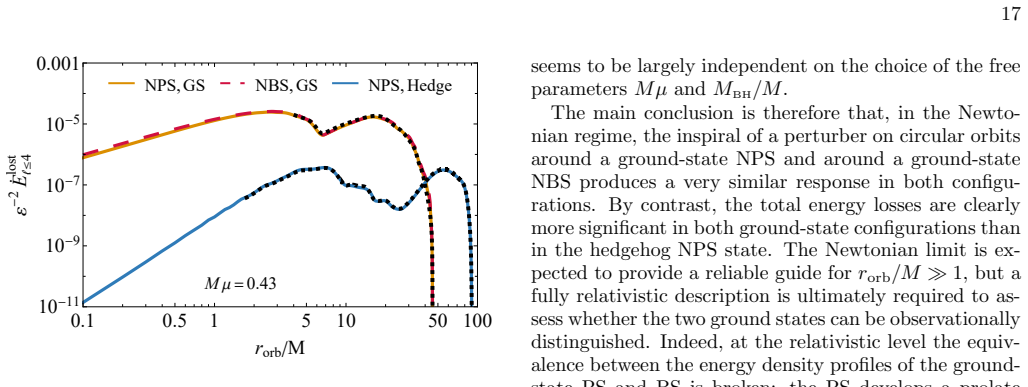
A small body inspiralling into the ground state of a Proca star loses almost the same energy as it would into a scalar boson star—at most about 20% difference—while the spherical Proca-star state radiates 10–100 times less energy when a sma
Reviewed by Pith at T0; open to challenge. T0 means a machine referee read the full paper against a public rubric. the ladder, T0–T4 →
T0 review · deepseek-v4-flash
2026-08-01 15:30 UTC pith:DOTVMACI
load-bearing objection First EMRI-into-Proca-star calculation, but the small-radius numbers that anchor the headline comparison are computed outside the nonrelativistic regime where the flux formulas are valid. the 3 major comments →
Extreme mass-ratio inspirals into Newtonian Proca stars
The pith
A machine-rendered reading of the paper's core claim, the machinery that carries it, and where it could break.
Core claim
In the Newtonian limit, the ground state of a Proca star displays the same spherically symmetric energy density profile as a scalar boson star ground state, despite the vector field itself being axially symmetric. As a consequence, the total orbital energy loss rate for a circular equatorial inspiral into a ground-state Proca star agrees with the scalar case within ~20%, differing mostly at very small orbital radii. In contrast, the spherical 'hedgehog' Proca star—an excited state—produces energy loss rates one to two orders of magnitude smaller than the ground state when a central point mass of 0.02 times the star mass is included.
What carries the argument
The central object is the vector Schrödinger–Poisson (SP) system, obtained as the Newtonian limit of the Einstein-Proca equations with the curvature-coupling term neglected. The ground-state Proca field is written as a dipolar ansatz whose radial profile satisfies the same SP equation as the scalar boson star ground state; this equivalence of backgrounds is what drives the similar energy-loss rates. The perturbation machinery consists of linearized SP equations with a point-particle source, expanded in vector and scalar spherical harmonics, with fluxes computed from asymptotic amplitudes of the outgoing Proca radiation.
Load-bearing premise
The Newtonian reduction of the Einstein-Proca system to a vector Schrödinger–Poisson system requires neglecting the curvature-coupling term R^i_j A^j, valid only when the star's radius is much larger than the boson Compton wavelength (2Rμ≫1); if this fails, the ~20% similarity between vector and scalar ground states is not guaranteed.
What would settle it
Redo the same Newtonian flux calculation for a ground-state Proca star at Mμ=0.43 with a central mass MBH=0.02M, pushing the numerical solution below r_orb/M<0.1 without the source-dominated approximation (e.g., with spectral or hyperboloidal methods that avoid fundamental-matrix inversion); if the ratio of Proca-star to scalar-boson-star energy loss falls outside ~0.8–1 there, the claimed ≤20% bound fails.
If this is right
- If the central claim is correct, ultralight vector dark matter forming a ground-state soliton would produce essentially the same environment-induced EMRI energy loss as scalar dark matter, to within roughly 20%.
- Proca radiation can dominate gravitational-wave emission in the early inspiral for orbital radii r_orb/M ≳ 1, shaping the dephasing of EMRI signals.
- The spherically symmetric Proca star, being an excited state, is a much weaker radiator; observational searches that assume spherical symmetry would systematically underestimate environmental dephasing.
- The result implies that distinguishing scalar from vector dark-matter cores via EMRI energy loss alone will require relativistic effects, where the ground-state Proca star becomes prolate and the density-profile equivalence is broken.
Where Pith is reading between the lines
- The near-equality of the loss rates may extend to any spherically symmetric density profile, since the source-dominated approximation reduces the physics to the background density; a non-bosonic but spherically symmetric density profile could be tested the same way.
- Non-circular or inclined orbits, which excite a richer set of multipoles and break the equatorial symmetry, are the most plausible place where the vector/scalar degeneracy could lift already at the Newtonian level—an explicit computation would settle this.
- If the Proca ground state is prolate at the relativistic level, eccentric EMRIs might exhibit orbit-plane precession and resonances absent for scalar boson stars; the Newtonian result suggests these would be the only distinguishing features in the waveform.
- The one-to-two-orders-of-magnitude difference between ground-state and excited-state Proca stars highlights that the internal state of the soliton is at least as important as its field-spin for environmental effects.
Editorial analysis
A structured set of objections, weighed in public.
Referee Report
Summary. The paper studies extreme mass-ratio inspirals into Newtonian Proca stars (NPSs), constructing both the spherically symmetric ('hedgehog') excited state and the axially symmetric ground state, and computing the energy lost by a point particle on circular equatorial orbits through Proca radiation. The central claims are that, at the Newtonian level, ground-state NPSs and ground-state Newtonian boson stars (NBSs) produce similar energy losses (within ~20%), while spherically symmetric Proca stars are much weaker radiators, especially in the presence of a central parasitic black hole. The work includes the perturbation equations for both backgrounds, flux formulas, three numerical methods (full setup, source-dominated, high-frequency), and convergence tests.
Significance. If the results hold, this is a useful first step toward understanding whether future EMRI observations can distinguish scalar from vector ultralight dark-matter solitons. The paper is commendably careful in several respects: the background solutions are cross-checked against the literature, the flux formulas are derived explicitly in Appendix B, three independent methods are compared in Appendix D, and convergence with multipole truncation is analyzed in Appendix C. No output quantity is fitted to data; the background eigenvalue is fixed by boundary conditions and the couplings are inputs. The headline comparison between ground-state NPS and NBS is physically surprising because the linear perturbation equations are very different, even though the background energy densities coincide.
major comments (3)
- [§VI B, §VI C, App. B; Eq. (69)] The nonrelativistic wavenumber approximation used in the flux formulas is not valid at the small radii where the headline claims are made. In Appendix B the flux is derived assuming γ≪μ and ω_orb≪μ, replacing the exact wavenumber sqrt((mω_orb+Ω)^2−μ^2) by sqrt(2μ(mω_orb−γ)). For the parameters of Fig. 7 (Mμ=0.43, M_BH=0.02M, r_orb=0.1M, m=2), the Keplerian frequency gives mω_orb/μ ≈ 20.8. The exact wavenumber is then about 21.8μ, while the nonrelativistic expression gives about 6.45μ — a factor of ~3.4. Thus the square-root factor in Eq. (69) and the perturbation equations themselves (which rely on the same nonrelativistic dispersion) are not controlled in this regime. Since the ~20% bound is explicitly associated with small r_orb, this part of the central quantitative claim is not supported by the derivation as written.
- [§V A 1, §V B 1, App. D] The small-radius results, which drive the one-to-two-orders-of-magnitude enhancement, are obtained only with the source-dominated and high-frequency approximations, because the full-setup method is numerically unstable in that region. The high-frequency approximation is applied precisely where mω_orb/μ is large, but its analytic homogeneous solutions, Eq. (100), are Bessel functions of argument sqrt(2μ mω_orb) r, derived from the nonrelativistic Schrödinger dispersion. In the regime where the approximation is used, the correct massive-vector dispersion is qualitatively different. The agreement between source-dominated and high-frequency approximations shown in Appendix D is therefore not an independent check of the small-radius curves, since both methods share the same invalid dispersion. A quantitative estimate of the error, or a computation retaining the exact wavenumber, is needed bef
- [§VI C, Fig. 7] The total loss rate is computed with ℓ≤4, and the assertion that higher multipoles do not alter the conclusions is based on the observation that cutoff radii do not shift appreciably. However, convergence is only demonstrated in Appendix C for a single mode (ℓ=m=2) at fixed r_orb=5M. At the small radii where the ~20% comparison is made, the contribution of higher ℓ to the vector-vs-scalar ratio could be different, especially because the ground-state NPS mixes multipoles while the NBS does not. Please provide a convergence check for the total ℓ≤4 sum at the small radii entering the headline claim, or explicitly caveat the ℓ≤4 truncation in the main conclusion.
minor comments (4)
- [§VI A, text before Eq. (116)] The statement that 'the high-frequency approximation is only applicable in the presence of a parasitic BH and at small enough orbital radii' is true only relative to the background potential. Since the approximation is also used at frequencies where ω_orb is not small compared with μ, the name is misleading; please clarify that 'high-frequency' means ω_orb≫γ, μU, and that the nonrelativistic condition ω_orb≪μ is a separate requirement that fails in the same region.
- [§III A 2, text after Eq. (32)] Typographical issues: 'distinctively prolatestructure' should read 'distinctively prolate structure', and elsewhere 'the lowest energy parameter γ' would be more precise as 'lowest binding-energy eigenvalue γ'.
- [§VII, Conclusions] The concluding paragraph says the results 'should be a good approximation for dilute bosonic stars, with secondaries moving at sufficiently large orbital radii', which is consistent with my main concern. Consider moving this caveat to the abstract or the beginning of the results section, so that the small-radius quantitative claims are immediately accompanied by this limitation.
- [Appendix B, Eq. (B11)] The derivation of the flux uses the nonrelativistic wavenumber but the text does not state the explicit inequality (mω_orb−γ)≪μ that is required. Please state this condition and verify where in the presented parameter space it is satisfied, ideally marking a shaded validity region in Figs. 3–7.
Circularity Check
No significant circularity: the central energy-loss comparison is computed from an independently derived perturbation framework, not fitted or forced by definition.
full rationale
I walked the claimed derivation chain and found no load-bearing step that reduces by construction to its inputs. The background profiles are obtained by solving the Newtonian SP eigenvalue problem: the binding-energy parameter γ is fixed by regularity at the origin and asymptotic flatness via shooting, not by matching the energy-loss output (Sec. III A 1–2, Figs. 1–2). The Mμ and MBH/M values used in Sec. VI are chosen inputs from the scalar literature, not fitted parameters. The ground-state NPS/NBS background equivalence is explicitly derived from the identical form of the radial SP equations (Eq. 33 vs. Eq. 39 of Ref. [69]) and is used only as a background statement; the paper does not assume that the vector and scalar perturbation fluxes are equal. On the contrary, the vector perturbation equations (Eqs. 56–59) differ structurally from the scalar ones, with coupled multipoles and mixed axial/polar sectors, and the ~20% agreement is found only after the full flux computation (Eqs. 67–69, Fig. 7). The paper itself flags this as 'surprising' given the very different master equations. No fitted quantity is renamed as a prediction, and no central result is justified solely by a self-citation: the cited ground-state and Newtonian-limits results (Refs. [98, 113, 114]) are not by the present authors, and the formal perturbation framework follows the external Ref. [69]. The validity caveats raised by the skeptical reading—e.g., the high-frequency approximation requires r/M ≪ 1 (App. D) and the Newtonian reduction assumes 2Rμ ≫ 1 (App. A)—are regime/correctness concerns, not circular reductions, and the paper explicitly scopes its conclusions to the Newtonian/dilute regime. Finding: no significant circularity; score 0.
Axiom & Free-Parameter Ledger
free parameters (1)
- background binding-energy eigenvalue γ =
γ̃ ≈ 0.162769 (ground state), ≈ 0.0541072 (hedgehog)
axioms (7)
- domain assumption Newtonian/weak-field reduction of Einstein-Proca to the vector Schrödinger-Poisson system, including neglect of the curvature-coupling term R^i_j A^j in Eq. (A11).
- domain assumption Background NPS solutions: hedgehog and dipolar ground-state ansatz (Eqs. (23), (32)) are the correct Newtonian limits of Proca stars from Refs. [98,113,114].
- domain assumption Point particle moves on a fixed circular equatorial geodesic of the background and sources perturbations only through its mass density in the Poisson equation; backreaction, eccentric/inclined orbits, and BH absorption are neglected.
- domain assumption Noether charge/mass relation M=μQ, and total Proca energy loss = Ė_rad + μĖ_Qrad.
- ad hoc to paper Multipole truncation L=4 (full setup) / L=10 (source-dominated) is sufficient for total loss rates.
- ad hoc to paper Source-dominated approximation: μ² A0j δA_j is negligible compared to the point-particle source in the Poisson equation.
- standard math Sommerfeld outgoing radiation and asymptotic flatness uniquely select physical solutions.
read the original abstract
Massive bosonic fields can form self-gravitating solitonic structures, which for vector fields are known as Proca stars. For ultralight fields, these structures can describe the cores of dark matter haloes surrounding the supermassive black holes at the center of galaxies. It has been argued that future gravitational-wave detectors might be able to probe the properties of dark matter structures. However, most of the analyses considering ultralight dark matter have focused on massive scalar fields. In this work, we study how Proca stars respond to a perturbing small object inspiralling in their interior, in the Newtonian limit. We consider both Newtonian spherically symmetric Proca stars and the non-spherically symmetric ground-state solutions. We compute the total energy lost by the orbiting object and compare it to the case where the bosonic star is composed of a scalar field. Our results show that, at the Newtonian level, the energy lost by the object in a Proca star ground state is similar to that in its scalar field counterpart, with relative differences of at most $\sim 20\%$, while the maximum orbital energy loss rate in the ground-state configuration can be one to two orders of magnitude larger than in the spherically symmetric Proca star, when a central parasitic black hole is present. Our work motivates the need to study extreme mass-ratio inspirals into Proca stars using a fully relativistic setup, where differences between the Proca and scalar boson star ground states are expected to become more significant.
Figures




Reference graph
Works this paper leans on
-
[1]
(61) is subleading 12 with respect to the source termP(see Refs
Source-dominated approximation In the Newtonian limit, the NPS density is typically sufficiently small that the termµ 2A0jδAj in Eq. (61) is subleading 12 with respect to the source termP(see Refs. [69, 82] for a related discussion). Letε B de- note the field amplitude, such thatA 0j ∼ε B, and let ε=m p/MNPS be the mass ratio. If the perturbation scales a...
-
[2]
parasitic BH
Source-dominated approximation As discussed in the hedgehog case, it is useful to take the approximation in which the solution to the potential uℓ(r) is given, Eq. (94), such thatu ℓ(r) only appears as a source term in Eqs. (57)–(59). Following the same steps as in the hedgehog case, we find that, for any truncation L, we can completely decouple the syste...
2025
-
[3]
Planck 2018 results. VI. Cosmological parameters,
N. Aghanimet al.(Planck), “Planck 2018 results. VI. Cosmological parameters,” Astron. Astrophys.641, A6 (2020), [Erratum: Astron.Astrophys. 652, C4 (2021)], arXiv:1807.06209 [astro-ph.CO]
Pith/arXiv arXiv 2018
-
[4]
Particle dark mat- ter: Evidence, candidates and constraints,
G. Bertone, D. Hooper, and J. Silk, “Particle dark mat- ter: Evidence, candidates and constraints,” Phys. Rept. 405, 279–390 (2005), arXiv:hep-ph/0404175
Pith/arXiv arXiv 2005
-
[5]
Dark matter candidates and searches,
N. Bozorgnia, J. Bramante, J. M. Cline, D. Curtin, D. McKeen, D. E. Morrissey, A. Ritz, S. Viel, A. C. Vincent, and Y. Zhang, “Dark matter candidates and searches,” Can. J. Phys.103, 671–703 (2025), arXiv:2410.23454 [hep-ph]
Pith/arXiv arXiv 2025
-
[6]
Cosmological Lower Bound on Heavy Neutrino Masses,
B. W. Lee and S. Weinberg, “Cosmological Lower Bound on Heavy Neutrino Masses,” Phys. Rev. Lett. 39, 165–168 (1977)
1977
-
[7]
Limits on Masses and Number of Neutral Weakly Interacting Particles,
P. Hut, “Limits on Masses and Number of Neutral Weakly Interacting Particles,” Phys. Lett. B69, 85 (1977)
1977
-
[8]
GeV-scale thermal WIMPs: Not even slightly ruled out,
R. K. Leane, T. R. Slatyer, J. F. Beacom, and K. C. Y. Ng, “GeV-scale thermal WIMPs: Not even slightly ruled out,” Phys. Rev. D98, 023016 (2018), arXiv:1805.10305 [hep-ph]
Pith/arXiv arXiv 2018
-
[9]
Closing the window on WIMP Dark Matter,
S. Bottaro, D. Buttazzo, M. Costa, R. Franceschini, P. Panci, D. Redigolo, and L. Vittorio, “Closing the window on WIMP Dark Matter,” Eur. Phys. J. C82, 31 (2022), arXiv:2107.09688 [hep-ph]
Pith/arXiv arXiv 2022
-
[10]
G. Jungman, M. Kamionkowski, and K. Griest, “Su- persymmetric dark matter,” Phys. Rept.267, 195–373 (1996), arXiv:hep-ph/9506380
Pith/arXiv arXiv 1996
-
[11]
WIMP dark matter candidates and searches—current status and future prospects,
L. Roszkowski, E. M. Sessolo, and S. Trojanowski, “WIMP dark matter candidates and searches—current status and future prospects,” Rept. Prog. Phys.81, 066201 (2018), arXiv:1707.06277 [hep-ph]
Pith/arXiv arXiv 2018
-
[12]
Towards the Final Word on Neu- tralino Dark Matter,
J. Bramante, N. Desai, P. Fox, A. Martin, B. Ost- diek, and T. Plehn, “Towards the Final Word on Neu- tralino Dark Matter,” Phys. Rev. D93, 063525 (2016), arXiv:1510.03460 [hep-ph]
Pith/arXiv arXiv 2016
-
[13]
Small-Scale Challenges to the ΛCDM Paradigm,
J. S. Bullock and M. Boylan-Kolchin, “Small-Scale Challenges to the ΛCDM Paradigm,” Ann. Rev. As- tron. Astrophys.55, 343–387 (2017), arXiv:1707.04256 [astro-ph.CO]
Pith/arXiv arXiv 2017
-
[14]
Observational and theoretical constraints on singular dark matter ha- los,
R. A. Flores and J. R. Primack, “Observational and theoretical constraints on singular dark matter ha- los,” Astrophys. J. Lett.427, L1–4 (1994), arXiv:astro- ph/9402004
arXiv 1994
-
[15]
Where are the missing Galactic satel- lites?
A. A. Klypin, A. V. Kravtsov, O. Valenzuela, and F. Prada, “Where are the missing Galactic satel- lites?” Astrophys. J.522, 82–92 (1999), arXiv:astro- ph/9901240
arXiv 1999
-
[16]
Astrophysical tests of dark matter self-interactions,
S. Adhikariet al., “Astrophysical tests of dark matter self-interactions,” Rev. Mod. Phys.97, 045004 (2025), arXiv:2207.10638 [astro-ph.CO]
arXiv 2025
-
[17]
A baryonic solution to the missing satellites problem,
A. M. Brooks, M. Kuhlen, A. Zolotov, and D. Hooper, “A baryonic solution to the missing satellites problem,” The Astrophysical Journal765, 22 (2013)
2013
-
[18]
Born to be starless: Revisiting the missing satellite problem,
S. Jeon, S. K. Yi, E. Contini, Y. Dubois, S. Han, K. Kraljic, S. Peirani, C. Pichon, and J. Rhee, “Born to be starless: Revisiting the missing satellite problem,” (2025), arXiv:2506.09152 [astro-ph.GA]
Pith/arXiv arXiv 2025
-
[19]
E. G. M. Ferreira, “Ultra-light dark matter,” Astron. Astrophys. Rev.29, 7 (2021), arXiv:2005.03254 [astro- ph.CO]
Pith/arXiv arXiv 2021
-
[20]
CP Conservation in the Presence of Instantons,
R. D. Peccei and H. R. Quinn, “CP Conservation in the Presence of Instantons,” Phys. Rev. Lett.38, 1440–1443 (1977)
1977
-
[21]
Recent Progress in the Physics of Axions and Axion-Like Par- ticles,
K. Choi, S. H. Im, and C. Sub Shin, “Recent Progress in the Physics of Axions and Axion-Like Par- ticles,” Ann. Rev. Nucl. Part. Sci.71, 225–252 (2021), arXiv:2012.05029 [hep-ph]
Pith/arXiv arXiv 2021
-
[22]
New experimental ap- proaches in the search for axion-like particles,
I. G. Irastorza and J. Redondo, “New experimental ap- proaches in the search for axion-like particles,” Prog. Part. Nucl. Phys.102, 89–159 (2018), arXiv:1801.08127 [hep-ph]
Pith/arXiv arXiv 2018
-
[23]
A. Arvanitaki, S. Dimopoulos, S. Dubovsky, N. Kaloper, and J. March-Russell, “String Axiverse,” Phys. Rev. D 81, 123530 (2010), arXiv:0905.4720 [hep-th]
Pith/arXiv arXiv 2010
-
[24]
P. Svrcek and E. Witten, “Axions In String Theory,” JHEP06, 051 (2006), arXiv:hep-th/0605206
Pith/arXiv arXiv 2006
-
[25]
S. Alexander, T. Manton, and E. McDonough, “Field theory axiverse,” Phys. Rev. D109, 116019 (2024), arXiv:2404.11642 [hep-ph]
Pith/arXiv arXiv 2024
-
[26]
Two U(1)’s and Epsilon Charge Shifts,
B. Holdom, “Two U(1)’s and Epsilon Charge Shifts,” Phys. Lett. B166, 196–198 (1986)
1986
-
[27]
Fabbrichesi, E
M. Fabbrichesi, E. Gabrielli, and G. Lanfranchi,The Physics of the Dark Photon: A Primer(Springer, Cham, 2021)
2021
-
[28]
Recent develop- ments in bimetric theory,
A. Schmidt-May and M. von Strauss, “Recent develop- ments in bimetric theory,” J. Phys. A49, 183001 (2016), arXiv:1512.00021 [hep-th]
Pith/arXiv arXiv 2016
-
[29]
C. de Rham, “Massive Gravity,” Living Rev. Rel.17, 7 (2014), arXiv:1401.4173 [hep-th]
Pith/arXiv arXiv 2014
-
[30]
Oscillating Spin-2 Dark Matter,
L. Marzola, M. Raidal, and F. R. Urban, “Oscillating Spin-2 Dark Matter,” Phys. Rev. D97, 024010 (2018), arXiv:1708.04253 [hep-ph]
Pith/arXiv arXiv 2018
-
[31]
Ultralight fuzzy dark matter review,
A. Eberhardt and E. G. M. Ferreira, “Ultralight fuzzy dark matter review,” (2025), arXiv:2507.00705 [astro- ph.CO]
Pith/arXiv arXiv 2025
-
[32]
W. Hu, R. Barkana, and A. Gruzinov, “Cold and fuzzy dark matter,” Phys. Rev. Lett.85, 1158–1161 (2000), arXiv:astro-ph/0003365
Pith/arXiv arXiv 2000
-
[33]
C. Capanelli, E. G. M. Ferreira, and E. McDonough, “Cold and fuzzy dark sector,” (2025), arXiv:2509.15299 [astro-ph.CO]
arXiv 2025
-
[34]
A Review on the Scalar Field/Bose-Einstein Condensate Dark Mat- ter Model,
A. Su´ arez, V. H. Robles, and T. Matos, “A Review on the Scalar Field/Bose-Einstein Condensate Dark Mat- ter Model,” Astrophys. Space Sci. Proc.38, 107–142 (2014), arXiv:1302.0903 [astro-ph.CO]
Pith/arXiv arXiv 2014
-
[35]
Cosmo- 24 logical Constraints on Bose-Einstein-Condensed Scalar Field Dark Matter,
B. Li, T. Rindler-Daller, and P. R. Shapiro, “Cosmo- 24 logical Constraints on Bose-Einstein-Condensed Scalar Field Dark Matter,” Phys. Rev. D89, 083536 (2014), arXiv:1310.6061 [astro-ph.CO]
Pith/arXiv arXiv 2014
-
[36]
L. Hui, “Wave Dark Matter,” Ann. Rev. Astron. As- trophys.59, 247–289 (2021), arXiv:2101.11735 [astro- ph.CO]
Pith/arXiv arXiv 2021
-
[37]
Galactic halos as boson stars,
J.-w. Lee and I.-g. Koh, “Galactic halos as boson stars,” Phys. Rev. D53, 2236–2239 (1996), arXiv:hep- ph/9507385
arXiv 1996
-
[38]
Brief History of Ultra-light Scalar Dark Matter Models,
J.-W. Lee, “Brief History of Ultra-light Scalar Dark Matter Models,” EPJ Web Conf.168, 06005 (2018), arXiv:1704.05057 [astro-ph.CO]
Pith/arXiv arXiv 2018
-
[39]
Galactic halos and ro- tating bosonic dark matter,
J. C. Mourelle and C. Adam, “Galactic halos and ro- tating bosonic dark matter,” Phys. Rev. D110, 123001 (2024), arXiv:2407.07839 [astro-ph.GA]
Pith/arXiv arXiv 2024
-
[40]
Ghostly Galaxies as Solitons of Bose-Einstein Dark Matter,
T. Broadhurst, I. de Martino, H. N. Luu, G. F. Smoot, and S. H. H. Tye, “Ghostly Galaxies as Solitons of Bose-Einstein Dark Matter,” Phys. Rev. D101, 083012 (2020), arXiv:1902.10488 [astro-ph.CO]
Pith/arXiv arXiv 2020
-
[41]
Reproducing galactic rotation curves with a two- component bosonic dark matter model,
J. C. Mourelle, N. Sanchis-Gual, and J. A. Font, “Reproducing galactic rotation curves with a two- component bosonic dark matter model,” Phys. Rev. D 112, 063054 (2025), arXiv:2505.07465 [astro-ph.GA]
arXiv 2025
-
[42]
Astrophysical signatures of boson stars: quasinormal modes and inspiral resonances,
C. F. B. Macedo, P. Pani, V. Cardoso, and L. C. B. Crispino, “Astrophysical signatures of boson stars: quasinormal modes and inspiral resonances,” Phys. Rev. D88, 064046 (2013), arXiv:1307.4812 [gr-qc]
Pith/arXiv arXiv 2013
-
[43]
Spherical bo- son stars as black hole mimickers,
F. S. Guzm´ an and J. M. Rueda-Becerril, “Spherical bo- son stars as black hole mimickers,” Physical Review D 80(2009), 10.1103/physrevd.80.084023
-
[44]
The imitation game: Proca stars that can mimic the Schwarzschild shadow,
C. A. R. Herdeiro, A. M. Pombo, E. Radu, P. V. P. Cunha, and N. Sanchis-Gual, “The imitation game: Proca stars that can mimic the Schwarzschild shadow,” JCAP04, 051 (2021), arXiv:2102.01703 [gr-qc]
Pith/arXiv arXiv 2021
-
[45]
Head-on collisions and orbital merg- ers of Proca stars,
N. Sanchis-Gual, C. Herdeiro, J. A. Font, E. Radu, and F. Di Giovanni, “Head-on collisions and orbital merg- ers of Proca stars,” Phys. Rev. D99, 024017 (2019), arXiv:1806.07779 [gr-qc]
Pith/arXiv arXiv 2019
-
[46]
Long-Term Stable Nonlinear Evolutions of Ultra- compact Black-Hole Mimickers,
G. A. Marks, S. J. Staelens, T. Evstafyeva, and U. Sper- hake, “Long-Term Stable Nonlinear Evolutions of Ultra- compact Black-Hole Mimickers,” Phys. Rev. Lett.135, 131402 (2025), arXiv:2504.17775 [gr-qc]
arXiv 2025
-
[47]
Inspirals into bosonic dark matter stars and chirp mimickers,
C. F. B. Macedo, H. C. D. Lima, R. F. P. Mendes, R. Vicente, and V. Cardoso, “Inspirals into bosonic dark matter stars and chirp mimickers,” (2026), arXiv:2603.08795 [gr-qc]
arXiv 2026
-
[48]
Superradiance: New Frontiers in Black Hole Physics,
R. Brito, V. Cardoso, and P. Pani, “Superradiance: New Frontiers in Black Hole Physics,” Lect. Notes Phys. 906, pp.1–237 (2015), arXiv:1501.06570 [gr-qc]
Pith/arXiv arXiv 2015
-
[49]
Kerr black holes with scalar hair,
C. A. R. Herdeiro and E. Radu, “Kerr black holes with scalar hair,” Phys. Rev. Lett.112, 221101 (2014), arXiv:1403.2757 [gr-qc]
Pith/arXiv arXiv 2014
-
[50]
Kerr black holes with Proca hair,
C. Herdeiro, E. Radu, and H. R´ unarsson, “Kerr black holes with Proca hair,” Class. Quant. Grav.33, 154001 (2016), arXiv:1603.02687 [gr-qc]
Pith/arXiv arXiv 2016
-
[51]
Gravitational wave probes of dark matter: challenges and opportunities,
G. Bertoneet al., “Gravitational wave probes of dark matter: challenges and opportunities,” SciPost Phys. Core3, 007 (2020), arXiv:1907.10610 [astro-ph.CO]
Pith/arXiv arXiv 2020
-
[52]
Gravitational wave probes of particle dark matter: A review,
A. L. Miller, “Gravitational wave probes of particle dark matter: A review,” Int. J. Mod. Phys. D35, 2530005 (2026), arXiv:2503.02607 [astro-ph.HE]
arXiv 2026
-
[53]
A. G. Abacet al.(LIGO Scientific, VIRGO, KAGRA), “GWTC-4.0: Updating the Gravitational-Wave Tran- sient Catalog with Observations from the First Part of the Fourth LIGO-Virgo-KAGRA Observing Run,” (2025), arXiv:2508.18082 [gr-qc]
Pith/arXiv arXiv 2025
-
[54]
GWTC-4.0: Tests of General Relativity. I. Overview and General Tests,
A. G. Abacet al.(LIGO Scientific, VIRGO, KAGRA), “GWTC-4.0: Tests of General Relativity. I. Overview and General Tests,” (2026), arXiv:2603.19019 [gr-qc]
Pith/arXiv arXiv 2026
-
[55]
Taiji program: Gravitational-wave sources,
W.-H. Ruan, Z.-K. Guo, R.-G. Cai, and Y.-Z. Zhang, “Taiji program: Gravitational-wave sources,” Int. J. Mod. Phys. A35, 2050075 (2020), arXiv:1807.09495 [gr- qc]
Pith/arXiv arXiv 2020
-
[56]
TianQin: a space-borne gravi- tational wave detector,
J. Luoet al.(TianQin), “TianQin: a space-borne gravi- tational wave detector,” Class. Quant. Grav.33, 035010 (2016), arXiv:1512.02076 [astro-ph.IM]
Pith/arXiv arXiv 2016
-
[57]
M. Colpiet al.(LISA), “LISA Definition Study Report,” (2024), arXiv:2402.07571 [astro-ph.CO]
Pith/arXiv arXiv 2024
-
[58]
The unique po- tential of extreme mass-ratio inspirals for gravitational- wave astronomy,
C. P. L. Berry, S. A. Hughes, C. F. Sopuerta, A. J. K. Chua, A. Heffernan, K. Holley-Bockelmann, D. P. Mi- haylov, M. C. Miller, and A. Sesana, “The unique po- tential of extreme mass-ratio inspirals for gravitational- wave astronomy,” Bull. Am. Astron. Soc.51, 42 (2019), arXiv:1903.03686 [astro-ph.HE]
Pith/arXiv arXiv 2019
-
[59]
Science with the space-based interferometer LISA. V: Extreme mass-ratio inspirals,
S. Babak, J. Gair, A. Sesana, E. Barausse, C. F. Sop- uerta, C. P. L. Berry, E. Berti, P. Amaro-Seoane, A. Pe- titeau, and A. Klein, “Science with the space-based interferometer LISA. V: Extreme mass-ratio inspirals,” Phys. Rev. D95, 103012 (2017), arXiv:1703.09722 [gr- qc]
Pith/arXiv arXiv 2017
-
[60]
L. Speri, F. Duque, S. Barsanti, A. Santini, S. Kejri- wal, O. Burke, and C. E. A. Chapman-Bird, “Quan- tifying the Scientific Potential of Intermediate and Ex- treme Mass Ratio Inspirals with the Laser Interferom- eter Space Antenna,” (2026), arXiv:2603.17072 [astro- ph.IM]
arXiv 2026
-
[61]
Using LISA EMRI sources to test off-Kerr deviations in the geometry of massive black holes,
L. Barack and C. Cutler, “Using LISA EMRI sources to test off-Kerr deviations in the geometry of massive black holes,” Phys. Rev. D75, 042003 (2007), arXiv:gr- qc/0612029
arXiv 2007
-
[62]
Extreme and Intermediate-Mass Ratio Inspirals in Dynamical Chern- Simons Modified Gravity,
C. F. Sopuerta and N. Yunes, “Extreme and Intermediate-Mass Ratio Inspirals in Dynamical Chern- Simons Modified Gravity,” Phys. Rev. D80, 064006 (2009), arXiv:0904.4501 [gr-qc]
Pith/arXiv arXiv 2009
-
[63]
Gravitational waves from extreme mass-ratio inspirals in Dynamical Chern-Simons gravity,
P. Pani, V. Cardoso, and L. Gualtieri, “Gravitational waves from extreme mass-ratio inspirals in Dynamical Chern-Simons gravity,” Phys. Rev. D83, 104048 (2011), arXiv:1104.1183 [gr-qc]
Pith/arXiv arXiv 2011
-
[64]
Approximate Waveforms for Extreme-Mass-Ratio Inspirals in Modified Grav- ity Spacetimes,
J. Gair and N. Yunes, “Approximate Waveforms for Extreme-Mass-Ratio Inspirals in Modified Grav- ity Spacetimes,” Phys. Rev. D84, 064016 (2011), arXiv:1106.6313 [gr-qc]
Pith/arXiv arXiv 2011
-
[65]
Testing Gravity with Extreme-Mass-Ratio Inspirals,
A. C´ ardenas-Avenda˜ no and C. F. Sopuerta, “Testing Gravity with Extreme-Mass-Ratio Inspirals,” (2024) arXiv:2401.08085 [gr-qc]
Pith/arXiv arXiv 2024
-
[66]
Extreme Mass Ratio Inspirals with Scalar Hair,
A. Kuntz, R. Penco, and F. Piazza, “Extreme Mass Ratio Inspirals with Scalar Hair,” JCAP08, 023 (2020), arXiv:2004.10772 [gr-qc]
Pith/arXiv arXiv 2020
-
[67]
Gravi- tational waves from eccentric extreme mass-ratio inspi- rals as probes of scalar fields,
C. Zhang, Y. Gong, D. Liang, and B. Wang, “Gravi- tational waves from eccentric extreme mass-ratio inspi- rals as probes of scalar fields,” JCAP06, 054 (2023), arXiv:2210.11121 [gr-qc]
Pith/arXiv arXiv 2023
-
[68]
L. Speri, S. Barsanti, A. Maselli, T. P. Sotiriou, N. War- burton, M. van de Meent, A. J. K. Chua, O. Burke, and J. Gair, “Probing fundamental physics with ex- treme mass ratio inspirals: Full Bayesian inference for scalar charge,” Phys. Rev. D113, 023036 (2026), arXiv:2406.07607 [gr-qc]. 25
arXiv 2026
-
[69]
Tidal heating as a discriminator for horizons in ex- treme mass ratio inspirals,
S. Datta, R. Brito, S. Bose, P. Pani, and S. A. Hughes, “Tidal heating as a discriminator for horizons in ex- treme mass ratio inspirals,” Phys. Rev. D101, 044004 (2020), arXiv:1910.07841 [gr-qc]
Pith/arXiv arXiv 2020
-
[70]
P. Pani and A. Maselli, “Love in Extrema Ratio,” Int. J. Mod. Phys. D28, 1944001 (2019), arXiv:1905.03947 [gr-qc]
Pith/arXiv arXiv 2019
-
[71]
Response of ultralight dark matter to supermassive black holes and binaries,
L. Annulli, V. Cardoso, and R. Vicente, “Response of ultralight dark matter to supermassive black holes and binaries,” Phys. Rev. D102, 063022 (2020), arXiv:2009.00012 [gr-qc]
Pith/arXiv arXiv 2020
-
[72]
Testing the nature of dark compact objects with gravita- tional waves,
E. Maggio, P. Pani, and G. Raposo, “Testing the nature of dark compact objects with gravita- tional waves,” (2021), 10.1007/978-981-15-4702-7 29-1, arXiv:2105.06410 [gr-qc]
Pith/arXiv arXiv 2021
-
[73]
K. Destounis, F. Angeloni, M. Vaglio, and P. Pani, “Extreme-mass-ratio inspirals into rotating boson stars: Nonintegrability, chaos, and transient resonances,” Phys. Rev. D108, 084062 (2023), arXiv:2305.05691 [gr- qc]
Pith/arXiv arXiv 2023
-
[74]
Extreme mass-ratio inspi- ral around the horizonless massive object,
T. Zi, L. Ren, and J. Cheng, “Extreme mass-ratio inspi- ral around the horizonless massive object,” Eur. Phys. J. C84, 828 (2024)
2024
-
[75]
Plunge spectra as discriminators of black- hole mimickers,
S. Nair, “Plunge spectra as discriminators of black- hole mimickers,” Phys. Rev. D113, 104005 (2026), arXiv:2509.09986 [gr-qc]
Pith/arXiv arXiv 2026
-
[76]
Can en- vironmental effects spoil precision gravitational-wave astrophysics?
E. Barausse, V. Cardoso, and P. Pani, “Can en- vironmental effects spoil precision gravitational-wave astrophysics?” Phys. Rev. D89, 104059 (2014), arXiv:1404.7149 [gr-qc]
Pith/arXiv arXiv 2014
-
[77]
Probing the existence of ultralight bosons with a single gravitational-wave measurement,
O. A. Hannuksela, K. W. K. Wong, R. Brito, E. Berti, and T. G. F. Li, “Probing the existence of ultralight bosons with a single gravitational-wave measurement,” Nature Astron.3, 447–451 (2019), arXiv:1804.09659 [astro-ph.HE]
Pith/arXiv arXiv 2019
-
[78]
Gravitational Collider Physics,
D. Baumann, H. S. Chia, R. A. Porto, and J. Stout, “Gravitational Collider Physics,” Phys. Rev. D101, 083019 (2020), arXiv:1912.04932 [gr-qc]
Pith/arXiv arXiv 2020
-
[79]
Dynamical friction in gravitational atoms,
G. M. Tomaselli, T. F. M. Spieksma, and G. Bertone, “Dynamical friction in gravitational atoms,” JCAP07, 070 (2023), arXiv:2305.15460 [gr-qc]
Pith/arXiv arXiv 2023
-
[80]
Extreme mass-ratio inspirals into black holes surrounded by scalar clouds,
R. Brito and S. Shah, “Extreme mass-ratio inspirals into black holes surrounded by scalar clouds,” Phys. Rev. D 108, 084019 (2023), [Erratum: Phys.Rev.D 110, 109902 (2024)], arXiv:2307.16093 [gr-qc]
Pith/arXiv arXiv 2023
discussion (0)
Sign in with ORCID, Apple, or X to comment. Anyone can read and Pith papers without signing in.