REVIEW 4 major objections 5 minor 17 references
Finite density lattice QCD via effective Polyakov loop theories
T0 review · 4 major / 5 minor · reviewed 2026-08-09 · deepseek-v4-flash
Pith's one-line read This paper shows that a resummed mean-field approximation evaluates effective Polyakov loop theories with quantitative accuracy for first-order deconfinement transitions, making finite-density QCD phase diagrams accessible for heavy quarks.
desk verdict The r-mf benchmark is the real result; the low-temperature phase diagram is not covered by it, and the paper basically admits that. read the letter →
The pith
A machine-rendered reading of the paper's core claim, the machinery that carries it, and where it could break.
The reading
What carries the argument
The machinery is the effective action $S_{\mathrm{eff}}$ for the traced temporal Wilson lines $L_x=\mathrm{Tr}\,W_x$, truncated to $O(u^n\kappa^m)$ with $n+m\le4$: a nearest-neighbor gauge interaction $\ln(1+\lambda_1 L_x L_y^*+\lambda_1 L_y L_x^*)$, static quark determinant terms, and kinetic quark contributions built from the hopping functions $W_{nm\bar n\bar m}$. Evaluation is done by three mean-field schemes that differ in how local fluctuations $\delta L_x=L_x-l$ are treated. The resummed mean field is the load-bearing one: it neglects non-local fluctuation products but resums all orders of local fluctuations, giving a factorized partition function $Z\simeq z^V$ and a modified self-consistency condition. For the low-temperature, finite-density regime the classical (saddle-point) approximation is used instead, parameterizing $L$ by two angles with the Haar-measure Jacobian as an effective potential.
What would settle it
Simulate the same truncated effective action directly (e.g. with complex Langevin or a dual representation) at $\kappa=0.12$, $N_\tau=500$ and scan $\mu_B$: if the entropy density does not jump to negative values at the same chemical potential as the mean-field liquid-gas transition, the transition line and thermodynamic results are truncation artifacts. Alternatively, extend the effective action to $O(u^n\kappa^m)$ with $n+m=5$ and check whether the resummed mean-field critical coupling in the pure gauge limit stays within 3% of the series-expansion value.
Extended reading notes
Core claim
The central claim is that local fluctuations are the main source of error in mean-field evaluations of effective Polyakov loop theories, and that resumming them to all orders restores quantitative accuracy. Using the leading-order pure gauge action, the classical saddle-point approximation (no local fluctuations) gives $\lambda_{1,c}\approx 0.09$, a 50% error against the series-expansion value $\lambda_{1,c}\approx 0.1885$; the standard mean field (Haar-measure fluctuations only) gives $\lambda_{1,c}\approx 0.15$, a 20% error; the resummed mean field, which keeps all powers of the local fluctuation $\delta L_x^n\delta L_x^{*m}$, gives $\lambda_{1,c}\approx 0.18505$, a 3% error. The paper takes this as evidence that the resummed scheme is reliable for first-order deconfinement transitions and applies it to obtain the deconfinement and liquid-gas transition lines at non-zero baryon chemical potential.
Load-bearing premise
The low-temperature, finite-density results assume the effective action truncated at $O(u^n\kappa^m)$ with $n+m\le4$ is accurate enough at $\kappa=0.12$, $N_\tau=500$ and large chemical potentials, even though the paper itself sees negative entropy and Pauli-principle violations there; if that truncation is not adequate, the liquid-gas transition line is an artifact.
Editorial extensions
If this is right
- The resummed mean field makes first-order deconfinement transition predictions in effective Polyakov loop theories quantitative at the few-percent level, not just qualitative.
- The deconfinement transition at finite $\mu_B$ for heavy quarks is first order and ends in a second-order critical endpoint, with its location still fluctuation-sensitive.
- A first-order nuclear liquid-gas transition exists for moderately heavy quarks at low temperature, and its transition line bends toward larger $\mu_B$ as temperature rises.
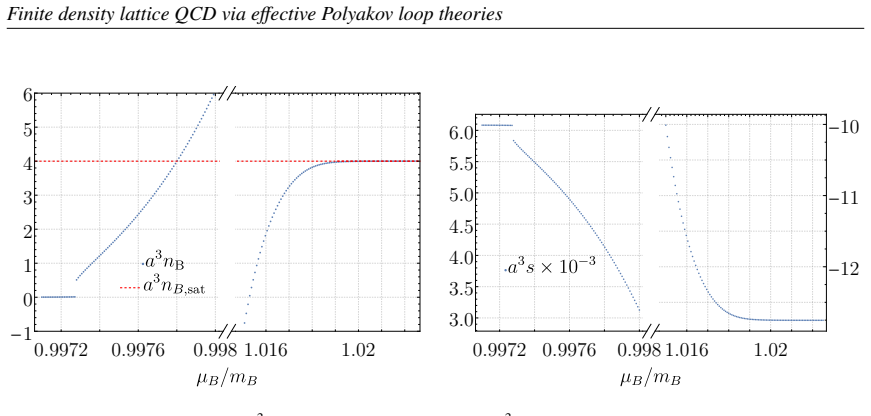
- Thermodynamic observables near the liquid-gas transition, especially entropy, show unphysical behavior (negative values near saturation) that is consistent with a perturbative analysis but indicates truncation artefacts.
- Higher-order effective actions and improved resummations are the stated route to extend the approach to smaller quark masses.
Reading between the lines
- If the few-percent accuracy persists when higher-order terms ($n+m>4$) are included, the resummed mean-field scheme could serve as a cheap pre-screener for Monte Carlo or complex Langevin simulations of heavy-dense QCD.
- The observed negative entropy suggests a concrete diagnostic: compare $\partial p/\partial T$ from the truncated effective action with the full static-plus-kinetic determinant, and check whether the sign flip is tied to the rational $h_1$ factors rather than to genuine physics.
- The same fluctuation-resummation idea could be tested on other Polyakov-loop models with long-range interactions, where the mean-field error should shrink further, making first-order transition locations more reliable.
- One could use the spread among the three mean-field variants as a systematic error estimate for the critical endpoint location, since the paper finds the endpoint is driven by fluctuations.
Editorial analysis
A structured set of objections, weighed in public.
Referee Report
Summary. The paper applies three mean-field approximations (standard, resummed, and classical) to effective Polyakov loop theories derived from lattice QCD by strong-coupling and hopping-parameter expansions. It benchmarks these approximations in the pure-gauge limit against an independent high-temperature series-expansion critical coupling, finding that the resummed mean field (r-mf) gives lambda_1,c ≈ 0.18505, a 3% relative error versus the series value 0.1885, while the classical approximation (ca) has about 50% error and the standard mean field (s-mf) about 20%. It then uses r-mf to compute the heavy-quark deconfinement transition at finite baryon chemical potential and ca to study the low-temperature, finite-density regime at N_tau = 500, kappa = 0.12, reporting a first-order nuclear liquid-gas transition, negative entropy density near saturation, Pauli-principle violations, and a transition line bending toward larger mu_B. The paper explicitly acknowledges that several of these low-temperature results may be truncation artefacts.
Significance. The paper has a clear and useful positive result: the r-mf scheme is benchmarked against an independent series-expansion result rather than fit to it, and the 3% accuracy for the first-order deconfinement transition is a genuinely quantitative improvement over naive mean field. The explicit formulas for the three mean-field variants and the honest discussion of the negative-entropy and Pauli-violation problems are also strengths. If the r-mf benchmark is robust, the scheme is a valuable tool for first-order transitions in effective Polyakov loop theories at high temperature and heavy quark mass. However, the paper's broader claim that mean-field evaluations are quantitatively reliable for finite-density phase diagram studies is not supported by the benchmark, because the low-temperature finite-density results are obtained with the ca approximation, whose benchmark error is an order of magnitude larger, and because the paper itself labels several key features as likely artefacts.
major comments (4)
- [§4.2, Figs. 2–3] The low-temperature finite-density results are obtained with the ca approximation, but the benchmark in §4.1 (Fig. 1 left) shows that ca has a ~50% relative error in the pure-gauge critical coupling (lambda_1,c ≈ 0.09 versus 0.1885). The 3% accuracy of r-mf therefore does not carry over to the liquid-gas transition line, and no cross-check, error estimate, or stabilized r-mf evaluation is provided for the N_tau = 500, kappa = 0.12 regime. The abstract and conclusion imply that mean-field evaluations are quantitatively reliable for finite-density phase diagrams, but the presented benchmark only supports that claim for the high-temperature deconfinement line in the r-mf scheme.
- [§4.2, Fig. 3 (right)] The slope of the liquid-gas transition line is governed by the Clausius-Clapeyron relation with a negative entropy jump, dT_c/dmu = -Delta n / Delta s > 0, which the paper itself describes as unexpected and 'presumably due to lattice and/or truncation artefacts.' Since the negative entropy jump directly determines the line's bending and its critical endpoint, the plotted first-order line is not quantitatively controlled. The authors should either identify a physical mechanism for the negative entropy jump or present the line as a truncation artefact rather than a predicted phase boundary.
- [§2, Eqs. (3)–(6); §4.2] The effective action is truncated at O(u^n kappa^m) with n + m <= 4, and at N_tau = 500, kappa = 0.12 the effective couplings are large, so the neglected higher-order terms (long-range interactions and higher representations) may become important. The paper itself acknowledges Pauli-principle violations and possible truncation artefacts in this regime. The existence of a first-order liquid-gas transition is therefore inferred from a truncated action whose validity in this parameter region is explicitly untested; this limitation should be stated as an assumption in the abstract and conclusions, not only in the discussion of Fig. 2.
- [§4.1, Fig. 1 (right)] The claim that the deconfinement transition ends in a critical endpoint for each N_tau is asserted without visible error bars, a convergence check, or a specification of how the endpoint is located. Because the paper notes that the endpoint location is 'imprecise due to fluctuation-driven dynamics,' the phase diagram as presented is only indicative. Reporting the endpoint coordinates and an uncertainty estimate would make this claim falsifiable and would strengthen the paper.
minor comments (5)
- [§3.3, before Eq. (11)] The condition 'kappa 0 0' appears to be a typesetting error; it should presumably read 'kappa != 0'.
- [§4.2] The phrase 'the saturation density implied by the Pauli-principle the lattice' is missing a preposition and should read 'on the lattice'.
- [References] Reference [12] is a duplicate of reference [2] and should be removed or replaced with the correct citation.
- [§4.2, Fig. 2] The text mentions that the search for self-consistent mean fields is restricted to l, bar l < 3; this is a technical constraint that affects the interpretation of the mu_B scan and should be stated in the figure caption.
- [§4.1, Fig. 1] The axes of the right panel are not explicitly labeled in the text; please confirm in the caption that the horizontal axis is mu_B / m_B and the vertical axis is the critical temperature in physical units.
Circularity Check
No significant circularity: the mean-field benchmark is compared with an independent high-temperature series expansion, and the effective-action inputs come from prior first-principles derivations rather than from fits to the predicted quantities.
full rationale
The derivation chain is not circular. The paper's headline quantitative claim—that the r-mf scheme reproduces the pure-gauge first-order deconfinement coupling with about 3% relative error—is obtained by solving the mean-field equations (8)–(10) for the leading-order effective action (3) and comparing the resulting λ1,c ≈ 0.18505 with λ1,c ≈ 0.1885 from the high-temperature series expansion [18]. Nothing in the mean-field computation is fitted to 0.1885; the series-expansion value is a parameter-free result from a different approximation scheme (high-temperature expansion), and the comparison is therefore an external benchmark rather than an input. The effective action itself (Eq. (3) and Eqs. (4)–(6)) is cited from prior strong-coupling and hopping-parameter derivations [1,2]; those derivations are not defined in terms of the mean-field predictions, and this paper does not claim to re-derive them. The later entropy comparison with the perturbative analysis [2] is likewise a cross-check between two independent approximations of the same effective theory, not a fit or a definitional identity; the paper even corrects an inconsistency in [2] by including the O(κ²) scale-setting correction rather than simply importing its conclusion. The fact that several key references share authors is self-citation, but a cited result counts as independent support when, as here, it is parameter-free and does not assume the target. The observation that the ca approximation carries roughly 50% error in the benchmark while being used for the low-temperature liquid-gas line is a legitimate accuracy or scope concern, but it is not circularity: the ca results are computed, not fitted, and the paper itself flags possible truncation artefacts. No equation reduces to another by construction, and no fitted parameter is relabeled as a prediction.
Assumptions & free parameters
assumptions (5)
- domain assumption The effective action is truncated at O(u^n kappa^m) with n+m <= 4, with gauge corrections from [13]; higher-order terms introducing long-range interactions and higher representations are neglected.
- domain assumption Mean-field approximations drop non-local fluctuation terms O(delta L_x delta L_y) for x != y; the resummed scheme keeps only local fluctuations to all orders.
- domain assumption The classical saddle-point approximation in the Polyakov-loop angle variables is reliable when effective couplings are large.
- domain assumption The pure-gauge scale-setting relation a(beta) and the hopping-resummed mass expressions (14)-(16) remain valid for finite heavy quark masses and at finite density.
- domain assumption The truncated effective theory's Boltzmann weight exp(-S_eff), with rational functions of h1, adequately represents the full quark determinant at finite density.
Cite this review
Pith. "Pith review of Finite density lattice QCD via effective Polyakov loop theories." pith.science (2026). https://pith.science/paper/DQ3TFM23
@misc{pith2026250119052,
  author       = {Pith},
  title        = {Pith review of: Finite density lattice QCD via effective Polyakov loop theories},
  year         = {2026},
  howpublished = {\url{https://pith.science/paper/DQ3TFM23}},
  note         = {Machine review of arXiv:2501.19052}
}
read the original abstract
For the exploration of the phase diagram of QCD, effective Polyakov loop theories derived from lattice QCD provide a valuable tool in the heavy quark mass regime. Using mean field approximations these theories are evaluated in the high and low temperature regimes at finite baryon chemical potential. The resulting phase diagram is discussed.
Figures


Reference graph
Works this paper leans on
-
[1]
J. Langelage, S. Lottini and O. Philipsen,Centre symmetric 3d effective actions for thermal SU(N) Yang-Mills from strong coupling series, J. High Energy Phys.2011 (2011) 57 [1010.0951]
arXiv 2011
-
[3]
J. Glesaaen, M. Neuman and O. Philipsen,Equation of state for cold and dense heavy QCD, JHEP03 (2016) 100 [1512.05195]
arXiv 2016
- [4]
- [5]
-
[6]
O. Philipsen and J. Scheunert,QCD in the heavy dense regime for general N𝑐: on the existence of quarkyonic matter,JHEP11 (2019) 022 [1908.03136]
arXiv 2019
-
[7]
A. Dumitru, R.D. Pisarski and D. Zschiesche,Dense quarks, and the fermion sign problem, in a SU(N) matrix model, Phys. Rev. D72(2005) 065008 [hep-ph/0505256]
arXiv 2005
-
[8]
K. Fukushima and Y. Hidaka,A Model study of the sign problem in the mean-field approximation,Phys. Rev. D75(2007) 036002 [hep-ph/0610323]
arXiv 2007
-
[9]
J. Greensite and K. Splittorff,Mean field theory of effective spin models as a baryon fugacity expansion,Phys. Rev. D86 (2012) 074501 [1206.1159]
arXiv 2012
Show all 17 references
-
[10]
particle-hole
T. Rindlisbacher and P. de Forcrand,Two-flavor lattice QCD with a finite density of heavy quarks: heavy-dense limit and “particle-hole” symmetry,JHEP 02(2016) 051 [1509.00087]
2016 arXiv
-
[11]
Borisenko, V
O. Borisenko, V. Chelnokov, E. Mendicelli and A. Papa,Dual simulation of a Polyakov loop model at finite baryon density: Phase diagram and local observables, Nucl. Phys. B965 (2021) 115332 [2011.08285]
2021 arXiv
-
[12]
Langelage, M
J. Langelage, M. Neuman and O. Philipsen,Heavy dense QCD and nuclear matter from an effective lattice theory, JHEP09(2014) 131 [1403.4162]
2014 arXiv
-
[13]
Neuman,Effective Theory for Heavy Quark QCD at Finite Temperature and Density with Stochastic Quantization, phd thesis, Goethe Universität Frankfurt am Main, 2015
M. Neuman,Effective Theory for Heavy Quark QCD at Finite Temperature and Density with Stochastic Quantization, phd thesis, Goethe Universität Frankfurt am Main, 2015
2015
-
[14]
Zinn-Justin,Quantum Field Theory and Critical Phenomena, Oxford University Press (jun, 2002), 10.1093/acprof:oso/9780198509233.001.0001
J. Zinn-Justin,Quantum Field Theory and Critical Phenomena, Oxford University Press (jun, 2002), 10.1093/acprof:oso/9780198509233.001.0001
2002
-
[15]
M.Gross, J.BartholomewandD.Hochberg, SU(N)DECONFINEMENTTRANSITIONAND THE N STATE CLOCK MODEL,
-
[16]
Necco and R
S. Necco and R. Sommer,The N(f) = 0 heavy quark potential from short to intermediate distances,Nucl. Phys. B622 (2002) 328 [hep-lat/0108008]
2002 arXiv
-
[17]
Smit,Introduction to Quantum Fields on a Lattice, Cambridge Lecture Notes in Physics, Cambridge University Press (2002)
J. Smit,Introduction to Quantum Fields on a Lattice, Cambridge Lecture Notes in Physics, Cambridge University Press (2002)
2002
-
[18]
Kim, A.Q
J. Kim, A.Q. Pham, O. Philipsen and J. Scheunert,The Yang-Mills deconfinement transition from a high temperature expansion,PoSLATTICE2019(2019) 065 [1912.01705]. 9
2019 arXiv
Reviewed August 9, 2026 · model on record in the stance chip above.
Discussion (0). Continue with ORCID to comment.