REVIEW 4 major objections 6 minor 1 cited by
BOFormer: Learning to Solve Multi-Objective Bayesian Optimization via Non-Markovian RL
T0 review · 4 major / 6 minor · reviewed 2026-08-07 · deepseek-v4-flash
Pith's one-line read BOFormer, a Transformer Q-network trained on synthetic functions, is presented as the first RL-learned acquisition function for multi-objective Bayesian optimization, beating handcrafted rules and prior learned methods without fine-tuning.
desk verdict First RL-based acquisition function for MOBO with a genuinely novel Q-augmented history representation and broad zero-shot experiments, but the abstract overclaims and the paper's central identifiability fix rests on a heuristic rather than a proof. read the letter →
The pith
A machine-rendered reading of the paper's core claim, the machinery that carries it, and where it could break.
The reading
What carries the argument
The load-bearing object is the generalized optimal Q-function on histories, $Q^*(h,a)$, defined by the non-Markovian Bellman optimality equation $Q(h,a) = \mathbb{E}_{o \sim p(\cdot|h,a)}[r(h,a,o) + \gamma \max_{a'} Q(h', a')]$ with $h' = (h,a,o)$, which the paper imports from the general-RL literature and turns into a temporal-difference loss with a frozen target network. BOFormer approximates this Q-function with a GPT-2-style Transformer that consumes the sequence of past per-point observation-action tokens; the crucial augmentation is that each observation carries its own Q-value from the target network, which acts as a learned summary of the prospective hypervolume improvement and keeps the token size constant as the domain grows. The reward is the normalized hypervolume improvement $r_t = (HV(X_t) - HV(X_{t-1}))/(HV(X^{*}) - HV(X_t))$, which keeps the learning signal strong late in an episode, and the fixed history window ($w = 31$) supplies the context that posterior statistics alone provably lack. The action-selection rule carries the argument: at each step the query is $x_t = \arg\max_{x \in X} Q_{\hat{\theta}}(h_t, o_t(x))$.
What would settle it
Build the pair of scenarios from the paper's motivating example: a candidate point whose posterior statistics and best-observed values are identical in the two settings, but whose hypervolume improvement upon sampling differs because the earlier histories differ, and ask BOFormer to score that point in both settings. If the learned Q-values coincide, the representation has not encoded history in exactly the case the paper says it fixes; a complementary stress test would check whether BOFormer's margin over qNEHVI collapses when the training lengthscales are drawn from a wider range than the paper's [0.1, 0.4].
Extended reading notes
Core claim
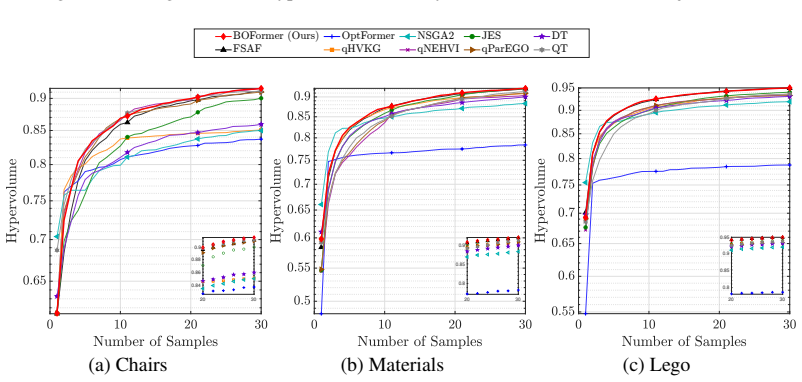
The paper's central claim is that the history-dependence of hypervolume improvement, which makes multi-objective Bayesian optimization non-Markovian in a way single-objective BO is not, can be handled by learning a generalized optimal Q-function over histories rather than over states, and that this yields a working acquisition function. It formalizes the idea as Generalized DQN, built on the non-Markovian Bellman optimality equation, and implements it as BOFormer, a GPT-2-style Transformer that consumes a sequence of per-step observation-action tokens and outputs Q-values. The decisive design choice is the Q-augmented representation: each candidate point $x$ is encoded as $o_t(x) = (\mu_t^{(i)}(x), \sigma_t^{(i)}(x), y_t^{(i)*}, t/T)$ over objectives $i$, augmented with the Q-value produced by a frozen target network, and the chosen point is $x_t = \arg\max_{x \in X} Q_{\hat{\theta}}(h_t, o_t(x))$ with $h_t$ the history of past observation-action pairs. Because each token describes one candidate point and its size does not grow with the domain size, the model transfers across domains and dimensions and avoids the memory blow-up of a direct full-state implementation. Trained on randomly drawn GP functions with a normalized hypervolume-improvement reward, guided partly by an expected-hypervolume-improvement demo policy and replayed from a prioritized trajectory buffer, BOFormer is deployed without fine-tuning; the authors report that it attains the largest or near-largest hypervolume at the final sampling step on the synthetic benchmarks and on a 3D Gaussian Splatting hyperparameter-tuning dataset.
Load-bearing premise
The whole scheme rests on the assumption that a fixed-size summary — each candidate point's posterior statistics, a window of the last 31 decisions, and the network's own predicted Q-value — captures enough of the sampling history to tell the policy what the next query is worth; the paper verifies this empirically on its benchmarks but provides no guarantee that this summary identifies the hypervolume improvement in general.
Editorial extensions
If this is right
- Multi-objective acquisition becomes a cheap forward pass: reported per-step inference time is roughly constant (about 14 ms) for 2, 3, and 4 objectives, whereas qNEHVI grows from about 6 ms to 224 ms, so the learned rule is the cheaper option as the number of objectives grows.
- Zero-shot and cross-domain deployment is claimed: the same weights trained only on synthetic GP functions produce competitive hypervolumes on 10-, 30-, 40-, and 100-dimensional test problems and on the real 3D Gaussian Splatting tuning task, without fine-tuning or task metadata.
- The appended Q-value is the load-bearing piece of the representation: Q-Transformer, which uses the same temporal-difference sequence modeling without the Q-augmented observation, performs noticeably worse, isolating the paper's key design choice.
- History is doing real work: the ablation across sequence lengths shows that variants with $w > 1$ beat the Markovian variant with $w = 1$, supporting the diagnosis that the improvement signal is history-dependent.
- The paper positions BOFormer as the first RL-based acquisition function for multi-objective Bayesian optimization, extending the learned-acquisition paradigm from the single-objective setting where FSAF-style methods worked to the multi-objective setting where their direct extension fails.
Reading between the lines
- The Q-augmented observation is self-referential: the appended value is an output of the same network being trained, so it is informative only to the extent the policy has already learned, and early in training it cannot help identify history-dependent improvements. A testable consequence is that the method's edge over expected-hypervolume-improvement baselines should shrink if the Q-augmentation i
- The window length is a fixed hyperparameter ($w = 31$), making the method approximate, not exact, in its non-Markovianity; a natural stress test is to check whether the window must grow with the number of objectives or with the GP lengthscale, since longer-range posterior correlations should make more distant history relevant.
- The training-time reward normalizes by the optimal hypervolume $HV(X^{*})$ of the synthetic training functions, a quantity unavailable at deployment; this makes the training distribution the carrier of that information, and the policy's behavior on tasks whose Pareto front is hard to estimate is an open question the benchmarks do not fully settle.
- The Generalized DQN machinery is not specific to hypervolume: other acquisition problems with history-dependent utility, such as batch acquisition where the value of a point depends on the other points chosen alongside it, or constrained BO where past queries affect future feasibility, could be cast in the same sequence-modeling form.
Editorial analysis
A structured set of objections, weighed in public.
Referee Report
Summary. The manuscript proposes BOFormer, a Transformer-based deep Q-network for multi-objective Bayesian optimization (MOBO). It formulates MOBO as non-Markovian RL, uses a generalized DQN loss over histories, and compresses each history into a fixed-dimensional sequence of posterior statistics, best-so-far values, rewards, and target-network Q-values. The policy selects the point maximizing the learned Q-value. BOFormer is trained solely on synthetic GP functions and evaluated zero-shot on synthetic benchmarks and a new 3D Gaussian Splatting hyperparameter optimization dataset. The paper claims to be the first RL-based acquisition function for MOBO and claims to systematically resolve the hypervolume identifiability issue while consistently outperforming rule-based and learning-based baselines.
Significance. The contribution is potentially significant: a learning-based, domain-agnostic, non-myopic acquisition function for MOBO with zero-shot transfer would be a useful advance, and the paper provides broad empirical coverage, public code, and a new HPO-3DGS dataset. The Generalized DQN framing is sound, and the ablations on the demo policy, sequence length, and transfer across numbers of objectives are informative. However, the central theoretical claim about resolving the identifiability issue is not established for the compressed representation, and the empirical claim of consistent superiority is not supported by the reported tables. The paper warrants a major revision rather than acceptance in its current form.
major comments (4)
- [Abstract and §5, Tables 1–2] The abstract's claim that BOFormer 'constantly outperforms' the benchmark algorithms is contradicted by the reported numbers. In Table 1, BOFormer attains 0.4476 on BC versus 0.4773 for qNEHVI, 0.9461 on DRa versus 0.9573 for NSGA-II, and 0.8642 on Matern versus 0.8696 for qNEHVI; in Table 2, BOFormer attains 0.8816 on Mic versus 0.8871 for FSAF. The text later hedges to 'largest or among the largest' (Section 5). The load-bearing claim of consistent outperformance should be replaced with a precise statement of where and by how much BOFormer wins, together with the associated statistical evidence.
- [§5, Tables 1–2 and Figure 3] The main results are reported as point estimates without error bars or confidence intervals, despite being averages over 100 evaluation episodes. This is not a purely cosmetic issue: on many tasks the differences between BOFormer and qNEHVI are around 1% (e.g., AR, RBF, BCD in Table 1; Chairs, Lego, Materials in Table 2), which is precisely the threshold used for bold/underline formatting. Performance profiles are shown only for a subset of tasks in Figure 3 and the appendix. The authors should report standard errors or bootstrap intervals for all tasks and perform a paired comparison (e.g., Wilcoxon signed-rank or performance-profile analysis) to support the claimed superiority.
- [§3.2–§4.2, Eq. (5), Figure 1] The theoretical justification only covers full histories: Proposition 3.1 characterizes Q* for histories H_t, and Figure 1 demonstrates the identifiability failure for an observation representation without the Q-augmented token. However, BOFormer's policy is a function of the fixed-dimensional summary h_t in Eq. (5), which stores posterior means and standard deviations at past selected points, the best-so-far vector, normalized rewards, and a Q-bar token. It does not store the queried locations x_j or the observed values y_j, and Q-bar is itself computed by the target network from the same compressed inputs, so it cannot inject information absent from h_t. No theorem, invariant, or bound establishes that this compressed representation preserves all information relevant to future hypervolume improvement. Two runs with different GP posteriors can in principle yield identical BOFormer inputs but different optimal future improvements, in which case no function of the BOFormer input can represent Q*. The claim that BOFormer 'systematically addresses' the identifiability issue is therefore not supported; at present this resolution is heuristic, and its success may depend on the training distribution and window size. The authors should either prove sufficiency for a well-defined class of environments, or explicitly downgrade the claim and provide evidence that the failure cases are rare in the tested distribution.
- [§5, Figure 4 and Appendix A.2] The history window w=31 is selected by an ablation on DRa, RBF, and Matern52 (Figure 4), which are the same test functions used in Table 1. Selecting hyperparameters on the evaluation tasks can inflate the reported performance and makes the zero-shot claim less clean. Please move the window-size selection to a separate validation set drawn from the training distribution (e.g., held-out synthetic GP functions) and report the final configuration with that protocol.
minor comments (6)
- [Abstract and §5] The abstract's 'constantly outperforms' conflicts with Section 5's 'largest or among the largest'; please harmonize the wording.
- [§4.2, Eq. (5)] The definition of y(i)*_t contains a typo ('y(i)_i' instead of 'y(i)_j'), and the history in Eq. (5) uses y(i)*_{j-1}; make the index convention explicit.
- [Abstract and §5] The abstract states 68,000 parameters for HPO-3DGS while the main text says 'dense-grid searching 1440 hyperparameters'; clarify whether 1440 refers to hyperparameter configurations per scene and how the 68,000 figure is derived.
- [Appendix C.1, Algorithm 1] The loss in Algorithm 1 uses the notation Qb_bθ and Qb_¯θ without defining the superscript b; define it in the caption or surrounding text.
- [§2.2] The text says 'first learning-based solution to MOBO' while the introduction claims 'first RL-based AF for MOBO'; the former is broader and should be qualified.
- [Table 3] The heading 'per-sample inference time' is ambiguous; specify that it is time per acquisition-function evaluation or query.
Circularity Check
No significant circularity; the core RL derivation is self-contained, with only minor non-load-bearing self-citations and a methodological confound that falls short of a definitional circularity.
full rationale
The paper's central training objective, Eq. (4), is the standard temporal-difference residual of deep Q-learning adapted to history-dependent value functions, and Proposition 3.1 is imported from the external result of Dong et al. (2022), not from the authors' own prior work. The empirical claims are tested against external rule-based and learning-based baselines on synthetic GP functions and an independently constructed 3DGS dataset, so the main reported predictions are not forced by the training inputs. The only self-citations (FSAF, Sobol-grid maximization) are used as a benchmark or as a standard implementation detail and are not load-bearing for the claimed derivation. Two concerns raised by the reader and skeptic are better classified as correctness or methodological risks rather than circularity. First, the Q-augmented representation in Eq. (5) is bootstrapped: Q-bar is computed recursively from the same compressed history tokens, so it is not established that appending Q-bar restores the raw information omitted from the summary; this is a representational-sufficiency gap, not a definitional equivalence. Second, the demo policy used during training is qNEHVI, which also appears as a headline baseline; this is a benchmark-contamination confound, but BOFormer's advantage over qNEHVI is not statistically forced by that construction. Accordingly, no step reduces by construction to its own inputs, and the appropriate finding is no significant circularity.
Assumptions & free parameters
free parameters (4)
- Window size w =
31
- Demo policy mix rate r_demo =
0.01
- Discount factor gamma =
not reported in paper
- Architecture and training hyperparameters =
hidden size 128, 8 layers, 4 heads, learning rate 1e-5, batch size 8, buffer size 64, target sync every 5 episodes
assumptions (5)
- standard math Non-Markov Bellman optimality: (V*, Q*) is the unique solution of Eqs. (2)-(3).
- domain assumption GP posteriors are sufficient surrogates for the true black-box functions.
- ad hoc to paper Training lengthscale distribution Uniform(0.1, 0.4) covers the test functions.
- domain assumption Approximate action maximization over Sobol grids is sufficient to realize the policy.
- domain assumption HV(X*) is known or cheaply approximated during training.
Cite this review
Pith. "Pith review of BOFormer: Learning to Solve Multi-Objective Bayesian Optimization via Non-Markovian RL." pith.science (2026). https://pith.science/paper/DZG2KGYK
@misc{pith2026250521974,
  author       = {Pith},
  title        = {Pith review of: BOFormer: Learning to Solve Multi-Objective Bayesian Optimization via Non-Markovian RL},
  year         = {2026},
  howpublished = {\url{https://pith.science/paper/DZG2KGYK}},
  note         = {Machine review of arXiv:2505.21974}
}
read the original abstract
Bayesian optimization (BO) offers an efficient pipeline for optimizing black-box functions with the help of a Gaussian process prior and an acquisition function (AF). Recently, in the context of single-objective BO, learning-based AFs witnessed promising empirical results given its favorable non-myopic nature. Despite this, the direct extension of these approaches to multi-objective Bayesian optimization (MOBO) suffer from the \textit{hypervolume identifiability issue}, which results from the non-Markovian nature of MOBO problems. To tackle this, inspired by the non-Markovian RL literature and the success of Transformers in language modeling, we present a generalized deep Q-learning framework and propose \textit{BOFormer}, which substantiates this framework for MOBO via sequence modeling. Through extensive evaluation, we demonstrate that BOFormer constantly outperforms the benchmark rule-based and learning-based algorithms in various synthetic MOBO and real-world multi-objective hyperparameter optimization problems. We have made the source code publicly available to encourage further research in this direction.
Figures


Figures from the paper (11 more)




Forward citations
Cited by 1 Pith paper
-
Model-free Reinforcement Learning for Model-based Control: Towards Safe, Interpretable and Sample-efficient Agents
A perspective paper argues that model predictive control can be used as a learned policy in model-free reinforcement learning and reviews the methods and open problems.
Reference graph
Works this paper leans on
-
[1]
Deep reinforcement learning at the edge of the statistical precipice
Rishabh Agarwal, Max Schwarzer, Pablo Samuel Castro, Aaron C Courville, and Marc Bellemare. Deep reinforcement learning at the edge of the statistical precipice. Advances in Neural Information Processing Systems, 34: 0 29304--29320, 2021
work page 2021
-
[2]
BoTorch: A framework for efficient Monte-Carlo Bayesian optimization
Maximilian Balandat, Brian Karrer, Daniel Jiang, Samuel Daulton, Ben Letham, Andrew G Wilson, and Eytan Bakshy. BoTorch: A framework for efficient Monte-Carlo Bayesian optimization . Advances in Neural Information Processing Systems, 33: 0 21524--21538, 2020
work page 2020
-
[3]
Max-value entropy search for multi-objective Bayesian optimization
Syrine Belakaria, Aryan Deshwal, and Janardhan Rao Doppa. Max-value entropy search for multi-objective Bayesian optimization . Advances in Neural Information Processing Systems, 32, 2019
work page 2019
-
[4]
Uncertainty-aware search framework for multi-objective Bayesian optimization
Syrine Belakaria, Aryan Deshwal, Nitthilan Kannappan Jayakodi, and Janardhan Rao Doppa. Uncertainty-aware search framework for multi-objective Bayesian optimization . In Proceedings of the AAAI Conference on Artificial Intelligence, volume 34, pp.\ 10044--10052, 2020
work page 2020
-
[5]
Output space entropy search framework for multi-objective Bayesian optimization
Syrine Belakaria, Aryan Deshwal, and Janardhan Rao Doppa. Output space entropy search framework for multi-objective Bayesian optimization . Journal of Artificial Intelligence Research, 72: 0 667--715, 2021
work page 2021
-
[6]
SMS-EMOA: Multiobjective selection based on dominated hypervolume
Nicola Beume, Boris Naujoks, and Michael Emmerich. SMS-EMOA: Multiobjective selection based on dominated hypervolume . European Journal of Operational Research, 181 0 (3): 0 1653--1669, 2007
work page 2007
-
[7]
Settling the reward hypothesis
Michael Bowling, John D Martin, David Abel, and Will Dabney. Settling the reward hypothesis. In International Conference on Machine Learning, pp.\ 3003--3020, 2023
work page 2023
-
[8]
Q-Transformer: Scalable offline reinforcement learning via autoregressive q-functions
Yevgen Chebotar, Quan Vuong, Karol Hausman, Fei Xia, Yao Lu, Alex Irpan, Aviral Kumar, Tianhe Yu, Alexander Herzog, Karl Pertsch, et al. Q-Transformer: Scalable offline reinforcement learning via autoregressive q-functions . In Conference on Robot Learning, pp.\ 3909--3928, 2023
work page 2023
Show all 77 references
-
[9]
Decision Transformer: Reinforcement learning via sequence modeling
Lili Chen, Kevin Lu, Aravind Rajeswaran, Kimin Lee, Aditya Grover, Misha Laskin, Pieter Abbeel, Aravind Srinivas, and Igor Mordatch. Decision Transformer: Reinforcement learning via sequence modeling . Advances in Neural Information Processing Systems, 34: 0 15084--15097, 2021
2021
-
[10]
Towards learning universal hyperparameter optimizers with transformers
Yutian Chen, Xingyou Song, Chansoo Lee, Zi Wang, Richard Zhang, David Dohan, Kazuya Kawakami, Greg Kochanski, Arnaud Doucet, Marc'aurelio Ranzato, et al. Towards learning universal hyperparameter optimizers with transformers. Advances in Neural Information Processing Systems, ...
2022
-
[11]
A reference vector guided evolutionary algorithm for many-objective optimization
Ran Cheng, Yaochu Jin, Markus Olhofer, and Bernhard Sendhoff. A reference vector guided evolutionary algorithm for many-objective optimization . IEEE Transactions on Evolutionary Computation, 20 0 (5): 0 773--791, 2016
2016
-
[12]
Unifying PAC and regret: Uniform PAC bounds for episodic reinforcement learning
Christoph Dann, Tor Lattimore, and Emma Brunskill. Unifying PAC and regret: Uniform PAC bounds for episodic reinforcement learning . Advances in Neural Information Processing Systems, 30, 2017
2017
-
[13]
Hypervolume knowledge gradient: A lookahead approach for multi-objective Bayesian optimization with partial information
Sam Daulton, Maximilian Balandat, and Eytan Bakshy. Hypervolume knowledge gradient: A lookahead approach for multi-objective Bayesian optimization with partial information . In International Conference on Machine Learning, pp.\ 7167--7204, 2023
2023
-
[14]
Differentiable expected hypervolume improvement for parallel multi-objective Bayesian optimization
Samuel Daulton, Maximilian Balandat, and Eytan Bakshy. Differentiable expected hypervolume improvement for parallel multi-objective Bayesian optimization . Advances in Neural Information Processing Systems, 33: 0 9851--9864, 2020
2020
-
[15]
Parallel Bayesian optimization of multiple noisy objectives with expected hypervolume improvement
Samuel Daulton, Maximilian Balandat, and Eytan Bakshy. Parallel Bayesian optimization of multiple noisy objectives with expected hypervolume improvement . Advances in Neural Information Processing Systems, 34: 0 2187--2200, 2021
2021
-
[16]
Multi-objective Bayesian optimization over high-dimensional search spaces
Samuel Daulton, David Eriksson, Maximilian Balandat, and Eytan Bakshy. Multi-objective Bayesian optimization over high-dimensional search spaces . In Uncertainty in Artificial Intelligence, pp.\ 507--517, 2022
2022
-
[17]
A fast and elitist multiobjective genetic algorithm: NSGA-II
Kalyanmoy Deb, Amrit Pratap, Sameer Agarwal, and TAMT Meyarivan. A fast and elitist multiobjective genetic algorithm: NSGA-II . IEEE Transactions on Evolutionary Computation, 6 0 (2): 0 182--197, 2002
2002
-
[18]
Simple agent, complex environment: Efficient reinforcement learning with agent states
Shi Dong, Benjamin Van Roy, and Zhengyuan Zhou. Simple agent, complex environment: Efficient reinforcement learning with agent states . Journal of Machine Learning Research, 23 0 (1): 0 11627--11680, 2022
2022
-
[19]
The computation of the expected improvement in dominated hypervolume of Pareto front approximations
Michael Emmerich and Jan-willem Klinkenberg. The computation of the expected improvement in dominated hypervolume of Pareto front approximations . Rapport technique, Leiden University, 2008
2008
-
[20]
Hypervolume-based expected improvement: Monotonicity properties and exact computation
Michael TM Emmerich, Andr \'e H Deutz, and Jan Willem Klinkenberg. Hypervolume-based expected improvement: Monotonicity properties and exact computation . In IEEE Congress of Evolutionary Computation (CEC), pp.\ 2147--2154, 2011
2011
-
[21]
Generalized decision transformer for offline hindsight information matching
Hiroki Furuta, Yutaka Matsuo, and Shixiang Shane Gu. Generalized decision transformer for offline hindsight information matching. In International Conference on Learning Representations, 2021
2021
-
[22]
Conditional neural processes
Marta Garnelo, Dan Rosenbaum, Christopher Maddison, Tiago Ramalho, David Saxton, Murray Shanahan, Yee Whye Teh, Danilo Rezende, and SM Ali Eslami. Conditional neural processes. In International Conference on Machine Learning, pp.\ 1704--1713, 2018
2018
-
[23]
Predictive entropy search for multi-objective Bayesian optimization with constraints
Eduardo C Garrido-Merch \'a n and Daniel Hern \'a ndez-Lobato. Predictive entropy search for multi-objective Bayesian optimization with constraints . Neurocomputing, 361: 0 50--68, 2019
2019
-
[24]
Automatic chemical design using a data-driven continuous representation of molecules
Rafael G \'o mez-Bombarelli, Jennifer N Wei, David Duvenaud, Jos \'e Miguel Hern \'a ndez-Lobato, Benjam \' n S \'a nchez-Lengeling, Dennis Sheberla, Jorge Aguilera-Iparraguirre, Timothy D Hirzel, Ryan P Adams, and Al \'a n Aspuru-Guzik. Automatic chemical design using a data-...
2018
-
[25]
Deep recurrent Q-learning for partially observable MDPs
Matthew Hausknecht and Peter Stone. Deep recurrent Q-learning for partially observable MDPs . In AAAI Fall Symposium Series, 2015
2015
-
[26]
Predictive entropy search for multi-objective Bayesian optimization
Daniel Hern \'a ndez-Lobato, Jose Hernandez-Lobato, Amar Shah, and Ryan Adams. Predictive entropy search for multi-objective Bayesian optimization . In International Conference on Machine Learning, pp.\ 1492--1501, 2016
2016
-
[27]
Reinforced few-shot acquisition function learning for Bayesian optimization
Bing-Jing Hsieh, Ping-Chun Hsieh, and Xi Liu. Reinforced few-shot acquisition function learning for Bayesian optimization . Advances in Neural Information Processing Systems, 34: 0 7718--7731, 2021
2021
-
[28]
Faster exact algorithms for computing expected hypervolume improvement
Iris Hupkens, Andr \'e Deutz, Kaifeng Yang, and Michael Emmerich. Faster exact algorithms for computing expected hypervolume improvement. In International Conference on Evolutionary Multi-Criterion Optimization, pp.\ 65--79. Springer, 2015
2015
-
[29]
Joint entropy search for maximally-informed Bayesian optimization
Carl Hvarfner, Frank Hutter, and Luigi Nardi. Joint entropy search for maximally-informed Bayesian optimization . Advances in Neural Information Processing Systems, 35: 0 11494--11506, 2022
2022
-
[30]
Reinforcement learning algorithm for partially observable Markov decision problems
Tommi Jaakkola, Satinder Singh, and Michael Jordan. Reinforcement learning algorithm for partially observable Markov decision problems . Advances in Neural Information Processing systems, 7, 1994
1994
-
[31]
Offline reinforcement learning as one big sequence modeling problem
Michael Janner, Qiyang Li, and Sergey Levine. Offline reinforcement learning as one big sequence modeling problem. Advances in Neural Information Processing Systems, 34: 0 1273--1286, 2021
2021
-
[32]
3d gaussian splatting for real-time radiance field rendering
Bernhard Kerbl, Georgios Kopanas, Thomas Leimk \"u hler, and George Drettakis. 3d gaussian splatting for real-time radiance field rendering. ACM Transactions on Graphics, 42 0 (4): 0 1--14, 2023
2023
-
[33]
Attentive neural processes
Hyunjik Kim, Andriy Mnih, Jonathan Schwarz, Marta Garnelo, Ali Eslami, Dan Rosenbaum, Oriol Vinyals, and Yee Whye Teh. Attentive neural processes. In International Conference on Learning Representations, 2018
2018
-
[34]
Adam: A method for stochastic optimization
Diederik P Kingma and Jimmy Ba. Adam: A method for stochastic optimization . In International Conference for Learning Representations, 2015
2015
-
[35]
Fast Bayesian optimization of machine learning hyperparameters on large datasets
Aaron Klein, Stefan Falkner, Simon Bartels, Philipp Hennig, and Frank Hutter. Fast Bayesian optimization of machine learning hyperparameters on large datasets . In International Conference on Artificial Intelligence and Statistics, pp.\ 528--536, 2017
2017
-
[36]
ParEGO: A hybrid algorithm with on-line landscape approximation for expensive multiobjective optimization problems
Joshua Knowles. ParEGO: A hybrid algorithm with on-line landscape approximation for expensive multiobjective optimization problems . IEEE Transactions on Evolutionary Computation, 10 0 (1): 0 50--66, 2006
2006
-
[37]
Stabilizing off-policy Q-learning via bootstrapping error reduction
Aviral Kumar, Justin Fu, Matthew Soh, George Tucker, and Sergey Levine. Stabilizing off-policy Q-learning via bootstrapping error reduction . Advances in Neural Information Processing Systems, 32, 2019
2019
-
[38]
The sample-complexity of general reinforcement learning
Tor Lattimore, Marcus Hutter, and Peter Sunehag. The sample-complexity of general reinforcement learning. In International Conference on Machine Learning, pp.\ 28--36, 2013
2013
-
[39]
Multi-game decision transformers
Kuang-Huei Lee, Ofir Nachum, Mengjiao Sherry Yang, Lisa Lee, Daniel Freeman, Sergio Guadarrama, Ian Fischer, Winnie Xu, Eric Jang, Henryk Michalewski, et al. Multi-game decision transformers. Advances in Neural Information Processing Systems, 35: 0 27921--27936, 2022
2022
-
[40]
Nonparametric general reinforcement learning
Jan Leike. Nonparametric general reinforcement learning. PhD thesis, The Australian National University (Australia), 2016
2016
-
[41]
SMAC3: A versatile Bayesian optimization package for hyperparameter optimization
Marius Lindauer, Katharina Eggensperger, Matthias Feurer, Andr \'e Biedenkapp, Difan Deng, Carolin Benjamins, Tim Ruhkopf, Ren \'e Sass, and Frank Hutter. SMAC3: A versatile Bayesian optimization package for hyperparameter optimization . Journal of Machine Learning Research, 2...
2022
-
[42]
Reinforcement learning, bit by bit
Xiuyuan Lu, Benjamin Van Roy, Vikranth Dwaracherla, Morteza Ibrahimi, Ian Osband, Zheng Wen, et al. Reinforcement learning, bit by bit. Foundations and Trends in Machine Learning , 16 0 (6): 0 733--865, 2023
2023
-
[43]
Batch Bayesian optimization via multi-objective acquisition ensemble for automated analog circuit design
Wenlong Lyu, Fan Yang, Changhao Yan, Dian Zhou, and Xuan Zeng. Batch Bayesian optimization via multi-objective acquisition ensemble for automated analog circuit design . In International Conference on Machine Learning, pp.\ 3306--3314, 2018
2018
-
[44]
Abstractions of general reinforcement learning: An inquiry into the scalability of generally intelligent agents
Sultan J Majeed. Abstractions of general reinforcement learning: An inquiry into the scalability of generally intelligent agents . PhD thesis, The Australian National University (Australia), 2021
2021
-
[45]
End-to-end meta-Bayesian optimisation with Transformer neural processes
Alexandre Maraval, Matthieu Zimmer, Antoine Grosnit, and Haitham Bou Ammar. End-to-end meta-Bayesian optimisation with Transformer neural processes . Advances in Neural Information Processing Systems, 2023
2023
-
[46]
Nonlinear multiobjective optimization, volume 12
Kaisa Miettinen. Nonlinear multiobjective optimization, volume 12. Springer Science & Business Media, 1999
1999
-
[47]
NeRF: Representing scenes as neural radiance fields for view synthesis
Ben Mildenhall, Pratul P Srinivasan, Matthew Tancik, Jonathan T Barron, Ravi Ramamoorthi, and Ren Ng. NeRF: Representing scenes as neural radiance fields for view synthesis . Communications of the ACM, 65 0 (1): 0 99--106, 2021
2021
-
[49]
A survey of partially observable Markov decision processes: Theory, models, and algorithms
George E Monahan. A survey of partially observable Markov decision processes: Theory, models, and algorithms . Management Science, 28 0 (1): 0 1--16, 1982
1982
-
[50]
A unifying view of optimism in episodic reinforcement learning
Gergely Neu and Ciara Pike-Burke. A unifying view of optimism in episodic reinforcement learning. Advances in Neural Information Processing Systems, 33: 0 1392--1403, 2020
2020
-
[51]
A flexible framework for multi-objective Bayesian optimization using random scalarizations
Biswajit Paria, Kirthevasan Kandasamy, and Barnab \'a s P \'o czos. A flexible framework for multi-objective Bayesian optimization using random scalarizations . In Uncertainty in Artificial Intelligence, pp.\ 766--776, 2020
2020
-
[52]
Multiobjective optimization using Gaussian process emulators via stepwise uncertainty reduction
Victor Picheny. Multiobjective optimization using Gaussian process emulators via stepwise uncertainty reduction . Statistics and Computing, 25 0 (6): 0 1265--1280, 2015
2015
-
[53]
Multiobjective optimization on a limited budget of evaluations using model-assisted-metric selection
Wolfgang Ponweiser, Tobias Wagner, Dirk Biermann, and Markus Vincze. Multiobjective optimization on a limited budget of evaluations using model-assisted-metric selection. In International Conference on Parallel Problem Solving From Nature, pp.\ 784--794. Springer, 2008
2008
-
[54]
Prioritized experience replay
Tom Schaul, John Quan, Ioannis Antonoglou, and David Silver. Prioritized experience replay. In International Conference for Learning Representations, 2016
2016
-
[55]
Reinforcement learning upside down: Don't predict rewards--Just map them to actions
Juergen Schmidhuber. Reinforcement learning upside down: Don't predict rewards--Just map them to actions . arXiv preprint arXiv:1912.02875, 2019
1912 arXiv
-
[56]
RTDK-BO: High dimensional Bayesian optimization with reinforced transformer deep kernels
Alexander Shmakov, Avisek Naug, Vineet Gundecha, Sahand Ghorbanpour, Ricardo Luna Gutierrez, Ashwin Ramesh Babu, Antonio Guillen, and Soumyendu Sarkar. RTDK-BO: High dimensional Bayesian optimization with reinforced transformer deep kernels . In IEEE International Conference o...
2023
-
[57]
Practical Bayesian optimization of machine learning algorithms
Jasper Snoek, Hugo Larochelle, and Ryan P Adams. Practical Bayesian optimization of machine learning algorithms . Advances in Neural Information Processing Systems, 25, 2012
2012
-
[58]
Multi-objective Bayesian optimization using Pareto-frontier entropy
Shinya Suzuki, Shion Takeno, Tomoyuki Tamura, Kazuki Shitara, and Masayuki Karasuyama. Multi-objective Bayesian optimization using Pareto-frontier entropy . In International Conference on Machine Learning, pp.\ 9279--9288, 2020
2020
-
[59]
MuJoCo: A physics engine for model-based control
Emanuel Todorov, Tom Erez, and Yuval Tassa. MuJoCo: A physics engine for model-based control . In IEEE/RSJ International Conference on Intelligent Robots and Systems, pp.\ 5026--5033, 2012
2012
-
[60]
Joint entropy search for multi-objective Bayesian optimization
Ben Tu, Axel Gandy, Nikolas Kantas, and Behrang Shafei. Joint entropy search for multi-objective Bayesian optimization . Advances in Neural Information Processing Systems, 35: 0 9922--9938, 2022
2022
-
[61]
COMBO: An Efficient Bayesian Optimization Library for Materials Science
Tsuyoshi Ueno, Trevor David Rhone, Zhufeng Hou, Teruyasu Mizoguchi, and Koji Tsuda. COMBO: An Efficient Bayesian Optimization Library for Materials Science . Materials Discovery, 4: 0 18--21, 2016
2016
-
[62]
Meta-learning acquisition functions for transfer learning in Bayesian optimization
Michael Volpp, Lukas P Fr \"o hlich, Kirsten Fischer, Andreas Doerr, Stefan Falkner, Frank Hutter, and Christian Daniel. Meta-learning acquisition functions for transfer learning in Bayesian optimization . In International Conference on Learning Representations, 2020
2020
-
[63]
Bayesian optimization for multi-objective optimization and multi-point search
Takashi Wada and Hideitsu Hino. Bayesian optimization for multi-objective optimization and multi-point search . arXiv preprint arXiv:1905.02370, 2019
1905 arXiv
-
[64]
Max-value entropy search for efficient Bayesian optimization
Zi Wang and Stefanie Jegelka. Max-value entropy search for efficient Bayesian optimization . In International Conference on Machine Learning, pp.\ 3627--3635, 2017
2017
-
[65]
Gaussian processes for machine learning, volume 2
Christopher KI Williams and Carl Edward Rasmussen. Gaussian processes for machine learning, volume 2. MIT Press, 2006
2006
-
[66]
Multi-objective Bayesian global optimization using expected hypervolume improvement gradient
Kaifeng Yang, Michael Emmerich, Andr \'e Deutz, and Thomas B \"a ck. Multi-objective Bayesian global optimization using expected hypervolume improvement gradient . Swarm and Evolutionary Computation, 44: 0 945--956, 2019
2019
-
[67]
Bayesian model-agnostic meta-learning
Jaesik Yoon, Taesup Kim, Ousmane Dia, Sungwoong Kim, Yoshua Bengio, and Sungjin Ahn. Bayesian model-agnostic meta-learning. Advances in Neural Information Processing Systems, 31, 2018
2018
-
[68]
MVImgNet: A large-scale dataset of multi-view images
Xianggang Yu, Mutian Xu, Yidan Zhang, Haolin Liu, Chongjie Ye, Yushuang Wu, Zizheng Yan, Chenming Zhu, Zhangyang Xiong, Tianyou Liang, et al. MVImgNet: A large-scale dataset of multi-view images . In Proceedings of the IEEE/CVF Conference on Computer Vision and Pattern Recogni...
2023
-
[69]
MOEA/D: A multiobjective evolutionary algorithm based on decomposition
Qingfu Zhang and Hui Li. MOEA/D: A multiobjective evolutionary algorithm based on decomposition . IEEE Transactions on Evolutionary Computation, 11 0 (6): 0 712--731, 2007
2007
-
[70]
Expensive multiobjective optimization by MOEA/D with Gaussian process model
Qingfu Zhang, Wudong Liu, Edward Tsang, and Botond Virginas. Expensive multiobjective optimization by MOEA/D with Gaussian process model . IEEE Transactions on Evolutionary Computation, 14 0 (3): 0 456--474, 2009
2009
-
[71]
Online decision transformer
Qinqing Zheng, Amy Zhang, and Aditya Grover. Online decision transformer. In International Conference on Machine Learning, pp.\ 27042--27059, 2022
2022
-
[72]
A trust-region parallel Bayesian optimization method for simulation-driven antenna design
Jinzhu Zhou, Zhanbiao Yang, Yu Si, Le Kang, Haitao Li, Mei Wang, and Zhiya Zhang. A trust-region parallel Bayesian optimization method for simulation-driven antenna design . IEEE Transactions on Antennas and Propagation, 69 0 (7): 0 3966--3981, 2020
2020
-
[73]
Multiobjective evolutionary algorithms: A comparative case study and the strength Pareto approach
Eckart Zitzler and Lothar Thiele. Multiobjective evolutionary algorithms: A comparative case study and the strength Pareto approach . IEEE Transactions on Evolutionary Computation, 3 0 (4): 0 257--271, 1999
1999
-
[74]
write newline
" write newline "" before.all 'output.state := FUNCTION n.dashify 't := "" t empty not t #1 #1 substring "-" = t #1 #2 substring "--" = not "--" * t #2 global.max substring 't := t #1 #1 substring "-" = "-" * t #2 global.max substring 't := while if t #1 #1 substring * t #2 gl...
-
[75]
write newline
" write newline "" before.all 'output.state := FUNCTION n.dashify 't := "" t empty not t #1 #1 substring "-" = t #1 #2 substring "--" = not "--" * t #2 global.max substring 't := t #1 #1 substring "-" = "-" * t #2 global.max substring 't := while if t #1 #1 substring * t #2 gl...
-
[76]
@esa (Ref
\@ifxundefined[1] #1\@undefined \@firstoftwo \@secondoftwo \@ifnum[1] #1 \@firstoftwo \@secondoftwo \@ifx[1] #1 \@firstoftwo \@secondoftwo [2] @ #1 \@temptokena #2 #1 @ \@temptokena \@ifclassloaded agu2001 natbib The agu2001 class already includes natbib coding, so you should ...
-
[77]
\@lbibitem[] @bibitem@first@sw\@secondoftwo \@lbibitem[#1]#2 \@extra@b@citeb \@ifundefined br@#2\@extra@b@citeb \@namedef br@#2 \@nameuse br@#2\@extra@b@citeb \@ifundefined b@#2\@extra@b@citeb @num @parse #2 @tmp #1 NAT@b@open@#2 NAT@b@shut@#2 \@ifnum @merge>\@ne @bibitem@firs...
-
[78]
@open @close @open @close and [1] URL: #1 \@ifundefined chapter * \@mkboth \@ifxundefined @sectionbib * \@mkboth * \@mkboth\@gobbletwo \@ifclassloaded amsart * \@ifclassloaded amsbook * \@ifxundefined @heading @heading NAT@ctr thebibliography [1] @ \@biblabel @NAT@ctr \@bibset...
2019 arXiv
Reviewed August 7, 2026 · model on record in the stance chip above.
Discussion (0). Continue with ORCID to comment.