REVIEW 3 major objections 6 minor 50 references
c=-2 conformal blocks solve a modified Riemann-Hilbert problem
Reviewed by Pith at T0; open to challenge. T0 means a machine referee read the full paper against a public rubric. the ladder, T0–T4 →
T0 review · deepseek-v4-flash
2026-08-01 15:56 UTC pith:E2GXCGXJ
load-bearing objection Genuine extension of the ILT/GM isomonodromy/CFT construction to (1,k), with c=-2 worked out in detail — but the advertised uniqueness proof is a 'checked explicitly' black box that a referee should force open. the 3 major comments →
(1,k) CFT and RH problem with the c=-2 case
The pith
A machine-rendered reading of the paper's core claim, the machinery that carries it, and where it could break.
Core claim
The central claim is Theorem 4.4: the matrix-valued functions Φ_i built from radially ordered correlators of periodic vertex operators and two degenerate fields ψ± form a solution of the k-modified Riemann-Hilbert problem, with the intermediate momenta and dual coordinates playing the roles of Fenchel–Nielsen lengths and angles. For k=2 the paper gives an explicit hypergeometric description of the three-puncture solution and proves uniqueness under Φ'(z0)=0 and Φ''(z0) proportional to the identity. The determinant of the solution is a rational function, which, through the operator I(z)=J_+∧J_-, yields three families of bilinear relations for c=-2 tau functions. The construction is conditiona
What carries the argument
The periodic vertex operator—a block operator acting on L_[θ]_k = ⊕_{n∈Z} L_{θ+nk} whose restriction is the Virasoro vertex operator V^{θ_2}_{θ_3+n_3 k, θ_1+n_1 k}—is the object that makes the construction work. Its fusion with degenerate fields is 1-periodic after an appropriate normalization, so correlation functions with two degenerate insertions have constant SL_2 monodromy and yield solutions of the modified Riemann-Hilbert problem. For k=2 the additional structure is the symplectic-fermion field I(z)=J_+(z)∧J_-(z), whose OPE with the tensor square of periodic vertex operators controls the rational determinant and produces the bilinear tau-function relations.
Load-bearing premise
The entire construction rests on the assumption that the infinite series in (4.27) defining the periodic-vertex-operator correlators converges, and that Virasoro conformal blocks are analytic; the authors state this as a conjecture directly after Theorem 4.4.
What would settle it
Compute the series (4.27) numerically for k=2, n=3 at a few generic puncture positions and check whether the monodromy matrices obtained by analytic continuation match the prescribed Fenchel–Nielsen data; if the series diverges or the monodromy differs, Theorem 4.4 is false. Alternatively, evaluate the bilinear relations (5.29) beyond the first few orders of t-expansion and look for a first-order violation.
If this is right
- For k=2 and n=3 the modified Riemann-Hilbert problem has a unique solution once the extra conditions Φ'(z0)=0 and Φ''(z0)∈C·1 are imposed; this pins down the periodic vertex operators from local-system data.
- The determinant of the modified RH solution is an explicit rational function, giving an overdetermined set of constraints that close into bilinear relations for c=-2 tau functions.
- The bilinear relations include algebraic, first-order, and second-order Hirota-type equations, linking the c=-2 tau functions to structures reminiscent of KZ and Toda equations.
- A generalized Wick theorem expresses correlators with many symplectic-fermion insertions in terms of correlators with at most two insertions, so three-point data determines the vertex operators.
- For k>1 the solution space of the modified RH problem has dimension at least k^{n-3}, with generic linear combinations parameterized by a tensor Λ∈(C^k)^{⊗(n-3)}.
Where Pith is reading between the lines
- If the conjectured convergence of (4.27) holds for all k≥1, the same construction should give explicit tau functions and bilinear identities for every (1,k) minimal model, not just k=2; the authors note the OPEs become more complicated.
- The apparent singularities w_j appearing as zeros of det Φ resemble Hecke modifications in the BPS/CFT picture; a testable extension would be to match these zeros with surface-defect fusion data in gauge theory.
- The bilinear relations for k=2 look like discrete analogues of Painlevé hierarchies; one could try to take suitable limits to recover known Painlevé VI relations or connect them to blowup equations from a different route.
- The uniqueness result for n=3 suggests a bootstrap: combined with the Wick theorem, it may determine all higher-point c=-2 tau functions purely from local-system data, without input from the normalization formulas.
Editorial analysis
A structured set of objections, weighed in public.
Referee Report
Summary. The paper proposes an extension of the Iorgov–Lisovyy–Teschner construction of solutions of Riemann–Hilbert problems from Virasoro conformal blocks to the case b^2 = k ∈ Z_{>0}, i.e. central charges c = 1 - 6(k-1)^2/k. For k>1 the authors introduce a modified RH problem with more singular local behaviour at the punctures and construct solutions using periodic vertex operators that are invariant under the appropriate lattice shifts. The central charge c=-2 (k=2) is studied in detail: an explicit three-puncture solution is given in terms of hypergeometric functions, a uniqueness statement is made under additional initial-data conditions, determinant formulae and bilinear tau-function identities are derived, and a generalized Wick theorem for symplectic fermions is proved. The paper is largely conditional: Theorem 4.4 depends on analyticity assumptions and on a conjectured convergence of the infinite series defining the periodic vertex-operator solution, and the uniqueness result in Prop. 4.10 rests on an unshown linear-algebra check.
Significance. If the main construction and the uniqueness claim are correct, the paper provides a substantial new class of explicit solutions of modified RH problems for c=-2 and opens a concrete path toward analogous results for all (1,k) minimal models. The determinant formula (5.16), the bilinear relations (5.29), and the Wick theorem (5.38) are concrete, falsifiable statements that go beyond the previously known c=1 case. The authors are honest about the analyticity/convergence limitations of Theorem 4.4, and the explicit hypergeometric formulas in Prop. 4.11 give a useful testing ground. However, the advertised uniqueness theorem is not proven in the manuscript as written, and the central existence theorem is conditional, so the paper's strongest claims are not yet established at the level of rigour one expects for a journal publication.
major comments (3)
- [Sec. 4.4, Prop. 4.10] The uniqueness claim for the 2-modified RH problem with n=3 is not proved. The proof reduces the question to a system of 14 affine-linear equations in 13 variables (12 coefficients of K(z) plus the scalar ν), and then says 'We have checked explicitly that this system has a unique solution.' No coefficient matrix, rank argument, or reproducible computation is supplied. This is load-bearing: the system is overdetermined, so unique solvability requires a specific linear dependence among the 14 equations that is never exhibited. Moreover, the dimension count earlier in §4.4 gives -1 for (k,n)=(2,3), so generic parameter counting cannot be used to support the claim. Remark 5.13 and the reconstruction of periodic vertex operators from RH data rely on this uniqueness. Please provide the explicit linear system, its rank, and the solution, or a reproducible computer algebra verification.
- [Sec. 4.3, Theorem 4.4] Theorem 4.4 is stated as a theorem, but the text immediately below it says the theorem is conditional on the assumed analyticity of Virasoro conformal blocks and that convergence of the series in (4.27) is only conjectured for k≥1. Without convergence, the functions Φ_i need not be analytic and the monodromy conclusion is not established. This conditionality affects all subsequent results that rely on Theorem 4.4, including the determinant and bilinear identities. The abstract and introduction present the construction as a proven theorem; the conditional status should be clearly stated in the abstract and throughout, or the convergence should be proved at least for the cases where explicit formulas are available (k=2, n=3, Prop. 4.11).
- [Sec. 5.2.4, Theorem 5.10] The proof of the bilinear relations is sketched by comparing expansions (5.31)–(5.32), but the final comparison is not fully written out, and the text states that in the case n=4 the relations were only checked numerically in low orders. If the identities are proven for all n by the OPE/rational-function argument, then the numerical check is merely illustrative and should be labelled as such. If the comparison has not been made rigorously for all n, then Theorem 5.10 is not proven in the manuscript. Please clarify the logical status and, if necessary, provide the full derivation of the coefficient matching.
minor comments (6)
- [Abstract and Sec. 1] The abstract says 'prove its uniqueness under suitable initial data conditions', but Prop. 4.10 contains only 'we have checked explicitly'. Please align the abstract with the actual proof content.
- [Example 3.7] Typo: 'Cobsider' should be 'Consider'.
- [Sec. 4.4, Eq. (4.35)] The notation A'(z0) is used without specifying that the derivative is with respect to z; please clarify, especially because A(z) also depends on z0.
- [Sec. 4.4] The dimension count giving -1 for (k,n)=(2,3) is acknowledged, but the reason for the failure of the independence assumption is not discussed. Please add a comment explaining what this implies for the generic dimension estimate.
- [Prop. 4.1] The proof of det(\tilde F^{[ji]})=1 is only 'Direct calculation'; a short derivation or a reference to a supplementary file would be helpful for reproducibility.
- [Sec. 5.2.3] The notation τ^{⊗2,(i,j)} is defined in words but could be made more precise with an explicit formula; this would aid readability.
Circularity Check
No significant circularity: the CFT-to-RH construction is explicitly engineered but rests on nontrivial monodromy/fusion computations, and the bilinear relations are derived from independent OPE data.
full rationale
The paper's central result, Theorem 4.4, is conditional and partly definitional: the k-modified RH problem (Def. 4.3) is deliberately stated with local exponents (θ_i, 1−k−θ_i) that match the degenerate-field asymptotics (4.23), and the FN-angle dependence is inserted via (4.25) so that the matrices C_{i,i−1} acquire the expected diag(s^{-1/2},s^{1/2}) factors. However, the nontrivial content — that the correlator family (4.27) has constant monodromy and that the resulting local system has the stated FN coordinates — is proved, not assumed, using the fusion/braiding relations of Prop. 3.11 and the normalization choices of Sec. 4.1. The authors honestly flag the convergence/analyticity caveat immediately after Theorem 4.4; this is a rigor limitation, not circularity. The determinant formula and bilinear relations of Sec. 5 are obtained by comparing two independent OPE-based computations of the same correlator/determinant; no fitted parameter is renamed as a prediction. Self-citations ([BS15], [BS19]) appear as context or comparison, not as load-bearing input; the main external ingredients are from [ILT15], [GM16], [PT99] and other prior work. Prop. 4.10's uniqueness claim rests on an unshown 14×13 linear-system check, and the dimension count in §4.4 gives −1 in the (2,3) case, as the authors themselves note; these are serious correctness/rigor concerns but not instances of circular reasoning. Overall, the derivation chain is self-consistent and contains genuine independent computation, so the circularity score is 0.
Axiom & Free-Parameter Ledger
axioms (4)
- domain assumption Virasoro conformal blocks exist, converge in the relevant regions, and can be analytically continued.
- domain assumption The infinite series of conformal blocks defining the periodic vertex operators in (4.27) converges for k≥1.
- standard math Fusion and braiding relations of the degenerate field ψ± (Prop. 3.11, and the periodic fusion relations (4.14)–(4.16)).
- domain assumption Genericness conditions on θ_i and σ_i (e.g. 2θ_i, 2σ_i ∉ Z) ensuring irreducibility of Verma modules, diagonalizable monodromy, and uniqueness of the standard RH solution.
invented entities (2)
-
Periodic vertex operators \bar{V}_{[θ_3]_k,[θ_1]_k}(t)
no independent evidence
-
k-modified Riemann–Hilbert problem and apparent singularities w_j
no independent evidence
read the original abstract
Following approach of Iorgov--Lisovyy--Teschner, we construct solutions of the (modified) Riemann--Hilbert problem using conformal blocks of $(1,k)$ Virasoro models. For $k>1$ case, the solution of this Riemann--Hilbert problem is not unique due to more singular behavior at punctures. On the CFT side the dimension of the space of conformal blocks also increases. We specifically study the $k=2$ case, which corresponds to the central charge $c=-2$ and symplectic fermions. We explicitly construct a corresponding solution of the modified Riemann--Hilbert problem in the case of 3 punctures and prove its uniqueness under suitable initial data conditions. We also obtain new bilinear relations for $c=-2$ tau functions.
Figures


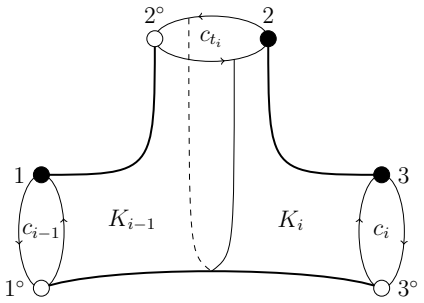
Reference graph
Works this paper leans on
-
[1]
Alba, Vasyl A. and Fateev, Vladimir A. and Litvinov, Alexey V. and Tarnopolskiy, Grigory M. On combinatorial expansion of the conformal blocks arising from AGT conjecture. Lett. Math. Phys. 2011. doi:10.1007/s11005-011-0503-z. arXiv:1012.1312
Pith/arXiv arXiv 2011
-
[2]
and Gaiotto, Davide and Tachikawa, Yuji
Alday, Luis F. and Gaiotto, Davide and Tachikawa, Yuji. Liouville Correlation Functions from Four-dimensional Gauge Theories. Lett. Math. Phys. 2010. doi:10.1007/s11005-010-0369-5. arXiv:0906.3219
Pith/arXiv arXiv 2010
-
[3]
Free fermions and tau-functions
Alexandrov, Alexander and Zabrodin, Anton. Free fermions and tau-functions. J. Geom. Phys. 2013. doi:10.1016/j.geomphys.2013.01.007. arXiv:1212.6049
Pith/arXiv arXiv 2013
-
[4]
Logarithmic Conformal Field Theory: Beyond an Introduction
Creutzig, Thomas and Ridout, David. Logarithmic Conformal Field Theory: Beyond an Introduction. J. Phys. A. 2013. doi:10.1088/1751-8113/46/49/494006. arXiv:1303.0847
Pith/arXiv arXiv 2013
-
[5]
Creutzig, Thomas and Dimofte, Tudor and Garner, Niklas and Geer, Nathan. A QFT for non-semisimple TQFT. Adv. Theor. Math. Phys. 2024. doi:10.4310/ATMP.2024.v28.n1.a4. arXiv:2112.01559
Pith/arXiv arXiv 2024
-
[6]
Feigin, Boris L. and Gainutdinov, Azat M. and Semikhatov, Alexei M. and Tipunin, Ilya Yu. Logarithmic extensions of minimal models: characters and modular transformations. Nucl. Phys. B. 2006. doi:10.1016/j.nuclphysb.2006.09.019. arXiv:hep-th/0606196
Pith/arXiv arXiv 2006
-
[7]
Representation of Lie groups and related topics , volume=
Representations of the Virasoro algebra , author=. Representation of Lie groups and related topics , volume=. 1990 , publisher=
1990
-
[8]
Gaudin Model, Bethe Ansatz and Critical Level
Feigin, Boris and Frenkel, Edward and Reshetikhin, Nikolai. Gaudin Model, Bethe Ansatz and Critical Level. Commun. Math. Phys. 1994. doi:10.1007/BF02099300. arXiv:hep-th/9402022
Pith/arXiv arXiv 1994
-
[9]
Opers on the projective line, flag manifolds and Bethe Ansatz
Frenkel, Edward. Opers on the projective line, flag manifolds and Bethe Ansatz. Mosc. Math. J. 2004. arXiv:math/0308269
Pith/arXiv arXiv 2004
-
[10]
Feigin, Boris L. and Tipunin, Ilya Yu. Logarithmic CFTs connected with simple Lie algebras. 2010. arXiv:1002.5047
Pith/arXiv arXiv 2010
-
[11]
2012 , publisher=
Conformal field theory , author=. 2012 , publisher=
2012
-
[12]
Gamayun, O. and Iorgov, N. and Lisovyy, O. Conformal field theory of Painlev\'e VI. JHEP. 2012. doi:10.1007/JHEP10(2012)038. arXiv:1207.0787
Pith/arXiv arXiv 2012
-
[13]
Gavrylenko, P. G. and Marshakov, A. V. Free fermions, W-algebras and isomonodromic deformations. Theor. Math. Phys. 2016. doi:10.1134/S0040577916050044. arXiv:1605.04554
Pith/arXiv arXiv 2016
-
[14]
Iorgov, N. and Lisovyy, O. and Teschner, J. Isomonodromic tau-functions from Liouville conformal blocks. Commun. Math. Phys. 2015. doi:10.1007/s00220-014-2245-0. arXiv:1401.6104
Pith/arXiv arXiv 2015
-
[15]
Jimbo, M. and Miwa, T. and Ueno, K. Monodromy preserving deformation of linear ordinary differential equations with rational coefficients: I. General theory and -function. Physica D: Nonlinear Phenomena. 1981. doi:10.1016/0167-2789(81)90013-0
-
[16]
V.G. Knizhnik and A.B. Zamolodchikov. Current algebra and Wess-Zumino model in two dimensions. Nuclear Physics B. 1984. doi:10.1016/0550-3213(84)90374-2
-
[17]
Moore, Gregory W. and Seiberg, Nathan. Classical and Quantum Conformal Field Theory. Commun. Math. Phys. 1989. doi:10.1007/BF01238857
-
[18]
Ponsot, B. and Teschner, J. Liouville bootstrap via harmonic analysis on a noncompact quantum group. 1999. arXiv:hep-th/9911110
Pith/arXiv arXiv 1999
-
[19]
From Quantum Curves to Topological String Partition Functions II
Coman, Ioana and Longhi, Pietro and Teschner, J. From Quantum Curves to Topological String Partition Functions II. Annales Henri Poincare. 2025. doi:10.1007/s00023-025-01538-2. arXiv:2004.04585
Pith/arXiv arXiv 2025
-
[20]
Iorgov, N. and Lisovyy, O. and Tkhyy, Yu. Painlev \'e VI connection problem and monodromy of c=1 conformal blocks. JHEP. 2013. doi:10.1007/JHEP12(2013)029. arXiv:1308.4092
Pith/arXiv arXiv 2013
-
[21]
On the Virasoro fusion kernel at c=25
Ribault, Sylvain and Tsiares, Ioannis. On the Virasoro fusion kernel at c=25. SciPost Phys. 2024. doi:10.21468/SciPostPhys.17.2.058. arXiv:2310.09334
Pith/arXiv arXiv 2024
-
[22]
On the Virasoro Crossing Kernels at Rational Central Charge
Roussillon, Julien and Tsiares, Ioannis. On the Virasoro Crossing Kernels at Rational Central Charge. 2025. arXiv:2512.03172
Pith/arXiv arXiv 2025
-
[23]
Studies on the Painlev \'e equations: I.-Sixth Painlev \'e equation PVI
Okamoto, K. Studies on the Painlev \'e equations: I.-Sixth Painlev \'e equation PVI. Annali di Matematica pura ed applicata. 1986. doi:10.1007/BF01762370
-
[24]
Isomonodromic deformations of the sl (2) Fuchsian systems on the Riemann sphere
Oblezin, Sergey. Isomonodromic deformations of the sl (2) Fuchsian systems on the Riemann sphere. Mosc. Math. J. 2005. doi:10.17323/1609-4514-2005-5-2-415-441. arXiv:math-ph/0309048
Pith/arXiv arXiv 2005
-
[25]
Irregular conformal blocks, Painlev \'e III and the blow-up equations
Gavrylenko, Pavlo and Marshakov, Andrei and Stoyan, Artem. Irregular conformal blocks, Painlev \'e III and the blow-up equations. JHEP. 2020. doi:10.1007/JHEP12(2020)125. arXiv:2006.15652
Pith/arXiv arXiv 2020
-
[26]
Cluster integrable systems, q -Painlev \'e equations and their quantization
Bershtein, Mikhail and Gavrylenko, Pavlo and Marshakov, Andrei. Cluster integrable systems, q -Painlev \'e equations and their quantization. JHEP. 2018. doi:10.1007/JHEP02(2018)077. arXiv:1711.02063
Pith/arXiv arXiv 2018
-
[27]
Painlev \'e equations from Nakajima--Yoshioka blowup relations
Bershtein, Mikhail and Shchechkin, Anton. Painlev \'e equations from Nakajima--Yoshioka blowup relations. Lett. Math. Phys. 2019. doi:10.1007/s11005-019-01198-4. arXiv:1811.04050
Pith/arXiv arXiv 2019
-
[28]
Bershtein, Mikhail A. and Shchechkin, Anton I. Bilinear equations on Painlev \'e functions from CFT. Commun. Math. Phys. 2015. doi:10.1007/s00220-015-2427-4. arXiv:1406.3008
Pith/arXiv arXiv 2015
-
[29]
Seiberg--Witten theory as a Fermi gas
Bonelli, Giulio and Grassi, Alba and Tanzini, Alessandro. Seiberg--Witten theory as a Fermi gas. Lett. Math. Phys. 2017. doi:10.1007/s11005-016-0893-z. arXiv:1603.01174
Pith/arXiv arXiv 2017
-
[30]
On Painlev \'e /gauge theory correspondence
Bonelli, Giulio and Lisovyy, Oleg and Maruyoshi, Kazunobu and Sciarappa, Antonio and Tanzini, Alessandro. On Painlev \'e /gauge theory correspondence. Lett. Math. Phys. 2017. doi:10.1007/s11005-017-0983-6. arXiv:1612.06235
Pith/arXiv arXiv 2017
-
[31]
Bershtein, Mikhail A. and Shchechkin, Anton I. q -deformed Painlev \'e function and q -deformed conformal blocks. J. Phys. A. 2017. doi:10.1088/1751-8121/aa5572. arXiv:1608.02566
Pith/arXiv arXiv 2017
-
[32]
CFT approach to the q -Painlev \'e VI equation
Jimbo, Michio and Nagoya, Hajime and Sakai, Hidetaka. CFT approach to the q -Painlev \'e VI equation. J. Integrable Syst. 2017. doi:10.1093/integr/xyx009. arXiv:1706.01940
Pith/arXiv arXiv 2017
-
[33]
Fredholm determinant and Nekrasov sum representations of isomonodromic tau functions
Gavrylenko, Pavlo and Lisovyy, Oleg. Fredholm determinant and Nekrasov sum representations of isomonodromic tau functions. Commun. Math. Phys. 2018. doi:10.1007/s00220-018-3224-7. arXiv:1608.00958
Pith/arXiv arXiv 2018
-
[34]
Isomonodromic -functions and W_N conformal blocks
Gavrylenko, Pavlo. Isomonodromic -functions and W_N conformal blocks. JHEP. 2015. doi:10.1007/JHEP09(2015)167. arXiv:1505.00259
Pith/arXiv arXiv 2015
-
[35]
N =2^* gauge theory, free fermions on the torus and Painlev \'e VI
Bonelli, Giulio and Del Monte, Fabrizio and Gavrylenko, Pavlo and Tanzini, Alessandro. N =2^* gauge theory, free fermions on the torus and Painlev \'e VI. Commun. Math. Phys. 2020. doi:10.1007/s00220-020-03743-y. arXiv:1901.10497
Pith/arXiv arXiv 2020
-
[36]
The Liouville side of the Vortex
Bonelli, Giulio and Tanzini, Alessandro and Zhao, Jian. The Liouville side of the Vortex. JHEP. 2011. doi:10.1007/JHEP09(2011)096. arXiv:1107.2787
Pith/arXiv arXiv 2011
-
[37]
Lectures on Instanton Counting
Nakajima, Hiraku and Yoshioka, Kota. Lectures on Instanton Counting. CRM Proc. Lecture Notes. 2004. doi:10.1090/crmp/038/02. arXiv:math/0311058
Pith/arXiv arXiv 2004
-
[38]
Riemann--Hilbert correspondence and blown up surface defects
Jeong, Saebyeok and Nekrasov, Nikita. Riemann--Hilbert correspondence and blown up surface defects. JHEP. 2020. doi:10.1007/JHEP12(2020)006. arXiv:2007.03660
Pith/arXiv arXiv 2020
-
[39]
Blowups in BPS/CFT correspondence, and Painlev \'e VI
Nekrasov, Nikita. Blowups in BPS/CFT correspondence, and Painlev \'e VI. Annales Henri Poincare. 2024. doi:10.1007/s00023-023-01301-5. arXiv:2007.03646
Pith/arXiv arXiv 2024
-
[40]
BPS/CFT correspondence: non-perturbative Dyson--Schwinger equations and qq -characters
Nekrasov, Nikita. BPS/CFT correspondence: non-perturbative Dyson--Schwinger equations and qq -characters. JHEP. 2016. doi:10.1007/JHEP03(2016)181. arXiv:1512.05388
Pith/arXiv arXiv 2016
-
[41]
BPS/CFT correspondence IV: sigma models and defects in gauge theory
Nekrasov, Nikita. BPS/CFT correspondence IV: sigma models and defects in gauge theory. Lett. Math. Phys. 2019. doi:10.1007/s11005-018-1115-7. arXiv:1711.11011
Pith/arXiv arXiv 2019
-
[42]
BPS/CFT correspondence V: BPZ and KZ equations from qq -characters
Nekrasov, Nikita. BPS/CFT correspondence V: BPZ and KZ equations from qq -characters. 2017. arXiv:1711.11582
Pith/arXiv arXiv 2017
-
[43]
Surface defects in gauge theory and KZ equation
Nekrasov, Nikita and Tsymbaliuk, Alexander. Surface defects in gauge theory and KZ equation. Lett. Math. Phys. 2022. doi:10.1007/s11005-022-01511-8. arXiv:2103.12611
Pith/arXiv arXiv 2022
-
[44]
Parallel surface defects, Hecke operators, and quantum Hitchin system
Jeong, Saebyeok and Lee, Norton and Nekrasov, Nikita. Parallel surface defects, Hecke operators, and quantum Hitchin system. Commun. Math. Phys. 2026. doi:10.1007/s00220-026-05603-7. arXiv:2304.04656
arXiv 2026
-
[45]
Poincar \'e polynomial of moduli spaces of framed sheaves on (stacky) Hirzebruch surfaces
Bruzzo, Ugo and Poghossian, Rubik and Tanzini, Alessandro. Poincar \'e polynomial of moduli spaces of framed sheaves on (stacky) Hirzebruch surfaces. Commun. Math. Phys. 2011. doi:10.1007/s00220-011-1231-z. arXiv:0909.1458
Pith/arXiv arXiv 2011
-
[46]
Highest-weight vectors and three-point functions in GKO coset decomposition
Bershtein, Mikhail and Feigin, Boris and Trufanov, Aleksandr. Highest-weight vectors and three-point functions in GKO coset decomposition. Commun. Math. Phys. 2025. doi:10.1007/s00220-025-05318-1. arXiv:2404.14350
Pith/arXiv arXiv 2025
-
[47]
Refined Painlev \'e /gauge theory correspondence and quantum tau functions
Bonelli, Giulio and Shchechkin, Anton and Tanzini, Alessandro. Refined Painlev \'e /gauge theory correspondence and quantum tau functions. Annales Henri Poincare. 2025. doi:10.1007/s00023-025-01621-8. arXiv:2502.01499
Pith/arXiv arXiv 2025
-
[48]
2022 , month = jun, doi =
Teschner, Joerg , title = ". 2022 , month = jun, doi =
2022
-
[49]
Ferrari, Andrea and Lentner, Simon and Teschner, J
-
[50]
A Lecture on the Liouville vertex operators
Teschner, J. A Lecture on the Liouville vertex operators. Int. J. Mod. Phys. A. 2004. doi:10.1142/S0217751X04020567. arXiv:hep-th/0303150
Pith/arXiv arXiv 2004
discussion (0)
Sign in with ORCID, Apple, or X to comment. Anyone can read and Pith papers without signing in.