REVIEW 2 major objections 5 minor 111 references
This paper argues that the galaxy bispectrum, not the power spectrum, supplies most of the constraining power on folded primordial non-Gaussianity, and that whether such a signal can be detected depends as much on the width and morphology o
Reviewed by Pith at T0; open to challenge. T0 means a machine referee read the full paper against a public rubric. the ladder, T0–T4 →
T0 review · deepseek-v4-flash
2026-08-01 23:38 UTC pith:E5GTP5G2
load-bearing objection First non-separable folded-PNG galaxy bispectrum forecast; numbers are conditional on zero equilateral/orthogonal PNG, so treat σ(f_NL) as optimistic. the 2 major comments →
Searching for Folded Primordial Non-Gaussianity with Galaxy Surveys
The pith
A machine-rendered reading of the paper's core claim, the machinery that carries it, and where it could break.
Core claim
The paper's central claim is that folded PNG is best hunted in the galaxy bispectrum, because the folded enhancement is intrinsically a property of triangle shapes; the power spectrum sees it only indirectly through scale-dependent bias and loop corrections. For the cutoff-regulated templates, the forecast uncertainty on the amplitude scales as sigma(f_NL) proportional to the square root of lambda in the idealized unbinned limit, degrading to proportional to lambda once the folded core is narrower than the Fourier bin. For dissipative inflation, the constraint scales as sigma(f_NL) proportional to H/gamma and is only weakly affected by binning, at the price of a larger overlap with the equil
What carries the argument
The central object is the scale-dependent bias response F_*^(3)(k), a smoothed integral of the primordial bispectrum over short modes that converts any squeezed-limit primordial shape into a galaxy-bias correction. Here the smoothing is a top-hat filter at R* = 3.1 h^-1 Mpc, and the amplitude is set by a single bias coefficient. This response feeds into the redshift-space galaxy kernels, and the comparisons are made with Fisher forecasts over power-spectrum multipoles (ell=0,2,4) and the bispectrum monopole, with binned versus unbinned forecasts isolating the role of the folded-core width.
Load-bearing premise
The forecasts assume that folded non-Gaussianity's effect on galaxy formation is fully captured by a single bias coefficient whose fiducial value comes from a simple universality relation; if that coefficient needs extra freedom, or the smoothing scale is different, the balance between power spectrum and bispectrum information could shift.
What would settle it
Measure the binned galaxy bispectrum from a large survey at two bin widths, say 0.005 and 0.010 h/Mpc, for a fixed lambda. For a narrow-core template, the paper predicts a clear degradation of sigma(f_NL) with coarser bins that follows a lambda scaling; if finer bins do not improve constraints, the core-dilution mechanism is wrong.
If this is right
- Most of the folded-PNG signal is in the galaxy bispectrum; the power spectrum contributes only indirectly via scale-dependent bias and loop corrections.
- For non-Bunch-Davies and imaginary-speed-of-sound templates, constraints follow sigma(f_NL) proportional to sqrt(lambda) until the folded core narrows below the Fourier bin width, after which they degrade as lambda.
- For dissipative inflation, the exponentially narrow core is unresolvable; what is measurable is the logarithmic shoulder, so constraints scale as H/gamma and depend weakly on binning.
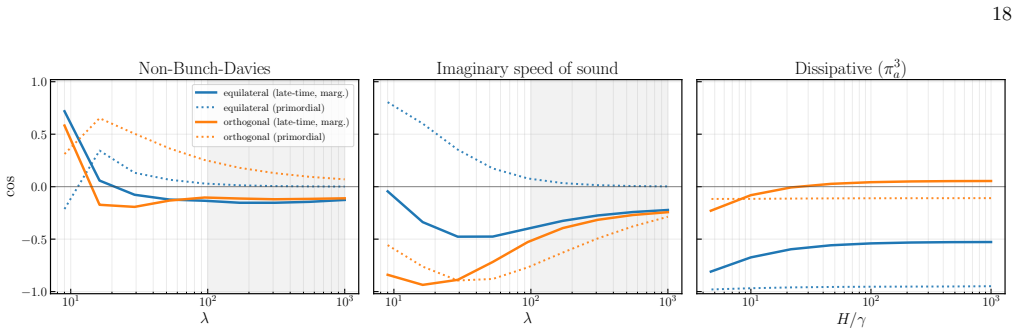
- Folded templates remain distinguishable from equilateral and orthogonal shapes after bias marginalization, so dedicated folded searches would capture information standard template fits miss.
- The numerical framework generalizes to arbitrary non-separable primordial bispectra, including other collider-type shapes beyond the three models studied.
Where Pith is reading between the lines
- An extension the paper leaves implicit: adaptive, non-uniform Fourier binning concentrated near the folded boundary could recover part of the sqrt(lambda) information that uniform bins lose at high lambda.
- The prediction of a k^{-1} scale-dependent bias in the cutoff-regulated models could be tested directly in the galaxy power spectrum, providing a cross-check independent of bispectrum template fitting.
- The dissipative model's substantial overlap with the equilateral template suggests that joint fits including the equilateral amplitude will be needed; the paper's Fisher-cosine diagnostic only probes degeneracy direction, not a full joint likelihood recovery.
- If the bias coefficient b_zeta departs from the universality fiducial value, the power spectrum's already subdominant role could grow, so the bispectrum-dominance conclusion deserves rechecking with a wider bias prior.
Editorial analysis
A structured set of objections, weighed in public.
Referee Report
Summary. This paper studies the prospects for constraining folded primordial non-Gaussianity (PNG) with galaxy clustering, focusing on three inflationary models: non-Bunch-Davies initial states, imaginary speed of sound, and dissipative inflation. The models are grouped into two classes—cutoff-regulated templates with power-law folded-core widths (∝1/λ) and dissipation-regulated templates with exponentially narrow cores (∝e^{-H/γ}). The authors develop a numerical pipeline that computes the PNG contributions to the one-loop redshift-space galaxy power spectrum multipoles and tree-level bispectrum monopole within EFTofLSS, including scale-dependent bias through the F_*^{(3)} construction. Using Fisher forecasts for a DESI-like survey, they find that the bispectrum provides the dominant constraining power, that nuisance marginalization causes only mild degradation for large folded enhancement in the cutoff-regulated cases, and that finite binning degrades constraints once the folded core becomes narrower than the bin width. For dissipative inflation, constraints scale as σ(f_NL)∝H/γ and are weakly binning-dependent. The paper also computes late-time Fisher cosines to assess distinguishability from equilateral and orthogonal templates.
Significance. If the results hold, this is a valuable contribution: it provides the first consistent EFTofLSS treatment of folded PNG shapes in galaxy clustering, going beyond the standard equilateral/local/orthogonal templates and demonstrating that the width and morphology of the folded enhancement are crucial for detectability. The distinction between cutoff- and dissipation-regulated folded bispectra is physically meaningful and likely to influence future survey analyses. The numerical pipeline is general for non-separable bispectra, and the validation against class-pt for equilateral/orthogonal shapes gives some confidence in the implementation. The scaling arguments for σ(f_NL) in the unbinned and binned cases are transparent and falsifiable. The main weakness is that the headline forecasts condition on vanishing equilateral and orthogonal amplitudes, which is not clearly stated as a limitation and could affect the quantitative conclusions.
major comments (2)
- [Sec. IV, Eq. (64), Figs. 4–7] The forecast parameter vector contains only a single PNG amplitude, f_NL for the folded template; f_NL_equil and f_NL_ortho are fixed to zero. The quoted σ(f_NL) values in Figs. 4–6 are therefore conditional on the absence of standard PNG amplitudes. This matters because Fig. 7 shows non-negligible late-time Fisher overlap between the folded templates and equilateral/orthogonal templates, especially for the dissipative π_a^3 template (which anti-correlates with equilateral) and for cutoff-regulated templates at moderate λ. In a joint analysis, the marginalized error on the folded amplitude is σ_cond/√(1−cos²), so even |cos|=0.9 would worsen the constraint by a factor ~2.3. Moreover, because the scale-dependent bias has different k-dependence for folded (∝k^{−1}) versus equilateral (∝k^0) shapes, marginalizing over equilateral/orthogonal amplitudes could alter the relative information con
- [Sec. III A, Eqs. (39)–(40), Fig. 3] The scale-dependent bias for folded shapes is modeled with a single response coefficient b_ζ and the F_*^{(3)} construction of [93], using a fixed smoothing scale R_*=3.1 h^{-1} Mpc and fiducial b_ζ from universality relations. This construction is not directly validated for folded shapes, whose moderately squeezed limits are constant or scale as (k_l/k_s)^{γ/H} rather than the local-like behavior for which the peak-background-split derivation is standard. If folded PNG requires additional bias parameters, a different smoothing prescription, or non-universal b_ζ, the power-spectrum contribution and the nuisance-marginalization behavior could change. The paper partially addresses this by showing that setting b_ζ=b_ζδ=0 changes the joint constraint by less than ~1% at large λ for the cutoff-regulated models, which suggests the bispectrum-dominance conclusion is robust. However, since the p
minor comments (5)
- [Fig. 5 caption] The statement that the equilateral and orthogonal pieces are 'projected out from the template' is important but the implementation is not described. Please clarify how the projection is performed (e.g., by orthogonalizing with respect to the Fisher inner product) and whether Fig. 4 uses the same projection or the raw template.
- [Sec. IV, Eq. (65)–(66)] The underbrace notation in the scaling estimates is hard to read. Please spell out in words that the unbinned Fisher information scales as (folded amplitude)^2 × (width in k-space), and similarly for the binned case.
- [Sec. III E] The numerical pipeline is not released. For reproducibility, consider providing the code or, at minimum, a more detailed description of the integration scheme (tolerances, grid resolution near the folded ridge, and the treatment of the exponentially narrow dissipative core).
- [Sec. IV, footnote 12] The choice k_max=0.155 h/Mpc with a tree-level bispectrum is somewhat aggressive. The footnote acknowledges this, but a sentence in the main text would help readers interpret the forecasts.
- [References] Several references (e.g., [3], [10], [72], [103]) lack publication years in the bibliography. Please complete the reference entries.
Circularity Check
No significant circularity: forecasts are f_NL=0 Fisher derivatives with externally sourced folded templates; same-group citations are minor, not load-bearing.
full rationale
The derivation chain is not circular. The folded bispectrum templates are taken from external inflationary-model literature: the non-Bunch-Davies shape is quoted from [14] (Eq. 10), the imaginary-speed-of-sound shape from [33] (Eq. 21), and the dissipative shape is computed here and checked against [41]. None of these templates is fitted to the forecast target f_NL or to galaxy-survey statistics. The forecast is performed at fiducial f_NL=0 (Sec. IV), so the quoted sigma(f_NL) values are Fisher derivatives of the model response, not fitted parameters renamed as predictions. The scale-dependent-bias response is imported from [93] ('A powerful way to estimate the scale-dependent bias generated by a general squeezed primordial bispectrum was introduced in [93]') and the EFTofLSS kernels from [72] ('We will mainly follow the treatment of local PNG in [72]'); [72] is co-authored by one of the current authors, but it is an established framework already applied to BOSS data, and the PNG loop implementation is additionally checked against class-pt for equilateral/orthogonal templates, so it constitutes independent support rather than a self-referential premise. The central claim that the bispectrum dominates folded-PNG constraints follows from the folded enhancement being a triangle-geometry feature and is robust to removing the scale-dependent-bias terms: the power-spectrum constraint changes by a factor of 2, while the bispectrum and joint constraints change by less than 1% at large lambda. The main modeling caveat, flagged by a skeptical reader, is that the Fisher parameter vector in Eq. (64) omits f_NL^equil and f_NL^ortho, and Fig. 7 shows non-negligible overlap with those standard shapes; the quoted constraints are therefore conditional and may be optimistic in a joint multi-shape analysis. That is a statistical/robustness limitation, not circularity: no equation in the paper equates a fitted input with the claimed prediction, and the self-citations present are minor and not load-bearing.
Axiom & Free-Parameter Ledger
free parameters (7)
- Fiducial f_NL =
0
- Fiducial linear bias b1 =
2.5
- Fiducial b2, b_G2, b_Gamma3 =
fitting relations of [104] and coevolution
- Fiducial b_zeta, b_zeta-delta, b_zeta-epsilon =
universality relations [91]; b_zeta-epsilon=0
- Survey setup =
V=2.5 h^-3 Gpc^3, nbar=4e-4 h^3 Mpc^-3, kmin=0.005, kmax=0.155, Delta k=0.005 h/Mpc, z=0, R*=3.1 h^-1 Mpc
- non-Bunch-Davies Bogoliubov phase delta =
pi/3
- Model parameters lambda and H/gamma =
scanned from ~10 to 10^3
axioms (8)
- standard math In-in formalism and the positive/negative-frequency mode-function decomposition correctly compute the primordial bispectra for the three models.
- domain assumption Scale-dependent bias is captured by the F*^(3)(k) variance-modulation response of [93] with smoothing scale R*=3.1 h^-1 Mpc; folded squeezed limits are no more singular than local PNG so the same bias expansion applies.
- domain assumption Universality and coevolution relations fix fiducial b_zeta, b_zeta-delta, and b_Gamma3.
- domain assumption Perturbative control holds for one-loop power spectrum and tree-level bispectrum up to k_max=0.155 h/Mpc, and PNG-induced counterterms are higher order and negligible.
- domain assumption Gaussian covariance for P and B, with no cross-covariance, adequately represents survey errors for Fisher forecasts.
- domain assumption IR resummation of fast non-Bunch-Davies oscillations can be omitted without changing the constraints.
- ad hoc to paper Normalization convention S(k/2,k/2,k)=1 for folded templates.
- domain assumption Fisher information at f_NL=0 with broad Gaussian priors approximates survey sensitivity.
read the original abstract
Large-scale structure provides a powerful probe of inflationary physics through primordial non-Gaussianity (PNG): the galaxy power spectrum depends on local PNG through scale-dependent bias, while the galaxy bispectrum depends sensitively on both equilateral and orthogonal PNG. In this paper, we study whether galaxy surveys can also probe folded PNG, whose shape is enhanced near $k_1+k_2-k_3\rightarrow0$. We consider three inflationary models with folded PNG, including excited initial states, imaginary speeds of sound, and dissipative inflation. These models fall into two classes: cutoff-regulated cases in which the folded-enhanced region has a power-law width, and dissipation-regulated cases in which the enhanced region is exponentially narrow. We develop a numerical pipeline for computing the corresponding PNG contributions to the redshift-space galaxy power spectrum multipoles and bispectrum monopole within the EFTofLSS. Using Fisher forecasts, we show that most of the constraining power on folded PNG comes from the galaxy bispectrum. For the cutoff-regulated models, nuisance parameter marginalization causes only a mild loss of information at large folded enhancement, but finite Fourier-space binning degrades constraints once the folded region becomes narrower than the bin width. For the dissipation-regulated models, the exponentially narrow folded enhancement is hard to resolve and the observable signal instead comes from the broader support of the template, leading to weaker binning dependence but larger overlap with the equilateral template. Our results show that folded PNG is a distinctive and promising target for galaxy bispectrum analyses, and the detectability depends on the width and morphology of the folded enhancement. The numerical pipeline developed in this work is general and can be used to study a wide class of non-separable primordial bispectra.
Figures


Reference graph
Works this paper leans on
-
[1]
D. H. Lyth, What would we learn by detecting a gravitational wave signal in the cosmic microwave background anisotropy?, Phys. Rev. Lett.78, 1861 (1997), arXiv:hep-ph/9606387
Pith/arXiv arXiv 1997
-
[2]
− 1 14 G2(k1,k 2) (k1 +k 2)·k 3 |k1 +k 2|2 F (3) ∗ (k3) M(k3) + 2 perms. # +f NL bζ
Imaginary Speed of Sound A second realization of folded enhancement arises in multi-field inflation with strongly non-geodesic motion. In negatively curved field spaces, slow-roll trajectories can be geometrically destabilized and attracted to rapidly turning solutions, leading to a transient tachyonic instability of entropic fluctuations [23–31]. When th...
-
[3]
P. A. R. Adeet al.(BICEP, Keck), Improved Constraints on Primordial Gravitational Waves using Planck, WMAP, and BICEP/Keck Observations through the 2018 Observing Season, Phys. Rev. Lett.127, 151301 (2021), arXiv:2110.00483 [astro-ph.CO]
arXiv 2018
-
[4]
G. Cabass, E. Pajer, and F. Schmidt, How Gaussian can our Universe be?, JCAP01, 003, arXiv:1612.00033 [hep-th]. 21
-
[5]
J. M. Maldacena, Non-Gaussian features of primordial fluctuations in single field inflationary models, JHEP05, 013, arXiv:astro-ph/0210603
-
[6]
X. Chen, M.-x. Huang, S. Kachru, and G. Shiu, Observational signatures and non-Gaussianities of general single field inflation, JCAP01, 002, arXiv:hep-th/0605045
-
[7]
N. Bartolo, E. Komatsu, S. Matarrese, and A. Riotto, Non-Gaussianity from inflation: Theory and observations, Phys. Rept.402, 103 (2004), arXiv:astro-ph/0406398
Pith/arXiv arXiv 2004
-
[8]
D. H. Lyth and D. Wands, Generating the curvature perturbation without an inflaton, Phys. Lett. B524, 5 (2002), arXiv:hep-ph/0110002
Pith/arXiv arXiv 2002
-
[9]
K. Enqvist and M. S. Sloth, Adiabatic CMB perturbations in pre - big bang string cosmology, Nucl. Phys. B626, 395 (2002), arXiv:hep-ph/0109214
Pith/arXiv arXiv 2002
-
[10]
T. Moroi and T. Takahashi, Effects of cosmological moduli fields on cosmic microwave background, Phys. Lett. B522, 215 (2001), [Erratum: Phys.Lett.B 539, 303–303 (2002)], arXiv:hep-ph/0110096
Pith/arXiv arXiv 2001
-
[11]
C. Cheung, P. Creminelli, A. L. Fitzpatrick, J. Kaplan, and L. Senatore, The Effective Field Theory of Inflation, JHEP 03, 014, arXiv:0709.0293 [hep-th]
-
[12]
Chen, Running non-Gaussianities in DBI inflation, Phys
X. Chen, Running non-Gaussianities in DBI inflation, Phys. Rev. D72, 123518 (2005), arXiv:astro-ph/0507053
Pith/arXiv arXiv 2005
-
[13]
R. Holman and A. J. Tolley, Enhanced Non-Gaussianity from Excited Initial States, JCAP05, 001, arXiv:0710.1302 [hep-th]
-
[14]
P. D. Meerburg, J. P. van der Schaar, and P. S. Corasaniti, Signatures of Initial State Modifications on Bispectrum Statistics, JCAP05, 018, arXiv:0901.4044 [hep-th]
-
[15]
P. D. Meerburg, J. P. van der Schaar, and M. G. Jackson, Bispectrum signatures of a modified vacuum in single field inflation with a small speed of sound, JCAP02, 001, arXiv:0910.4986 [hep-th]
-
[16]
A. Aravind, D. Lorshbough, and S. Paban, Non-Gaussianity from Excited Initial Inflationary States, JHEP07, 076, arXiv:1303.1440 [hep-th]
-
[17]
P. D. Meerburg and M. M¨ unchmeyer, Optimal CMB estimators for bispectra from excited states, Phys. Rev. D92, 063527 (2015), arXiv:1505.05882 [astro-ph.CO]
Pith/arXiv arXiv 2015
-
[18]
B. Greene, K. Schalm, J. P. van der Schaar, and G. Shiu, Extracting new physics from the CMB, eConfC041213, 0001 (2004), arXiv:astro-ph/0503458
Pith/arXiv arXiv 2004
-
[19]
K. Schalm, G. Shiu, and J. P. van der Schaar, Decoupling in an expanding universe: Boundary RG flow affects initial conditions for inflation, JHEP04, 076, arXiv:hep-th/0401164
-
[20]
X. Chen, Folded Resonant Non-Gaussianity in General Single Field Inflation, JCAP12, 003, arXiv:1008.2485 [hep-th]
-
[21]
J. Byun, N. Agarwal, R. Bean, and R. Holman, Looking for non-Gaussianity in all the right places: A new basis for nonseparable bispectra, Phys. Rev. D91, 123518 (2015), arXiv:1504.01394 [astro-ph.CO]
Pith/arXiv arXiv 2015
-
[22]
N. Agarwal, R. Holman, A. J. Tolley, and J. Lin, Effective field theory and non-Gaussianity from general inflationary states, JHEP05, 085, arXiv:1212.1172 [hep-th]
-
[23]
A. Albrecht, N. Bolis, and R. Holman, Cosmological Consequences of Initial State Entanglement, JHEP11, 093, arXiv:1408.6859 [hep-th]
-
[24]
S. Renaux-Petel and K. Turzy´ nski, Geometrical Destabilization of Inflation, Phys. Rev. Lett.117, 141301 (2016), arXiv:1510.01281 [astro-ph.CO]
Pith/arXiv arXiv 2016
-
[25]
S. Cremonini, Z. Lalak, and K. Turzynski, Strongly Coupled Perturbations in Two-Field Inflationary Models, JCAP03, 016, arXiv:1010.3021 [hep-th]
-
[26]
A. R. Brown, Hyperbolic Inflation, Phys. Rev. Lett.121, 251601 (2018), arXiv:1705.03023 [hep-th]
Pith/arXiv arXiv 2018
-
[27]
S. Mizuno and S. Mukohyama, Primordial perturbations from inflation with a hyperbolic field-space, Phys. Rev. D96, 103533 (2017), arXiv:1707.05125 [hep-th]
Pith/arXiv arXiv 2017
-
[28]
T. Bjorkmo and M. C. D. Marsh, Hyperinflation generalised: from its attractor mechanism to its tension with the ‘swampland conditions’, JHEP04, 172, arXiv:1901.08603 [hep-th]
Pith/arXiv arXiv 1901
-
[29]
P. Christodoulidis, D. Roest, and E. I. Sfakianakis, Attractors, Bifurcations and Curvature in Multi-field Inflation, JCAP 08, 006, arXiv:1903.03513 [gr-qc]
Pith/arXiv arXiv 1903
-
[30]
P. Christodoulidis, D. Roest, and E. I. Sfakianakis, Scaling attractors in multi-field inflation, JCAP12, 059, arXiv:1903.06116 [hep-th]
Pith/arXiv arXiv 1903
-
[31]
V. Aragam, S. Paban, and R. Rosati, Multi-field Inflation in High-Slope Potentials, JCAP04, 022, arXiv:1905.07495 [hep-th]
Pith/arXiv arXiv 1905
-
[32]
S. Garcia-Saenz, Y. Lu, and S. Renaux-Petel, Loops in inflation with strongly non-geodesic motion, JCAP11, 039, arXiv:2503.18516 [hep-th]
-
[33]
S. Aoki, D. Roest, and D. Werth, Universal Non-Gaussian Signatures from Transient Instabilities, (2026), arXiv:2604.01035 [astro-ph.CO]
arXiv 2026
-
[34]
S. Garcia-Saenz and S. Renaux-Petel, Flattened non-Gaussianities from the effective field theory of inflation with imagi- nary speed of sound, JCAP11, 005, arXiv:1805.12563 [hep-th]
-
[35]
J. Fumagalli, S. Garcia-Saenz, L. Pinol, S. Renaux-Petel, and J. Ronayne, Hyper-Non-Gaussianities in Inflation with Strongly Nongeodesic Motion, Phys. Rev. Lett.123, 201302 (2019), arXiv:1902.03221 [hep-th]
Pith/arXiv arXiv 2019
-
[36]
T. Bjorkmo, R. Z. Ferreira, and M. C. D. Marsh, Mild Non-Gaussianities under Perturbative Control from Rapid-Turn Inflation Models, JCAP12, 036, arXiv:1908.11316 [hep-th]
Pith/arXiv arXiv 1908
-
[37]
R. Z. Ferreira, Non-Gaussianities in models of inflation with large and negative entropic masses, JCAP08, 034, arXiv:2003.13410 [astro-ph.CO]
Pith/arXiv arXiv 2003
-
[38]
O. Iarygina, M. C. D. Marsh, and G. Salinas, Non-Gaussianity in rapid-turn multi-field inflation, JCAP03, 014, 22 arXiv:2303.14156 [astro-ph.CO]
-
[39]
D. Lopez Nacir, R. A. Porto, and M. Zaldarriaga, The consistency condition for the three-point function in dissipative single-clock inflation, JCAP09, 004, arXiv:1206.7083 [hep-th]
-
[40]
M. Mirbabayi and A. Gruzinov, Shapes of non-Gaussianity in warm inflation, JCAP02, 012, arXiv:2205.13227 [astro- ph.CO]
-
[41]
D. Green and R. A. Porto, Signals of a Quantum Universe, Phys. Rev. Lett.124, 251302 (2020), arXiv:2001.09149 [hep-th]
Pith/arXiv arXiv 2020
-
[42]
S. A. Salcedo, T. Colas, and E. Pajer, The open effective field theory of inflation, JHEP10, 248, arXiv:2404.15416 [hep-th]
-
[43]
Weinberg, Quantum contributions to cosmological correlations, Phys
S. Weinberg, Quantum contributions to cosmological correlations, Phys. Rev. D72, 043514 (2005), arXiv:hep-th/0506236
Pith/arXiv arXiv 2005
-
[44]
A. Berera, Warm inflation, Phys. Rev. Lett.75, 3218 (1995), arXiv:astro-ph/9509049
Pith/arXiv arXiv 1995
-
[45]
A. Berera and L.-Z. Fang, Thermally induced density perturbations in the inflation era, Phys. Rev. Lett.74, 1912 (1995), arXiv:astro-ph/9501024
Pith/arXiv arXiv 1912
-
[46]
Berera, Thermal properties of an inflationary universe, Phys
A. Berera, Thermal properties of an inflationary universe, Phys. Rev. D54, 2519 (1996), arXiv:hep-th/9601134
Pith/arXiv arXiv 1996
-
[47]
A. Berera, Warm inflation at arbitrary adiabaticity: A Model, an existence proof for inflationary dynamics in quantum field theory, Nucl. Phys. B585, 666 (2000), arXiv:hep-ph/9904409
Pith/arXiv arXiv 2000
-
[48]
D. Lopez Nacir, R. A. Porto, L. Senatore, and M. Zaldarriaga, Dissipative effects in the Effective Field Theory of Inflation, JHEP01, 075, arXiv:1109.4192 [hep-th]
-
[49]
M. Bastero-Gil, A. Berera, and R. O. Ramos, Shear viscous effects on the primordial power spectrum from warm inflation, JCAP07, 030, arXiv:1106.0701 [astro-ph.CO]
-
[50]
M. Bastero-Gil, A. Berera, I. G. Moss, and R. O. Ramos, Theory of non-Gaussianity in warm inflation, JCAP12, 008, arXiv:1408.4391 [astro-ph.CO]
-
[51]
K. V. Berghaus, P. W. Graham, and D. E. Kaplan, Minimal Warm Inflation, JCAP03, 034, [Erratum: JCAP 10, E02 (2023)], arXiv:1910.07525 [hep-ph]
Pith/arXiv arXiv 2023
-
[52]
H. Jiang and Y. Wang, Towards the physical vacuum of cosmic inflation, Phys. Lett. B760, 202 (2016), arXiv:1507.05193 [hep-th]
Pith/arXiv arXiv 2016
-
[53]
D. Baumann, A. Nicolis, L. Senatore, and M. Zaldarriaga, Cosmological Non-Linearities as an Effective Fluid, JCAP07, 051, arXiv:1004.2488 [astro-ph.CO]
-
[54]
J. J. M. Carrasco, M. P. Hertzberg, and L. Senatore, The Effective Field Theory of Cosmological Large Scale Structures, JHEP09, 082, arXiv:1206.2926 [astro-ph.CO]
-
[55]
S. Foreman, H. Perrier, and L. Senatore, Precision Comparison of the Power Spectrum in the EFTofLSS with Simulations, JCAP05, 027, arXiv:1507.05326 [astro-ph.CO]
-
[56]
J. J. M. Carrasco, S. Foreman, D. Green, and L. Senatore, The Effective Field Theory of Large Scale Structures at Two Loops, JCAP07, 057, arXiv:1310.0464 [astro-ph.CO]
-
[57]
T. Baldauf, E. Schaan, and M. Zaldarriaga, On the reach of perturbative methods for dark matter density fields, JCAP 03, 007, arXiv:1507.02255 [astro-ph.CO]
-
[58]
G. D’Amico, Y. Donath, M. Lewandowski, L. Senatore, and P. Zhang, The one-loop bispectrum of galaxies in redshift space from the Effective Field Theory of Large-Scale Structure, JCAP07, 041, arXiv:2211.17130 [astro-ph.CO]
-
[59]
O. H. E. Philcox, M. M. Ivanov, G. Cabass, M. Simonovi´ c, M. Zaldarriaga, and T. Nishimichi, Cosmology with the redshift-space galaxy bispectrum monopole at one-loop order, Phys. Rev. D106, 043530 (2022), arXiv:2206.02800 [astro- ph.CO]
Pith/arXiv arXiv 2022
-
[60]
T. Steele and T. Baldauf, Precise Calibration of the One-Loop Trispectrum in the Effective Field Theory of Large Scale Structure, Phys. Rev. D103, 103518 (2021), arXiv:2101.10289 [astro-ph.CO]
Pith/arXiv arXiv 2021
-
[61]
D. Bertolini, K. Schutz, M. P. Solon, and K. M. Zurek, The Trispectrum in the Effective Field Theory of Large Scale Structure, JCAP06, 052, arXiv:1604.01770 [astro-ph.CO]
-
[62]
M. M. Ivanov, M. Simonovi´ c, and M. Zaldarriaga, Cosmological Parameters from the BOSS Galaxy Power Spectrum, JCAP05, 042, arXiv:1909.05277 [astro-ph.CO]
Pith/arXiv arXiv 1909
-
[63]
G. D’Amico, J. Gleyzes, N. Kokron, K. Markovic, L. Senatore, P. Zhang, F. Beutler, and H. Gil-Mar ´ ın, The Cos- mological Analysis of the SDSS/BOSS data from the Effective Field Theory of Large-Scale Structure, JCAP05, 005, arXiv:1909.05271 [astro-ph.CO]
Pith/arXiv arXiv 1909
-
[64]
S.-F. Chen, Z. Vlah, and M. White, A new analysis of galaxy 2-point functions in the BOSS survey, including full-shape information and post-reconstruction BAO, JCAP02(02), 008, arXiv:2110.05530 [astro-ph.CO]
-
[65]
A. G. Adameet al.(DESI), DESI 2024 VII: cosmological constraints from the full-shape modeling of clustering measure- ments, JCAP07, 028, arXiv:2411.12022 [astro-ph.CO]
Pith/arXiv arXiv 2024
-
[66]
A. Chudaykin, M. M. Ivanov, and O. H. E. Philcox, Reanalyzing DESI DR1. I. ΛCDM constraints from the power spectrum and bispectrum, Phys. Rev. D113, 063502 (2026), arXiv:2507.13433 [astro-ph.CO]
arXiv 2026
-
[67]
T. Bakx, M. M. Ivanov, O. H. E. Philcox, and Z. Vlah, One-Loop Galaxy Bispectrum: Consistent Theory, Efficient Analysis with COBRA, and Implications for Cosmological Parameters, (2025), arXiv:2507.22110 [astro-ph.CO]
Pith/arXiv arXiv 2025
-
[68]
G. Cabass, O. H. E. Philcox, M. M. Ivanov, K. Akitsu, S.-F. Chen, M. Simonovi´ c, and M. Zaldarriaga, BOSS constraints on massive particles during inflation: The cosmological collider in action, Phys. Rev. D111, 063510 (2025), arXiv:2404.01894 [astro-ph.CO]
Pith/arXiv arXiv 2025
-
[69]
V. Assassi, D. Baumann, and F. Schmidt, Galaxy Bias and Primordial Non-Gaussianity, JCAP12, 043, arXiv:1510.03723 [astro-ph.CO]
-
[70]
V. Assassi, D. Baumann, E. Pajer, Y. Welling, and D. van der Woude, Effective theory of large-scale structure with 23 primordial non-Gaussianity, JCAP11, 024, arXiv:1505.06668 [astro-ph.CO]
-
[71]
Akramiet al.(Planck), Planck 2018 results
Y. Akramiet al.(Planck), Planck 2018 results. IX. Constraints on primordial non-Gaussianity, Astron. Astrophys.641, A9 (2020), arXiv:1905.05697 [astro-ph.CO]
Pith/arXiv arXiv 2018
-
[72]
G. Jung, M. Citran, B. van Tent, L. Dumilly, and N. Aghanim, Constraints on primordial non-Gaussianity from Planck PR4 data, Astron. Astrophys.702, A204 (2025), arXiv:2504.00884 [astro-ph.CO]
arXiv 2025
-
[73]
G. Cabass, M. M. Ivanov, O. H. E. Philcox, M. Simonovi´ c, and M. Zaldarriaga, Constraints on multifield inflation from the BOSS galaxy survey, Phys. Rev. D106, 043506 (2022), arXiv:2204.01781 [astro-ph.CO]
Pith/arXiv arXiv 2022
-
[74]
G. Cabass, M. M. Ivanov, O. H. E. Philcox, M. Simonovi´ c, and M. Zaldarriaga, Constraints on Single-Field Inflation from the BOSS Galaxy Survey, Phys. Rev. Lett.129, 021301 (2022), arXiv:2201.07238 [astro-ph.CO]
Pith/arXiv arXiv 2022
-
[75]
A. Chudaykin, M. M. Ivanov, and O. H. E. Philcox, Reanalyzing DESI DR1. III. Constraints on inflation from galaxy power spectra and bispectra, Phys. Rev. D113, 063552 (2026), arXiv:2512.04266 [astro-ph.CO]
arXiv 2026
-
[76]
M. M. Ivanov, C. Cuesta-Lazaro, S. Mishra-Sharma, A. Obuljen, and M. W. Toomey, Full-shape analysis with simulation- based priors: Constraints on single field inflation from BOSS, Phys. Rev. D110, 063538 (2024), arXiv:2402.13310 [astro- ph.CO]
Pith/arXiv arXiv 2024
-
[77]
S.-F. Chen, P. Chakraborty, and C. Dvorkin, Analysis of BOSS galaxy data with weighted skew-spectra, JCAP05, 011, arXiv:2401.13036 [astro-ph.CO]
-
[78]
G. D’Amico, M. Lewandowski, L. Senatore, and P. Zhang, Limits on primordial non-Gaussianities from BOSS galaxy- clustering data, Phys. Rev. D111, 063514 (2025), arXiv:2201.11518 [astro-ph.CO]
Pith/arXiv arXiv 2025
-
[79]
E. Chaussidonet al., Constraining primordial non-Gaussianity with DESI 2024 LRG and QSO samples, JCAP06, 029, arXiv:2411.17623 [astro-ph.CO]
Pith/arXiv arXiv 2024
-
[80]
S. A. Salcedo, T. Colas, P. Suman, B. Zhang, J. Fergusson, and E. P. S. Shellard, Primordial non-Gaussianity constraints on dissipative inflation, (2026), arXiv:2603.13473 [astro-ph.CO]
arXiv 2026
discussion (0)
Sign in with ORCID, Apple, or X to comment. Anyone can read and Pith papers without signing in.