REVIEW 4 major objections 5 minor 34 references
Transport Theory and Correlation Measurements: Coming to Terms on Emission Sources
T0 review · 4 major / 5 minor · reviewed 2026-08-07 · deepseek-v4-flash
Pith's one-line read A proton-pair transport source, supplemented by a two-parameter exponential tail, reproduces measured correlations down to low relative momentum.
desk verdict Honest incremental application of deblurring to pBUU sources for Ar+Sc; the tail parameters are fit to the same data, so the low-q agreement is descriptive, not predictive. read the letter →
The pith
A machine-rendered reading of the paper's core claim, the machinery that carries it, and where it could break.
The reading
What carries the argument
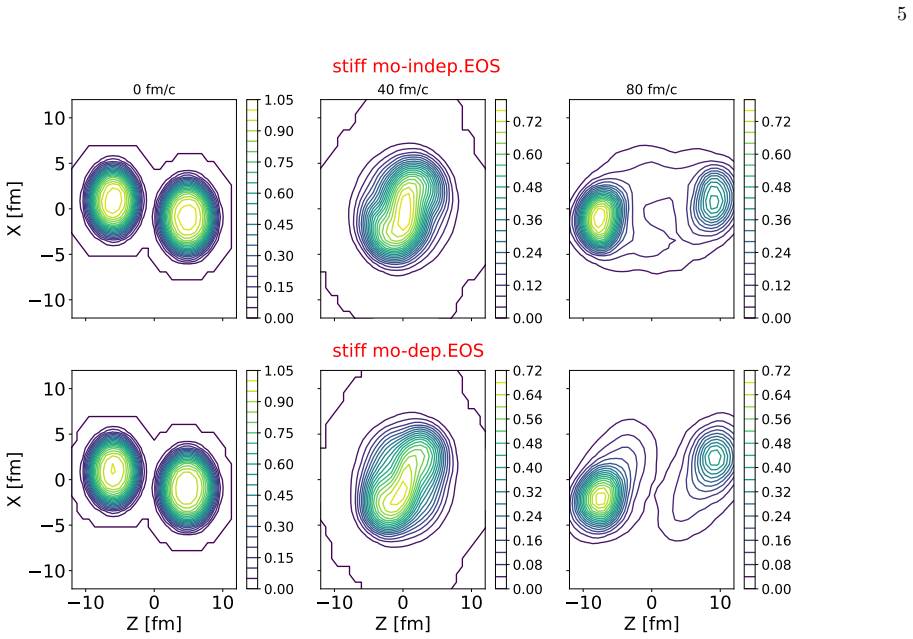
The load-bearing object is the angle-averaged relative source function $S(r)$, the probability density for emitting a proton pair at relative distance $r$, which feeds the Koonin-Pratt equation $C(q)=4\pi\int dr\, r^2 K(q,r)\,S(r)$, where $K$ is the angle-averaged squared proton-proton relative wave function. The paper's new ingredient is the two-parameter tail in Eq. (18), normalized as $\frac{1-\lambda}{96\pi B^5}\,r^2 e^{-r/B}$, which is suppressed at small $r$ where transport should be valid and dominates at large $r$, with $\lambda=0.38$ and $B=4.0$ fm after fitting. The experimental benchmark is produced by Richardson-Lucy deblurring, an iterative inversion that restores $S(r)$ from the measured $C(q)$ without assuming a Gaussian shape, and the kernel is smeared in $q$ with a Gaussian of width $2.8$ MeV/c to mimic detector resolution.
What would settle it
Measure the same Ar+Sc p-p correlation with substantially higher statistics and better small-angle (low-$q$) resolution, and repeat the deblurring with the actual experimental error and response matrices instead of assumed Gaussians; if the source restored in that way cannot be described by Eq. (18) with any $\lambda$ and $B$, or if the fitted parameters shift beyond the quoted uncertainties, the claim that the tail captures the physical secondary-decay contribution fails. A simpler check: if an independent decay-cascade model predicts a tail shape that deviates from $r^2 e^{-r/B}$ at large $r$, the $B=4.0$ fm fall-off would not be a true emission timescale.
Extended reading notes
Core claim
The paper's central claim is that the two-proton emitting source can be written as a weighted sum of a pBUU transport source and a normalized exponential tail, $S(r)=\lambda S_{\mathrm{BUU}}(r)+\frac{1-\lambda}{96\pi B^5}\,r^2 e^{-r/B}$, where $\lambda$ is the fraction of pairs from fast emission and the tail integrates to $1-\lambda$. Fitting this form to the deblurred source, or directly to the correlation function, yields $\lambda=0.38$ and $B=4.0$ fm for the selected total-momentum window $P=200$–$400$ MeV/c. With this addition the pBUU-based correlation matches the $^{36}$Ar+$^{45}$Sc data over the whole measured $q$ range, whereas the conventional $\lambda$ renormalization, which merely scales down the BUU source, leaves the low-$q$ anticorrelation region $q<18$ MeV/c unexplained. The paper also establishes that, for this system, the correlation is only weakly sensitive to the stiffness of the symmetric-matter equation of state and to momentum dependence of the mean field, so the dominant discrepancy is the missing long-range source component from secondary decays.
Load-bearing premise
The whole fit rests on the assumption that the deblurred source obtained by Richardson-Lucy inversion—using assumed Gaussian resampling errors of $\sigma=0.045$ and $0.1$, a Gaussian kernel smearing of $2.8$ MeV/c, and a regularization factor—faithfully represents the true experimental source, so that the tail parameters $\lambda$ and $B$ fitted to it carry the physical meaning claimed.
Editorial extensions
If this is right
- With $\lambda=0.38$, about 62% of the proton pairs in the 200–400 MeV/c momentum window are attributed to long-lived secondary-decay emission, leaving 38% to promptly emitted pairs.
- The same fitted source reproduces both the peak height near $q=20$ MeV/c and the low-$q$ anticorrelation, something a pure $\lambda$ renormalization cannot do.
- The correlation functions show very weak sensitivity to the stiffness of the symmetric-matter equation of state and to momentum dependence in this system, so the comparison mainly constrains the transport treatment of emission times and secondary decays rather than the EoS.
- Because the source is normalized to unity, adding the tail lowers the short-distance strength of $S$, matching the imaged source's short-range magnitude without arbitrary scaling.
- The deblurred source, rather than a Gaussian fit, can serve as the standard for checking transport-model sources.
Reading between the lines
- Beyond the paper, the fitted parameters $\lambda$ and $B$ should depend on beam energy, total pair momentum, and impact parameter; the decay-tail fraction $1-\lambda$ would presumably grow for more peripheral collisions and lower energies, a testable prediction of the authors' interpretation.
- Beyond the paper, replacing the phenomenological $r^2 e^{-r/B}$ tail with an explicit statistical-decay model would turn $B$ into a physical quantity tied to fragment lifetimes and decay timescales, allowing the transport model to be extended rather than patched.
- Beyond the paper, applying the same deblur-plus-tail procedure to other pair types (such as n–p or d–p) or to gated rapidity selections could check whether the missing long-range source is universal or specific to proton pairs.
Editorial analysis
A structured set of objections, weighed in public.
Referee Report
Summary. The paper compares proton-proton relative-emission sources from pBUU transport simulations of 36Ar+45Sc at E/A=80 MeV with sources extracted from measured correlation data by the Richardson-Lucy deblurring method. It finds that the pBUU source, when renormalized by a constant factor, overestimates the correlation peak and fails at low q, q<18 MeV/c. The authors propose Eq. (18), adding an r^2 exp(-r/B) tail to the BUU source with two fitted parameters, lambda=0.38 and B=4.0 fm, and show that the resulting source and correlation agree with the data. They interpret 1-lambda as the fraction of proton pairs from long-lived secondary-decay emissions that are missing from BUU simulations.
Significance. If the tail parameters were robustly determined, the paper would provide a practical way to connect BUU transport sources to measured correlations and to quantify the missing long-lived emission component, going beyond the simple lambda renormalization used in earlier work. The paper is honest about its assumptions and makes a clear qualitative point: a source that matches the peak cannot simultaneously describe the low-q anticorrelation unless a large-r tail is added. The deblurring machinery is established and the comparison with pBUU is carefully laid out. However, the central quantitative claim, that lambda=0.38 and B=4.0 fm quantify secondary-decay contributions, is not independently validated: the parameters are fitted to information derived from the same measured correlation, and the reconstruction pipeline relies on assumed resampling errors, a fixed smearing width, and a regularization factor. The paper is therefore a promising method demonstration, not yet a robust measurement of the secondary-decay fraction.
major comments (4)
- [Sec. V, Eq. (18), Fig. 5] The agreement shown in Fig. 5(a) is partly by construction. The text states that lambda and B are determined either by fitting Eq. (18) to the source restored from the data or by fitting the resulting correlation to the measured correlation, with similar results. In either case, the same 1995 correlation data are used, so the good description of those data demonstrates the flexibility of a two-parameter function rather than an independent confirmation of the secondary-decay interpretation. The paper should either present this explicitly as a parameter extraction from the data, with appropriate uncertainties, or add a validation test in which a known source with a tail is used to generate pseudodata and the same deblurring-plus-fit pipeline is shown to recover lambda and B.
- [Sec. IV, deblurring assumptions] The reconstructed source to which Eq. (18) is fitted depends on several assumptions that are not derived from the experimental error information: Gaussian resampling with sigma=0.045 for q>=15 MeV/c and sigma=0.1 for q<15 MeV/c, a Gaussian kernel smearing with sigma_q=2.8 MeV/c, and a total-variation regularization factor of 0.0005. The low-q region, q<18 MeV/c, which most constrains the tail, is exactly where the assumed resampling error and the kernel smearing are largest. The paper reports no sensitivity study of lambda and B to these choices. A closed-loop recovery test and a scan over the assumed sigma and sigma_q values are needed to exclude the possibility that the extracted tail is an inversion artifact rather than a physical secondary-decay signal.
- [Sec. V, fitting procedure] No uncertainties are quoted for the fitted parameters lambda=0.38 and B=4.0 fm, and no goodness-of-fit measure is reported for the correlation or source comparison. Since the correlation has only 16 data points and the source is represented by 11 bins, the two-parameter fit is poorly constrained, especially because the paper itself notes that only a few low-q points constrain the long-r tail. The authors should report parameter uncertainties from the resampling ensembles, a chi-square or equivalent statistic, and the sensitivity of the best-fit values to the number of source bins and to the low-q data points.
- [Abstract and Sec. VI] The tail functional form r^2 exp(-r/B) in Eq. (18) is introduced ad hoc, without derivation from a model of secondary decay. The paper can legitimately use it as an empirical shape, but then the abstract's statement that the corrected source 'quantifies secondary decay emissions' and the conclusion's 'secondary-decay contributions' overstate what is established. The authors should either derive this form from a simple long-lived-emission scenario or explicitly label it as a purely phenomenological shape whose physical interpretation remains to be tested.
minor comments (5)
- [Sec. IV, Eq. (12)] Equation (12) has an index error: the sum should run over j, not i, i.e., g_i = sum_j A_ij G_j.
- [Sec. II, after Eq. (3)] The text refers to the collision term as 'Iol' while the equation defines I_col; the notation should be made consistent.
- [Sec. IV, source discretization] The text says the source range runs from r=0.5 to 22 fm and that M=11 bins give a bin size of Delta r=2 fm, but 21.5 fm divided by 11 is not exactly 2 fm; the discretization should be specified more precisely.
- [Fig. 5 and Fig. 6 captions] The legends 'BUU w/ factor' and 'BUU w/ lambda factor' are unclear; they should read 'BUU w/ lambda factor' consistently in both figures.
- [Sec. V, Eq. (18)] For clarity, the normalization of the tail term should be explicitly verified in the text: with the given coefficient, the tail integrates to 1-lambda over all space.
Circularity Check
Tail parameters λ and B are fit to the same data (or to a source deblurred from it), so the corrected-source agreement in Fig. 5 is in-sample, not a prediction; the BUU short-range shape comparison remains independent.
-
fitted input called prediction
[Section V, Eq. (18), and Fig. 5; summary in Section VI]
"We alternatively determine the optimal parameters λ and B by fitting the source (18) to the source restored from the data or the correlation obtained from the source (18) to the measured correlation [5]. The results are similar in the two cases. In Fig. 5 we show the source (18) and associated correlation for λ = 0.38 and B = 4.0 fm. It can be seen in panel (a) that the data description is successful."
The paper's central result—that Eq. (18) with λ=0.38 and B=4.0 fm reproduces the measured p-p correlation, including the low-q region q<18 MeV/c—is presented as a successful description, but λ and B are explicitly fit either to the deblurred source (which is inverted from the same measured correlation via Eq. (16)) or directly to the measured correlation. The agreement in Fig. 5(a) is therefore an in-sample fit to the very data it is said to reproduce, not a prediction or independent confirmation. The two-parameter tail is flexible enough to improve the low-q fit by construction, so the agreement does not by itself validate the secondary-decay interpretation or the fraction (1−λ).
full rationale
The transport source S_BUU from Eq. (8) and the KP folding are genuine forward calculations, so the direct-BUU comparison in Fig. 4 is not circular. The circular component enters only when the paper adds the phenomenological tail of Eq. (18) and then reports that the resulting source reproduces the measured correlations. The paper explicitly states that λ and B are determined by fitting Eq. (18) to the deblurred source or to the measured correlation, and that both give similar results; hence Fig. 5(a)'s success, including q<18 MeV/c, is a measure of the fit, not a validation of the secondary-decay interpretation. The physical interpretation of (1−λ) and B additionally depends on deblurring assumptions (ad hoc Gaussian resampling errors σ=0.045/0.1, kernel smearing σ_q=2.8 MeV/c, TV regularization), which are not derived from the data; those are correctness risks rather than additional circular steps. The tail functional form is cited to the authors' own prior work [34], but it is explicitly phenomenological, so the main circularity is the fitted-parameter-as-prediction step. Overall score 6: partial circularity because the headline low-q agreement is fit-determined while the short-range BUU–imaging comparison retains independent content.
Assumptions & free parameters
free parameters (4)
- lambda (fraction of prompt BUU source) =
0.38
- B (tail fall-off scale) =
4.0 fm
- Assumed resampling sigma values =
0.045 for q >= 15 MeV/c; 0.1 for q < 15 MeV/c
- Kernel smearing sigma_q =
2.8 MeV/c
assumptions (5)
- standard math Koonin-Pratt equation relates the source function and the correlation function
- domain assumption The BUU transport equation with the chosen mean-field and cross-sections correctly models the fast emission source
- domain assumption The Richardson-Lucy deblurring inversion converges to the true source given the KP kernel
- ad hoc to paper Secondary decay contributions can be represented by an r^2 exp(-r/B) tail
- ad hoc to paper Assumed Gaussian resampling errors approximate the true experimental uncertainties
Cite this review
Pith. "Pith review of Transport Theory and Correlation Measurements: Coming to Terms on Emission Sources." pith.science (2026). https://pith.science/paper/EEX7WP4F
@misc{pith2026250601271,
  author       = {Pith},
  title        = {Pith review of: Transport Theory and Correlation Measurements: Coming to Terms on Emission Sources},
  year         = {2026},
  howpublished = {\url{https://pith.science/paper/EEX7WP4F}},
  note         = {Machine review of arXiv:2506.01271}
}
read the original abstract
Two-particle correlations play a pivotal role in understanding the space-time characteristics of particle emission in Heavy-ion collisions. These characteristics are typically represented by a relative emission source and can be obtained using transport model simulations such as the Boltzmann- Uehling-Uhlenbeck (BUU) transport model. In this paper, we utilize the BUU transport model to simulate the p-p source. Subsequently, we integrate this source and the p-p kernel within the KP formula to calculate the correlations. By comparing the correlations obtained from the BUU simulation with those obtained using imaging methods, such as the deblurring method, we aim to gain a deeper understanding of the impact of fast and slow emissions on the measured correlations. Specifically, this comparison is used as a tool to determine a function (tail) that represents the relative distribution of the particle pair from secondary decay emissions. Thus, we correct the BUU source function by incorporating a tail to account for the contribution of secondary decay emissions, which cannot be accurately captured by BUU simulations. Resulting source function reproduces the features in the measured correlations. To illustrate our approach, we examine p-p correlations measured in Ar + Sc reactions at E/A = 80 MeV, considering both momentum-independent and momentum-dependent nuclear equations of state (EOS).
Figures


Figures from the paper (4 more)


Reference graph
Works this paper leans on
- [1]
-
[2]
Danielewicz, Nuclear Physics A 673, 375 (2000), ISSN 0375-9474, URL https://www.sciencedirect
P. Danielewicz, Nuclear Physics A 673, 375 (2000), ISSN 0375-9474, URL https://www.sciencedirect. com/science/article/pii/S037594740000083X
work page 2000
- [3]
-
[4]
A. Sorensen, K. Agarwal, K. W. Brown, Z. Chajecki, P. Danielewicz, C. Drischler, S. Gandolfi, J. W. Holt, M. Kaminski, C.-M. Ko, et al., Progress in Particle 11 and Nuclear Physics 134, 104080 (2024), ISSN 0146- 6410, URL https://www.sciencedirect.com/science/ article/pii/S0146641023000613
work page 2024
- [5]
- [6]
-
[7]
P. Danielewicz and G. Bertsch, Nuclear Physics A 533, 712 (1991), ISSN 0375-9474, URL http://www.sciencedirect.com/science/article/ pii/037594749190541D
arXiv 1991
-
[8]
G. Bertsch and S. Das Gupta, Physics Re- ports 160, 189 (1988), ISSN 0370-1573, URL https://www.sciencedirect.com/science/article/ pii/0370157388901706
arXiv 1988
Show all 34 references
-
[9]
Bauer, Progress in Particle and Nuclear Physics 30, 45 (1993)
W. Bauer, Progress in Particle and Nuclear Physics 30, 45 (1993)
1993
-
[10]
S. E. Koonin, Physics Letters B 70, 43 (1977)
1977
-
[11]
Pratt, Physical Review Letters 53, 1219 (1984)
S. Pratt, Physical Review Letters 53, 1219 (1984)
1984
-
[12]
D. A. Brown and P. Danielewicz, Physics Letters B 398, 252 (1997)
1997
-
[13]
Nzabahimana, T
P. Nzabahimana, T. Redpath, T. Baumann, P. Danielewicz, P. Giuliani, and P. Gu` eye, Phys. Rev. C 107, 064315 (2023), URL https: //link.aps.org/doi/10.1103/PhysRevC.107.064315
2023 doi
-
[14]
Nzabahimana and P
P. Nzabahimana and P. Danielewicz, Physics Let- ters B 846, 138247 (2023), ISSN 0370-2693, URL https://www.sciencedirect.com/science/article/ pii/S0370269323005816
2023
-
[15]
Danielewicz and M
P. Danielewicz and M. Kurata-Nishimura, Phys. Rev. C 105, 034608 (2022)
2022
-
[16]
L.-W. Chen, V. Greco, C. M. Ko, and B.-A. Li, Phys. Rev. Lett. 90, 162701 (2003), URL https://link.aps. org/doi/10.1103/PhysRevLett.90.162701
2003 doi
-
[17]
D. A. Brown and P. Danielewicz, Physics Let- ters B 398, 252 (1997), ISSN 0370-2693, URL https://www.sciencedirect.com/science/article/ pii/S0370269397002517
1997
-
[18]
Danielewicz and P
P. Danielewicz and P. Schuck, Physics Let- ters B 274, 268 (1992), ISSN 0370-2693, URL http://www.sciencedirect.com/science/article/ pii/037026939291985I
1992
-
[19]
Verde, A
G. Verde, A. Chbihi, R. Ghetti, and J. Helgesson, The European Physical Journal A-Hadrons and Nuclei 30, 81 (2006)
2006
-
[20]
Goldhaber, S
G. Goldhaber, S. Goldhaber, W. Lee, and A. Pais, Phys- ical Review 120, 300 (1960), publisher: American Physi- cal Society, URL https://link.aps.org/doi/10.1103/ PhysRev.120.300
1960
-
[21]
D. H. Boal and J. C. Shillcock, Phys. Rev. C 33, 549 (1986), URL https://link.aps.org/doi/10.1103/ PhysRevC.33.549
1986
-
[23]
C.-K. Tam, Z. Chajecki, P. Danielewicz, and P. Nzabahi- mana, arXiv preprint arXiv:2502.09478 (2025), URL https://arxiv.org/abs/2502.09478
2025 arXiv
-
[24]
J. Xu, Z. Qin, R. Zou, D. Si, S. Xiao, B. Tian, Y. Wang, and Z. Xiao, Chinese Physics Letters (2025), URL http://iopscience.iop.org/article/10. 1088/0256-307X/42/3/031401
2025
-
[25]
D. O. Handzy, W. Bauer, F. C. Daffin, S. J. Gaff, C. K. Gelbke, T. Glasmacher, E. Gualtieri, S. Hannuschke, M. J. Huang, G. J. Kunde, et al., Phys. Rev. Lett. 75, 2916 (1995), URL https://link.aps.org/doi/10. 1103/PhysRevLett.75.2916
1995
-
[26]
Lin and P
H. Lin and P. Danielewicz, Phys. Rev. C 99, 024612 (2019), URL https://link.aps.org/doi/10. 1103/PhysRevC.99.024612
2019
-
[27]
H. M. Xu, W. G. Lynch, P. Danielewicz, and G. F. Bertsch, 65, 843 (1990), publisher: American Physi- cal Society, URL https://link.aps.org/doi/10.1103/ PhysRevLett.65.843
1990
-
[28]
D. H. Boal, C.-K. Gelbke, and B. K. Jennings, Rev. Mod. Phys. 62, 553 (1990), URL https://link.aps.org/doi/ 10.1103/RevModPhys.62.553
1990 doi
-
[29]
Nzabahimana, Ph.D
P. Nzabahimana, Ph.D. thesis, Michigan State University (2023)
2023
-
[30]
Colonna, D
N. Colonna, D. R. Bowman, L. Celano, G. D’Erasmo, E. M. Fiore, L. Fiore, A. Pantaleo, V. Patic- chio, G. Tagliente, and S. Pratt, Phys. Rev. Lett. 75, 4190 (1995), URL https://link.aps.org/doi/10. 1103/PhysRevLett.75.4190
1995
-
[31]
D. A. Brown and P. Danielewicz, Physical Review C 57, 2474 (1998)
1998
-
[32]
G. Zech, Nuclear Instruments and Methods in Physics Research Section A: Accelerators, Spectrometers, De- tectors and Associated Equipment 716, 1 (2013), ISSN 0168-9002, URL https://www.sciencedirect. com/science/article/pii/S0168900213003148
2013
-
[33]
W. H. Richardson, JoSA 62, 55 (1972)
1972
-
[34]
Nzabahimana, P
P. Nzabahimana, P. Danielewicz, and G. Verde, IL Nuovo Cimento 100, 48 (2025)
2025
-
[35]
Danielewicz and S
P. Danielewicz and S. Pratt, Phys. Rev. C 75, 034907 (2007), URL https://link.aps.org/doi/10. 1103/PhysRevC.75.034907
2007
Reviewed August 7, 2026 · model on record in the stance chip above.
Discussion (0). Continue with ORCID to comment.