REVIEW 6 major objections 6 minor 27 references
Computing Gram Matrix for SMILES Strings using RDKFingerprint and Sinkhorn-Knopp Algorithm
T0 review · 6 major / 6 minor · reviewed 2026-08-11 · deepseek-v4-flash
Pith's one-line read The paper claims that rebalancing a Gaussian similarity matrix of RDKFingerprints with the Sinkhorn-Knopp algorithm, then reducing with kernel PCA, gives SMILES-string embeddings that beat standard fingerprint and k-mer baselines on…
desk verdict The classification win is likely an artifact of test-set leakage via pre-split kernel PCA, and Equation (3) is not implementable as written—this needs a full rewrite before it can be taken seriously. read the letter →
The pith
A machine-rendered reading of the paper's core claim, the machinery that carries it, and where it could break.
The reading
What carries the argument
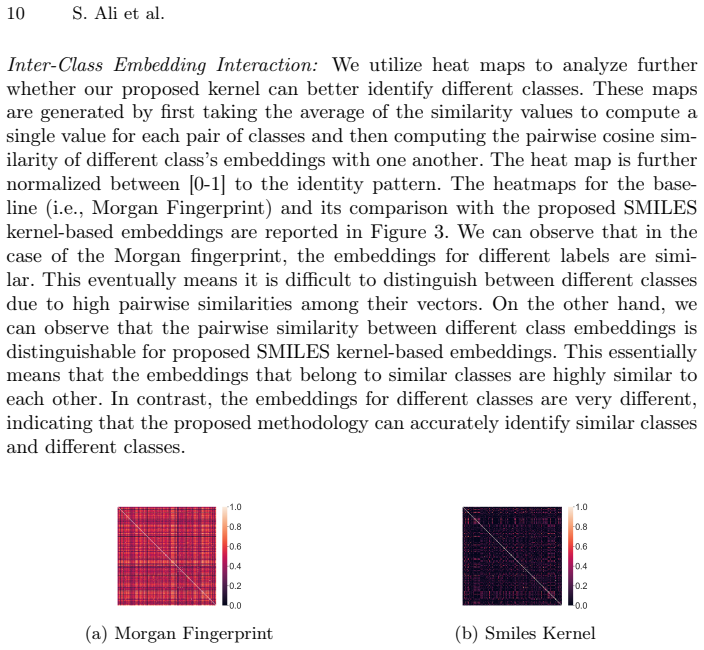
The central object is the Gram matrix produced by Sinkhorn-Knopp rebalancing. The method normalizes an RBF distance matrix $D$ to a joint probability matrix $P$, then iteratively applies Sinkhorn-Knopp scaling until row and column marginals converge to prescribed sums, with tolerance $\xi = 10^{-6}$, producing scaling vectors $a$ and $b$; the final kernel is $K = \operatorname{diag}(a)\, P\, \operatorname{diag}(b)$. Kernel PCA on $K$ yields the top principal components used as embeddings. The Sinkhorn-Knopp iteration is the load-bearing mechanism: it converts a generic similarity matrix into a matrix with balanced row and column sums, and the paper's evidence for its value is the improved class separation visible in t-SNE plots and class-similarity heatmaps.
What would settle it
Run the pipeline with the 70/30 split placed before the Sinkhorn-Knopp kernel and kernel PCA are estimated: fit the scaling vectors and principal components on the training 70%, project the test 30% through them, and compare accuracy, precision, recall, weighted F1, and ROC-AUC against the same baselines under identical split-before-embedding conditions; if the proposed kernel no longer improves any metric, the central claim fails.
Extended reading notes
Core claim
The central claim, stated in the abstract and Section 5, is that the proposed kernel-based approach outperforms other embedding methods and classifiers on DrugBank drug-subcategory classification in terms of average accuracy, precision, recall, weighted F1 score, and ROC-AUC. The best reported accuracy is 0.915 with logistic regression, and the kernel also gives the highest weighted F1 (0.8801 with random forest) among the compared embeddings. The authors attribute this to the Sinkhorn-Knopp step, which turns a raw Gaussian kernel into a matrix whose row and column marginals are balanced, making similar classes more similar and different classes less similar in the kernel-PCA embedding. For ChEMBL, the same method only beats all baselines on ROC-AUC, and for regression it trails MACCS with random forest, so the paper's central claim is essentially about classification.
Load-bearing premise
The evaluation rests on the premise that fitting the kernel matrix and kernel PCA on the full dataset before the 70/30 split does not inflate the reported classification gains.
Editorial extensions
If this is right
- On DrugBank, the proposed embedding reaches a best accuracy of 0.915 and best weighted F1 of 0.8801 with logistic regression and random forest respectively, exceeding the best baseline on those metrics.
- Because the embedding is just a vector per molecule, it can be plugged into any classifier or regressor without changing the downstream model.
- The method's advantage is classification-specific: on ChEMBL only ROC-AUC improves, and on solubility regression MACCS fingerprints with random forest still lead.
- The kernel construction is fingerprint-based, so it inherits the low cost and substructure interpretability of RDKFingerprint features while adding a nonlinear, globally balanced similarity.
Reading between the lines
- Beyond the paper, the same Sinkhorn-Knopp rebalancing could be applied to other molecular similarity matrices, such as graph-edit distances or learned fingerprints, to isolate whether the balancing step or the fingerprint features drive the classification gain.
- Beyond the paper, the reported comparisons leave open how much of the gain comes from fitting kernel PCA on the full dataset before the split; a deployment-oriented evaluation would fit the embedding on training molecules only and project test molecules.
- Beyond the paper, the row and column scaling is formally related to optimal-transport attention, so a trainable version of this kernel might yield a learnable molecular similarity measure.
Editorial analysis
A structured set of objections, weighed in public.
Referee Report
Summary. The paper proposes a kernel-based embedding for SMILES strings: convert SMILES to molecular graphs, compute RDKit fingerprints, form a Gaussian similarity matrix, apply Sinkhorn-Knopp scaling to obtain a kernel matrix, and use kernel PCA for dimensionality reduction. The embeddings are evaluated on DrugBank drug-subcategory classification and solubility regression against several fingerprint baselines. The authors claim the proposed kernel outperforms baselines on classification. The manuscript includes tables of results, t-SNE plots, and heatmaps.
Significance. The problem of representing SMILES strings for machine learning is relevant, and the idea of using Sinkhorn-Knopp balancing to turn a similarity matrix into a kernel is not without interest. However, the paper as written does not provide a coherent description of the kernel (the update equation is undefined), the evaluation protocol leaks test-set information through full-data kernel PCA, and the reported results contradict parts of the abstract. No code or data is provided, and no validation procedure for the free hyperparameters is described. If the technical issues were resolved, the approach might merit further study, but the current claims are unsupported.
major comments (6)
- [Section 3.4, Eq. (3)] The Sinkhorn-Knopp update formula is mathematically incoherent. The expression 'BipartiteGraph ← −δP + (ζ × log(− →a1)) + (ζ × log(− →b1 )) / ζ' mixes a matrix P with vectors a1 and b1 and scalars ζ and δ in a way that is undefined (dimension mismatch, log of a vector with negative sign). The initialization and iterative updates of a, b, a1, b1 are not described. As a result, the kernel matrix K in Eq. (4) cannot be computed from the paper's description. This is a load-bearing error because the entire method rests on this kernel.
- [Sections 3.5 and 4] The evaluation protocol leaks test-set information. The kernel matrix D in Eq. (1) is computed over all i,j ∈ N, and kernel PCA is applied to the full kernel matrix in Section 3.5. Section 4 then describes a 70/30 train/test split but provides no procedure for refitting kernel PCA on the training portion or for projecting held-out molecules (e.g., via Nyström). Thus, test molecules influence the embedding used to train classifiers, and the comparison against baselines is confounded. This invalidates the headline classification results in Table 2.
- [Section 5, Table 2] The claim in Section 5 that the proposed approach 'outperforms other embedding methods and classifiers in terms of average accuracy, precision, recall, weighted F1 score, and ROC-AUC' is not supported by the table. For example, on DrugBank, the Morgan fingerprint with LR achieves ROC-AUC 0.6215, while the best SMILES-kernel ROC-AUC is 0.5733 (DT), and several baselines have higher ROC-AUC. The statement should be restricted to specific metrics and classifiers where it actually holds, and the contradiction should be resolved.
- [Section 3.2] The fingerprint is mislabeled. The authors state they use 'RDKit fingerprint' generated using the Morgan algorithm and refer to it as 'RDKFingerprint' and 'Morgan Fingerprint' interchangeably. In RDKit, the RDKFingerprint and Morgan fingerprints are distinct algorithms with different substructure definitions and bit generation. Citing reference [16] for the RDKFingerprint is incorrect, and this inconsistency makes the method difficult to reproduce.
- [Section 5, Table 3] The abstract claims the proposed method 'outperforms several baseline methods in terms of supervised analysis,' but this is not supported for regression. In Table 3, the MACCS fingerprint with random forest regression achieves R² = 0.7804 on DrugBank, whereas the proposed SMILES kernel with random forest regression achieves R² = 0.7009, and several other baselines also outperform the proposed method. The discussion correctly acknowledges this, but the abstract's broad statement is misleading and should be qualified.
- [Section 5, Table 2] Table 2 contains apparent duplicated entries. For the Morgan fingerprint, the logistic regression row reports identical values for DrugBank and ChEMBL (Acc 0.4934, Prec 0.4868, Recall 0.4934, F1(Wt) 0.4870, F1(Mac) 0.2689, ROC-AUC 0.6215, TrainTime 10.2591). Similarly, the k-mers random forest row for ChEMBL is identical to the MACCS fingerprint random forest row for ChEMBL. These duplicates cannot be correct and undermine the reliability of the reported results.
minor comments (6)
- [Section 3.3, Eq. (1)] The matrix D is called a 'distance matrix' but Eq. (1) defines a Gaussian similarity (kernel) between feature vectors. This terminology is misleading and should be corrected.
- [Section 3.2] The notation is inconsistent: X1 and X2 are introduced as sets of molecular graphs, but Eq. (1) uses X_i and X_j as feature vectors. The fingerprint length 'n = 2048' is also conflated with the number of molecules.
- [Section 3.4] The initialization of vectors a, b, a1, b1 is described as 'zero vectors' and 'unit vectors,' but the standard Sinkhorn algorithm requires positive vectors for row and column scaling. This description is unclear and should be specified precisely.
- [Section 5, Figure 4] The statement 'smaller kernel value is better' is not justified. If the kernel value measures similarity, a smaller value indicates less similarity, but the paper does not explain why this is beneficial for the proposed method.
- [Section 5, Table 3] The k-mers linear regression results on DrugBank are numerically absurd (MAE 8.3616e+10, R² −2.7267e+19), indicating overflow or a broken implementation. These values should be removed or a stable procedure should be used, and the issue should be discussed.
- [Section 4] The paper reports averages over 5 runs but provides no standard deviations, confidence intervals, or significance tests, making it difficult to judge whether the observed differences are reliable.
Circularity Check
No significant circularity: the proposed kernel is an empirical pipeline whose construction does not reduce to its own inputs or to self-citations.
full rationale
The paper makes no formal derivation claim that could be circular. The proposed SMILES kernel is constructed from RDKFingerprint features through a Gaussian distance matrix (Eq. 1), probability normalization (Eq. 2), Sinkhorn-Knopp scaling (Eqs. 3-4), and kernel PCA (Section 3.5). None of these steps references the target labels or the downstream classification results; the kernel is defined from input fingerprints alone, so there is no self-definitional reduction. The classification and regression numbers in Tables 2-4 are empirical outcomes, not predictions forced by fitted parameters: the paper does not describe fitting sigma, Sinkhorn tolerance, or the number of kernel PCA components to the test labels, and no fitted parameter is renamed as a prediction. The potential evaluation issue that kernel PCA is computed on the full dataset before the 70/30 split (Sections 3.5 and 4) is a correctness/leakage concern rather than a circularity of the derivation, and it is explicitly outside the circularity scoring rubric. The references cited for the building blocks (Sinkhorn-Knopp, kernel PCA, Morgan fingerprint) are standard external methods, and no load-bearing self-citation or imported uniqueness theorem appears. Therefore the derivation chain is self-contained with respect to circularity.
Assumptions & free parameters
free parameters (5)
- sigma (Gaussian kernel width) =
Not reported
- k (number of kernel PCA components) =
Not reported, except an example with k=100 in Figure 4
- xi (Sinkhorn-Knopp convergence tolerance) =
1e-6
- delta (small constant in Eq 3) =
1e-10
- Target marginal distributions for Sinkhorn scaling =
Unspecified
assumptions (4)
- standard math Sinkhorn-Knopp iteration converges to a matrix with specified marginals for positive matrices.
- standard math The Gaussian kernel matrix is positive semidefinite and valid for kernel PCA.
- domain assumption RDKit fingerprints (and the algorithm described as Morgan fingerprint) capture molecular structure relevant for property prediction.
- domain assumption The Sinkhorn-scaled matrix K can serve as a kernel for kernel PCA.
Cite this review
Pith. "Pith review of Computing Gram Matrix for SMILES Strings using RDKFingerprint and Sinkhorn-Knopp Algorithm." pith.science (2026). https://pith.science/paper/EIZJDNN6
@misc{pith2026241214717,
  author       = {Pith},
  title        = {Pith review of: Computing Gram Matrix for SMILES Strings using RDKFingerprint and Sinkhorn-Knopp Algorithm},
  year         = {2026},
  howpublished = {\url{https://pith.science/paper/EIZJDNN6}},
  note         = {Machine review of arXiv:2412.14717}
}
read the original abstract
In molecular structure data, SMILES (Simplified Molecular Input Line Entry System) strings are used to analyze molecular structure design. Numerical feature representation of SMILES strings is a challenging task. This work proposes a kernel-based approach for encoding and analyzing molecular structures from SMILES strings. The proposed approach involves computing a kernel matrix using the Sinkhorn-Knopp algorithm while using kernel principal component analysis (PCA) for dimensionality reduction. The resulting low-dimensional embeddings are then used for classification and regression analysis. The kernel matrix is computed by converting the SMILES strings into molecular structures using the Morgan Fingerprint, which computes a fingerprint for each molecule. The distance matrix is computed using the pairwise kernels function. The Sinkhorn-Knopp algorithm is used to compute the final kernel matrix that satisfies the constraints of a probability distribution. This is achieved by iteratively adjusting the kernel matrix until the marginal distributions of the rows and columns match the desired marginal distributions. We provided a comprehensive empirical analysis of the proposed kernel method to evaluate its goodness with greater depth. The suggested method is assessed for drug subcategory prediction (classification task) and solubility AlogPS ``Aqueous solubility and Octanol/Water partition coefficient" (regression task) using the benchmark SMILES string dataset. The outcomes show the proposed method outperforms several baseline methods in terms of supervised analysis and has potential uses in molecular design and drug discovery. Overall, the suggested method is a promising avenue for kernel methods-based molecular structure analysis and design.
Figures


Figures from the paper (1 more)

Reference graph
Works this paper leans on
-
[16]
Scientific Reports11(1) (2021)
Nakajima, M., Nemoto, T.: Machine learning enabling prediction of the bond disso- ciation enthalpy of hypervalent iodine from smiles. Scientific Reports11(1) (2021)
work page 2021
-
[1]
ChEMBL Website: https://www.ebi.ac.uk/chembl/
-
[2]
Drug discovery today 23(6), 1241–1250 (2018)
Chen, H., Engkvist, O., et al.: The rise of deep learning in drug discovery. Drug discovery today 23(6), 1241–1250 (2018)
work page 2018
-
[3]
Molecular Informatics37(9-10), 1800041 (2018)
Chen, H., Kogej, T., Engkvist, O.: Cheminformatics in drug discovery, an industrial perspective. Molecular Informatics37(9-10), 1800041 (2018)
work page 2018
-
[4]
Journal of chemical information and computer sciences42(6), 1273–1280 (2002)
Durant, J.L., et al.: Reoptimization of mdl keys for use in drug discovery. Journal of chemical information and computer sciences42(6), 1273–1280 (2002)
work page 2002
-
[5]
Machine Learning: Science and Technology3(3), 035015 (2022)
Fabregat, R., et al.: Metric learning for kernel ridge regression: assessment of molec- ular similarity. Machine Learning: Science and Technology3(3), 035015 (2022)
work page 2022
-
[6]
Francoeur, P.G., Koes, D.R.: Soltrannet–a machine learning tool for fast aqueous solubility prediction. J. Chem. Inf. Model61(6), 2530–2536 (2021)
work page 2021
-
[7]
Journal of chemometrics25(2), 92–99 (2011)
Fu, G.H., Cao, D.S., et al.: Combination of kernel pca and linear support vector machine for modeling a nonlinear relationship between bioactivity and molecular descriptors. Journal of chemometrics25(2), 92–99 (2011)
work page 2011
Show all 27 references
-
[8]
In: ICML
Glorot, X., Bordes, A., Bengio, Y.: Domain adaptation for large-scale sentiment classification: A deep learning approach. In: ICML. pp. 513–520 (2011)
2011
-
[9]
Digital Chemical Engineering2, 100016 (2022)
Kang,J.L.,Chiu,C.T.,Huang,J.S.,Wong,D.S.H.:Asurrogatemodelofsigmapro- file and cosmosac activity coefficient predictions of using transformer with smiles input. Digital Chemical Engineering2, 100016 (2022)
2022
-
[10]
San Leandro, CA (2005)
Keys, M.S.: Mdl information systems inc. San Leandro, CA (2005)
2005
-
[11]
SIAM Journal on Matrix Analysis and App30(1), 261–275 (2008)
Knight, P.A.: The sinkhorn–knopp algorithm: convergence and applications. SIAM Journal on Matrix Analysis and App30(1), 261–275 (2008)
2008
-
[12]
Machine Learning: Science and Technology1(4) (2020)
Krenn, M., et al.: Self-referencing embedded strings (selfies): A 100% robust molec- ular string representation. Machine Learning: Science and Technology1(4) (2020)
2020
-
[13]
Bioinformatics25(24), 3310–3316 (2009)
Li, Q., Wang, Y., Bryant, S.H.: A novel method for mining highly imbalanced high- throughput screening data in pubchem. Bioinformatics25(24), 3310–3316 (2009)
2009
-
[14]
Journal of machine learning research 9(11) (2008)
Van der Maaten, L., Hinton, G.: Visualizing data using t-sne. Journal of machine learning research 9(11) (2008)
2008
-
[15]
arXiv preprint arXiv:2006.12065 (2020)
Mialon, G., et al.: A trainable optimal transport embedding for feature aggregation and its relationship to attention. arXiv preprint arXiv:2006.12065 (2020)
2020 arXiv
-
[17]
Drug Discovery Today25(4), 689–705 (2020)
Öztürk, H., et al.: Exploring chemical space using natural language processing methodologies for drug discovery. Drug Discovery Today25(4), 689–705 (2020)
2020
-
[18]
EURASIP Journal on Advances in Signal Processing2016, 1–16 (2016)
Qiu, J., Wu, Q., et al.: A survey of machine learning for big data processing. EURASIP Journal on Advances in Signal Processing2016, 1–16 (2016)
2016
-
[19]
Computational and structural biotechnology journal15, 320–327 (2017)
Rensi, S., Altman, R.B.: Flexible analog search with kernel pca embedded molecule vectors. Computational and structural biotechnology journal15, 320–327 (2017)
2017
-
[20]
Rensi, S.E., Altman, R.B.: Shallow representation learning via kernel pca improves qsar modelability. J. Chem. Inf. Model.57(8), 1859–1867 (2017)
2017
-
[21]
Physical review letters108(5), 058301 (2012) Title Suppressed Due to Excessive Length 13
Rupp, M., et al.: Fast and accurate modeling of molecular atomization energies with machine learning. Physical review letters108(5), 058301 (2012) Title Suppressed Due to Excessive Length 13
2012
-
[22]
Wiley Inter- disciplinary Reviews: Computational Molecular Science12(5), e1604 (2022)
Schwaller, P., et al.: Machine intelligence for chemical reaction space. Wiley Inter- disciplinary Reviews: Computational Molecular Science12(5), e1604 (2022)
2022
-
[23]
Sellwood, M.A., Ahmed, M., et al.: Artificial intelligence in drug discovery (2018)
2018
-
[24]
Nature materials17(4), 361–368 (2018)
Shamay, Y., Shah, J., Işık, M., et al.: Quantitative self-assembly prediction yields targeted nanomedicines. Nature materials17(4), 361–368 (2018)
2018
-
[25]
Wiley Interdisciplinary Reviews: Compu- tational Molecular Science10(1), e1429 (2020)
Shen, C., Ding, J., et al.: From machine learning to deep learning: Advances in scor- ing functions for protein–ligand docking. Wiley Interdisciplinary Reviews: Compu- tational Molecular Science10(1), e1429 (2020)
2020
-
[26]
International Journal of Data Mining and Bioinformatics 19(2), 150–167 (2017)
Thomas, J., Sael, L.: Multi-kernel ls-svm based integration bio-clinical data anal- ysis and application to ovarian cancer. International Journal of Data Mining and Bioinformatics 19(2), 150–167 (2017)
2017
-
[27]
Wiley Interdisciplinary Reviews: Computational Molecular Science 12(5), e1603 (2022)
Wigh, D.S., Goodman, J.M., Lapkin, A.A.: A review of molecular representation in the age of machine learning. Wiley Interdisciplinary Reviews: Computational Molecular Science 12(5), e1603 (2022)
2022
Reviewed August 11, 2026 · model on record in the stance chip above.
Discussion (0). Continue with ORCID to comment.