REVIEW 4 major objections 3 minor 1 cited by
Thermodynamic significance of QUBO encoding on quantum annealers
T0 review · 4 major / 3 minor · reviewed 2026-08-03 · deepseek-v4-flash
Pith's one-line read This paper claims that QUBO penalty weights are thermodynamic control knobs: they set not only whether a quantum annealer finds feasible solutions but also how much entropy production, work, and heat the annealing cycle costs.
desk verdict Useful empirical mapping of QUBO penalties to TUR-based thermodynamic diagnostics on D-Wave, plausible but the inference pipeline needs validation before the dissipation claims are fully trusted. read the letter →
The pith
A machine-rendered reading of the paper's core claim, the machinery that carries it, and where it could break.
The reading
What carries the argument
The load-bearing tool is the thermodynamic uncertainty relation (TUR): for a process with a fluctuation symmetry, the mean entropy production is bounded below by a function of the ratio of the mean to the standard deviation of any current, here the stochastic processor energy change ΔE1. Measuring only the first two moments of ΔE1 during a cyclic reverse-anneal protocol yields lower bounds on entropy production, work, and heat. The unknown bath temperature is estimated from the device's own output samples using pseudo-likelihood fitting of an Ising model, and the resulting bounds are checked against adiabatic master-equation simulations.
What would settle it
Take the same Job Shop instance and reverse-annealing protocol, but record the joint distribution of processor and bath energy changes using an independent calorimetric or weak-measurement probe; if the measured ΔE2 violates the heat bound derived from the TUR, or if the pseudo-likelihood estimate of the bath temperature disagrees with the true bath temperature enough to change the sign of the inferred work/heat bounds near the feasible/infeasible boundary, the central thermodynamic reading is falsified.
Extended reading notes
Core claim
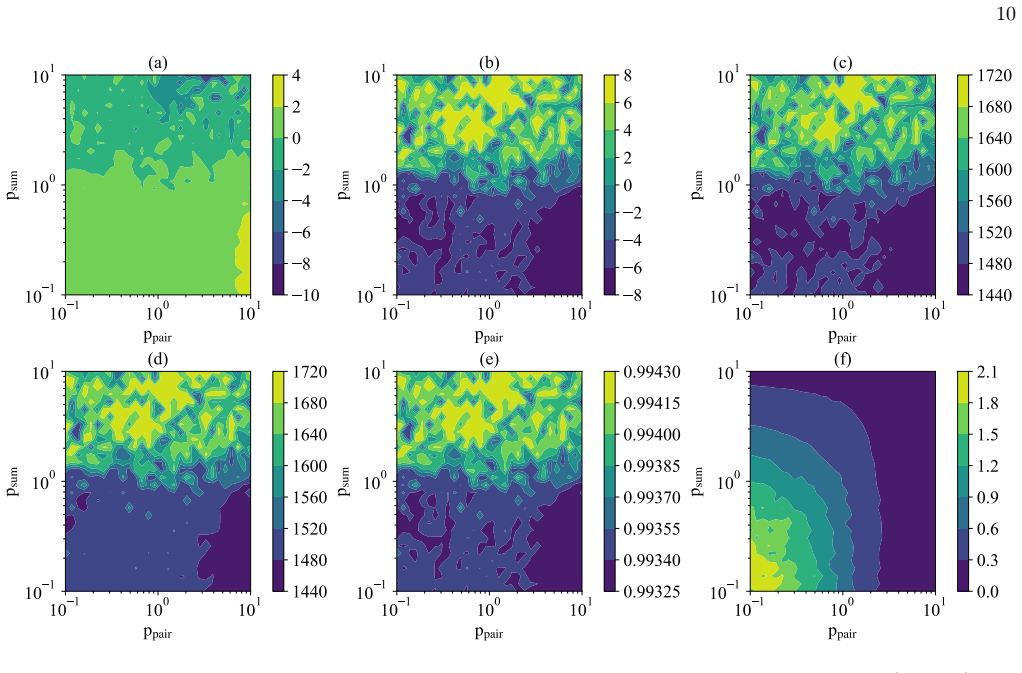
The paper's central discovery is that the penalty weights used to translate a constrained scheduling problem into QUBO form do not merely gate whether an annealer returns feasible answers; they reshape the low-energy spectrum and, through it, the thermodynamic cost of the machine's operation. Sweeping the one-hot penalty p_sum and the precedence penalty p_pair, the authors find sharp boundaries between feasible and infeasible QUBO ground states, and show that these same boundaries appear as coordinated changes in inferred entropy production, work, and heat bounds measured in cyclic reverse-annealing runs on a quantum annealer. Weak penalties leave low-energy infeasible manifolds that dominat
Load-bearing premise
The reported entropy, work, and heat values all inherit the assumption that the annealer's output can be read through a multivariate fluctuation theorem with a single effective bath temperature estimated by pseudo-likelihood from the device's own samples; if the final samples are not approximately Gibbsian, or the system is not weakly coupled with a factorized initial state, the inferred thermodynamic quantities lose their physical meaning.
Editorial extensions
If this is right
- The same quantities that mark computational hardness—the feasible/infeasible and split/unsplit transitions—also reorganize dissipation, so hardness and inefficiency are linked in a measurable way.
- Tuning penalties is not an algorithmic detail; it changes the effective energy scale seen by the hardware, so 'as large as possible' is not a valid heuristic.
- Because p_sum acts on the diagonal of the QUBO, encoding families should be expected to have asymmetric thermodynamic sensitivity; sum-type constraints are the dominant control.
- Reverse-annealing energy statistics give a practical, device-agnostic route to building a thermodynamic phase diagram of a QUBO encoding space without access to bath observables.
Reading between the lines
- If this correlation holds beyond Job Shop problems, the variance of ΔE1 in a short reverse-anneal scan could serve as a cheap pre-screening metric for encoding quality, before any full optimization campaign.
- The paper's effective-temperature interpretation suggests a concrete design rule: choose penalty magnitudes so that the smallest meaningful energy gap in the encoded spectrum stays above the analogue control-error and thermal-noise scale of the specific device.
- A natural extension is to combine the thermodynamic-efficiency ordering with time-to-solution or hybrid post-processing costs; if those orderings conflict, resource-aware encoding selection would need a multi-objective version of the claimed trade-off.
- Because the TUR bounds are only bounds, tighter single-shot work measurements or calorimetric access to the bath would be needed to confirm whether the relative efficiency ordering survives at the level of true values, not just bounds.
Editorial analysis
A structured set of objections, weighed in public.
Referee Report
Summary. The paper studies how QUBO penalty weights (p_sum for one-hot/sum constraints and p_pair for precedence constraints) affect both the computational hardness and the thermodynamic cost of solving a Job Shop Scheduling problem on a quantum annealer. On a D-Wave Advantage processor, the authors perform cyclic reverse-annealing experiments initialized from thermal samples, measure the stochastic processor energy change ΔE1, and apply a thermodynamic uncertainty relation (TUR) to derive lower bounds on entropy production, work, and heat. These bound maps are swept over a two-dimensional penalty plane for three reverse-annealing depths, and are complemented by classical solver sweeps and adiabatic master-equation simulations. The central claim is that the same encoding transitions that govern solver success also reorganize dissipation: weak penalties create low-energy infeasible manifolds, over-strong penalties suppress the effective problem energy scale and increase irreversibility, and the apparent thermodynamic efficiency is reduced in the computationally hard regimes. The paper concludes that QUBO penalties should be viewed as thermodynamic control knobs.
Significance. If the thermodynamic inference were validated, the paper would make a timely and useful contribution: it connects encoding choices in QUBO problems to the open-system thermodynamics of commercial quantum annealers, and it proposes an experimentally accessible diagnostic based on energy-change statistics. The combination of hardware experiments, classical solver benchmarks, master-equation simulations, and an open code repository is a definite strength. The qualitative observation that penalty strength reshapes both solution statistics and dissipation is plausible and corroborated by the simulations. However, the experimental thermodynamic conclusions rest entirely on TUR lower bounds with a fitted effective bath temperature β2, and the reported efficiency is formed from a ratio of lower bounds. These load-bearing aspects are not validated against ground truth, and the central experimental maps lack uncertainty quantification. The result is therefore not yet established at the level claimed.
major comments (4)
- [Sec. IV.A, Eqs. (19)-(22)] The thermodynamic inference pipeline is not validated. The bounds in Eqs. (19)-(21) require the bath inverse temperature β2, which is estimated by pseudo-likelihood from the device's own final samples (Eqs. (23)-(24)). Section V.A explicitly acknowledges that these samples are non-equilibrium freeze-out outputs, not Gibbs states. Since the bounds scale with 1/β2 times g(...), a biased β2 can create or destroy the apparent ordering in Figs. 4-6. The authors should validate the pipeline in the master-equation simulations of Sec. IV.B, where β2 and the environment temperature are known: compute the TUR bounds from simulated ΔE1 moments and compare them with the directly integrated ⟨Σ⟩, ⟨W⟩, and ⟨Q⟩, and also test whether the pseudo-likelihood estimator recovers the true β2 under non-equilibrium sampling. Without such a ground-truth check, the central claim that penalties 'control' dissipati
- [Sec. IV.A, Eq. (19) vs Eqs. (20)-(21)] There is an internal inconsistency in the TUR application. Eq. (19) uses √⟨ΔE1²⟩ in the argument of g, while Eqs. (20)-(21) use √var(ΔE1). For a nonzero mean, these quantities are different and only one expression can be the correct TUR. This discrepancy changes every plotted bound in Figs. 4-6. Please identify the correct form, justify it from the cited TUR, and recompute the results consistently.
- [Sec. IV.A, Eq. (22) and Sec. V.A, Fig. 4-6(e)] The efficiency is formed as a ratio of two lower bounds: Eqs. (20)-(21) give lower bounds on -⟨Q⟩ and ⟨W⟩, not estimates of these quantities. A ratio of lower bounds is not a valid bound on -⟨W⟩/⟨Q⟩, so the relative efficiency ordering in panel (e) is not established. If the intended claim is only that the two bounds move in the same direction, say so and do not call it thermodynamic efficiency; otherwise derive a rigorous bound on the ratio or report direct simulation values.
- [Sec. V.A, Figs. 4-6] The experimental maps are presented without any error bars or confidence intervals. The text interprets fine spatial 'speckling' as hardware sensitivity, but with no uncertainty quantification this could be sampling noise, especially near transitions where var(ΔE1) grows. Please report standard errors (e.g., bootstrapped) for at least ⟨ΔE1⟩, the TUR bound, and the efficiency, and demonstrate that the p_sum-dominated regime boundary is statistically significant rather than an artifact of finite sampling.
minor comments (3)
- [Sec. IV.A] Typo: 'efficency' should be 'efficiency'. Also, Eq. (23) is typeset awkwardly with the equation number appearing inline ('Λ(β) =(23)'); it should be a normal numbered equation.
- [References] References [49] and [53] both cite 'D-Wave samplers (2025)' with the same URL. These should be distinct entries or merged, with a clear description of what was accessed.
- [Sec. IV.B, Figs. 7-8] The simulation results use τ = 10 ns and β = 10 for 4-qubit instances, while the hardware experiments use τ = 10 μs and β1 = 10 on a 10-qubit instance. The captions and main text should state this difference explicitly and explain why the comparison is expected to be qualitative.
Circularity Check
No significant circularity: the thermodynamic analysis is measurement-driven, the entropy-production bound is independent of the fitted β2, and the acknowledged pseudo-likelihood limitation is a validity concern rather than a circular reduction.
full rationale
The paper's central encoding-versus-dissipation claim is not produced by fitting or by self-referential definition. The feasible/infeasible and split/unsplit regimes in Fig. 2 are computed directly from the QUBO objectives in Eqs. (B2)-(B6); the solver transitions in Fig. 3 and the master-equation simulations of Sec. IV.B use independent inputs and known bath parameters. The TUR entropy-production bound in Eq. (19), 2g(⟨ΔE1⟩/√⟨ΔE1²⟩), contains no fitted parameter and is thus not a renamed fit. The work/heat bounds in Eqs. (20)-(21) do use the pseudo-likelihood estimate β̂2 from Eqs. (23)-(24), and the paper itself flags this as an acknowledged limitation: "estimation bias in β̂2, since the pseudo-likelihood procedure assumes approximate Gibbsian sampling, whereas the device outputs are generally non-equilibrium samples influenced by freeze-out and readout noise" (Sec. V.A). That is an unvalidated modeling assumption, not a circular reduction: β̂2 is not defined in terms of the target efficiency ordering, and the ordering is corroborated by simulations in which the bath temperature is known independently. The self-citations (Refs. [3,4,7,20,23,26]) are background or application-oriented and none is load-bearing for the derivation. The inconsistency between √⟨ΔE1²⟩ in Eq. (19) and √var(ΔE1) in Eqs. (20)-(21), and the questionable use of Eq. (22) as a ratio of two lower bounds, are mathematical/validity concerns outside circularity. No fitted parameter is renamed as a prediction, no known result is merely relabelled, and no uniqueness claim is imported from the authors' own prior work. The derivation chain is self-contained in the sense required by the circularity pass.
Assumptions & free parameters
free parameters (4)
- beta_1 =
10 (dimensionless)
- beta_2 (effective bath inverse temperature) =
~0.986-0.997 (dimensionless, Figs. 4-6 panel f)
- reverse-annealing schedule parameters =
τ=10 μs, s̄=0.15, 0.27, 0.35
- master equation simulation parameters =
γ=10^-4, ω_c=4 GHz, T=16 mK, τ=10 ns, β=10
assumptions (5)
- domain assumption Joint system-bath initial state is factorized Gibbs and the cyclic protocol satisfies the multivariate fluctuation theorem (Eqs. 12-13).
- domain assumption D-Wave processor Hamiltonian is Eq. (6) with A(s)=Γ(1-s), B(s)=s, Γ=1.
- domain assumption Output spin configurations at s=1 approximate equilibrium samples for pseudo-likelihood β2 estimation (Eq. 23).
- domain assumption The adiabatic master equation with weak Ohmic coupling models the annealer dynamics (Sec. IV.B).
- standard math Thermodynamic uncertainty relation (18) applies to the cyclic protocol with the fluctuation symmetry (17).
Cite this review
Pith. "Pith review of Thermodynamic significance of QUBO encoding on quantum annealers." pith.science (2026). https://pith.science/paper/ELEL662I
@misc{pith2026260104402,
  author       = {Pith},
  title        = {Pith review of: Thermodynamic significance of QUBO encoding on quantum annealers},
  year         = {2026},
  howpublished = {\url{https://pith.science/paper/ELEL662I}},
  note         = {Machine review of arXiv:2601.04402}
}
abstract
Quadratic unconstrained binary optimization (QUBO) is the standard interface to quantum annealers, yet a single constrained task admits many QUBO encodings whose penalty choices reshape the energy landscape experienced by hardware. We study a Job Shop Scheduling instance using a two-parameter family of encodings controlled by penalty weights $p_{\rm sum}$ (one-hot/sum constraints) and $p_{\rm pair}$ (precedence constraints). Sweeping $(p_{\rm sum},p_{\rm pair})$, we observe sharp transitions in feasibility and solver success across classical annealing-inspired heuristics and on a D-Wave Advantage processor. Going beyond solution probability, we treat the annealer as an open thermodynamic system and perform cyclic reverse-annealing experiments initialized from thermal samples, measuring the stochastic processor energy change. From the first two moments of this energy change we infer lower bounds on entropy production, work, and exchanged heat via thermodynamic uncertainty relations, and corroborate the observed trends with adiabatic master equation simulations. We find that the same encoding transitions that govern computational hardness also reorganize dissipation: weak penalties generate low-energy infeasible manifolds, while overly strong penalties suppress the effective problem energy scale and increase irreversibility, reducing the thermodynamic efficiency. Our results establish QUBO penalties as thermodynamic control knobs and motivate thermodynamics-aware encoding strategies for noisy intermediate-scale quantum annealers.
Figures


Figures from the paper (5 more)




Forward citations
Cited by 1 Pith paper
-
Energy-error tradeoff in encoding quantum error correction
Quantum error correction encoding requires energy that scales exponentially with desired precision, varying by code and physical realization.
Reference graph
Works this paper leans on
-
[1]
Generate a set of initial spin configurations{σz i }(k) from the thermal distribution atβ1
-
[2]
For each configuration, program the couplings {hi, Jij}and perform the chosen annealing sched- ule on the D-Wave quantum annealer
-
[3]
At the final timet=τ, read out the classical spin configuration{σ z i }(k) f and compute the final energy E(k) 1,f =E z({σz i }(k) f )
-
[4]
In the relaxation experiment (s(t)≡1) we use1000in- dependent initial configurations and perform10anneals per configuration, yielding10 4 samples for each value of τ
Definethestochasticenergychangeoftheprocessor as ∆E(k) 1 =E (k) 1,f −E (k) 1,i .(11) For each parameter set we repeat this procedure over many independent runs to build up statistics of∆E 1. In the relaxation experiment (s(t)≡1) we use1000in- dependent initial configurations and perform10anneals per configuration, yielding10 4 samples for each value of τ....
-
[5]
For a given minimum annealing parameter¯s, run the reverse annealing protocol and collect a large sample of final spin configurations ats= 1
-
[6]
ComputeΛ(β)from (23) for a range ofβand find the maximiser ˆβ2 according to (24)
-
[7]
For ¯s≲0.5the inferred ˆβ2 is approximately indepen- dent of¯s; we therefore take the corresponding aver- agevalueasourestimateoftheenvironmentinverse temperature
Repeat this estimation for several values of¯s. For ¯s≲0.5the inferred ˆβ2 is approximately indepen- dent of¯s; we therefore take the corresponding aver- agevalueasourestimateoftheenvironmentinverse temperature. B. Simulation and Numerical Estimation To simulate the quantum annealing process, we em- ployed the adiabatic master equation as developed in Ref...
-
[8]
feasible vs. infeasible
Post-processing Computing bounds on the entropy production, heat flux, and work using the thermodynamic uncertainty re- lations from our simulation results is straightforward. The initial temperatureβand environment temperature βenv are known, so all that needs to be computed are the expected first and second moments of the energy change, ⟨∆E⟩and ∆E2 . Gi...
2024
Show all 67 references
-
[9]
Lucas, Ising formulations of many np problems, Fron- tiers in Physics2, 5 (2014)
A. Lucas, Ising formulations of many np problems, Fron- tiers in Physics2, 5 (2014)
2014
-
[10]
Glover, G
F. Glover, G. Kochenberger, and Y. Du, Quantum bridge analytics i: a tutorial on formulating and using qubo models, 4OR17, 335 (2019)
2019
-
[11]
Domino, E
K. Domino, E. Doucet, R. Robertson, B. Gardas, and S. Deffner, On the baltimore light raillink into the quan- tum future, Scientific Reports15, 29576 (2025)
2025
-
[12]
Domino, M
K. Domino, M. Koniorczyk, K. Krawiec, K. Jałowiecki, S. Deffner, and B. Gardas, Quantum annealing in the nisq era: Railway conflict management, Entropy25, 191 (2023)
2023
-
[13]
Robertson, E
R. Robertson, E. Doucet, Z. Mzaouali, K. Domino, B. Gardas, and S. Deffner, Simon’s period finding on a quantum annealer, in2025 IEEE International Confer- ence on Quantum Computing and Engineering (QCE), Vol. 01 (2025) pp. 190–196
2025
-
[14]
Hanussek, J
P. Hanussek, J. Pawłowski, Z. Mzaouali, and B. Gar- das,Solvingquantum-inspireddynamicsonquantumand classical annealers (2025), arXiv:2509.03952 [quant-ph]
2025 arXiv
-
[15]
Kędziera, W
E. Kędziera, W. Gamon, M. Koniorczyk, Z. Mzaouali, A. Galadíková, and K. Domino, Quantum and classical algorithmsfordailyrailwayrollingstockcirculationplans (2025), arXiv:2512.19340 [quant-ph]
2025 arXiv
-
[16]
M. W. Johnsonet al., Quantum annealing with manu- factured spins, Nature473, 194 (2011)
2011
-
[17]
Stollenwerk, E
T. Stollenwerk, E. Lobe, and M. Jung, Flight gate assignment with a quantum annealer, inQuantum Technology and Optimization Problems(Springer, 2019) arXiv:1811.09465 [quant-ph]
2019 arXiv
-
[18]
Carugno, M
C. Carugno, M. Ferrari Dacrema, and P. Cremonesi, Evaluating the job shop scheduling problem on a d-wave quantum annealer, Scientific Reports12, 6539 (2022)
2022
- [19]
-
[20]
Munoz-Bauza and D
H. Munoz-Bauza and D. Lidar, Scaling advantage in ap- proximate optimization with quantum annealing, Phys. Rev. Lett.134, 160601 (2025)
2025
- [21]
-
[22]
Tuziemski, J
J. Tuziemski, J. Pawłowski, P. Tarasiuk, Ł. Pawela, and B. Gardas, Recent quantum runtime (dis)advantages (2025), arXiv:2510.06337 [quant-ph]
2025 arXiv
-
[23]
Delacour, M
C. Delacour, M. M. H. Sajeeb, J. a. P. Hespanha, and K. Y. Camsari, Two-dimensional parallel tempering for constrained optimization, Phys. Rev. E112, L023301 (2025)
2025
-
[24]
T. F. Rønnow, Z. Wang, J. Job, S. Boixo, S. V. Isakov, D. Wecker, J. M. Martinis, D. A. Lidar, and M. Troyer, Defining and detecting quantum speedup, Science345, 420–424 (2014)
2014
-
[25]
Hauke, H
P. Hauke, H. G. Katzgraber, W. Lechner, H. Nishimori, and W. D. Oliver, Perspectives of quantum annealing: methods and implementations, Reports on Progress in Physics83, 054401 (2020)
2020
-
[26]
Campbell, I
S. Campbell, I. D’Amico, M. A. Ciampini, J. Anders, N. Ares, S. Artini, A. Auffèves, L. B. Oftelie, L. P. Bettmann, M. V. S. Bonança, T. Busch, M. Campisi, M. F. Cavalcante, L. A. Correa, E. Cuestas, C. B. Dag, S. Dago, S. Deffner, A. D. Campo, A. Deutschmann- Olek, S. Donadi,...
2025
-
[27]
Auffèves, Quantum technologies need a quantum en- ergy initiative, PRX Quantum3, 020101 (2022)
A. Auffèves, Quantum technologies need a quantum en- ergy initiative, PRX Quantum3, 020101 (2022). 16
2022
-
[28]
Mzaouali, R
Z. Mzaouali, R. Puebla, J. Goold, M. El Baz, and S. Campbell, Work statistics and symmetry breaking in an excited-state quantum phase transition, Phys. Rev. E 103, 032145 (2021)
2021
-
[29]
Stevens and S
J. Stevens and S. Deffner, Hamiltonian quantum gates- energetic advantage from entangleability, Quantum Sci- ence and Technology10, 04LT03 (2025)
2025
-
[30]
Deffner, Energetic cost of hamiltonian quantum gates, Europhysics Letters134, 40002 (2021)
S. Deffner, Energetic cost of hamiltonian quantum gates, Europhysics Letters134, 40002 (2021)
2021
-
[31]
Gardas and S
B. Gardas and S. Deffner, Quantum fluctuation theorem for error diagnostics in quantum annealers, Scientific re- ports8, 17191 (2018)
2018
-
[32]
Campisi and L
M. Campisi and L. Buffoni, Improved bound on entropy production in a quantum annealer, Phys. Rev. E104, L022102 (2021)
2021
-
[33]
Buffoni and M
L. Buffoni and M. Campisi, Thermodynamics of a quan- tum annealer, Quantum Science and Technology5, 035013 (2020)
2020
-
[34]
Śmierzchalski, Z
T. Śmierzchalski, Z. Mzaouali, S. Deffner, and B. Gar- das, Efficiency optimization in quantum computing: bal- ancing thermodynamics and computational performance, Scientific Reports14, 4555 (2024)
2024
- [35]
-
[36]
P. P. Angara, E. Martins, U. Stege, and H. Müller, Scoop: A quantum-computing framework for constrained combi- natorial optimization, in2025 IEEE International Con- ference on Quantum Computing and Engineering (QCE), Vol. 01 (2025) pp. 65–75
2025
-
[37]
Karimi and P
S. Karimi and P. Ronagh, A subgradient approach for constrained binary optimization via quantum adiabatic evolution, Quantum Inf Process16, 10.1007/s11128-017- 1639-2 (2017)
2017 doi
-
[38]
Gusmeroli and A
N. Gusmeroli and A. Wiegele, EXPEDIS: An exact penalty method over discrete sets, Discrete Optimization 44, 100622 (2022)
2022
-
[39]
Hrga and J
T. Hrga and J. Povh, MADAM: a parallel exact solver for max-cut based on semidefinite programming and ADMM, Computational Optimization and Applications 80, 347 (2021)
2021
-
[40]
Apolloni, C
B. Apolloni, C. Carvalho, and D. De Falco, Quantum stochastic optimization, Stochastic Processes and their Applications33, 233 (1989)
1989
-
[41]
Kadowaki and H
T. Kadowaki and H. Nishimori, Quantum annealing in the transverse Ising model, Physical Review E58, 5355 (1998)
1998
- [42]
-
[43]
M. L. Pinedo,Scheduling, Vol. 29 (Springer, 2012)
2012
-
[44]
A. C. Barato and U. Seifert, Thermodynamic uncertainty relation for biomolecular processes, Phys. Rev. Lett.114, 158101 (2015)
2015
-
[45]
T. R. Gingrich, J. M. Horowitz, N. Perunov, and J. L. England, Dissipation bounds all steady-state current fluctuations, Phys. Rev. Lett.116, 120601 (2016)
2016
-
[46]
Seifert, Stochastic thermodynamics, fluctuation the- orems and molecular machines, Reports on Progress in Physics75, 126001 (2012)
U. Seifert, Stochastic thermodynamics, fluctuation the- orems and molecular machines, Reports on Progress in Physics75, 126001 (2012)
2012
-
[47]
Blazewicz, K
J. Blazewicz, K. Ecker, E. Pesch, G. Schmidt, and J. Weglarz,Handbook on Scheduling: From Theory to Applications(Springer, 2007)
2007
-
[48]
A.S.JainandS.Meeran,Deterministicjob-shopschedul- ing: Past, present and future, European Journal of Op- erational Research113, 390 (1999)
1999
-
[49]
Mönch, J
L. Mönch, J. W. Fowler, and S. J. Mason,Production Planning and Control for Semiconductor Wafer Fabrica- tion Facilities(Springer, 2013)
2013
-
[50]
Y. Xu, S. Wandelt, and X. Sun, Airline scheduling opti- mization: literature review and a discussion of modelling methodologies, Intelligent Transportation Infrastructure 3, liad026 (2024)
2024
-
[51]
I. A. Hansen, State-of-the-art of railway operations re- search, Journal of Rail Transport Planning & Manage- ment1, 1 (2010)
2010
-
[52]
Cacchiani, D
V. Cacchiani, D. Huisman, M. P. Kidd,et al., An overview of recovery models and algorithms for real-time railway rescheduling, Transportation Research Part B 63, 15 (2014)
2014
-
[53]
Robertson, C
R. Robertson, C. Riffel, M. Slodov, and P. Hendrickson, Implementing grover’s algorithm on nisq chips, inNAE- CON 2025 - IEEE National Aerospace and Electronics Conference(2025) pp. 1–6
2025
-
[54]
Baptiste, C
P. Baptiste, C. Le Pape, and W. Nuijten,Constraint- based scheduling: applying constraint programming to scheduling problems, Vol. 39 (Springer Science & Busi- ness Media, 2001)
2001
-
[55]
Venturelli, D
D. Venturelli, D. Marchand, and G. Rojo, Job shop scheduling solver based on quantum annealing, inProc. of ICAPS-16 Workshop on Constraint Satisfaction Tech- niques for Planning and Scheduling (COPLAS)(2016) pp. 25–34, no DOI (workshop proceedings)
2016
-
[56]
Kochenberger, J.-K
G. Kochenberger, J.-K. Hao, F. Glover, M. Lewis, Z. Lü, H. Wang, and Y. Wang, The unconstrained binary quadratic programming problem: a survey, Journal of combinatorial optimization28, 58 (2014)
2014
-
[58]
Chowdhury, N
S. Chowdhury, N. A. Aadit, A. Grimaldi, E. Rai- mondo, A. Raut, P. A. Lott, J. H. Mentink, M. M. Rams, F. Ricci-Tersenghi, M. Chiappini, L. S. Theoga- rajan, T. Srimani, G. Finocchio, M. Mohseni, and K. Y. Camsari, Pushing the boundary of quantum advantage in hard combinatoria...
2025 doi
-
[59]
N. A. Aadit, A. Grimaldi, M. Carpentieri, L. Theoga- rajan, J. M. Martinis, G. Finocchio, and K. Y. Cam- sari, Massively parallel probabilistic computing with sparse ising machines, Nat. Electron. 10.1038/s41928- 022-00774-2 (2022)
2022 doi
-
[60]
Albash, S
T. Albash, S. Boixo, D. A. Lidar, and P. Zanardi, Quan- tum adiabatic markovian master equations, New Journal of Physics14, 123016 (2012)
2012
-
[61]
D-Wave, D-Wave samplers (2025), accessed: 2025-12-17
2025
-
[62]
Albash, W
T. Albash, W. Vinci, A. Mishra, P. A. Warburton, and D. A. Lidar, Consistency tests of classical and quantum models for a quantum annealer, Phys. Rev. A91, 042314 (2015)
2015
-
[63]
Albash, I
T. Albash, I. Hen, F. M. Spedalieri, and D. A. Lidar, Reexamination of the evidence for entanglement in a quantum annealer, Physical Review A92, 10.1103/phys- reva.92.062328 (2015)
2015 doi
-
[64]
G. E. Crooks, Nonequilibrium measurements of free en- ergy differences for microscopically reversible markovian systems, Journal of Statistical Physics90, 1481–1487 (1998)
1998
-
[65]
Jarzynski, Equilibrium free-energy differences from 17 nonequilibrium measurements: A master-equation ap- proach, Physical Review E56, 5018–5035 (1997)
C. Jarzynski, Equilibrium free-energy differences from 17 nonequilibrium measurements: A master-equation ap- proach, Physical Review E56, 5018–5035 (1997)
1997
-
[66]
Aharonov, W
D. Aharonov, W. van Dam, J. Kempe, Z. Landau, S. Lloyd, and O. Regev, Adiabatic quantum computation is equivalent to standard quantum computation, SIAM Review50, 755–787 (2008)
2008
-
[67]
D. A. Lidar, A. T. Rezakhani, and A. Hamma, Adiabatic approximation with exponential accuracy for many-body systems and quantum computation, Journal of Mathe- matical Physics50, 10.1063/1.3236685 (2009)
2009 doi
-
[68]
Boixo and R
S. Boixo and R. D. Somma, Necessary condition for the quantum adiabatic approximation, Physical Review A 81, 10.1103/physreva.81.032308 (2010)
2010 doi
Reviewed August 3, 2026 · model on record in the stance chip above.
Discussion (0). Sign in to comment.