REVIEW 3 major objections 6 minor 1 cited by
Edge General Intelligence Through World Models and Agentic AI: Fundamentals, Solutions, and Challenges
T0 review · 3 major / 6 minor · reviewed 2026-08-05 · deepseek-v4-flash
Pith's one-line read World models can serve as the cognitive brain that lets edge AI agents plan before they act.
desk verdict A useful, well-organized survey linking world models to edge intelligence, but the wireless application claims are asserted rather than demonstrated; still deserves serious peer review. read the letter →
The pith
A machine-rendered reading of the paper's core claim, the machinery that carries it, and where it could break.
The reading
What carries the argument
The load-bearing object is the latent world model: an encoder that compresses high-dimensional observations into a compact latent state $h_t$, a dynamics module that learns the latent transition $h_{t+1} = f_{\mathrm{dyn}}(h_t, a_t)$ — typically a recurrent state-space model (RSSM) mixing deterministic memory with stochastic latents — and a decoder that reconstructs observations and rewards. What carries the argument is the imagination step: once the latent transition is learned, the agent can generate imagined trajectories $\hat{\tau} = (h_t, a_t, \hat{r}_t; h_{t+1}, \ldots)$ and either search over action sequences with model-predictive control or Monte Carlo tree search, or train an actor-
What would settle it
Deploy a Dreamer-style world model on a live UAV or mmWave V2X testbed, train on its channel traces, then shift the environment (new blockage geometry, weather, or mobility pattern) and compare the agent's imagined rollouts against realized throughput under channel coherence times below 1 ms. If the model-based policy underperforms a model-free baseline at matched interaction budgets whenever the deployment distribution moves off the training distribution, the paper's central transfer claim — and its "imagine-and-action" efficiency argument — would fail in exactly the regime EGI targets.
Extended reading notes
Core claim
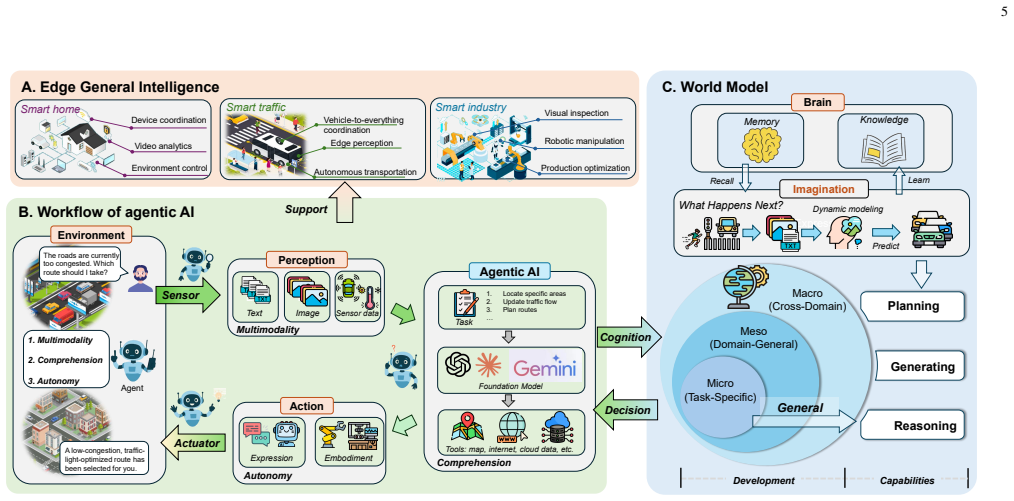
At the center of the paper is a division of labor: the world model is the "cognitive backbone or brain" of the AI agent and the agentic AI framework is the "interaction frontend or body" that senses and acts (Section II-B). A world model, in this view, is a deep network that compresses raw observations into a latent state, learns to predict how that latent state evolves under actions, and reconstructs observations or rewards — so that the agent can roll out thousands of imaginary futures offline and pick the action sequence with the best predicted outcome. The survey's core assertion is that this latent, action-conditioned simulator, which already enables game-playing agents of the Dreamer a
Load-bearing premise
The paper assumes that latent dynamics models trained in video games and control benchmarks will transfer to real wireless edge environments — non-stationary, partially observable, and latency-, energy-, and privacy-constrained — without first demonstrating that transfer empirically; Section I-B asserts the motivation and Section IV applies it to concrete scenarios.
Editorial extensions
If this is right
- Reactive wireless optimization becomes proactive: schedulers and UAV trajectory planners can evaluate candidate decisions against imagined futures instead of responding to stale channel measurements.
- Sample efficiency improves dramatically in data-starved edge settings: a POMDP world model for channel access achieves over 50% higher radio success ratio with 1/20 of the training data of deep Q-learning, and Wireless Dreamer converges 46.15% faster than DQN.
- Safety can be enforced before acting: planning inside the learned model with a safety critic (SafeDreamer) filters out constraint-violating trajectories, which the paper argues is essential for mission-critical edge deployments.
- Lightweight variants can fit edge budgets: Sparse Imagination and the SGF model show that dropping transformers, RNNs, or pixel reconstruction cuts compute and training time (12 hours to 3 hours on Atari 100k) while preserving performance.
- The same latent-imagination loop applies to any edge environment with learnable dynamics and an optimization objective, so the four surveyed scenarios are instances of one paradigm rather than four separate solutions.
Reading between the lines
- Beyond the paper: if the transfer assumption holds, the same latent-imagination loop could become a generic substrate for self-managing networks, so that spectrum, routing, and slicing decisions share one learned simulator rather than separate tuned agents — a unification the paper's taxonomy implies but does not state.
- Beyond the paper: the survey reports sample-efficiency gains but does not isolate compute budgets; a fair head-to-head would compare a world-model agent against a model-free agent with equal wall-clock or FLOP allowance, since latent rollouts are cheap per step but training the dynamics model itself is not free.
- Beyond the paper: the three-tier division of labor suggested in Section V — foundation model for declarative knowledge, digital twin for high-fidelity state, world model for action-conditioned simulation — points to a testable architecture: route sub-second control decisions through the world model and escalate only novel situations to the large model.
- Beyond the paper: the strongest unstated consequence is architectural — if latent imagination really replaces most real-world interaction, then edge hardware priorities shift from inference accelerators for large models to small onboard simulators, changing what "edge AI chip" should mean.
Editorial analysis
A structured set of objections, weighed in public.
Referee Report
Summary. The paper is a survey positioning world models as the 'cognitive backbone' of Edge General Intelligence (EGI), with agentic AI as the interaction frontend. It reviews world-model fundamentals (encoders, dynamics models, planners), compares representative algorithms (World Models, PlaNet, MuZero, Dreamer family, SafeDreamer, Sparse Imagination, SGF, etc.), and maps world-model capabilities to four edge application areas: vehicular networks, low-altitude wireless networks, IoT, and network functions virtualization. It also contrasts world models with digital twins and foundation models, and closes with deployment challenges. The central claim is that imagination-driven planning in latent space can provide the foresight, sample efficiency, and safety required for autonomous edge decision-making.
Significance. If the central claim is accepted, the paper provides a useful conceptual bridge between the model-based RL / world-model literature and wireless edge optimization. Its strengths are a faithful summary of the main world-model architectures (Sections III-B–III-E, Tables II–III), a clear high-level taxonomy, and a practical compilation of open-source implementations in Table V. The comparison with digital twins and foundation models (Section V-A, Table IV) is helpful for positioning future work. However, the paper does not provide new derivations or empirical results, and its significance depends on whether the surveyed evidence supports the claimed transfer from game/control benchmarks to non-stationary wireless edge environments. That support is currently asserted more than demonstrated.
major comments (3)
- [Sections I-B, III-A, II-D, V-C3] The load-bearing premise of the survey is that world models trained on video-game and control benchmarks transfer to non-stationary, partially observable wireless edge environments. This is asserted in Section III-A ('the underlying principles in CarRacing and other video games translate directly to edge environments') and visualized in Fig. 6, but no evidence is provided that a learned transition model T_hat_theta remains accurate under the channel non-stationarity that motivates EGI in Section I-B (e.g., coherence times below 1 ms). The formal setup in Section II-D assumes a fixed unknown MDP with stationary T. Crucially, Section V-C3 itself lists out-of-distribution robustness and online adaptation as unsolved challenges. The cited wireless applications ([27], [32], [118]) are simulated task-specific results; they do not establish the broad 'imagine-and-action' advantage claimed for E
- [Sections IV-A1, IV-A2, IV-C1, IV-C2] Several 'world models can solve X' claims are supported by citations that do not actually instantiate a learned latent-dynamics world model with imagination-based planning. For example, [122] is a predictive power allocation method, not a world model; [126] uses a GAN for spectrum environment simulation; [131] uses predicted user locations; [139] is a model-based caching method. The text repeatedly appeals to analogies with CarRacing, VizDoom, and Minecraft (e.g., Section IV-A1, IV-B2) without showing that the cited edge method contains the encoder–dynamics–decoder architecture defined in Section II-C. The survey should distinguish (a) works that truly integrate world models, (b) works that use predictive or generative components, and (c) speculative proposals. As written, the application section overstates the maturity of the field.
- [Abstract and Section I-B] The abstract claims the survey 'illustrate[s]... how they can enhance optimization under latency, energy, and privacy constraints,' and Section I-B lists 'Robustness to Dynamics' as a potential advantage. Yet no quantitative comparison, benchmark, or case study in the paper demonstrates that world models outperform model-free baselines under edge constraints. The only quantitative results are quoted from individual cited papers, with no critical comparison of their assumptions (e.g., simulators, training data, hardware). The authors should soften the 'demonstrate' language to 'propose' or 'identify opportunities,' and add a limitations paragraph stating that real-world edge deployment of world models is not yet validated.
minor comments (6)
- [Section II-D, Eq. (1)] The expression '||s_{t+1} - T_hat_theta||' is a type error: T_hat_theta(s_t,a_t) is written as a state, but the norm is not defined on mixed state/action spaces. Use a generic loss L(s_{t+1}, T_hat_theta(s_t,a_t)) or a likelihood term.
- [Section I-C1] The sentence beginning 'Meanwhile, Finally, [9] explores...' contains a redundant 'Finally' and reads awkwardly. Please revise.
- [Throughout] The spacing in 'UA V' and 'V AE' is inconsistent; should be 'UAV' and 'VAE' in most venues. Minor typos such as 'TEXPLORE MBRL algorithm [77]' could be cleaned.
- [Section I-B] The third bullet, 'Robustness to Dynamics: Learned latent models enable adaptation to non-stationary wireless conditions,' is stated as fact, but Section V-C3 identifies OOD robustness as an open challenge. Please align these statements.
- [Section IV-A1] The line 'World models can solve V2X spectrum-power optimization' is too strong for a survey. Even if the transfer premise were accepted, the cited evidence ([122]) is a predictive method rather than a world model. Use 'could contribute to' or 'warrant investigation.'
- [Section I-B, reference [27]] The 'Wireless Dreamer' result [27] is an author preprint and is used as a key evidence point for the EGI advantage. A survey should flag when central evidence is non-archival and not independently reproduced.
Circularity Check
No significant circularity: the paper is a literature synthesis; its central EGI-world-model thesis is not derived from fitted data or self-cited theorems.
full rationale
The paper makes no formal derivation and reports no new experimental results; it synthesizes existing world-model and edge-AI literature. The central claim that world models act as the 'cognitive backbone' of EGI is a conceptual/architectural proposal, not a quantity fitted to data and then re-presented as a prediction. Self-citations appear (e.g., Wireless Dreamer [27] and the multi-LLM EGI survey [9]), but they are not load-bearing in the sense required for circularity: the survey's thesis is also supported by independent external works such as [17], [18], [32], [48], [80], and [118], and no uniqueness theorem or restricted ansatz is imported from the authors' prior work. The paper explicitly acknowledges transfer limitations in Sec. V-C3 ('world models trained on narrow or biased datasets may hallucinate when encountering novel conditions'), so the asserted video-game-to-edge transferability is an evidence gap / correctness risk rather than a circular construction. No equation in the paper reduces to its own input, and no fitted parameter is renamed as a prediction. Accordingly, no circular step meets the evidentiary bar.
Assumptions & free parameters
assumptions (3)
- domain assumption The environment can be modeled as a Markov Decision Process with latent state transitions (Section II-D).
- domain assumption Latent representations learned by autoencoders preserve task-relevant information sufficient for planning (Section II-C).
- domain assumption The cited prior results (e.g., Dreamer, PlaNet, MuZero) are correctly reproduced from the literature (multiple sections).
Cite this review
Pith. "Pith review of Edge General Intelligence Through World Models and Agentic AI: Fundamentals, Solutions, and Challenges." pith.science (2026). https://pith.science/paper/ELLU5G2F
@misc{pith2026250809561,
  author       = {Pith},
  title        = {Pith review of: Edge General Intelligence Through World Models and Agentic AI: Fundamentals, Solutions, and Challenges},
  year         = {2026},
  howpublished = {\url{https://pith.science/paper/ELLU5G2F}},
  note         = {Machine review of arXiv:2508.09561}
}
read the original abstract
Edge General Intelligence (EGI) represents a transformative evolution of edge computing, where distributed agents possess the capability to perceive, reason, and act autonomously across diverse, dynamic environments. Central to this vision are world models, which act as proactive internal simulators that not only predict but also actively imagine future trajectories, reason under uncertainty, and plan multi-step actions with foresight. This proactive nature allows agents to anticipate potential outcomes and optimize decisions ahead of real-world interactions. While prior works in robotics and gaming have showcased the potential of world models, their integration into the wireless edge for EGI remains underexplored. This survey bridges this gap by offering a comprehensive analysis of how world models can empower agentic artificial intelligence (AI) systems at the edge. We first examine the architectural foundations of world models, including latent representation learning, dynamics modeling, and imagination-based planning. Building on these core capabilities, we illustrate their proactive applications across EGI scenarios such as vehicular networks, unmanned aerial vehicle (UAV) networks, the Internet of Things (IoT) systems, and network functions virtualization, thereby highlighting how they can enhance optimization under latency, energy, and privacy constraints. We then explore their synergy with foundation models and digital twins, positioning world models as the cognitive backbone of EGI. Finally, we highlight open challenges, such as safety guarantees, efficient training, and constrained deployment, and outline future research directions. This survey provides both a conceptual foundation and a practical roadmap for realizing the next generation of intelligent, autonomous edge systems.
Figures


Figures from the paper (6 more)


Forward citations
Cited by 1 Pith paper
-
Agentic World Modeling for 6G: Near-Real-Time Generative State-Space Reasoning
WM-MS3M adds a compact stochastic latent and dual decoders to a causal multi-scale SSM, improving KPI MAE by 1.69% over MS3M with 32% fewer parameters and enabling PRB what-if rollouts.
Reference graph
Works this paper leans on
-
[27]
World models for cognitive agents: Transforming edge intelligence in future networks,
C. Zhao, R. Zhang, J. Wang, G. Zhao, D. Niyato, G. Sun, S. Mao, and D. I. Kim, “World models for cognitive agents: Transforming edge intelligence in future networks,” arXiv preprint arXiv:2506.00417, 2025
arXiv 2025
-
[32]
World model- based learning for long-term age of information minimization in vehicular networks,
L. Wang, R. Shelim, W. Saad, and N. Ramakrishnan, “World model- based learning for long-term age of information minimization in vehicular networks,” arXiv preprint arXiv:2505.01712 , 2025
arXiv 2025
-
[118]
Model-based deep reinforce- ment learning framework for channel access in wireless networks,
J. I. Park, J. B. Chae, and K. W. Choi, “Model-based deep reinforce- ment learning framework for channel access in wireless networks,” IEEE Internet Things J. , vol. 11, no. 6, pp. 10 150–10 167, Oct. 2023
2023
-
[122]
Deep learning based predictive power allocation for V2X communication,
J. Sang, T. Zhou, T. Xu, Y . Jin, and Z. Zhu, “Deep learning based predictive power allocation for V2X communication,” IEEE Access , vol. 9, pp. 72 881–72 893, May 2021
2021
-
[126]
Primary-user-friendly dynamic spectrum anti-jamming access: A GAN-enhanced deep reinforcement learning approach,
H. Han, Y . Xu, Z. Jin, W. Li, X. Chen, G. Fang, and Y . Xu, “Primary-user-friendly dynamic spectrum anti-jamming access: A GAN-enhanced deep reinforcement learning approach,” IEEE Wireless Commun. Lett., vol. 11, no. 2, pp. 258–262, Nov. 2021
2021
-
[131]
UA V trajectory optimization based on predicted user locations,
L. Ho and S. Jangsher, “UA V trajectory optimization based on predicted user locations,” in Proc. IEEE WCNC , Dubai, United Arab Emirates, Apr. 2024, pp. 1–6
2024
-
[139]
SwiftCache: Model-Based Learning for Dynamic Content Caching in CDNs
B. Abolhassani, A. Eryilmaz, and T. Hou, “Swiftcache: Model- based learning for dynamic content caching in CDNs,” arXiv preprint arXiv:2402.17111, 2024
work page Pith review arXiv 2024
-
[1]
A survey on mobility of edge computing networks in IoT: State-of-the-art, architectures, and challenges,
F. S. Abkenar, P. Ramezani, S. Iranmanesh, S. Murali, D. Chulerttiya- wong, X. Wan, A. Jamalipour, and R. Raad, “A survey on mobility of edge computing networks in IoT: State-of-the-art, architectures, and challenges,” IEEE Commun. Surv. Tutor., vol. 24, no. 4, pp. 2329–2365, Oct. 2022
2022
Show all 179 references
-
[2]
Edge-computing-driven internet of things: A survey,
L. Kong, J. Tan, J. Huang, G. Chen, S. Wang, X. Jin, P. Zeng, M. Khan, and S. K. Das, “Edge-computing-driven internet of things: A survey,” ACM Comput. Surv., vol. 55, no. 8, pp. 1–41, Dec. 2022
2022
-
[3]
Distributed artificial intelligence empowered by end-edge-cloud com- puting: A survey,
S. Duan, D. Wang, J. Ren, F. Lyu, Y . Zhang, H. Wu, and X. Shen, “Distributed artificial intelligence empowered by end-edge-cloud com- puting: A survey,” IEEE Commun. Surv. Tutor. , vol. 25, no. 1, pp. 591–624, Nov. 2022
2022
-
[4]
Disclosing edge intelligence: A systematic meta-survey,
V . Barbuto, C. Savaglio, M. Chen, and G. Fortino, “Disclosing edge intelligence: A systematic meta-survey,” Big Data Cogn. Comput. , vol. 7, no. 1, p. 44, Mar. 2023
2023
-
[5]
Edge intelligence: Empowering intelligence to the edge of network,
D. Xu, T. Li, Y . Li, X. Su, S. Tarkoma, T. Jiang, J. Crowcroft, and P. Hui, “Edge intelligence: Empowering intelligence to the edge of network,” Proc. IEEE, vol. 109, no. 11, pp. 1778–1837, Nov. 2021
2021
-
[6]
Edge intelligence: Paving the last mile of artificial intelligence with edge computing,
Z. Zhou, X. Chen, E. Li, L. Zeng, K. Luo, and J. Zhang, “Edge intelligence: Paving the last mile of artificial intelligence with edge computing,” Proc. IEEE, vol. 107, no. 8, pp. 1738–1762, Jun. 2019
2019
-
[7]
Security and privacy on 6G network edge: A survey,
B. Mao, J. Liu, Y . Wu, and N. Kato, “Security and privacy on 6G network edge: A survey,” IEEE Commun. Surv. Tutor., vol. 25, no. 2, pp. 1095–1127, Feb. 2023
2023
-
[8]
Edge intelligence: The confluence of edge computing and artificial intelligence,
S. Deng, H. Zhao, W. Fang, J. Yin, S. Dustdar, and A. Y . Zomaya, “Edge intelligence: The confluence of edge computing and artificial intelligence,” IEEE Internet Things J. , vol. 7, no. 8, pp. 7457–7469, Apr. 2020
2020
-
[9]
Toward edge general intelligence with multiple-large language model (multi-LLM): Architecture, trust, and orchestration,
H. Luo, Y . Liu, R. Zhang, J. Wang, G. Sun, D. Niyato, H. Yu, Z. Xiong, X. Wang, and X. Shen, “Toward edge general intelligence with multiple-large language model (multi-LLM): Architecture, trust, and orchestration,” arXiv preprint arXiv:2507.00672 , 2025
2025 arXiv
-
[10]
Towards edge general intelligence via large language models: Opportunities and challenges,
H. Chen, W. Deng, S. Yang, J. Xu, Z. Jiang, E. C. Ngai, J. Liu, and X. Liu, “Towards edge general intelligence via large language models: Opportunities and challenges,” IEEE Network, Early Assess, 2025
2025
-
[11]
Agentic AI: Autonomous intelligence for complex goals–a comprehensive survey,
D. B. Acharya, K. Kuppan, and B. Divya, “Agentic AI: Autonomous intelligence for complex goals–a comprehensive survey,” IEEE Access, vol. 13, pp. 18 912–18 936, Jan. 2025
2025
-
[12]
AI agents vs. agentic AI: A conceptual taxonomy, applications and challenge,
R. Sapkota, K. I. Roumeliotis, and M. Karkee, “AI agents vs. agentic AI: A conceptual taxonomy, applications and challenge,”arXiv preprint arXiv:2505.10468, 2025
2025
-
[13]
The road toward general edge intelligence: Standing on the shoulders of foundation models,
L. He, L. Fan, X. Lei, P. Fan, A. Nallanathan, and G. K. Karagiannidis, “The road toward general edge intelligence: Standing on the shoulders of foundation models,” IEEE Commun. Mag. , Early Assess, 2025
2025
-
[14]
Artificial general intelligence (AGI)-native wireless systems: A journey beyond 6G,
W. Saad, O. Hashash, C. K. Thomas, C. Chaccour, M. Debbah, N. Mandayam, and Z. Han, “Artificial general intelligence (AGI)-native wireless systems: A journey beyond 6G,” Proc. IEEE, Early Assess, 2025
2025
-
[15]
Thinking in space: How multimodal large language models see, remember, and recall spaces,
J. Yang, S. Yang, A. W. Gupta, R. Han, L. Fei-Fei, and S. Xie, “Thinking in space: How multimodal large language models see, remember, and recall spaces,” inProc. CVPR, Nashville, TN, Jun. 2025, pp. 10 632–10 643
2025
-
[16]
A path towards autonomous machine intelligence version 0.9. 2, 2022-06-27,
Y . LeCun, “A path towards autonomous machine intelligence version 0.9. 2, 2022-06-27,” Open Review, vol. 62, no. 1, pp. 1–62, Jun. 2022
2022
-
[17]
Recurrent world models facilitate policy evolution,
D. Ha and J. Schmidhuber, “Recurrent world models facilitate policy evolution,” in Proc. NeurIPS, vol. 31, Montr ´eal, Canada, Dec. 2018
2018
-
[18]
Mastering diverse control tasks through world models,
D. Hafner, J. Pasukonis, J. Ba, and T. Lillicrap, “Mastering diverse control tasks through world models,” Nature, vol. 640, no. 8059, pp. 647–653, Apr. 2025
2025
-
[19]
Understanding world or predicting future? a comprehensive survey of world models,
J. Ding, Y . Zhang, Y . Shang, Y . Zhang, Z. Zong, J. Feng, Y . Yuan, H. Su, N. Li, N. Sukiennik, F. Xu, and Y . Li, “Understanding world or predicting future? a comprehensive survey of world models,” ACM Comput. Surv., Early Assess, 2025
2025
-
[20]
Learning and leveraging world models in visual representation learning,
Q. Garrido, M. Assran, N. Ballas, A. Bardes, L. Najman, and Y . Le- Cun, “Learning and leveraging world models in visual representation learning,” arXiv preprint arXiv:2403.00504 , 2024
2024 arXiv
-
[21]
V-JEPA 2: Self- supervised video models enable understanding, prediction and plan- ning,
M. Assran, A. Bardes, D. Fan, Q. Garrido, R. Howes, M. Muckley, A. Rizvi, C. Roberts, K. Sinha, A. Zholus et al. , “V-JEPA 2: Self- supervised video models enable understanding, prediction and plan- ning,” arXiv preprint arXiv:2506.09985 , 2025
2025 arXiv
-
[22]
A survey of recent advances in optimization methods for wireless communications,
Y .-F. Liu, T.-H. Chang, M. Hong, Z. Wu, A. Man-Cho So, E. A. Jorswieck, and W. Yu, “A survey of recent advances in optimization methods for wireless communications,” IEEE J. Sel. Areas Commun. , vol. 42, no. 11, pp. 2992–3031, Aug 2024
2024
-
[23]
Fully-decoupled RAN for feedback-free multi-base station transmission in MIMO-OFDM system,
Y . Xu, Z. Liu, B. Qian, H. Du, J. Chen, J. Kang, H. Zhou, and D. Niyato, “Fully-decoupled RAN for feedback-free multi-base station transmission in MIMO-OFDM system,” IEEE J. Sel. Areas Commun. , vol. 43, no. 3, pp. 780–794, Jan. 2025
2025
-
[24]
Channel estimation for reconfigurable intelligent surface assisted high-mobility wireless systems,
C. Xu, J. An, T. Bai, S. Sugiura, R. G. Maunder, Z. Wang, L.-L. Yang, and L. Hanzo, “Channel estimation for reconfigurable intelligent surface assisted high-mobility wireless systems,” IEEE Trans. Veh. Technol., vol. 72, no. 1, pp. 718–734, Sept. 2022
2022
-
[25]
Federated learning over fully-decoupled RAN architecture for two-tier computing acceleration,
Y . Xu, B. Qian, K. Yu, T. Ma, L. Zhao, and H. Zhou, “Federated learning over fully-decoupled RAN architecture for two-tier computing acceleration,” IEEE J. Sel. Areas Commun., vol. 41, no. 3, pp. 789–801, Jan. 2023
2023
-
[26]
Navigating the road ahead: A comprehensive survey of radio resource allocation for vehicle platooning in C-V2X communications,
C. Yang, C. F. Kwong, D. Chieng, P. Kar, K.-L. A. Yau, and Y . Chen, “Navigating the road ahead: A comprehensive survey of radio resource allocation for vehicle platooning in C-V2X communications,” IEEE Commun. Surv. Tutor., vol. 27, no. 2, pp. 1326–1362, Aug. 2025
2025
-
[28]
Generative AI for secure physical layer communi- cations: A survey,
C. Zhao, H. Du, D. Niyato, J. Kang, Z. Xiong, D. I. Kim, X. Shen, and K. B. Letaief, “Generative AI for secure physical layer communi- cations: A survey,” IEEE Trans. Cogn. Commun. Netw., vol. 11, no. 1, pp. 3–26, Aug. 2025
2025
-
[29]
Reasoning with language model is planning with world model,
S. Hao, Y . Gu, H. Ma, J. J. Hong, Z. Wang, D. Z. Wang, and Z. Hu, “Reasoning with language model is planning with world model,” arXiv preprint arXiv:2305.14992, 2023
2023 arXiv
-
[30]
Vista: A generalizable driving world model with high fidelity and versatile controllability,
S. Gao, J. Yang, L. Chen, K. Chitta, Y . Qiu, A. Geiger, J. Zhang, and H. Li, “Vista: A generalizable driving world model with high fidelity and versatile controllability,” in Proc. NeurIPS , vol. 37, Vancouver, Canada, Dec. 2024, pp. 91 560–91 596
2024
-
[31]
Random 3D mobile UA V networks: Mobility modeling and coverage probability,
P. K. Sharma and D. I. Kim, “Random 3D mobile UA V networks: Mobility modeling and coverage probability,” IEEE Trans. Wireless Commun., vol. 18, no. 5, pp. 2527–2538, May 2019
2019
-
[33]
A survey of world models for autonomous driving,
T. Feng, W. Wang, and Y . Yang, “A survey of world models for autonomous driving,” arXiv preprint arXiv:2501.11260 , 2025
2025 arXiv
-
[34]
World models for autonomous driving: An initial survey,
Y . Guan, H. Liao, Z. Li, J. Hu, R. Yuan, G. Zhang, and C. Xu, “World models for autonomous driving: An initial survey,” IEEE Trans. Intell. Veh., Early Assess, 2024
2024
-
[35]
Edge intelligence: Architectures, challenges, and applications,
D. Xu, T. Li, Y . Li, X. Su, S. Tarkoma, T. Jiang, J. Crowcroft, and P. Hui, “Edge intelligence: Architectures, challenges, and applications,” arXiv preprint arXiv:2003.12172 , 2020
2003 arXiv
-
[36]
Is sora a world simulator? a comprehensive survey on general world models and beyond,
Z. Zhu, X. Wang, W. Zhao, C. Min, N. Deng, M. Dou, Y . Wang, B. Shi, K. Wang, C. Zhang et al. , “Is sora a world simulator? a comprehensive survey on general world models and beyond,” arXiv preprint arXiv:2405.03520, 2024
2024
-
[37]
Digital twin assisted intelligent network man- agement for vehicular applications,
K. Qu and W. Zhuang, “Digital twin assisted intelligent network man- agement for vehicular applications,” IEEE Wireless Communications , vol. 31, no. 4, pp. 208–214, Aug. 2024
2024
-
[38]
Auto-GPT for online deci- sion making: Benchmarks and additional opinions,
H. Yang, S. Yue, and Y . He, “Auto-GPT for online deci- sion making: Benchmarks and additional opinions,” arXiv preprint arXiv:2306.02224, 2023
2023 arXiv
-
[39]
LLM-based edge intelligence: A comprehensive survey on architectures, applications, security and trustworthiness,
O. Friha, M. Amine Ferrag, B. Kantarci, B. Cakmak, A. Ozgun, and N. Ghoualmi-Zine, “LLM-based edge intelligence: A comprehensive survey on architectures, applications, security and trustworthiness,” IEEE Open J. Commun. Soc. , vol. 5, pp. 5799–5856, Sept. 2024
2024
-
[40]
Energy-Efficient RSMA- enabled Low-altitude MEC Optimization Via Generative AI-enhanced Deep Reinforcement Learning,
X. Wang, H. Du, L. Feng, and K. Huang, “Energy-Efficient RSMA- enabled Low-altitude MEC Optimization Via Generative AI-enhanced Deep Reinforcement Learning,” arXiv preprint arXiv:2507.12910 , 2025
2025 arXiv
-
[41]
Llama: Open and efficient foundation language models,
H. Touvron, T. Lavril, G. Izacard, X. Martinet, M.-A. Lachaux, T. Lacroix, B. Rozi `ere, N. Goyal, E. Hambro, F. Azhar et al., “Llama: Open and efficient foundation language models,” arXiv preprint arXiv:2302.13971, 2023
2023 arXiv
-
[42]
Leveraging edge intelligence and LLMs to advance 6G-enabled internet of automated defense vehicles,
M. A. Onsu, P. Lohan, and B. Kantarci, “Leveraging edge intelligence and LLMs to advance 6G-enabled internet of automated defense vehicles,” IEEE Internet Things Mag. , vol. 8, no. 4, pp. 148–155, Jun. 2025. 19
2025
-
[43]
Trustworthy distributed AI systems: Robustness, privacy, and governance,
W. Wei and L. Liu, “Trustworthy distributed AI systems: Robustness, privacy, and governance,”ACM Comput. Surv., vol. 57, no. 6, pp. 1–42, Feb. 2025
2025
-
[44]
Generative AI-enabled wireless communi- cations for robust low-altitude economy networking,
C. Zhao, J. Wang, R. Zhang, D. Niyato, G. Sun, H. Du, D. I. Kim, and A. Jamalipour, “Generative AI-enabled wireless communi- cations for robust low-altitude economy networking,” arXiv preprint arXiv:2502.18118, 2025
2025 arXiv
-
[45]
From large AI models to agentic AI: A tutorial on future intelligent communications,
F. Jiang, C. Pan, L. Dong, K. Wang, O. A. Dobre, and M. Debbah, “From large AI models to agentic AI: A tutorial on future intelligent communications,” arXiv preprint arXiv:2505.22311 , 2025
2025 arXiv
-
[46]
MemGPT: Towards LLMs as operating systems,
C. Packer, S. Wooders, K. Lin, V . Fang, S. G. Patil, I. Stoica, and J. E. Gonzalez, “MemGPT: Towards LLMs as operating systems,” arXiv preprint arXiv:2310.08560, 2024
2024 arXiv
-
[47]
Agentic AI for scientific discovery: A survey of progress, challenges, and future directions,
M. Gridach, J. Nanavati, K. Z. E. Abidine, L. Mendes, and C. Mack, “Agentic AI for scientific discovery: A survey of progress, challenges, and future directions,” arXiv preprint arXiv:2503.08979 , 2025
2025 arXiv
-
[48]
Learning latent dynamics for planning from pixels,
D. Hafner, T. Lillicrap, I. Fischer, R. Villegas, D. Ha, H. Lee, and J. Davidson, “Learning latent dynamics for planning from pixels,” in Proc. ICML, Long Beach, CA, Jun. 2019, pp. 2555–2565
2019
-
[49]
Dream to con- trol: Learning behaviors by latent imagination,
D. Hafner, T. Lillicrap, J. Ba, and M. Norouzi, “Dream to con- trol: Learning behaviors by latent imagination,” arXiv preprint arXiv:1912.01603, 2019
1912 arXiv
-
[50]
Tutorial overview of model predictive control,
J. B. Rawlings, “Tutorial overview of model predictive control,” IEEE Control Syst. Mag. , vol. 20, no. 3, pp. 38–52, Jun. 2000
2000
-
[51]
Deep learning, reinforcement learning, and world models,
Y . Matsuo, Y . LeCun, M. Sahani, D. Precup, D. Silver, M. Sugiyama, E. Uchibe, and J. Morimoto, “Deep learning, reinforcement learning, and world models,” Neural Netw., vol. 152, pp. 267–275, May 2022
2022
-
[52]
Dyna, an integrated architecture for learning, planning, and reacting,
R. S. Sutton, “Dyna, an integrated architecture for learning, planning, and reacting,” ACM Sigart Bulletin , vol. 2, no. 4, pp. 160–163, Jul. 1991
1991
-
[53]
Auto-encoders in deep learning—a review with new perspectives,
S. Chen and W. Guo, “Auto-encoders in deep learning—a review with new perspectives,” Mathematics, vol. 11, no. 8, p. 1777, Apr. 2023
2023
-
[54]
Tutorial on variational autoencoders,
C. Doersch, “Tutorial on variational autoencoders,” arXiv preprint arXiv:1606.05908, 2016
2016 arXiv
-
[55]
Neural discrete representation learning,
A. Van Den Oord, O. Vinyals, and K. Kavukcuoglu, “Neural discrete representation learning,” in Proc. NeurIPS, vol. 30, Long Beach, CA, Dec. 2017
2017
-
[56]
Transformers in vision: A survey,
S. Khan, M. Naseer, M. Hayat, S. W. Zamir, F. S. Khan, and M. Shah, “Transformers in vision: A survey,” ACM Comput. Surv. , vol. 54, no. 10s, pp. 1–41, Sept. 2022
2022
-
[57]
A survey on vision transformer,
K. Han, Y . Wang, H. Chen, X. Chen, J. Guo, Z. Liu, Y . Tang, A. Xiao, C. Xu, Y . Xu et al. , “A survey on vision transformer,” IEEE Trans. Pattern Anal. Mach. Intell. , vol. 45, no. 1, pp. 87–110, Feb. 2022
2022
-
[58]
GPT (generative pre-trained transformer)— a comprehensive review on enabling technologies, po- tential applications, emerging challenges, and future directions,
G. Yenduri, M. Ramalingam, G. C. Selvi, Y . Supriya, G. Srivastava, P. K. R. Maddikunta, G. D. Raj, R. H. Jhaveri, B. Prabadevi, W. Wang, A. V . Vasilakos, and T. R. Gadekallu, “GPT (generative pre-trained transformer)— a comprehensive review on enabling technologies, po- tent...
2024
-
[59]
Vision-language models for vision tasks: A survey,
J. Zhang, J. Huang, S. Jin, and S. Lu, “Vision-language models for vision tasks: A survey,” IEEE Trans. Pattern Anal. Mach. Intell. , vol. 46, no. 8, pp. 5625–5644, Feb. 2024
2024
-
[60]
Sora: A review on background, technology, limitations, and opportunities of large vision models,
Y . Liu, K. Zhang, Y . Li, Z. Yan, C. Gao, R. Chen, Z. Yuan, Y . Huang, H. Sun, J. Gao et al. , “Sora: A review on background, technology, limitations, and opportunities of large vision models,” arXiv preprint arXiv:2402.17177, 2024
2024 arXiv
-
[61]
A generalist agent,
S. Reed, K. Zolna, E. Parisotto, S. G. Colmenarejo, A. Novikov, G. Barth-Maron, M. Gimenez, Y . Sulsky, J. Kay, J. T. Springenberg et al., “A generalist agent,” arXiv preprint arXiv:2205.06175 , 2022
2022 arXiv
-
[62]
Generative adversarial net- works,
I. Goodfellow, J. Pouget-Abadie, M. Mirza, B. Xu, D. Warde-Farley, S. Ozair, A. Courville, and Y . Bengio, “Generative adversarial net- works,” Commun. ACM, vol. 63, no. 11, pp. 139–144, Oct. 2020
2020
-
[63]
World-GAN: A gener- ative model for minecraft worlds,
M. Awiszus, F. Schubert, and B. Rosenhahn, “World-GAN: A gener- ative model for minecraft worlds,” in Proc. IEEE CoG , Copenhagen, Denmark, Aug. 2021, pp. 1–8
2021
-
[64]
Generative adversarial networks: An overview,
A. Creswell, T. White, V . Dumoulin, K. Arulkumaran, B. Sengupta, and A. A. Bharath, “Generative adversarial networks: An overview,” IEEE Signal Process. Mag. , vol. 35, no. 1, pp. 53–65, Jan. 2018
2018
-
[65]
Diffusion models: A comprehensive survey of methods and applications,
L. Yang, Z. Zhang, Y . Song, S. Hong, R. Xu, Y . Zhao, W. Zhang, B. Cui, and M.-H. Yang, “Diffusion models: A comprehensive survey of methods and applications,” ACM Comput. Surv., vol. 56, no. 4, pp. 1–39, Nov. 2023
2023
-
[66]
Diffusion world model: Future modeling beyond step-by-step rollout for offline reinforcement learning,
Z. Ding, A. Zhang, Y . Tian, and Q. Zheng, “Diffusion world model: Future modeling beyond step-by-step rollout for offline reinforcement learning,” arXiv preprint arXiv:2402.03570 , 2024
2024 arXiv
-
[67]
Video generation models as world simulators,
T. Brooks, B. Peebles, C. Holmes, W. DePue, Y . Guo, L. Jing, D. Schnurr, J. Taylor, T. Luhman, E. Luhman et al., “Video generation models as world simulators,” OpenAI Blog, vol. 1, p. 8, 2024
2024
-
[68]
Mastering atari with discrete world models,
D. Hafner, T. Lillicrap, M. Norouzi, and J. Ba, “Mastering atari with discrete world models,” arXiv preprint arXiv:2010.02193 , 2020
2010 arXiv
-
[69]
Transformer- based world models are happy with 100K interactions,
J. Robine, M. H ¨oftmann, T. Uelwer, and S. Harmeling, “Transformer- based world models are happy with 100K interactions,” arXiv preprint arXiv:2303.07109, 2023
2023 arXiv
-
[70]
VideoGPT: Video generation using VQ-V AE and transformers,
W. Yan, Y . Zhang, P. Abbeel, and A. Srinivas, “VideoGPT: Video generation using VQ-V AE and transformers,” arXiv preprint arXiv:2104.10157, 2021
2021 arXiv
-
[71]
WorldGPT: Empowering LLM as multimodal world model,
Z. Ge, H. Huang, M. Zhou, J. Li, G. Wang, S. Tang, and Y . Zhuang, “WorldGPT: Empowering LLM as multimodal world model,” in Proc. ACM MM, Melbourne, Australia, Oct. 2024, pp. 7346–7355
2024
-
[72]
Adversarial video generation on complex datasets,
A. Clark, J. Donahue, and K. Simonyan, “Adversarial video generation on complex datasets,” arXiv preprint arXiv:1907.06571 , 2019
1907 arXiv
-
[73]
World models via policy-guided trajectory diffusion,
M. Rigter, J. Yamada, and I. Posner, “World models via policy-guided trajectory diffusion,” arXiv preprint arXiv:2312.08533 , 2023
2023 arXiv
-
[74]
Prioritized sweeping: Reinforcement learning with less data and less time,
A. W. Moore and C. G. Atkeson, “Prioritized sweeping: Reinforcement learning with less data and less time,” Machine learning, vol. 13, pp. 103–130, Oct. 1993
1993
-
[75]
Wireless networks design in the era of deep learning: Model-based, AI-based, or both?
A. Zappone, M. Di Renzo, and M. Debbah, “Wireless networks design in the era of deep learning: Model-based, AI-based, or both?” IEEE Trans. Commun., vol. 67, no. 10, pp. 7331–7376, Jun. 2019
2019
-
[76]
Autonomous navigation of UA V by using real-time model-based reinforcement learning,
N. Imanberdiyev, C. Fu, E. Kayacan, and I.-M. Chen, “Autonomous navigation of UA V by using real-time model-based reinforcement learning,” in Proc. ICARCV, Phuket, Thailand, Dec. 2016, pp. 1–6
2016
-
[77]
Texplore: real-time sample-efficient reinforce- ment learning for robots,
T. Hester and P. Stone, “Texplore: real-time sample-efficient reinforce- ment learning for robots,” Machine learning, vol. 90, pp. 385–429, Oct. 2013
2013
-
[78]
A model-based reinforcement learning protocol for routing in vehicular ad hoc network,
O. Jafarzadeh, M. Dehghan, H. Sargolzaey, and M. M. Esnaashari, “A model-based reinforcement learning protocol for routing in vehicular ad hoc network,” Wireless Pers. Commun. , vol. 123, no. 1, pp. 975– 1001, Nov. 2022
2022
-
[79]
Model-based reinforcement learning with kernels for resource allocation in RAN slices,
J. J. Alcaraz, F. Losilla, A. Zanella, and M. Zorzi, “Model-based reinforcement learning with kernels for resource allocation in RAN slices,” IEEE Trans. Wireless Commun. , vol. 22, no. 1, pp. 486–501, Aug. 2022
2022
-
[80]
Mastering atari, go, chess and shogi by planning with a learned model,
J. Schrittwieser, I. Antonoglou, T. Hubert, K. Simonyan, L. Sifre, S. Schmitt, A. Guez, E. Lockhart, D. Hassabis, T. Graepel et al. , “Mastering atari, go, chess and shogi by planning with a learned model,” Nature, vol. 588, no. 7839, pp. 604–609, Dec. 2020
2020
-
[81]
Openai gym,
G. Brockman, V . Cheung, L. Pettersson, J. Schneider, J. Schul- man, J. Tang, and W. Zaremba, “Openai gym,” arXiv preprint arXiv:1606.01540, 2016
2016 arXiv
-
[82]
Machine learning for channel quality prediction: From concept to experimental validation,
Z. Becvar, J. Plachy, P. Mach, A. Nikolov, and D. Gesbert, “Machine learning for channel quality prediction: From concept to experimental validation,” IEEE Trans. Wireless Commun. , Jun. 2024
2024
-
[83]
Deep learning based prediction of traffic peaks in mobile networks,
S. Li, E. Magli, G. Francini, and G. Ghinamo, “Deep learning based prediction of traffic peaks in mobile networks,” Computer Networks , vol. 240, p. 110167, Jan. 2024
2024
-
[84]
Energy- efficient trajectory optimization with wireless charging in UA V-assisted MEC based on multi-objective reinforcement learning,
F. Song, M. Deng, H. Xing, Y . Liu, F. Ye, and Z. Xiao, “Energy- efficient trajectory optimization with wireless charging in UA V-assisted MEC based on multi-objective reinforcement learning,” IEEE Trans. Mobile Comput., vol. 23, no. 12, pp. 10 867–10 884, Apr. 2024
2024
-
[85]
Joint deployment and trajectory optimization in UA V-assisted vehicular edge computing networks,
Z. Wu, Z. Yang, C. Yang, J. Lin, Y . Liu, and X. Chen, “Joint deployment and trajectory optimization in UA V-assisted vehicular edge computing networks,” J. Commun. Netw. , vol. 24, no. 1, pp. 47–58, Sept. 2021
2021
-
[86]
Joint communication and trajectory optimization for multi-UA V enabled mobile internet of vehicles,
X. Liu, B. Lai, B. Lin, and V . C. Leung, “Joint communication and trajectory optimization for multi-UA V enabled mobile internet of vehicles,” IEEE Trans. Intell. Transp. Syst. , vol. 23, no. 9, pp. 15 354– 15 366, Jan. 2022
2022
-
[87]
Uncertainty-aware model-based reinforce- ment learning: Methodology and application in autonomous driving,
J. Wu, Z. Huang, and C. Lv, “Uncertainty-aware model-based reinforce- ment learning: Methodology and application in autonomous driving,” IEEE Trans. Intell. Veh., vol. 8, no. 1, pp. 194–203, Jun. 2022
2022
-
[88]
Uncertainty- aware multiview deep learning for internet of things applications,
C. Xu, W. Zhao, J. Zhao, Z. Guan, X. Song, and J. Li, “Uncertainty- aware multiview deep learning for internet of things applications,” IEEE Trans. Ind. Informat., vol. 19, no. 2, pp. 1456–1466, Sept. 2022
2022
-
[89]
Rm-Gen: Conditional diffusion model-based radio map generation for wireless networks,
X. Luo, Z. Li, Z. Peng, D. Xu, and Y . Liu, “Rm-Gen: Conditional diffusion model-based radio map generation for wireless networks,” in Proc. IFIP Networking, Thessaloniki, Greece, Jun. 2024, pp. 543–548
2024
-
[90]
Generative AI enabled robust data augmentation for wireless sensing in isac networks,
J. Wang, C. Zhao, H. Du, G. Sun, J. Kang, S. Mao, D. Niyato, and D. I. Kim, “Generative AI enabled robust data augmentation for wireless sensing in isac networks,” arXiv preprint arXiv:2502.12622 , 2025. 20
2025 arXiv
-
[91]
Generative AI based secure wireless sensing for ISAC networks,
J. Wang, H. Du, Y . Liu, G. Sun, D. Niyato, S. Mao, D. I. Kim, and X. Shen, “Generative AI based secure wireless sensing for ISAC networks,” arXiv preprint arXiv:2408.11398 , 2024
2024 arXiv
-
[92]
Generative AI for deep reinforcement learning: Framework, analysis, and use cases,
G. Sun, W. Xie, D. Niyato, F. Mei, J. Kang, H. Du, and S. Mao, “Generative AI for deep reinforcement learning: Framework, analysis, and use cases,” IEEE Wireless Communications , vol. 32, no. 3, pp. 186–195, Jan. 2025
2025
-
[93]
Deep reinforcement learning for channel estimation in RIS-aided wireless networks,
K. Kim, Y . K. Tun, M. S. Munir, W. Saad, and C. S. Hong, “Deep reinforcement learning for channel estimation in RIS-aided wireless networks,” IEEE Commun. Lett. , vol. 27, no. 8, pp. 2053–2057, May 2023
-
[94]
Model-based: End-to-end molecular communication system through deep reinforce- ment learning auto encoder,
S. Mohamed, J. Dong, A. R. Junejo, and D. C. Zuo, “Model-based: End-to-end molecular communication system through deep reinforce- ment learning auto encoder,” IEEE Access, vol. 7, pp. 70 279–70 286, May 2019
2019
-
[95]
Model predictive control: Theory and practice—a survey,
C. E. Garcia, D. M. Prett, and M. Morari, “Model predictive control: Theory and practice—a survey,” Automatica, vol. 25, no. 3, pp. 335– 348, Oct. 1989
1989
-
[96]
Model predictive path integral control for agile unmanned aerial vehicles,
M. Mina ˇr´ık, R. P ˇeniˇcka, V . V on´asek, and M. Saska, “Model predictive path integral control for agile unmanned aerial vehicles,” in Proc. IEEE/RSJ IROS , Abu Dhabi, United Arab Emirates, Oct. 2024, pp. 13 144–13 151
2024
-
[97]
Model predictive control for the receiving-side DC–DC converter of dynamic wireless power transfer,
Z. Zhou, L. Zhang, Z. Liu, Q. Chen, R. Long, and H. Su, “Model predictive control for the receiving-side DC–DC converter of dynamic wireless power transfer,” IEEE Trans. Power Electron., vol. 35, no. 9, pp. 8985–8997, Jan. 2020
2020
-
[98]
A low computational burden model predictive control for dynamic wireless charging,
T. Ma, C. Jiang, C. Chen, Y . Wang, J. Geng, and K. T. Chi, “A low computational burden model predictive control for dynamic wireless charging,” IEEE Trans. Ind. Electron., vol. 71, no. 9, pp. 10 402–10 413, Jan. 2024
2024
-
[99]
A survey of monte carlo tree search methods,
C. B. Browne, E. Powley, D. Whitehouse, S. M. Lucas, P. I. Cowling, P. Rohlfshagen, S. Tavener, D. Perez, S. Samothrakis, and S. Colton, “A survey of monte carlo tree search methods,” IEEE Trans. Comput. Intell. AI Games , vol. 4, no. 1, pp. 1–43, Feb. 2012
2012
-
[100]
Path planning for the dynamic UA V-aided wireless systems using monte carlo tree search,
Y . Qian, K. Sheng, C. Ma, J. Li, M. Ding, and M. Hassan, “Path planning for the dynamic UA V-aided wireless systems using monte carlo tree search,” IEEE Trans. Veh. Technol., vol. 71, no. 6, pp. 6716– 6721, Mar. 2022
2022
-
[101]
Mastering chess and shogi by self-play with a general reinforcement learning algorithm,
D. Silver, T. Hubert, J. Schrittwieser, I. Antonoglou, M. Lai, A. Guez, M. Lanctot, L. Sifre, D. Kumaran, T. Graepel et al. , “Mastering chess and shogi by self-play with a general reinforcement learning algorithm,” arXiv preprint arXiv:1712.01815 , 2017
2017 arXiv
-
[102]
Learning-based predictive beamforming for UA V communications with jittering,
W. Yuan, C. Liu, F. Liu, S. Li, and D. W. K. Ng, “Learning-based predictive beamforming for UA V communications with jittering,”IEEE Wireless Commun. Lett., vol. 9, no. 11, pp. 1970–1974, Jul. 2020
1970
-
[103]
DreamerPro: Reconstruction-free model- based reinforcement learning with prototypical representations,
F. Deng, I. Jang, and S. Ahn, “DreamerPro: Reconstruction-free model- based reinforcement learning with prototypical representations,” in Proc. ICML, vol. 162, Baltimore, MD, Jul. 2022, pp. 4956–4975
2022
-
[104]
Multipretext- task prototypes guided dynamic contrastive learning network for few- shot remote sensing scene classification,
J. Ma, W. Lin, X. Tang, X. Zhang, F. Liu, and L. Jiao, “Multipretext- task prototypes guided dynamic contrastive learning network for few- shot remote sensing scene classification,” IEEE Trans. Geosci. Remote Sens., vol. 61, pp. 1–16, Jun. 2023
2023
-
[105]
Multiscale prototype contrast network for high-resolution aerial imagery semantic segmentation,
Q. Wang, X. Luo, J. Feng, G. Zhang, X. Jia, and J. Yin, “Multiscale prototype contrast network for high-resolution aerial imagery semantic segmentation,” IEEE Trans. Geosci. Remote Sens. , vol. 61, pp. 1–14, Jul. 2023
2023
-
[106]
Deepmind control suite,
Y . Tassa, Y . Doron, A. Muldal, T. Erez, Y . Li, D. d. L. Casas, D. Budden, A. Abdolmaleki, J. Merel, A. Lefrancq et al., “Deepmind control suite,” arXiv preprint arXiv:1801.00690 , 2018
2018 arXiv
-
[107]
Dreaming: Model-based reinforcement learning by latent imagination without reconstruction,
M. Okada and T. Taniguchi, “Dreaming: Model-based reinforcement learning by latent imagination without reconstruction,” in Proc. IEEE ICRA, Xi’an, China, May 2021, pp. 4209–4215
2021
-
[108]
DreamingV2: Reinforcement learning with discrete world models without reconstruction,
M. Okada and T. Taniguchi, “DreamingV2: Reinforcement learning with discrete world models without reconstruction,” in Proc. IEEE/RSJ IROS, Kyoto, Japan, Oct. 2022, pp. 985–991
2022
-
[109]
Transdreamer: Rein- forcement learning with transformer world models,
C. Chen, Y .-F. Wu, J. Yoon, and S. Ahn, “Transdreamer: Rein- forcement learning with transformer world models,” arXiv preprint arXiv:2202.09481, 2022
2022 arXiv
-
[110]
Safedreamer: Safe reinforcement learning with world models,
W. Huang, J. Ji, C. Xia, B. Zhang, and Y . Yang, “Safedreamer: Safe reinforcement learning with world models,” arXiv preprint arXiv:2307.07176, 2023
2023 arXiv
-
[111]
Sparse imagination for efficient visual world model planning,
J. Chun, Y . Jeong, and T. Kim, “Sparse imagination for efficient visual world model planning,” arXiv preprint arXiv:2506.01392 , 2025
2025
-
[112]
Simple, good, fast: Self-supervised world models free of baggage,
J. Robine, M. H ¨oftmann, and S. Harmeling, “Simple, good, fast: Self-supervised world models free of baggage,” arXiv preprint arXiv:2506.02612, 2025
2025 arXiv
-
[113]
Attention is all you need,
A. Vaswani, N. Shazeer, N. Parmar, J. Uszkoreit, L. Jones, A. N. Gomez, Ł. Kaiser, and I. Polosukhin, “Attention is all you need,” in Proc. NeurIPS, vol. 30, Long Beach, CA, Dec. 2017
2017
-
[114]
Transformer- based reinforcement learning for scalable multi-UA V area coverage,
D. Chen, Q. Qi, Q. Fu, J. Wang, J. Liao, and Z. Han, “Transformer- based reinforcement learning for scalable multi-UA V area coverage,” IEEE Trans. Intell. Transp. Syst. , vol. 25, no. 8, pp. 10 062–10 077, Feb. 2024
2024
-
[115]
UA V trajectory planning for AoI-minimal data collection in UA V-aided IoT networks by transformer,
B. Zhu, E. Bedeer, H. H. Nguyen, R. Barton, and Z. Gao, “UA V trajectory planning for AoI-minimal data collection in UA V-aided IoT networks by transformer,” IEEE Trans. Wireless Commun. , vol. 22, no. 2, pp. 1343–1358, Sept. 2022
2022
-
[116]
Constrained cross-entropy method for safe reinforcement learning,
M. Wen and U. Topcu, “Constrained cross-entropy method for safe reinforcement learning,” in Proc. NeurIPS, vol. 31, Montr ´eal, Canada, Dec. 2018
2018
-
[117]
Energy-efficient resource allocation for mobile-edge computation offloading,
C. You, K. Huang, H. Chae, and B.-H. Kim, “Energy-efficient resource allocation for mobile-edge computation offloading,” IEEE Trans. Wire- less Commun., vol. 16, no. 3, pp. 1397–1411, Dec. 2016
2016
-
[119]
Joint spectrum allocation and power control in vehicular networks based on reinforcement learning,
K. Wang, Y . Feng, L. Liang, and S. Jin, “Joint spectrum allocation and power control in vehicular networks based on reinforcement learning,” in Proc. ISWCS, Hangzhou, China, Oct. 2022, pp. 1–6
2022
-
[120]
Joint spectrum and power allocation for V2X communications with imperfect CSI,
P. Wang, W. Wu, J. Liu, G. Chai, and L. Feng, “Joint spectrum and power allocation for V2X communications with imperfect CSI,” IEEE Trans. Veh. Technol., vol. 72, no. 12, pp. 16 338–16 353, Jul. 2023
2023
-
[121]
Optimizing V2X communication: Spectrum resource allocation and power control strategies for next-generation wireless technologies,
A. M. Ibrahim, Z. Chen, Y . Wang, H. A. Eljailany, and A. A. Ipaye, “Optimizing V2X communication: Spectrum resource allocation and power control strategies for next-generation wireless technologies,” Applied Sciences, vol. 14, no. 2, p. 531, Jan. 2024
2024
-
[123]
Joint power control and resource allocation mode selection for safety-related V2X communication,
X. Li, L. Ma, R. Shankaran, Y . Xu, and M. A. Orgun, “Joint power control and resource allocation mode selection for safety-related V2X communication,” IEEE Trans. Veh. Technol., vol. 68, no. 8, pp. 7970– 7986, Jun. 2019
2019
-
[124]
Deep-reinforcement-learning- based mode selection and resource allocation for cellular V2X com- munications,
X. Zhang, M. Peng, S. Yan, and Y . Sun, “Deep-reinforcement-learning- based mode selection and resource allocation for cellular V2X com- munications,” IEEE Internet Things J. , vol. 7, no. 7, pp. 6380–6391, Dec. 2019
2019
-
[125]
Deep reinforcement learning based resource allocation for V2V communications,
H. Ye, G. Y . Li, and B.-H. F. Juang, “Deep reinforcement learning based resource allocation for V2V communications,” IEEE Trans. Veh. Technol., vol. 68, no. 4, pp. 3163–3173, Feb. 2019
2019
-
[127]
Beam alignment in mmwave V2X communications: A survey,
J. Tan, T. H. Luan, W. Guan, Y . Wang, H. Peng, Y . Zhang, D. Zhao, and N. Lu, “Beam alignment in mmwave V2X communications: A survey,” IEEE Commun. Surv. Tutor. , vol. 26, no. 3, pp. 1676–1709, Mar. 2024
2024
-
[128]
DeepBeam: A multi-agent deep reinforce- ment learning framework for predictive mmWave beam management in dynamic V2X networks,
I. Rasheed and H. Mostafa, “DeepBeam: A multi-agent deep reinforce- ment learning framework for predictive mmWave beam management in dynamic V2X networks,” IEEE Trans. Veh. Technol., Early Assess, 2025
2025
-
[129]
Beam management optimization for V2V commu- nications based on deep reinforcement learning,
J. Ye and X. Ge, “Beam management optimization for V2V commu- nications based on deep reinforcement learning,” Scientific Reports , vol. 13, no. 1, p. 20440, Nov. 2023
2023
-
[130]
Multi-drone 3-D trajectory planning and scheduling in drone-assisted radio access networks,
W. Shi, J. Li, N. Cheng, F. Lyu, S. Zhang, H. Zhou, and X. Shen, “Multi-drone 3-D trajectory planning and scheduling in drone-assisted radio access networks,” IEEE Trans. Veh. Technol., vol. 68, no. 8, pp. 8145–8158, Jun. 2019
2019
-
[132]
Path planning for RIS-assisted UA V: Phase shift, scheduling and trajectory optimization,
X. Zhao and S. Wang, “Path planning for RIS-assisted UA V: Phase shift, scheduling and trajectory optimization,” in Proc. ICCC, Chengdu, China, Dec. 2024, pp. 1697–1703
2024
-
[133]
Joint optimization of resource allocation, phase shift, and UA V trajectory for energy-efficient RIS-assisted UA V-enabled MEC systems,
X. Qin, Z. Song, T. Hou, W. Yu, J. Wang, and X. Sun, “Joint optimization of resource allocation, phase shift, and UA V trajectory for energy-efficient RIS-assisted UA V-enabled MEC systems,” IEEE Trans. Green Commun. Netw., vol. 7, no. 4, pp. 1778–1792, Jun. 2023
2023
-
[134]
Small dataset, big gains: Enhancing reinforcement learning by offline pre-training with model- based augmentation,
G. Macaluso, A. Sestini, and A. D. Bagdanov, “Small dataset, big gains: Enhancing reinforcement learning by offline pre-training with model- based augmentation,” in Computer Sciences & Mathematics Forum , vol. 9, no. 1, Feb. 2024, p. 4. 21
2024
-
[135]
GANs the UA V path planner: UA V- based RIS-assisted wireless communication for internet of autonomous vehicles,
M. Eskandari and A. V . Savkin, “GANs the UA V path planner: UA V- based RIS-assisted wireless communication for internet of autonomous vehicles,” in Proc. IEEE ICIEA, Kuching, Malaysia, Aug. 2024, pp. 1– 6
2024
-
[136]
QoE-aware col- laborative edge caching and computing for adaptive video streaming,
W. Liu, H. Zhang, H. Ding, Z. Yu, and D. Yuan, “QoE-aware col- laborative edge caching and computing for adaptive video streaming,” IEEE Trans. Wireless Commun. , vol. 23, no. 6, pp. 6453–6466, Nov. 2023
2023
-
[137]
Intelligent video caching at network edge: A multi-agent deep reinforcement learning approach,
F. Wang, F. Wang, J. Liu, R. Shea, and L. Sun, “Intelligent video caching at network edge: A multi-agent deep reinforcement learning approach,” in Proc. IEEE INFOCOM, Toronto, Canada, Jul. 2020, pp. 2499–2508
2020
-
[138]
Navigation world models,
A. Bar, G. Zhou, D. Tran, T. Darrell, and Y . LeCun, “Navigation world models,” in Proc. CVPR, Nashville, TN, Jun. 2025, pp. 15 791–15 801
2025
-
[140]
Multi-hop task routing in vehicle-assisted collaborative edge computing,
Y . Deng, H. Zhang, X. Chen, and Y . Fang, “Multi-hop task routing in vehicle-assisted collaborative edge computing,” IEEE Trans. Veh. Technol., vol. 73, no. 2, pp. 2444–2455, Sept. 2023
2023
-
[141]
A location prediction-based routing scheme for opportunistic networks in an IoT scenario,
S. K. Dhurandher, S. J. Borah, I. Woungang, A. Bansal, and A. Gupta, “A location prediction-based routing scheme for opportunistic networks in an IoT scenario,” J. Parall. Distrib. Comput., vol. 118, pp. 369–378, May 2018
2018
-
[142]
URLLC and eMBB in 5G industrial IoT: A survey,
B. S. Khan, S. Jangsher, A. Ahmed, and A. Al-Dweik, “URLLC and eMBB in 5G industrial IoT: A survey,” IEEE Open J. Commun. Soc. , vol. 3, pp. 1134–1163, Jul. 2022
2022
-
[143]
Coexistence of URLLC and eMBB services in MIMO-NOMA systems,
Q. Chen, J. Wu, J. Wang, and H. Jiang, “Coexistence of URLLC and eMBB services in MIMO-NOMA systems,” IEEE Trans. Veh. Technol., vol. 72, no. 1, pp. 839–851, Sept. 2022
2022
-
[144]
Dynamic resource allocation with RAN slicing and scheduling for uRLLC and eMBB hybrid services,
L. Feng, Y . Zi, W. Li, F. Zhou, P. Yu, and M. Kadoch, “Dynamic resource allocation with RAN slicing and scheduling for uRLLC and eMBB hybrid services,” IEEE Access, vol. 8, pp. 34 538–34 551, Feb. 2020
2020
-
[145]
Stochastic opti- mization of URLLC-eMBB joint scheduling with queuing mechanism,
W. Zhang, M. Derakhshani, and S. Lambotharan, “Stochastic opti- mization of URLLC-eMBB joint scheduling with queuing mechanism,” IEEE Wireless Commun. Lett., vol. 10, no. 4, pp. 844–848, Dec. 2020
2020
-
[146]
AI-based resource allocation in end-to-end network slicing under demand and CSI uncertainties,
A. Gharehgoli, A. Nouruzi, N. Mokari, P. Azmi, M. R. Javan, and E. A. Jorswieck, “AI-based resource allocation in end-to-end network slicing under demand and CSI uncertainties,” IEEE Trans. Netw. Serv. Manag., vol. 20, no. 3, pp. 3630–3651, 2023
2023
-
[147]
Joint QoS and energy-efficient resource allocation and scheduling in 5G network slicing,
S. Saibharath, S. Mishra, and C. Hota, “Joint QoS and energy-efficient resource allocation and scheduling in 5G network slicing,” Computer Communications, vol. 202, pp. 110–123, Feb. 2023
2023
-
[148]
Evaluating the world model implicit in a generative model,
K. Vafa, J. Chen, A. Rambachan, J. Kleinberg, and S. Mullainathan, “Evaluating the world model implicit in a generative model,” in Proc. NeurIPS, Vancouver, Canada, Dec. 2024, pp. 26 941–26 975
2024
-
[149]
A survey on digital twin: Definitions, characteristics, applications, and design implica- tions,
B. R. Barricelli, E. Casiraghi, and D. Fogli, “A survey on digital twin: Definitions, characteristics, applications, and design implica- tions,” IEEE Access, vol. 7, pp. 167 653–167 671, Nov. 2019
2019
-
[150]
Digital twin paradigm: A systematic literature review,
C. Semeraro, M. Lezoche, H. Panetto, and M. Dassisti, “Digital twin paradigm: A systematic literature review,” Computers in Industry , vol. 130, p. 103469, May 2021
2021
-
[151]
A survey on intelligent pre- dictive maintenance (IPdM) in the era of fully connected intelligence,
T. Zhu, Y . Ran, X. Zhou, and Y . Wen, “A survey on intelligent pre- dictive maintenance (IPdM) in the era of fully connected intelligence,” IEEE Commun. Surv. Tutor., Early Assess, 2025
2025
-
[152]
Survey on digital twin edge networks (DITEN) toward 6G,
F. Tang, X. Chen, T. K. Rodrigues, M. Zhao, and N. Kato, “Survey on digital twin edge networks (DITEN) toward 6G,” IEEE Open J. Commun. Soc., vol. 3, pp. 1360–1381, Aug. 2022
2022
-
[153]
Toward enhanced reinforcement learning-based resource management via digital twin: Opportunities, applications, and challenges,
N. Cheng, X. Wang, Z. Li, Z. Yin, T. Luan, and X. S. Shen, “Toward enhanced reinforcement learning-based resource management via digital twin: Opportunities, applications, and challenges,” IEEE Network, vol. 39, no. 1, pp. 189–196, Jan. 2024
2024
-
[154]
Revolutionizing QoE-driven network management with digital agents in 6G,
X. S. Shen, X. Huang, J. Xue, C. Zhou, X. Shi, and W. Zhuang, “Revolutionizing QoE-driven network management with digital agents in 6G,” IEEE Commun. Mag. , Early Assess, 2025
2025
-
[155]
Adaptive device- edge collaboration on DNN inference in AIoT: A digital-twin-assisted approach,
S. Hu, M. Li, J. Gao, C. Zhou, and X. Shen, “Adaptive device- edge collaboration on DNN inference in AIoT: A digital-twin-assisted approach,” IEEE Internet Things J. , vol. 11, no. 7, pp. 12 893–12 908, Nov. 2023
2023
-
[156]
Digital twin- based network management for better QoE in multicast short video streaming,
X. Huang, S. Hu, H. Yang, X. Wang, Y . Pei, and X. Shen, “Digital twin- based network management for better QoE in multicast short video streaming,” IEEE Trans. Wireless Commun., vol. 23, no. 11, pp. 16 187– 16 202, Nov. 2024
2024
-
[157]
User- centric immersive communications in 6G: A data-oriented framework via digital twin,
C. Zhou, S. Hu, J. Gao, X. Huang, W. Zhuang, and X. Shen, “User- centric immersive communications in 6G: A data-oriented framework via digital twin,” IEEE Wireless Communications , vol. 32, no. 3, pp. 122–129, Jun. 2025
2025
-
[158]
Digital twin- empowered resource allocation for on-demand collaborative sensing,
M. Li, J. Gao, C. Zhou, L. Zhao, and X. Shen, “Digital twin- empowered resource allocation for on-demand collaborative sensing,” IEEE Internet Things J., vol. 11, no. 23, pp. 37 942–37 958, Dec. 2024
2024
-
[159]
Digital-twin-based 3-D map management for edge-assisted device pose tracking in mobile AR,
C. Zhou, J. Gao, M. Li, N. Cheng, X. S. Shen, and W. Zhuang, “Digital-twin-based 3-D map management for edge-assisted device pose tracking in mobile AR,” IEEE Internet Things J. , vol. 11, no. 10, pp. 17 812–17 826, May 2024
2024
-
[160]
GPT-4 technical report,
J. Achiam, S. Adler, S. Agarwal, L. Ahmad, I. Akkaya, F. L. Aleman, D. Almeida, J. Altenschmidt, S. Altman, S. Anadkat et al. , “GPT-4 technical report,” arXiv preprint arXiv:2303.08774 , 2023
2023 arXiv
-
[161]
Palm 2 technical report,
R. Anil, A. M. Dai, O. Firat, M. Johnson, D. Lepikhin, A. Passos, S. Shakeri, E. Taropa, P. Bailey, Z. Chen et al. , “Palm 2 technical report,” arXiv preprint arXiv:2305.10403 , 2023
2023 arXiv
-
[162]
The llama 3 herd of models,
A. Grattafiori, A. Dubey, A. Jauhri, A. Pandey, A. Kadian, A. Al-Dahle, A. Letman, A. Mathur, A. Schelten, A. Vaughan et al., “The llama 3 herd of models,” arXiv preprint arXiv:2407.21783 , 2024
2024 arXiv
-
[163]
Scaling rectified flow transformers for high-resolution image synthesis,
P. Esser, S. Kulal, A. Blattmann, R. Entezari, J. M ¨uller, H. Saini, Y . Levi, D. Lorenz, A. Sauer, F. Boesel et al. , “Scaling rectified flow transformers for high-resolution image synthesis,” in Proc. ICML, Vienna, Austria, Jul. 2024
2024
-
[164]
A comprehensive survey of large AI models for future com- munications: Foundations, applications and challenges,
F. Jiang, C. Pan, L. Dong, K. Wang, M. Debbah, D. Niyato, and Z. Han, “A comprehensive survey of large AI models for future com- munications: Foundations, applications and challenges,” arXiv preprint arXiv:2505.03556, 2025
2025 arXiv
-
[165]
A survey on applications of large language model-driven digital twins for intelligent network optimization,
Z. Guo, F. Tang, L. Luo, M. Zhao, and N. Kato, “A survey on applications of large language model-driven digital twins for intelligent network optimization,” IEEE Commun. Surv. Tutor. , Early Assess, 2025
2025
-
[166]
Foundation models defining a new era in vision: A survey and outlook,
M. Awais, M. Naseer, S. Khan, R. M. Anwer, H. Cholakkal, M. Shah, M.-H. Yang, and F. S. Khan, “Foundation models defining a new era in vision: A survey and outlook,” IEEE Trans. Pattern Anal. Mach. Intell., vol. 47, no. 4, pp. 2245–2264, Apr. 2025
2025
-
[167]
Wall-e: World alignment by rule learning improves world model-based llm agents,
S. Zhou, T. Zhou, Y . Yang, G. Long, D. Ye, J. Jiang, and C. Zhang, “Wall-e: World alignment by rule learning improves world model-based llm agents,” arXiv preprint arXiv:2410.07484 , 2024
2024 arXiv
-
[168]
Cosmos world foundation model platform for physical AI,
N. Agarwal, A. Ali, M. Bala, Y . Balaji, E. Barker, T. Cai, P. Chattopad- hyay, Y . Chen, Y . Cui, Y . Dinget al., “Cosmos world foundation model platform for physical AI,” arXiv preprint arXiv:2501.03575 , 2025
2025 arXiv
-
[169]
V-JEPA: Latent video prediction for visual representation learning,
A. Bardes, Q. Garrido, J. Ponce, X. Chen, M. Rabbat, Y . LeCun, M. Assran, and N. Ballas, “V-JEPA: Latent video prediction for visual representation learning,” 2023
2023
-
[170]
Gaia-1: A generative world model for autonomous driving,
A. Hu, L. Russell, H. Yeo, Z. Murez, G. Fedoseev, A. Kendall, J. Shotton, and G. Corrado, “Gaia-1: A generative world model for autonomous driving,” arXiv preprint arXiv:2309.17080 , 2023
2023 arXiv
-
[171]
Gaia-2: A controllable multi-view generative world model for autonomous driving,
L. Russell, A. Hu, L. Bertoni, G. Fedoseev, J. Shotton, E. Arani, and G. Corrado, “Gaia-2: A controllable multi-view generative world model for autonomous driving,” arXiv preprint arXiv:2503.20523 , 2025
2025 arXiv
-
[172]
CQM: Curriculum rein- forcement learning with a quantized world model,
S. Lee, D. Cho, J. Park, and H. J. Kim, “CQM: Curriculum rein- forcement learning with a quantized world model,” in Proc. NeurIPS, vol. 36, New Orleans, LA, Dec. 2023, pp. 78 824–78 845
2023
-
[173]
Twist: Teacher-student world model distillation for efficient sim-to-real transfer,
J. Yamada, M. Rigter, J. Collins, and I. Posner, “Twist: Teacher-student world model distillation for efficient sim-to-real transfer,” inProc. IEEE ICRA, Yokohama, Japan, May 2024, pp. 9190–9196
2024
-
[174]
Asynchronous methods for model-based reinforcement learning,
Y . Zhang, I. Clavera, B. Tsai, and P. Abbeel, “Asynchronous methods for model-based reinforcement learning,” arXiv preprint arXiv:1910.12453, 2019
1910 arXiv
-
[175]
Learning hierar- chical world models with adaptive temporal abstractions from discrete latent dynamics,
C. Gumbsch, N. Sajid, G. Martius, and M. V . Butz, “Learning hierar- chical world models with adaptive temporal abstractions from discrete latent dynamics,” in Proc. ICLR, Kigali, Rwanda, May 2023
2023
-
[176]
Trafficbots: Towards world models for autonomous driving simulation and motion prediction,
Z. Zhang, A. Liniger, D. Dai, F. Yu, and L. Van Gool, “Trafficbots: Towards world models for autonomous driving simulation and motion prediction,” in Proc. IEEE ICRA, London, United Kingdom, May 2023, pp. 1522–1529
2023
-
[177]
How far is video generation from world model: A physical law perspective,
B. Kang, Y . Yue, R. Lu, Z. Lin, Y . Zhao, K. Wang, G. Huang, and J. Feng, “How far is video generation from world model: A physical law perspective,” arXiv preprint arXiv:2411.02385 , 2024
2024 arXiv
-
[178]
Superlora: Parameter-efficient unified adaptation for large vision models,
X. Chen, J. Liu, Y . Wang, P. Wang, M. Brand, G. Wang, and T. Koike- Akino, “Superlora: Parameter-efficient unified adaptation for large vision models,” in Proc. CVPR , Seattle, W A, Jun. 2024, pp. 8050– 8055
2024
-
[179]
Edge-LLM: Enabling efficient large language model adaptation on edge devices via unified compression and adaptive layer voting,
Z. Yu, Z. Wang, Y . Li, R. Gao, X. Zhou, S. R. Bommu, Y . Zhao, and Y . Lin, “Edge-LLM: Enabling efficient large language model adaptation on edge devices via unified compression and adaptive layer voting,” in Proc. ACM/IEEE DAC, San Francisco, CA, Jun. 2024, pp. 1–6
2024
Reviewed August 5, 2026 · model on record in the stance chip above.
Discussion (0). Sign in to comment.