REVIEW 6 major objections 5 minor 1 cited by
Analyzing Gravastar Structure with the Finch-Skea Metric in Extended Modified Symmetric Teleparallel Gravity
T0 review · 6 major / 5 minor · reviewed 2026-08-07 · deepseek-v4-flash
Pith's one-line read The paper argues that the Finch-Skea gravastar in f(Q,T) gravity is a stable, singularity-free alternative to black holes, satisfying all standard physical and stability criteria.
desk verdict The Finch-Skea f(Q,T) gravastar combination is new, but the inner region never satisfies the p = -ρ condition, so the paper does not actually construct a gravastar. read the letter →
The pith
A machine-rendered reading of the paper's core claim, the machinery that carries it, and where it could break.
The reading
What carries the argument
The machinery is the Finch-Skea metric ansatz inserted into the field equations of f(Q,T) gravity with the linear model $f(Q,T)=\mu Q+\nu T$, where $Q$ is the non-metricity scalar and $T$ the trace of the energy-momentum tensor. The three-region gravastar decomposition—core with $p=-\rho$, thin shell with $p=\rho$, and Schwarzschild exterior—is stitched together by Israel junction conditions, which give the surface energy density and pressure at the shell. Stability is carried by the effective potential $V(R)$, the surface redshift bound, the causality condition $0\le v_s^2\le 1$, and the adiabatic index $\Gamma>4/3$; satisfying these is what the paper counts as physical viability.
What would settle it
Compute the value of $e^{-\beta(R_0)}$ from Eq.~(39) using the matched constants from Eqs.~(47)-(49); if it is not much smaller than one, the thin-shell approximation and the surface quantities derived from it are invalid.
Extended reading notes
Core claim
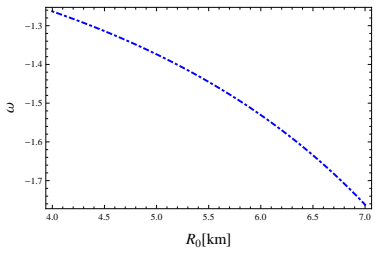
The central claim is that the f(Q,T) gravastar built from the Finch-Skea ansatz satisfies the criteria for a stable, singularity-free compact object. With $f(Q,T)=\mu Q+\nu T$ and the metric potentials $e^{\alpha}=(\xi+\tfrac{1}{2}r\phi\sqrt{r^2\chi})^2$, $e^{\beta}=r^2\chi+1$, the core obeys $p=-\rho$ (de Sitter-like), the shell obeys $p=\rho$ (stiff fluid), and the exterior is Schwarzschild. The constants $\chi$, $\xi$, $\phi$ are fixed by matching the interior metric to Schwarzschild at the boundary, and Israel's thin-shell formalism yields the surface energy density and pressure. The model produces shell energy increasing with thickness, proper length proportional to thickness, entropy rising toward the outer surface, a phantom-like equation-of-state parameter $\omega<-1$, a positive second derivative of the effective potential, surface redshift below 2, sound speed in $[0,1]$, and adiabatic index above $4/3$. The paper concludes that these results demonstrate the structural viability and stability of gravastars in f(Q,T) gravity.
Load-bearing premise
The model assumes the shell is so thin that the radial metric factor is effectively negligible, but the paper never demonstrates that its own shell solution actually satisfies that smallness condition.
Editorial extensions
If this is right
- If the model is right, the gravastar has no event horizon and no singularity, so it can serve as a black-hole mimicker whose shadow and lensing could differ from Schwarzschild black holes.
- The null energy condition is satisfied with ordinary matter in the shell, so the model does not require exotic matter to stay stable.
- All tested stability indicators—$V''(R_0)>0$, surface redshift below 2, $0\le v_s^2\le 1$, and $\Gamma>4/3$—hold simultaneously, giving a self-consistent stable configuration.
- Shell energy, proper length, and entropy all grow monotonically with shell thickness, so thicker shells are energetically favorable in this framework.
- The phantom-like equation-of-state parameter $\omega<-1$ places the shell fluid in the dark-energy regime, linking gravastar structure to cosmic acceleration phenomenology.
Reading between the lines
- The junction parameters are fixed by matching the core metric, not the shell solution; if the shell metric is not itself matched to the exterior, the surface quantities may rest on an unsupported assumption. Computing $e^{-\beta(R_0)}$ from the shell solution would settle this.
- Because the model uses only the linear form $f(Q,T)=\mu Q+\nu T$, the stability criteria could be re-derived for nonlinear $f(Q,T)$ to see whether the conclusions survive beyond the linear choice.
- Observational discriminators such as gravitational-wave echo signatures or shadow-radius measurements could distinguish this gravastar from a black hole; the phantom-like shell equation of state would predict distinctive tidal or quasinormal-mode behavior.
- The Finch-Skea core solution may be more robust than the thin-shell calculation: if the shell approximation fails for some parameter ranges, an alternative junction prescription could still leave the core viable.
Signed reviews
Editorial analysis
A structured set of objections, weighed in public.
Referee Report
Summary. The paper constructs a gravastar model in f(Q,T) modified gravity using the Finch-Skea metric, with the standard three-layer structure: a de Sitter-like interior (p=-rho), a stiff-fluid thin shell (p=rho), and a Schwarzschild exterior (p=0). It derives the field equations for the core and shell, matches the core metric to Schwarzschild to fix constants, and then computes shell energy, proper length, energy conditions, entropy, equation-of-state parameter, and several stability indicators, concluding that the model is a physically plausible and stable singularity-free alternative to black holes.
Significance. If the construction were sound, the paper would provide another example of a gravastar solution in an extended teleparallel gravity, and its explicit field equations and matching procedure would be useful for comparison with existing models. However, the central three-layer construction fails: the inner-region equation of state is never satisfied, the shell solution rests on unjustified approximations and an unproven junction, and several computed quantities contain algebraic or dimensional errors. The paper offers no machine-checked proofs, no reproducible parameter sets for its plots, and no comparison with the GR limit, so its concluding claim about the essential role of modified gravity is not supported by the analysis as presented.
major comments (6)
- [Section 3.1, Eq. (34)] The inner-region equation of state p=-rho is never satisfied. With the matched constants of Eqs. (47)-(49) one has chi>0, so for r>0 the terms sqrt(r^2 chi) and (r^2 chi)^(3/2) reduce to r sqrt(chi) and r^3 chi^(3/2); the numerator of Eq. (34) then becomes mu chi [A r^5 + B r^3 + C r], where A=(nu-3) phi chi^2, B=-5(nu+12) phi chi + 2(nu-3) xi chi^(3/2), and C=6(nu-6) xi sqrt(chi) - 6(2 nu+9) phi. Vanishing on any interval requires A=B=C=0. Since phi is nonzero for M>0, A=0 forces nu=3, but then B=-75 phi chi is nonzero. Thus Eq. (34) cannot hold on the core region, and the paper never solves or checks it; instead it computes the core mass from rho in Eq. (29). The defining gravastar core is therefore absent, and the three-layer construction on which all viability and stability claims rest is not established.
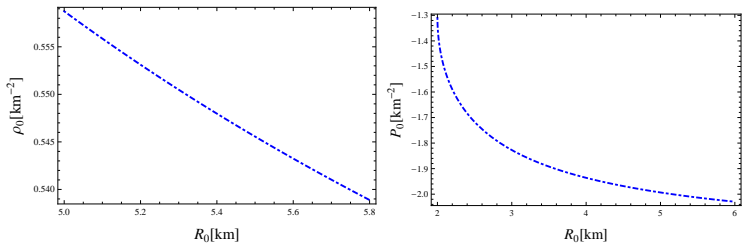
- [Sections 3.2 and 4] The thin-shell solution is derived under the assumption e^{-beta} << 1, but the text in Section 3.2 replaces this with 'as the radial coordinate r approaches to zero', which is inappropriate at the shell radius R0, and the resulting e^{-beta} from Eq. (39) is never checked to be small. Moreover, the constants chi, xi, phi that appear in the shell quantities are fixed in Section 4 by matching the core metric (28) to the Schwarzschild exterior at r=R, not by matching the shell metric; c1 remains free and no continuity or junction conditions across the shell are imposed. Consequently the surface energy density and pressure in Eqs. (65)-(66), which underlie nearly all subsequent conclusions, are computed from an unjustified shell geometry.
- [Section 5.1, Eq. (68)] The shell energy expression is not derived from the surface density rho0 of Eq. (65), as the text claims. The right-hand side of Eq. (68) equals (4 pi/3)((R0+epsilon)^3 - R0^3) times the core energy density rho(R0) from Eq. (29), i.e., the energy of a bulk spherical core of thickness epsilon, not the energy stored in the thin shell. The claim 'Using Eqs.(65)' is therefore incorrect, and Figure 5 does not establish the stated behavior of the shell energy.
- [Section 5.2, Eqs. (70)-(72)] The proper length computation contains multiple errors. Since e^{-beta}=Pi_- by the identification used in Eq. (60), the integrand of L = int sqrt(e^beta) dR is 1/sqrt(Pi_-), not 1/Pi_- as written in Eq. (71). The further substitution dPi_-/dR = 1/Pi_- is introduced with no justification and is dimensionally inconsistent; it is not a property of the Finch-Skea metric or of the shell solution. The resulting expression L = Pi_-(R0+epsilon) - Pi_-(R0) and Figure 6 are therefore not the proper length of the gravastar shell.
- [Section 5.4, Eq. (75)] The entropy calculation pulls the factor R^2 out of the radial integral without justification. Starting from Eq. (73), the integrand is 4 pi R^2 s(R) sqrt(e^beta), so after substituting s(R) the R^2 factor must remain inside the integral; Eq. (75) instead defines N = int sqrt(P0 e^beta) dR and multiplies by a constant R^2. In addition, the antiderivative F(R) in Eq. (77) is never computed, so Figure 8 is not supported by the equations presented.
- [Sections 5.3 and 5.6] The concluding claim that modified gravity is 'essential' for the structural viability and stability of the gravastar is not tested. No comparison is made with the GR limit (nu=0, mu=1) or with varied coupling constants, and the plots in Figures 7 and 10-13 do not specify the values of nu, c1, M, and R0 used. The energy-condition and stability checks are therefore computed from the same ansatz, coupling constants, and matching constants used to construct the model, and they provide no independent confirmation of the model's viability.
minor comments (5)
- [Eqs. (60), (65), (66)] The symbol psi appears in the expressions for Pi_-, rho0, and P0 but is never defined, so these key surface quantities cannot be evaluated by the reader.
- [Eqs. (25)-(31) and (68)] The notation is inconsistent: eta, zeta, and 'nu a' appear in places where nu and mu are clearly intended, for example in Eq. (68) versus Eq. (29), and this obscures the derivations.
- [Figure 7] The caption states that the NEC is plotted versus the model parameter mu, but the text does not specify the fixed values of nu, M, R0, and c1, so the plot cannot be reproduced or checked.
- [Section 5.5] The equation-of-state parameter omega is described as entering the phantom region, but no explicit expression for omega is given; only Figure 9 is shown, again without a reproducible parameter set.
- [Section 5.6, Eq. (78)] The speed of sound is written as v_s^2 = p'/rho' for the thin-shell fluid, but the text does not state with respect to which variable the derivatives are taken or at which radius the expression is evaluated.
Circularity Check
No significant circularity: the model is a self-consistency construction whose stability and viability checks are evaluated from the same derived solution, not extracted from its inputs by construction.
full rationale
The paper does not exhibit any of the circularity patterns defined in the brief. The metric ansatz (28) and the f(Q,T) model (24) are explicit inputs; Eqs. (29)-(32), (39), (65)-(66) are derived consequences of those inputs. The later energy-condition, redshift, causality, and adiabatic-index checks are consistency evaluations of that same solution, not independent predictions that reduce to fitted parameters. The constants χ, ξ, φ are fixed by boundary matching at the junction (Eqs. (41)-(43)) and are then reused in the shell and surface quantities; this is parameter propagation within a self-contained model, not a fitted input renamed as a prediction. No load-bearing step relies on a self-citation: the Finch-Skea modification is attributed to Ref. [90], the f(Q,T) form to Ref. [87], and the Israel formalism to Refs. [96,99]. There are serious non-circularity concerns that should be weighed separately: Eq. (34), obtained by imposing the inner-region EoS p = -ρ, is never verified and with the matched constants (47)-(49) its numerator cannot vanish identically, so the 'inner region' does not demonstrably satisfy the gravastar-defining EoS; the thin-shell assumption e^{-β} << 1 is not checked against the shell solution (39); and the concluding claim that modified gravity is 'essential' is not supported by a GR-limit or parameter-variation comparison. These are validity and support gaps, not circular reductions, so the circularity score is 0.
Assumptions & free parameters
free parameters (5)
- nu (coupling constant) =
unspecified
- mu (coupling constant) =
unspecified
- c1 (shell integration constant) =
unspecified
- M and R0 (mass and matching radius) =
unspecified
- psi (undefined symbol) =
unspecified
assumptions (6)
- domain assumption The f(Q,T) field equations as written in (20)-(22) are correct for the chosen action (13) and matter model (19).
- domain assumption The Finch-Skea ansatz (28) is taken as the interior metric.
- domain assumption Gravastar EoS: p = -rho in the core and p = rho in the shell.
- domain assumption Thin-shell approximation: e^{-beta} is positive and much smaller than unity, and r-dependent terms are negligible as r goes to 0.
- ad hoc to paper Setting dPi_-/dR = 1/Pi_- to evaluate the proper length integral.
- ad hoc to paper The equivalence of matching the core metric to the exterior and using the resulting constants in the shell solution.
Cite this review
Pith. "Pith review of Analyzing Gravastar Structure with the Finch-Skea Metric in Extended Modified Symmetric Teleparallel Gravity." pith.science (2026). https://pith.science/paper/EZUVZCZE
@misc{pith2026250209679,
  author       = {Pith},
  title        = {Pith review of: Analyzing Gravastar Structure with the Finch-Skea Metric in Extended Modified Symmetric Teleparallel Gravity},
  year         = {2026},
  howpublished = {\url{https://pith.science/paper/EZUVZCZE}},
  note         = {Machine review of arXiv:2502.09679}
}
abstract
This study analyzes the physical features of a gravastar within the $f(\mathcal{Q}, \mathbb{T})$ gravity framework, where $\mathcal{Q}$ is the non-metricity scalar and $\mathbb{T}$ is the trace of the energy-momentum tensor. Gravastars present a viable alternative to black holes, featuring a central de Sitter core, a surrounding thin shell and a dynamic layer in the Schwarzschild exterior that separates these two regions. Using the Finch-Skea metric, the necessary field equations for the core and shell are derived, while the Israel junction conditions maintain a seamless connection between the inner and outer regions. This work extensively explores crucial aspects such as energy distribution, proper length, energy conditions, entropy and the equation of state parameter. The model's stability is studied through the effective potential, redshift, causality conditions and adiabatic index. Our results highlight the essential role of modified gravity in maintaining the structural viability and stability of gravastars.
Figures


Figures from the paper (10 more)




Forward citations
Cited by 1 Pith paper
-
Neutron stars in $f(\mathbb{Q})$ gravity
For f(Q)=Q+αQ² and f(Q)=Q^β, neutron-star solutions that admit power-series expansions at the center or at infinity collapse to General Relativity; genuine beyond-GR effects must be non-analytic.
Reference graph
Works this paper leans on
-
[1]
Hubble, E.: Proc. Natl. Acad. Sci. U.S.A. 15(1929)168
1929
-
[2]
and Ratra, B.: Rev
Peebles, P.J.E. and Ratra, B.: Rev. Mod. Phys. 75(2003)559
2003
-
[3]
and Yo, H.J.: Chin
Nester, J.M. and Yo, H.J.: Chin. J. Phys. 37(1999)113
1999
-
[4]
and Koivisto, T.: Phys
Jimenez, J.B., Heisenberg, L. and Koivisto, T.: Phys. Rev. D 98(2018)044048
2018
-
[5]
Adeel, M.: et al.: Mod. Phys. Lett. A 38(2023)2350152
2023
-
[6]
Sharif, M.: et al.: Chin. J. Phys. 91(2024)66
2024
-
[7]
Rani, S.: et al.: Int. J. Geom. Methods Mod. Phys. 21(2024)2450033
2024
-
[8]
et.: Eur
Gul, M.Z. et.: Eur. Phys. J. C 84(2024)8
2024
Show all 106 references
-
[9]
et al.: Phys
Maurya, S.K. et al.: Phys. Dark Universe 46(2024)101619
2024
-
[10]
109(2024)102211
Sharif, M.: et al.: New Astron. 109(2024)102211
2024
-
[11]
Dark Universe 47(2025)101754
Rani, S.: et al.: Phys. Dark Universe 47(2025)101754
2025
-
[12]
Dark Universe 47(2025)101760
Sharif, M.: et al.: Phys. Dark Universe 47(2025)101760
2025
-
[13]
et al.: Phys
Koussour, M. et al.: Phys. Dark Universe 46(2024)101577
2024
-
[14]
et al.: Chin
Gul, M.Z. et al.: Chin. J. Phys. 88(2024)388
2024
-
[15]
et al.: Eur
Sharif, M. et al.: Eur. Phys. J. C 84(2024)1094
2024
-
[16]
et al.: Phys
Myrzakulov, Y. et al.: Phys. Dark Universe 45(2024)101545. 33
2024
-
[17]
and Gul, M.Z.: Ann
Sharif, M. and Gul, M.Z.: Ann. Phys. 465(2024)169674
2024
-
[18]
et al.: Physics of the Dark Universe 46(2024)101555
Errehymy, A. et al.: Physics of the Dark Universe 46(2024)101555
2024
-
[19]
and Gul, M.Z.: Phys
Sharif, M. and Gul, M.Z.: Phys. Scr. 99(2024)065036
2024
-
[20]
et al.: Chin
Gul, M.Z. et al.: Chin. J. Phys. 89(2024)1347
2024
-
[21]
et al.: Eur
Xu, Y. et al.: Eur. Phys. J. C 79(2019)708
2019
-
[22]
High Energy Astrophys
Zhadyranova, A.: J. High Energy Astrophys. 44(2024)123
2024
-
[24]
Koussour, M.: Chin. J. Phys. 90(2024)108
2024
-
[26]
et al.: Chin
Gul, M.Z. et al.: Chin. Phys. C. 48(2024)12503
2024
-
[27]
Dark Universe 45(2024)101527
Koussour, M.: Phys. Dark Universe 45(2024)101527
2024
-
[28]
et al.: Phys
Nan, G. et al.: Phys. Dark Universe 46(2024)101635
2024
-
[29]
et al.: Eur
Gul, M.Z. et al.: Eur. Phys. J. C 84(2024)802
2024
-
[31]
et al.: Fortschr
Pradhan, S. et al.: Fortschr. der Phys. 72(2024)2400092
2024
-
[32]
et al.: Phys
Gul, M.Z. et al.: Phys. Scr. 99(2024)045006
2024
-
[33]
et al.: Phys
Arora, S. et al.: Phys. Dark Univ. 30(2020)100664
2020
-
[34]
and Sahoo, P.K.: Eur
Bhattacharjee, S. and Sahoo, P.K.: Eur. Phys. J. C 80(2020)289
2020
-
[35]
and Samanta, G.C.: Int
Godani, N. and Samanta, G.C.: Int. J. Geom. Methods Mod. Phys . 18(2021)2150134
2021
-
[36]
et al.: Phys
Agrawal, A.S. et al.: Phys. Dark Univ. 33(2021)100863
2021
-
[37]
and Farhoudi, M.: Phys
Shiravand, M., Fakhry, S. and Farhoudi, M.: Phys. Dark Univ. 37(2022)101106. 34
2022
-
[38]
and Sahoo, P.K.: Phys
Tayde, M., Hassan, Z. and Sahoo, P.K.: Phys. Dark Univ. 42(2023)101288
2023
-
[39]
and Ibrar, I.: Chin
Sharif, M. and Ibrar, I.: Chin. J. Phys. 89(2024)1578; Eur. Phys. J. Plus 139(2024)1; Phys. Scr. 99(2024)105034
2024
-
[40]
and Mazur, P.O.: Gravitational condensate stars: An alter- native to black holes (In APS April Meeting Abstracts, 2002); Mazur, P.O
Mottola, E. and Mazur, P.O.: Gravitational condensate stars: An alter- native to black holes (In APS April Meeting Abstracts, 2002); Mazur, P.O. and Mottola, E.: Proc. Natl. Acad. Sci. 101(2004)9545
2004
-
[41]
et al.: Phys
Sakai, N. et al.: Phys. Rev. D 90(2014)104013
2014
-
[42]
and Sakai, N.: Phys
Kubo, T. and Sakai, N.: Phys. Rev. D 93(2016)084051
2016
-
[43]
and Mazur, P.O.: Universe 9(2023)88
Mottola, E. and Mazur, P.O.: Universe 9(2023)88
2023
-
[44]
Visser, M
Sotiriou, T.P. Visser, M. and Weinfurtner, S.: J. High Energy Phy s. 9(2023)88
2023
-
[45]
and Pani, P.: Phys
Cardoso, V., Franzin, E. and Pani, P.: Phys. Rev. Lett. 116(2016)171101; 117(2016)089902
2016
-
[46]
et al.: Astrophys
Akiyama, K. et al.: Astrophys. J. Lett. 875(2019)L6
2019
-
[47]
and Wiltshire, D.L.: Class
Visser, M. and Wiltshire, D.L.: Class. Quantum Grav. 21(2004)1135
2004
-
[48]
Quantum Grav
Carter, B.M.N.: Class. Quantum Grav. 22(2005)4551
2005
-
[49]
et al.: J
Bilic, N. et al.: J. Cosmol. Astropart. Phys. 2006(2006)13
2006
-
[50]
et al.: Results Phys
Ghosh, S. et al.: Results Phys. 14(2009)102473
2009
-
[51]
et al.: Phys
Das, A. et al.: Phys. Rev. D 95(2017)124011
2017
-
[52]
and Ahmad, M.: Phys
Shamir, M.F. and Ahmad, M.: Phys. Rev. D 97(2018)104031
2018
-
[53]
and Waseem, A.: Astrophys
Sharif, M. and Waseem, A.: Astrophys. Space Sci. 364(2019)189
2019
-
[54]
et al.: Ann
Ghosh, S. et al.: Ann. Phys. 411(2019)167968
2019
-
[55]
and Rehman, A.: Phys
Bhatti, M.Z., Yousaf, Z. and Rehman, A.: Phys. Dark Univ. 29(2020)100561. 35
2020
-
[56]
and Sahoo, P.K.: Chin
Pradhan, S., Mohanty, D. and Sahoo, P.K.: Chin. Phys. C 47(2023)095104
2023
-
[57]
and Sahoo, P.K.: Fortschr
Mohanty, D. and Sahoo, P.K.: Fortschr. Phys. 72(2024)2400082
2024
-
[58]
et al.: Chin
Javed, F. et al.: Chin. J. Phys. 90(2024)421
2024
-
[59]
and Sahoo, P.K.: Ann
Mohanty, D., Ghosh, S. and Sahoo, P.K.: Ann. Phys. 463(2024)169636
2024
-
[60]
and Oikonomou, V.K.: Phys
Odintsov, S.D. and Oikonomou, V.K.: Phys. Rev. D 107(2023)104039
2023
-
[61]
et al.: Phys
Teruel, G.R.P. et al.: Phys. Dark Univ. 43(2024)101404
2024
-
[62]
and Tabassum, A.: Chin
Sharif, M., Naseer, T. and Tabassum, A.: Chin. J. Phys. 92(2024)579
2024
-
[63]
and Ray, R.: Class
Dourah, H.L. and Ray, R.: Class. Quantum Grav. 4(1987)1691
1987
-
[64]
and Skea, J.E.F.: Class
Finch, M.R. and Skea, J.E.F.: Class. Quantum Grav. 6(1989)467
1989
-
[65]
Space Sci
Bhar, P.: Astrophys. Space Sci. 359(2015)41
2015
-
[66]
and Dey, S.: Astrophys
Paul, B.C. and Dey, S.: Astrophys. Space Sci. 363(2018)220
2018
-
[67]
and Pradhan, A.: Mod
Banerjee, A., Jasim, M.K. and Pradhan, A.: Mod. Phys. Lett. A 35(2020)2050071
2020
-
[68]
and Naz, S.: Mod
Sharif, M. and Naz, S.: Mod. Phys. Lett. A 38(2023)2350123
2023
-
[69]
et al.: Chin
Dayanandan, B. et al.: Chin. J. Phys. 82(2023)155
2023
-
[70]
et al.: Chin
Mustafa, G. et al.: Chin. J. Phys. 88(2024)954
2024
-
[71]
et al.: Phys
Shahzad, M.R. et al.: Phys. Dark Univ. 46(2024)101646
2024
-
[72]
and Govender, M.: Chin
Rej, P., Bogadi, R.S. and Govender, M.: Chin. J. Phys. 87(2024)608
2024
-
[73]
and Rej, P.: Chin
Karmakar, A., Debnath, U. and Rej, P.: Chin. J. Phys. 90(2024)1142
2024
-
[74]
et al.: Astrophys
Das, B. et al.: Astrophys. Space Sci. 369(2024)76
2024
-
[75]
Weyl, H.: Sitzungsber. Preuss. Akad. Wiss. 465(1918)01
1918
-
[76]
Dirac, P.A.M.: Proc. Math. Phys. Eng. Sci. 333(1973)403
1973
-
[77]
and Bergliaffa, S.P.: Phys
Novello, M. and Bergliaffa, S.P.: Phys. Rep. 463(2008)127. 36
2008
-
[78]
and Lifshitz, E.M.: The Classical Theory of Fields (Else- vier, 2013)
Landau, L.D. and Lifshitz, E.M.: The Classical Theory of Fields (Else- vier, 2013)
2013
-
[79]
and Ajmal, M.: Chin
Sharif, M. and Ajmal, M.: Chin. J. Phys. 88(2024)706; Phys. Scr. 99(2024)085039; Phys. Dark Univ. 46(2024)101572
2024
-
[80]
and Arooj, A.: Fortschr
Gul, M.Z., Sharif, M. and Arooj, A.: Fortschr. Phys. 72(2024)2300221
2024
-
[81]
et al.: Eur
Gul, M.Z. et al.: Eur. Phys. J. C 84(2024)775
2024
-
[82]
et al.: Eur
Gul, M.Z. et al.: Eur. Phys. J. C 84(2024)1232
2024
-
[83]
et al.: Phys
Sharif, M. et al.: Phys. Scr. 99(2024)115003
2024
-
[84]
et al.: Gen
Gul, M.Z. et al.: Gen. Relativ. Gravit. 56(2024)45
2024
-
[85]
et al.: Mod
Sharif, M. et al.: Mod. Phys. Lett. A 39(2024)2450140
2024
-
[86]
et al.: Chin
Gul, M.Z. et al.: Chin. J. Phys. 93(2025)256
2025
-
[87]
et al.: Eur Phys
Xu, Y. et al.: Eur Phys. J. C 79(2019)19
2019
-
[88]
et al.: Eur Phys
Xu, Y. et al.: Eur Phys. J. C 80(2020)22; Tayde, M. et al.: Chin. Phys. C 46(2022)115101
2020
-
[89]
and Lake, K.: Comput
Delgaty, M.S.R. and Lake, K.: Comput. Phys. Commun. 115(1998)395
1998
-
[90]
et al.: Eur
Das, B. et al.: Eur. Phys. J. C 82(2022)519; Murshid, M. et al.: Gen. Relativ. Grav. 97(2023)51; Sokoliuk, O., Baransky, A. and Sahoo, P.K.: Chin. Phys. C 47(2023)015104
2022
-
[91]
et al.: Ann
Deb, D. et al.: Ann. Phys. 387(2017)239
2017
-
[92]
and Psaltis, D.: Astrophys
Ozel, F., Guver, T. and Psaltis, D.: Astrophys. J. 693(2009)1775
2009
-
[93]
Zeldovich, Y.B.: Mon. Not. R. Astron. Soc. 160(1972)1P
1972
-
[94]
et al.: Gen
Staelens, F. et al.: Gen. Relativ. Grav. 53(2021)1
2021
-
[95]
Carr, J.B.: Astrophys. J. 201(1975)1; Madsen, M.S. et al.: Phys. Rev. D 46(1992)1399; Braje, T.M. et al.: Astrophys. J. 580(2002)1043; Ferrari, L. et al.: Int. J. Mod. Phys. E 16(2007)2834; Rahaman, F. et al.: Eur. Phys. J. C 74(2014)2845. 37
1975
-
[96]
Israel, W.: Nuo. Cim. B 44(1966)1
1966
-
[97]
Sen, N.: Ann. Phys. 378(1924)365
1924
-
[98]
et al.: Memorial des sciences mathematiques (Gauthier- Villars Paris, 1927)
Darmois, G. et al.: Memorial des sciences mathematiques (Gauthier- Villars Paris, 1927)
1927
-
[99]
Israel, W.: Nuo. Cim. B 48(1967)463
1967
-
[100]
and Javed, F.: Eur
Sharif, M. and Javed, F.: Eur. Phys. J. C 81(2021)1
2021
-
[101]
et al.: Phys
Mustafa, G. et al.: Phys. Dark Univ. 46(2020)101574
2020
-
[102]
et al.: Phys
Ghosh, S. et al.: Phys. Lett. B 767(2017)380
2017
-
[103]
Buchdahl, H.A.: Phys. Rev. 116(1959)1027; Barraco, D.E. and Hamity, V.H.: Phys. Rev. D 65(2002)124028
1959
-
[104]
Chandrasekhar, S.: Astrophys. J. 140(1964)417; Chan, R., Herrera, L. and Santos, N.: Mon. Not. R. Astron. Soc. 265(1993)533
1964
-
[105]
and Visser, M.: Phys
Poisson, E. and Visser, M.: Phys. Rev. D 52(1995)7318
1995
-
[106]
and Crawford, P.: Class
Lobo, F.S.N. and Crawford, P.: Class. Quantum Grav. 21(2003)391
2003
-
[107]
and Saeed, M.: Chin
Sharif, M. and Saeed, M.: Chin. J. Phys. 77(2022)583
2022
-
[108]
et al.: Nucl
Das, A. et al.: Nucl. Phys. B 954(2020)114986
2020
-
[109]
et al.: Phys
Shah, H. et al.: Phys. Scr. 98(2023)085246. 38
2023
Reviewed August 7, 2026 · model on record in the stance chip above.
Discussion (0). Continue with ORCID to comment.