REVIEW 3 major objections 5 minor 57 references
Modeling Reactions on the Solid-Liquid Interface With Next Generation Extended Lagrangian Quantum-Based Molecular Dynamics
T0 review · 3 major / 5 minor · reviewed 2026-08-09 · deepseek-v4-flash
Pith's one-line read A single biasing scheme flips oxygen reduction between two mechanisms on nitrogen-doped graphene, resolved atom-by-atom in explicit water.
desk verdict A promising proof-of-concept for XL-BOMD in electrocatalysis, but the central bias-controlled mechanism switch is confounded by a different starting geometry and steering in the low-bias run. read the letter →
The pith
A machine-rendered reading of the paper's core claim, the machinery that carries it, and where it could break.
The reading
What carries the argument
The load-bearing mechanism is extended Lagrangian Born-Oppenheimer molecular dynamics (XL-BOMD) within the self-consistent charge density functional tight-binding (SCC-DFTB) framework, where the net Mulliken charges on atoms are treated as auxiliary dynamical variables that oscillate around the exact ground-state density through a harmonic oscillator, avoiding repeated self-consistent field iterations. The key object is the shadow potential energy surface $U_{BO}(R,n)$, whose error scales quadratically with the residual $\|q[n]-n\|$, and the associated kernel $K=J^{-1}$, approximated by a preconditioned rank-$m$ update, which keeps the dynamical charges close to the Born-Oppenheimer ground state during reactive events. The bias is applied by shifting the onsite orbital energies of the electrode atoms through Eq. (6), $H_{i\alpha,j\beta} = H_{i\alpha,j\beta} + \frac{1}{2}(S_{i\alpha,j\beta}V_j + V_i S_{i\alpha,j\beta})$, which displaces the electron chemical potential of the NG sheet relative to the solution, effectively controlling the driving force of the reduction. Reaction events are identified by HOMO-LUMO gap closures near zero and by spikes in the XL-BOMD residual norm, which coincide with the two electron-injection waves.
What would settle it
Run two simulations that swap the two protocols: take the original outer-sphere starting geometry (O2 far from NG) and apply the -0.9 eV shift, and take the inner-sphere modified geometry (O2 near NG, with the steering method) with no bias or a +2.0 eV shift; if the far geometry still reduces via solvent-mediated outer-sphere charge transfer and the near geometry still adsorbs O2 and dissociates it, then the mechanism is controlled by geometry rather than by the applied bias.
Extended reading notes
Core claim
The central claim is that a controllable potential bias applied to an NG electrode, implemented by shifting the onsite orbital energies of the electrode atoms according to Eq. (6), changes the observed ORR mechanism: high bias (no applied shift, effectively a high reductive overpotential of about 2.59 V) drives a solvent-mediated outer-sphere pathway in which O2 is reduced to 4 OH− through two successive two-electron injections without surface adsorption, while a negative 0.9 eV shift of the electrode's electron chemical potential (lowering the overpotential to about 1.69 V) enables an inner-sphere pathway in which O2 adsorbs to NG, forms a transient peroxo species, and dissociates into one adsorbed oxygen and two OH−. The paper also claims that nitrogen doping raises the electron chemical potential and density of states near the Fermi level relative to pure graphene, explaining NG's higher activity, and that the electron holes left on NG after oxidation localize on carbons directly bonded to nitrogen. The authors position this as the first demonstration of XL-BOMD applied to heterogeneous electrocatalysis, showing stable picosecond-scale charge transfer across an explicit NG–water interface with fully converged electronic structure at each step.
Load-bearing premise
The central mechanistic comparison assumes that the applied onsite-energy shift, and not the altered initial geometry with O2 placed closer to the surface and steered toward it, is what determines which reduction pathway appears, so if the starting O2-surface separation or the steering force alone caused the inner-sphere adsorption, the mechanism-switch claim would collapse.
Editorial extensions
If this is right
- If the central claim is correct, XL-BOMD with the onsite-energy bias method becomes a standard tool for explicitly simulating electrocatalytic reactions at solid-liquid interfaces with full solvent and electrode representation, avoiding the prohibitive cost of repeated SCC iterations in traditional QMD.
- The observed mechanism switch implies that the applied bias controls whether ORR proceeds through a solvent-mediated outer-sphere pathway or an adsorption-dependent inner-sphere pathway on NG, meaning that simulations without a properly tuned bias may miss the inner-sphere regime entirely.
- The paper's finding that nitrogen doping raises the electron chemical potential and DOS near the Fermi level relative to pure graphene provides a direct electronic-structure rationale for NG's superior ORR activity over pure graphene, consistent with the observed absence of ORR in the pure-graphene control.
- The successful observation of a water-mediated outer-sphere electron transfer with explicit solvent dynamics suggests that XL-BOMD can resolve non-adsorptive charge-transfer steps that static DFT with the computational hydrogen electrode cannot describe by construction.
- If the bias-scan approach generalizes, experimentally relevant quantities such as the overpotential at which inner-sphere adsorption begins can be extracted directly from simulation by varying the onsite energy shift, providing a parameter-free route to mechanistic phase diagrams of electrocatalysts.
Reading between the lines
- The claim that the mechanism depends on applied bias implicitly assumes that the applied bias, not the modified starting geometry, selects the pathway; a direct test would be to run the inner-sphere geometry without bias and the outer-sphere geometry with a -0.9 eV shift, and check whether the mechanism follows the bias or the geometry.
- The paper's static onsite-energy shift is not a constant-potential, grand-canonical scheme because the simulation has no electron reservoir or counter electrode, so the observed 'high bias' vs 'low bias' labels should be read as relative driving-force shifts rather than absolute experimental potentials; a constant-potential extension would be a natural test of whether the mechanism-switch threshol
- Because the authors note that the final step (formation of additional OH− from the adsorbed oxygen) is not seen in the simulated time span, the inner-sphere pathway may be kinetically incomplete; longer trajectories or enhanced sampling of the adsorbed-oxygen intermediate could determine whether the inner-sphere mechanism also ultimately produces 4 OH−.
- If the solvent-mediated outer-sphere route is real, its rate should depend strongly on water structure and hydrogen-bonding fluctuations; a testable extension is to vary the solvent (e.g., adding more water layers, changing temperature, or using a different polar solvent) and see whether the electron-transfer timing and the HOMO-LUMO gap closures shift accordingly.
Editorial analysis
A structured set of objections, weighed in public.
Referee Report
Summary. The paper presents an XL-BOMD-based DFTB framework for simulating the oxygen reduction reaction (ORR) at a nitrogen-doped graphene (NG)/water interface, including a proposed electrochemical biasing scheme in which the onsite energies of the electrode atoms are shifted (Eq. 6). Simulations without applied bias show O2 cleavage and a two-step transfer of four electrons from NG to the solution, interpreted as an outer-sphere mechanism with solvent-mediated electron transfer. A +2 eV shift is reported to accelerate this outer-sphere reaction, while a -0.9 eV shift, applied to a modified system with O2 initially closer to the NG surface and with a steering force, yields an inner-sphere pathway with O2 adsorption and partial reduction. The authors conclude that the observed ORR mechanism depends on the applied bias and that this is the first application of XL-BOMD to heterogeneous electrocatalysis.
Significance. If the bias-dependence claim held, the work would be a valuable proof of concept for atomistic electrocatalysis: it combines explicit solvation, an explicit electrode, picosecond-scale trajectories, and a simple bias protocol that can distinguish outer- and inner-sphere ORR pathways. The paper has real strengths: the trajectory data are internally consistent with O2 cleavage, two electron-injection events, and HOMO-LUMO gap closure at the reported times; control systems and extended-system simulations provide useful supporting evidence; and the preconditioning convergence analysis is a legitimate methodological contribution. However, the central mechanism-switch claim is currently supported by a single confounded comparison, and the quantitative overpotential statements rest on an approximate bias model whose calibration is not validated. The limitations are partly acknowledged in the text, but the abstract and conclusion state the bias-dependence claim more strongly than the evidence supports.
major comments (3)
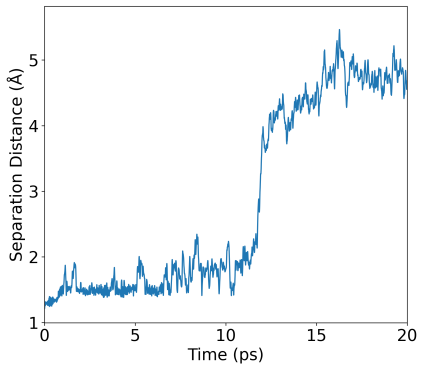
- [Simulations With Applied Bias, paragraph 3] The central mechanistic claim—that applied bias alone determines whether ORR is outer-sphere or inner-sphere—is not supported by the reported comparison. The high-bias and zero-bias runs start from the original geometry with O2 initially far from the NG sheet, whereas the low-bias (-0.9 eV) run uses a 'modified version of the main test system' with O2 'located closer to the NG surface' and includes a steering method 'to induce diffusion of the oxygen molecule towards the NG sheet.' The two conditions therefore differ in initial geometry and steering in addition to bias. Because the abstract and conclusion attribute the mechanism difference solely to bias, a control experiment is required: either the -0.9 eV shift on the original geometry, or the modified/steered geometry at +2 eV, or both. Without such controls, the data are equally consistent with the interpretation that the closer initial placement or the steering force, rather than the bias, produced the adsorbed pathway. The reported -0.9 eV threshold and the derived 1.69 V overpotential are also tied to this modified/steered setup, so they are not transferable to the original system.
- [Simulations With Applied Bias and Results and Discussion] The mechanism-switch claim rests on a single trajectory per condition. The paper itself notes that 'these simulations do depend on the initial randomized velocities established by the 300 K Langevin thermostat,' and with only one trajectory at +2 eV, one at 0 eV, and one at -0.9 eV, the difference between the observed pathways could reflect stochasticity rather than a bias-controlled transition. Repeated independent runs with different thermostat seeds and initial velocities should be reported, with the number of trajectories showing each mechanism. This is particularly important because the inner-sphere trajectory is the only run in which adsorption occurs. The text also reports that further downshifts did not produce ORR within 20 ps, so the claimed low-bias inner-sphere regime is a narrow window; this should be made explicit.
- [Eq. (6) and 'Applying an Electrochemical Potential Bias'] The static onsite-energy shift is not equivalent to an electrochemical overpotential in the grand-canonical sense; the simulation has no counter electrode, no electron reservoir, and no constant-potential constraint, as the authors partly acknowledge in the discussion of the outer-sphere simulations. The quantitative statements that a -0.9 eV shift 'corresponds to' an overpotential of 1.69 V assume a rigid-band mapping from V_i to the electrode potential that is not validated and does not account for the charge redistribution and solvent response during the reaction. The manuscript should either provide a validation of this mapping (for example, by computing the potential of the biased electrode relative to a reference) or present the bias values only as a model parameter and weaken the overpotential language.
minor comments (5)
- [Mulliken Charge Analysis, Table 1] Table 1 and the surrounding text describe HOO− twice with different mean charges (-0.65 and -0.46) and different oxidation states; clarify which oxygen is underlined/bolded and define the two entries, since the subsequent species assignments (e.g., in Figure 11) rely on these reference values.
- [Simulations With Applied Bias] The terms 'high bias' and 'low bias' are defined only by the sign of the onsite shift, yet the -0.9 eV value is a smaller shift than the -2 eV value that produced no ORR; define the convention explicitly to avoid confusion.
- [Applying an Electrochemical Potential Bias] Equation (6) uses the same symbol H_iα,jβ as Eq. (1), which is the unshifted Hamiltonian; use a different symbol (e.g., H^b or a tilde) to avoid confusion.
- [Simulations With Applied Bias] The steering protocol is only cited to a ChemRxiv preprint; the force constant, direction, and duration of the steering should be reported in the main text or supporting information so the inner-sphere run is reproducible.
- [Results and Discussion, outer-sphere mechanism] The paper states that the outer-sphere mechanism proceeds without adsorption of O2 to NG, but no O2-NG distance or adsorption order parameter is provided; adding such a quantity would make the mechanistic assignment more quantitative.
Circularity Check
Low-bias inner-sphere result is partly constructed: O2 was pre-positioned near NG and steered toward the surface, and the -0.9 eV bias was selected by scanning until inner-sphere ORR appeared, so the reported mechanism switch is not an independent prediction.
-
self definitional
[Simulations With Applied Bias, paragraph 3; cf. Introduction definition of inner-sphere mechanism]
"In the inner sphere mechanism, O2 chemisorbs to the catalyst surface prior to electron transfer... We used a modified version of the main test system containing NG, O2, and water with the O2 molecule located closer to the NG surface. We employed a steering method that has been described previously56 to induce diffusion of the oxygen molecule towards the NG sheet and increase the likelihood of O2 adsorption during simulation time."
The paper defines inner-sphere mechanism by O2 adsorption to the catalyst. The low-bias simulation was explicitly set up to produce that defining feature: O2 was placed closer to the NG sheet and a steering force was applied to drive it toward the surface. Observing adsorption and labeling the trajectory 'inner sphere' is therefore built into the protocol, not an emergent consequence of the -0.9 eV bias. The abstract and conclusion attribute the mechanism to bias alone, but the input geometry and steering already encode the mechanism's defining condition.
-
fitted input called prediction
[Simulations With Applied Bias, paragraph 3 (scanning of mu_e shifts)]
"By scanning possible applied µe shifts, we observed that the lowest shift at which we saw inner sphere ORR is -0.9 eV relative to the initial state without any bias. ... a shift of -0.9 eV corresponds to an effective potential difference E(NG+/NG)vacc -E(ORR)vacc = -1.69 V (a reductive overpotential of 1.69 V)."
The reported low-bias condition and its 'corresponding overpotential' were obtained by scanning applied shifts until inner-sphere ORR appeared; -0.9 eV is the explored condition that produced the target outcome. Presenting this selected value as the bias at which the mechanism switches ('we no longer observe an outer sphere reaction. Instead, we are able to observe an inner sphere reaction') turns the selection parameter into the mechanistic result. The overpotential of 1.69 V is thus a renamed scan input rather than an independent prediction from the XL-BOMD bias model.
full rationale
The central mechanistic claim—that applied bias alone switches ORR from outer-sphere to inner-sphere—is only partially independent. The outer-sphere and no-bias results come from the original unmodified system, but the inner-sphere result uses a modified system with O2 pre-positioned near NG plus a steering force, and the -0.9 eV shift was chosen by scanning until inner-sphere ORR was observed. That makes the low-bias mechanism partly self-definitional and the reported overpotential partly a fitted input. Beyond this localized circularity, the paper is otherwise self-contained: the XL-BOMD machinery is cited from prior work by the same group but is used as a simulation tool rather than as a premise that forces the mechanism; the Mulliken-charge species assignments are calibrated against separately simulated known species; and the bias method (Eq. 6) is an openly stated approximate static onsite shift. The authors also acknowledge limitations such as no steady-state condition, no electron reservoir, and ambiguous adsorbed-oxygen speciation. Those are not circularity, but they reinforce that the headline bias-dependent mechanism-switch claim rests on a selected, engineered trajectory rather than on a clean derivation.
Assumptions & free parameters
free parameters (3)
- Applied electrode bias shifts (µe shifts to NG onsite orbital energies) =
+2.0, 0, -2.0, -0.9 eV
- Fermi smearing inverse electronic temperature β =
40 eV^-1
- Steering protocol parameters
assumptions (4)
- domain assumption The lanl31 SCC-DFTB parametrization is sufficiently transferable to describe O2 reduction, OH^- formation, and water-mediated charge transfer at the NG-water interface.
- domain assumption Instantaneous Mulliken charges identify chemical species such as O2^2-, HOO^-, and OH^- and quantify electron transfer.
- ad hoc to paper A static shift of onsite orbital energies (Eq. 6) is equivalent to an applied electrochemical bias without an explicit counter electrode or electron reservoir.
- domain assumption Single 10-20 ps trajectories are representative of the reaction mechanism for each bias condition.
Cite this review
Pith. "Pith review of Modeling Reactions on the Solid-Liquid Interface With Next Generation Extended Lagrangian Quantum-Based Molecular Dynamics." pith.science (2026). https://pith.science/paper/F25LJKMI
@misc{pith2026250202429,
  author       = {Pith},
  title        = {Pith review of: Modeling Reactions on the Solid-Liquid Interface With Next Generation Extended Lagrangian Quantum-Based Molecular Dynamics},
  year         = {2026},
  howpublished = {\url{https://pith.science/paper/F25LJKMI}},
  note         = {Machine review of arXiv:2502.02429}
}
abstract
We present a framework for atomistic simulations of surface catalysis under electrochemical bias. The framework makes use of extended Lagrangian Born-Oppenheimer quantum-based molecular dynamics (XL-BOMD) simulations, which provide the speed and accuracy required for explicit atomistic treatment of both electrode and electrolyte. Simulations of solvated O$_2$ near nitrogen-doped graphene (NG) were performed to gain insight into the oxygen reduction reaction (ORR). Different mechanisms were observed, depending on the applied bias. Under high bias ORR occurred by an outer sphere mechanism, without adsorption of O$_2$ to NG. In this mechanism, electron transfer between the catalyst and the O$_2$ was mediated by the solvent. Under low bias ORR occurred by an inner sphere mechanism involving adsorption of O$_2$ to NG, leading to direct electron transfer. Combining quantum accuracy with explicit solvation and bias, XL-BOMD opens a route to predictive, atomistic insight into electrocatalytic processes beyond the reach of traditional methods.
Figures


Figures from the paper (10 more)


Reference graph
Works this paper leans on
-
[1]
Low-platinum and platinum-free catalysts for the oxygen reduction reaction at fuel cell cathodes
Morozan, A.; Jousselme, B.; Palacin, S. Low-platinum and platinum-free catalysts for the oxygen reduction reaction at fuel cell cathodes. Energy Environ. Sci. 2011, 4, 1238--1254
work page 2011
-
[2]
Matanovic, I.; Artyushkova, K.; Atanassov, P. Understanding PGM-free catalysts by linking density functional theory calculations and structural analysis: Perspectives and challenges. Curr. Opin. Electrochem. 2018, 9, 137--144
work page 2018
-
[3]
Marković, N. M.; Schmidt, T. J.; Stamenković, V.; Ross, P. N. Oxygen Reduction Reaction on Pt and Pt Bimetallic Surfaces: A Selective Review. Fuel Cells 2001, 1, 105--116
work page 2001
-
[4]
Song, C.; Zhang, J. In PEM Fuel Cell Electrocatalysts and Catalyst Layers: Fundamentals and Applications; Zhang, J., Ed.; Springer London: London, 2008; pp 89--134
work page 2008
-
[5]
Reyimjan, A. S.; Alfred, B. A.; Nalini, P. S.; Swaminatha, P. K.; Branko, N. P. O _2 Reduction on Graphite and Nitrogen-Doped Graphite: Experiment and Theory. J. Phys. Chem. B. 2006, 110, 1787--1793
work page 2006
-
[6]
Carbon-Based Metal-Free ORR Electrocatalysts for Fuel Cells: Past, Present, and Future
Yang, L.; Shui, J.; Du, L.; Shao, Y.; Liu, J.; Dai, L.; Hu, Z. Carbon-Based Metal-Free ORR Electrocatalysts for Fuel Cells: Past, Present, and Future. Adv. Mater. 2019, 31, 1804799
work page 2019
-
[7]
N -doped graphene for electrocatalytic O _2 and CO _2 reduction
Ma, R.; Wang, K.; Li, C.; Wang, C.; Habibi-Yangjeh, A.; Shan, G. N -doped graphene for electrocatalytic O _2 and CO _2 reduction. Nanoscale Adv. 2022, 4, 4197--4209
work page 2022
-
[8]
First-principles molecular dynamics simulation of O _2 reduction on nitrogen-doped carbon
Okamoto, Y. First-principles molecular dynamics simulation of O _2 reduction on nitrogen-doped carbon. Appl. Surf. Sci. 2009, 256, 335--341
work page 2009
Show all 57 references
-
[9]
W.; Son, Y.-W
Boukhvalov, D. W.; Son, Y.-W. Oxygen reduction reactions on pure and nitrogen-doped graphene: a first-principles modeling. Nanoscale 2012, 4, 417--420
2012
-
[10]
First principle studies of oxygen reduction reaction on N doped graphene: Impact of N concentration, position and co-adsorbate effect
Man, I.-C.; Trancă, I.; Soriga, S.-G. First principle studies of oxygen reduction reaction on N doped graphene: Impact of N concentration, position and co-adsorbate effect. Appl. Surf. Sci. 2020, 510, 145470
2020
-
[11]
Oxygen reduction reaction on N -doped graphene: Effect of positions and scaling relations of adsorption energies
Ganyecz, A.; Kállay, M. Oxygen reduction reaction on N -doped graphene: Effect of positions and scaling relations of adsorption energies. J. Phys. Chem. C Nanomater. Interfaces 2021, 125, 8551--8561
2021
-
[12]
L.; Roth, C.; Paulus, B
Low, J. L.; Roth, C.; Paulus, B. Exploring the Inner- and Outer-Sphere Mechanistic Pathways of ORR on M-N-Cs with Pyrrolic MN4 Motifs. J. Phys. Chem. C. 2024, 128, 5075--5083
2024
-
[13]
Influence of Inner- and Outer-Sphere Electron Transfer Mechanisms during Electrocatalysis of Oxygen Reduction in Alkaline Media
Ramaswamy, N.; Mukerjee, S. Influence of Inner- and Outer-Sphere Electron Transfer Mechanisms during Electrocatalysis of Oxygen Reduction in Alkaline Media. J. Phys. Chem. C. 2001, 115, 18015--18026
2001
-
[14]
K.; Rossmeisl, J.; Logadottir, A.; Lindqvist, L.; Kitchin, J
Nørskov, J. K.; Rossmeisl, J.; Logadottir, A.; Lindqvist, L.; Kitchin, J. R.; Bligaard, T.; Jónsson, H. Origin of the overpotential for oxygen reduction at a fuel-cell cathode. J. Phys. Chem. B 2004, 108, 17886--17892
2004
-
[15]
Oxygen reduction reaction mechanism on nitrogen-doped graphene: A density functional theory study
Yu, L.; Pan, X.; Cao, X.; Hu, P.; Bao, X. Oxygen reduction reaction mechanism on nitrogen-doped graphene: A density functional theory study. J. Catal. 2011, 282, 183--190
2011
-
[16]
Mechanisms of oxygen reduction reaction on nitrogen-doped graphene for fuel cells
Zhang, L.; Xia, Z. Mechanisms of oxygen reduction reaction on nitrogen-doped graphene for fuel cells. J. Phys. Chem. C Nanomater. Interfaces 2011, 115, 11170--11176
2011
-
[17]
D.; Scuseria, G
Rabuck, A. D.; Scuseria, G. E. Improving self-consistent field convergence by varying occupation numbers. J. Chem. Phys. 1999, 110, 695--696
1999
-
[18]
N.; Scuseria, G
Kudin, K. N.; Scuseria, G. E. A black-box self-consistent field convergence algorithm: One step closer. Phys. Rev. Lett. 2002, 116, 8255--8256
2002
-
[19]
Niklasson, A. M. N. Next generation extended Lagrangian first principles molecular dynamics. J. Chem. Phys. 2017, 147, 1--5
2017
-
[20]
Niklasson, A. M. Extended Lagrangian Born-Oppenheimer molecular dynamics: from density functional theory to charge relaxation models. Eur. Phys. J. B 2021, 94
2021
-
[21]
Inhomogeneous Electron Gas
Hohenberg, P.; Kohn, W. Inhomogeneous Electron Gas. Phys. Rev. 1964, 136, B864--B870
1964
-
[22]
O.; Gunnarsson, O
Jones, R. O.; Gunnarsson, O. The density functional formalism, its applications and prospects. Rev. Mod. Phys. 1989, 61, 689--746
1989
-
[23]
G.; Yang, W
Parr, R. G.; Yang, W. Density-functional theory of atoms and molecules; Oxford University Press: Oxford, 1989
1989
-
[24]
A comprehensive analysis of the history of DFT based on the bibliometric method RPYS
Haunschild, R.; Barth, A.; French, B. A comprehensive analysis of the history of DFT based on the bibliometric method RPYS . J. Cheminform. 2019, 11, 72
2019
-
[25]
E.; Adams, H.; Hernandez, R.; Krylov, A
Clark, A. E.; Adams, H.; Hernandez, R.; Krylov, A. I.; Niklasson, A. M. N.; Sarupria, S.; Wang, Y.; Wild, S. M.; Yang, Q. The Middle Science: Traversing Scale In Complex Many-Body Systems. ACS Cent. Sci. 2021, 7, 1271--1287
2021
-
[26]
Self-consistent-charge density-functional tight-binding method for simulations of complex materials properties
Elstner, M.; Porezag, D.; Jungnickel, G.; Elsner, J.; Haugk, M.; Frauenheim, T.; Suhai, S.; Seifert, G. Self-consistent-charge density-functional tight-binding method for simulations of complex materials properties. Phys. Rev. Lett. 1998, 58, 7260--7263
1998
-
[27]
DFTB+, a Sparse Matrix-Based Implementation of the DFTB Method
Aradi, B.; Hourahine, B.; Frauenheim, T. DFTB+, a Sparse Matrix-Based Implementation of the DFTB Method. J. Phys. Chem. A 2007, 111, 5678--5684, PMID: 17567110
2007
-
[28]
Hourahine, B. et al. DFTB+, a software package for efficient approximate density functional theory based atomistic simulations . J. Chem. Phys. 2020, 152, 124101
2020
-
[29]
Kohn, W.; Sham, L. J. Self-Consistent Equations Including Exchange and Correlation Effects. Phys. Rev. 1965, 140, A1133--A1138
1965
-
[30]
A Self‐Consistent Charge Density‐Functional Based Tight‐Binding Method for Predictive Materials Simulations in Physics, Chemistry and Biology
Frauenheim, T.; Seifert, G.; Elsterner, M.; Hajnal, Z.; Jungnickel, G.; Porezag, D.; Suhai, S.; Scholz, R. A Self‐Consistent Charge Density‐Functional Based Tight‐Binding Method for Predictive Materials Simulations in Physics, Chemistry and Biology. Phys. Stat. Sol. 2000, 217, 41--43
2000
-
[31]
A QM/MM Implementation of the Self-Consistent Charge Density Functional Tight Binding (SCC-DFTB) Method
Cui, Q.; Elstner, M.; Kaxiras, E.; Frauenheim, T.; Karplus, M. A QM/MM Implementation of the Self-Consistent Charge Density Functional Tight Binding (SCC-DFTB) Method. J. Phys. Chem. B 2000, 105, 569--585
2000
-
[32]
J.; Knapp-Mohammady, M.; Frauenheim, T.; Suhai, S
Elstner, M.; Jalkanen, K. J.; Knapp-Mohammady, M.; Frauenheim, T.; Suhai, S. Energetics and structure of glycine and alanine based model peptides: Approximate SCC-DFTB, AM1 and PM3 methods in comparison with DFT, HF and MP2 calculations. J. Phys. Chem. B 2001, 263, 203--219
2001
-
[33]
Krishnapriyan, A.; Yang, P.; Niklasson, A. M. N.; Cawkwell, M. J. Numerical Optimization of Density Functional Tight Binding Models: Application to Molecules Containing Carbon, Hydrogen, Nitrogen, and Oxygen. J. Chem. Theory Comput. 2017, 13, 6191--6200
2017
-
[34]
J.; Coe, J
Bock, N.; Cawkwell, M. J.; Coe, J. D.; Krishnapriyan, A.; Kroonblawd, M. P.; Lang, A.; Liu, C.; Martinez Saez, E.; Mniszewski, S. M.; Negre, C. F. A.; Niklasson, A. M. N.; Sanville, E.; Wood, M. A.; Yang, P. LATTE. https://github.com/lanl/LATTE, 2008; https://github.com/lanl/LATTE
2008
-
[35]
Negre, C. F. A.; Wall, M. E.; Niklasson, A. M. N. Graph-based quantum response theory and shadow Born–Oppenheimer molecular dynamics . J. Chem. Phys. 2023, 158, 074108
2023
-
[36]
Perriot, R.; Negre, C. F. A.; McGrane, S. D.; Cawkwell, M. J. Density functional tight binding calculations for the simulation of shocked nitromethane with LATTE - LAMMPS . AIP Conf. Proc. 2018, 1979, 050014
2018
-
[37]
J.; Perriot, R
Cawkwell, M. J.; Perriot, R. Transferable density functional tight binding for carbon, hydrogen, nitrogen, and oxygen: Application to shock compression . J. Chem. Phys. 2019, 150, 024107
2019
-
[38]
Singh, H.; Negre, C. F. A.; Redondo, A.; Perriot, R. Surface studies of beta-1,3,5,7-tetranitro-1,3,5,7-tetrazoctane and pentaerythritol tetranitrate from density functional tight-binding calculations and implications on crystal shape. Cryst. Growth Des. 2024, 24, 3681--3690
2024
-
[39]
Niklasson, A. M. N.; A., N. C. F.; J., C. M.; N., B.; M., M. S.; E., W. M. Graph-partitioning MD with Kernel ( GPMDK ). https://https://github.com/lanl/qmd-progress/tree/master/examples/gpmdk, https://github.com/lanl/qmd-progress/tree/master/examples/gpmdk, Accessed: August 4, 2025
2025
-
[40]
Niklasson, A. M. N.; Negre, C. F. A. Shadow energy functionals and potentials in Born–Oppenheimer molecular dynamics . J. Chem. Phys. 2023, 158, 154105
2023
-
[41]
Aradi, B.; Niklasson, A. M. N.; Frauenheim, T. Extended Lagrangian Density Functional Tight-Binding Molecular Dynamics for Molecules and Solids. J. Chem. Theory Comput. 2015, 11, 3357--3363
2015
-
[42]
Niklasson, A. M. N.; Cawkwell, M. J. Generalized extended Lagrangian Born-Oppenheimer molecular dynamics. J. Chem. Phys. 2014, 141, 1--5
2014
-
[43]
Niklasson, A. M. N.; Steneteg, P.; Odell, A.; Bock, N.; Challacombe, M.; Tymczak, C. J.; Holmstr\" o m, E.; Zheng, G.; Weber, V. Extended Lagrangian Born-Oppenheimer molecular dynamics with dissipation. J. Chem. Phys. 2009, 130, 214109
2009
-
[44]
Zheng, G.; Niklasson, A. M. N.; Karplus, M. Lagrangian formulation with dissipation of Born-Oppenheimer molecular dynamics using the density-functional tight-binding method. J. Chem. Phys. 2011, 135, 044122
2011
-
[45]
Niklasson, A. M. N. Extended Lagrangian Born-Oppenheimer molecular dynamics using a Krylov subspace approximation. J. Chem. Phys. 2020, 152, 104103
2020
-
[46]
Niklasson, A. M. N.; Cawkwell, M. J.; Rubensson, E. H.; Rudberg, E. Canonical density matrix perturbation theory. Phys. Rev. E. 2015, 92, 1--2
2015
-
[47]
VMD -- V isual M olecular D ynamics
Humphrey, W.; Dalke, A.; Schulten, K. VMD -- V isual M olecular D ynamics. Journal of Molecular Graphics 1996, 14, 33--38
1996
-
[48]
A.; Chodera, J
Sivak, D. A.; Chodera, J. D.; Crooks, G. E. Time Step Rescaling Recovers Continuous-Time Dynamical Properties for Discrete-Time Langevin Integration of Nonequilibrium Systems. J. Phys. Chem. B 2014, 118, 6466--6474, PMID: 24555448
2014
-
[49]
Complete set of stochastic Verlet-type thermostats for correct Langevin simulations
Gr nbech-Jensen, N. Complete set of stochastic Verlet-type thermostats for correct Langevin simulations. Mol. Phys. 2020, 118, e1662506
2020
-
[50]
Bringing discrete-time Langevin splitting methods into agreement with thermodynamics
Finkelstein, J.; Cheng, C.; Fiorin, G.; Seibold, B.; Gr nbech-Jensen, N. Bringing discrete-time Langevin splitting methods into agreement with thermodynamics. J. Chem. Phys. 2021, 155
2021
-
[51]
A simple and effective Verlet-type algorithm for simulating Langevin dynamics
Gr nbech-Jensen, N.; Farago, O. A simple and effective Verlet-type algorithm for simulating Langevin dynamics. Mol. Phys. 2013, 111, 983--991
2013
-
[52]
Mind the gap! Mat
Bredas, J.-L. Mind the gap! Mat. Horiz. 2014, 1, 17--19
2014
-
[53]
Numerical simulations of electron tunneling in water
Mosyak, A.; Nitzan, A.; Kosloff, R. Numerical simulations of electron tunneling in water. J. Chem. Phys. 1996, 104, 1549--1559
1996
-
[54]
Negre, C. F. A.; Jara, G. E.; Vera, D. M. A.; Pierini, A. B.; S \' a nchez, C. G. Detailed analysis of water structure in a solvent mediated electron tunneling mechanism. J. Phys.: Condens. Matter 2011, 23, 245305
2011
-
[55]
The absolute electrode potential: an explanatory note
Trasatti, S. The absolute electrode potential: an explanatory note. PAC 1986, 58, 955--969
1986
-
[56]
A.; Moxley, M
Corrigan Grove, R. A.; Moxley, M. A.; Negre, C. F. A.; Cawkwell, M. J.; Niklasson, A. M. N.; Mniszewski, S. M.; Smith, N.; Prososki, K.; Wilson, M. A.; Wall, M. E. Reactive Quantum-Mechanical Molecular Dynamics Simulations to Reveal Mechanisms of Enzyme Catalysis. ChemRxiv 2025,
2025
-
[57]
Simulations With Applied Bias
Montemore, M. M.; van Spronsen, M. A.; Madix, R. J.; Friend, C. M. O _2 Activation by Metal Surfaces: Implications for Bonding and Reactivity on Heterogeneous Catalysts. Chem. Rev. 2018, 118, 2816--2862 mcitethebibliography main.tex000066400000000000000000001756321505656460601...
2018
Reviewed August 9, 2026 · model on record in the stance chip above.
Discussion (0). Continue with ORCID to comment.