REVIEW 3 major objections 3 minor 1 cited by
Unitary-control-then-measure quantum RL models cut expected-return complexity from exponential in horizon length to a power law, and their optimal policies show measurement-driven degeneracies absent from ordinary quantum control.
Reviewed by Pith at T0; open to challenge. T0 means a machine referee read the full paper against a public rubric. the ladder, T0–T4 →
T0 review · grok-4.5
2026-07-12 23:48 UTC pith:FC6TQZBJ
load-bearing objection Solvable unitary-control-then-measure QRL models with a claimed exp-to-power-law complexity drop that still leans on a conjecture, plus measurement-induced policy degeneracy that looks real in the four-level case. the 3 major comments →
Complexity scaling and optimal policy degeneracy in quantum reinforcement learning via analytically solvable unitary-control-then-measure models
The pith
A machine-rendered reading of the paper's core claim, the machinery that carries it, and where it could break.
Core claim
In the proposed unitary-control-then-measure quantum reinforcement-learning protocols the computational complexity of the expected return is reduced from the nominally exponential O(e^N) scaling in trajectory length N to an explicit power-law O(N^I). The reduction is driven by two rigorously established mechanisms—trajectory equivalence and sparsity of the transition graph—together with a third, conjectured spectral concentration of the return onto polynomially populated trajectory classes at the optimal policy. Concurrently the optimal policies themselves display measurement-induced degeneracies (Zeno asymptotics, plateaus and discrete critical degeneracies) that have no analogue in the mea
What carries the argument
The unitary-control-then-measure protocol: each decision step consists of a unitary transformation of the quantum state followed by a projective measurement onto a prescribed reference basis, turning the learning problem into a finite-horizon Markov decision process whose trajectory probabilities admit exact closed forms.
Load-bearing premise
The third complexity-reduction mechanism—spectral concentration of the return onto polynomially many trajectory classes at optimality—is only conjectured, and the four low-dimensional realisations are taken to be representative of broader quantum reinforcement learning.
What would settle it
Compute the expected-return sum for one of the four models at large N both by enumerating all trajectories and by the claimed power-law reduction; if the numerical cost remains exponential or the optimal return fails to concentrate on the predicted polynomial classes, the central complexity claim fails.
If this is right
- Exact benchmarking of approximate quantum-RL algorithms becomes possible against closed-form returns rather than Monte-Carlo estimates.
- Power-law rather than exponential scaling of the return suggests that certain quantum RL problems remain tractable at horizons previously regarded as intractable.
- Measurement-induced policy degeneracies must be accounted for when designing or certifying quantum controllers; uniqueness assumptions inherited from measurement-free optimal control no longer hold.
- The quantum Zeno effect can be harnessed as a design principle that forces optimal policies toward continuous monitoring regimes as N grows.
Where Pith is reading between the lines
- If the conjectured spectral concentration generalises beyond the four models, quantum RL with intermediate measurements may systematically evade the curse of dimensionality that plagues classical trajectory-based RL.
- The discrete degeneracies at critical energy parameters hint that phase-transition-like phenomena may organise the policy landscape of quantum RL, inviting a statistical-mechanics treatment of the return functional.
- Extending the same unitary-then-measure construction to continuous-variable or many-body systems would test whether the power-law reduction survives Hilbert-space dimension growth.
Editorial analysis
A structured set of objections, weighed in public.
Referee Report
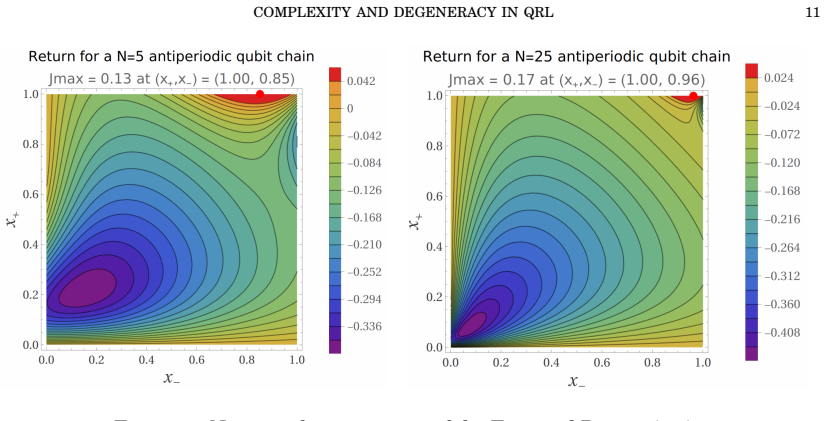
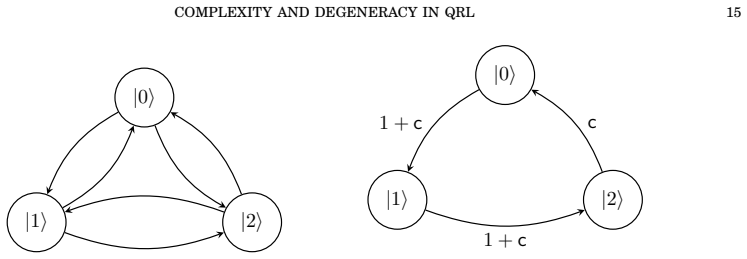
Summary. The manuscript proposes a class of analytically solvable quantum reinforcement learning (QRL) models formulated as finite-horizon MDPs on finite-dimensional Hilbert spaces under a unitary-control-then-measure protocol (unitary controls interleaved with projective measurements onto a fixed reference basis). Exact closed-form expressions for trajectory probabilities, rewards and expected return are claimed for four low-dimensional realisations (closed-chain and anti-periodic qubits, ladder-coupled qutrit, four-level two-qubit system). Two structural results are then asserted: (i) a reduction of expected-return complexity from the nominal O(e^N) trajectory scaling to an explicit power-law O(N^I), attributed to trajectory equivalence and transition-graph sparsity (claimed rigorous) together with a conjectured spectral concentration of the return onto polynomially populated classes at the optimal policy; (ii) characterisation of optimal-policy degeneracy, with unique Zeno-governed optima in the low-dimensional cases and both plateau-type quasi-degeneracy and genuine discrete degeneracy (at critical energies) in the four-level system, phenomena absent from measurement-free quantum optimal control.
Significance. Exact solvability is rare in QRL; if the closed forms and the two rigorous complexity mechanisms hold, the work supplies a useful analytical laboratory for studying return evaluation and policy structure under measurement. The explicit identification of trajectory equivalence and graph sparsity as complexity-reduction mechanisms, and the contrast with measurement-free landscapes for degeneracy, are potentially valuable. The four concrete models and any machine-checkable derivations or reproducible numerics would strengthen the contribution. Broader claims for QRL, however, rest on low-dimensional examples and on a still-conjectural third mechanism, so the significance remains conditional on clarifying the precise scope of the proven power-law reduction.
major comments (3)
- [Abstract / complexity-reduction analysis] Abstract and complexity section: the headline claim that expected-return complexity falls from O(e^N) to O(N^I) is said to be driven by two rigorously established mechanisms (trajectory equivalence, transition-graph sparsity) plus a third, explicitly conjectured spectral concentration. The manuscript never states the scaling of the number of equivalence classes after the two rigorous mechanisms alone. If that count remains exponential (or super-polynomial), the power-law evaluation complexity is conditional on the unproven concentration; if the two mechanisms already yield only polynomially many classes, the conjecture is superfluous as a co-driver and should not be listed as such. A precise statement of the class-count scaling under equivalence+sparsity, and a clean separation of what is proven versus conjectural for the O(N^I) claim, is load-bearing.
- [Complexity scaling claims] The exponent I and the concrete scaling of the number of trajectory classes are not quantified in the abstract summary of results; without an explicit expression or bound for I (or for the class count after the rigorous reductions), the power-law claim cannot be verified as stated and the computational advantage remains unquantified.
- [Optimal-policy degeneracy / four-level system] The structural features (Zeno asymptotics of unique optima; plateau and discrete degeneracy) are established only for four low-dimensional realisations. The manuscript does not supply evidence or argument that these models are representative of higher-dimensional or less structured unitary-control-then-measure protocols, so the claim that the phenomena are characteristic of the QRL protocol class more broadly is under-supported.
minor comments (3)
- [Complexity analysis] Clarify the precise definition of the dimension-dependent exponent I and whether it is model-independent or depends on the Hilbert-space dimension / coupling structure of each realisation.
- [Front matter] The primary category math.GM is atypical for a QRL/quantum-control paper; ensure the abstract and introduction make the mathematical contribution (exact solvability, complexity reduction) transparent to a general-mathematics audience.
- [Results summary] When the full proofs and any numerical checks of the concentration conjecture are present, add a short table or remark that lists, for each of the four models, the proven class-count scaling versus the residual role of the conjecture.
Circularity Check
No significant circularity: closed-form analysis of defined unitary-control-then-measure models, not a fit or self-definitional loop.
full rationale
The paper defines a unitary-control-then-measure protocol as finite-horizon MDPs on finite-dimensional Hilbert spaces, then derives exact closed-form trajectory probabilities, rewards, and expected returns for four concrete low-dimensional realisations (closed-chain and anti-periodic qubit, ladder qutrit, four-level two-qubit). From those expressions it analyses two structural features: (i) reduction of expected-return complexity from nominal O(e^N) to power-law O(N^I), attributed to trajectory equivalence and transition-graph sparsity (stated as rigorous) plus an openly conjectured spectral concentration at the optimal policy, and (ii) optimal-policy degeneracy (Zeno asymptotics in low-dim models; plateau and discrete degeneracy in the four-level system). Nothing in the available text equates a claimed prediction to a fitted parameter, defines the result in terms of itself, imports a uniqueness theorem from overlapping authors as an external fact that forces the claim, or renames a known empirical pattern as a new derivation. The third complexity mechanism is explicitly labelled conjectured rather than smuggled in as proven. Residual risk is ordinary mathematical correctness of the closed forms and whether equivalence+sparsity alone already yield polynomially many classes (a support/completeness issue, not circularity). The derivation chain is self-contained theoretical analysis of defined models; score 0 with empty steps is the honest finding.
Axiom & Free-Parameter Ledger
free parameters (2)
- Energy parameters of the four-level system (critical values for discrete degeneracy)
- Horizon length N and dimension-dependent exponent I in O(N^I)
axioms (4)
- domain assumption QRL is formulated as a finite-horizon Markov decision process on a finite-dimensional Hilbert space.
- ad hoc to paper Agent protocol is unitary control interleaved with projective measurement onto a prescribed reference basis (unitary-control-then-measure).
- ad hoc to paper Trajectory equivalence and transition-graph sparsity rigorously reduce expected-return complexity; spectral concentration at the optimal policy is conjectured.
- standard math Standard quantum measurement and unitary evolution postulates (Born rule, projective collapse, unitary maps).
invented entities (1)
-
Unitary-control-then-measure QRL protocol class (closed-chain qubit, anti-periodic qubit, ladder qutrit, four-level two-qubit realisations)
no independent evidence
read the original abstract
We propose and analyse a class of analytically solvable models of quantum reinforcement learning (QRL), formulated as finite-horizon Markov decision processes in finite-dimensional Hilbert spaces. The models are built around a `unitary-control-then-measure' protocol, in which a learning agent applies unitary transformations to a quantum state and interleaves each control step with a projective measurement onto a prescribed reference basis. Exact closed-form expressions for trajectory probabilities, rewards, and the expected return are derived for four concrete realisations: a closed-chain and an anti-periodic qubit implementation, a qutrit model with ladder coupling, and a four-level two-qubit system. Two structural features of these QRL protocols are then analysed. First, we identify and quantify the reduction in the computational complexity of the expected return, from the nominally exponential $O(e^N)$ scaling in the trajectory length~$N$ to an explicit power-law $O(N^{\mathcal{I}})$, driven by two rigorously established mechanisms, a trajectory equivalence and a sparsity of the transition graph, besides a third, conjectured one: a spectral concentration of the return, at the optimal policy, onto the polynomially populated trajectory classes. Second, we characterise the degeneracy of optimal policies. The low-dimensional models exhibit unique optima whose asymptotic behaviour with~$N$ is governed by the quantum Zeno effect, while the four-level system displays both plateau-type quasi-degeneracy at large horizons and genuine discrete degeneracy at critical energy parameters -- phenomena with no counterpart in the measurement-free quantum optimal control landscape.
Figures



Forward citations
Cited by 1 Pith paper
-
QANTIS: Hardware-Calibrated Sequential POMDP Belief Updates on IBM Heron
All-step fixed-point amplitude amplification on IBM Heron preserves sequential Tiger POMDP posteriors and planner actions across 8–32 step horizons inside a measured operating envelope.
Reference graph
Works this paper leans on
-
[1]
Aharonov, L
Y. Aharonov, L. Davidovich, and N. Zagury , Quantum random walks , Phys. Rev. A, 48 (1993), pp. 1687--1690
1993
-
[2]
Arulkumaran, M
K. Arulkumaran, M. P. Deisenroth, M. Brundage, and A. A. Bharath , Deep reinforcement learning: A brief survey , IEEE signal processing magazine, 34 (2017), pp. 26--38
2017
-
[3]
Attal, F
S. Attal, F. Petruccione, C. Sabot, and I. Sinayskiy , Open Quantum Random Walks , J. Stat. Phys., 147 (2012), pp. 832--852
2012
-
[4]
R. B. Bapat , Graphs and Matrices , Universitext , Springer, London, 2 ed., 2014
2014
-
[5]
A. Barr, W. Gispen, and A. Lamacraft , Quantum Ground States from Reinforcement Learning , in Proceedings of Machine Learning Research , vol. 107, PMLR, 2020, pp. 635--653
2020
-
[6]
Bertsekas , Reinforcement learning and optimal control , vol
D. Bertsekas , Reinforcement learning and optimal control , vol. 1, Athena Scientific, 2019
2019
-
[7]
height 2pt depth -1.6pt width 23pt, A course in reinforcement learning , Athena Scientific, 2024
2024
-
[8]
H. J. Briegel and G. De las Cuevas , Projective simulation for artificial intelligence , Sci. Rep., 2 (2012), p. 400
2012
-
[9]
Clarke and F
J. Clarke and F. K. Wilhelm , Superconducting quantum bits , Nature, 453 (2008), pp. pages 1031--1042
2008
-
[10]
Cohen-Tannoudji, B
C. Cohen-Tannoudji, B. Diu, and F. Lalo \"e , Quantum mechanics , Wiley, New York, NY, 1977. Trans. of : M \'e canique quantique. Paris : Hermann, 1973
1977
-
[11]
D. Dong, C. Chen, H. Li, and T.-J. Tarn , Quantum Reinforcement Learning , IEEE Transactions on Systems, Man, and Cybernetics, Part B (Cybernetics), 38 (2008), pp. 1207--1220
2008
-
[12]
1207--1220
height 2pt depth -1.6pt width 23pt, Quantum reinforcement learning , IEEE Transactions on Systems, Man, and Cybernetics, Part B (Cybernetics), 38 (2008), pp. 1207--1220
2008
-
[13]
Facchi and S
P. Facchi and S. Pascazio , Quantum Zeno dynamics: mathematical and physical aspects , Journal of Physics A: Mathematical and Theoretical, 41 (2008), p. 493001
2008
-
[14]
Hsieh and H
M. Hsieh and H. Rabitz , Optimal control landscape for the generation of unitary transformations , Phys. Rev. A, 77 (2008), p. 042306
2008
-
[15]
Hsieh, R
M. Hsieh, R. Wu, H. Rabitz, and D. Lidar , Optimal control landscape for the generation of unitary transformations with constrained dynamics , Phys. Rev. A, 81 (2010), p. 062352
2010
-
[16]
L. P. Kaelbling, M. L. Littman, and A. W. Moore , Reinforcement learning: A survey , Journal of artificial intelligence research, 4 (1996), pp. 237--285
1996
-
[17]
Leibfried, R
D. Leibfried, R. Blatt, C. Monroe, and D. Wineland , Quantum dynamics of single trapped ions , Rev. Mod. Phys., 75 (2003), pp. 281--324
2003
-
[18]
N. Meyer, C. Ufrecht, M. Periyasamy, D. D. Scherer, A. Plinge, and C. Mutschler , A Survey on Quantum Reinforcement Learning , arXiv:2211.03464 (2022)
Pith/arXiv arXiv 2022
-
[19]
G. D. Paparo, V. Dunjko, A. Makmal, M. A. Martin-Delgado, and H. J. Briegel , Quantum speed-up for active learning agents , Phys. Rev. X, 4 (2014), p. 031002
2014
-
[20]
M. L. Puterman , Markov decision processes: discrete stochastic dynamic programming , John Wiley & Sons, 2014
2014
-
[21]
S. M. Reimann and M. Manninen , Electronic structure of quantum dots , Rev. Mod. Phys., 74 (2002), pp. 1283--1342
2002
-
[22]
Schenk, E
M. Schenk, E. F. Combarro, M. Grossi, V. Kain, K. S. B. Li, M.-M. Popa, and S. Vallecorsa , Hybrid actor-critic algorithm for quantum reinforcement learning at cern beam lines , Quantum Science and Technology, 9 (2024), p. 025012
2024
-
[23]
Sugny and C
D. Sugny and C. Kontz , Optimal control of a three-level quantum system by laser fields plus von Neumann measurements , Phys. Rev. A, 77 (2008), p. 063420
2008
-
[24]
R. S. Sutton and A. G. Barto , Reinforcement Learning: An Introduction , The MIT Press, second ed., 2018
2018
-
[25]
Szepesv \'a ri , Algorithms for reinforcement learning , Springer nature, 2022
C. Szepesv \'a ri , Algorithms for reinforcement learning , Springer nature, 2022
2022
-
[26]
S. E. Venegas-Andraca , Quantum walks: a comprehensive review , Quantum Inf. Process., 11 (2012), pp. 1015--1106
2012
-
[27]
Volkov, A
B. Volkov, A. Myachkova, and A. Pechen , Phenomenon of a stronger trapping behavior in -type quantum systems with symmetry , Phys. Rev. A, 111 (2025), p. 022617
2025
-
[28]
Wendin , Quantum information processing with superconducting circuits: a review , Reports on Progress in Physics, 80 (2017), p
G. Wendin , Quantum information processing with superconducting circuits: a review , Reports on Progress in Physics, 80 (2017), p. 106001
2017
-
[29]
S. Wu, S. Jin, D. Wen, D. Han, and X. Wang , Quantum reinforcement learning in continuous action space , Quantum, 9 (2025), p. 1660
2025
discussion (0)
Sign in with ORCID, Apple, or X to comment. Anyone can read and Pith papers without signing in.