REVIEW 3 major objections 6 minor 78 references
Exploring the dynamics of coincident f(Q) gravity in the presence of DBI-essence scalar field
T0 review · 3 major / 6 minor · reviewed 2026-08-06 · deepseek-v4-flash
Pith's one-line read This paper claims that two coincident $f(Q)$ gravity models, power-law and exponential, each with a DBI-essence scalar field, reproduce the cosmic sequence from stiff matter through late-time acceleration and yield present-day dark-energy…
desk verdict The exponential-model half of this paper is invalidated by a variable-definition constraint its critical points do not satisfy; the power-law half is a routine but competent exercise. read the letter →
The pith
A machine-rendered reading of the paper's core claim, the machinery that carries it, and where it could break.
The reading
What carries the argument
The key machinery is a phase-space reduction of the Friedmann equations. For the power-law model the dimensionless variables are $x=(\Psi-2Q\Psi_Q)/(6H^2)$, $z=\nu\dot{\phi}/(\sqrt{3(1+\nu)}\,H)$, $u=\sqrt{V(\phi)}/(\sqrt{3}H)$, and $\nu$, with $\Psi(Q)=nQ^m$; for the exponential model $\Psi(Q)=Q e^{\beta Q_0/Q}-Q$ and an extra variable $y=-2\Psi_Q$ is added so that $\Omega_Q=x+y$. The autonomous systems (40)-(43) and (51)-(55) are closed using $Q=6H^2$, the DBI Klein-Gordon equation, and the separate conservation equations for matter, the scalar field, and the geometric dark energy. Fixed points are classified by the eigenvalues of the Jacobian (Hartman-Grobman theorem), and the physical phase space is restricted to $0\le 1-x-z^2-u^2\le 1$ and $\nu>0$; this step is what connects parameter choices $(m,\lambda,\mu,\beta)$ to specific epochs such as stiff matter, radiation, matter, quintessence, and de Sitter.
What would settle it
Restrict the exponential-model system (51)-(55) to the surface $y+2x=2(\beta Q_0/Q)(1+x)$ with finite $\beta$ and $Q_0$, evolve from generic initial data, and check whether the $B_{1\pm}$ and $B_{2\pm}$ fixed points appear; if they disappear, the model's claimed stiff-matter and matter eras are artifacts of the unconstrained phase space.
Extended reading notes
Core claim
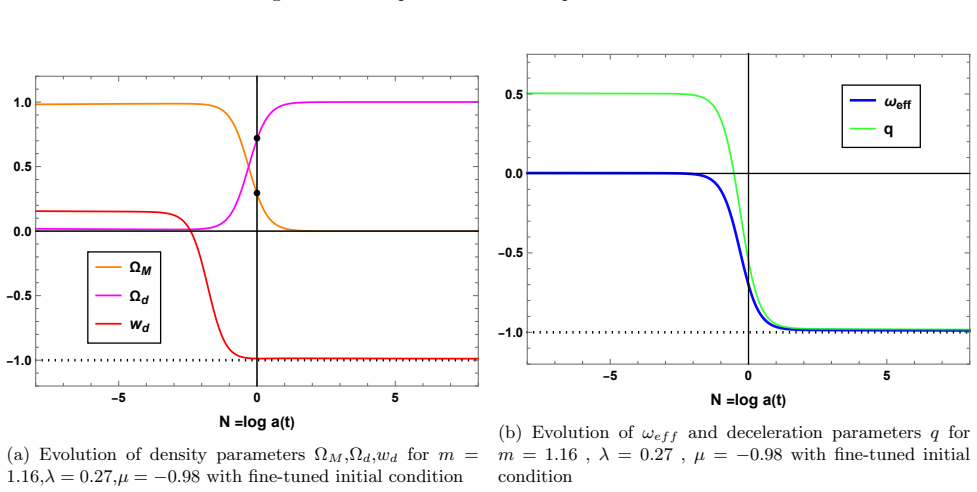
The central claim, stated in the Conclusions, is that the accelerated cosmological solution obtained for specific parameter choices can serve as an alternative to $\Lambda$CDM dark energy. In support, the paper shows that the critical points of the two $f(Q)$ models reproduce the standard sequence of epochs: $A_{4\pm}$ and $B_{1\pm}$ give decelerated stiff matter, $A_{3\pm}$ and $B_{4\pm}$ can give radiation, $A_{1\pm}$ and $B_{2\pm}$ give matter domination, and $A_{2\pm}$ (for $|\lambda|<\sqrt{2}$) and $B_{3-}$ give accelerated quintessence or de Sitter phases. The phase portraits and evolution diagrams yield present-day density parameters $\Omega_M \approx 0.3$, $\Omega_d \approx 0.7$, dark-energy equations of state $\omega_d \approx -1$ (power law) and $-1.01$ (exponential), and deceleration parameters $q \approx -0.6$ and $-0.5$, which the authors take to be compatible with observational data. The exponential model's $\omega_d \approx -1.01$ crosses the phantom divide at the present epoch.
Load-bearing premise
For the exponential model, every physical trajectory must satisfy $y+2x=2(\beta Q_0/Q)(1+x)$, but the critical points $B_{1\pm}$ and $B_{2\pm}$ have $y=-2x$ and so satisfy this only when $\beta=0$ or $Q\to\infty$; if those points are excluded, the claimed stiff-matter and matter eras of that model are unsupported.
Editorial extensions
If this is right
- If the analysis is correct, both $f(Q)$ models reproduce the sequence stiff matter to radiation to matter to late-time acceleration without a cosmological constant.
- The power-law model's present values ($\Omega_M \approx 0.3$, $\Omega_d \approx 0.7$, $\omega_d \approx -1$, $q \approx -0.6$) can be compared directly with current observational compilations.
- The exponential model's $\omega_d \approx -1.01$ puts it in the phantom regime at the present epoch, which the authors note is closer to the observed range than $\omega_d=-1$.
- The stability conditions on the parameters $m,\lambda,\mu,\beta$ determine which critical points act as past and future attractors, so the model can be tuned to begin decelerating and end accelerating.
- The acceleration is driven jointly by the DBI-essence field and the geometric $\Omega_Q$ component, so neither the scalar field nor the modified gravity alone has to mimic $\Lambda$.
Reading between the lines
- The exponential-model phase space is analyzed with $x$ and $y$ treated as independent, even though the definitions imply $y+2x=2(\beta Q_0/Q)(1+x)$; imposing that constraint could remove the $B_{1\pm}$ and $B_{2\pm}$ epochs, leaving the model's late-time attractor $B_{3-}$ as its main physical content.
- The present-day values come from fine-tuned initial conditions in the evolution plots; testing whether these values are reached from a generic basin of attraction would show whether they are an attractor property or a curve fit.
- The same analysis could be run for the log-square-root or logarithmic $f(Q)$ forms named in the Conclusions; if those also end on the same dark-energy attractor, the result would be a feature of the $f(Q)$+DBI coupling rather than of the two chosen functions.
- A measurement of the dark-energy equation of state that excludes $\omega<-1$ would discriminate the exponential model ($\omega_d\approx-1.01$) from the power-law model ($\omega_d\approx-1$), because the phantom value depends on $\beta\neq 0$.
Editorial analysis
A structured set of objections, weighed in public.
Referee Report
Summary. This paper studies flat FLRW cosmology in coincident f(Q) gravity with a generalized DBI-essence scalar field. It constructs dimensionless dynamical variables for two forms of f(Q) — a power-law f(Q)=Q+nQ^m and an exponential f(Q)=Q exp(beta Q0/Q) — obtains autonomous systems, lists critical points (Tables 1 and 2), analyzes their stability with linear stability theory, and presents phase portraits and evolution diagrams. On this basis the authors claim that the models can reproduce the standard cosmic sequence from stiff matter through late-time acceleration and that the present-day values (Omega_M approx 0.3, Omega_d approx 0.7, omega_d approx -1 or -1.01, q approx -0.6 or -0.5) are compatible with observations, providing an alternative to the Lambda-CDM model.
Significance. The paper applies a standard and well-motivated dynamical-system methodology to a pair of f(Q) models with a DBI-essence field, and a correct version of the power-law classification would be a useful reference. However, the exponential-model analysis is invalid as written, the power-law evolution equation contains a factor error, and the claimed observational compatibility is a fine-tuned consistency check rather than a prediction. These issues affect the central claims, so the manuscript in its present form does not establish its conclusions.
major comments (3)
- [Section 3.2, Eqs. (44)-(55), Table 2] The variables x and y are not independent. For Psi(Q)=Q e^{beta Q0/Q} - Q, with x=Psi/(6H^2), y=-2 Psi_Q, and x+1=e^{beta Q0/Q}, the definitions imply y+2x=2(beta Q0/Q)(1+x). Every family in Table 2 (B1±, B2±, B3±, B4±) has y=-2x, so y+2x=0. For finite Q and beta≠0 the right-hand side is nonzero, and since x+1>0 it cannot vanish; hence none of the listed critical points lies on the constraint surface. The dynamical system (51)-(55) was solved in the full five-variable space without imposing this algebraic relation, so the exponential-model critical points, their stability, and the claimed stiff-matter, matter, and accelerating epochs are not solutions of the original field equations. The only escape is beta=0, where Psi=0 and the model reduces to GR without a cosmological constant, in which case the exponential-model alternative-to-Lambda-CDM conclusion disappears.
- [Section 3.1, Eqs. (32), (37), (40)] For the power-law model Psi=nQ^m, the definition x=(Psi-2Q Psi_Q)/(6H^2) gives x=n(1-2m)Q^{m-1}. With Q=6H^2 and N=ln a, differentiating yields dx/dN=2(m-1)x Hdot/H^2. Inserting Eq. (37) gives dx/dN=3(m-1)x S/(1-mx), where S=x-1-z^2/nu+u^2, which differs from Eq. (40) by a factor of 6. The critical-point locations are the same, but the Jacobian, eigenvalues, stability regions (Figs. 1-3), and phase-portrait conclusions for A_i± are computed from the wrong differential equation and must be rederived.
- [Section 3, Figs. 5 and 11, Section 4] The paper's claim that the present values are compatible with observational data is not a test of the models. The parameters m, lambda, mu, and the fine-tuned initial conditions in the figure captions are chosen so that the trajectories pass through Omega_M≈0.3, Omega_d≈0.7, omega_d≈-1 (or -1.01), and q≈-0.6 (or -0.5); no likelihood, error budget, or comparison with a data set is provided. These values are therefore consistency checks determined by construction, and they cannot by themselves establish the models as alternatives to Lambda-CDM.
minor comments (6)
- [Section 2, Eq. (21)] The pressure equation is inconsistent with Eq. (23). For Psi=0, Eq. (21) gives 2Hdot+3H^2=-4 p_phi, whereas Eq. (23) gives 2Hdot+3H^2=-p_phi; correct the factor or remove Eq. (21).
- [Abstract and Introduction] The power-law model is written as f(Q)=Q+nQ^m in the abstract and as f(Q)=Q+mQ^n in the Introduction; the notation should be unified throughout.
- [Table 2] The quantity u_c in the entries for B3± is not defined; it should be defined in the table caption or in the text.
- [Section 4] The Conclusions refer to B3+ as the late-time accelerating point, but Section 3.2 identifies B3- as the accelerated one; the cross-reference should be corrected.
- [Figures 5 and 11] The initial conditions are described only as fine-tuned; the actual numerical values should be given so the evolution curves are reproducible.
- [Section 2, Eq. (31) discussion] The quoted observational value q≈-0.810±0.1 is stated without a reference and is far from the commonly quoted q0≈-0.55; either provide a proper reference or correct the value.
Circularity Check
Present-day outputs are fine-tuned consistency checks, and the exponential-model critical points all violate the constraint y+2x=2βQ0/Q(1+x) imposed by the variable definitions, so the claimed ΛCDM alternative is unsupported.
-
other
[Section 3.2, Eq. (44)-(55), Table 2]
"In order to construct the dynamical system, we have considered the auxiliary variable as x = Ψ/6H², y = −2Ψ_Q, z = νϕ˙√3(1+ν)H, u = √V(ϕ)√3H ... dx/dN = − 3(x + 1)(x + y − 1 − z²/ν + u²)/(2(x + 1) − y(x + 1) + (2x + y)²)(y + 2x) ... Table 2: B1± xc −2xc ±√1 + xc 0 1 xc ≥ −1"
With Ψ=Qe^{βQ0/Q}−Q and Q=6H², the definitions imply y+2x=2(βQ0/Q)(1+x). Every family in Table 2 (B1±, B2±, B3±, B4±) has y+2x=0, so these fixed points lie on the physical constraint surface only when β=0 (or Q→∞). Because the system (51)-(52) was solved on the full unconstrained (x,y) plane, the exponential-model critical points are artifacts of the variable definitions, not solutions of the stated f(Q)=Qe^{βQ0/Q} dynamics. The claimed stiff-matter, matter, and late-time accelerating epochs reduce by construction to the β=0 (GR-without-Λ) limit, so they cannot support the paper's ΛCDM-alternative conclusion.
-
fitted input called prediction
[Section 3.1 (Fig. 5) and Section 3.2 (Fig. 11)]
"The evolution of density parameters are presented in Figure[5], where the vertical line corresponding to N = 0 indicates the present cosmological epoch. ... For Model-1, we obtain the present values of ΩM ≈ 0.3 and Ωd ≈ 0.7 respectively, which is compatible with observational data. ... Evolution of density parameters ΩM, Ωd, wd for m = 1.16, λ = 0.27, µ = −0.98 with fine-tuned initial condition"
The parameter triple (m,λ,μ)=(1.16,0.27,−0.98) and the initial conditions are explicitly fine-tuned so that the N=0 integration outputs ΩM≈0.3, Ωd≈0.7 and ωd≈−1. The paper then reports these same outputs as compatible with observational data. Because no independent data subset is used and the initial conditions are chosen to produce the target present-day values, the claimed observational compatibility is a consistency check of the chosen inputs, not a prediction; the same applies to the exponential model's Figure 11 (λ=0.27, μ=−0.98, fine-tuned initial condition).
full rationale
The power-law critical-point and stability analysis is a genuine dynamical-system reduction of the field equations: the fixed points, epochs, and stability conditions follow from Eqs. (40)-(43) and are not circular. The two circular/self-defeating elements are at the level of the paper's advertised results. First, the present-day observables are not independent predictions: the figures explicitly label the runs as fine-tuned initial-condition choices, and the parameter values (m=1.16, λ=0.27, μ=-0.98) are selected so that N=0 outputs hit ΩM≈0.3, Ωd≈0.7, ωd≈-1; reporting those outputs as consistent with Planck/SNe data is a consistency check, though not statistically circular in the sense of a fitted parameter renamed as a prediction. Second and more serious, the exponential model's critical-point table is internally inconsistent with the variable definitions: the definitions force y+2x=2(βQ0/Q)(1+x), while every tabulated fixed point satisfies y+2x=0, so the exponential-model epochs are those of the β=0 limit, not of f(Q)=Qe^{βQ0/Q}. This does not fit the classic self-citation pattern and may be classified as a validity error as much as circularity, but it makes the exponential model's central 'alternative to ΛCDM' claim unsupported by construction. Overall score 6: one or more predictions reduce by construction, while the power-law dynamical-system derivation retains independent content.
Assumptions & free parameters
free parameters (6)
- m (power-law exponent) =
1.16 in Figure 5
- λ (DBI potential exponent) =
0.27 in Figures 5 and 11
- μ (DBI warp-factor exponent) =
-0.98 in Figures 5 and 11
- n (power-law coefficient) =
not specified
- β (exponential model parameter) =
not specified
- fine-tuned initial conditions for evolution plots =
not reported
assumptions (4)
- domain assumption FLRW metric and the coincident-gauge f(Q) field equations (22)-(25) are the correct starting point.
- domain assumption The DBI scalar field is described by Lagrangian (12) with exponential potential and warp factor V=e^{λφ}, f=e^{μφ}.
- ad hoc to paper x and y can be treated as independent dynamical variables without enforcing the constraint y+2x=2(βQ0/Q)(1+x) from their definitions.
- ad hoc to paper The present-day values from the evolution diagrams are obtained by choosing parameters and initial conditions; no fitting procedure or uncertainty is given.
Cite this review
Pith. "Pith review of Exploring the dynamics of coincident f(Q) gravity in the presence of DBI-essence scalar field." pith.science (2026). https://pith.science/paper/FEEWLJAT
@misc{pith2026250713406,
  author       = {Pith},
  title        = {Pith review of: Exploring the dynamics of coincident f(Q) gravity in the presence of DBI-essence scalar field},
  year         = {2026},
  howpublished = {\url{https://pith.science/paper/FEEWLJAT}},
  note         = {Machine review of arXiv:2507.13406}
}
abstract
In theoretical cosmology, symmetric teleparallel gravity or $f(Q)$ gravity based on nonmetricity tensor Q has become an interesting alternative to General relativity in recent years. The present research paper contains a rigorous dynamical system analysis of coincident f (Q) gravity in the presence of a generalized DBI essence scalar field. We have considered two different models of coincident f(Q) gravity, such as power law model $f(Q) = Q + nQ^m$ and exponential model $f(Q) = Q e^{\frac{\beta Q_0}{Q}}$ respectively, where n, m, \b{eta} are constant parameter and Q is the nonmetricity component. In this study, the generalized DBI essence scalar field acts as an additional dark energy component. After obtaining the field equation for the corresponding cosmological model, we employed several dynamical variables to form the dynamical system. The critical points of these dynamical systems are influenced by cosmological parameters and associated with particular epochs in the cosmological timeline. For different combinations of cosmological parameters, the critical points exhibit different cosmological eras, starting from the accelerated stiff matter era to late-time acceleration phenomena. The stability criteria of each critical point are studied by using linear stability theory, and the physical constraints on the cosmological parameters are also considered during this analysis. Furthermore, the current values of energy densities, deceleration parameters, and equation of state parameters obtained from the evolution diagram are compatible with observational data.
Figures


Figures from the paper (8 more)



Reference graph
Works this paper leans on
-
[70]
Ghosh, S., Solanki, R. & Sahoo, P. Dynamical system analysis of Dirac-Born-Infeld scalar field cosmology in coincident f(Q) gravity*. Chinese Physics C 48, 095102. https://dx.doi.org/ 10.1088/1674-1137/ad50aa (Sept. 2024)
-
[1]
Riess, A. G. et al. Observational Evidence from Supernovae for an Accelerating Universe and a Cosmological Constant. The Astronomical Jour- nal 116, 1009–1038. issn: 0004-6256. http : / / dx.doi.org/10.1086/300499 (Sept. 1998)
-
[2]
Perlmutter, S. et al. Measurements of Ω and Λ from 42 High Redshift Supernovae. Astrophys. J. 517, 565–586. arXiv: astro-ph/9812133 (1999)
arXiv 1999
-
[3]
Hinshaw, G. et al. NINE-YEAR WILKIN- SON MICROW A VE ANISOTROPY PROBE ( WMAP ) OBSER V ATIONS: COSMOLOGI- CAL PARAMETER RESULTS. The Astrophys- ical Journal Supplement Series 208, 19. issn: 1538-4365. http://dx.doi.org/10.1088/0067- 0049/208/2/19 (Sept. 2013)
-
[4]
Aghanim, N. et al. Planck 2013 results. XXVII. Doppler boosting of the CMB: Eppur si muove. Astron. Astrophys. 571, A27. arXiv: 1303.5087 [astro-ph.CO] (2014)
arXiv 2014
-
[5]
Spergel, D. N. et al. First-Year Wilkinson Mi- crowave Anisotropy Probe (WMAP)* Observa- tions: Determination of Cosmological Parame- ters. The Astrophysical Journal Supplement Se- ries 148, 175. https://dx.doi.org/10.1086/ 377226 (Sept. 2003). 17
-
[6]
Anderson, L. et al. The clustering of galaxies in the SDSS-III Baryon Oscillation Spectroscopic Survey: Baryon Acoustic Oscillations in the Data Release 9 Spectroscopic Galaxy Sample. Mon. Not. Roy. Astron. Soc. 427, 3435–3467. arXiv: 1203.6594 [astro-ph.CO] (2013)
arXiv 2013
-
[7]
Zlatev, I., Wang, L. & Steinhardt, P. J. Quintessence, Cosmic Coincidence, and the Cos- mological Constant. Phys. Rev. Lett. 82, 896–
Show all 78 references
-
[8]
J., Kolda, C
Arkani-Hamed, N., Hall, L. J., Kolda, C. & Mu- rayama, H. New Perspective on Cosmic Coinci- dence Problems. Phys. Rev. Lett.85, 4434–4437. https : / / link . aps . org / doi / 10 . 1103 / PhysRevLett.85.4434 (21 Nov. 2000)
2000
-
[9]
Cosmological constant—the weight of the vacuum
Padmanabhan, T. Cosmological constant—the weight of the vacuum. Physics Reports 380, 235–320. issn: 0370-1573. https : / / www . sciencedirect . com / science / article / pii / S0370157303001200 (2003)
2003
-
[10]
The cosmological constant problem
Weinberg, S. The cosmological constant problem. Rev. Mod. Phys.61, 1–23. https://link.aps. org / doi / 10 . 1103 / RevModPhys . 61 . 1(1 Jan. 1989)
1989
-
[11]
Cosmology and the fate of dilata- tion symmetry
Wetterich, C. Cosmology and the fate of dilata- tion symmetry. Nuclear Physics B302, 668–696. issn: 0550-3213. https://www.sciencedirect. com/science/article/pii/0550321388901939 (1988)
1988
-
[12]
Quintessence: a review
Tsujikawa, S. Quintessence: a review. Classical and Quantum Gravity30, 214003. https://dx. doi.org/10.1088/0264- 9381/30/21/214003 (Oct. 2013)
2013 doi
-
[13]
& Stein- hardt, P
Armendariz-Picon, C., Mukhanov, V. & Stein- hardt, P. J. Essentials of k-essence. Phys. Rev. D 63, 103510. https://link.aps.org/doi/10. 1103/PhysRevD.63.103510 (10 Apr. 2001)
2001
-
[14]
& Yamaguchi, M
Chiba, T., Okabe, T. & Yamaguchi, M. Ki- netically driven quintessence. Phys. Rev. D 62, 023511. https://link.aps.org/doi/10.1103/ PhysRevD.62.023511 (2 June 2000)
-
[15]
& Yamaguchi, M
Martin, J. & Yamaguchi, M. DBI-essence. Phys. Rev. D 77, 123508. https : / / link . aps . org / doi / 10 . 1103 / PhysRevD . 77 . 123508(12 June 2008)
2008
-
[16]
& Liddle, A
Calcagni, G. & Liddle, A. R. Tachyon dark energy models: Dynamics and constraints. Phys. Rev. D 74, 043528. https://link.aps.org/doi/10. 1103/PhysRevD.74.043528 (4 Aug. 2006)
2006
-
[17]
& Chakraborty, S
Debnath, U., Banerjee, A. & Chakraborty, S. Role of modified Chaplygin gas in accelerated universe. Classical and Quantum Gravity21, 5609. https: //dx.doi.org/10.1088/0264-9381/21/23/019 (Nov. 2004)
2004 doi
-
[18]
& Zhang, X
Xia, J.-Q., Li, H. & Zhang, X. Dark energy con- straints after the new Planck data. Phys. Rev. D 88, 063501. https://link.aps.org/doi/10. 1103/PhysRevD.88.063501 (6 Sept. 2013)
2013
-
[19]
& Pe- lykh, V
Novosyadlyj, B., Sergijenko, O., Durrer, R. & Pe- lykh, V. Constraining the dynamical dark energy parameters: Planck-2013 vs WMAP9. Journal of Cosmology and Astroparticle Physics2014, 030–
2013
-
[20]
J., Mizuno, S
Copeland, E. J., Mizuno, S. & Shaeri, M. Cos- mological dynamics of a Dirac-Born-Infeld field. Phys. Rev. D 81, 123501. https://link.aps. org / doi / 10 . 1103 / PhysRevD . 81 . 123501(12 June 2010)
2010
-
[21]
& Linder, E
Ahn, C., Kim, C. & Linder, E. V. Dark en- ergy properties in DBI theory. Phys. Rev. D80, 123016. https://link.aps.org/doi/10.1103/ PhysRevD.80.123016 (12 Dec. 2009)
2009
-
[22]
& Linder, E
Ahn, C., Kim, C. & Linder, E. V. Cosmological constant behavior in DBI theory. Physics Letters B 684, 181–184. issn: 0370-2693. https://www. sciencedirect . com / science / article / pii / S0370269310000766 (2010)
2010
-
[23]
& Tsujikawa, S
De Felice, A. & Tsujikawa, S. f(R) theories. Liv- ing Rev. Rel.13, 3. arXiv: 1002.4928 [gr-qc] (2010)
2010 arXiv
-
[24]
Sotiriou, T. P. & Faraoni, V. f (R) theories of gravity. Rev. Mod. Phys. 82, 451–497. https : / / link . aps . org / doi / 10 . 1103 / RevModPhys . 82.451 (1 Mar. 2010)
2010
-
[25]
& Samanta, G
Shah, P. & Samanta, G. C. Cosmological dynam- ics of f (R) models in dynamical system analysis. Int. J. Mod. Phys. A35, 2050124. arXiv: 2111. 09009 [gr-qc] (2020)
2020
-
[26]
Odintsov, S. D. & Oikonomou, V. K. Autonomous dynamical system approach for f (R) gravity. Phys. Rev. D 96, 104049. https://link.aps. org / doi / 10 . 1103 / PhysRevD . 96 . 104049(10 Nov. 2017)
2017
-
[27]
& Uggla, C
Alho, A., Carloni, S. & Uggla, C. On dynamical systems approaches and methods in f (R) cosmol- ogy. JCAP 08, 064. arXiv: 1607.05715 [gr-qc] (2016)
2016 arXiv
-
[28]
A new approach to the analysis of the phase space of f (R)-gravity
Carloni, S. A new approach to the analysis of the phase space of f (R)-gravity. JCAP 09, 013. arXiv: 1505.06015 [gr-qc] (2015). 18
2015 arXiv
-
[29]
& Maroto, A
De la Cruz-Dombriz, A., Dobado, A. & Maroto, A. L. Black holes in f (R) theories. Phys. Rev. D 80, 124011. https://link.aps.org/doi/10. 1103/PhysRevD.80.124011 (12 Dec. 2009)
2009
-
[30]
http://dx.doi.org/10
issn: 1475-7516. http://dx.doi.org/10. 1088/1475-7516/2014/05/030 (May 2014)
2014
-
[31]
& Odintsov, S
Nojiri, S. & Odintsov, S. D. Modified Gauss–Bonnet theory as gravitational alternative for dark energy. Physics Letters B631, 1–6. issn: 0370-2693. https://www.sciencedirect.com/ science / article / pii / S0370269305014619 (2005)
2005
-
[32]
F., Malik, A
Shamir, M. F., Malik, A. & Mustafa, G. Non- commutative wormhole solutions in modified f(R) theory of gravity. Chinese Journal of Physics 73, 634–648. issn: 0577-9073. https : / / www . sciencedirect . com / science / article / pii / S0577907321001982 (2021)
2021
-
[33]
& Cano, P
Bueno, P. & Cano, P. A. Einsteinian cubic grav- ity. Phys. Rev. D 94, 104005. https : / / link . aps . org / doi / 10 . 1103 / PhysRevD . 94 . 104005 (10 Nov. 2016)
2016
-
[34]
& Mimoso, J
Carloni, S. & Mimoso, J. P. Phase space of mod- ified Gauss–Bonnet gravity. Eur. Phys. J. C77,
-
[35]
& Fiorini, F
Ferraro, R. & Fiorini, F. Modified teleparallel gravity: Inflation without an inflaton. Phys. Rev. D 75, 084031. https://link.aps.org/doi/10. 1103/PhysRevD.75.084031 (8 Apr. 2007)
2007
-
[36]
& Ferraro, R
Fiorini, F. & Ferraro, R. A type of Born-Infeld regular gravity and its cosmological consequences. International Journal of Modern Physics A24, 1686–1689. eprint: https://doi.org/10.1142/ S0217751X09045236. https : / / doi . org / 10 . 1142/S0217751X09045236 (2009)
2009
-
[37]
& Saridakis, E
Erices, C., Papantonopoulos, E. & Saridakis, E. N. Cosmology in cubic and f (P ) gravity. Phys. Rev. D 99, 123527. https : / / link . aps . org / doi / 10 . 1103 / PhysRevD . 99 . 123527(12 June 2019)
2019
-
[38]
F., Farajollahi, H
Capozziello, S., Cardone, V. F., Farajollahi, H. & Ravanpak, A. Cosmography in f (T ) gravity. Phys. Rev. D 84, 043527. https://link.aps. org/doi/10.1103/PhysRevD.84.043527 (4 Aug. 2011)
2011 doi
-
[39]
Cai, Y.-F., Capozziello, S., Laurentis, M. D. & Saridakis, E. N. f(T) teleparallel gravity and cosmology. Reports on Progress in Physics 79, 106901. https://dx.doi.org/10.1088/0034- 4885/79/10/106901 (Sept. 2016)
2016 doi
-
[40]
Accelerating universe from F(T) gravity
Myrzakulov, R. Accelerating universe from F(T) gravity. Eur. Phys. J. C71, 1752. arXiv: 1006. 1120 [gr-qc] (2011)
2011
-
[41]
B., Heisenberg, L
Jim´ enez, J. B., Heisenberg, L. & Koivisto, T. Coincident general relativity. Phys. Rev. D 98, 044048. https://link.aps.org/doi/10.1103/ PhysRevD.98.044048 (4 Aug. 2018)
2018
-
[42]
B., Heisenberg, L., Koivisto, T
Jim´ enez, J. B., Heisenberg, L., Koivisto, T. & Pekar, S. Cosmology in f (Q) geometry. Phys. Rev. D 101, 103507. https://link.aps.org/ doi / 10 . 1103 / PhysRevD . 101 . 103507(10 May 2020)
2020
-
[43]
& Chakraborty, S
Mishra, S. & Chakraborty, S. Stability and bi- furcation analysis of interacting f(T) cosmology. Eur. Phys. J. C79, 328 (2019)
2019
-
[44]
G., J¨ arv, L
Bahamonde, S., Valcarcel, J. G., J¨ arv, L. & Lem- ber, J. Black hole solutions in scalar-tensor sym- metric teleparallel gravity. 2022, 082. https:// dx.doi.org/10.1088/1475-7516/2022/08/082 (Aug. 2022)
2022 doi
-
[45]
& Mustafa, G
Javed, F., Fatima, G., Sadiq, S. & Mustafa, G. Thermodynamics of Charged Black Hole in Sym- metric Teleparallel Gravity. Fortsch. Phys. 71, 2200214 (2023)
2023
-
[46]
& Kuhn, S
D’Ambrosio, F., Heisenberg, L. & Kuhn, S. Revis- iting cosmologies in teleparallelism. Class. Quant. Grav. 39, 025013. arXiv: 2109 . 04209 [gr-qc] (2022)
2022
-
[47]
& Ra- haman, F
Banerjee, A., Pradhan, A., Tangphati, T. & Ra- haman, F. Wormhole geometries in f (Q) gravity and the energy conditions. Eur. Phys. J. C 81,
-
[48]
& Sahoo, P
Pradhan, S., Solanki, R. & Sahoo, P. K. Cosmo- logical constraints on f(Q) gravity models in the non-coincident formalism. JHEAp 43, 258–267. arXiv: 2410.00922 [gr-qc] (2024)
2024 arXiv
-
[49]
& Sahoo, P
Hassan, Z., Mustafa, G. & Sahoo, P. K. Worm- hole Solutions in Symmetric Teleparallel Gravity with Noncommutative Geometry. Symmetry 13. issn: 2073-8994. https://www.mdpi.com/2073- 8994/13/7/1260 (2021)
2021
-
[50]
Signatures of f (Q) gravity in cos- mology
Frusciante, N. Signatures of f (Q) gravity in cos- mology. Phys. Rev. D 103, 044021. https : / / link . aps . org / doi / 10 . 1103 / PhysRevD . 103 . 044021 (4 Feb. 2021)
2021
-
[51]
S., Lobo, F
Harko, T., Koivisto, T. S., Lobo, F. S. N., Olmo, G. J. & Rubiera-Garcia, D. Coupling matter in modified Q gravity. Phys. Rev. D 98, 084043. https : / / link . aps . org / doi / 10 . 1103 / PhysRevD.98.084043 (8 Oct. 2018). 19
2018
-
[52]
Pradhan, A., Maurya, D. C. & Dixit, A. Dark en- ergy nature of viscus universe in f(Q)-gravity with observational constraints. Int. J. Geom. Meth. Mod. Phys.18, 2150124 (2021)
2021
-
[53]
Mandal, S., Sahoo, P. K. & Santos, J. R. L. En- ergy conditions in f (Q) gravity. Phys. Rev. D 102, 024057. https://link.aps.org/doi/10. 1103/PhysRevD.102.024057 (2 July 2020)
2020
-
[54]
C., Dixit, A
Maurya, D. C., Dixit, A. & Pradhan, A. Tran- sit String Dark Energy Models in f (Q) Gravity. arXiv: 2302.14104 [gr-qc] (Feb. 2023)
2023 arXiv
-
[55]
K., Rani, R., Singh, J
Goswami, G. K., Rani, R., Singh, J. K. & Prad- han, A. FLR W cosmology in Weyl type f(Q) gravity and observational constraints.JHEAp 43, 105–113. arXiv: 2309.01233 [gr-qc] (2024)
2024 arXiv
-
[56]
& Koivisto, T
Beltr´ an Jim´ enez, J. & Koivisto, T. S. Acciden- tal Gauge Symmetries of Minkowski Spacetime in Teleparallel Theories. Universe 7. issn: 2218-
-
[57]
& Maurya, D
Pradhan, A., Dixit, A. & Maurya, D. C. Quintessence Behavior of an Anisotropic Bulk Viscous Cosmological Model in Modified f(Q)- Gravity. Symmetry 14, 2630. arXiv: 2210.13730 [gr-qc] (2022)
2022 arXiv
-
[58]
J., Sami, M
Copeland, E. J., Sami, M. & Tsujikawa, S. Dynamics of dark energy. International Jour- nal of Modern Physics D 15, 1753–1935. eprint: https : / / doi . org / 10 . 1142 / S021827180600942X. https : / / doi . org / 10 . 1142/S021827180600942X (2006)
2006
-
[59]
Coley, A. A. Dynamical Systems in Cosmology
-
[60]
Boehmer, C. G. & Chan, N. Dynamical systems in cosmology in (Sept. 2014). arXiv: 1409.5585 [gr-qc]
2014 arXiv
-
[61]
& Chakraborty, S
Pal, S. & Chakraborty, S. Dynamical system anal- ysis of a Dirac-Born-Infeld model: a center mani- fold perspective. Gen. Rel. Grav.51, 124. arXiv: 2103.02715 [gr-qc] (2019)
2019 arXiv
-
[62]
Bahamonde, S. et al. Dynamical systems applied to cosmology: Dark energy and modified grav- ity. Physics Reports775-777. Dynamical systems applied to cosmology: Dark energy and modified gravity, 1–122. issn: 0370-1573. https : / / www . sciencedirect . com / science / article ...
2018
-
[63]
& Debnath, U
Bhadra, J. & Debnath, U. Dynamical Study of DBI-essence in Loop Quantum Cosmology and Braneworld. Eur. Phys. J. C 72, 2087. arXiv: 1207.2144 [gr-qc] (2012)
2012 arXiv
-
[64]
Khyllep, W., Dutta, J., Saridakis, E. N. & Yesmakhanova, K. Cosmology in f (Q) gravity: A unified dynamical systems analysis of the back- ground and perturbations. Phys. Rev. D 107, 044022. https://link.aps.org/doi/10.1103/ PhysRevD.107.044022 (4 Feb. 2023)
-
[65]
& Dutta, J
Khyllep, W., Paliathanasis, A. & Dutta, J. Cos- mological solutions and growth index of matter perturbations in f (Q) gravity. Phys. Rev. D103, 103521. https://link.aps.org/doi/10.1103/ PhysRevD.103.103521 (10 May 2021)
2021
-
[66]
& Tripathy, S
Narawade, S., Pati, L., Mishra, B. & Tripathy, S. Dynamical system analysis for accelerating models in non-metricity f (Q) gravity. Physics of the Dark Universe 36, 101020. issn: 2212-6864. https : / / www . sciencedirect . com / science / article/pii/S2212686422000383 (2022)
2022
-
[67]
& Shah, P
Vishwakarma, P. & Shah, P. Stability analysis of f (Q) gravity models using dynamical systems. International Journal of Modern Physics D32. issn: 1793-6594. http://dx.doi.org/10.1142/ S0218271823500712 (Aug. 2023)
2023
-
[68]
& Chakraborty, S
Mahata, N. & Chakraborty, S. Dynamical sys- tem analysis for DBI dark energy interacting with dark matter. Modern Physics Letters A30, 1550009. eprint: https : / / doi . org / 10 . 1142 / S0217732315500091. https : / / doi . org / 10 . 1142/S0217732315500091 (2015)
2015
-
[69]
& Shah, P
Vishwakarma, P. & Shah, P. Qualitative be- haviour of higher-curvature gravity with bound- ary terms i.e the f(Q) gravity models by dynam- ical system analysis. Eur. Phys. J. C 84, 159. arXiv: 2402.07951 [gr-qc] (2024)
2024 arXiv
-
[71]
W., McCrea, J., Mielke, E
Hehl, F. W., McCrea, J., Mielke, E. W. & Ne’eman, Y. Metric-affine gauge theory of grav- ity: field equations, Noether identities, world spinors, and breaking of dilation invariance. Physics Reports 258, 1–171. issn: 0370-1573. https : / / www . sciencedirect . com / science /...
1995
-
[72]
Samaddar, A., Singh, S. S. & Alam, M. K. Dy- namical system approach of interacting dark en- ergy models with minimally coupled scalar field. International Journal of Modern Physics D32, 2350062. eprint: https : / / doi . org / 10 . 1142 / S0218271823500621. https : / / doi . ...
2023
-
[74]
& Lazkoz, R
B¨ ohmer, C., Jensko, E. & Lazkoz, R. Dynami- cal Systems Analysis of f(Q) Gravity. Universe 9. issn: 2218-1997. https://www.mdpi.com/2218- 1997/9/4/166 (2023)
2023
-
[547]
arXiv: 1701.00231 [gr-qc] (2017)
2017 arXiv
-
[899]
https : / / link . aps . org / doi / 10 . 1103 / PhysRevLett.82.896 (5 Feb. 1999)
1999
-
[1031]
arXiv: 2109.15105 [gr-qc] (2021)
2021 arXiv
-
[1997]
https://www.mdpi.com/2218-1997/7/5/ 143 (2021)
2021
-
[1999]
https : //arxiv.org/abs/gr-qc/9910074
arXiv: gr - qc / 9910074 [gr-qc]. https : //arxiv.org/abs/gr-qc/9910074
Reviewed August 6, 2026 · model on record in the stance chip above.
Discussion (0). Continue with ORCID to comment.