REVIEW 3 major objections 6 minor 55 references
Cross validation of albedo determination for 1627 Ivar from three different techniques
T0 review · 3 major / 6 minor · reviewed 2026-08-10 · deepseek-v4-flash
Pith's one-line read Using photometry, infrared thermophysical modeling, and polarimetry together, this paper claims that the near-Earth asteroid 1627 Ivar has a geometric albedo of about 0.24, well above the 0.15 commonly cited, and that the three techniques…
desk verdict A useful single-object albedo study with new polarimetric data, but the headline error bar omits calibration scatter and the cross-validation claim runs ahead of the evidence. read the letter →
The pith
A machine-rendered reading of the paper's core claim, the machinery that carries it, and where it could break.
The reading
What carries the argument
The load-bearing device is the polarimetric slope-albedo relation: the empirically calibrated curve that converts the slope of the polarization-phase curve at the inversion angle, the phase angle where polarization crosses zero, into geometric albedo, following Cellino et al. (2015). The measured polarization slope at inversion angle, $h = 0.088 \pm 0.003$ %/deg, is the direct observable that fixes the proposed $p_V = 0.24^{+0.04}_{-0.02}$. The paper also relies on two supporting machines: an MCMC fit of the $H, G_1, G_2$ phase function with S-type prior distributions to extract $H_V = 12.43$, and a rotating cratered thermophysical model applied to 16 NEOWISE epochs to fit diameter, albedo, thermal inertia, and shape. The absolute magnitude acts as the lever that shifts the photometric and thermal albedos, while polarimetry bypasses it entirely.
What would settle it
Resolve Ivar's shape and diameter by radar or stellar occultation and fit the NEOWISE thermal fluxes with a free diameter and a strongly relaxed albedo prior: if the resulting geometric albedo comes out near 0.15 rather than 0.24, the proposed value is wrong. Alternatively, re-derive the slope-albedo calibration using a set of asteroids whose albedos are known from direct imaging or spacecraft encounters and check whether Ivar still maps to $p_V \approx 0.24$.
Extended reading notes
Core claim
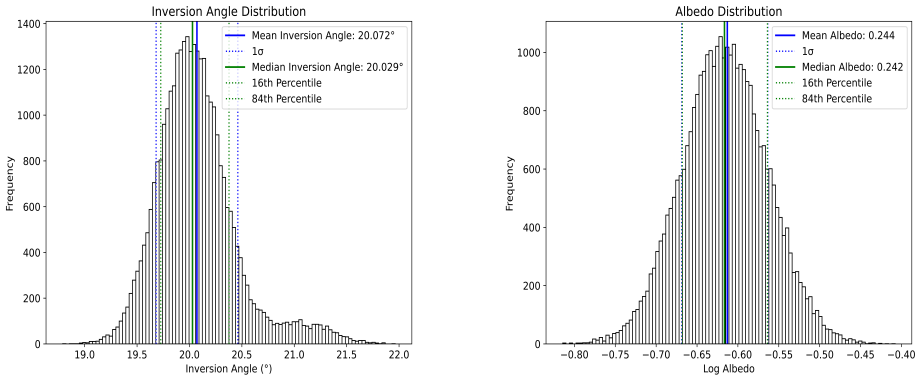
The paper's central discovery is that 1627 Ivar's geometric albedo is about $p_V = 0.24$, not the 0.15 previously quoted, and that the three techniques used to obtain this number are mutually consistent. Using a refined absolute magnitude of $H_V = 12.43$, derived from an $H, G_1, G_2$ phase-function fit with S-type priors, photometry yields $p_V = 0.29 \pm 0.03$; a spherical thermophysical fit to NEOWISE data gives $0.28 \pm 0.10$ and a triaxial ellipsoid fit gives $0.36 \pm 0.15$; and polarimetry, via the slope-albedo relation applied to a measured polarization slope at inversion angle of $h = 0.088 \pm 0.003$ %/deg, gives $p_V = 0.24^{+0.04}_{-0.02}$. The authors propose the polarimetric value as the headline result because it is independent of the absolute magnitude and size whose uncertainties plague the other two techniques, and they note that it agrees with earlier indications above 0.20 in the literature.
Load-bearing premise
The proposed albedo rests on the empirical slope-albedo calibration being accurate for Ivar, with unquantified scatter not folded into the quoted uncertainty; it also depends on the new absolute magnitude $H_V = 12.43$ being correct, since the photometric and thermal albedos shift with it.
Editorial extensions
If this is right
- If Ivar's albedo is truly near 0.24, previous database values near 0.15 are systematically underestimated, largely because they used the fainter MPC absolute magnitude.
- A single polarimetric measurement at phase angle above 30 degrees can yield a reliable albedo for a near-Earth asteroid without lightcurve, shape, or size information.
- The agreement among photometry, thermophysical modeling, and polarimetry validates the cross-referencing approach, allowing it to be extended to a larger sample of near-Earth asteroids.
- For Ivar, the thermophysical fits support an elongated, triaxial shape consistent with the radar-based dimensions of roughly 15 by 6 by 6 kilometers.
- The proposed albedo of about 0.24 implies that Ivar's surface is brighter and likely less primitive than a 0.15 albedo would suggest, with implications for its taxonomic classification.
Reading between the lines
- If the new absolute magnitude is correct, many NEOWISE-derived albedos that rely on MPC magnitudes could be biased low; re-fitting $H$ with phase-function priors across the NEO population would test the size of that shift.
- A public calibration sample for the slope-albedo relation, built from asteroids with albedos measured by spacecraft or direct imaging, would let polarimetry stand fully independent of thermal-model assumptions.
- Applying the same three-technique comparison to radar-shaped NEOs, where the diameter is known geometrically, would separate absolute-magnitude errors from model errors.
- Quantifying how much the internal scatter of the slope-albedo calibration widens the error bars would sharpen the comparison among the three techniques.
Editorial analysis
A structured set of objections, weighed in public.
Referee Report
Summary. The paper determines the geometric albedo of the near-Earth asteroid 1627 Ivar using three techniques: (i) photometric phase-curve fitting to ATLAS data to derive an absolute magnitude H_V = 12.43 ± 0.02, which is then converted to an albedo using a published volume-equivalent diameter; (ii) thermophysical modeling (TPM) of 16 epochs of NEOWISE infrared data with both spherical and triaxial shape models; and (iii) polarimetric observations analyzed with the slope-albedo relation and a single-phase-angle calibration. The authors report a proposed albedo of p_V = 0.24^{+0.04}_{-0.02} from polarimetry and argue that the three techniques give mutually consistent results, validating polarimetry as an efficient independent method for albedo determination.
Significance. If the proposed albedo is correct, it would revise the commonly cited values for Ivar (near 0.15) upward to about 0.24, with implications for the object's inferred size and taxonomic interpretation. The paper's strength is its explicit multi-technique comparison using public data and its candid demonstration that the derived absolute magnitude varies by ~0.2 mag across apparitions, which affects H-dependent albedos. However, the central polarimetric result rests on an empirical calibration whose intrinsic scatter is not propagated, and the claimed cross-validation is weakened by the shared dependence of the photometric and TPM results on the choice of H_V. The study is a useful case study but does not yet establish the claimed level of precision or the full validity of the cross-referencing approach.
major comments (3)
- [Section 4.1 and Table 4] The headline result p_V = 0.24^{+0.04}_{-0.02} is obtained by converting the measured polarization slope h = 0.088 ± 0.003 %/deg through the Cellino et al. (2015) slope-albedo relation. The quoted uncertainties appear to propagate only the formal slope uncertainty (and possibly the inversion-angle prior), but they do not include the intrinsic scatter of the calibration relation itself. Since the calibration is built from asteroids whose albedos were largely determined by thermal modeling, the polarimetric result is not methodologically independent of the TPM values in Table 4, and omitting the calibration scatter makes the headline uncertainty unrealistically small. The authors should either propagate a measured scatter (e.g., via a leave-one-out recalibration or the RMS residual of the Cellino et al. relation) or explicitly state and justify why the calibration scatter can be neglected.
- [Section 2 and Table 4] The paper itself reports that H_V ranges from 12.43 to 12.64 (and up to 12.83 for the MPC value) depending on apparition and dataset, yet the photometric albedo (0.29 ± 0.03) and both TPM albedos (0.28 and 0.36) in the main comparison are computed only from the bright end, H_V = 12.43. As the authors note, using H_V = 12.83 shifts the photometric value to 0.20 and the TPM spherical value to 0.22. Because the polarimetric result is independent of H_V, the 'consistency' between techniques is therefore partly a consequence of choosing the brightest absolute magnitude. To support the cross-validation claim, the paper should show the comparison over the full plausible H_V range (e.g., 12.43, 12.57, 12.64, 12.83) and assess whether the three techniques remain consistent under a conservative choice of H_V.
- [Section 3.4 and Table 2] The consistency claim for the TPM results is weakened by the large uncertainties and model dependence: the spherical model gives p_V = 0.28 ± 0.10 and the triaxial model gives 0.36 ± 0.15, which are mutually consistent only because of error bars of ~35–40%. The paper states the two models agree by a 22% margin, but this is not a strong test of the cross-referencing approach. Moreover, the triaxial fit has a poorly constrained pole position and the authors deliberately excluded the available radar shape model (Section 3.3), which would have provided a much stronger external constraint on the shape and hence on the albedo. The paper should either quantify the consistency with a formal metric (e.g., reduced chi-square or frequentist comparison of overlapping distributions) or temper the claim that the three techniques 'demonstrate the validity' of the approach.
minor comments (6)
- [Section 5] There is a typographical error in the first sentence of Section 5: '1672 Ivar' should be '1627 Ivar'.
- [Figure 3 caption] The caption contains the typo 'mdodel' in reference to the triaxial model; it should read 'model'.
- [Table 4 note] The note under Table 4 contains the typo 'magnitdue' instead of 'magnitude'.
- [Section 5, paragraph 2] The phrase 'as well as much being less computationally-requiring' is grammatically broken; it should read 'as well as being much less computationally demanding'.
- [Introduction, Section 1.1] The taxonomic class 'Sqw' is unusual; consider citing the source taxonomy (e.g., DeMeo et al. 2009 or the specific reference used) to avoid ambiguity.
- [References] The reference list seems to duplicate the Muinonen et al. (2009) and Muinonen et al. (2010) entries under the same journal volume and page; the in-text citation for the H-G1-G2 model (equations 18 and 19) should be resolved to the correct year and page.
Circularity Check
No significant circularity: the polarimetric albedo is an empirical conversion through an external general calibration, and the photometric and TPM estimates are independent of the polarimetric input.
full rationale
The paper's albedo estimates come from three distinct empirical chains. The photometric albedo (0.29±0.03) uses an externally determined radar/lightcurve shape diameter from Crowell (2017) combined with an ATLAS-based HV; neither input is defined in terms of the resulting albedo. The thermophysical model fits diameter and albedo directly from NEOWISE fluxes with the HV held fixed, and the paper explicitly reruns the fit with the MPC HV to show the sensitivity. The headline polarimetric albedo (0.24+0.04/-0.02) is obtained by converting a newly measured polarization-slope h = 0.088±0.003%/deg through the published slope-albedo relation of Cellino et al. (2015), a general empirical calibration based on many other asteroids, not fitted to Ivar. The second polarimetric estimate (0.21±0.05) uses a separate calibration at α=34.29° built from other objects. Thus no 'prediction' is equivalent to an input by construction. The Cellino calibration and the Devogele et al. (2024) MCMC procedure share authors with the present paper, but they are external benchmark results that do not incorporate Ivar's fitted values, so the self-citation is not load-bearing in a circular sense. The photometric and TPM estimates share the same HV, so their mutual consistency is partly H-dependent; the paper discloses this and Table 4 shows the MPC-H variant. Omitting the intrinsic scatter of the Cellino calibration from the quoted uncertainties is an error-bar concern, not a circularity. The claimed cross-validation is a consistency check rather than a logically forced derivation, so the appropriate circularity score is 0.
Assumptions & free parameters
free parameters (4)
- Absolute magnitude H_V =
12.43 ± 0.02 (o-band fit with color correction)
- Phase function parameters G1, G2 =
G1 = 0.23 ± 0.01, G2 = 0.26 ± 0.01
- TPM parameters (diameter, albedo, thermal inertia, crater fraction, pIR/pV, pole, axis ratios) =
Diameter 7.914±0.418 (spherical), 6.700±0.935 (triaxial); albedo 0.28±0.10 and 0.36±0.15; etc.
- Polarimetric phase curve parameters A, B, C =
slope at inversion h = 0.088 ± 0.003%/deg
assumptions (5)
- domain assumption The Cellino et al. (2015) slope-albedo relation maps the polarization slope at inversion angle to geometric albedo for S-type asteroids.
- domain assumption The Umov law calibration at phase angle 34.29 deg (log-log linear fit) gives albedo from polarization.
- standard math The H,G1,G2 phase function (Muinonen et al. 2010) describes Ivar's photometric phase curve.
- domain assumption The thermophysical model (Wright 2007) with specified priors (e.g., two-Rayleigh albedo prior, log-uniform diameter) is appropriate for Ivar.
- domain assumption The color correction of 0.33 mag between ATLAS o band and Johnson V band is accurate.
Cite this review
Pith. "Pith review of Cross validation of albedo determination for 1627 Ivar from three different techniques." pith.science (2026). https://pith.science/paper/FLKSNHZK
@misc{pith2026250102108,
  author       = {Pith},
  title        = {Pith review of: Cross validation of albedo determination for 1627 Ivar from three different techniques},
  year         = {2026},
  howpublished = {\url{https://pith.science/paper/FLKSNHZK}},
  note         = {Machine review of arXiv:2501.02108}
}
abstract
Near Earth Asteroids are of great interest to the scientific community due to their proximity to Earth, making them both potential hazards and possible targets for future missions, as they are relatively easy to reach by spacecraft. A number of techniques and models can be used to constrain their physical parameters and build a comprehensive assessment of these objects. In this work, we compare physical property results obtained from improved $H_V$ absolute magnitude values, thermophysical modeling, and polarimetry data for the well-known Amor-class NEO 1627 Ivar. We show that our fits for albedo are consistent with each other, thus demonstrating the validity of this cross-referencing approach, and propose a value for Ivar's albedo of $0.24^{+0.04}_{-0.02}$ . Future observations will extend this work to a larger sample size, increasing the reliability of polarimetry for rapid asteroid property characterization, as a technique independent of previously established methods and requiring significantly fewer observations.
Figures


Figures from the paper (2 more)

Reference graph
Works this paper leans on
-
[1]
Belskaya, I., Cellino, A., Gil-Hutton, R., et al. 2015, Asteroids iv, 151
work page 2015
- [2]
- [3]
-
[4]
Carry, B., Solano, E., Eggl, S., & DeMeo, F. E. 2016, Icarus
work page 2016
-
[5]
2018, Monthly Notices of the Royal Astronomical Society: Let- ters, 481, L49
Cellino, A., Bagnulo, S., Belskaya, I., & Christou, A. 2018, Monthly Notices of the Royal Astronomical Society: Let- ters, 481, L49
work page 2018
-
[6]
2016, Monthly Notices of the Royal Astronomical Society, 455, 2091 —
Cellino, A., Bagnulo, S., Gil-Hutton, R., et al. 2016, Monthly Notices of the Royal Astronomical Society, 455, 2091 —. 2015, MNRAS, 451, 3473, doi: 10.1093/mnras/stv1188
-
[7]
Crowell, J. e. a. 2017, Icarus, 291
work page 2017
-
[8]
Delbo, M. e. a. 2015, Asteroids IV Delb´ o, M., Harris, A. W., Binzel, Richard P.and Pravec, P., &
work page 2015
Show all 55 references
-
[9]
Davies, J. K. 2003, Icarus, 166 Devog` ele, M., McGilvray, A., MacLennan, E., et al. 2024, The Planetary Science Journal, 5, 44, doi: 10.3847/PSJ/ad1f70 Devog` ele, M., Cellino, A., Bagnulo, S., et al. 2017, Monthly Notices of the Royal Astronomical Society, 465, 4335, doi: 10...
2003 doi
-
[10]
L., Wheeler, L., & Mathias, D
Dotson, J. L., Wheeler, L., & Mathias, D. 2024, Acta Astro- nautica
2024
-
[11]
2010, Astronomy & Astrophysics, 513
Durech, J., Sidorin, V., & Kaasalainen, M. 2010, Astronomy & Astrophysics, 513
2010
-
[12]
2023, Astronomy & Astrophysics, 675, A134
Fenucci, M., Novakovi´ c, B., & Marˇ ceta, D. 2023, Astronomy & Astrophysics, 675, A134
2023
-
[13]
W., Lang, D., & Goodman, J
Foreman-Mackey, D., Hogg, D. W., Lang, D., & Goodman, J. 2013, The Astronomical Society of the Pacific
2013
-
[14]
N., Shkuratov, Y
Fornasier, S., Belskaya, I. N., Shkuratov, Y. G., et al. 2006, Astronomy & Astrophysics
2006
-
[15]
P., et al
Geem, J., Ishiguro, M., Bach, Y. P., et al. 2022, Astronomy & Astrophysics, 658, A158
2022
-
[16]
2024, The Planetary Science Journal, 5, 18 Hanuˇ s, J., Delbo’, M., ˇDurech, J., & Al ´ ı-Lagoa, V
Gray, Z., Bagnulo, S., Granvik, M., et al. 2024, The Planetary Science Journal, 5, 18 Hanuˇ s, J., Delbo’, M., ˇDurech, J., & Al ´ ı-Lagoa, V. 2015, Icarus, 256, 101
2024
-
[17]
W., & Young, J
Harris, A. W., & Young, J. W. 1985, Bulletin of the American Astronomical Society, 17
1985
-
[18]
L., et al
Hoffmann, T., Micheli, M., Cano, J. L., et al. 2024, arXiv preprint arXiv:2408.07474
2024 arXiv
-
[19]
R., & Tholen, D
Hung, D., Hanuˇ s, J., Masiero, J. R., & Tholen, D. J. 2022, Planetary Science Journal
2022
-
[20]
P., Geem, J., et al
Ishiguro, M., Bach, Y. P., Geem, J., et al. 2022, Monthly No- tices of the Royal Astronomical Society, 509, 4128
2022
-
[21]
2000, Kinematika i Fizika Nebesnykh Tel Supplement, 3, 13
Jockers, K., Credner, T., Bonev, T., & et al. 2000, Kinematika i Fizika Nebesnykh Tel Supplement, 3, 13
2000
-
[22]
2018, Electronic Theses and Dissertations, 5838
Jones, J. 2018, Electronic Theses and Dissertations, 5838
2018
-
[23]
2004, Icarus, 167, 178
Kaasalainen, M., et al. 2004, Icarus, 167, 178
2004
-
[24]
1999, Icarus, 140, 464
Kiselev, N., Rosenbush, V., & Jockers, K. 1999, Icarus, 140, 464
1999
-
[25]
2002, in Aster- oids, Comets, and Meteors: ACM 2002, Vol
Kiselev, N., Rosenbush, V., Jockers, K., et al. 2002, in Aster- oids, Comets, and Meteors: ACM 2002, Vol. 500, 887–890
2002
-
[26]
2022, Monthly Notices of the Royal Astronomical Society, 514, 4861
Kiselev, N., Rosenbush, V., Petrov, D., et al. 2022, Monthly Notices of the Royal Astronomical Society, 514, 4861
2022
-
[27]
C., Wright, E
Koren, S. C., Wright, E. L., & Mainzer, A. 2015, Icarus, 258, 82
2015
-
[28]
K., Chandler, C
Kueny, J. K., Chandler, C. O., Devog´ ele, M., et al. 2023, The Planetary Science Journal, 4, 56
2023
-
[29]
S., Balram-Knutson, S
Lauretta, D. S., Balram-Knutson, S. S., Beshore, E., et al. 2017, Space Science Reviews, 212, 925
2017
-
[30]
S., Nolan, M
Magri, C., Howell, E. S., Nolan, M. C., et al. 2011, Icarus, 214, 210
2011
-
[31]
2011a, ApJ, 736, 100, doi: 10.1088/0004-637X/736/2/100 —
Mainzer, A., Grav, T., Masiero, J., et al. 2011a, ApJ, 736, 100, doi: 10.1088/0004-637X/736/2/100 —. 2011b, ApJ, 741, 90, doi: 10.1088/0004-637X/741/2/90
-
[32]
2014, ApJ, 792, 30
Mainzer, A., et al. 2014, ApJ, 792, 30
2014
-
[33]
J., Laher, R
Masci, F. J., Laher, R. R., Rusholme, B., et al. 2018, Publica- tions of the Astronomical Society of the Pacific
2018
-
[34]
R., Redwing, E., Mainzer, A
Masiero, J. R., Redwing, E., Mainzer, A. K., et al. 2018, AJ, 156, 60, doi: 10.3847/1538-3881/aacce4
2018 doi
-
[35]
R., Wright, E
Masiero, J. R., Wright, E. L., & Mainzer, A. K. 2019, AJ, 158, 97, doi: 10.3847/1538-3881/ab31a6 —. 2021b, The Planetary Science J, 2, 32, doi: 10.3847/PSJ/ abda4d
2019 doi
-
[36]
R., et al
Masiero, J. R., et al. 2012, ApJ, 749, 104
2012
-
[37]
L., et al
Mueller, M., Delbo’, M., Hora, J. L., et al. 2011, AJ
2011
-
[38]
N., Cellino, A., et al
Muinonen, K., Belskaya, I. N., Cellino, A., et al. 2010, Icarus, 209, 542
2010
-
[39]
2009, Icarus 209, 542
Muinonen, K., Penttil¨ a, A., Cellino, A., et al. 2009, Icarus 209, 542
2009
-
[40]
2020, Planetary and Space Science, 180, 104774
Okazaki, R., Sekiguchi, T., Ishiguro, M., et al. 2020, Planetary and Space Science, 180, 104774
2020
-
[41]
J., Campbell, D
Ostro, S. J., Campbell, D. B., Hine, A. A., et al. 1990, AJ, 99, 2012
1990
-
[42]
S., et al
Rivkin, A. S., et al. 2021, Planet. Sci. J., 2, 173
2021
-
[43]
R., et al
Satpathy, A., Mainzer, A., Masiero, J. R., et al. 2022, PSJ
2022
-
[44]
G., & Opanasenko, N
Shkuratov, Y. G., & Opanasenko, N. 1992, Icarus, 99, 468
1992
-
[45]
2016, The As- tronomical Journal, 152, 163
Thirouin, A., Moskovitz, N., Binzel, R., et al. 2016, The As- tronomical Journal, 152, 163
2016
-
[46]
2018, Publications of the Astronomical Society of the Pacific, 130, 064505
Tonry, J., Denneau, L., Heinze, A., et al. 2018, Publications of the Astronomical Society of the Pacific, 130, 064505
2018
-
[47]
E., Mueller, M., Hora, J., et al
Trilling, D. E., Mueller, M., Hora, J., et al. 2008, The Astro- physical Journal, 683, L199 Umow, v. N. 1905, Phys. Z, 6, 674
2008
-
[48]
2023, LPI Contributions, 2851, 2590
Vega, N., & Devogele, M. 2023, LPI Contributions, 2851, 2590
2023
-
[49]
Warner, B. D. 2015, Minor Planet Bull., 42, 172
2015
-
[50]
2017, Space Science Reviews, 208, 3
Watanabe, S., Tsuda, Y., Yoshikawa, M., et al. 2017, Space Science Reviews, 208, 3
2017
- [51]
-
[52]
L., Mainzer, A., Masiero, J., Grav, T., & Bauer, J
Wright, E. L., Mainzer, A., Masiero, J., Grav, T., & Bauer, J. 2016, AJ, 152
2016
-
[53]
L., et al
Wright, E. L., et al. 2010, AJ, 140, 1868
2010
-
[54]
L., Eisenhardt, P
Wright, E. L., Eisenhardt, P. R. M., Mainzer, A. K., et al. 2019, IPAC, doi: 10.26131/IRSA1
2019 doi
-
[55]
J., & Dempster, A
Xie, R., Bennett, N. J., & Dempster, A. G. 2021, Acta Astro- nautica, 181, 249 11
2021
Reviewed August 10, 2026 · model on record in the stance chip above.
Discussion (0). Continue with ORCID to comment.