REVIEW 4 major objections 6 minor 28 references
Optimization of Flight Routes: Quantum Approximate Optimization Algorithm for the Tail Assignment Problem
T0 review · 4 major / 6 minor · reviewed 2026-08-11 · deepseek-v4-flash
Pith's one-line read The paper shows that QAOA can solve small, cost-weighted tail-assignment instances with enough circuit layers, and that its time-to-solution scaling is worse than classical branch-and-price and quantum annealing.
desk verdict Honest small-scale application study with a real cost-weighted formulation, but the central Ising coupling is wrong by a factor of two and the numerical claims need that fixed before they can be trusted. read the letter →
The pith
A machine-rendered reading of the paper's core claim, the machinery that carries it, and where it could break.
The reading
What carries the argument
The central object is the reduced set-partitioning QUBO of Eq. (12), in which route costs enter linearly and a penalty term squares the coverage constraint; the binary variables are mapped to an Ising cost Hamiltonian via $x_r \to (1-\hat{\sigma}^z_r)/2$. QAOA alternates cost and mixer unitaries with $2p$ variational parameters, and the INTERP heuristic produces starting angles for depth $p+1$ by interpolating the local optimum found at depth $p$. The route graph's average valency, the number of routes sharing flights with a given route, is used as the diagnostic for problem difficulty.
What would settle it
Re-solve one of the paper's 10-route instances after restoring the tail-usage constraint (each aircraft can fly at most one route and some aircraft cannot serve some flights); if QAOA's success probability falls well below 90% at the same layer counts, the simplified set-partitioning result does not transfer to the full problem.
Extended reading notes
Core claim
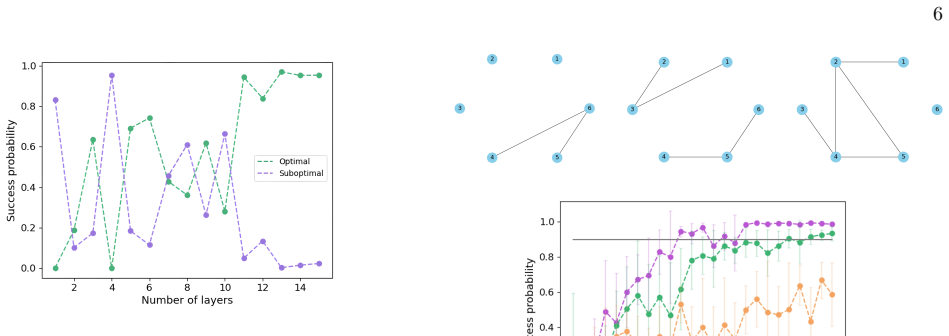
The paper's central claim is that the cost-weighted Tail Assignment Problem, reduced to a set-partitioning problem, can be solved by QAOA with INTERP parameter initialization on realistic small instances: success probability rises with circuit depth and reaches roughly 90% on low-connectivity route graphs with up to 10 routes, while higher average valency degrades that performance. Measured by time-to-solution, QAOA scales worse than both branch-and-price and quantum annealing in the 4-to-14-route range. The paper presents the algorithm as a viable solver for very small simplified instances, with scalability limited by both circuit depth and route-graph connectivity.
Load-bearing premise
The load-bearing premise is that every flight can be assigned, enough aircraft exist, and any aircraft can fly any route, so the tail-usage constraint and aircraft eligibility can be dropped from the model; if those constraints are active, the reported results do not carry over to the full Tail Assignment Problem.
Editorial extensions
If this is right
- With enough layers, QAOA distinguishes the minimum-cost route set from suboptimal feasible sets on the tested instances.
- The number of layers needed grows with route-graph connectivity, so instances where flights appear in many routes are harder regardless of qubit count.
- Time-to-solution grows faster for QAOA than for branch-and-price and quantum annealing in the 4-to-14-route range, so QAOA is not competitive on current sizes.
- Including route costs extends earlier feasibility-only formulations without increasing the number of qubits.
- Any practical quantum advantage would only appear at instance sizes where branch-and-price slows down, which current quantum hardware cannot reach.
Reading between the lines
- Restoring tail-route eligibility and tail-usage constraints would turn the set-partitioning QUBO back into the full Tail Assignment Problem, so the reported success rates are likely an upper bound for the harder problem.
- The time-to-solution model assumes two-qubit gates are executed sequentially; QAOA's disadvantage relative to classical solvers could shrink on hardware that parallelizes entangling gates.
- The INTERP initialization recipe is not problem-specific and could be tested on other set-partitioning QUBOs, with route-graph valency serving as a general hardness predictor.
Editorial analysis
A structured set of objections, weighed in public.
Referee Report
Summary. The paper applies the Quantum Approximate Optimization Algorithm (QAOA) to a simplified version of the Tail Assignment Problem (TAP). The authors formulate the problem as a QUBO with a coverage penalty, map it to an Ising Hamiltonian, and solve small instances (4–15 routes) built from BTS flight data with ICAO-based route costs. They report that QAOA with INTERP parameter initialization finds high-probability optimal solutions when enough layers are used, that higher route-graph valency makes instances harder, and that QAOA's time-to-solution scales worse than branch-and-price and quantum annealing on these sizes.
Significance. If the formulation were correct, the paper would provide a useful empirical benchmark of QAOA on a realistic, cost-weighted airline scheduling problem, and its honest comparison with classical methods would be a valuable data point for quantum optimization research. The use of real flight data, ICAO cost figures, and the INTERP initialization are positive features. However, the central derivation of the Ising coefficients is flawed, which calls into question whether the experiments actually solve the problem stated. The paper's scope is also narrower than its title suggests, since the tail-assignment and unassigned-flight variables are removed.
major comments (4)
- [Section III B 1, Eqs. (15)–(17)] The Ising coefficients in Eqs. (15)–(17) are algebraically inconsistent with the QUBO in Eq. (12) under the substitution x_r = (1 − σ^z_r)/2 of Eq. (13). Expanding the penalty term in Eq. (12) gives a quadratic cross-term 2P Σ_f a_{fr} a_{fr'} x_r x_{r'}, which after substitution yields a ZZ coupling J_{rr'} = (P/2) Σ_f a_{fr} a_{fr'}, not P/4 as written in Eq. (16). Correspondingly, the constant term in Eq. (17) is off by −(P/4) Σ_f (Σ_r a_{fr}) relative to the correct expansion. The h_r coefficient in Eq. (15) is correct. Because Eqs. (16) and (17) are wrong, the cost Hamiltonian actually minimized by QAOA is not an affine image of Q(x). In fact, for flights covered by more than two routes, the effective penalty contribution in the wrong Hamiltonian can become negative, so the ground state may be infeasible even for arbitrarily large P. This directly affects the success probabilities in Section IV A and the time-to-solution comparison in Figure 9. Please correct Eqs. (16) and (17), and state clearly whether the simulations used the printed coefficients or the correct expansion. If the printed (incorrect) coefficients were used, the experimental results need to be re-evaluated.
- [Section III B] The reduction from Eq. (1) to Eq. (11) assumes that all flights can be assigned and that there are enough aircraft, each suitable for any route, thereby removing the variables u_f and v_t. This reduces the problem to a set-partitioning problem over routes, not the full Tail Assignment Problem as defined in Eq. (1). The abstract and conclusions state that 'the TAP is successfully solved using QAOA' without this caveat. The claims should be explicitly qualified to say that a simplified variant of TAP is being solved, since the tail-usage constraint and aircraft-route eligibility are not modeled.
- [Section IV] The penalty weight P in Eq. (12) is never specified for any instance or experiment. P controls the trade-off between route costs and flight-coverage constraints; without P values, the results are not reproducible, and the statement that violating configurations are 'discouraged' depends on P. Please report the P values used in Section IV and provide a sensitivity analysis showing that the reported success probabilities and TTS values are stable with respect to the choice of P.
- [Section IV B, Figure 9] The time-to-solution comparison in Figure 9 is not clearly defined. The text says 'TTS for different instances using different methods,' which may mean that each method was run on different problem instances. In particular, the QA TTS values are attributed to reference [20], a review, suggesting they are not computed on the same instances generated for this paper. A meaningful scalability comparison requires that all methods solve identical instances. Please clarify the benchmarking protocol, state explicitly whether the same instances were used, and if not, explain how the comparison supports the scalability conclusions.
minor comments (6)
- [Section IV A] The heading 'ectionResults applying QAOA' appears to be truncated or mis-formatted; the section structure should be fixed.
- [Section III B] The word 'Formulation' is typeset as 'F ormulation' in the section heading.
- [Table I] The cost data in Table I is attributed to a generic ICAO/DOT Form 41 source without specifying the actual data file or date. Please provide a precise citation for the operating costs.
- [Eq. (18)] The symbol 'log' in Eq. (18) should be specified as the natural logarithm, or the base should be stated explicitly.
- [Figure 8] The caption of Figure 8 does not explain how the gate counts and therefore the time per layer are computed from the problem size; please add the counting formula or a reference for the gate execution times.
- [Section IV A] The 'extra cost for routes with fewer flights' mentioned in the dataset description is not formalized in the model. Please state how this cost is computed and incorporated into the route cost c_r.
Circularity Check
No significant circularity: the QAOA/TAP formulation is an independent QUBO-to-Ising construction benchmarked against external data and classical baselines.
full rationale
The paper derives the cost Hamiltonian from a stated QUBO objective using the standard substitution x_r = (1 - sigma^z_r)/2; the coefficients in Eqs. 15-17 are presented as the result of that expansion, and the subsequent QAOA experiments compare sampled bitstrings against known optimal solutions of the generated instances. The route-cost data come from external BTS/ICAO sources, the route-generation construction is based on a published algorithm (Vikstål et al.), and the comparison methods (brute force, branch-and-price, quantum annealing) are independent baselines. No parameter is fit to the quantity later called a prediction, and no load-bearing premise is justified by a self-citation. The only notable derivation issue is an apparent arithmetic mismatch: re-expanding Eq. 12 under Eq. 13 gives a ZZ coefficient of (P/2) sum_f a_fr a_fr' rather than the P/4 stated in Eq. 16, so the printed Hamiltonian is not exactly equivalent to the printed QUBO objective. That is a correctness/implementation concern, not a circularity of the claimed derivation chain, because the QUBO objective itself is independently defined and the experiments are not defined in terms of the Hamiltonian coefficients.
Assumptions & free parameters
free parameters (3)
- QUBO penalty weight P =
not reported
- Extra cost for routes with fewer flights =
not reported
- Gate execution times for TTS =
one-qubit 50 ns, two-qubit 500 ns
assumptions (5)
- domain assumption A feasible TAP solution exists with all flights assigned and with enough aircraft suitable for any route, so u_f variables and tail-usage constraints are removed.
- ad hoc to paper The QUBO penalty P is large enough that the ground state satisfies the flight coverage constraints.
- domain assumption INTERP parameter initialization, developed for Max-Cut, transfers usefully to TAP route graphs.
- standard math Trotter-Suzuki decomposition gives a valid approximation of the cost and mixer evolution for QAOA.
- domain assumption Circuit execution time can be modeled as worst-case sequential two-qubit gates with 50 ns one-qubit and 500 ns two-qubit gate times.
Cite this review
Pith. "Pith review of Optimization of Flight Routes: Quantum Approximate Optimization Algorithm for the Tail Assignment Problem." pith.science (2026). https://pith.science/paper/FOBLECPT
@misc{pith2026241212773,
  author       = {Pith},
  title        = {Pith review of: Optimization of Flight Routes: Quantum Approximate Optimization Algorithm for the Tail Assignment Problem},
  year         = {2026},
  howpublished = {\url{https://pith.science/paper/FOBLECPT}},
  note         = {Machine review of arXiv:2412.12773}
}
read the original abstract
The Tail Assignment Problem (TAP) is a critical optimization challenge in airline operations, requiring the optimal assignment of aircraft to scheduled flights to maximize efficiency and minimize costs. To address the TAP, this work applies the Quantum Approximate Optimization Algorithm (QAOA), a promising quantum computing algorithm developed for tackling complex combinatorial optimization problems. A detailed formulation of the TAP is provided and QAOA's performance is evaluated on realistic problem instances, examining its strengths and weaknesses. Additionally, QAOA is compared with classical methods such as brute force and branch-and-price, as well as Quantum Annealing (QA), another quantum approach. The analysis reveals the current limitations of quantum hardware but suggests potential advantages as technology advances.
Figures


Figures from the paper (5 more)


Reference graph
Works this paper leans on
-
[20]
M. Suzuki, Generalized trotter’s formula and systematic approximants of exponential operators and inner deriva- tions with applications to many-body problems, Commu- nications in Mathematical Physics 51, 183 (1976)
1976
-
[1]
Then, to apply a full layer in the circuit, the Trotter-Suzuki decomposition formula in Eq
Trotterization The total Hamiltonian is expressed as the sum of the cost and mixer Hamiltonians ( ˆH = ˆHM + ˆHC), which do not necessarily commute. Then, to apply a full layer in the circuit, the Trotter-Suzuki decomposition formula in Eq. 7 is required, from which the corresponding unitary operator is approximated by Eq. 8. eA+B = lim n→∞ eA/neB/n n (7)...
-
[2]
Parameter initialization As discussed in Zhou et al., the task of finding quasi- optimal parameters through random initialization re- quires 2O(p) optimization runs, which becomes exponen- tially difficult as p increases [7]. Addressing this issue, they introduced heuristic optimization strategies for large p, based on observed patterns in the optimal par...
-
[3]
Ising Hamiltonian Applying QAOA involves encoding the objective func- tion into a Hamiltonian, which represents the total en- ergy of the quantum system. An effective qubit encoding scheme is essential to translate the binary decision vari- ables to quantum computation. In this context, the Ising model (Eq. 13) is used, where Pauli-Z operators are in- tro...
work page 2024
-
[4]
Optimal vs Suboptimal Solutions The algorithm can generally find feasible solutions, but identifying the optimal among them is more challenging. This is illustrated in Figure 3, where the INTERP strat- egy was applied to an instance of 6 routes and a low average valency of 0.66 in the route graph. In this ex- ample, there are only two feasible solutions: ...
-
[5]
Connectivity in the route graph The effect of the route graph connectivity was analyzed for instances of 6 and 10 routes, with different average valencies. The INTERP strategy was used for the results, executing each instance 5 times to achieve more reliable results. For the instance of 6 routes, average valencies of 0.66, 1.33, and 1.66 were considered. ...
-
[6]
M. Gr¨ onkvist,The Tail Assignment Problem, Phd thesis, Chalmers University of Technology and G¨ oteborg Uni- versity (2005)
work page 2005
- [7]
Show all 28 references
-
[8]
Montoito, Application of the Simulated Annealing with Adaptive Local Neighborhood Search to the Tail Assign- ment Problem The Case Study of TAP , Ph.D
F. Montoito, Application of the Simulated Annealing with Adaptive Local Neighborhood Search to the Tail Assign- ment Problem The Case Study of TAP , Ph.D. thesis, Master’s thesis, Instituto Superior T´ ecnico, Universidade de Lisboa (2016)
2016
-
[9]
L. N. Martins, A. P. Rocha, and A. J. Castro, A qubo model to the tail assignment problem., in ICAART (2) (2021) pp. 899–906
2021
-
[10]
Vikst ˚ al, M
P. Vikst ˚ al, M. Gr¨ onkvist, M. Svensson, M. Andersson, G. Johansson, and G. Ferrini, Applying the quantum ap- proximate optimization algorithm to the tail-assignment problem, Physical Review Applied 14, 034009 (2020)
2020
-
[11]
Farhi, J
E. Farhi, J. Goldstone, and S. Gutmann, A quan- tum approximate optimization algorithm, arXiv preprint arXiv:1411.4028 (2014)
2014 arXiv
-
[12]
Zhou, S.-T
L. Zhou, S.-T. Wang, S. Choi, H. Pichler, and M. D. Lukin, Quantum approximate optimization algorithm: Performance, mechanism, and implementation on near- term devices, Physical Review X 10, 021067 (2020). 9
2020
-
[13]
Farhi and A
E. Farhi and A. W. Harrow, Quantum supremacy through the quantum approximate optimization algo- rithm, arXiv preprint arXiv:1602.07674 (2016)
2016 arXiv
-
[14]
Willsch, D
M. Willsch, D. Willsch, F. Jin, H. De Raedt, and K. Michielsen, Benchmarking the quantum approximate optimization algorithm, Quantum Information Process- ing 19, 1 (2020)
2020
-
[15]
G. E. Crooks, Performance of the quantum approximate optimization algorithm on the maximum cut problem, arXiv preprint arXiv:1811.08419 (2018)
2018 arXiv
-
[16]
M. N. Omidvar, X. Li, and K. Tang, Designing bench- mark problems for large-scale continuous optimization, Information Sciences 316, 419 (2015)
2015
-
[17]
Preskill, Quantum computing in the nisq era and be- yond, Quantum 2, 79 (2018)
J. Preskill, Quantum computing in the nisq era and be- yond, Quantum 2, 79 (2018)
2018
-
[18]
Hadfield, Z
S. Hadfield, Z. Wang, B. O’gorman, E. G. Rieffel, D. Ven- turelli, and R. Biswas, From the quantum approximate optimization algorithm to a quantum alternating opera- tor ansatz, Algorithms 12, 34 (2019)
2019
-
[19]
Blekos, D
K. Blekos, D. Brand, A. Ceschini, C.-H. Chou, R.-H. Li, K. Pandya, and A. Summer, A review on quan- tum approximate optimization algorithm and its vari- ants, Physics Reports 1068, 1 (2024)
2024
-
[21]
aspx?gnoyr_VQ=FGJ&QO_fu146_anzr=b0-gvzr
https://www.transtats.bts.gov/DL_SelectFields. aspx?gnoyr_VQ=FGJ&QO_fu146_anzr=b0-gvzr
-
[22]
https://www.icao.int/Pages/default.aspx
-
[23]
Bucher, N
D. Bucher, N. Kraus, J. Blenninger, M. Lachner, J. Stein, and C. Linnhoff-Popien, Towards robust bench- marking of quantum optimization algorithms (2024), arXiv:2405.07624 [quant-ph]
2024 arXiv
-
[24]
Barnhart, E
C. Barnhart, E. L. Johnson, G. L. Nemhauser, M. W. Savelsbergh, and P. H. Vance, Branch-and-price: Column generation for solving huge integer programs, Operations research 46, 316 (1998)
1998
-
[25]
Yarkoni, E
S. Yarkoni, E. Raponi, T. B¨ ack, and S. Schmitt, Quan- tum annealing for industry applications: Introduction and review, Reports on Progress in Physics 85, 104001 (2022)
2022
-
[26]
N. Jain, B. Coyle, E. Kashefi, and N. Kumar, Graph neu- ral network initialisation of quantum approximate opti- misation, Quantum 6, 861 (2022)
2022
-
[27]
Shaydulin, I
R. Shaydulin, I. Safro, and J. Larson, Multistart methods for quantum approximate optimization, in 2019 IEEE high performance extreme computing conference (HPEC) (IEEE, 2019) pp. 1–8
2019
-
[28]
S. H. Sack and M. Serbyn, Quantum annealing initializa- tion of the quantum approximate optimization algorithm, quantum 5, 491 (2021)
2021
Reviewed August 11, 2026 · model on record in the stance chip above.
Discussion (0). Continue with ORCID to comment.