REVIEW 4 major objections 5 minor 2 cited by
Direct Evidence for the $\bar{D}D^*/D\bar{D}^*$ Molecular Nature of $G(3900)$ Through Triangular Singularity Mechanisms
T0 review · 4 major / 5 minor · reviewed 2026-08-10 · deepseek-v4-flash
Pith's one-line read The paper predicts triangular-singularity peaks that would confirm the disputed G(3900) as a genuine P-wave Dbar-D* molecular state and pin down its mass.
desk verdict A testable proposal to confirm the molecular nature of G(3900) via triangular singularities, but the 'direct evidence' claim outruns an amplitude that drops spin factors and a mass window that hinges on an upward fluctuation. read the letter →
The pith
A machine-rendered reading of the paper's core claim, the machinery that carries it, and where it could break.
The reading
What carries the argument
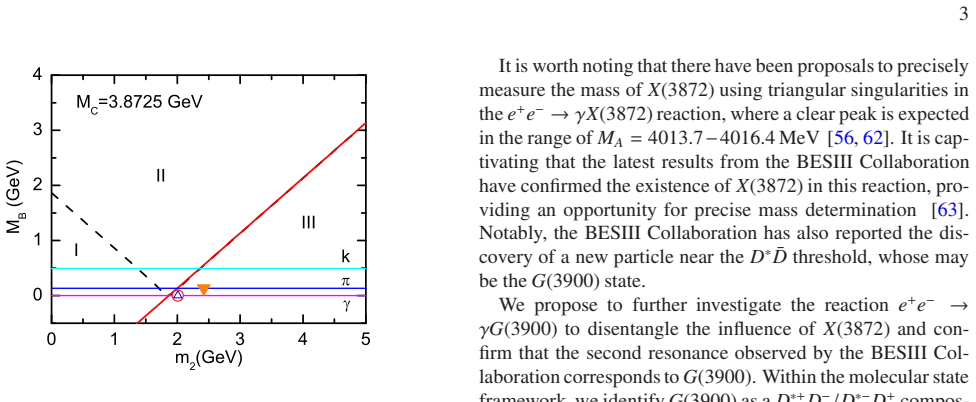
The machinery is the triangular singularity: a decay $A \to B C$ through three intermediate particles $1,2,3$ acquires a branch-point singularity when all three go on-shell and become collinear, as encoded in the Landau equation and the Coleman–Norton theorem. The mass windows in Eqs. (2) and (3) convert that singularity condition into explicit ranges for the external masses $M_A$ and $M_C$; for G(3900) as particle $C$ these ranges select $X(4020)$, $Y(4320)$, and $X(4014)$ as the only viable initial states. The cross section is then approximated by $\sigma[e^+e^- \to \gamma G(3900)] \simeq F^2$, with $F$ the loop amplitude of Eq. (4) from the corresponding $X(3872)$ study; spin factors and coupling constants are dropped because they do not shift the singularity peak.
What would settle it
A dedicated measurement of $e^+e^- \to \gamma G(3900)$ with sufficient statistics to resolve a peak would settle it: if G(3900) is found in the predicted mass window but no peak appears near $M_A \simeq 4020.5$–$4023.2$ MeV (and none near $4013.7$–$4016.4$ MeV from the neutral scenario), the central claim fails. A separate decisive check is a precise mass measurement of G(3900) below $3879.92$ MeV, which would eliminate the charged-channel scenario outright.
Extended reading notes
Core claim
On the paper's own terms, the central claim is that the triangular singularity mechanism turns G(3900) from a disputed bump into a testable prediction: if G(3900) is a real $P$-wave $\bar{D}D^*/D\bar{D}^*$ molecule, then triangle-loop decays of heavy quarkonium-like states into $\gamma G(3900)$ or $\pi G(3900)$ must produce narrow peaks at masses fixed by the Landau conditions. In the charged-channel scenario, with G(3900) built from $D^{*+}D^-$, the required mass window for G(3900) is $3879.92$–$3882.47$ MeV and the peak should appear with an initial-state mass near $4020.52$–$4023.16$ MeV, matching $X(4020)$; the neutral scenario with $\bar{D}^{*0}D^0$ pins the initial state to $4013.7$–$4016.4$ MeV, matching the tentative $X(4014)$, and the $D_1(2420)$ loop places a second peak near $4286.94$–$4303.62$ MeV, matching $Y(4320)$. The line shapes plotted in the paper are obtained by squaring the amplitude $F$ of Eq. (4), adopted from the analogous $X(3872)$ calculation, so the predicted peak positions, not the absolute normalization, are the content that experiment can check.
Load-bearing premise
The load-bearing premise is that G(3900)'s true mass sits inside the narrow window $3879.92$–$3882.47$ MeV required for the charged-channel triangular singularity, even though the measured central value of $3872.5$ MeV (with a $\pm14.2$ MeV error) lies below that window.
Editorial extensions
If this is right
- A triangular-singularity peak in $e^+e^- \to \gamma G(3900)$ near $M_A = 4020.52$–$4023.16$ MeV would confirm G(3900) as a molecular $\bar{D}D^*/D\bar{D}^*$ state without relying on the $D\bar{D}$ channel.
- A peak near $M_A = 4013.7$–$4016.4$ MeV would support the neutral $D^{*0}\bar{D}^0$ assignment and, because it relies on the tentative X(4014), would also provide evidence for that state.
- A peak near $M_A = 4286.94$–$4303.62$ MeV from the $D_1(2420)$ loop would tie G(3900) to Y(4320) and extend the molecular picture to a higher-mass initial state.
- Any detected peak would refine the mass of G(3900) into the window $3879.92$–$3882.47$ MeV, a precision gain over the current $3872.5 \pm 14.2$ MeV measurement.
- The same reactions would separate G(3900) from X(3872), since the two states give triangular-singularity peaks at different initial-state masses in the same final state.
Reading between the lines
- If the predicted peaks are not seen despite a confirmed G(3900) mass inside the required window, the molecular interpretation would be in trouble; a null result outside that window would only test the window, not the state.
- The same Landau-window logic could be applied to other proposed molecular states whose constituent thresholds straddle their measured masses, turning mass measurements into peak-location predictions.
- Equation (4) fixes the shape but not the normalization, so the absolute cross-section size is not predicted; measured rates would supply the omitted spin and coupling factors.
- Confirming or excluding X(4014) is a direct way to discriminate between the neutral and charged scenarios, because the two predict peaks roughly 7–8 MeV apart in the initial-state mass.
Signed reviews
Editorial analysis
A structured set of objections, weighed in public.
Referee Report
Summary. The Letter argues that the exotic state G(3900), observed by BESIII in e+e- → D\bar{D}, is a P-wave D*\bar{D}/D\bar{D}* molecule and proposes triangular-singularity mechanisms in e+e- → γ G(3900) and e+e- → π G(3900) as a way to test this hypothesis. It identifies X(4020), Y(4320), and the tentative X(4014) as possible sources of the triangular-singularity peaks, uses the Landau/Coleman-Norton conditions to derive mass windows, and plots σ[e+e- → γ G(3900)] ≈ F^2 using the amplitude F borrowed from the X(3872) formalism of Ref. [56]. The paper concludes that observation of such peaks would provide direct evidence for the molecular nature of G(3900) and refine its mass.
Significance. If the proposed peaks were computed with the correct P-wave dynamics and shown to be robust against backgrounds, the reactions e+e- → γ(π)G(3900) would offer a genuinely new, experimentally accessible test of the molecular interpretation of G(3900), independent of the original e+e- → D\bar{D} channel. The paper also gives concrete mass windows that could be used by BESIII or Belle II. The strength of the proposal is its falsifiability: the triangle diagram predicts sharp, localized peaks. However, as it stands the calculation is schematic: the amplitude is borrowed from an S-wave X(3872) calculation with spin and coupling factors omitted, the normalization is arbitrary, and the mass-window condition for the charged-channel prediction sits above the BESIII central value. The claim of 'direct evidence' is therefore not yet supported.
major comments (4)
- [Results and Discussions, Eq. (4)] The paper states that the only difference between X(3872) and G(3900) is S-wave versus P-wave, and then uses the same amplitude F from the X(3872) formalism for G(3900). For a P-wave D*\bar{D} molecule, the D*D → G(3900) vertex carries a factor of the relative momentum k, which is energy-dependent inside the loop integral and is not an overall coupling constant. This factor can shift, suppress, or reshape the triangular-singularity peak. As written, Fig. 3 is not a demonstrated prediction for a P-wave G(3900); the calculation must either include the P-wave momentum factor explicitly or justify why it can be absorbed into the proportionality in Eq. (4).
- [Results and Discussions, charged-channel mass window] The X(4020) triangular-singularity scenario for the charged channel requires the mass of G(3900) to lie in the narrow window M_C = 3879.92–3882.47 MeV, as enforced by Eqs. (2) and (3). The BESIII central value quoted in the introduction is M_G(3900) = 3872.5 ± 14.2 ± 3.0 MeV, which is below the lower bound of this window. The paper gives no reason to prefer an upward fluctuation of the measured mass. Consequently, the charged-channel curve in Fig. 3 is not a prediction at the current central mass but a conditional scan over a mass range that is only partially consistent with the experimental measurement; this must be stated and the robustness of the scenario across the full 1σ range must be quantified.
- [Results and Discussions, Eq. (4) and Fig. 3] The plotted cross section is defined only up to an arbitrary normalization, σ[e+e- → γ G(3900)] ≃ F^2 with F known up to a proportionality constant and with coupling constants omitted. There is no estimate of the expected signal size, no background model from continuum e+e- → γ(D\bar{D}) or non-triangle production mechanisms, and no uncertainty band. A 'prominent peak' in an arbitrarily normalized curve is not, by itself, direct evidence for the molecular interpretation. The central claim needs at least a relative normalization, a background estimate, or a dedicated experimental-search strategy with expected yields.
- [Our Strategies, Eqs. (2)–(3)] The construction uses the experimentally measured mass of G(3900) and the assumption that G(3900) is a D*\bar{D} molecule as inputs to the Landau conditions. The mass windows for X(4020), X(4014), and Y(4320) are then kinematic consequences of those inputs, not independent predictions. This does not make the proposal circular in a destructive sense—the predicted reaction peaks are still testable—but the manuscript should be rewritten so that the testable content is explicit: a variety of G(3900) masses and molecular scenarios should be varied, and the conclusions should distinguish between 'prediction' and 'conditioned on the molecular hypothesis and the current central mass.'
minor comments (5)
- [Abstract and Introduction] The abstract says BESIII analyses 'classify it as a P-wave molecular state,' but the cited experimental paper [35] is an experimental observation; the P-wave molecular classification comes from theoretical analyses [36, 42]. The wording should attribute the classification to theory rather than to the BESIII data analysis.
- [Results and Discussions] There is a grammatical error in the sentence 'whose may be the G(3900) state'; it should be rephrased, for example, 'which may be the G(3900) state.'
- [Results and Discussions and Summary] The phrase 'linear shape' is used where 'line shape' is intended; this occurs in the paragraph introducing Eq. (4) and in the Summary.
- [Fig. 3] The axis labels in Fig. 3 are difficult to read in the manuscript version, and the caption should state explicitly which mass window is used for each curve (neutral versus charged D*\bar{D}).
- [References] Reference [41] is cited as an arXiv preprint; if a published version exists, it should be cited instead. Also, Ref. [36] is cited as 'Phys. Rev. Lett. 133 (2024), 24.'—the article number should be verified.
Circularity Check
No significant circularity: the predicted γG(3900) line shape follows from external masses and the Landau conditions, with no fitted parameters; the self-citation is non-load-bearing.
full rationale
The derivation is not circular in the sense defined here. The paper takes the BESIII mass of G(3900) and an external triangular-singularity amplitude F from Ref. [56] as inputs, and computes the line shape of e+e- → γG(3900) by direct substitution into Eq. (4); the peak locations are dictated by the Landau/Coleman-Norton conditions (Eqs. (2)-(3)) and the known charmed-meson masses. No parameter in F is fitted to the e+e- → γG(3900) process, because no such data exist. The molecular nature of G(3900) is an assumption under test, not an output of the calculation, so a future observation of the predicted peaks would be genuine support. The only self-citation, Ref. [69], supplies a mass range for the Y(4320) scenario that is a direct application of Eqs. (2)-(3), so it is not load-bearing in a circular way. The use of the S-wave X(3872) amplitude for a P-wave G(3900) without the P-wave momentum factor is a physics-overclaim/correctness risk, not a circularity, and the requirement MC ≥ 3879.92 MeV places a stringent condition on the BESIII central value; these concerns belong in a correctness review rather than a circularity score.
Assumptions & free parameters
assumptions (4)
- standard math The Landau and Coleman-Norton conditions correctly locate triangular singularity peaks in the reactions considered.
- domain assumption G(3900) is a P-wave D-D* molecular state with mass near the values used (3872.5 MeV or 3879.9-3882.5 MeV).
- domain assumption The amplitude F for X(4020) to gamma G(3900) equals the X(3872) production amplitude from Ref. [56] with masses substituted; spin and coupling factors do not affect the peak position.
- domain assumption The candidate states X(4020), Y(4320), and X(4014) exist and can couple to the required intermediate states.
Cite this review
Pith. "Pith review of Direct Evidence for the $\bar{D}D^*/D\bar{D}^*$ Molecular Nature of $G(3900)$ Through Triangular Singularity Mechanisms." pith.science (2026). https://pith.science/paper/FSVV3LCX
@misc{pith2026250110992,
  author       = {Pith},
  title        = {Pith review of: Direct Evidence for the $\barDD^*/D\barD^*$ Molecular Nature of $G(3900)$ Through Triangular Singularity Mechanisms},
  year         = {2026},
  howpublished = {\url{https://pith.science/paper/FSVV3LCX}},
  note         = {Machine review of arXiv:2501.10992}
}
abstract
The exotic hadron $G(3900)$, initially observed in the process $e^+ e^- \to D\bar{D}$, has been further supported by analyses from the BESIII Collaboration, which classify it as a $P$-wave molecular state of $D^{+}D^{*-}/D^{-}D^{*+}$. However, theoretical discussions raise concerns about its status as a true particle, emphasizing the need for additional studies. In this Letter, we employ the triangular singularity mechanism to investigate $G(3900)$ across various reaction channels, allowing us to produce significant peaks without relying on the existence of a real particle. We identify $X(4020)$, $Y(4320)$, and the tentative $X(4014)$ as potential sources of these peaks via decay processes to $\gamma G(3900)$ or $\pi G(3900)$. We stress the importance of experimental explorations of $e^+ e^- \to X/Y \to \gamma(\pi) G(3900)$, which are essential for confirming the molecular composition of $D^{+}D^{*-}/D^{-}D^{*+}$ and refining the mass measurement of $G(3900)$.
Figures


Forward citations
Cited by 2 Pith papers
-
Searching for the $G(3900)$ via the $K^- p \to D_s^- \Lambda_c^+ G(3900)^0$ reaction
Predicted total and differential cross sections for K−p→Ds−Λc+G(3900)0, enhanced by KN initial-state interactions, offer an interference-free probe of whether G(3900) is a genuine P-wave molecular resonance.
-
Pole trajectories from $S$- and $P$-wave $D\bar{D}^*$ interactions
A pole-trajectory study of D-D* interactions finds molecular candidates matching X(3872), its isovector partner, Z_c(3900), and G(3900), plus a new predicted 0-+ state.
Reference graph
Works this paper leans on
-
[56]
F. K. Guo, Phys. Rev. Lett. 122 (2019), 202002
work page 2019
-
[1]
Par- ticle B originates from the decay of the intermediate particle 2 through the reaction 2 → 3 + B, implying that the mass of particle 2 must exceed the threshold mass of the 3 and B system. Based on the mass relationships of particles A and C, we find that to observe a triangular singularity signal experim en- tally, the masses of particles A and C must...
work page 2006
- [2]
-
[3]
R. Koniuk and N. Isgur, Phys. Rev. D 21, 1868 (1980) [erratum: Phys. Rev. D 23, 818 (1981)]
work page 1980
-
[4]
N. Isgur and G. Karl, Phys. Rev. D 19, 2653 (1979) [erratum: Phys. Rev. D 23, 817 (1981)]
work page 1979
-
[5]
S. Navas et al et al. [Particle Data Group], Phys. Rev. D 110, 030001 (2024)
work page 2024
- [6]
-
[7]
J. A. Oller and U. G. Meissner, Phys. Lett. B 500, 263-272 (2001)
work page 2001
Show all 76 references
-
[8]
Nemoto, N
Y . Nemoto, N. Nakajima, H. Matsufuru and H. Suganuma, Phys. Rev. D 68, 094505 (2003)
2003
-
[9]
F. K. Guo, C. Hanhart, U. G. Meißner, Q. Wang, Q. Zhao and B. S. Zou, Rev. Mod. Phys. 90, 015004 (2018) [erratum: Rev. Mod. Phys. 94, 029901 (2022)]
2018
-
[10]
S. K. Choi et al. [Belle], Phys. Rev. Lett. 91, 262001 (2003)
2003
-
[11]
Brambilla, S
N. Brambilla, S. Eidelman, C. Hanhart, A. Nefediev, C. P . Shen, C. E. Thomas, A. V airo and C. Z. Y uan, Phys. Rept.873, 1-154 (2020)
2020
-
[12]
H. X. Chen, W. Chen, X. Liu, Y . R. Liu and S. L. Zhu, Rept. Prog. Phys. 86, 026201 (2023)
2023
-
[13]
Coleman and Nor - ton’s careful analysis of Eq
(1) Where yi j = (m2 i + m2 j − p2 i j)/ (2mim j), with mi (i = 1, 2, 3) representing the masses of intermediate particles, and p2 i j = (pi + p j)2 = m2 i j being the four-momentum of the i j pair, which corresponds to the external particle. Coleman and Nor - ton’s careful an...
-
[14]
J. M. M. Hall, W. Kamleh, D. B. Leinweber, B. J. Menadue, B. J. Owen, A. W. Thomas and R. D. Y oung, Phys. Rev. Lett. 114, 132002 (2015)
2015
-
[15]
Ablikim et al
M. Ablikim et al. [BESIII], Phys. Rev. Lett. 111, 242001 (2013)
2013
-
[16]
Ablikim et al
M. Ablikim et al. [BESIII], Phys. Rev. Lett. 113, 212002 (2014)
2014
-
[17]
L. Meng, B. Wang, G. J. Wang and S. L. Zhu, Phys. Rept. 1019, 1-149 (2023)
2023
-
[18]
Ablikim et al
M. Ablikim et al. [BESIII], Phys. Rev. Lett.112,132001 (2014)
2014
-
[19]
Aaij et al
R. Aaij et al. [LHCb], Phys. Rev. Lett. 117, 082002 (2016)
2016
-
[20]
Aaij et al
R. Aaij et al. [LHCb], Phys. Rev. Lett. 117,082003 (2016)
2016
-
[21]
Bondar et al
A. Bondar et al. [Belle], Phys. Rev. Lett. 108, 122001 (2012)
2012
-
[22]
Aaij et al
R. Aaij et al. [LHCb], Phys. Rev. Lett. 115, 072001 (2015)
2015
-
[23]
Aaij et al
R. Aaij et al. [LHCb], Phys. Rev. Lett. 131, 031901 (2023)
2023
-
[24]
H. X. Chen, W. Chen and S. L. Zhu, Phys. Rev. D 100, 051501 (2019)
2019
-
[25]
Aaij et al
R. Aaij et al. [LHCb], Phys. Rev. Lett. 122, 222001 (2019)
2019
-
[26]
Aaij et al
R. Aaij et al. [LHCb], Sci. Bull. 66, 1278-1287 (2021)
2021
-
[27]
J. He, Eur. Phys. J. C 79,393 (2019)
2019
-
[28]
C. J. Xiao, Y . Huang, Y . B. Dong, L. S. Geng and D. Y . Chen, Phys. Rev. D 100,014022 (2019)
2019
-
[29]
F. K. Guo, H. J. Jing, U. G. Meißner and S. Sakai, Phys. Rev . D 99,091501 (2019)
2019
-
[30]
C. W. Xiao, J. Nieves and E. Oset, Phys. Rev. D 100,014021 (2019)
2019
-
[31]
R. Chen, X. Liu, X. Q. Li and S. L. Zhu, Phys. Rev. Lett. 115,132002 (2015)
2015
-
[32]
Yang and J
G. Yang and J. Ping, Phys. Rev. D 95, 014010 (2017)
2017
-
[33]
L. Roca, J. Nieves and E. Oset, Phys. Rev. D 92, 094003 (2015)
2015
-
[34]
H. X. Chen, W. Chen, X. Liu, T. G. Steele and S. L. Zhu, Phys . Rev. Lett. 115,172001 (2015)
2015
-
[35]
Ablikim et al
M. Ablikim et al. [BESIII], Phys. Rev. Lett. 133 (2024), 081901
2024
-
[36]
Z. Y . Lin, J. Z. Wang, J. B. Cheng, L. Meng and S. L. Zhu, Phys. Rev. Lett. 133 (2024), 24
2024
-
[37]
Huang, C
H. Huang, C. Deng, J. Ping and F. Wang, Eur. Phys. J. C 76, 624 (2016)
2016
-
[38]
M. L. Du, V . Baru, F. K. Guo, C. Hanhart, U. G. Meißner, J. A. Oller and Q. Wang, Phys. Rev. Lett. 124 (2020), 072001
2020
-
[39]
Eichten, K
E. Eichten, K. Gottfried, T. Kinoshita, K. D. Lane and T. M. Yan, Phys. Rev. D 21 (1980), 203
1980
-
[40]
T. V . Uglov, Y . S. Kalashnikova, A. V . Nefediev, G. V . Pakhlova and P . N. Pakhlov, JETP Lett.105 (2017), 1-7
2017
-
[41]
Aubert et al
B. Aubert et al. [BaBar], Phys. Rev. D 76 (2007), 111105
2007
-
[42]
Pakhlova et al
G. Pakhlova et al. [Belle], Phys. Rev. D 77 (2008), 011103
2008
-
[43]
S. G. Salnikov and A. I. Milstein, Phys. Rev. D 109 (2024), 114015
2024
-
[44]
H¨ usken, R
N. H¨ usken, R. F. Lebed, R. E. Mitchell, E. S. Swanson, Y . Q. Wang and C. Z. Y uan, Phys. Rev. D109 (2024), 114010
2024
-
[45]
S. X. Nakamura, X. H. Li, H. P . Peng, Z. T. Sun and X. R. Zhou, [arXiv:2312.17658 [hep-ph]]
-
[46]
M. L. Du, U. G. Meißner and Q. Wang, Phys. Rev. D 94 (2016), 096006
2016
-
[47]
Ablikim et al
M. Ablikim et al. [BESIII], Phys. Rev. Lett. 108 (2012), 182001
2012
-
[48]
J. J. Wu, X. H. Liu, Q. Zhao and B. S. Zou, Phys. Rev. Lett. 108 (2012), 081803
2012
-
[49]
N. N. Achasov and A. A. Kozhevnikov, Z. Phys. C 48 (1990), 121-130
1990
-
[50]
S. I. Bityukov, R. I. Dzhelyadin, V . A. Dorofeev, S. V . Golovkin, M. V . Gritsuk, A. S. Konstantinov, V . P . Kubarovsky, A. I. Kulyavtsev, V . F. Kurshetsov and L. G. Landsberg, et al. Phys. Lett. B 188 (1987), 383
1987
-
[51]
F. K. Guo, C. Hanhart, G. Li, U. G. Meissner and Q. Zhao, Phys. Rev. D 83, 034013 (2011)
2011
-
[52]
F. K. Guo, X. H. Liu and S. Sakai, Prog. Part. Nucl. Phys. 112 (2020), 103757
2020
-
[53]
Mikhasenko, B
M. Mikhasenko, B. Ketzer and A. Sarantsev, Phys. Rev. D 91 (2015), 094015
2015
-
[54]
F. K. Guo, C. Hanhart, Q. Wang and Q. Zhao, Phys. Rev. D 91 (2015), 051504
2015
-
[55]
A. S. Sakthivasan, M. Mai, A. Rusetsky and M. D¨ oring, JH EP 10 (2024), 246
2024
-
[57]
F. K. Guo, U. G. Meißner, W. Wang and Z. Yang, Phys. Rev. D 92,071502 (2015)
2015
-
[58]
X. H. Liu, M. Oka and Q. Zhao, Phys. Lett. B 753 (2016), 297- 302
2016
-
[59]
Coleman and R
S. Coleman and R. E. Norton, Nuovo Cim. 38, 438-442 (1965)
1965
-
[60]
Schmid, Phys
C. Schmid, Phys. Rev. 154,1363 (1967)
1967
-
[61]
Karplus, C
R. Karplus, C. M. Sommerfield and E. H. Wichmann, Phys. Rev. 111, 1187-1190 (1958)
1958
-
[62]
L. D. Landau, Nucl. Phys. 13, 181-192 (1959)
1959
-
[63]
Ablikim et al
M. Ablikim et al. [BESIII], Phys. Rev. Lett. 132 (2024), 151903
2024
-
[64]
Braaten, L
E. Braaten, L. P . He and K. Ingles, Phys. Rev. D 101 (2020), 014021
2020
-
[65]
X. L. Wang et al. [Belle], Phys. Rev. D 105 (2022), 112011
2022
-
[66]
Braaten, L
E. Braaten, L. P . He and K. Ingles, Phys. Rev. D 100 (2019), 031501
2019
-
[67]
von Detten, V
L. von Detten, V . Baru, C. Hanhart, Q. Wang, D. Winney and Q. Zhao, Phys. Rev. D 109 (2024), 116002
2024
-
[68]
Colangelo, F
P . Colangelo, F. De Fazio and R. Ferrandes, Phys. Lett. B 634 (2006), 235-239
2006
-
[69]
Braaten, L
E. Braaten, L. P . He, K. Ingles and J. Jiang, Phys. Rev. D 101 (2020), 096020
2020
-
[70]
Dubynskiy and M
S. Dubynskiy and M. B. V oloshin, Phys. Rev. D 74 (2006), 094017
2006
-
[71]
T. Ji, X. K. Dong, F. K. Guo and B. S. Zou, Phys. Rev. Lett. 129 (2022), 102002
2022
-
[72]
Q. Wang, C. Hanhart and Q. Zhao, Phys. Rev. Lett. 111 (2013), 132003
2013
- [73]
-
[74]
Ablikim et al
M. Ablikim et al. [BESIII], Phys. Rev. D 106 (2022), 072001
2022
-
[1869]
Under these conditions, the mass of G(3900) must surpass 3879.92 MeV
66 MeV). Under these conditions, the mass of G(3900) must surpass 3879.92 MeV . This finding indicates that the tri - angular singularity mechanism not only facilitates the ide nti- fication of G(3900) as a true D∗ ¯D/ ¯D∗D molecular state but also enhances precision in mass mea...
-
[4013]
4 MeV, a range capable of generating a triangu- lar singularity
7−4016. 4 MeV, a range capable of generating a triangu- lar singularity. Currently, there remains uncertainty reg arding the existence of such a particle that can decay into the final state D∗0 ¯D∗0. Notably, in 2022, the Belle Collaboration re- ported measurements of the cross...
2022
Reviewed August 10, 2026 · model on record in the stance chip above.
Discussion (0). Continue with ORCID to comment.