REVIEW 3 major objections 7 minor 1 cited by
Entropy and singular-value moments of products of truncated random unitary matrices
T0 review · 3 major / 7 minor · reviewed 2026-08-10 · deepseek-v4-flash
Pith's one-line read The singular-value moments of products of truncated Haar unitary matrices are given by the Erlang delay function in the double-scaling limit, yielding an explicit von Neumann entropy reduction formula.
desk verdict Clean double-scaling moment formula and entropy for truncated unitary products, honest about a load-bearing unproven Erlang conjecture; deserves peer review. read the letter →
The pith
A machine-rendered reading of the paper's core claim, the machinery that carries it, and where it could break.
The reading
What carries the argument
The mechanism is a recursion for the moments $S_p(n)=N^{-1}\mathrm{Tr}\,(Q_nQ_n^\dagger)^p$ in the large-$N$ Gaussian approximation. Adding one projector $P_{n+1}$ produces a first-order linear recursion in $S_p$ whose coefficients are sums over binary strings $x_i\in\{0,1\}$ of products of lower moments $S_{d_i}(n)^{x_i}$, with $d_i$ determined by cyclic runs of ones. Solving these recursions sequentially and taking $L,N\to\infty$ at fixed $\tau=L\delta N/N$ gives the polynomial family (4.2), which is then identified with the Erlang delay function $G_p(\tau)$, a function whose usual home is queueing theory. The decisive feature is that the identification yields an analytic function of $p$, so singular-value density and R\'enyi and von Neumann entropies can be extracted without a separate moment-generating-function calculation.
What would settle it
Take $N$ large with fixed truncation depth $\delta N$, form many independent products of $L=\tau N/\delta N$ truncated Haar unitary matrices, and numerically histogram $\lambda=-\ln\sigma^2$ or compute the R\'enyi entropy $E_\alpha$ at a non-integer index such as $\alpha=1/2$ or $3/2$ directly from the singular values. Compare with the inverse Laplace transform of (4.1) and with (6.7): the integer-moment checks in the paper cannot distinguish the assumed all-$p$ Erlang continuation, but a non-integer R\'enyi entropy or a high-resolution density histogram can, so a systematic disagreement would disprove the continuation while leaving the integer moments intact.
Extended reading notes
Core claim
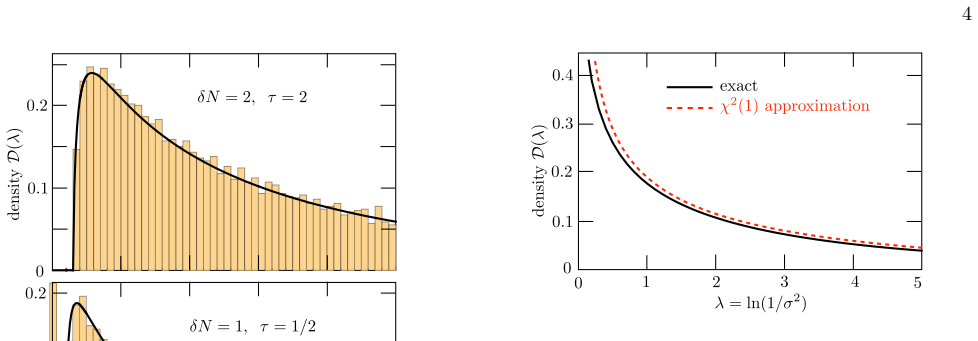
The central discovery is formula (4.1): in the double-scaling limit, the moments $S_p(L)$ of the squared singular values of $C_L=\tilde U_L\cdots \tilde U_1$ are $S_p(L)=e^{-p\tau}G_p(\tau)/\Gamma(p)$, with $G_p(\tau)$ the Erlang delay function $G_p(\tau)=(1-\tau)(p-1)!\sum_{i=0}^{p-1}(p\tau)^i/i!+\tau^p p^{p-1}$. The first six polynomial cases match a known series pattern that identifies $G_p$ as the Erlang delay function, and the paper assumes this identification for all $p$. This closed form allows analytic continuation in $p$, so the moment sequence determines the density of $\lambda=-\ln\sigma^2$ by inverse Laplace transform, producing a delta-function peak at unit singular value for $\tau<1$, a square-root edge at $\lambda_{\min}=\tau-1-\ln\tau$ for $\tau>1$, and near $\tau=1$ an exponentiated chi-square distribution. The same continuation yields the von Neumann entropy reduction $S_L-\ln N = -\ln\tau+e^\tau(\tau-1)\Gamma(0,\tau)-\gamma_{\rm Euler}$, whose small- and large-$\tau$ asymptotics match existing weak-measurement models.
Load-bearing premise
The load-bearing premise is that the polynomial family (4.2), checked for $p=1,\dots,6$, coincides with the Erlang delay function for every real $p$, including the non-integer values needed for the density and entropy; the author states this is assumed without insight, and if it fails the derived density and entropy formulas would be wrong even though the integer moments are correct.
Editorial extensions
If this is right
- All singular-value statistics in the double-scaling limit depend only on the single parameter $\tau=L\delta N/N$, with integer moments $e^{-p\tau}G_p(\tau)/\Gamma(p)$.
- The singular-value density separates into regimes: for $\tau<1$ a fraction $1-\tau$ of singular values sit at unity plus a continuous part with a square-root edge; for $\tau>1$ the continuous part starts at $\lambda_{\min}=\tau-1-\ln\tau$; at $\tau=1$ the density is close to an exponentiated chi-square with one degree of freedom.
- The von Neumann entropy of the normalized product is $S_L=\ln N -\ln\tau + e^\tau(\tau-1)\Gamma(0,\tau)-\gamma_{\rm Euler}$, giving linear decay in $\tau$ for small $\tau$ and logarithmic decay $\ln(N/\tau)$ for $1\ll\tau\ll N$.
- The $\tau=1$ case gives a closed-form moment formula for products of $N$ rank-$(N-1)$ random projections, relevant to Kaczmarz-type projection algorithms.
- The entropy asymptotics agree with non-projective weak-measurement models, supporting universality of the purification transition in monitored quantum circuits.
Reading between the lines
- Because the Gaussian approximation treats real and complex projection vectors alike, the same Erlang moment formula should hold for products of truncated real orthogonal matrices; a direct finite-$N$ check at non-integer powers of the singular values would test the all-$p$ continuation.
- The appearance of the Erlang delay function hints that the log singular values in the double-scaling limit may follow a Poisson or queueing-type process, which would give a mechanistic explanation the paper does not supply.
- The $\tau=1$ exponentiated chi-square distribution could provide a quantitative convergence criterion for Kaczmarz-type algorithms, going beyond the heuristic connection the paper closes with.
- The entropy formula suggests that finite-$N$ corrections to the double-scaling limit depend only on $\delta N/N$; computing those corrections would show whether the Erlang continuation is exact or only leading order.
Editorial analysis
A structured set of objections, weighed in public.
Referee Report
Summary. The paper analyzes products C_L = tilde U_L ... tilde U_1 of L independently Haar-distributed unitary matrices of dimension N, each truncated by zeroing the first delta N rows and columns, in the double-scaling limit L, N -> infinity with fixed tau = L delta N / N. The equivalent random-projector product (Sec. II.B) permits a large-N Gaussian average over the projector vectors, which yields a closed system of first-order recursion relations (Eq. 3.3) for the singular-value moments S_p(n) = (1/N) E Tr(Q_n Q_n^dagger)^p. The paper's central claim is that in the double-scaling limit S_p(L) = e^{-p tau} G_p(tau) / Gamma(p), with G_p the Erlang delay function of queueing theory (Eqs. 4.1-4.3); the match is verified numerically for p = 1..6. From the claimed analytic continuation in p, the author reconstructs the singular-value density by inverse Laplace transformation (Sec. V), derives the large-p tail (4.4) and the square-root edge lambda_min = tau - 1 - ln tau of the density (5.3), and obtains the von Neumann entropy reduction S_L - ln N = -ln tau + e^tau (tau - 1) Gamma(0, tau) - gamma_Euler (Eq. 6.8) by analytically continuing the Rényi entropy. The entropy asymptotics agree with three independent weak-measurement models (Refs. 15-17). The paper states explicitly that the all-p identification with the Erlang function, and hence the analytic continuation, is assumed rather than proved.
Significance. If Eq. (4.1) holds for all p, this is a clean, parameter-free characterization of random contraction products in the double-scaling limit, with new falsifiable predictions: the large-p decay (4.4), the square-root density edge (5.3), and the full Rényi entropy curve (6.7). The paper earns credit for deriving the moment recursion from elementary Wick contractions, for checking both unitary and orthogonal ensembles numerically (N = 300, 20 realizations), for reporting the explicit match to a known special function, and for confirming the entropy asymptotics against independent models (Refs. 15-17). The crossover from linear to logarithmic entropy reduction in tau is robust and clearly presented. The central limitation is that the technical basis of the density and entropy results, the all-p Erlang identification and its analytic continuation to non-integer p, is explicitly conjectural; the present evidence does not determine the quantities in Eqs. (5.3) and (6.8).
major comments (3)
- [Sec. IV.A, Eqs. (4.1)-(4.3)] The transition from the recursion (3.3) to the closed form (4.1) is not demonstrated (the text says 'We find'), and the matching of the six polynomials in (4.2) to the Erlang delay function (4.3) is explicitly stated as an assumption: 'We assume the correspondence between Eqs. (4.2) and (4.3) holds for all p, although we have no insight why a delay function from queueing theory would appear in the present context.' This assumption is load-bearing for Eq. (4.4), for the density near the edge (5.3), and for the Rényi and von Neumann entropies (6.7)-(6.8). The numerical check (N = 300, 20 realizations, p up to 6) does not constrain the large-p moments that determine those quantities. Because the recursion (3.3) is a closed deterministic system for integer p within the leading-order Gaussian theory, the identification can be checked without further random-matrix sampling to moderately large p (for example, p up to about 30) by iterating the recursion symbolically, and ideally proved by induction if a closed-form solution exists. I ask that the author either supply the derivation of (4.1) for general p, or at minimum add the high-p recursion check, and state explicitly which numbered results are theorems and which are conjectural.
- [Secs. V.A and VI, Eqs. (5.1)-(5.2), (6.4)-(6.8)] The analytic continuation to non-integer p is used but not justified. The recursion (3.3) defines S_p(n) only for positive integer p, yet the inverse Laplace transform (5.2) evaluates S_p(L) on a vertical contour in the complex p-plane, and the Rényi entropy expression (6.7) requires S_alpha for real alpha, including the limit alpha -> 1 that gives the von Neumann entropy (6.8). Infinitely many entire functions interpolate the integer moments, so the Erlang continuation is one of many possibilities unless the physical moment sequence is shown to be its restriction. For (6.8) it would suffice to prove correctness of the continuation in a neighborhood of alpha = 1; for the density (5.3), a direct verification that the claimed density reproduces all integer moments, or a moment-problem determinacy argument applied to the full integer moment sequence of the claimed density, would close the gap.
- [Sec. II.C and Eq. (3.3)] The Gaussian approximation is not controlled uniformly in p. Equation (3.3) is quoted to leading order in 1/N with O(1/N^2) remainders, and the number of recursion steps is L = tau N / delta N, so the accumulated error is O(tau / (N delta N)) only if the remainders are uniform in n and do not grow too rapidly with p. The Wick-contraction count in the average over the projector vectors grows factorially with p, so the large-p tail (4.4), which generates the square-root edge (5.3), is the part of the result least protected by the N -> infinity limit. A brief statement on the p-dependence of the discarded remainders, or a numerical comparison of the tail against the recursion solution at moderately large p, would address the point.
minor comments (7)
- [Eq. (3.1)] There is a typesetting error: 'TrBp n]' should read 'Tr(B_n^p)', and 'B n' should read 'B_n' in the same line.
- [Eq. (3.3)] The definition of d_i as the smallest integer delta such that x_{i+delta mod p} = 1 is difficult to parse; a worked example for p = 4 would help the reader verify the recursion.
- [Sec. II.B] The correspondence between the length-L truncated product C_L and the (L+1)-term projector product, which underlies the shifted comparison tau = (L+1) delta N / N in Fig. 1 and footnote 30, should be stated explicitly in the main text.
- [Refs. [24] and [29]] References [24] and [29] cite the same book by R. B. Cooper with different publishers; they should be merged into a single entry.
- [Sec. V.A] The numerical Laplace inversion of (5.2) is not described (contour choice, discretization); one sentence on the method would aid reproducibility.
- [Footnote 32] The notation 'N = 2N' uses the same symbol N for the Hilbert-space dimension and the number of spin-1/2 degrees of freedom; distinct symbols would avoid confusion.
- [Sec. VI, Eq. (6.5)] The replacement of the random traces by their expectation values in Eq. (6.5) presumes self-averaging of Tr(C_L C_L^dagger)^alpha; a brief variance estimate would make this step explicit.
Circularity Check
No circularity: the all-p Erlang identification is an explicit conjecture and a correctness risk, not a fitted input or self-referential reduction.
full rationale
The derivation chain is self-contained. Equation (3.3) is obtained by Gaussian averaging over the random projector vectors, and solving that recursion gives the integer-order singular-value moments in Eqs. (4.1) and (4.2). The identification of the polynomials G_p(tau) with the Erlang delay function in Eq. (4.3) is a pattern match checked for p = 1,...,6 and then explicitly conjectured for all p. The paper states: "We assume the correspondence between Eqs. (4.2) and (4.3) holds for all p, although we have no insight why a delay function from queueing theory would appear in the present context." That all-p assumption is load-bearing for the Laplace inversion in Eq. (5.2) and for the von Neumann entropy limit in Eq. (6.8), but it is not circular: the Erlang form is not fitted to the singular-value density or to the entropy, and the density and entropy results are derived consequences rather than inputs. The paper provides independent numerical checks in Figs. 1-4 and consistency with Refs. [15-17] for the entropy asymptotics. There are no load-bearing self-citations, no fitted parameter renamed as a prediction, and no target quantity defined into the result. The all-p conjecture is an unproven analytic-continuation step; if it fails, Eqs. (5.3) and (6.8) could be wrong, but that is a correctness risk, not circularity.
Assumptions & free parameters
assumptions (4)
- domain assumption Large-N Gaussian approximation of projection vectors
- domain assumption Self-averaging of traces in the large-N limit
- ad hoc to paper All-p identification of the polynomials with the Erlang delay function, including analytic continuation to complex p
- standard math von Neumann-Halperin alternating projections theorem
Cite this review
Pith. "Pith review of Entropy and singular-value moments of products of truncated random unitary matrices." pith.science (2026). https://pith.science/paper/FV4VHNHQ
@misc{pith2026250111085,
  author       = {Pith},
  title        = {Pith review of: Entropy and singular-value moments of products of truncated random unitary matrices},
  year         = {2026},
  howpublished = {\url{https://pith.science/paper/FV4VHNHQ}},
  note         = {Machine review of arXiv:2501.11085}
}
abstract
Products of truncated unitary matrices, independently and uniformly drawn from the unitary group, can be used to study universal aspects of monitored quantum circuits. The von Neumann entropy of the corresponding density matrix decreases with increasing length $L$ of the product chain, in a way that depends on the matrix dimension $N$ and the truncation depth $\delta N$. Here we study that dependence in the double-scaling limit $L,N\rightarrow\infty$, at fixed ratio $\tau=L\delta N/N$. The entropy reduction crosses over from a linear to a logarithmic dependence on $\tau$ when this parameter crosses unity. The central technical result is an expression for the singular-value moments of the matrix product in terms of the Erlang function from queueing theory.
Figures


Figures from the paper (1 more)

Forward citations
Cited by 1 Pith paper
-
Free Multiplicative Convolution and Erlang Moments in Monitored Quantum Transport
Fixed-length monitored Haar products converge to ν_c^⊠L; the free small-loss limit has S-transform exp(τ/(1+z)) and Erlang moments that explain Beenakker’s recursions.
Reference graph
Works this paper leans on
-
[1]
M. Wilkinson and J. Grant, A matrix contraction process, J. Phys. A 51, 105002 (2018)
work page 2018
-
[2]
von Neumann, On rings of operators
J. von Neumann, On rings of operators. Reduction the- ory, Ann. Math. 50, 401 (1949)
work page 1949
-
[3]
Halperin, The product of projection operators, Acta Sci
I. Halperin, The product of projection operators, Acta Sci. Math. (Szeged) 23, 96 (1962)
work page 1962
-
[4]
The Method of Alternating Projections
O. Ginat, The method of alternating projections , arXiv:1809.05858
-
[5]
A. Crisanti, G. Paladin, and A. Vulpiani, Products of Random Matrices in Statistical Physics (Springer, 1993)
work page 1993
-
[6]
G. Akemann, Z. Burda, M. Kieburg, and T. Nagao, Uni- versal microscopic correlation functions for products of truncated unitary matrices, J. Phys. A 47, 255202 (2014)
work page 2014
-
[7]
G. Akemann and J. R. Ipsen, Recent exact and asymp- totic results for products of independent random matrices, Acta Phys. Polonica B 46, 1747 (2015). 6
work page 2015
-
[8]
J. R. Ipsen and M. Kieburg, Weak commutation relations and eigenvalue statistics for products of rectangular ran- dom matrices, Phys. Rev. E 89, 032106 (2014)
work page 2014
Show all 35 references
-
[9]
Adhikari, N
K. Adhikari, N. Kishore Reddy, T. Ram Reddy, and K. Saha, Determinantal point processes in the plane from products of random matrices , Ann. Inst. H. Poincar´ e Probab. Statist. 52, 16 (2016)
2016
-
[10]
Kieburg, A
M. Kieburg, A. B. J. Kuijlaars, and D. Stivigny, Singular value statistics of matrix products with truncated unitary matrices, Int. Math. Res. Notices 2016, 3392 (2016)
2016
-
[11]
P. J. Forrester and S. Kumar, The probability that all eigenvalues are real for products of truncated real orthog- onal random matrices , J. Theor. Prob. 31, 2056 (2018)
2018
-
[12]
Adhikari and A
K. Adhikari and A. Bose, Limiting spectral distribution of the product of truncated Haar unitary matrices , Random Matrices: Theory and Appl. 09, 2050002 (2020)
2020
-
[13]
Giacomin, Random Matrix Products and the Statis- tical Mechanics of Disordered Systems (2024)
G. Giacomin, Random Matrix Products and the Statis- tical Mechanics of Disordered Systems (2024)
2024
-
[14]
To truncate the matrix, we might remove the first δN rows and columns, but it is convenient to keep the size of Un and ˜Un the same, so instead we set these rows and columns to zero
-
[15]
V. B. Bulchandani, S. L. Sondhi, and J. T. Chalker, Random-matrix models of monitored quantum circuits, J. Stat. Phys. 191, 55 (2024)
2024
-
[16]
Gerbino, P
F. Gerbino, P. Le Doussal, G. Giachetti, and A. De Luca, A Dyson brownian motion model for weak mea- surements in chaotic quantum systems , Quantum Rep. 6, 200 (2024)
2024
-
[17]
De Luca, C
A. De Luca, C. Liu, A. Nahum, and T. Zhou,Universality classes for purification in nonunitary quantum processes , arXiv:2312.17744
-
[18]
Yaodong Li, Xiao Chen, and Matthew P. A. Fisher, Quantum Zeno effect and the many-body entanglement transition, Phys. Rev. B 98, 205136 (2018)
2018
-
[19]
A. Chan, R. M. Nandkishore, M. Pretko, and G. Smith, Phys. Rev. B 99, 224307 (2019)
2019
-
[20]
Skinner, J
B. Skinner, J. Ruhman, and A. Nahum, Measurement- induced phase transitions in the dynamics of entangle- ment, Phys. Rev. X 9, 031009 (2019)
2019
-
[21]
Szyniszewski, A
M. Szyniszewski, A. Romito, and H. Schomerus, Entan- glement transition from variable-strength weak measure- ments, Phys. Rev. B 100, 064204 (2019)
2019
-
[22]
Soonwon Choi, Yimu Bao, Xiao-Liang Qi, and Ehud Alt- man, Quantum error correction in scrambling dynamics and measurement-induced phase transition , Phys. Rev. Lett. 125, 030505 (2020)
2020
-
[23]
M. J. Gullans and D. A. Huse, Dynamical purifica- tion phase transition induced by quantum measurements , Phys. Rev. X 10 041020 (2020)
2020
-
[24]
R. B. Cooper, Introduction to Queueing Theory (North Holland, 1981)
1981
-
[25]
Y. V. Fyodorov and B. A. Khoruzhenko, Systematic an- alytical approach to correlation functions of resonances in quantum chaotic scattering , Phys. Rev. Lett. 83, 65 (1999)
1999
-
[26]
Zyczkowski and H.-J
K. Zyczkowski and H.-J. Sommers, Truncations of ran- dom unitary matrices , J. Phys. A 33, 2045 (2000)
2000
-
[27]
Tiefeng Jiang and Yongcheng Qi, Spectral radii of large non-Hermitian random matrices, J. Theor. Prob. 30, 326 (2017)
2017
-
[28]
The Erlang delay formula is ∝ 1/Gp(τ ), see series A122525 at the OEIS database
-
[29]
R. B. Cooper, Introduction to Queueing Theory (Else- vier, 1981)
1981
-
[30]
The +1 slightly improves the agreement
Because of the correspondence of CL with QL+1 we com- pute the parameter τ as τ = ( L + 1)δN/N when com- paring the numerics for random-matrix products with the analytics for random-projector products. The +1 slightly improves the agreement
-
[31]
Ferreira, J
C. Ferreira, J. L´ opez, and E. P´ erez Sinus ´ ıa,Incomplete gamma functions for large values of their variables , Adv. Appl. Math. 34, 467 (2005)
2005
-
[32]
Our projective implementation of a weak measurement corresponds to a collective measurement of the whole system. For example, if the Hilbert space of dimension N = 2N is constructed from N spin-1/2 degrees of free- dom, a projection onto a N − 1-dimensional subspace is realize...
-
[33]
I. A. Ferreira, J. A. Acebr´ on, and J. Monteiro,Survey of a class of iterative row-action methods: The Kaczmarz method, arXiv:2401.02842
-
[34]
Popa, Convergence rates for Kaczmarz-type algo- rithms, Numer
C. Popa, Convergence rates for Kaczmarz-type algo- rithms, Numer. Algor. 79, 1 (2018)
2018
-
[35]
Chuan-gang Kang, Convergence rates of the Kaczmarz- Tanabe method for linear systems, J. Comp. Appl. Math. 394, 113577 (2021)
2021
Reviewed August 10, 2026 · model on record in the stance chip above.
Discussion (0). Continue with ORCID to comment.