REVIEW 2 major objections 5 minor 36 references
Operator Spreading in Random Unitary Circuits with Unitary-invariant Gate Distributions
T0 review · 2 major / 5 minor · reviewed 2026-08-10 · deepseek-v4-flash
Pith's one-line read Operator spreading in random unitary circuits remains drift-diffusive for general unitary-invariant gate distributions, with gate-dependent butterfly velocity and diffusion constant; for the Poisson kernel the two coefficients are derived…
desk verdict Solid extension of Haar-random-circuit operator spreading to unitary-invariant gates; the Poisson-kernel results are reliable, but the general-ensemble claim rests on an unproven truncation. read the letter →
The pith
A machine-rendered reading of the paper's core claim, the machinery that carries it, and where it could break.
The reading
What carries the argument
The key machinery is the mapping of the Pauli-string evolution to a classical stochastic growth model on projected binary strings, whose pair transition probabilities factorize and depend only on four moments of the gate distribution, $R_{1;1}$, $R_{2;2}$, $R_{1,1;1,1}$, and $R_{1,1;2}$. The hierarchy of right-propagating $n$-point densities is closed by the maximally-random truncation ansatz (41), and a two-component spinor rewrite converts the growth process into a drift-diffusion equation whose coefficients are given in terms of the transition matrix by Eqs. (50) and (51).
What would settle it
Run the binary stochastic growth process (33) for a unitary-invariant gate ensemble whose moments place $(\mathrm{Re}\,A_1,\,A_2+A_3)$ at the boundary of the allowed region in Fig. 2 and check whether the extracted $v_{\rm B}^{(n)}$ and $\mathcal{D}^{(n)}$ converge with truncation order $n$; failure of convergence would show that the maximally-random ansatz (41) does not hold at finite distance.
Extended reading notes
Core claim
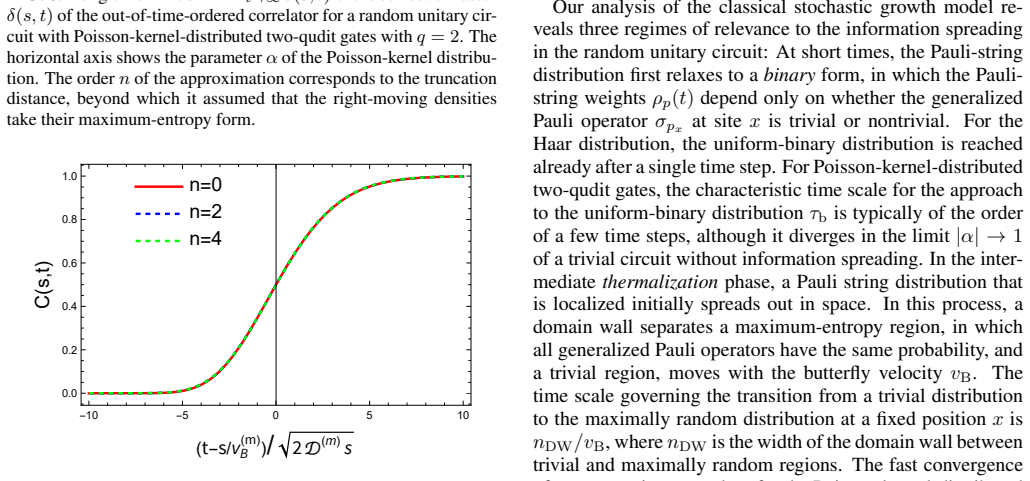
The central claim is that for any two-qudit gate distribution satisfying the unitary-invariance condition $P(U)=P(VUV^\dagger)$, the ensemble-averaged Pauli-string weights $\rho_p(t)=\langle|\gamma_p(t)|^2\rangle$ evolve under a closed Markov chain, and in the long-time limit the right-moving front of Pauli strings obeys a drift-diffusion equation with butterfly velocity $v_{\rm B}$ and diffusion constant $\mathcal{D}$ that depend on the gate distribution. For the Poisson kernel ensemble, the paper obtains explicit formulas for $v_{\rm B}$ and $\mathcal{D}$ (Eqs. (58) and (59)) that reduce to the Haar values at $\alpha=0$, vanish in the trivial limit $\alpha\to1$, and in the large-$q$ limit give $v_{\rm B}=(1-|\alpha|^4)/(1+|\alpha|^4)$ and $\mathcal{D}=4|\alpha|^4(1-|\alpha|^4)/(1+|\alpha|^4)^2$. Two qualitative differences from the Haar case are established: a finite time $\tau_{\rm b}$ elapses before Pauli-string weights acquire a binary form, and the operator front has a finite domain-wall width $n_{\rm DW}$ separating a random-matrix-like bulk from a trivial region.
Load-bearing premise
The load-bearing premise is that, at distances more than a few sites behind the operator front, the Pauli-string distribution is already maximally random, so the hierarchy of $n$-point densities can be truncated at finite $n$; this is verified numerically for the Poisson kernel but not proven for every unitary-invariant ensemble.
Editorial extensions
If this is right
- For any unitary-invariant gate distribution, the operator front in a random circuit is asymptotically a drift-diffusion front, so measuring the OTOC profile determines the gate-dependent $v_{\rm B}$ and $\mathcal{D}$ directly.
- For the Poisson kernel at fixed $|\alpha|>0$ in the large-$q$ limit, the front remains diffusive with $\mathcal{D}>0$ and $v_{\rm B}<1$, in contrast to the Haar limit where $v_{\rm B}\to1$ and $\mathcal{D}\to0$.
- The finite time $\tau_{\rm b}$ to reach a binary Pauli-string distribution and the finite width $n_{\rm DW}$ of the domain wall grow only when the circuit approaches the trivial limit $|\alpha|\to1$.
- The long-time OTOC is well approximated by a complementary error function profile, with a subleading correction $\delta$ that becomes independent of position and time at late times.
- The same truncation scheme, applied to the Dyson Brownian-motion interpolating ensemble, yields closed-form drift-diffusion coefficients that agree with the Poisson-kernel results in the large-$q$ limit.
Reading between the lines
- If the unitary-invariant result holds generally, the scrambling hydrodynamics of a random circuit is parametrized by the moments of the gate distribution rather than by the qudit dimension alone; the Poisson kernel is only the maximum-entropy representative of that family.
- The dependence of $\tau_{\rm b}$ and $n_{\rm DW}$ on the gate ensemble suggests a practical diagnostic: the subleading OTOC correction (Fig. 8) could be used experimentally to distinguish Haar-like scrambling from structured unitary-invariant scrambling even when the main front profile looks identical.
- The agreement between the Poisson-kernel and Brownian-motion ensembles at large $q$ (after identifying $|\alpha|^2=\mathrm{e}^{-\lambda}$) raises the possibility that the leading front parameters depend only on the first moment $\langle U\rangle$ in that limit, a property the paper does not prove.
Signed reviews
Editorial analysis
A structured set of objections, weighed in public.
Referee Report
Summary. The paper studies operator spreading in one-dimensional random unitary circuits whose two-qudit gates are drawn from any unitary-invariant distribution. It shows that the ensemble-averaged Pauli-string weights satisfy a closed Markov process, which can be projected exactly onto a binary (identity/non-identity) stochastic growth model. The evolution of right-propagating n-point densities is closed by a maximal-randomness truncation, Eq. (41), leading to drift-diffusion equations with a butterfly velocity v_B and diffusion constant D. For the Poisson-kernel ensemble, the paper derives explicit formulas for the relevant moments, for v_B and D, for the binary-relaxation time τ_b, and for the domain-wall correction to the OTOC. The analytical Poisson-kernel results are compared with numerical simulations of the projected binary stochastic process, and the paper also treats the Dyson Brownian-motion ensemble in an appendix.
Significance. If the general-ensemble claim holds, the paper extends the hydrodynamic description of operator spreading from Haar-random circuits to the full unitary-invariant class, with quantitative predictions that depend on the gate ensemble through Re A1 and A2+A3. The paper is unusually careful in several places: the Markovian reduction and the binary projection are exact, the Poisson-kernel parameters are not fitted, and the results reproduce the Haar and trivial limits correctly. The explicit Poisson-kernel formulas, including the finite τ_b and finite domain-wall width n_DW, are new and are supported by convergence-in-order checks and by simulations of the same stochastic process. The main limitation is that the truncation (41) is an uncontrolled approximation for the general unitary-invariant class, so the breadth of the central claim currently outpaces the evidence.
major comments (2)
- [Sec. III D, Eq. (41)] The general-ensemble calculation of v_B and D rests on replacing the (n+1)-point density by its maximally random factorized form in Eq. (41). This is an uncontrolled closure except in the Haar limit and the q→∞ limit, and it is verified only for the Poisson-kernel ensemble in Figs. 4–6 and, without numerical simulation, for the Brownian-motion ensemble in App. E. Because the simulations in Figs. 4 and 5 run the same projected binary Markov process (33) that the truncation is meant to solve, they do not constrain other unitary-invariant distributions. I ask the authors to test Eq. (41) at least one additional point in the allowed (Re A1, A2+A3) region of Fig. 2, for example a fixed two-qudit gate U0 conjugated by Haar-random V, and to compare direct simulations of the binary process with v_B^(n) and D^(n) for n=0,2,4. If no such test is provided, the claims in Secs. III and VI about the entire unitary-invariant class should be explicitly restricted to ensembles for which convergence of the truncation has been demonstrated.
- [Sec. V A, Eq. (70)] The statement that λ_W<1 for every non-trivial unitary-invariant distribution is asserted without proof, even though the allowed parameter region in Fig. 2 is only sampled numerically. Since λ_W<1 is what guarantees the finite relaxation time τ_b, this should be justified, either by an analytic bound using the unitarity relations (17) or by a dense numerical scan of the allowed moment region. Without such a justification, the generality of the finite-τ_b claim remains an assumption.
minor comments (5)
- [Abstract and Sec. I] There are typos: “Pauli strong” should be “Pauli string” in the abstract, and “out-of-time-ordrered” should be “out-of-time-ordered” in Sec. I.
- [Sec. V A] The degeneracy formula for even q is garbled: “Ni = q2/ − 8” should be a proper expression such as (q^4 − 8)/4 or the intended polynomial; please correct it.
- [Sec. IV and App. F] The Poisson-kernel parameter α is introduced as a complex number in Eqs. (6)–(7), but all final results depend only on |α|; the authors should state explicitly that the phase can be absorbed by a redefinition of the gate or that it is otherwise irrelevant.
- [App. F, Eqs. (F3)–(F10)] Inline notation such as “|α|2q4” is ambiguous: it can be read as |α|^2 q^4 or as |α|^{2q^4}. Using explicit braces or separate factors would avoid this confusion.
- [App. E] The Brownian-motion ensemble results are presented without a numerical check; a sentence explaining that they follow the same convergence checks as the Poisson-kernel results, or a small figure, would strengthen the appendix.
Circularity Check
No material circularity: reported v_B and D are parameter-free consequences of gate-distribution moments; the only uncontrolled assumption (Eq. 41) is an approximation caveat, not a fitted input.
full rationale
The paper's derivation chain is self-contained in the relevant sense. The transition probabilities (26) are obtained from the unitary-invariant measure by Haar integration over a conjugate unitary V, using Weingarten calculus; Eq. (22) follows directly from unitary invariance. The parameters A1, A2, and A3 are functions of the moments (25) of the physical gate distribution (Eqs. B17-B19), not fitted constants. For the Poisson kernel, the moments are evaluated from the known eigenphase distribution and standard trace-moment identities (Eqs. F3-F6, with F9 from Diaconis-Evans and Johansson), so the resulting v_B and D in Eqs. (58)-(59) are parameter-free predictions for each alpha. The truncation (41) is indeed an uncontrolled structural ansatz for general unitary-invariant ensembles, and the paper explicitly states this limitation in the conclusion; this is an approximation-risk issue, not circularity. Numerical simulations of the binary Markov process (33) validate the approximate solution of that process; they do not fit the reported v_B and D, and the process itself is derived rather than assumed. The self-citations ([16], [24]) supply standard definitions and a standard integration technique, and no load-bearing claim is justified only by those citations. No equation was found that is equivalent to its own input by construction.
Assumptions & free parameters
assumptions (5)
- domain assumption The two-qudit gate distribution is invariant under arbitrary unitary conjugation, P(U)=P(V U V^dagger), which allows the transition matrix to depend only on four low-order moments of the gate distribution.
- standard math The generalized Pauli matrices form an orthonormal operator basis with the trace and commutation properties stated in App. A.
- ad hoc to paper The (n+1)-point density can be replaced by its maximally random approximation beyond a distance n_DW from the end of a Pauli string, Eq. (41).
- standard math Haar-averaged products of traces of powers of unitary matrices are evaluated using Weingarten calculus and known results for unitary group integrals.
- domain assumption The singular value lambda_W of the transition matrix, excluding binary weights, is less than 1 except for the trivial circuit, giving exponential relaxation to the binary distribution.
Cite this review
Pith. "Pith review of Operator Spreading in Random Unitary Circuits with Unitary-invariant Gate Distributions." pith.science (2026). https://pith.science/paper/FZXUJM67
@misc{pith2026250104091,
  author       = {Pith},
  title        = {Pith review of: Operator Spreading in Random Unitary Circuits with Unitary-invariant Gate Distributions},
  year         = {2026},
  howpublished = {\url{https://pith.science/paper/FZXUJM67}},
  note         = {Machine review of arXiv:2501.04091}
}
abstract
Random unitary circuits have become a model system to investigate information scrambling in quantum systems. In the literature, mostly random circuits with Haar-distributed gate operations have been considered. In this work, we investigate operator spreading in random unitary circuits in which the elementary gate operations are drawn from general unitary-invariant ensembles, which include the well-studied Haar-distributed random unitary circuits as a special case. Similar to the Haar-distributed case, the long-time behavior of operator spreading with the more general unitary-invariant gate distribution is governed by drift-diffusion equations characterized by the butterfly velocity $v_{\rm B}$ and a diffusion constant $\mathcal{D}$. Differences with the Haar-random case are (i) that it takes a finite time $\tau_{\rm b}$ until ensemble-averaged Pauli-string weights take a ``binary'' form, in which they depend only on whether Pauli operators inside the support of the Pauli strong are equal to the identity matrix, and (ii) that the operator spreading is characterized by a finite ``domain-wall width'' $n_{\rm DW}$ separating regions with a random-matrix-like Pauli-string distribution. To illustrate these findings, we perform explicit calculations for random unitary circuits distributed according to the Poisson kernel, which interpolates between the trivial and Haar-distributed circuits.
Figures


Figures from the paper (8 more)




Reference graph
Works this paper leans on
-
[1]
W. Brown and O. Fawzi, Scrambling speed of random quantum circuits, arXiv:1210.6644
-
[2]
are two solutions that generate nonzero χλ(ι) and χλ(ι′) for the same partition λ. The non-vanishing terms are sgn(σ)xσ(1)−1 L · · ·xj2+σ(L+1−i)−1 i · · ·xj1+σ(L)−1 1 sgn(σ′)xσ′(1)−1 L · · ·xj′ 2+σ′(L+1−i′)−1 i′ · · ·xj′ 1+σ′(L)−1 1 Because each part of λ is positive, one must have either σ(L) = 1 or σ(L + 1 − i) = 1 . If σ(L) = 1 , then we must have σ′(L...
-
[3]
A. Chan, A. De Luca, and J. T. Chalker, Solution of a Minimal Model for Many-Body Quantum Chaos, Phys. Rev. X8, 041019 (2018)
work page 2018
- [4]
-
[5]
C. W. von Keyserlingk, T. Rakovszky, F. Pollmann, and S. L. Sondhi, Operator Hydrodynamics, OTOCs, and Entanglement Growth in Systems without Conservation Laws, Phys. Rev. X 8, 021013 (2018)
2018
- [6]
-
[7]
V . Khemani, A. Vishwanath, and D. A. Huse, Operator Spread- ing and the Emergence of Dissipative Hydrodynamics under Unitary Evolution with Conservation Laws, Phys. Rev. X 8, 031057 (2018)
work page 2018
-
[8]
T. Rakovszky, F. Pollmann, and C. von Keyserlingk, Diffu- sive Hydrodynamics of Out-of-Time-Ordered Correlators with Charge Conservation, Phys. Rev. X8, 031058 (2018)
work page 2018
Show all 36 references
-
[9]
Skinner, Lecture notes: Introduction to random unitary cir- cuits and the measurement-induced entanglement phase transi- tion, arXiv:2307.02986
B. Skinner, Lecture notes: Introduction to random unitary cir- cuits and the measurement-induced entanglement phase transi- tion, arXiv:2307.02986
-
[10]
M. P. Fisher, V . Khemani, A. Nahum, and S. Vijay, Random Quantum Circuits, Annu. Rev. Condens. Matter Phys. 14, 335 (2023)
2023
-
[11]
Styliaris, N
G. Styliaris, N. Anand, and P. Zanardi, Information Scrambling over Bipartitions: Equilibration, Entropy Production, and Typi- cality, Phys. Rev. Lett.126, 030601 (2021)
2021
-
[12]
Xu and B
S. Xu and B. Swingle, Locality, Quantum Fluctuations, and Scrambling, Phys. Rev. X 9, 031048 (2019)
2019
-
[13]
X. Mi, P. Roushan, C. Quintana, S. Mandr `a, J. Marshall, C. Neill, F. Arute, K. Arya, J. Atalaya, R. Babbush, J. C. Bardin, R. Barends, J. Basso, A. Bengtsson, S. Boixo, A. Bourassa, M. Broughton, B. B. Buckley, D. A. Buell, B. Burkett, et al., Information scrambling in quant...
2021
-
[14]
Xu and B
S. Xu and B. Swingle, Scrambling Dynamics and Out-of-Time- Ordered Correlators in Quantum Many-Body Systems, PRX Quantum 5, 010201 (2024)
2024
-
[15]
P. J. Forrester, Log-Gases and Random Matrices (Princeton University Press, 2010)
2010
-
[16]
T. J. Krieger, Statistical theory of nuclear cross section fluctua- tions, Ann. Phys. 42, 375 (1967)
1967
-
[17]
P. A. Mello, P. Pereyra, and T. H. Seligman, Information theory and statistical nuclear reactions. I. General theory and applica- tions to few-channel problems, Ann. Phys. 161, 254 (1985)
1985
-
[18]
P. W. Brouwer, Generalized circular ensemble of scattering ma- trices for a chaotic cavity with nonideal leads, Phys. Rev. B51, 16878 (1995)
1995
-
[19]
Hunter-Jones, Operator growth in random quantum circuits with symmetry, arXiv:1812.08219
N. Hunter-Jones, Operator growth in random quantum circuits with symmetry, arXiv:1812.08219
-
[20]
D. A. Roberts and B. Yoshida, Chaos and complexity by design, J. High Energy Phys. 2017 (4), 121
2017
-
[21]
F. J. Dyson, A class of matrix ensembles, J. Math. Phys. 13, 90 (1972)
1972
-
[22]
F. J. Dyson, A brownian-motion model for the eigenvalues of a random matrix, J. Math. Phys. 3, 1191 (1962)
1962
-
[23]
Patera and H
J. Patera and H. Zassenhaus, The Pauli matrices in n dimen- sions and finest gradings of simple Lie algebras of type An−1, J. Math. Phys. 29, 665 (1988)
1988
-
[24]
Following Ref
to perform the average over ≡ Vx,x+1. Following Ref. [24], the elements of the Haar-distributed matrix Vx,x+1 are represented by double lines, V = V ∗ = *. (B8) (We suppressed the spatial indices x and x + 1 to keep the notation simple.) Elements of the evolution matrix Ux,x+1...
-
[25]
Tang, Brownian gaussian unitary ensemble: non-equilibrium dynamics, efficient k-design and application in classical shadow tomograph, arXiv:2406.11320 (2024)
H. Tang, Brownian gaussian unitary ensemble: non-equilibrium dynamics, efficient k-design and application in classical shadow tomograph, arXiv:2406.11320 (2024)
2024 arXiv
-
[26]
P. W. Brouwer and C. W. J. Beenakker, Diagrammatic method of integration over the unitary group, with applications to quan- tum transport in mesoscopic systems, J. Math. Phys. 37, 4904 (1996)
1996
-
[27]
Weingarten, Asymptotic behavior of group integrals in the limit of infinite rank, J
D. Weingarten, Asymptotic behavior of group integrals in the limit of infinite rank, J. Math. Phys. 19, 999 (1978)
1978
-
[28]
Collins, Moments and Cumulants of Polynomial Random 21 Variables on Unitary Groups, the Itzykson-Zuber Integral, and Free Probability, Int
B. Collins, Moments and Cumulants of Polynomial Random 21 Variables on Unitary Groups, the Itzykson-Zuber Integral, and Free Probability, Int. Math. Res. Not. 2003, 953 (2003)
2003
-
[29]
Chen and E
A. Chen and E. Renshaw, The General Correlated Random Walk, J. Appl. Probab. 31, 869 (1994)
1994
-
[30]
Henderson, E
R. Henderson, E. Renshaw, and D. Ford, A Correlated Random Walk Model for Two-Dimensional Diffusion, J. Appl. Probab. 21, 233 (1984)
1984
-
[31]
Renshaw and R
E. Renshaw and R. Henderson, The Correlated Random Walk, J. Appl. Probab. 18, 403 (1981)
1981
-
[32]
Pandey and P
A. Pandey and P. Shukla, Eigenvalue correlations in the circular ensembles, J. Phys. A Math. Gen. 24, 3907 (1991)
1991
-
[33]
M. L. Mehta, Random matrices (Elsevier, 2004)
2004
-
[34]
Diaconis and S
P. Diaconis and S. Evans, Linear Functionals of Eigenvalues of Random Matrices, Trans. Am. Math. Soc. 353, 2615 (2001)
2001
-
[35]
Johansson, On Random Matrices from the Compact Classi- cal Groups, Ann
K. Johansson, On Random Matrices from the Compact Classi- cal Groups, Ann. Math. 145, 519 (1997)
1997
-
[36]
Fulton and J
W. Fulton and J. Harris, Representation Theory, Graduate Texts in Mathematics, V ol. 129 (Springer, 2004)
2004
Reviewed August 10, 2026 · model on record in the stance chip above.
Discussion (0). Continue with ORCID to comment.