REVIEW 6 minor 4 cited by
Enhanced Axion-wind near Earth's Surface
T0 review · 0 major / 6 minor · reviewed 2026-08-08 · deepseek-v4-flash
Pith's one-line read Quadratic interactions with Earth can boost the effective dark-matter gradient signal by orders of magnitude at low masses.
desk verdict Solid scattering-theory extension of quadratically coupled ultralight DM to gradient observables; the quantitative enhancement maps lean on square-well Earth models, but the broad low-mass effect is robust. read the letter →
The pith
A machine-rendered reading of the paper's core claim, the machinery that carries it, and where it could break.
The reading
What carries the argument
The key object is the quadratic coupling $-\frac{\lambda}{2}\phi^2\rho$ in the action, which changes the Klein-Gordon equation to $(\Box+m^2+\lambda\rho)\phi=0$; with Earth modeled as a constant-density sphere (or two-layer sphere with atmosphere), $\lambda\rho(r)$ becomes a piecewise constant potential. The spatial part of the stationary solution is a combination of trigonometric or hyperbolic functions in each layer, matched by continuity at the boundaries. For nonzero incoming velocity the problem is solved by partial-wave expansion in spherical Bessel functions, with the enhancement quantified by the effective velocity $v_{\rm eff}=|\nabla\phi|/(m\phi(\infty))$. This machinery converts the strength of the quadratic coupling into concrete predictions for power spectra of the field and its gradient on Earth's surface.
What would settle it
A direct test would be an experiment sensitive to the radial gradient of an ultralight scalar field at a mass below roughly $10^{-12}$ eV that sees no increase in signal power above the free-field expectation for couplings in the range $10^{-14}$–$10^{-10}$ GeV$^{-1}$ where the paper predicts order-of-magnitude enhancement; the absence of the predicted low-velocity tail in the measured power spectrum would also falsify the mechanism.
Extended reading notes
Core claim
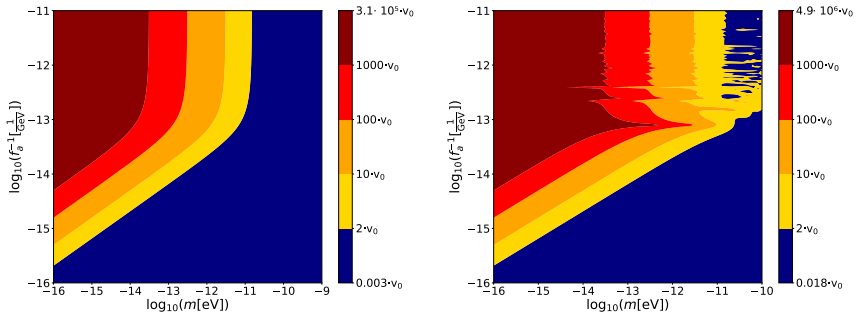
The central claim is that the quadratic coupling term $-\frac{\lambda}{2}\phi^2\rho$ in the action transforms the dark-matter field around Earth, so that the field itself develops a spatial profile with gradients set by the local matter density rather than by the incoming velocity. Using the effective velocity $v_{\rm eff}=|\nabla\phi|/(m\phi(\infty))$, the paper finds enhancements that grow as $1/m$ at low masses, reaching many orders of magnitude above the canonical $v\sim 10^{-3}$ expectation. For attractive couplings, resonances appear when Earth's potential well supports a new bound state, and the paper shows these divergences are absent for any nonzero incoming velocity and remain finite in the frequency-integrated power spectrum. It further provides maps of the signal-power ratio for gradient and field-value experiments over the mass--coupling plane, and identifies a residual concern: for masses $m\lesssim 10^{-16}$ eV, field values could grow to problematic levels, motivating a time-dependent treatment.
Load-bearing premise
The quantitative enhancement maps rest on modeling Earth as a homogeneous sphere (plus a constant-density atmosphere), so the quadratic potential $\lambda\rho(r)$ is piecewise constant; real density gradients, time dependence, or local environmental effects could shift resonance positions and enhancement factors.
Editorial extensions
If this is right
- Gradient-based searches such as spin-precession experiments and accelerometers should include quadratic-coupling effects when setting limits at low axion masses.
- Experiments sensitive to the field value, including haloscopes, see modified expected signals, with the modification less severe than a zero-velocity estimate once kinetic energy is included.
- The previously noted divergences for attractive couplings at zero velocity are resolved for nonzero velocity, and the frequency-integrated power spectrum remains finite.
- At masses below $10^{-16}$ eV, field values may become large enough to be problematic, so time-dependent modeling is needed in that regime.
Reading between the lines
- The same enhancement mechanism should operate near other dense bodies, such as neutron stars and white dwarfs, where the density is far larger; the quadratic potential $\lambda\rho$ could shift resonances and produce even stronger local gradients than around Earth.
- A measurable prediction implied by this paper is that the gradient power spectrum should acquire a low-velocity tail with a characteristic $1/v$ divergence at resonance, which could be searched for by examining the frequency shape rather than the total power.
- If the enhancement is real, the effective direction of the axion wind seen by gradient experiments may be distorted relative to the halo velocity because the quadratic interaction creates a radial component; this directional signature could help discriminate the effect from ordinary velocity.
- The authors' treatment assumes a universal coupling to total matter density; allowing species-dependent couplings would introduce composition-dependent gradients that might be probed with dual-species experiments.
Editorial analysis
A structured set of objections, weighed in public.
Referee Report
Summary. The paper studies the effect of a quadratic coupling of a light scalar dark matter field to ordinary matter, L ⊃ −(λ/2) φ²ρ, on the field value and gradient near Earth's surface. The authors first treat the static (zero-relative-velocity) case for one- and two-layer spherical Earth models, introduce an effective velocity veff = |∇φ|/(m φ∞), and show that the gradient can exceed the naive velocity-suppressed estimate at low masses. They then solve the Klein-Gordon equation for an incoming plane wave with velocity v using partial-wave matching, verify the v→0 limit in Appendix B, and prove in Appendix C that the attractive case has no poles for k>0. A Maxwellian halo velocity distribution is used to compute gradient and field power spectra via a random-phase ensemble average, leading to signal-power ratios in Figs. 7 and 8. The central claim is that quadratic interactions can enhance gradient-sensitive experimental signals by orders of magnitude at low masses, and that including the velocity reduces the previously reported field-value modifications at higher masses.
Significance. This is a relevant and timely phenomenological question for wave-like dark matter detection. The analytic treatment is a strength: the partial-wave matching conditions are explicit, the v→0 limit is checked, the no-pole proof for attractive couplings is a useful addition, and the power-spectrum formalism correctly avoids the naive cancellation of gradients when random phases are averaged. The main limitation, that Earth is modelled as a piecewise-constant density sphere, is explicitly acknowledged by the authors in Sec. 2.1 ('clearly still very simplistic') and Sec. 4.2 ('involving approximations'). In my reading, this affects the precise quantitative contours of Fig. 7, especially the narrow attractive resonances, but it does not undermine the robust broad enhancement at low masses, which is controlled by the exterior 1/r solution. The paper therefore makes a credible case that quadratic interactions should be included when estimating the sensitivity of gradient-based experiments such as CASPEr-wind, QUAX, and accelerometers, and also improves the treatment of field-value experiments by including the halo velocity.
minor comments (6)
- [Sec. 4.3, Eqs. (48), (79)-(80)] The stated scaling ∫dω S_φφ(ω) ∼ 1/m² for small m appears inconsistent with the expressions in Appendix D when one uses φ0² ∝ 1/m² and σ, Λ ∝ m; Eqs. (79)-(80) instead give ∼1/m⁴. Please correct the scaling or clarify what is held fixed in the limit.
- [Sec. 4.2, Fig. 7] The paper should add an explicit sentence near Fig. 7 stating that the high-enhancement contours in the attractive panel are square-well resonances whose positions and widths depend on the piecewise-constant density profile, so a continuous Earth density would shift or broaden them; the broad low-mass enhancement is more robust.
- [References, Ref. [27]] Ref. [27] cites a YouTube playlist; please replace it with a standard quantum-mechanics textbook or review that discusses scattering from a spherical potential.
- [Sec. 3.1, Eq. (22)] The sentence introducing φ̃ as the modulus of the complex solution is imprecise; φ̃ is the complex spatial amplitude and |φ̃| is its modulus, so that φ = |φ̃| cos(ωt − arg φ̃). Please rephrase.
- [Fig. 1 and Fig. 3 captions] The notation 'log10(|rX|/m)' in the captions is unclear; please use |∇X|/m (or veff) explicitly and state that φ0 is normalized to a reference value.
- [Sec. 4.2, Eq. (46)] Please specify whether the frequency integral in Eq. (46) runs over positive frequencies only and note that the same convention is used for the free and interacting spectra; the unlabelled ∫dω is ambiguous.
Circularity Check
No significant circularity: the enhancement is derived from the explicit action (1) by solving the Klein-Gordon equation, with no fitted parameter renamed as a prediction; the only self-citation ([24]) is not load-bearing.
full rationale
The paper's central claim, that quadratic couplings can enhance axion-wind gradients near Earth's surface, is derived by solving the Klein-Gordon equation (3) with the stated quadratic coupling and boundary conditions (4) and (14). The v=0 profiles (9)-(12) and the partial-wave solutions (16)-(19) are exact analytic solutions for the assumed density profile (5); the effective velocity in Eq. (13) is introduced as a normalization for comparison with the ordinary velocity-induced gradient, not as a fitted input. The enhancement ratios in Figs. 7 and 8 are computed via Eq. (46), comparing the interacting power spectrum (42)-(43) against the analytic free-field spectrum (44)-(45), so the predicted enhancement is a genuine output of the calculation. No parameter is fitted to the claimed enhancement, and the piecewise-constant density model is explicitly flagged as 'clearly still very simplistic' (Sec. 2.1), which is a robustness concern rather than a circular one. The one self-citation by overlapping authors, Ref. [24], is used in Sec. 1 to justify considering stationary solutions ('it has been shown that stationary solutions are quickly approached in relevant experimental situations [24]') and again in Sec. 4.3 as a cross-reference on time-dependence. That cited result is not the target claim of this paper, does not define or fit the enhancement, and the present paper also constructs the full velocity-dependent solutions independently, so the self-citation is minor and not load-bearing. Overall, no step in the derivation reduces to its own input by construction.
Assumptions & free parameters
free parameters (3)
- Scalar dark matter mass m
- Quadratic coupling 1/fa (equivalently lambda)
- Halo velocity distribution parameters k0 and sigma =
k0 ~ 1e-3 m, sigma ~ 1e-3 m
assumptions (6)
- domain assumption Wave-like dark matter can be described as a classical scalar field with action S = integral (1/2 (d phi)^2 - 1/2 m^2 phi^2 - lambda/2 phi^2 rho).
- domain assumption The quadratic coupling to matter density is universal, neglecting species-dependent equivalence-principle violations.
- domain assumption Earth is modeled as a homogeneous sphere, or as a two-layer constant-density sphere with an atmosphere.
- domain assumption Stationary scattering solutions are reached on experimentally relevant timescales.
- domain assumption The dark matter velocity distribution is a shifted Maxwellian with random, delta-correlated phases.
- standard math Non-relativistic dispersion omega = sqrt(m^2 + k^2) with k = m v, plus interlacing properties of spherical Bessel functions.
Cite this review
Pith. "Pith review of Enhanced Axion-wind near Earth's Surface." pith.science (2026). https://pith.science/paper/GIBUW7CT
@misc{pith2026250204456,
  author       = {Pith},
  title        = {Pith review of: Enhanced Axion-wind near Earth's Surface},
  year         = {2026},
  howpublished = {\url{https://pith.science/paper/GIBUW7CT}},
  note         = {Machine review of arXiv:2502.04456}
}
abstract
Several detection strategies for wave-like dark matter make use of gradients in the dark matter field, e.g. searches for spin-dependent derivative interactions in CASPEr-wind or experiments looking for oscillating forces. These gradients are usually suppressed by the local dark matter velocity $\sim 10^{-3}$. In this note we investigate how these gradients are modified in the presence of additional quadratic interactions of the dark matter field with ordinary matter. In this case the dark matter density and field are modified in the vicinity of Earth, affecting the detection sensitivity due to the change in the local field value at the Earth's surface but also due to the gradient of the field profile itself. We also use this opportunity to present results on the expected field profiles in presence of a non-vanishing relative velocity of the dark matter with respect to Earth. We also comment how this ameliorates the divergences that appear for certain attractive coupling values.
Figures


Figures from the paper (5 more)


Forward citations
Cited by 4 Pith papers
-
Dark matter pair absorption
Pair absorption of two dark matter particles in atomic transitions can probe electroweak-scale couplings of mu-eV-to-eV mass bosonic dark matter, and could bound the cosmic neutrino background overdensity near 10^9.
-
Probing Quadratically Coupled Ultralight Dark Matter with the Laser Interferometer Space Antenna
LISA forecasts for quadratically coupled ultralight dark matter show competitive or superior sensitivity to terrestrial and astrophysical probes in selected mass windows, free of screening.
-
Probing Quadratically Coupled Ultralight Dark Matter with Pulsar Timing Arrays
For quadratically coupled ultralight dark matter, pulsar timing arrays can set competitive coherent-signal limits at 10^-24–10^-22 eV, while stochastic-signal limits remain weaker than equivalence-principle constraint...
-
Search for a solar-bound axion halo using the Global Network of Optical Magnetometers for Exotic physics searches
A 12-station global magnetometer network search for a solar-bound axion halo found no signal and set leading laboratory limits on quadratic axion-proton couplings.
Reference graph
Works this paper leans on
-
[1]
P. Sikivie, “Axion Cosmology,” Lect. Notes Phys.741 (2008) 19–50, arXiv:astro-ph/0610440
arXiv 2008
-
[2]
The Low-Energy Frontier of Particle Physics,
J. Jaeckel and A. Ringwald, “The Low-Energy Frontier of Particle Physics,” Ann. Rev. Nucl. Part. Sci.60 (2010) 405–437, arXiv:1002.0329 [hep-ph]
arXiv 2010
-
[3]
D. J. E. Marsh, “Axion Cosmology,” Phys. Rept.643 (2016) 1–79, arXiv:1510.07633 [astro-ph.CO]
arXiv 2016
-
[4]
L. Hui, “Wave Dark Matter,” Ann. Rev. Astron. Astrophys.59 (2021) 247–289, arXiv:2101.11735 [astro-ph.CO]
arXiv 2021
-
[5]
New Horizons: Scalar and Vector Ultralight Dark Matter,
D. Antypas et al., “New Horizons: Scalar and Vector Ultralight Dark Matter,” arXiv:2203.14915 [hep-ex]
-
[6]
C. B. Adams et al., “Axion Dark Matter,” in Snowmass 2021. 3, 2022. arXiv:2203.14923 [hep-ex]
arXiv 2021
-
[7]
Violation of the equivalence principle from light scalar dark matter,
A. Hees, O. Minazzoli, E. Savalle, Y. V. Stadnik, and P. Wolf, “Violation of the equivalence principle from light scalar dark matter,” Phys. Rev. D98 no. 6, (2018) 064051, arXiv:1807.04512 [gr-qc]
arXiv 2018
-
[8]
The phenomenology of quadratically coupled ultra light dark matter,
A. Banerjee, G. Perez, M. Safronova, I. Savoray, and A. Shalit, “The phenomenology of quadratically coupled ultra light dark matter,” JHEP 10 (2023) 042, arXiv:2211.05174 [hep-ph]
arXiv 2023
Show all 53 references
-
[9]
On the Validity of Bounds on Light Axions for f ≲ 1015 GeV,
M. Bauer and S. Chakraborti, “On the Validity of Bounds on Light Axions for f ≲ 1015 GeV,” arXiv:2408.06408 [hep-ph]
-
[10]
Overview of the Cosmic Axion Spin Precession Experiment (CASPEr),
D. F. Jackson Kimball et al., “Overview of the Cosmic Axion Spin Precession Experiment (CASPEr),” Springer Proc. Phys.245 (2020) 105–121, arXiv:1711.08999 [physics.ins-det]
2020 arXiv
-
[11]
Axion search with a quantum-limited ferromagnetic haloscope,
QUAX Collaboration, N. Crescini et al., “Axion search with a quantum-limited ferromagnetic haloscope,” Phys. Rev. Lett.124 no. 17, (2020) 171801, arXiv:2001.08940 [hep-ex]. 24
2020 arXiv
-
[12]
Torsion balance experiments: A low-energy frontier of particle physics,
E. G. Adelberger, J. H. Gundlach, B. R. Heckel, S. Hoedl, and S. Schlamminger, “Torsion balance experiments: A low-energy frontier of particle physics,” Prog. Part. Nucl. Phys. 62 (2009) 102–134
2009
-
[13]
Dark Matter Direct Detection with Accelerometers,
P. W. Graham, D. E. Kaplan, J. Mardon, S. Rajendran, and W. A. Terrano, “Dark Matter Direct Detection with Accelerometers,” Phys. Rev. D93 no. 7, (2016) 075029, arXiv:1512.06165 [hep-ph]
2016 arXiv
-
[14]
Experimental Tests of the Invisible Axion,
P. Sikivie, “Experimental Tests of the Invisible Axion,” Phys. Rev. Lett.51 (1983) 1415–1417. [Erratum: Phys.Rev.Lett. 52, 695 (1984)]
1983
-
[15]
WISPy Cold Dark Matter,
P. Arias, D. Cadamuro, M. Goodsell, J. Jaeckel, J. Redondo, and A. Ringwald, “WISPy Cold Dark Matter,” JCAP 06 (2012) 013, arXiv:1201.5902 [hep-ph]
2012 arXiv
-
[16]
Probing axions with neutron star inspirals and other stellar processes,
A. Hook and J. Huang, “Probing axions with neutron star inspirals and other stellar processes,” JHEP 06 (2018) 036, arXiv:1708.08464 [hep-ph]
2018 arXiv
-
[17]
Prospects for axion searches with Advanced LIGO through binary mergers,
J. Huang, M. C. Johnson, L. Sagunski, M. Sakellariadou, and J. Zhang, “Prospects for axion searches with Advanced LIGO through binary mergers,” Phys. Rev. D99 no. 6, (2019) 063013, arXiv:1807.02133 [hep-ph]
2019 arXiv
-
[18]
First Constraints on Nuclear Coupling of Axionlike Particles from the Binary Neutron Star Gravitational Wave Event GW170817,
J. Zhang, Z. Lyu, J. Huang, M. C. Johnson, L. Sagunski, M. Sakellariadou, and H. Yang, “First Constraints on Nuclear Coupling of Axionlike Particles from the Binary Neutron Star Gravitational Wave Event GW170817,” Phys. Rev. Lett.127 no. 16, (2021) 161101, arXiv:2105.13963 [hep-ph]
2021 arXiv
-
[20]
Heavy neutron stars from light scalars,
R. Balkin, J. Serra, K. Springmann, S. Stelzl, and A. Weiler, “Heavy neutron stars from light scalars,” arXiv:2307.14418 [hep-ph]
-
[22]
Constraining light QCD axions with isolated neutron star cooling,
A. G´ omez-Ba˜ n´ on, K. Bartnick, K. Springmann, and J. A. Pons, “Constraining light QCD axions with isolated neutron star cooling,” arXiv:2408.07740 [hep-ph]
-
[24]
On the time-dependent density of quadratically coupled dark matter around ordinary matter objects,
C. Burrage, B. Elder, Y. G. del Castillo, and J. Jaeckel, “On the time-dependent density of quadratically coupled dark matter around ordinary matter objects,” arXiv:2410.23350 [hep-ph]
-
[25]
“Earth.” https://en.wikipedia.org/wiki/Earth
-
[26]
A new signal model for axion cavity searches fromn-body simulations,
E. W. Lentz, T. R. Quinn, L. J. Rosenberg, and M. J. Tremmel, “A new signal model for axion cavity searches fromn-body simulations,” The Astrophysical Journal845 no. 2, (Aug., 2017) 121. http://dx.doi.org/10.3847/1538-4357/aa80dd. 25
2017 doi
-
[27]
Quantum Theory of collisions: resonant condition in the lth partial wave
P. C. Deshmukh, “Quantum Theory of collisions: resonant condition in the lth partial wave.” https://www.youtube.com/playlist?list=PLbMVogVj5nJSdsqPcC1J9SmCuKg5DIUwn; visited 18.01.2025
2025
-
[28]
Squid-based microwave cavity search for dark-matter axions,
S. J. Asztalos, G. Carosi, C. Hagmann, D. Kinion, K. van Bibber, M. Hotz, L. J. Rosenberg, G. Rybka, J. Hoskins, J. Hwang, P. Sikivie, D. B. Tanner, R. Bradley, and J. Clarke, “Squid-based microwave cavity search for dark-matter axions,” Physical Review Letters104 no. 4, (Jan....
2010 doi
-
[29]
Search for invisible axion dark matter with the axion dark matter experiment,
N. Du, N. Force, R. Khatiwada, E. Lentz, R. Ottens, L. Rosenberg, G. Rybka, G. Carosi, N. Woollett, D. Bowring, A. Chou, A. Sonnenschein, W. Wester, C. Boutan, N. Oblath, R. Bradley, E. Daw, A. Dixit, J. Clarke, S. O’Kelley, N. Crisosto, J. Gleason, S. Jois, P. Sikivie, I. Ste...
2018 doi
-
[30]
Extended search for the invisible axion with the axion dark matter experiment,
T. Braine, R. Cervantes, N. Crisosto, N. Du, S. Kimes, L. Rosenberg, G. Rybka, J. Yang, D. Bowring, A. Chou, R. Khatiwada, A. Sonnenschein, W. Wester, G. Carosi, N. Woollett, L. Duffy, R. Bradley, C. Boutan, M. Jones, B. LaRoque, N. Oblath, M. Taubman, J. Clarke, A. Dove, A. E...
2020
-
[31]
Piezoelectrically tuned multimode cavity search for axion dark matter,
C. Boutan, M. Jones, B. LaRoque, N. Oblath, R. Cervantes, N. Du, N. Force, S. Kimes, R. Ottens, L. Rosenberg, G. Rybka, J. Yang, G. Carosi, N. Woollett, D. Bowring, A. Chou, R. Khatiwada, A. Sonnenschein, W. Wester, R. Bradley, E. Daw, A. Agrawal, A. Dixit, J. Clarke, S. O’Kel...
2018
-
[32]
Search for invisible axion dark matter in the mass range,
C. Bartram, T. Braine, E. Burns, R. Cervantes, N. Crisosto, N. Du, H. Korandla, G. Leum, P. Mohapatra, T. Nitta, L. Rosenberg, G. Rybka, J. Yang, J. Clarke, I. Siddiqi, A. Agrawal, A. Dixit, M. Awida, A. Chou, M. Hollister, S. Knirck, A. Sonnenschein, W. Wester, J. Gleason, A....
2021
-
[33]
Broadband Solenoidal Haloscope for Terahertz Axion Detection,
BREAD Collaboration, J. Liu et al., “Broadband Solenoidal Haloscope for Terahertz Axion Detection,” Phys. Rev. Lett.128 no. 13, (2022) 131801, arXiv:2111.12103 [physics.ins-det]
2022 arXiv
-
[34]
Wispdmx: A haloscope for wisp dark matter between 0.8-2 µev,
L. H. Nguyen, D. Horns, A. Lobanov, and A. Ringwald, “Wispdmx: A haloscope for wisp dark matter between 0.8-2 µev,” 2015
2015
-
[35]
The klash proposal,
D. Alesini, D. Babusci, D. D. Gioacchino, C. Gatti, G. Lamanna, and C. Ligi, “The klash proposal,” 2017
2017
-
[36]
First axion dark matter search with toroidal geometry,
J. Choi, H. Themann, M. Lee, B. Ko, and Y. Semertzidis, “First axion dark matter search with toroidal geometry,” Physical Review D96 no. 6, (Sept., 2017) . http://dx.doi.org/10.1103/PhysRevD.96.061102
2017 doi
-
[37]
Generalized harmonic analysis,
N. Wiener, “Generalized harmonic analysis,” Acta Mathematica55 no. none, (1930) 117 – 258. https://doi.org/10.1007/BF02546511
1930 doi
-
[38]
Korrelationstheorie der station¨ aren stochastischen prozesse,
A. Khintchine, “Korrelationstheorie der station¨ aren stochastischen prozesse,” Mathematische Annalen 109 (1934) 604–615. https://api.semanticscholar.org/CorpusID:122842868
1934
-
[39]
Nonequilibrium Quantum Fields: From Cold Atoms to Cosmology,
J. Berges, “Nonequilibrium Quantum Fields: From Cold Atoms to Cosmology,” arXiv:1503.02907 [hep-ph]
-
[40]
Constraining axion dark matter with big bang nucleosynthesis,
K. Blum, R. T. D’Agnolo, M. Lisanti, and B. R. Safdi, “Constraining axion dark matter with big bang nucleosynthesis,” Physics Letters B737 (Oct., 2014) 30–33. http://dx.doi.org/10.1016/j.physletb.2014.07.059
2014 doi
-
[41]
New limit on axionlike dark matter using cold neutrons,
I. Schulthess, E. Chanel, A. Fratangelo, A. Gottstein, A. Gsponer, Z. Hodge, C. Pistillo, D. Ries, T. Soldner, J. Thorne, and F. M. Piegsa, “New limit on axionlike dark matter using cold neutrons,” Physical Review Letters129 no. 19, (Nov., 2022) . http://dx.doi.org/10.1103/Phy...
2022 doi
-
[42]
Experimental constraint on axionlike particles over seven orders of magnitude in mass,
T. S. Roussy, D. A. Palken, W. B. Cairncross, B. M. Brubaker, D. N. Gresh, M. Grau, K. C. Cossel, K. B. Ng, Y. Shagam, Y. Zhou, V. V. Flambaum, K. W. Lehnert, J. Ye, and E. A. Cornell, “Experimental constraint on axionlike particles over seven orders of magnitude in mass,” Phy...
2021 doi
-
[43]
Prospects of nuclear-coupled-dark-matter detection via correlation spectroscopy of I2+ and Ca+,
E. Madge, G. Perez, and Z. Meir, “Prospects of nuclear-coupled-dark-matter detection via correlation spectroscopy of I2+ and Ca+,” Phys. Rev. D110 no. 1, (2024) 015008, arXiv:2404.00616 [physics.atom-ph]
2024 arXiv
-
[44]
Search for axionlike dark matter through nuclear spin precession in electric and magnetic fields,
C. Abel, N. J. Ayres, G. Ban, G. Bison, K. Bodek, V. Bondar, M. Daum, M. Fairbairn, V. V. Flambaum, P. Geltenbort, K. Green, W. C. Griffith, M. van der Grinten, Z. D. Gruji´ c, P. G. Harris, N. Hild, P. Iaydjiev, S. N. Ivanov, M. Kasprzak, Y. Kermaidic, K. Kirch, H.-C. Koch, S...
2017
-
[45]
First results from a search for axionlike dark matter using octupole-deformed nuclei in a crystal,
M. Fan, B. Nima, A. Radak, G. Alonso- ´Alvarez, and A. Vutha, “First results from a search for axionlike dark matter using octupole-deformed nuclei in a crystal,” 2024. https://arxiv.org/abs/2410.02218
2024
-
[46]
Nuclear decay anomalies as a signature of axion dark matter,
X. Zhang, N. Houston, and T. Li, “Nuclear decay anomalies as a signature of axion dark matter,” Physical Review D108 no. 7, (Oct., 2023) . http://dx.doi.org/10.1103/PhysRevD.108.L071101
2023 doi
-
[47]
First constraints on nuclear coupling of axionlike particles from the binary neutron star gravitational wave event gw170817,
J. Zhang, Z. Lyu, J. Huang, M. C. Johnson, L. Sagunski, M. Sakellariadou, and H. Yang, “First constraints on nuclear coupling of axionlike particles from the binary neutron star gravitational wave event gw170817,” Physical Review Letters127 no. 16, (Oct., 2021) . http://dx.doi...
2021 doi
-
[48]
Constraining light qcd axions with isolated neutron star cooling,
A. G´ omez-Ba˜ n´ on, K. Bartnick, K. Springmann, and J. A. Pons, “Constraining light qcd axions with isolated neutron star cooling,” Physical Review Letters133 no. 25, (Dec.,
-
[49]
Pi in the sky: Neutron stars with exceptionally light qcd axions,
M. Kumamoto, J. Huang, C. Drischler, M. Baryakhtar, and S. Reddy, “Pi in the sky: Neutron stars with exceptionally light qcd axions,” 2024. https://arxiv.org/abs/2410.21590
2024 arXiv
-
[50]
White dwarfs as a probe of exceptionally light qcd axions,
R. Balkin, J. Serra, K. Springmann, S. Stelzl, and A. Weiler, “White dwarfs as a probe of exceptionally light qcd axions,” 2024. https://arxiv.org/abs/2211.02661
2024 arXiv
-
[52]
An even lighter qcd axion,
L. Di Luzio, B. Gavela, P. Quilez, and A. Ringwald, “An even lighter qcd axion,” Journal of High Energy Physics2021 no. 5, (May, 2021) . http://dx.doi.org/10.1007/JHEP05(2021)184
2021 doi
-
[53]
Probing axions with neutron star inspirals and other stellar processes,
A. Hook and J. Huang, “Probing axions with neutron star inspirals and other stellar processes,” Journal of High Energy Physics2018 no. 6, (June, 2018) . http://dx.doi.org/10.1007/JHEP06(2018)036
2018 doi
-
[54]
cajohare/axionlimits: Axionlimits
C. O’Hare, “cajohare/axionlimits: Axionlimits.” https://cajohare.github.io/AxionLimits/, July, 2020
2020
-
[55]
Momentum and Matter Matter for Axion Dark Matter Matters on Earth,
A. Banerjee, I. M. Bloch, Q. Bonnefoy, S. A. R. Ellis, G. Perez, I. Savoray, K. Springmann, and Y. V. Stadnik, “Momentum and Matter Matter for Axion Dark Matter Matters on Earth,” arXiv:2502.04455 [hep-ph]
-
[56]
NIST Digital Library of Mathematical Functions
“ NIST Digital Library of Mathematical Functions.” https://dlmf.nist.gov/, release 1.2.1 of 2024-06-15. https://dlmf.nist.gov/. F. W. J. Olver, A. B. Olde Daalhuis, D. W. Lozier, B. I. Schneider, R. F. Boisvert, C. W. Clark, B. R. Miller, B. V. Saunders, H. S. Cohl, and M. A. ...
2024
-
[2024]
http://dx.doi.org/10.1103/PhysRevLett.133.251002
Reviewed August 8, 2026 · model on record in the stance chip above.
Discussion (0). Continue with ORCID to comment.