REVIEW 3 major objections 4 minor 28 references
High precision X-ray spectroscopy of kaonic neon
T0 review · 3 major / 4 minor · reviewed 2026-08-11 · deepseek-v4-flash
Pith's one-line read The paper reports the first measurement of kaonic neon X-rays, with six transitions identified and three of them determined to sub-eV statistical precision, together with absolute yields.
desk verdict First kaonic neon X-ray measurement is plausible and worth refereeing, but the energy scale beyond the fluorescence calibration range is under-defended and the abstract overstates precision. read the letter →
The pith
A machine-rendered reading of the paper's core claim, the machinery that carries it, and where it could break.
The reading
What carries the argument
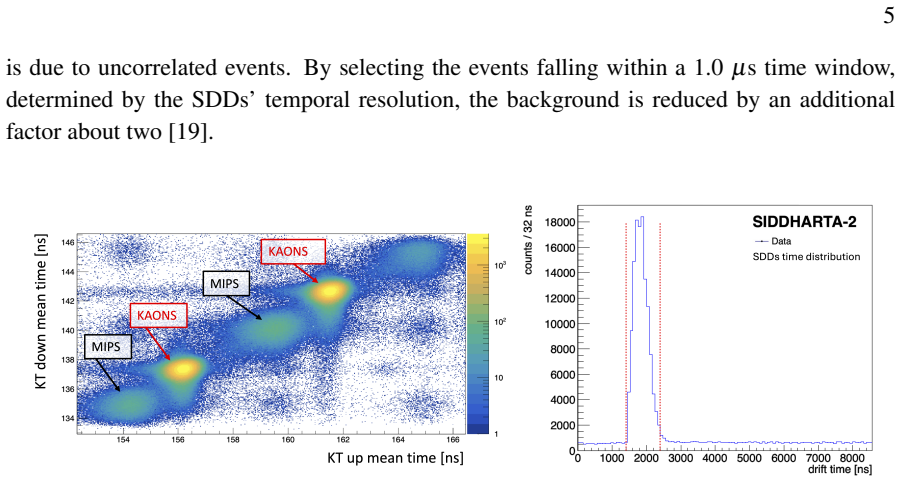
The carrying mechanism is the kaonic-atom cascade itself: a low-momentum kaon stops in cold neon gas, forms an atom, and de-excites through high-n X-ray transitions. The experimental chain that makes the measurement work combines an array of silicon drift detectors with a kaon trigger, an X-ray fluorescence calibration of the energy scale, and a spectral fit using a Gaussian-plus-exponential-tail line shape. Line assignment uses theoretical transition energies from a multiconfiguration Dirac-Fock calculation, and yields are extracted by comparing detected X-rays, normalized to kaon triggers, with a Monte Carlo simulation of the stopping and detection process. The high yield of the $\Delta n=1$ transitions is what carries the sub-eV statistical precision.
What would settle it
A second, independent measurement of the same six lines, for example with a different detector calibration method or a different neon gas density, that reproduces the energies in Table 1 to within the combined uncertainties would confirm the claim; a discrepancy larger than the quoted systematics, especially for the 6→5 line at 15673.30 eV with its 9 eV systematic error, would falsify it.
Extended reading notes
Core claim
The paper claims that six X-ray lines from kaonic neon can be cleanly measured against background, and that three of them, the 8→7, 7→6, and 6→5 transitions, carry statistical errors below 1 eV. The measured energies and absolute yields are listed in Table 1; the Δn=1 transitions have yields up to about 30 percent, which the authors argue makes kaonic neon a practical system for precision tests of bound-state QED. The paper further claims that this measurement demonstrates the feasibility of sub-eV X-ray spectroscopy with a low-Z gaseous target, and that the yields provide new constraints on the de-excitation cascade in kaonic atoms.
Load-bearing premise
The line identifications and the energy scale depend on theoretical transition energies from a multiconfiguration calculation and on an X-ray fluorescence calibration; if either is wrong by more than the quoted uncertainties, the reported energies and yields would shift.
Editorial extensions
If this is right
- The six measured energies become anchor points for cascade models and for the first bound-state QED calculations in kaonic neon.
- Because the $\Delta n=1$ yields reach about 30 percent, future precision QED runs on kaonic neon can collect enough counts without extremely long data-taking periods.
- The sub-eV statistical precision on the 8→7, 7→6, and 6→5 lines shows that low-Z gaseous targets are a workable route to high-precision kaonic X-ray spectroscopy.
- The absolute yields constrain how many electrons remain bound during the kaonic cascade, giving models a handle on Auger emission and electron recapture.
Reading between the lines
- A dedicated bound-state QED calculation for kaonic neon, rather than the paper's scaling from muonic and antiprotonic neon, would turn the measured 6→5 energy into a quantitative QED test.
- Repeating the measurement at several gas densities would test whether the yields shift with electron recapture probability, separating density-dependent cascade effects from intrinsic atomic physics.
- The 9 eV systematic uncertainty on the 6→5 line is the clearest target for improvement; an independent calibration of the detector energy scale would sharpen that line most.
Editorial analysis
A structured set of objections, weighed in public.
Referee Report
Summary. The paper reports the first measurement of kaonic neon X-ray transitions, performed by the SIDDHARTA-2 collaboration at DAΦNE. The authors present energies and absolute yields for six high-n kaonic neon transitions, obtained from a spectral fit of the X-ray spectrum after kaon-triggered event selection. Three of the transition energies are quoted with statistical uncertainties below 1 eV, and the paper argues that this demonstrates the feasibility of sub-eV X-ray spectroscopy for kaonic atoms with low-Z gaseous targets, with implications for cascade models and for future bound-state QED tests in strange exotic atoms.
Significance. If the reported energies and yields are correct, this is the first data set for kaonic neon X-rays and provides useful input for kaonic-atom cascade models and for the planning of future high-precision kaonic-atom spectroscopy. The paper has several strengths: the statistical and systematic uncertainties are separated in Table 1, the event selection (kaon trigger, time-of-flight, SDD coincidence) is described concretely, and the yield normalization is defined through an explicit formula (Eq. 1) based on a GEANT4 simulation. The use of the MCDFGME code only for peak identification, without constraining the fitted energies to those theoretical values, is appropriate. The main weakness is that the energy calibration is not demonstrated for the highest-energy transitions, and the abstract's 'sub-eV X-ray spectroscopy' claim goes beyond what the quoted uncertainties support.
major comments (3)
- [Sec. 1.1 and Table 1] The energy calibration is described using Ti, Fe, and Cu fluorescence lines, with Cu Kβ at about 8.9 keV as the highest calibration point, yet Table 1 reports K-Ne (7→6) at 9.45 keV, K-Ne (10→7) at 13.35 keV, and K-Ne (6→5) at 15.67 keV. The quoted systematic uncertainties of 1.5, 3.0, and 9.0 eV for these lines are therefore based on an extrapolation of the calibration curve, but the paper does not show calibration residuals, a linearity test, or any independent reference line above 8.9 keV. A modest 0.1% energy-scale nonlinearity would shift the 15.67 keV line by about 16 eV, well above the quoted 9 eV systematic. The authors should provide evidence for the linearity of the SDD energy scale over the full 3–19 keV fit range or conservatively increase the systematic uncertainties for the three transitions above the highest calibration line.
- [Abstract, Sec. 1, and Sec. 3.1] The claim of 'sub-eV X-ray spectroscopy' and 'sub-eV statistical error precision' is not supported as a statement of total measurement precision. In Table 1, the three transitions with statistical uncertainties below 1 eV have systematic uncertainties of 1.5–9.0 eV, so the total uncertainties are not sub-eV on any line. The abstract should be rephrased to state explicitly that the sub-eV precision is statistical only, or the total uncertainties should be used in the headline claim.
- [Sec. 3.2 and Eq. (1)] The absolute yields in Table 1 depend on the ratio of experimental detection efficiency to the GEANT4 Monte Carlo efficiency, where the simulation assumes a 100% X-ray yield per triggered kaon. The systematic uncertainties quoted for the yields include gas density and material thickness, but the paper does not describe any validation of the GEANT4 model for kaon stopping, trigger efficiency, or detector acceptance against control distributions from the data. Since the yield values are a central result, the authors should state what validation was performed or add a model-dependence term to the yield systematics.
minor comments (4)
- [Sec. 4] In the Conclusions, 'This result demonstrate that precision measurements...' should read 'This result demonstrates...'.
- [Table 1 caption] The caption refers to 'absolute yields' but does not define the normalization; adding 'per triggered kaon' or the equivalent definition would make the table self-contained.
- [Sec. 2] The fit range is stated as 3–19 keV and the background model as a first-degree polynomial plus an exponential, but the number of free parameters, the χ²/ndf, and the residuals are not reported; including this information would strengthen confidence in the line-shape fits.
- [Sec. 1.1] Reference [17] is cited for the calibration accuracy of 'within a few eV', but since this accuracy is central to the energy results, a brief summary of the calibration residuals from that work would be helpful.
Circularity Check
No significant circularity: the measured kaonic neon energies and yields are derived from spectral fits and Monte Carlo efficiency corrections that are not constrained by the values being reported.
full rationale
The paper's central results are measured X-ray transition energies and yields for kaonic neon. The energies are obtained by spectral fitting of the calibrated SDD response, with the energy scale set by titanium, iron, and copper fluorescence lines from an X-ray tube system. The MCDFGME theoretical code is used only to identify the peaks, not to constrain the fitted energies; the quoted energies are free fit parameters and could disagree with the theoretical labels. The yields are defined in Eq. (1) as the ratio of the experimental detection efficiency to a Monte Carlo efficiency that assumes a 100% yield. This is a standard acceptance correction, not a parameter fitted from the same data, so the reported yields are not forced by construction. Self-citations for the detector performance and calibration accuracy (Refs. [11,17]) describe independent characterizations of the apparatus and do not smuggle in the kaonic-neon result. The skeptical concern about extrapolating the calibration curve above the highest fluorescence line is a legitimate systematic-uncertainty issue, but it is a correctness risk rather than circularity: the measurement would remain a measured quantity even if the calibration were imperfect. No instance of self-definition, fitted-input-called-prediction, or load-bearing self-citation chain is present.
Assumptions & free parameters
assumptions (3)
- domain assumption MCDFGME theoretical transition energies are accurate enough for peak identification.
- domain assumption GEANT4 Monte Carlo simulation correctly models trigger efficiency, kaon stopping in the target, and SDD detection efficiency.
- domain assumption The X-ray tube fluorescence calibration provides an accurate energy scale to within the quoted systematic uncertainty.
Cite this review
Pith. "Pith review of High precision X-ray spectroscopy of kaonic neon." pith.science (2026). https://pith.science/paper/GK5IPEVG
@misc{pith2026241216101,
  author       = {Pith},
  title        = {Pith review of: High precision X-ray spectroscopy of kaonic neon},
  year         = {2026},
  howpublished = {\url{https://pith.science/paper/GK5IPEVG}},
  note         = {Machine review of arXiv:2412.16101}
}
abstract
The high-precision kaonic neon X-ray transitions measurement performed by the SIDDHARTA-2 collaboration at the DA$\Phi$NE collider is reported. Both the X-ray energies and yields for high-n transitions were measured, demonstrating the feasibility of sub-eV Xray spectroscopy for kaonic atoms using low-Z gaseous targets. The measurement provides valuable insights into the de-excitation processes in kaonic atoms, providing new input data for the refinement of the corresponding theoretical models, and a framework for testing Quantum Electrodynamics in strange exotic atoms.
Figures


Reference graph
Works this paper leans on
-
[1]
Tomonaga S and Araki G 1940 Phys. Rev. 58(1) 90–91
work page 1940
-
[2]
Borie E and Rinker G A 1982 Rev. Mod. Phys. 54 67–118
work page 1982
-
[3]
Bernabeu J, Ericson T E O and Jarlskog C 1974 Phys. Lett. B 50 467
work page 1974
-
[4]
Feinberg G and Chen M Y 1974 Phys. Rev. D 10 3789
work page 1974
-
[5]
Bazzi M et al. (SIDDHARTA) 2011Phys. Lett. B 704 113–117 (Preprint 1105.3090) 9
-
[6]
Hashimoto T et al. (J-PARC E62) 2022 Phys. Rev. Lett. 128 112503
work page 2022
-
[7]
Paul N, Bian G, Azuma T, Okada S and Indelicato P 2021 Phys. Rev. Lett. 126 173001 ( Preprint 2011.09715)
arXiv 2021
-
[8]
Indelicato P 2019 J. Phys. B 52 232001 (Preprint 1909.06274)
arXiv 2019
Show all 28 references
-
[9]
Adkins G S and Jentschura U D 2024 Phys. Rev. A 110 032816 (Preprint 2409.17068)
2024 arXiv
-
[10]
2023 Phys
Okumura T et al. 2023 Phys. Rev. Lett. 130(17) 173001 URL https://link.aps.org/doi/10.1103/ PhysRevLett.130.173001
2023
-
[11]
2021 Measur
Miliucci M et al. 2021 Measur . Sci. Tech.32 095501
2021
-
[12]
2018 Preparation Activity for the Siddharta-2 Run at DA ΦNE 9th International Particle Accelerator Conference, IPAC2018, V ancouver BC Canada
Milardi C et al. 2018 Preparation Activity for the Siddharta-2 Run at DA ΦNE 9th International Particle Accelerator Conference, IPAC2018, V ancouver BC Canada
2018
-
[13]
2021 JACoW IPAC2021TUPAB001
Milardi C et al. 2021 JACoW IPAC2021TUPAB001
2021
-
[14]
2024 JACoW IPAC2024WEPR17
Milardi C et al. 2024 JACoW IPAC2024WEPR17
2024
-
[15]
2022 Measur
Miliucci M et al. 2022 Measur . Sci. Tech.33 095502
2022
-
[16]
2024 JINST 19 P11006 (Preprint 2311.16144)
Sirghi F et al. 2024 JINST 19 P11006 (Preprint 2311.16144)
2024 arXiv
- [17]
-
[18]
Boscolo M, Raimondi P, Paoloni E and Perez A 2011 Conf. Proc. C 110904 2262–2264
2011
-
[19]
2023 Eur
Sgaramella F et al. 2023 Eur . Phys. J. A59 56 (Preprint 2304.11352)
2023
-
[20]
Santos J P, Parente F, Boucard S, Indelicato P and Desclaux J P 2005 Phys. Rev. A 71 032501 (Preprint physics/0408106)
2005 arXiv
-
[21]
Campbell J L 1990 Nucl. Instrum. Meth. B 49 115–125
1990
-
[22]
Campbell J and Maxwell J 1997 Nuclear Instruments and Methods in Physics Research Section B: Beam Interactions with Materials and Atoms 129 297–299 ISSN 0168-583X
1997
-
[23]
Gysel M, Lemberge P and Van Espen P 2003 X-Ray Spectrometry 32 434 – 441
2003
-
[24]
2023 Front
Curceanu C et al. 2023 Front. in Phys. 11 1240250
2023
-
[25]
2016 Nucl
Allison J et al. 2016 Nucl. Instrum. Meth. A 835 186–225
2016
-
[26]
2006 IEEE Trans
Allison J et al. 2006 IEEE Trans. Nucl. Sci. 53 270
2006
-
[27]
(GEANT4) 2003 Nucl
Agostinelli S et al. (GEANT4) 2003 Nucl. Instrum. Meth. A 506 250–303
2003
-
[28]
2023 Nucl
Sirghi D L et al. 2023 Nucl. Phys. A 1029 122567
2023
Reviewed August 11, 2026 · model on record in the stance chip above.
Discussion (0). Continue with ORCID to comment.